Saturday, February 16, 2008

Saudi Arabia and Wahhabism: a toxic combination

The Kingdom of Saudi Arabia is in the news for yet another of its barbaric practices. This time it is the story of a woman about to be executed on a charge of witchcraft. The court convicted her on the evidence of a man’s claim she had made him impotent and also that of a divorced woman who reportedly returned to her ex-husband during the month the accused woman predicted. The woman, Fawza Falih, also made a forced confession which she later retracted. She told the court she was illiterate and did not understand the document she was forced to fingerprint.

Human Rights Watch said the charges were absurd and had no basis in Saudi law. Saudi Arabia does not have a written penal code, and “witchcraft” is not a defined crime. HRW have called on King Abdullah to halt the execution. They said judges never investigated whether her confession was voluntary or reliable nor did they investigate her allegations of torture. They also did not enquire whether she could have been responsible for the supernatural occurrences she supposedly did. Instead, the court judges sentenced her to death for the benefit of “public interest” and to “protect the creed, souls and property of this country.”

Of one thing there is no doubt and that is the creed, souls and property of Saudi Arabia need protection; but the danger does not come from witchcraft. The real problem with the oil-rich kingdom is the nefarious alliance between the ruling House of Saud and its venomous court of Wahhabi scholars, the “uluma” that is a key part in Saudi decision making. Not only do the uluma rule on the law, they are also responsible for spreading a toxic brand of intolerant Islam that is spreading across the world. Funded by the world’s largest oil reserves, it is an alliance that has directly led to the rise of Al Qaeda and 9/11 and is responsible for sponsoring an education of hatred in Saudi-funded madrassas in the Third World and beyond.

The story of this alliance and its terrible consequences for the world is brilliantly told in Dore Gold’s “Hatred’s Kingdom: How Saudi Arabia supports the new global terrorism” (2003). Gold is a partisan: He is an Israeli and the president of the Jerusalem Centre for Public Affairs who served as Israel’s ambassador to the UN between 1997 and 1999. But he is also superbly knowledgeable about Greater Middle East affairs. He was a diplomatic envoy to the leaders of Egypt, Jordan, the Gulf States and the Palestinian Authority. He also has a PhD in International relations and Middle Eastern studies and is a world-renowned expert on Saudi Arabia.

Gold's thesis in Hatred’s Kingdom is America has grossly overlooked Saudi Arabia’s role in the promotion of international terrorism. In fact, says Gold, Saudi is responsible for Middle-Eastern inspired terror. The cause is its dominant religious creed: Wahhabism, which regards all non Wahhabists (not just non-Muslims) as “mushrikun” (polytheists), or idolaters. According to Saudi religious textbooks, mushrikun have no rights to live and it is permissible to “demolish, burn or destroy” the bastions of these infidels. Gold says the Wahhabists who preach this dangerous nonsense are not extremist “Saudi versions of the Ku Klux Klan”, but are instead the product of Saudi mainstream society and culture and are sponsored by the government.

The founder of Wahhabism was Muhammad ibn Abdul Wahhab who was born around the start of the 18th century in a village in east central Arabia. His father was a qadi (a religious judge) and he instilled a love of learning of Islamic law in his son. Wahhab travelled to Medina where he learned the Hanbali Islamic tradition and later moved to Baghdad and Damascus where he learned the ways of the Shiites and the Sufi. He became an exponent of mystical Sufism but later abandoned it. On his return to his homeland, he announced that Islam had been corrupted by foreign influences. In his Book of Tawhid, he expounded on his view of Islam which was a rejected of all Gods except Allah. He also denounced the veneration of tombs as a Christian influence. In the name of strict monotheism, he launched a jihad against the mushrikun (polytheists).

Wahhab antagonised the local uluma (religious leadership) with his extremist ideas and was expelled from his home town. He sought refuge from the ruler of Riyadh Muhammad ibn Saud. Wahhab married Saud’s daughter and the two men launched an alliance that survives to this day. Saud would provide military protection for Wahhab while the latter would legitimise Saudi rule over local Bedouin tribes subjugated by jihad.

The Wahhabists were brutal to their enemies. If captured, they were offered the choice of conversion to Wahhabism or death. Unlike most Muslims, they gave no respite to the “people of the book” (Jews and Christians). Wahhab himself advocated an anti-Christian and Jewish agenda describing believers as “sorcerers who believed in devil worship”. Wahhabi writings elevated jihad to the “ultimate manifestation of Islam”. When ibn Saud died in 1765, the cause was taken up with relish by his son Abdul Aziz. Wahhab himself died in 1791 but the Saudi empire expanded in his memory. In 1802 an army of Wahhabists attacked the southern Iraqi city of Kerbala. There they massacred 4,000 Shiites and sacked the shrine of the tomb of Hussein, the martyred grandson of the prophet Muhammad.

The Saudis stormed Mecca in 1803 where again they attacked shrines including the chapel on Jebel Nur mountain where Muslim traditions says the angel Gabriel brought the Koran to Muhammad. Controlling the entire Arab peninsula they were now a serious threat to the Ottoman Empire. The empire fought back led by the Albanian born governor of Cairo Muhammad Ali who launched a series of raids across the Red Sea. French trained Egyptian forces retook the cities of Mecca and Medina and captured King Abdullah in 1818 to end the first Saudi reign.

But the Saudi-Wahhabi alliance was to survive this setback. After the Egyptian army was forced to withdraw to bases in the 1840, the Saudis retook Riyadh with Wahhabism firmly seated at the centre of power. This second Saudi state was terminated in the late 1860s by an Ottoman Empire revived by the newly built Suez Canal. But this was a temporary respite for the Sick Man of Europe. Britain was starting to assert its influence on the region. They struck an alliance with a new Saudi leader. Abdul ibn Saud returned to power in Riyadh in 1903 with help from Lord Curzon’s naval flotilla in the Persian Gulf.
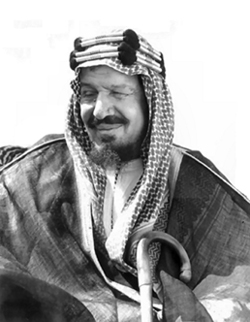
Ibn Saud co-opted his old family allies the Wahhabists and provided them with funds and religious instructors. In World War I, Britain took control of all of the old Ottoman Arab territories and established a relationship with Sharif Hussein, the Hashemite ruler of Mecca since 1908. The end of the war meant that the map would need to be redrawn to establish the border between Hussein’s and Saud’s kingdoms. Wahhabi armies terrorised its neighbours but were hemmed in by the airpower of the RAF.

When the new Turkish republic abolished the Ottoman caliphate, King Hussein proclaimed himself caliph. An enraged Saud declared a jihad against the Hashemites. The war was enthusiastically pursued by the Wahhabists who wanted to “purify” the holy cities of Mecca and Medina. Hussein abdicated and his son Ali fled to Iraq in 1925. Seeing the changed landscape, Britain transferred the northern cities of Maan and Aqaba to Hashemite Transjordan. Saud returned in triumph to Mecca.

The greater Muslim world was appalled by the Saudi government of the Holy Cities. Indian Muslims called for an internationalisation of the Hijaz area and the Egyptians also voiced their disapproval. Ibn Saud succeeded in calm Muslim fears by declaring they had nothing to fear from Wahhabism. But quietly the movement was building up a new head of steam. In 1928 Muhammad Rida set up a new militant movement in Cairo called the Muslim Brotherhood. Rida espoused Wahhabi doctrines and was now about to export them overseas.

Back in Arabia, ibn Saud was suffering from the world’s Great Depression. With his country on the verge of bankruptcy he signed a deal in 1933 with Standard Oil of California (SOCAL) to grant them a huge oil concession in Eastern Arabia. They struck oil five years later and Saudi royalties grew fast as war demand grew. Saudi royalties went from $3 million in 1938 to $10 million in 1946. By 1952 that had increased to $212 million. The Wahhabi uluma were not happy about the “infidels” in their country but bought ibn Saud’s argument they were helping to extract the material resources “placed by Allah” underneath the land.

In return for their support, ibn Saud allowed the Wahhabis a monopoly over education and religious policies. After ibn Saud died in 1953, his weak second son, Saud became king. Saud terminated the US airbase in Dhahran and plunged his country’s finances into disarray. The uluma deposed him in 1964 in favour of his younger brother Faisal. Faisal’s mother was a direct descendent of the original Muhammad Wahhab and her father was a major Wahhabi scholar.

As a counterweight to the secular Arabism espoused by Egypt’s Nasser, Faisal turned to Islam. Arabia established the Muslim World League dedicated to the spread of the religion. The League became a mouthpiece for Saudi Arabia, run by Saudi government employees and was an effective promoter of Wahhabi Islam. At home, Faisal created new government ministries in 1970 and the Wahhabists won control of justice and education, including universities. The entire generation of Saudis born in the 1960s grew up on Wahhabi doctrines.

Faisal gave renewed powers to the mutawain (religious police). They scrutinised public behaviour, ensured men and women did not mingle, checked for suitable attire, and made sure people attended public prayers. Thanks to Faisal they were given back powers of arrest, which they had lost in the 1930s under ibn Saud. Meanwhile Saudi oil revenue was skyrocketing. They earned $22.6 billion in 1974 and funds were becoming available for the export of Wahhabism.

Riza’s Muslim Brotherhood had suffered under Nasser in Egypt and many members had fled to Saudi Arabia. There they became prominent scholars and were influential in the creation of the Islamic University of Medina. The Brothers had a great deal of affinity with the Wahhabists. The university was directly controlled by Wahhabi clerics and it quickly became a hotbed of Islamic militancy. Later 85 percent of the university’s students would be foreigners, making it a crucial tool for the export of Wahhabi ideas.

The university also imported Muslim brotherhood ideas especially from the hugely influential Egyptian writer Sayyid Qutb. Qutb spend some time in the US where he became extremely anti-American. He predicted a clash of civilisations between Islam and the West which Islam would win. Although executed by Nasser, Qutb’s call for a militant jihad was taken to Arabia by his brother Muhammad who taught Islamic studies in Jeddah. In the 1980s Saudi Arabia welcomed another Egyptian radical Ayman al-Zawahiri who had been jailed for a part in Sadat’s assassination. Later he would leave for Afghanistan where he became Al Qaeda’s second-in-command and chief ideologue.

A lesser known but equally important import was the Palestinian scholar Abdullah Azzam. Azzam was also a member of the Muslim Brotherhood and he joined Muhammad Qutb at Jeddah University. There Azzam and Qutb were both teachers of a young Saudi student named Osama Bin Laden. Azzam was instrumental in the resurgence of jihad as a central facet of Islamic fundamentalism and said it was “obligatory on all Muslims”. The Russian invasion of Afghanistan was the trigger Azzam needed to preach jihad. He went to Pakistan where he ran the Muslim World League office as a terrorist front. This office would become a feeder for Bin Laden’s later network. Although successful in removing the Russians, he was killed in 1989 by a car bomb, probably planted by Afghanistan’s pro-Soviet intelligence services.

Azzam’s effective successor was his Saudi student Osama Bin Laden. Bin Laden was heavily influenced by his Wahhabi upbringing. He was immersed in officially sanctioned Saudi religious texts that labelled Christians as “polytheists” which effectively removed the protection they were owed as “people of the book”. This teaching also influenced Juhaiman al-Utaibi who attacked Mecca’s grand mosque in 1979 taking hundreds of hostages. He declared himself to be the “mahdi” (guided one). Al-Utaibi held a particularly pure strain of Wahhabism believing Muslims should not have any contact with the kufar (infidels) and called the Saudi regime corrupt. After two weeks, Saudi troops stormed the mosque and killed and executed the kidnappers.

However the rattled government began to take on al-Utaibi’s ideologies. Women were banned from appearing on television. Music disappeared from the media. Stores closed during daily prayers and the religious police were granted further prohibitive powers. Wahhabists were angered by the US build up in the region in response to the Iranian revolution and the Carter Doctrine. The Saudis supported the Iraqi Sunni Saddam Hussein in his war against the hated Shiite Iranian leadership. Meanwhile they poured $4 billion towards the Afghan mujahideen via Azzam’s Peshawar office. After Azzam was killed, Bin Laden evolved the movement into Al Qaeda. Bin Laden was dedicated to the task of spreading Wahhabism in Afghanistan. Saudi Arabia supported the Taliban militia who had similar radical ideas about Islam. The Saudis were one of just three countries (Pakistan and UAE were the others) to recognise the Taliban rule of Afghanistan.

But the biggest impact to the homeland was the Iraqi invasion of Kuwait in 1990. Overnight, Saudi Arabia’s 1980s ally was now its primary enemy. King Fahd (who inherited the throne after Faisal’s assassination by his nephew in 1975) consulted the uluma and reluctantly allowed an American force into the country. After the 1991 Gulf War thousands of US troops roamed the country even setting up their own radio station which could be picked up across the kingdom. Their presence fed a huge sense of anti-Americanism. The uluma began to tell Fahd the real enemy was not Iraq – but the west. In 1994 Fahd denied Bill Clinton’s request to agree to host a US armoured brigade.

Bin Laden meanwhile had moved to Sudan on the invite of local Islamic leader Hassan al-Turabi. There he established contacts with Zawahiri’s Islamic Jihad, Hezbollah, Hamas and Algeria’s Front Islamique du Salut (FIS). Bin Laden sent forces to oppose the US in Somalia and an affiliated group bombed the World Trade Center in 1993. He also attacked King Fahd as not sufficiently Wahhabi. But he was not in favour of the overthrow of the Saudi monarchy. He supported Crown Prince Abdullah who succeeded Fahd in 1995. Abdullah was noticeably less pro-Western. In 1998 Bin Laden called for a jihad “against Jews and Crusaders” and lambasted the American “occupation” of the lands of Islam’s holiest places. He was supported within Saudi Arabia by mosque sermons which were full of anti-Jewish themes. The Clinton administration put pressure on Sudan to extradite Bin Laden but Saudi Arabia refused to take him. He was expelled to Afghanistan instead in 1996.

In 1998 Al Qaeda struck the US embassies in Kenya and Tanzania killing 240 people. Two years later they bombed the USS Cole in port in Yemen. Saudi citizens and money were responsible for all three attacks. On 11 September 2001, 15 Saudi citizens and four others hijacked four airplanes attacking the Pentagon and destroying the World Trade Center at the second attempt. Saudi Arabia denied all involvement. Yet within days of the attack, Saudi Sheik Hamud al-Shuaibi issued a fatwa announcing “whoever supports the infidel against Muslims is considered an infidel”.

The Saudis had a deep PR problem and they paid US advertising company Burston-Marsteller $2.7 million to place ads in American media depicting Saudi Arabia as a staunch ally. They paid retainers to Congress insiders and paid Patton Boggs to educate congressmen and their staff on issues of concern to the kingdom. Back home however, a confidential poll of Saudi men found 95 percent approval of Bin Laden’s cause. Meanwhile, the religious police showed their contempt for human values when in 2002 they prevented Saudi firemen from rescuing 15 girls caught in a school fire in Mecca because they were not wearing their headscarves.

Though Abdullah took responsibility for girl’s education away from the Wahhabists in response to the Mecca fire, he cannot afford to unduly rock the boat. The uluma’s power remains strong. Wahhabi hatred remains at the core of Saudi society. Through the Muslim World League and the sponsorship of madrassas and Islamic universities they have taken this peculiarly Arabic version of Islam across the globe. Oil money has spread what Bernard Lewis called “this fanatical, destructive form of Islam” all over the Muslim world and among Muslims in the west. Without oil, they would have remained a lunatic fringe. Instead they are a serious world power dedicated to hatred. And a poor illiterate witch pays the same price for this hatred as the Western mushrikun.

Friday, February 15, 2008

Ghana’s Kufuor gets ready for Bush swansong

Ghana’s outgoing president John Kufuor said Thursday his country is buoyant, solvent and economically strong on the back of a vibrant financial sector as well as a 35 percent surge in gold exports. Kufuor was speaking at his final state of the nation address. Kufuor is serving his second term as president and the constitution does not allow a third term. His current term expires this year. Kufuor is one of Africa's elder statesmen and is also head of the AU. He will celebrate his country’s good health by hosting US President Bush next week.

Bush leaves the US today for a week in five African countries: Benin, Tanzania, Rwanda, Ghana and Liberia. In Ghana, Bush will meet with Kufuor and visit with Peace Corps volunteers. He will also meet Ghanaian entrepreneurs who have benefited from the African Growth and Opportunity Act (AGOA) the US Trade Act that enhances American market access for 39 Sub-Saharan African (SSA) countries. However the centrepiece of the visit will be bilateral talks with Kufuor just two years after the Ghanaian president visited the White House.

Bush arrives in Ghana next Tuesday 19 February and will spend two nights in the country. He follows in the footsteps of Bill Clinton who came to Ghana in 1998. Ghana’s Foreign Minister Akwasi Osei-Adjei said President Bush would be making a major policy statement in the capital Accra after a bilateral meeting with President John Kufuor. He said the discussion would feature the promotion of free trade, as well as economic and investment opportunities. The US gave $55 million in aid to Ghana in 2007.

However the major investment between the two countries is via the Millennium Challenge Corporation (MCC). Two years ago the MCC signed its biggest ever deal; a five-year, $547 million anti-poverty Compact with Ghana. Established in 2004. The MCC is a US Government corporation with the aim of reducing global poverty through the promotion of sustainable economic growth. The Ghana program focuses on improving the productivity of agriculture, increasing production of high-value commercial and basic food crops, and fostering greater private investment in agriculture. The Ghanaian government created the Millennium Development Authority (MiDA) to be accountable for the implementation of the five-year program MCC program. The money will be split across the sectors of agriculture, transportation (roads and ferry upgrades) and rural development (community services such as education, facilities and banking).

However some analysts say the devil is in the detail with the Ghana program. The MCC has attracted criticism for being slow to spend its allocated budget. Its chief problem has been its sluggish record in getting projects beyond the planning stage. The US Senate is now proposing that Congress provide no more than half the money up front. African leaders are worried by the change. By changing how its projects are financed, “the MCC becomes like the World Bank and all the other countries using overseas development aid in stop and go fashion,” complained President Kufuor. “The aid is spread so thin that at the end of the day the necessary difference is not made.”

But Kufuor has other concerns close to home. Ghana’s problem is a perennial African one – the country has been mired in corruption and mismanagement since independence from Britain in 1957. Ruled by the military up until the eighties, the country made the transition to democracy when a referendum in 1992 approved a constitution for a multi-party system. Today, Ghana is considered a well-administered country by regional standards and a model for political and economic reform in Africa.

Ghana is the world's second-largest producer of cocoa and the country is famed for the high quality of its produce. The cocoa beans are used to make chocolate, both in Ghana, and for the export market. Cadbury Schweppes source most of their cocoa from Ghana. Cadbury’s are sensitive to allegations of exploitation particularly over the use of child labour.

They were among a group of several multinational companies who met in Ghana in October to discuss the International Cocoa Initiative (ICI), a partnership to combat child and forced labour in cocoa farming areas. While Kufuor has claimed "I can say emphatically that we have taken legislative measures to ensure that such practices are eliminated," researchers on the ground disagree. They found that while industry and Ghana have made initial steps such as creating task forces, children still work in cocoa production, regularly miss school, perform dangerous tasks and suffer injury and sickness. Ali Lakiss, the director general of neighbouring Ivory Coast’s Saf-Cacao says it is all about economics. "The farmers don't get the best price,” he said. “If the cocoa price is good, then kids go to school. No money, and kids work at home."

Thursday, February 14, 2008

Kirsty Sword Gusmao tells of Timor attack

The Australian wife of East Timor Prime Minister Xanana Gusmao has spoken yesterday about how their home was surrounded by armed rebels minutes before her husband was attacked. Kirsty Sword Gusmao said armed men had surrounded their home on Monday morning while Xanana was out. She made her three children lie under the bed while the house was defended by a small local security contingent. As Sword Gusmao then tried to ring her husband, his own convoy came under attack. "I attempted to call Xanana at that point and got through to his driver, but it was right at the time his vehicle was being ambushed,” she said. “So I was hardly able to get the message through that we were in peril.”

While none of them were injured in the ambush, Timorese President Jose Ramos-Horta remains in a critical condition in a Darwin hospital after a simultaneous attack. Rebel leader Alfredo Reinhado was killed in the attack on Ramos-Horta. A Timorese friendship group in Sword Gusmao’s native Bendigo in Victoria spoke of their shock of the attack. The Maubisse Friendship Community Committee raises money for the Maubisse community in East Timor’s central highlands, approximately 70km from Dili. Bendigo councillor and Maubisse committee member Wayne Gregson said “We’d had some contact with a senior bureaucrat from East Timor as recently as last week in Bendigo and he said he thought the situation was improving.” Sword Gusmao was due to visit Bendigo in April but that is now thought to be unlikely.

Born in Melbourne in 1966, Kirsty grew up in Bendigo in central Victoria. As a young girl, she seriously considered a ballet career. She abandoned this idea and studied languages (majoring in Indonesian and Italian) at Monash University in Melbourne. In 1985, while Kirsty Sword was at university, she started to mix with members of the Timorese resistance, even translating some of Xanana's letters. Her primary school headmaster father Brian taught Kirsty her first words of Indonesian when she was just four. Her family took great interest in Asia and politics and her mother Rosalie, also a teacher, marched against the Vietnam War. The family went on holidays to Bali and Jakarta. She told the Saturday Telegraph in 2003: “as a teenager I fell in love with Indonesia and was always saving up to go back,” she said.

Sword met Timorese student Joao at Monash. She said Joao "brought East Timor's sad story to life for me". Sword travelled to East Timor in 1990 on a mission to deliver materials to supporters of independence. On graduation, Kirsty and Joao migrated to England to work on the Refugee Studies Program at Oxford University. Sword landed a job at Yorkshire Television as a researcher on a documentary about the Timorese struggle for Independence. As it happens, the documentary makers were in Timor at a decisive moment and captured the massacre at Santa Cruz cemetery in the documentary they eventually called “Cold Blood”. Sword had returned to England before the massacre but had met many of those killed. The incident left a profound impression on the young woman.

In May 1992, she went to Jakarta to closer to the struggle. She supported herself in the Indonesian capital by teaching English. Five months later, she learned of the Dili arrest of the leader of the Timorese resistance Xanana Gusmao. Gusmao had led Falintil, "the national liberation army" in the mountains of East Timor since the Indonesian invasion in 1975. Imprisoned in Jakarta’s Cipinang jail, Gusmao had heard of Sword’s presence in Indonesia and asked for her help with the organisation.

The couple first met in 1994. Xanana was serving a twenty year sentence for subversion while Kirsty worked for the clandestine East Timorese independence movement in Jakarta. The pair started a romance using letters smuggled through prison bars. “There were many times when I questioned if I was being realistic,” Kirsty said of this time, 'as we could not put the relationship to the test.” But after she met him for the first time, they began to discuss marriage. They would have to be patient while Gusmao remained incarcerated.

While her fiancé languished in a Jakarta cell, Sword redoubled her efforts on behalf of Timorese independence. Her official role was development worker for an Australian aid agency, and an English teacher. However she led a double life on behalf of the clandestine independence movement. For her spywork, Sword adopted the pseudonym of Ruby Blade because, she said, “it sounded kind of Agatha Christie”.

Gusmao was released in 1999 after his nation voted for independence in a referendum. Xanana and Kirsty finally married in 2000 in a traditional Timorese wedding. Gusmao became the newly independent country’s first president two years later Kirsty Sword Gusmao became the country’s First Lady. She wrote her autobiography A Woman of Independence in 2003. "I had put my life on a parallel course with his and indeed that of East Timor" she wrote then. That parallel course could easily have run to a parallel end this week.

Wednesday, February 13, 2008

The ethanol fraud

Two damaging new studies released last week have shown ethanol is even worse for the environment than fossil fuels. The studies found that almost all biofuels currently in use cause more greenhouse gas emissions than conventional fuels if the full emissions costs of producing these so-called “green” fuels are taken into account. The destruction of the ecosystems converted to cropland releases greenhouse gases into the atmosphere as well as reducing the amount of carbon sinks as the cropland also absorbs far less carbon than the land it replaced.

The peer-reviewed Science journal printed both studies on ethanol and other biofuels. The first by ecologists at Princeton, the Woods Hole Research Center, and Iowa State University was the first ever comprehensive review of the environmental consequences of increased biofuel consumption. It found that over 30 years, use of traditional corn-based ethanol would produce twice as much greenhouse gas emissions as regular gasoline. The second study by Nature Conservancy along with University of Minnesota researchers, found that converting rainforests, peatlands, savannas or grasslands in Southeast Asia and Latin America to produce biofuels will increase global warming pollution for tens to hundreds of years.

The key finding of the studies is that global production of biofuels results in new lands being cleared, either for food or fuel. Land use had not previously been taken into account in ethanol studies. The end result is massive carbon debt. Even in the best case scenario of Brazilian sugar cane grown in scrubby savannahs, a carbon debt is created which takes 17 years to repay. The worst case scenario is Indonesia palm oil displacing tropical rainforest growing in peat which invokes a carbon debt of 423 years.

The process of turning plants into fuels causes its own emissions especially in the areas of refining and transport. The result is bad maths for fans of ethanol. Grassland clearance releases 93 times the amount of greenhouse gas that would be saved by the fuel made annually on that land, said Joseph Fargione, lead author of the second paper, and a scientist at the Nature Conservancy. “So for the next 93 years you’re making climate change worse, just at the time when we need to be bringing down carbon emissions.”

The US is making the problem worse by heavily subsidising the ethanol industry. Already subsidised to the tune of $3 billion each year, the gravy train is about to get even richer. Iowa is the centre of the industry and state farmland values are up 18 percent in the past 12 months, according to Federal Reserve Board surveys, making paper millionaires of farmers owning more than 200 acres. Now a bill recently passed in Congress will provide another whopping $10.5 billion to the industry regardless of prices, profits, yields or weather. "A farmer's best friend in Iowa is the energy bill," said Bruce Babcock, a professor of economics at Iowa State. "What do you need the direct payments for? It's money for nothing."

Interestingly however, Babcock refused to sign off the first report which was co-authored by several economists at Iowa State’s faculty in the centre of the corn-growing belt. The study was based in part on a model developed at the University's Center for Agricultural and Rural Development for estimating changes in global crop production. Babcock claimed he was not sufficiently comfortable with the study's methodology because it relied on outdated land-use data from the 1990s. Nonetheless he agreed with the study's fundamental premise, that increased use of biofuels would boost commodity prices and encourage more crop production.

Biofuels expert Michael O’Hare at The Reality Based Community reiterated some of these points about to growing emissions. Firstly as more corn is used to make ethanol, the corn used is no longer in the food and feed corn market. This causes corn prices to increase which in turn is likely to stimulate the demand to grow more corn. Corn growing will intensify with additional fertilization which generates the potent N2O greenhouse gas. This increase will also impact land use for other crops which may make it more profitable for ranchers to turn more forest into farmland, further adding to greenhouse emissions.

Consumers are paying for ethanol subsidies with increased grocery prices. Production of ethanol also means we avoid looking at the longer-term problem: how to reduce consumption of transport fuel. Biofuels are an increasing extravagance and seem only to exist as result of lobby group pressure for those getting rich on the subsidies. As George Monbiot says “there is no such thing as sustainable biofuel.”

Biofuels cause severe greenhouse problems and a land-grab for farmers desperate to get in on the act. Where land is not available, food production suffers. As Monbiot again puts it “every time we fill up the car, we snatch food from people's mouths.” Ethanol is a costly and criminally inefficient solution to our energy problems. According to Minnesota's Republican state senator David Hann, "ethanol is bad science, bad environmental policy and bad economic policy." Now the scientists have offered proof to show Hann is right. Its time to end the cornball.

Tuesday, February 12, 2008

All Apologies

The text of Kevin Rudd’s apology has been tabled today in federal parliament ahead of its reading as the first item of business tomorrow. The text reflects on the mistreatment of the Stolen Generations, which it calls a “blemished chapter” in Australian history. Rudd will apologise for laws and policies of successive Parliaments and governments and the removal of Aboriginal and Torres Strait Islander children from their families. The apology is aimed at the “Stolen Generations, their descendants and for their families left behind”. Rudd will also say sorry for “the indignity and degradation thus inflicted on a proud people and a proud culture”.

The apology will come 11 years after the release of the 'Bringing Them Home' report found the forced removal of Aboriginal children was a gross violation of human rights. With former PM John Howard refusing to say sorry, Kevin Rudd made a public apology an election commitment. However the new Prime Minister had faced criticism for delaying the release of the text of the apology. His argument was he had to consult with Aboriginal group to make sure it was right. Opposition leader Brendan Nelson has confirmed the Coalition will give its bipartisan support to the apology now that it has seen the exact words. However the Greens will try to amend the motion to include compensation, something that Rudd has ruled out.

Tasmanian Aboriginal activist and lawyer Michael Mansell told the ABC he supported the apology but hoped it would contain references to compensation as well as expecting it to contain references an explanation why it happened. He said he was pleased the word “sorry” appears the text three times. "We are looking forward to working with the Prime Minister and the Government to work out the terms of the compensation package if that's what the words mean," he said.

Mansell is likely to be disappointed. New Indigenous affairs minister Jenny Macklin said last month Labor would not be creating a compensation fund for members of the Aboriginal Stolen Generations. This is despite the view of the Labor senators on the Stolen Generations enquiry who recommended a tribunal be established to look at reparation and monetary compensation. The report found that almost every Aboriginal family in the country was affected by the forcible removal policy.

The release of the apology text came after today’s official opening of parliament which included a first ever ‘welcome to country’ ceremony by the traditional owners of the land. The new ceremony was warmly endorsed by Brendan Nelson who said "I don’t think the opening of our Parliaments will ever be the same again and that is good". The members of the parliament were sworn in by High Court Chief Justice Anthony Gleeson. Later came the quaint ritual of the Usher of the Black Rod stating that “His Excellency the Governor-General desires the attendance of honourable Members in the Senate Chamber” to officially open the parliament. The only items of business on day one were a series of condolence motions including those for former parliamentarians Kim Beazley snr and Peter Andren and the three Australian soldiers killed in Afghanistan in the last six months.

But the main buzz outside the House was the impending apology. The activist group Getup! laid 4,000 candles outside the building spelling out the words “sorry, the first step”. The group’s Executive Director Brett Solomon said the candles were a symbol of hope which also recognised the darkness they illuminate. “The ‘sorry is the first step’ message is much more than just a celebration,” he said “It fills our minds for the journey ahead for a reconciled nation.”

Solomon’s sentiment is echoed in the final words of Rudd apology text. It is a call to look forward to a “future where all Australians, whatever their origins, are truly equal partners, with equal opportunities and with an equal stake in shaping the next chapter in the history of this great country”. An apology is certainly the first step in reconciliation, but it is hardly a guaranteed gateway to equal opportunity and equal stakes. That will take money, and lots of it. Whether or not the new Government is prepared to compensate the Stolen Generations, it needs to seriously ramp up spending on Aboriginal health issues to end the criminal situation where Aboriginal life expectancy is 20 years lower than for White Australia. That will take a lot more than an apology to solve.

Monday, February 11, 2008

Timor reels after assassination attempts on Ramos-Horta and Gusmao

East Timor president Jose Ramos-Horta is now recovering in Royal Darwin hospital after surviving an assassination attempt at his home in the capital Dili this morning. The Nobel Peace laureate Ramos-Horta survived gunshots in the arm and stomach. The predawn raid was carried out by fugitive rebel leader Alfredo Reinhado who was shot dead by Timorese loyalists in the attack. Ramos Horta underwent emergency surgery in Dili before being flown to Australia. Prime Minister Xanana Gusmao was also attacked in his car but was unhurt in what appears to be a co-ordinated coup attempt against the East Timorese leadership.

The incidents which began the drama occurred just after dawn this morning. Dili-based Diligence blog reported a friend who lived within 5km of Ramos-Horta’s presidential residence hearing gunfire around 6:30am which lasted for 15 minutes. Diligence reported that the gunfire started while Ramos-Horta was taking his morning walk. Ramos-Horta then managed to get home which about 500m to 1km away where he was attacked in a second flurry of gunfire a few minutes later. He was immediately taken to the Australian military hospital at Dili heliport.

According to government spokesman Major Domingos da Camara, two cars carrying rebels soldiers passed Ramos-Horta's house on the outskirts of the capital, Dili, at around 7 a.m. local time and began shooting, da Camara said. The guards returned fire, he said. The rebels were led by Alfredo Reinhado, an army major who has been on the run since March 2006. Government sources have confirmed Reinhado was killed in the attack on Ramos-Horta’s residence.

Alfredo Reinhado was from the west of the country where as most of the new country’s rulers are from the east. Easterners were seen as patriots while westerners were viewed with suspicion due to their closer relations with the former Indonesian occupiers. Violence between the two groups erupted in Dili in 2006. The violence started after then-PM Mari Alkatiri sacked 595 soldiers over minor grievances. The sacked army men were mostly westerners and Reinhado protected them when they went on strike.

Reinhado deserted and he and the rebel soldiers headed for the hills outside Dili. Reinhado was later arrested but escaped custody. He remained in hiding until he agreed to meet Ramos-Horta in August 2007. His troops were active again in the last few days. According to Timorese blogger Catholicgauze, Reinhado "got greedy" and attempted to seize the presidency and launch a coup. Catholicgauze hopes that with Reinhado’s death “perhaps easterners and westerners will have the chance to start again”.

The country could certainly do with a break or two. Over half a million people died during the 25 year Indonesian occupation. The country has struggled since independence to thread its way to economic prosperity. The 2006 Human Development Report (pdf) for Timor Leste from the UN Development Program showed that the poorest country in a poor region was becoming even poorer with almost every indicator of health and collective wellbeing in decline. Yet Timor showed an optimistic face when 1996 Nobel Peace laureate Jose Ramos-Horta won an overwhelming victory in the 2007 presidential elections in May 2007 with a massive 73 per cent of the vote.

In December 2007, the UN pledged to reform East Timor’s police and military after the gun battles that tore the country apart in 2006. The news came just a month after Reinhado threatened to turn to violence again if the demands of his 600 renegade soldiers were not addressed. Now Reinhado is no longer around to make threats. Hopefully Ramos-Horta will make a full recovery. His troubled country needs him at the peak of his powers.

Sunday, February 10, 2008

Thomas Paine: These are the times that try men's souls

The recent 271st anniversary of the birth of Thomas Paine mostly passed unheralded apart from a letter to the editor of TC Palm, a small Florida newspaper. This is a poor lack of appreciation for one of the great figures of both the American and French Revolutions. This British born American patriot’s powerful, widely read pamphlet, Common Sense, written in the independence year of 1776, advocated an end to the colonial system and was an important intellectual boost to the baby republic. Paine was also a great influence on the French Revolution. He wrote the Rights of Man in defence of the Revolution and served in the Assembly before being arrested in the Terror. He returned to the US on the invitation of then president Thomas Jefferson and died a hero in New York in 1809.

Thomas Paine was born in Thetford, Norfolk on 29 January 1737. He grew up in an environment of modest poverty which did not prevent his parents from sending him to the local grammar school. Paine was technically brought up in his mother’s creed as an Anglican, but his father's Quakerism left an indelible impression and was instrumental in forging his ideas about egalitarianism. His father also objected to his son’s learning Latin at school because it was ‘popish’. With Latin the lingua franca of intellectuals of the day, this left Paine with the view of an outsider. Paine was later to quote “I scarcely ever quote; the reason is; I always think.”

Paine left school at 13 and moved to London to work as an apprentice garment maker. He worked as an exciseman and then schoolmaster. He became familiar with the new science of Newtonian mechanics. He married only for his young wife to die in labour. Another job with the excise board brought him to the Sussex town of Lewes. Here he met another Quaker Samuel Ollive, a tobacconist, who aroused Paine’s interest in politics. Paine was elected to the local municipal body, the Council of Twelve and quickly became a local celebrity as a vociferous member of the discussion-cum-social Headstrong Club.

In 1773 he distributed his first pamphlet, “The Case of the Officers of the Excise” arguing for higher pay based on the high cost of living at the time. Paine pointed out that to underpay excisemen invited corruption. His case for democracy rested on the principle the rich did not know what it was like to be poor. “There are habits of thinking peculiar to different conditions,” he wrote. “And to find them out is truly study mankind”.

His visits to London to lobby for the cause of excisemen brought him into contact with Benjamin Franklin. Paine was fascinated by Franklin’s experiments with electricity and Franklin in turn was impressed by the younger man’s eloquence, talent and self-education. Paine left for America with a letter of recommendation from Franklin who described him as “an ingenious, worthy young man”. The year was 1774 and Paine was then 37 years old.

Paine arrived in Philadelphia to find a city electrically charged with pre-revolutionary fervour. In England he was known as a conversationalist; suddenly in America he found his vocation as a journalist. He wrote in a number of Pennsylvania journals about black emancipation, justice for women and cruelty to animals, all from a humanitarian standpoint. He was one of the first in America to demand the end of slavery. But it was his attitude to independence that brought him a national audience. In January 1775 he wrote in support of the right of the colonies to control their own affairs.

When fighting broke out later that year, no one really expected that full independence would result. It took Paine’s January 1776 pamphlet “Common Sense” to electrify that sense of growing republicanism. It attacked not only George III’s policies in America but also the monarchy itself. He wrote that a hereditary monarchy was wrong in principle and harmful in practice. He wanted a strong central government and prophesised that a free and republican America would have no argument with European nations. Common Sense’s impact was immediate and tremendous. At the time it looked as if Britain would defeat the republicans but the weight of Paine’s support for Washington was crucial psychological support for the rebels.

In 1777 Paine was possibly the first person to use the term “United States of America” and saw it as a society that would expand its economy in the interest of all productive classes. In 1782 as the war drew to an end, he was employed by the new American government as an official propagandist. He found time to devote himself to the design of an iron bridge and a smokeless candle. In 1787 he sailed to France to promote his bridge ideas.

When he arrived in Paris he became quickly aware of the mood for political change while he also saw the mood of distrust of his native Britain. He crossed to England where he was well received by the Whig opposition. He was in London when the French Revolution broke out in May 1789. He returned to France in September and devoted his time equally to politics and furthering his bridge ideas. He went back to England in 1790 where he was disturbed by Edmund Burke’s ferocious attack on the Revolution in his speech to the House of Commons. Paine’s reply was part one of The Rights of Man in 1791.

It was a strident defence of the Revolution which defended the authority of the people. Britain became polarised in camps for and against Paine. He returned to Paris where he found his pamphlet had caused ructions too. In 1792 he published the second part which was an even more explicit call to revolution. He attacked hereditary government as tyranny. Britain issued a Royal Proclamation against this “wicked seditious writing” and summoned him to appear in court. Paine fled back to France where he took up a seat of the National Assembly despite speaking no French.

His friends were the Girondists but they were out of favour after war broke out in April 1792. Louis XVII was executed in January 1793 despite Paine voting against it in the Assembly. He was opposed to it because of his humanitarianism and the fact Louis had been an ally of the young America. Most of all, Paine was too good a propagandist not to realise the impact the execution would have in the outside world. He was arrested for his rejection of the vote and imprisoned at the Luxembourg. He completed his next major work from prison and smuggled it out to a friend.

The book, the Age of Reason was an anti-clerical work devoted to the idea of refuting the Bible as the word of God. It was pure Enlightenment but it didn't stop him from rotting in a Jacobin prison waiting for the end of the revolutionary regime. He never forgave his former benefactor Washington for failing to use his influence to get him released. He was finally released after pressure from Jefferson in November 1794. Paine’s last important work “Agrarian Justice” appeared three years later and linked his economic ideas with his views on politics and religion.

This book took Paine to the door of socialism but it was a threshold he never crossed. In Agrarian Justice, Paine said the poverty of the majority was a direct result of civilisation, the evils of which included an ever-growing national debt. But it would take others to make the next step to define socialism, such as Thomas Walker, Robert Owen and the Chartists. All of them looked back with a debt of their own to Paine. While the 20th century has not been so kind to his reputation, his critical role in the two great revolutions of the 18th century leaves a giant footprint. As Henry Collins wrote in the introduction to Rights of Man, Paine’s ability to foresee some of the revolutionary implications meant not only did he speak for his time but also “through it, to our own”.

Saturday, February 09, 2008

The one about the archbishop, the media and Sharia

British newspaper the Daily Express printed this picture (left) on its front page yesterday. The three women were snapped for a totally unrelated story about the controversy that has erupted in the wake of Rowan Williams’ “Sharia” speech earlier this week. The preferred reading of the Express was these women represented the future hostile face of Islam in Britain. Nevertheless the women were not giving the finger to Britain but to the intrusive photographer who was harassing them as they went about their perfectly legal business. There hasn't been sumptuary laws in Britain since the 16th century and the women are free to wear burqas if they so desire. In any case as one commentator asked “Is there anything more British than the two-fingered salute to authority? She looks very much like the rest of us”.

The other key point, of course, is that the women also had absolutely nothing to with the story. They were just a handy stick to use to show the dangerous “otherness” of Islam. That this fear is a stick is shown by Britain's second largest selling newspaper the Daily Mail which had a poll for readers to decide “which of these men pose the bigger threat to Britain’s way of life?” While there are several likely candidates to fulfill this intriguing threat (politicians or media owners perhaps, such as billionaire Viscount Rothermere, chair of the Daily Mail and General Trust plc, one of the largest media companies in the UK), the only choices offered in the poll are two bearded clerics: Abu Hamza and Rowan Williams.

Both are considered dangerous demagogues in reference to Islam. Abu Hamza al-Masri is a leading British radical Islamist whose activities in the Finsbury Park mosque led to intense police and media scrutiny. Demonised for his apparent preaching of jihad in the homeland, it didn’t help his image he had a sinister-looking hook in place of his left hand. Hamza’s own lawyer Edward Fitzgerald QC said Hamza was “probably the most frequently abused and ridiculed figure” in Britain.

Though perhaps he has relinquished that title for the moment. If Abu Hamza was the media’s Blackbeard with his pirate’s hook, the new villain is the snowy whitebearded mild-mannered Rowan Williams. But Williams is not a Muslim. He is in fact, the current Archbishop of Canterbury, metropolitan of the province of Canterbury, Primate of All England, senior archbishop of the Church of England and the symbolic head of the worldwide Anglican Communion.

Williams’ offence was to tap into a fear in the Western psyche about the takeover by Islam. Muslims are a minority in Britain but they are outbreeding other sectors of the population. Combined with a steady steam of immigrants from Muslim countries and the sense of “other” they generate when practicing their culture, any suggestion that their “power” may increase causes howls of protest from Britons feeling vulnerable about their culture and their place in the world. Britain is a Christian country, they say. Actually, like most Northern European countries, Britain is a post-Christian country. And Williams, more than most, is aware of this.

Williams has often been in the headlines for some controversial statements about various aspects of Christianity. But when he moved on to Islam, the media went ballistic. In a speech to lawyers and jurists at the Royal Courts of Justice on Thursday, the Archbishop examined the intertwining of civil and religious law in England and suggested that some aspects of Sharia law might be practical in terms of solving cultural questions without damaging the civil law of the land. In the last two days this speech has caused a political and social firestorm. While his subject matter was learned and thoughtful, it was doomed from the moment when he said the magical word Sharia.

While Williams has claimed to be shocked by the reaction, he prophesised it himself in the early part of his speech when he quotes Tariq Ramadan’s Western Muslims and the Future of Islam:
“In the west the idea of Sharia calls up all the darkest images of Islam...It has reached the extent that many Muslim intellectuals do not dare even to refer to the concept for fear of frightening people or arousing suspicion of all their work by the mere mention of the word”

Williams’ main point in the speech was that Sharia was a method of jurisprudence governed by revealed texts rather than a single system. He said more latitude should be given in law to rights and scruples rooted in religious identity. Religious groups could provide cultural clarity in issues related to marriage and inheritance much as the Islamic Sharia Council already do. But the media were only interested in the "darkest images of Islam".

And so the evidence that Williams supplied in the speech, such a similar dispensation that already exists for Jewish law (Beth Din) was lost in the stampede to criticise Williams. Reuters reported that bastion of British tolerance The Sun saying yesterday: "It's easy to dismiss Archbishop of Canterbury Rowan Williams as a silly old goat. In fact he's a dangerous threat to our nation." The Daily Express thundered “Muslim laws must come to Britain” before weaseling out with a passive voice “he was accused” without appearing to accuse him themselves. Upmarket was no easier on Williams. The Times said Williams was dangerous and “must be resisted”.

Even the left joined in the criticism. The Guardian said Rowan Williams has a knack for creating problems where none yet exist. The Independent said “let the backlash commence” and put Williams' error as the assumption he had the same intellectual freedom as the leader of a major church that he had when he was merely an eminent theologian. Spiked's editor Brendan O'Neill said Williams (whom he personally attacked as a "smug, guitar-strumming religious leader with a social-worker voice") claimed the adoption of some aspects of Sharia law in the UK is "inevitable" when the only inevitability mentioned by Williams was to “mutual questioning” and only perhaps mutual influence towards change.

There were a few voices in support. On BBC Radio Wales Kim Fabricius launched a spirited defence of Williams in a radio interview with Sunday Mail's editor Peter Hitchens and made the point that if anyone had actually taken the time to read the speech, then there wouldn’t be an issue. Australian blogger and theologian Benjamin Myers defended Williams saying the speech was a “dense, thoughtful, informed, and highly nuanced reflection…on the complex relation between law, citizenship, and the identity of religious communities.” Myers made the very good point that Williams wants us all to think more about the issue. “But thinking is hard work,” says Myers. “It’s neither as enjoyable as a good lynching, nor as satisfying as a posture of moral indignation.”

The Church Times columnist Andrew Brown drew a comparison between Williams and his more worldly predecessor: "The trouble with Rowan Williams is that he can never remember that he is Archbishop; the trouble with George Carey was that he could never forget." Williams clearly has more important things on his mind than merely being an archbishop. If he has upset this many people, it is likely he is doing something revolutionary. As the conclusion to his speech says “if we are to think intelligently about the relations between Islam and British law, we need a fair amount of 'deconstruction' of crude oppositions and mythologies.” Replace the word “British” with “American” or “Australian” and the sentence remains valid.

Friday, February 08, 2008

The Knight rides again: Berlusconi likely to win Italian election

Silvio Berlusconi is poised to win his third term as Italian Prime Minister in the snap election called for April. The man known as Il Cavaliere, "The Knight", is riding high in opinion polls. Berlusconi’s centre-right coalition is at least 10 percentage points ahead of his opponents. This week he has kept out of the media spotlight as after his 97 year old mother died on Sunday. But he is expected to go on the attack once he comes out of mourning showing that the country’s wealthiest man remains a dominant force in Italian politics.

Berlusconi is seriously rich. In 2006, Forbes ranked Silvio Berlusconi as the 37th wealthiest person in the world with an estimated personal wealth of $11 billion. He is the owner of Fininvest investment company, which has interests in television, life insurance, movie production, magazines, news and the AC Milan football club. But Berlusconi was never satisfied by wealth alone. He formed his political party Forza Italia (named for a football chant) in 1993 and he became Prime Minister just one year later in coalition with neo-fascist Alleanza Nazionale and Northern League. That lasted one year but he returned to power in 2001. His subsequent five-year stint is a post-war record in Italy’s volatile political landscape.

His likely third win will be a remarkable turnaround in the fortunes of the 71 year old Berlusconi coming just 18 months after Italy exulted in removing him from office. While in power, he was heavily criticised for putting himself above the law and using his media empire to stifle criticism. He also raised eyebrows with his blunders, eccentricities, and apparent misogyny. No one was exactly sure what he and his party Forza Italia stood for, except perhaps for Berlusconi himself.

According to Bronwen Maddox writing in The Times, Berlusconi does not deserve another chance to become PM. Maddox cites his conflicts of interest with his media and business empire, his change of laws while in power to sidestep charges of false accounting and the fact that nothing in his record suggested he merited another shot at leadership. Maddox said Berlusconi’s most damaging legacy was his 2005 reform of the electoral law which replaced the first-past-the-post element with proportional representation. The first-past-the-post law had been introduced in 1993 and ended Italy’s decades of insecure governments.

Berlusconi’s law change ushered in the fragile nine-party coalition of Romani Prodi which resigned 12 months ago after a Senate defeat on Prodi’s decision to keep Italy’s 1,800 troops in Afghanistan. However Prodi cobbled together another administration, the 61st Italian government since World War II. However he found history repeating itself in January this year. This time the Senate passed another no confidence motion after a small centrist party pulled out of the coalition. This time there was no reprieve and Prodi was left with no alternative but to resign and call a snap election to be held 13-14 April.

Berlusconi was immediate ready to pounce calling for stability in the Senate. His centre-right coalition is now aiming to recruit the small centrist and Catholic party whose defection sank Prodi. Prodi has since stood aside and Berlusconi’s new rival will be Rome's 52-year-old mayor Walter Veltroni. Veltroni has been criticised on the left by Communist and Green groups for not forging a coalition with them. They urged him to rethink his solo strategy and avoid "handing Mr Berlusconi victory on a silver platter". Veltroni, a former Communist himself, has refused these entreaties saying he was open to parliamentary alliances later on with "the reform-minded left, but not the radical left”.

Veltroni says he is avoiding alliances in order to give his Democratic Party a strong identity. This is likely to be a longer term gamble to strengthen his bid to win future elections. He has achieved some success as mayor of Rome, being at the helm when the city achieved 6.4 per cent of the national GDP growing faster than any other part of Italy. Given his relative youth and Italy’s unstable parliamentary system, an election win may not be too far in the future. For now however his uncompromising attitude has left the door wide open for "Il Cavaliere" Berlusconi to ride to a comfortable victory in April.

Thursday, February 07, 2008

Enrique Peñalosa speaks in Brisbane

Thanks to a notification from Public Polity, I was fortunate enough to hear about the visit to Brisbane of one of the world’s great public transport thinkers Enrique Peñalosa. He spoke tonight in front of a packed audience of 200 people at the Griffith Auditorium in Brisbane’s Southbank about his ideas and experiences. In the invite, Griffith University described him as an "urban transport revolutionary" who transformed Colombia's largest city from a gridlock of congested streets to a blueprint for sustainable cities.

Enrique Peñalosa holds a BA in Economics and History from Duke University, a master's in management at the Institut International D'Administration Publique, and a Diploma of specialized higher studies (DESS) in Public Administration at the University of Paris II. In recent years Peñalosa has advised governments on urban issues in several developing world cities and currently is Senior Fellow at the Institute for Transportation and Development Policy (ITDP).

Peñalosa served as Mayor of Bogotá, between 1998 and 2001. During that time Peñalosa revolutionised public transport planning in Colombia’s capital. About the time Peñalosa was elected mayor, Bogotá had a plan to build a series of multi-level highways. Peñalosa realised this was not going to solve the city’s problems and instead would create a huge negative environmental impact. He scrapped the project and for a fraction of the cost built the worlds most advanced bus rapid transit system called Transmilenio. He also created a network of bicycle and pedestrian pathways that are the envy of most cities of the world.

His speech tonight was entitled “towards a more socially and environmentally sustainable city” and it was sponsored by Griffith University’s Urban Research Program and the Pedestrian and Bicycle Transport Institute of Australasia (PedBikeTrans). Peñalosa began by saying his speech would not just be about Bogotá but about cities in general. He described transport as the most complicated issue a city faces. According to the UN, there will be twice as many people living in cities in developing nations in the next 30 years. Peñalosa wondered how sustainable will these cities’ transport policies be? How, he asked, should cities be?

Peñalosa believes the answer to these questions is related to the concept of equality. He defined two types of equality. The first was legal: all people are equal before the law. This constitutional sense of equality has practical implications. For one, it means that public transport should always take priority over private cars. If applied more radically, it could means that cars should be banned entirely. The second equality relates to quality of life. It means having equal access to public facilities such as schools, hospitals and libraries. The way we organise cities can much to increase this kind of equality. This includes decisions about transport systems and high density housing. But, said Peñalosa, this invites controversy. Talk about public transport is more akin to religion, he said, than engineering.

Peñalosa went on to discuss the impact of the car. Cities have been around for 5,000 years. Cars have been here for the last 90 years. He said children live in terror of cars and 200,000 children die worldwide each year as a result of car accidents. Yet we accept this as normal. Cars are to children today, he said, as wolves were to children in the Middle Ages. Was this the best we could do after 5,000 years, he asked. Peñalosa said the twentieth century will be remembered as a disastrous one in urban history. After five millennia of planning cities for people, in the 20th century we planned cities for cars. Yet no one goes to France and says “what great highways Paris has”. Peñalosa said that a good city is about pedestrian spaces, which, he said, were the only public spaces available for people. The rest is either privately owned or streets and roads where you are likely to get killed by cars.

These public spaces were a microscopic part of the available land, he said. This lack of space impacts the quality of life. The key ingredient for the growth of society was not capital or land, but people. A city is a collective work of art, he said and we needed to revisit the philosophies of the Middle Ages where they built gothic cathedrals that took hundreds of years to complete. Where is the thinking today, Peñalosa asked, that asks how a city should look in fifty or one hundred years time?

Peñalosa said there were three key facets to happiness. The first was that people need to be with people. Secondly was the need to walk (or cycle, which is merely a more efficient way of walking) and thirdly was the need to not feel inferior. People need to share their time with their family, not spend three hours every day in a traffic jam. We walk, he said, not to survive but to feel well. But we need attractive places to go. Every great city, he said, has a public space. He mentioned New York’s Central Park and London’s Hyde Park where billionaires could mix with homeless people on an equal basis. Peñalosa also said that a good city was one where people want to be outside not inside houses or shopping malls. Malls, he said, were designed to keep the poor out. Good cities that are safe for children, the elderly and handicapped are more likely to be good for everyone else too. To that end, governments needed to make decisions that favoured bicycles and pedestrians over cars.

Peñalosa said it was the number of cars on the road that was the problem, not whether they were polluting or clean. The biggest impediment to life quality is a continual attempt to make room for cars. If at the start of the 20th century transport designers had realised what problems cars were going to cause they would have built a parallel road. But the ‘horseless carriage’ didn’t look like a threat and were allowed to share the space until they eventually took it over. Every city these days, he said, has pedestrianised areas but what if instead of it just being a couple of streets there were 100 kilometres of pedestrianised streets. As mayor, he created 23km of pedestrian streets in Bogotá. These areas transformed the way that the poor people of Bogotá thought about themselves. Every transport decision, he said, should show humans are sacred. We need to design for human dignity.

Peñalosa also spoke about the sanctity of the waterfront. Waterfronts are so unique, he said, they should never be privatised. And many cities are now regretting their mistakes of building highways that destroy waterfronts. Engineers used to love building roads next to rivers because there were few intersections. But at the end of the last century, humans realised they have made a stupid mistake. Riverfronts should be pedestrianised, and roads should be on the other side of buildings, not next to rivers.

He then made the observation that transport presents a peculiar problem: it is the only problem that gets worse as a society gets richer. This was clearly not a sustainable model. In developed countries cities are trying to reduce car usage, while cities in under-developed countries are trying to facilitate car use. But more roads do not work. Despite its giant highways, Atlanta is getting more traffic jams each year. In Montreal the average commute time has increased from 62 minutes in 1992 to 76 minutes in 2005. Only Vancouver, which has not permitted highway development, has decreased travel time. Creating new roads does not work as all it means is that existing cars drive more. New roads generate their own traffic and may solve a problem for a year or maybe two or even five, but will eventually clog up like all the ones before them. Peñalosa said just as the earth going round the sun was counter-intuitive so is the fact more road infrastructure brings more traffic jams.

Under his regime, Bogotá chose not to build the $10 billion highways proposed by Japanese aid organisation JICA and instead restricted car use. They spent the money on quality public transport and had more than enough left over to improve the lives of the poor on libraries, hospitals and schools. Instead of an eight-lane highway, they built a 35km greenway. Peñalosa said there was no “natural level” of car usage in cities. It was not a decision for traffic engineers but politicians. It’s a simple fact that if you create more space for cars, there will be more cars. Heavy traffic is a signal that a decent public transport needs to be installed.

Peñalosa said that a good public transport system had two critical success factors: low cost and high frequency. He said legislators should not be afraid to force people to use public transport. Parking was not a constitutional right in any city. Governments have many obligations in areas such as public objectives behind health, education and housing, but not, he said, providing parking on sidewalks. Sidewalks were more akin to parks than streets and were places where people could meet other people.

He finished up with a few other innovations he introduced in Bogotá, such as closing down the city to cars on Sundays and having a ‘tag’ restriction system in place during peak hours. The Transmilenio buses were designed for heavy load and now carry 1.4 million people every day, funded by a 25 per cent fuel surcharge. He also created a bicycle network from scratch that is now used by 350,000 people daily to commute to work. But he warned that a bikeway that cannot be used by eight year olds is not a bikeway. They are powerful symbols of democracy and play a vital role in constructing community. In advanced cities rich and poor are treated as equals in public spaces. A good city is not made by great highways but by places where eight-year-olds can cycle safely. Peñalosa finished his speech to great applause from the 200 people gathered to hear his wisdom. Let’s hope some of Brisbane’s key decision makers were there. Our transport decision-making remains mired in archaic pro-car 20th century falsehoods.

Wednesday, February 06, 2008

A comparison of audience research in two participatory media

Alternative media such as community broadcasting and blogging play an important role promoting diversity in the Australian mediascape. However participatory media have also blurred the demarcation lines between journalists and audiences. Detailed knowledge of their audience is required to understand where the line is drawn in these fields of citizen journalism. To that end, this paper examines recent Australian audience research using two groundbreaking case studies in broadcasting and the Internet. The first is “Empowering audiences: transformative processes in Australian community broadcasting” (2007) by Michael Meadows, Susan Forde, Jacqui Ewart and Kerrie Foxwell. The second is An Nguyen’s “Journalism in the wake of participatory publishing” (2006) about the rise of blogging. Community broadcasting has a poor research tradition despite attracting large audiences. The industry suffers in relation to its richer commercial cousin. Its stakeholders want to use the research results to justify government spending. In the case of community television, there is the added problem of the move to digital. The research also attempts to show the importance of the industry to Indigenous groups. The qualitative research methodology supported all these objectives. The second case study examines the rise of participatory publishing, mainly blogging. This media sector has exploded in the last few years. The sudden rise in blogging has important implications for journalist educators. Our understanding of the role of the audience has also struggled to keep up with online developments. The research found that Australia is slow to embrace the new trends in comparison to other parts of the world. There is also resistance from established corporate media who fear losing audience share to newer players. A comparison of the two media case studies shows similarities in terms of the way the community broadcasting and blogging industries attempt to use their influence. They are both about empowerment, innovation and ensuring a continuation of alternative voices.

Community broadcasting is a large but under-appreciated alternative voice. Community radio is a highly innovative medium, provides skilled personnel to the commercial sector and has always been important in developing new forms, types and types of radio. The ability to imagine an audience is critical to the processes of radio production however the field of community broadcasting suffers a notable absence of audience research. To that end, the researchers conducted the first national qualitative study of the Australian community broadcasting sector in 2007. Their objective was to reveal some of the ways audiences use local radio and television as a cultural resource. This is important because community broadcasting achieves large and diverse audiences.

However the industry has a problem gaining attention from decision-makers. Although community radio licences vastly outnumber commercial licences they are dwarfed by the financial clout of the latter. The community sector has an annual budget of $51 million compared to the estimated $12 billion industry that is commercial radio. Yet despite the disparity, it is the community sector which is far more diverse, producing more local content, news, music and culture than its richer cousins. Margaret Simons described community broadcasting as the “most diverse if not the most polished sector in the Australian media”. Whereas the commercial media depend upon advertising revenue, the community broadcasting sector survives on subscriptions, donations, sponsorship and fundraising. Minority groups tend to be marginalised because of the commercial imperatives in media production. The aim of the researchers was to uncover evidence that could convince legislators of the worth of the marginalised community broadcasting media.

The people with most to gain from the research were the stakeholders in the community broadcasting industry. The research was paid for by an ARC Linkage Grant funded jointly by the Australian Research Council and the federal Department of Communication, Information Technology and the Arts (DCITA) through the Community Broadcasting Foundation. There was also ‘in-kind’ support from other industry stakeholders including the Community Broadcasting Association of Australia, and Indigenous, ethnic, and print handicapped media groups. Institutional audience research has a close relationship with the politics of power and competition for market share and is tied up with the strategies and plans of stakeholders to prosecute their own agendas. All of the community broadcasting stakeholders expected the research to justify funding of their constituency.

In addition, the community television (CTV) industry has a particular problem which it hopes the survey results will help solve. CTV has been in a policy limbo since the early 1990s and has so far been frozen out of the move to the digital spectrum. The industry has been losing tens of thousands of viewers annually as digital set-top boxes prevent easy access to its analogue signals. The research results were announced just months after a parliamentary enquiry said CTV would die unless the Government set aside digital broadcasting spectrum for community television. It also follows the 2007 annual budget which gave no money to CTV to help it upgrade to digital. One aim therefore of the research is to put the move to digital back on the government agenda. That pressure will now be applied to the new Labor Government in the year ahead.

The research also monitored the Indigenous community broadcasting scene. Aboriginal Australians have longed pressed the view that electronic media, especially radio, is a vital resource for them given their widespread lack of literacy. However Meadows has noted elsewhere difficulties of suspicion and trust in researching Indigenous issues. To get around this requires careful fieldwork incorporating the perspectives of those studied. To this end, the group invited listeners to call into the radio show “TalkBlack” as well as conducting focus groups and attending community cultural events across the country. The field research confirmed that audiences see Indigenous radio and television as “essential services”. Community broadcasting emerged as an important public space for Indigenous culture.

To help the decision-makers, the researchers were keen to explore why community broadcasting attracts significant audiences. They decided on a qualitative approach using focus groups and interviews. In their words the approach “enable(s) a deeper understanding of chosen environments. However as an example of the shift towards a textual treatment of audience media readings, the approach is not without problems, particularly due to its reliance on unmediated observable truths of experience. The audience research model chosen was the “medium audience” where audiences are identified by the choice of a particularly medium. The researchers decided against the quantitative method of the ‘representative sample’ and instead used a ‘theoretical sample’ aimed at extending the range of thinking about the subject matter. They conducted focus groups in a number of languages to get ethnic radio feedback. This approach enabled a deeper understanding of the complexities of the audience environment.

While community broadcasting blossoms in Australia, it still pales in comparison to the explosive rise of the online media. The second case study chosen for analysis is An Nguyen’s paper which concentrates on the rise of Participatory Publishing (hereafter called PP) and its implications for journalism and audiences. As consumers seek more news from different sources, journalism will undergo changes as it seeks to accommodate fragmenting audiences. Nguyen defines PP as the act of a citizen or citizens collecting and disseminating information in order to provide independent and accurate information. Examples of PP include weblogs, email lists, bulletin boards, online forums, chat rooms and collaborative publishing websites. The vast range of easy-to-use tools has given every citizen the potential to be a reporter. However tangible evidence of the contribution of blogs to mainstream journalism remains scarce. Nguyen’s objective was to study the health of this growing sector and the implications of news as a mode of popular expression.

Nguyen was also keen to encourage debate among journalistic educators about those implications. He makes the case that journalism education would benefit from embracing PP both in theory and practice. At the time of the research, An Nguyen was a Ph D student studying public adoption and social impact of online news at the University of Queensland. His research was funded by a federal government International Postgraduate Research Scholarship. Nguyen now teaches journalism part-time at the University of Queensland and the Queensland University of Technology so he does have a vested interest in the research outcome. Nevertheless, his point about journalism educators embracing PP is well made as the Internet continues its apparently inexorable growth.

The timing of the research coincided with an exponential increase in PP. Blogging is the most pervasive form of PP and the numbers of blogs have exploded from a handful in 1999 to 14.2 million in 2005. This has created a wider range of participants in the field of journalism including those that Jay Rosen described as “the people formerly known as the audience”. These participants have the capability of performing “random acts of journalism” merely by pointing out whatever they stumble upon in their web surfing. In this audience-sender model, communication is normative and audience members are essentially participants. However critics of news media assert that journalists are unaware of their audiences’ real interests. Research has shown that over a third of all Australian journalists reported having their copy changed in the newsroom to increase audience appeal. Journalists also frequently complain they have limited access to demographic data and readership survey information. This lack of audience knowledge is as much a problem for online journalism as it is the more traditional forms of print and broadcasting.

An Nguyen attempted to address this with his ambitious audience research methodology. His goal was a quantitative national survey of online news using as stratified sample of Australian addresses. 790 people responded to the survey. The research was originally conducted in 2004 as part of the first national survey of online news consumption in Australia. The researchers sent a questionnaire aimed at eliciting data about their online news activities. The study is an example of uses and gratifications research in that it posits audiences as active agencies using media for their own purposes and pleasures. The question they were attempting to answer was whether people were attracted to online news because of its exclusive technological features or was it simply due to the fact it was offered without charge. The study found that news and information exchange websites remain a minor source of news with poor knowledge of blogs in the wider community. This outcome is corroborated in other studies which found that audiences overwhelmingly prefer to access websites of established media to source their online news. Nguyen blames the established media for hindering the power of PP with practices such as compulsory online registration. Strategic alliances between global transnational corporations dominate the Internet producing a homogeneity of information aimed at middle-class western audiences. The apparent poor reception of Australian blogs is in stark contrast to its success in other parts of the world. In South Korea the ohmynews.com site had over 40,000 citizen reporters as of late 2005. In the same year, the US Pew Centre reported that 32 million Americans read blogs which compares quite well with the country’s 50 million weekly newspaper readers. Nguyen’s research shows there is a long way to go before the Australian industry achieves this level of relative strength.

But Nguyen also admits the industry is vibrant, something it shares in common with the community broadcasting sector. Both sectors are part of the gift economy. This is defined as people giving their best thoughts free or for very little reward. They rely on participants to freely donate their time and enthusiasm. It is critical then, that the overarching theme of both case studies is the issue of empowerment and a sense of agency. Both studies are concerned with negotiating media meaning and are more interested in what audiences do with media rather than what media does to audiences. While the ultimate object is different for each case study, they are both third generation constructionist view of audience research. The main focus is not audience reception but rather to gain a grasp of contemporary media culture particularly about its role in everyday life. With mainstream journalists being denounced as little more than “process workers manipulating information for commercial purposes”, alternative media can shape a significant part of that culture. What Hartley wrote about the alternative press in the 1980s holds true today for community broadcasting and blogs: they have turned away from the mass and seek to build counter-hegemonic consciousness in specific cultural and political constituencies. The media has been constructed as central to the experience of living and full participation in a mediated social sphere is conditional on access and use of media technologies. Both case studies chosen address gaps in the knowledge of what audiences do with participatory media. They are both on the ‘pro audience’ end of McQuail’s audience research spectrum, that is they take the perspective and ‘side’ of the audience and are about “people seeking to satisfy their media needs”. For both media the research is showing the biggest problem preventing empowerment is the distribution system. In an era of concentrated global news ownership, maintaining access to these alternative voices has never been more important.

The two case studies have added greatly to our knowledge of Australian participatory media. The community broadcasting sector can use the rich qualitative nature of the evidence to both cement its place in the national culture and also lobby for a seat at the digital table. The participatory publishing industry faces slightly different challenges as it copes with exponential growth. The journalism education model needs to adapt to the new world as do the corporate giants of the old media. But thanks to the vibrancy of its participants and the strength of the audiences, the future looks bright for both community broadcasting and participatory publishing. The two case studies have provided a blueprint of empowerment for the future.

Tuesday, February 05, 2008

UN Security council supports Chad’s government against rebel assault

The UN Security Council yesterday condemned rebel attempts to seize power in Chad and called on all countries in the region to co-operate to end the war. The council welcomed the AU decision to mandate Libyan leader Gaddafy and Republic of Congo leader Denis Nguesso to commence negotiations with both sides of the conflict and to initiate efforts aimed to seeking a lasting solution to the crisis. The council also pledged its support for the two international missions to Chad, the United Nations Mission in the Central African Republic and Chad (MINURCAT) and the European Union force (EUFOR TCHAD/RCA) and called upon member states to “provide support as requested'' by the government.

According to many media, including the London Daily Telegraph, the Security Council call was a coded message for France to intervene in the crisis. France is the former colonial power and already has almost two thousand troops in the country. It has been a strong backer of the current administration with weapons and military intelligence. The Telegraph quoted Zalmay Khalilzad, the US ambassador to the UN, who said that if the French decide to intervene, they have the support of the Security Council.

Last week, Chadian rebels launched a major military offensive that reached the capital N’Djaména on the weekend. Government forces countered with tanks and attack helicopters and by Sunday night the rebels were forced into a “tactical” withdrawal from the city. Human Rights Watch (HRW) has called on the Chadian government to ensure that it clearly distinguish between civilians and military targets and asked that both sides not put civilians at risk. There have also been reports of arrests of opposition politicians. HRW said they were concerned that the Chadian government was using the fighting as a pretext for settling scores with the unarmed opposition.

The French foreign minister said the Chadian government was in control of the capital N'Djamena "for the time being". Thousands of people fled the city during a lull in fighting, urged by the rebels. Waves of refugees carried blankets and bed sheets on their heads and crossed a drought-stricken river to get to neighbouring Cameroon. The normal 30 minute trip to cross the Chari River into Cameroon is taking ten hours. There is no firm number on the dead so far. According to one aid worker "There are many deaths, the morgue is full and the Chadian Red Cross will not start picking up bodies from the roads until tomorrow”.

The conflict is related to the problems in the Darfur region of western Sudan. Long-term Chadian President Idriss Deby's has accused Sudan of backing the militants attacking N'Djamena, while Sudan accuses Chad of supporting rebels in Darfur. The Chadian rebels are from the Unified Military Command, an umbrella group of anti-Deby forces. The war in Chad intensified last year after the collapse of a Libyan brokered ceasefire between Chad and four rebel groups.

The conflict is delaying the deployment of the outside military force EUFOR TCHAD/RCA. This EU-led bridging operation in eastern Chad and north-eastern Central African Republic was authorized by UN Security Council resolution 1778 last year to “contribute to the protection of vulnerable civilian populations and to facilitate the provision of humanitarian assistance”.

The council also approved the establishment of a UN Mission in Chad and the Central African Republic (MINURCAT) and authorised the EU to deploy forces in these countries for a period of 12 months. But EUFOR has been delayed and won't start until the fighting stops in Chad. This is a ridiculous catch-22 situation; EUFOR is waiting for the situation to improve so they can implement their mandate to “protect civilians in danger”. Once again, Africa weeps while Europe dithers.

Monday, February 04, 2008

Google weighs in on Microsoft-Yahoo bid

Google announced yesterday it finds Microsoft’s $45 billion bid for Yahoo “troubling” and also stated the move threatens the “openness and innovation” of the Internet. Senior Vice President David Drummond said the acquisition could allow Microsoft to extend unfair practices from browsers and operating systems into the Internet. He also question whether a Microsoft-Yahoo combination would take advantage of a software monopoly to unfairly limit free access to competitors' email, IM, and web-based services. “Policymakers around the world need to ask these questions,” he said. “And consumers deserve satisfying answers.”

CEO Steve Ballmer said that Microsoft had been talking with Yahoo for 18 months and called Yahoo co-founder and CEO Jerry Yang last week to make the proposal. In their statement to the market, Microsoft admitted Google was a major factor in the bid. Ballmer openly admitted that the market “is increasingly dominated by one player.” He believes that the merged entity could “offer a competitive choice while better fulfilling the needs of customers and partners”.

Nevertheless, Google has 65 per cent of the US search market and would still dwarf the combined entity which would account for between 25 and 35 per cent of the market. The $44.6 billion bid is a mixture of cash and stock, based on a total of $31 per share. The price is 62 percent greater than Yahoo's Thursday closing price of $19.18. Yahoo recently announced plans to lay off 1,000 workers and their 2008 earnings forecast has not caused great joy in Wall St. Nor is the market happy about Microsoft whose shares had their worst fall in 21 months falling over six per cent to $30.45 on Friday night. The merger is a risky move, as combining two companies that are losing market share offers no guarantees that the trend will be reversed.

In any case, the deal is a long way from consummation. Not only must Yahoo’s shareholders approve, US and European anti-trust regulators must also signoff. Getting Europe onside may prove difficult given the bad blood that exists between the European Commission and Microsoft following last year’s court battle that forced the software giant to comply with a landmark 2004 EU antitrust decision. The EU will need to weigh up issues relating to competition and privacy when making their decision. Following on from the anti-trust suit, the EU is likely to insist Yahoo's portal services should not be bundled up with Microsoft's Windows operating system on personal computers.

Despite its dominance in the PC domain, Microsoft’s move is based on their continuing failure to make a significant impression in the Internet. Blue chip Microsoft will be looking to tap in to Yahoo’s Silicon Valley undergraduate culture. Some analysts say the culture clash between Microsoft and Yahoo is not as big as it might seem. According to Charlene Li, an analyst at Forrester Research, the companies are surprisingly similar in outlook. ”Yahoo is not the sort of strapping startup it was 10 years ago,” she said. “It's a corporate organisation with its own bureaucracies.”

Writing in ReadWriteWeb, Marshall Kirkpatrick believes the acquisition will be positive from a cultural perspective. He focuses on the synergies that Yahoo will bring such as content and online innovation. He says the major threat Google poses to Microsoft is that they are shifting the software world online. To combat this, the merged entity would have to put more muscle into services such as Flickr and Del.icio.us and innovative content sites like Yahoo Sports and Finance. “All of that will be good for Microsoft,” he said. “And it will be good for those of us who find those sites and services inspiring.”

The size of the bid shows how many Internet companies have grown to be even larger than the traditional media players. Yahoo’s market capitalisation is larger than CBS’s. The dynamism of the newer media also leaves the older players for dead. The trend for acquisition has accelerated in the last five years. Since 2002 Google have bought 27 web services, Yahoo have bought 25 and Microsoft have bought 24. In 2006 alone Yahoo acquired Bix, an advertising/contest service, MyBlogLog, a blogging aggregation tool and Kenetworks, a cellphone service. A merged entity is not just a threat to Google; it will pose a serious threat to News Corporation, Disney, Time Warner and the other traditional telecommunications and media companies.