Showing posts with label social media. Show all posts

Sunday, August 05, 2012

Olympics 2.012: NBCfail and the future


Photo via Nick Trask
LONDON is currently hosting the last Olympics of the twentieth century as well as the first of the 21st.  It is the last of the 20th century because it is the last to be dominated by the century’s most important technology: Television.  London is also the first 21st century Olympics as it is the first one where the audience has talked back to the organisers and their broadcaster partner proxies. Come Rio in 2016, the Olympics is likely be a very different spectator sport thanks to social media, the power of the Internet and a global movement for more audience power. 

The professional Olympics are huge money and have become partly slave to its sponsors who take ridiculous steps to ward off ambush marketing.  However in London as in previous Olympics, most of the shots are called by the television companies who broadcast the games. They pay an extraordinary amount of money to the International Olympics Committee and local Olympic Committees for the rights.  In America, the largest of the old-style TV hegemonies NBC has had the rights to the summer and winter Olympics since 1988. Four years ago they paid the AOC and IOC $2.2 billion for the Vancouver 2010 and London 2012. NBC made the London Games the most-watched Olympics ever by tape-delaying marquee events to air in US prime time, maximising viewers and advertising dollars. 

Yet they are likely to lose money despite the large audience they have congregated for advertisers.  NBC lost $223 million on Vancouver. It was on tape delay despite being in the same timezone as LA. This allowed NBC to maximise ads but it frustrated audiences who for the first time were seeing results in real time through the Internet and social media. For the TV companies who had the content but who could no longer control the message, these external forces had become,as Jeff Jarvis called them, a "gigantic spoiler machine".

The spoiler machine has been on overdrive in the 2012 Olympics. London is four hours east of the US east coast and also on tape delay and the response has been overwhelmingly negative. NBC refused to show the opening ceremony in real time because it was “too complicated to watch”. An NBC statement defended the indefensible thus: “They are complex entertainment spectacles that do not translate well online because they require context, which our award-winning production team will provide for the large prime-time audiences that gather together to watch them. We will be providing clips and highlights of each ceremony online so viewers know what to look forward to in primetime on NBC.”

But when it got to actual competition, the “award-winning production team” stuffed up again. They advertised an interview with swimming champion Missy Franklin before showing her gold medal-winning race. These abject failures and others led to Steven Marx creating the “nbcfail” hashtag which went berserk.  But it was UK Independent LA-based journalist Guy Adams who led the most high profile attack with a series of criticisms online which eventually saw NBC call in favours at Twitter to suspend his account. 

Adams had tweeted the email address of an NBC executive in charge of Olympics coverage, when he was upset over the quality of that coverage, encouraging others upset to contact the executive.  “The man responsible for NBC pretending the Olympics haven't started yet is Gary Zenkel. Tell him what u think! Email: Gary.zenkel@nbcuni.com.
 
Twitter claimed this breached their guidelines as it contained Zenkel’s email. Adams retorted Zenkel’s corporate email address was widely available.  The response to the ban was scathing. Novelist Irvine Welsh said the ban illustrated three tendencies of hegemonic power “1) hates criticism, 2) takes itself seriously 3) no sense of fun.”

NBC Sports Chairman Mark Lazarus claimed they understood the problem but his words betrayed they hadn’t. “We listen. We read. We understand there are people that don't like what we are doing, but we think that is a very loud minority and the silent majority has been with us for the first six days," Lazarus said.  Well of course the “silent majority” have been with NBC for a week because they have no choice if they want to watch the Olympics. Silence is not assent. Not everyone took to Twitter or Facebook to complain but as they realise they can, more will.

As in drugs, the technology to beat the TV companies is changing quickly. The BBC offers a comprehensive ad-free service of the Games courtesy of British TV licence holders and the British taxpayer.  On the Internet they use “geoblocking” based on IP address to ensure only British audiences can view the content.  But just as the Chinese get around geo-blocking to access banned political sites, anyone across the world can view the BBC content by masking their IP address using a virtual private network.  As Melbourne's Monash University copyright law teacher Rebecca Giblin said broadcast television is a dying industry. As growing number of people are no longer willing to watch TV on someone else's schedule," Giblin said. "They want to watch it on their own terms when and where it's convenient for them."

With the US delaying the opening ceremony, dodgy sites like VIPBox.TV sprung up to fill the void.  It provides high quality live content at a price. As Mashable noted,  VIPBox.TV wanted to install a proprietary MPlayer on your computer “which comes with a bunch of crapware that you will want to decline, and it is one of those sites that can turn into a bit of a pop-up monster.” VIPBox.TV are the bootleggers of the 21st century. They flourish only because of prohibition.
 
Author, editor and futurist Jeff Jarvis said NBCFail showed how the people formerly known as the audience have found a voice to complain about the time-shifting “We in the U.S. are being robbed of the opportunity to share a common experience with the world in a way that was never before possible,” Jarvis said.  He said the argument that the time-shifting was done to make more money does not stand up. Instead it should have super-served its audience by giving them what they want rather than what Mark Lazarus and Gary Zenkel thought they wanted. “I ask you to imagine what Olympics coverage would look like if Google had acquired the rights,” Jarvis said “It would give us what we want and make billions, I’ll bet."

Monday, March 05, 2012

On Common Ground? Questioning Finkelstein's Media Inquiry assumptions

I’ve just finished reading Bruce Guthrie’s hugely enjoyable autobiography Man Bites Murdoch. Guthrie was the editor of Australia’s biggest selling daily, the Melbourne Herald-Sun when he was sacked in 2008. Guthrie successfully sued for wrongful dismissal and he gleefully turned News Corp’s courtroom embarrassment into a fine read. Guthrie was a hugely experienced editor who had two stints with News Ltd and also work for Fairfax and Time Magazines. In his recounting of his career in the book, the thing that most stands out is the constant dysfunctional management he had to deal with at every newspaper and magazine he worked for. Only in the early days of his stay at Time did Guthrie ever feel that management were on the same wavelength as the editor and even that was short-lived after the disastrous corporate merger with AOL.

I was thinking about this as I read Justice Ray Finkelstein’s opening remarks in his long-awaited Australian media inquiry. “There is common ground among all those who think seriously about the role of the news media and about journalistic ethics,” began his Lordship, before proceeding to list the steps along this “common ground”. These were journalism’s “essential role” in democracy, its need to be “fair and accurate”, its powerful effect on the political system, its ability to cause harm, its accountability, and its code of ethics.

This supposed consensus mixes up concepts of media with concepts of journalism, a mistake rarely made by news proprietors, managing directors and senior editors. All of these actors do not necessarily share Finkelstein’s assumptions though they do think seriously about the news media (less so about journalist ethics). Finkelstein leaves out one crucial fact in his “common ground”: that is, the need for news media to make a profit to thrive. Independent media like Crikey and New Matilda would be the closest in Australia that adhere to Finkelstein’s model but neither are big money-spinning ventures that must bow to corporate pressures. By contrast, the large daily metropolitan mastheads are huge commercial operations with profit and circulation imperatives, while chasing audiences fleeing from the heavy-duty but fading world of print into the more uncertain terrain of online media.

For owners and managing directors, the primary goals of these brands are to make money and add shareholder value. As Guthrie found out time after time in his career, Finkelstein's editorial assumptions ran a distant second. Issues such as the media’s effect on democracy, fairness and accuracy, accountability or a code of ethics were of little concern to senior management desperate to make profits and cut costs. In Guthrie's time (and probably the same today), the Herald-Sun was just another brand to advertising managers who sought to form partnerships with other organisations and who took a dim view of editorial staff failing to give these partners preferential status.

Let's look at Finkelstein's assumptions. Firstly, where is the proof of journalism’s essential role in Australian society? If there were no journalists, or if say they were under state control (such as Xinhua in China), would Australia be any worse off? As a journalist I’d like to say no, but given political journalism is mostly an "inside the beltway" game between the two key players, it is hard to say how useful it is. You could say, as I did to Julia Gillard when she came to Roma during the floods, that journos and pollies have a symbiotic relationship (she agreed with me). But as we head towards a social media age (and John Howard understood this aspect of talkback radio) journalists will become less necessary to the dissemination of the political message.

What too of journalism’s need to be fair and accurate? Fairness is notoriously difficult to judge. One man’s fair is another woman’s bias. Was former Howard Communications Minister Richard Alston seeking fairness or wasting public money on frivolous challenges with his 68 accusations of ABC bias in 2004? Who knows, but only 2 out of 68 held up. As for accuracy, a viewing of the Kurosawa film Rashomon should be enough to disabuse anyone of the notion of some universally established truth. Accuracy is at best a function of how many person-hours you can throw at a problem, an informed guess based on the observations of journalists and the estimate of the truth of observers they talk to.

No one would deny Finkelstein’s comment the media is powerful and affects the political system in “dramatic ways”. But so what of that drama? Was it as Robert Manne said, the overt campaign of the Australian that destroyed Kevin Rudd’s prime ministership or was it ruthless backroom boys (and there were no girls involved, apart from the winner) who obsessed over secret polling and focus groups that told them Rudd was haemorrhaging support from the party? The media are a channel and as they are finding out rapidly, they are not the only channel.

Finkelstein’s next assumption was about the harm the media can cause. Again, so what? If the definition of news is something someone somewhere doesn’t want published, then that person will be harmed by its publishing. Should the media “means test” its harm, before it publishes something that someone will be offended by?

Finkelstein then states “a free press should be publicly accountable for its performance”. That already happens. It is called a shareholder meeting. The only accountability the public can have for the publication is not to buy it, and that is all they need.

The last of Finkelstein’s “common ground” commandments is a code of ethics regarding accuracy, fairness, impartiality, integrity and independence. This he said, “should guide journalists and news organisations.” Journalists already have a code of ethics - a code that is followed, for the most part. But the problem is there is no such thing as an organisational code of ethics and no way of forcing them to set one up.

Ray Finkelstein’s report is well meaning and the fact Big Media doesn't like it must mean it is useful. But his set of assumptions completely neglects the business side of the industry and that is its greatest failing. Saving Australian media is not about getting new technology onto the Press Council or giving it teeth to address journalist failings (though neither are bad things). It is about somehow persuading an industry its long-term profitability depends on getting back its core level of trust with its audience. That means moving away from the assumptions that drive corporate behaviour. This ground is not as common as Justice Finkelstein thinks.

Tuesday, August 16, 2011

The politics of social media

“Corporations and politicians worldwide have latched onto social media to advertise their brand and get the message out. Barack Obama’s 2008 presidential election was supercharged by Facebook and social networking, which became the ultimate tool for gauging public opinion and speaking to the masses. But working with social media can fast go horribly wrong. US Congressman Anthony Weiner’s recent fall from grace was brutal and should be a lesson to all who merge online networking with real-time power chasing. Social media holds power potential for those who play the game correctly. But if you don’t know what you’re doing, hire someone else to do it right. And always keep your pants on.”
Paul Barry, The Power Index

Hot on the heels of British plans to shut down social networks to stop rioting, comes news they have already been beaten to it by the US. Demonstrators in San Francisco had planned a protest to condemn the shooting death of Charles Hill. Bay Area Rapid Transit police officers killed Hill on 3 July after they responded to complaints about a drunk man at a station. A week later protesters shut down three BART stations and planned a second protest last week. This time BART interrupted wireless service for three hours at some stations, to “ensure the safety of everyone on the platform." Initially they claimed they asked providers to stop service, but later admitted they did it themselves as it is allowed to do under its contracts with the providers - Sprint, Verizon, AT&T and T-Mobile.

The move prompted hacking group Anonymous to hit back. They have planned Operation BART which they said was “meant to teach BART a lesson about the dangers of censoring people...and is supposed to be an educational experience for the operators.” Yesterday, they defaced BART affiliated websites and released user info for the website mybart.org but said they “are just warming up.”

Anonymous compared the San Francisco moves to government censorship in the Arab Spring. “In Egypt and Tunisia, we saw people struggling to make their voices heard,” Anonymous said. “We have seen companies such as Telecomix delve into the nastiness of political corruption in an attempt to free those censored individuals from their prisons of silence.”

Whatever the truth of that comparison, the Arab regimes remain suspicious of social networks. This week, an Egyptian has been charged with using Facebook to incite violence. The Egyptian Military Prosecution has arrested activist and blogger Asmaa Mahfouz, 26 for defaming the junta and calling for armed rebellion. The court said Mahfouz used Facebook to call for the assassinations of Supreme Council of Armed Forces members and judges. “If justice is not achieved and the justice system fails us, no-one should feel upset or surprised if armed gangs emerge to carry out assassinations,” Mahfouz wrote. “As long as there is no law and there is no justice, anything can happen, and nobody should be upset.”

Mahfouz and others may be helped by the Telecomix site mentioned in the Anonymous post about BART. Telecomix is an international organisation “dedicated to informing the public about internet freedom issues”. Telecomix member Peter Fein said it was guerrilla informational warfare. "We're kind of like an inverse Anonymous," Fein said. "We operate in a very similar way to Anonymous not just IRC (Internet Relay Chat) but also the non-hierarchical structure. Except they break things and we build them.” In Egypt when authorities cut off the internet and telephones, Telecomix filled a a need for internal communication. “Not for people to be able to talk on Facebook or Twitter to the world, but amongst themselves ... so there were a number of tools, mesh technology and so on — that we tried to help people figure out,” Fein said.

The experiences learned in North Africa may need to be re-applied to the Western world. British Prime Minister’s knee-jerk “kill switch” proposal for social networks may sound idiotic and undemocratic but that does not mean it will not be tried if he thinks there are votes in it. All there is to go on is Cameron’s statement to MPs: "We are working with the police, the intelligence services and industry to look at whether it would be right to stop people communicating via these websites and services when we know they are plotting violence, disorder and criminality."

The short answer is, no it would not. People will plot violence regardless of the availability of social networks. But as the current Australian Government has shown with its internet censorship plans, draconian moves to limit free speech are justified using tropes such as “not acceptable to civilised society” and protecting “young children”. China too has successfully mastered internet censorship with its Golden Shield (though 30 second Internet response times are starting to throttle innovation) with equally vague excuses about protecting citizens from dangers. As Electronic Frontiers Foundation says of the Australian proposals, successful technology isn't necessarily successful policy. “We're still yet to hear a sensible explanation of what this policy is for, who it will help and why it is worth spending so much taxpayer money on,” said EFF.

Yet it is hardly surprising politicians are so wary of the technology. Many of the social media most widely used today are still in their infancy and their uses and potential effects remain difficult to understand. As the Paul Barry quote illuminates, there is a coming of age of online political engagement, According to researchers Jim Macnamara and Gail Kenning (E-electioneering 2010: Trends in Social Media Use in Australian Political Communication) three-quarters of Australia’s federal politicians had a Facebook presence of some kind in 2010 and local studies have shown that 57 per cent of citizens would like opportunities to comment on policies online and 36 per cent are interested in communication with their MPs online. But old habits die hard. Macnamara and Kenning found most politicians used social media primarily for one-way transmission of political messages, rather than citizen engagement or listening to the electorate. Maybe that will change as the technology matures, but equally likely it will be shackled to keep out of powerbrokers' pants.

Tuesday, April 05, 2011

EIDOS Brisbane conference: Social media in times of crisis

(Kym Charlton of QPS speaks at Eidos. photo: Fiona Muirhead)

One of the predicted outcomes of climate change is more frequent and intense severe weather events (today’s report in The Australian predicting exactly the opposite should be treated with caution due to the paper’s well documented ideological biases.) Given the likelihood of such events increasing, a conference called “Social media in times of crisis” held yesterday in Brisbane was timely. Organised by the Eidos Institute, the conference brought together a number of speakers from academia, media, public relations and public affairs to discuss the use of tools such as Twitter and Facebook in crises, particularly in the 2010-2011 Queensland flood event.

First speaker Kym Charlton was ideally placed to talk to the topic. Head of Queensland Police Service media unit, she was responsible for the delivery of a service that set the gold standard in crisis response. Charlton told the audience she set up the QPS Facebook Page in May 2010 without asking the powers that be for permission.

She admits it was a risky move in a notoriously risk-averse organisation. Without telling anyone about it, the page grew slowly through word of mouth. Charlton eventually realised she needed high level signoff for the page and approached her boss Deputy Commissioner Ian Stewart (who would later play a critical leading role in the flood response). The tech savvy Stewart agreed to trial the page for six months and by December 2010 the page had 6,000 likes. Early experiments such as live-streaming the funeral of an officer who died on duty failed, but the experience gained was crucial.

Then on 15 December as Charlton laconically put it, “it began to rain”. Many people, myself included, signed up to the QPS Facebook feed in the days that followed as it sent out reams of useful and relevant information covering the flood events across a huge area of the state. Then on 11 January, a torrent of water rushed through Toowoomba and into the Lockyer Valley below. Journalist Amanda Gearing would later take the conference through a harrowing blow by blow of events in the region from her eye-witness perspective.

There was a desperate need for credible and quick information about missing family and friends. USQ’s Kelly McWilliam told the afternoon session how one person’s page Toowoomba and Darling Downs Flood Photos and Info was set up within an hour of the flood (well ahead of scanty official responses from the Toowoomba Regional Council) as a repository of photos and information about the missing. It remains the most popular site with 37,000 fans.

QUT’s Axel Bruns and Jean Burgess measured Twitter use of the #qldfloods hashtag. They noted a huge spike in tweets on the day marked “Lockyer” (there would be an even greater number marked “Brisbane” in the days that followed.) The ABC’s Monique Potts told the conference how the national broadcaster used tools such as Ushahidi to map crowdsourced incidents in the flood (and later cyclone) region.

On the day of the Toowoomba/Lockyer Valley flood, the QPS Facebook page was a crucial resource. Suddenly as Kim Charlton said, their facebook page feed was on the pointy end of social media. 16,000 fans of the page became 160,000 in just 24 hours as people across Queensland, Australia and the world desperately sought to get information about those in the disaster zone. There were 39 million views of the page in that day, over 450 views every second. “Thank heavens it wasn’t our website,” Charlton said. “January 11 blew us out of the water.” The pressure remained intense to get timely and accurate news out all week as the wall of water headed towards Brisbane. Just as valuable as the information sharing were the QPS “mythbuster” posts and tweets which punctured the many rumours that were rife at the time. Then “after a week off” as Charlton put it, tropical cyclones Antony and Yasi struck the north coast pushing the QPS team into overdrive again.

It was an astonishing effort for a team with just one acknowledged social media expert in an organisation with no official social media policy. Emergency 2.0 Wiki Project Leader Eileen Culleton (herself a survivor of Darwin’s Cyclone Tracy in 1974 when it took days to let the world know what happened) would later tell the conference that setting a social media policy was a must for all organisations with a public presence. Culleton noted how the Brisbane City Council galvanised the "mud army" to help with the clean-up with their use of social media.

But for Charlton the QPS social media updates were simpler still; it was something they had to do to save lives. The conference's final speaker UQ’s Mark Bahnisch put these usages in a social sciences context of “social resilience”. Disasters, said Bahnisch, expose our social structures more sharply than any other important event. They unsettle us by taking us out of our normal rituals. But panic is rare, Bahnisch argues and there is a social good of new communities created out of the common bond of crisis. Social media go a long way to help creating those communities, not to mention as the QPS found out, saving lives.

Wednesday, November 10, 2010

The Social Network and Facebook's foreign policy

A few weeks ago, Internet law writer Tim Wu playfully asked (or his headline writers did) whether “Facebook had a foreign policy?” It’s a reasonable enough question. If Facebook were a national state, it would be the third largest in the world after China and India. Facebook is not anywhere so powerful as a nation yet but its 500 million adherents mostly recognise there is no other tool yet that manages that social network side of life nearly as well.

Wu called Facebook “an integral part of the world's social architecture”. The author of the book Who Controls the Internet understands what makes Facebook interesting: “a mutual agreement to tell others who you are, what you like, and what you are doing.” Not only has this “agreement” attracted mass audiences, it attracted a massive intensity of international and domestic scrutiny which Wu said would give us a sense of the soul of this company more so than any “recent movie” ever could.

Wu was making a powerful point about Facebook but erred badly in his faint praise of the “recent movie”, the acclaimed David Fincher and Aaron Sorkin film “The Social Network”. It deserves better. Director Fincher reins in the violent storytelling ability he showed in Seven and Fight Club while Sorkin brings the intelligence of the West Wing to the script. The result is a brilliant but tight expose of how and why the biggest social network of our generation came into being.

How Facebook became “The Social Network” is indubitably the story of its chief founder Mark Zuckerberg. The 27 year-old New Yorker officially owns just under a quarter of Facebook but his mindshare in the company is a lot closer to one hundred percent. The story of the film is set in the recent past with Zuckerberg facing two law suits from those that feel they lost out while Zuckerberg made billions. “You’re not an asshole, you’re just trying really hard to be one,” one sympathetic female lawyer said in the film, yet whether he was or wasn’t became immaterial to the film's purpose.

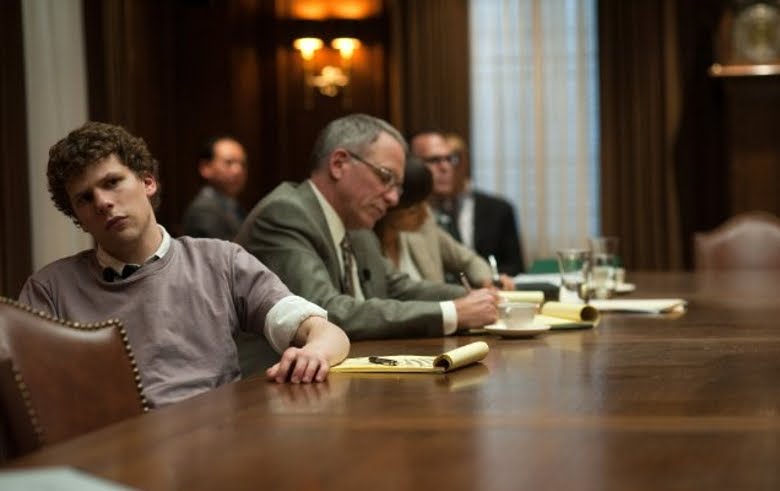
Zuckerberg didn’t cooperate with the filmmakers yet right from the electric opening scene, we see a strange hagiography emerging. Zuckerberg harangues a soon-to-be-ex-girlfriend and paints himself as an intensely burning candle with little or no thought to what way his smoke went out. Jesse Eisenberg’s gift is to make audiences awed by his audacity and awareness of opportunity as much as they detest the way he treats people. Sorkin and Fincher are both 20 years older than their main character and it may they are trying to channel their own X-gen faults with women through the Zuckerberg they came up with. His jilting/jilted lover is “Erica Albright” who is made up for dramatic purposes (his real girlfriend is Priscilla Chan) but it isn’t difficult to believe he might be that chimeric with women.

Aided by a deft soundtrack by Trent Reznor, the plot surges along in a manner most would not associate with computer nerds. We see how Zuckerberg and his friends turned a new idea called “the Facebook” (complete with definite article, it is a pre-Internet Ivy League invention to describe a set of photographic data that defined a student) into a success story. As it gets closer to becoming a billion dollar industry, bottom feeders such as Sean Parker (played with Best Supporting Actor Oscar-winning conviction by Justin Timberlake) start to shape Zuckerberg’s vision.

Zuckerberg’s Brazilian friend Eduardo Saverin (Andrew Garfield) provides inspiration in the shape of intellectual honesty as well as a mathematical algorithm and funds to keep the server running. The film is based on the book "The Accidental Billionaires" a semi-fictional account that tells the story primarily from Saverin's point of view. But in the movie Saverin overplays his hand and is ousted by the Machiavellian Parker. The eventual feud forms one of the two dramatised court cases; the other being Zuckerberg’s fight with the Winkelvoss twins (both effortlessly played by Arnie Hammer) who claim they gave him the idea to use the Harvard .edu domain to promote the social network. Zuckerberg tells the “Winkelvi” if it was their idea then they would have done it. The filmmakers’ sympathy is with the nerdy Jew over his upper-class co-religionists.

How much he has won since that battle was shown in a new item this week on the BBC about a fight between Facebook and fellow Internet heavyweight Google. Facebook has offered users a workaround after Google Gmail blocked the export of contact material because Facebook “did not share its data reciprocally”. Mike Davis, a senior analyst with research firm Ovum, told the BBC the stand-off says a lot about the developing rivalry between the two firms. "Facebook is a significant challenge to Google's dominance of the web sphere and it has decided that it doesn't want to give Facebook any more advantage,” he said. "This is Google waking up to the fact that it was the next big thing and that now Facebook is," he said.

Because Facebook’s phenomenal reach shows little sign of slowing, there are those who worry greatly about its power. Criticism to date has focused on data mining, child safety, and the inability to terminate accounts without first manually deleting all the content. But there is a bigger hankering issue which Wu alluded to earlier. In the film Zuckerberg acknowledges Facebook’s phenomenal growth is based on its “cool” value Wu called the “mutual agreement to tell others who you are”. But when Zuckerberg himself is such a cipher, why should we treat the agreement as mutual? Without a foreign policy to guide us, Fincher and Sorkin have done us a favour by asking the question.

Saturday, March 13, 2010

The People's Republic of Facebook

Sooner or later, we will all probably hate Facebook enough to leave it. It will become too commercialistic, too voyeuristic, too invasive of privacy or just too damn powerful. And we’ll all pack up our digital bags and go somewhere else. And that will be a shame because as social networks go, Facebook has a lot going for it.

Facebook is easily the most popular social network in the world and now has a massive user base capable of connecting a planet. There are more than 300 million members and growth is showing little sign of slowing. And to date, its effect is mostly benign and very often beneficial. It allows people from across the world to get a window in other people’s lives. It re-opens old and stalled friendships. And though it has more than five percent of the world’s population in it, it hasn’t caused any wars, terrorism, or large scale hatred. Yes sure there are hate groups out there on Facebook, but these can be easily named and shamed or better still simply shunned. And despite the media stink about linking every nastiness with Facebook, usually there is only a tangential link. There is no evidence to suggest Facebook is evil.

What is evident is Facebook is in danger of becoming a massive time sink. Facebook is changing the way we deal with the world because it is a one-stop shop for multiple communication needs. It has email, instant messaging, twitter-like status updates with added banter, there are a limitless number of games, there are links to be shared, and there are photos to be posted and enjoyed. Before you know fifteen minutes of the day is gone in a flash. No wonder some employers hate it. Yet it caters for a crucial part of human existence: the need to know more about the world. If Facebook didn’t exist, people would still be on the phone or reading letters or playing games.

Mark Zuckerberg has already made a lot of money from Facebook. Aged just 25 he is a “youthful multi-millionaire” however most of his wealth is virtual and tied into the possible worth of Facebook if it ever went for public stock options. And when that happens the gloves will be off. The corrupting influence of power and money will likely turn Facebook into a grubby advertising pit.

So here’s my suggestion to Mr Zuckerberg. Instead of making gazillions out of it, why not give it away. Release it into the wild of the public domain. Let the users take it over and turn it into open source or wikify it. Let Facebook privacy finds its own equilibrium. Sack your army of lawyers and offer passports to the People’s Republic of Facebook. If that idea sounds too radical, then consider the alternatives. The desire to make serious money out it will eventually kill it. You may be gone on to other things by then and may not care but the destruction of Facebook will still be forever associated with you.

It remains a good idea to put the world on one network. That doesn’t mean everyone has to talk to everyone, but it does open up infinite possibilities. It will require a whole new universe of trust; it will redefine what it means to publish. It will stretch and pulsate our neural network without the nagging fear that ultimately its all about exploiting users to turn a buck. Facebook could yet be that network but only if Zuckerberg lets it run free.

Monday, February 08, 2010

Pew finds the young are deserting blogging for social media

A new report from the Pew Internet and American Life project has found blogging has dropped among teens and young adults while simultaneously rising among older adults since 2006. The findings suggest that as blogging has matured as a practice, so has its practitioners. The survey was conducted as one of a series of reports undertaken by the Pew Research Center to highlight the attitudes and behaviours of American adults ages 18 to 29. The report brought together recent findings about internet and social media use among young adults and situated it within comparable data for adolescents and adults older than 30. Pew surveyed 800 adolescents and 2,253 adults in 2009 to get their data. (photo:eurleif)

The report found the Internet is a crucial “central and indispensable element” of the lives of American teenagers and young adults. 93 percent of teens between the ages of 12 and 17 went online, a number that has remained stable for three years. Nearly two-thirds of teen internet users go online every day. Families with teenage children are also most like to have a broadband connection (76 percent and up 5 points since 2006). It will probably surprise no one that the older you get, the less likely you are to be connected to the net. 74 percent of adults use the internet. But that number is skewed because younger adults (18-29) go online at a rate equal to that of teens (at 93 percent).81 percent of adults aged 30-49 are online while just 38 percent (but still rising) of those over 65 are hooked up.

Use of gadgets
is on the rise as the Internet increasingly moves away from the desktop and onto mobile and wireless platforms. But again the growth is skewed towards the young. In September 2009, Pew asked adults about seven gadgets: (however they listed just six: mobile phones, laptops and desktops, mp3 players, gaming devices and ebook readers). On average, adults owned just under three gadgets. Young adults of age 18-29 averaged nearly 4 gadgets while adults ages 30 to 64 average 3 gadgets. But adults 65 and older on average owned roughly 1.5 gadgets out of the 7.

While the desktop or laptop remains the dominant way of getting online, newer ways of connecting are making headway. More than a quarter of teen mobile phone users use their cell phone to go online. A similar number of teens with a game console (PS3, Xbox or Wii) use it to go online. One in five owners of portable gaming devices uses it for Internet access. Perhaps surprisingly white adults are less likely than African Americans and Hispanics to use the internet wirelessly. African Americans are the most active users of the mobile internet, and their use is growing at a faster pace than mobile internet use among whites or Hispanics.

Less of a surprise is the fact that teens are avid users of social networks. Three quarters of online American teens ages 12 to 17 used an online social network website, a statistic that has been growing at 7 percent each year since 2006. Teenagers are also more likely to use it as they get older. While more than 4 in 5 online teens ages 14-17 use online social networks, just a bit more than half of online teens ages 12-13 say they use the sites. Pew says this may be due to age restrictions on social networking sites that request that 12 year olds refrain from registering or posting profiles, but do not actively prevent it. The other notable statistic is that differences in gender are evening out ending the previous dominance of girls on social networks.

Usage of social networks stays constant in the 18-29 age group but then drops off rapidly for those over 40. Adults are also more likely to have profiles on multiple sites. Among adult profile owners, Facebook is currently the social network of choice; 73 percent of adults now maintain a profile on Facebook, 48 percent are on MySpace and 14 percent use LinkedIn. Analysis by education and household income show that support for Facebook and LinkedIn rises with both factors validating Danah Boyd’s research into the subject.

The news is not so good for Twitter. Pew’s September 2009 data suggest teens do not use the microblogging platform in large numbers. While one in five adult internet users ages 18 and older use Twitter or update their status online, teen data collected at a similar time show that only 8 percent of online American teens ages 12-17 use Twitter. Pew did add a rider to say the question for teens was worded quite differently from how the question was posed to adults so the results are not strictly comparable. With adults there was a sliding scale of Twitter usage with age. 37 percent of online 18-24 year olds use the platform compared to just 4 percent of over 65s.

But while use of all other web2.0 platforms was on the rise among the young, the striking exception was blogging. Teenage blogging has dropped from 28 percent to 14 percent of all users in the last three years. The decline spreads to commenting on other blogs. 52 percent of social network-using teens report commenting on friends’ blogs, down from 76 percent commenting in 2006. Young adults show a similar decline. However blog as a whole had not declined as there has been a corresponding increase in blogging among older adults. The hard work involved in blogging is increasingly becoming an old person’s game.

Wednesday, December 02, 2009

Ushahidi used to expose fraud in Namibian elections

Namibia is still waiting for confirmation of its election results three days after voting completed. The country’s presidential and national assembly elections took place over Friday and Saturday 27–28 November 2009. And while the first ballots came in on Sunday, the final result will not be known until Wednesday. Fourteen political parties participated in the elections with the ruling party, South West Africa People's Organisation (SWAPO) overwhelming favourite to win over its main challenger Rally for Democracy and Progress (RDP). Meanwhile SWAPO’s Hifikepunye Pohamba is seeking a second five-year term as president. But social media is casting a long shadow over the election led by the African crowd-sourcing tool Ushahidi. (photo credit: Agence France Press)

The former rebel movement SWAPO has dominated Namibian politics since the nation’s independence from South Africa in 1990. They won a landslide in the last election five years ago but are expecting a closer result this time. The opposition RDP is a new party which broke away from SWAPO two years ago. The party headed by former foreign minister Hidipo Hamutenya is hoping that voters have had enough of SWAPO after a series of corruption scandals. These include the bribery of Chinese President's Hu Jintao's eldest son over a $56 million deal to supply scanners to Namibia's ports and airports.

However with early results suggest that SWAPO will be heading for a comfortable victory, opposition parties have begun suggesting the election was rigged. Four opposition parties including the RDP said the Namibian electoral commission had provided different figures for the number of people on the voters’ roll to each party. They also complained that their agents were barred from manning polling stations and supposedly indelible ink used to prevent double voting could be washed off. The four parties said in a joint statement their concerns “may compromise the outcome of the election.”

The National Society for Human Rights has also been highly critical of the electoral commission. The human rights watchdog claimed the voters' roll had a discrepancy of 180,000 voters including double-listed constituencies and voters as well as under-age people. The commission disagreed and revoked its status as an election observer on Wednesday deeming it “not impartial”. The Namibian High Court ruled to have the observer status reinstated barely hours after polls opened on Friday although the NSHR were still complaining of continued harassment as they tried to monitor the polls.

According to Global Voices Online, the NSHR were prominent among political parties and non-governmental organisations who used a number of social media tools to campaign, monitor and report on the elections. The NSHR used the African crowdsourcing tool Ushahidi to monitor the poll. Ushahidi was a tool created in the aftermath of disputed Kenya's elections in 2007 to collect and map eyewitness reports of violence. Ushahidi means testimony in Kiswahili (East Africa’s lingua franca) and as explained by Riyaad Minty to Sydney’s Media140 conference last month, the tool was also used by Al Jazeera to crowdsource crisis mapping during Israel’s 2008 invasion of Gaza.

In the Namibian election, the NSHR used Ushahidi to collect reports about incidents of fraud, undue influence, intimidation and violence. Eye-witnesses sent in their reports via SMS, email or by filling out a form on the website. At the time of writing there were 64 reports on the site. Examples include instances of presiding officers denying observers taking pictures of electoral fraud and a human rights activist was arrested for “insulting the former president”. While these reports are unverified, Ushahidi is showing itself to be a simple but formidable tool for the broadcasting of grass-roots activism in a continent with poor media coverage. It may yet prove to be a game-breaker in the torturous world of African politics.

Sunday, November 15, 2009

Media140: Internet political economy in Asia and Africa

This is my sixth and final post about the Media140 conference in Sydney last week. I've enjoyed putting together my reflections of an important event and I’d encourage readers to check out Julie Posetti’s (Sydney Media140's editorial director) excellent overview and discussion of where it might lead next. See also my prior posts about my initial impressions, and the speeches of Mark Scott, Posetti, Mark Colvin and Jason Wilson, and Jay Rosen. (photo by Derek Barry)

I wanted to finish off by talking about some of the underexplored political economy of the Internet. The presentations of Riyaad Minty and Jude Mathurine brought some of the brightest ideas of Asia and Africa to Friday’s events. Both presenters are South African of similar age with a fascination for all things new media working in different fields. Minty was a digital entrepreneur at 19 before joining Al Jazeera in 2006 as a new media analyst. Jude Mathurine went into education and advocacy and is now head of the new media lab at Rhodes University in Grahamstown, Eastern Cape Province.

Minty’s presentation was a quick introduction to how the new media team in Doha promotes Al Jazeera online. Minty noted that Al Jazeera is broken into six major functions: Arabic, English, documentary, sport, training and research and his group is involved with all of them. Their job is to ensure the brand stays relevant in the new digital age. Their mantra is “people trust people” so Al Jazeera has been personalising its message in what Minty called a “virtuous circle” of old and new tools and old and new audiences.

He discussed how Al Jazeera covered Operation Cast Lead (Israel’s 2008 invasion of Gaza). According to the UN Goldstone Report this was a particularly brutal occupation and unsurprisingly Israel didn’t want the media around to question their actions. They made Gaza off-limits to westerners but Al Jazeera had two reporters Ayman Mohyeldin and Sherine Tadros inside the Strip who got their message of the devastation out on television, the website and Twitter. Al Jazeera also urged the people of Gaza to give their online “views from the ground”. Their Twitter live updates were a compelling real time unveiling of suffering that was otherwise unheard in the western media.

Al Jazeera used Ushahidi to integrate mobile, email and alerts for crowdsourced crisis mapping and provided Google maps mashed up with up-to-date bombing information. The site also enabled creative commons video footage which was used creatively by artists, activists and educators alike. Minty said that telling the truth was hard, but not telling it is even harder. His team give Al Jazeera the tools to make it just a little easier.

While Minty is doing great things in Asia, Jude Mathurine is determined Africa will not be left behind in the digital revolution. The theme of Mathurine’s presentation was that the future of journalism in that continent is firmly tied up to mobile social networks and its enormous array of tools.

The question for Africa is how many people will be able to access the tools. Although 15 percent of the world’s people live there, Africa has just four percent of the world’s Internet users. The continent is handicapped by huge income disparities, education issues, poor bandwidth and bad regulation. In South Africa the black and poor are digitally disenfranchised and online social media is biased towards the white and wealthy. Journalists suffer just as badly as the general population and have little by way of media education or exposure. Media organisations are staid and hierarchical and do not engage audiences.

Yet Mathurine says Africa will not be left out of the global village of social networks. He sees hope in the fact the social network sites such as Facebook, Youtube and Blogger are among the most popular sites in many African countries. Critically, this trend is further exacerbated on mobile services. “The revolution will be mobilised,” says Mathurine. In the last six years world mobile growth has outstripped landlines by a factor of over a hundred to one. By 2007 Africa had almost 200 million mobiles compared fewer than 30 million fixed phones. Mobile users are transforming the continent using SMS (and reconnecting the millions elsewhere of the African Diaspora).

Mobile growth is fastest among the young and are taking to the social networks in greatest numbers. Online tools such as Kabissa and Zoopy are changing the political landscape too as Africa looks to local and cheap solutions to get around its many problems. People can buy mobile handsets using open source operating systems with camera and recording capability for just $15 and the Internet backbone is slowly increasing around the continent. But SMS remains the killer app and sets the agenda often bypassing media censorship in the process. Young people and social media are Africa’s great hope for a truly democratic continent, concluded Mathurine. And mobile technology will be far more important than desktop access.

Tuesday, August 25, 2009

The last post and chorus

(picture adapted from original by Annie Mole).

What happens to a blog when it turns seven? Well, if it belongs to Lawrence Lessig it is retired. To be fair to the legal scholar Lessig, he doesn’t actually use the r-word. Instead he called it hibernation and a sabbatical but he did write it was “the last post in this frame”. Whatever he calls it, Lessig’s departure is the latest in a line of events that is giving the impression that blogging is passé.

Lessig named three reasons why he was cutting back. These were the impending birth of his third child, a new five-year directorship at Edmond J. Safra Center for Ethics at Harvard and the workload involved in maintaining a blog. He needed two friends’ admin help to cull the 10,000 spam comments that were causing pollution among the 20,000 genuine ones. Lessig said he was not abandoning web2.0. He was continuing presence at Twitter, Blip.tv and podcasting.

Here in Australia, Kate Carruthers picked up the theme today that newer social networks have made blogs look so 2004. While Carruthers accepted there was still a need for longer-form communication platforms, she suggested there may be a move away from the likes of Blogger and Wordpress. Carruthers said possible replacements include Tumblr and Posterous which are half-way houses between blogs and shorter messages. “They seem to sit between a short message sharing medium and a traditional blog,” she said. “They also easily incorporate multimedia content.”

Carruthers didn’t mention Lessig but did link to an article Paul Bautin wrote in Wired a year ago. Boutin’s friendly advice to anyone wanting to start a blog was “don’t”. He went further and suggested all current bloggers should also down tools. “Writing a weblog today isn't the bright idea it was four years ago,” he argued. “The blogosphere, once a freshwater oasis of folksy self-expression and clever thought, has been flooded by a tsunami of paid bilge.” He says blogging lacks the intimacy it used to have. And as well as dealing with spammers and trolls, Boutin says big media have taken over. The buzz was now at social multimedia sites like YouTube, Flickr, and Facebook which “made publishing pics and video as easy as typing text”. His message condensed to 140 characters was: "@WiredReader: Kill yr blog. 2004 over. Google won't find you. Too much cruft from HuffPo, NYT. Commenters are tards. C u on Facebook?"

Boutin himself linked to another high profile blogger who had called it quits. Weblogs network owner Jason Calacanis also announced his retirement from blogging in 2008 despite professing to love the craft. Calacanis said blogging had gotten too big, too impersonal and too lacking in intimacy. But unlike Boudin, Calacanis was heading towards a more primitive form: a 600-750 member mail-list he was going to have a conversation with “I’m looking for something more acoustic, something more authentic and something more private,” he said.

Calacanis, like Lessig and Boudin, has good reasons to stop blogging. But are they indicative of a wider trend? It may be 12 months old, but Technorati’s State of the Blogosphere 2008 would beg to differ. Its data suggests that blogs are pervasive and part of our lives. 184 million people worldwide have started one and 346 million people read them. There are almost a million new posts every day written in 80 languages. Blogs are part of the daily traffic of 77 percent of active Internet users. Twice as many people go to a blog as those who visit Facebook. This seems like a practice in rude health, but Technorati does acknowledge one issue: the lines are continuing to blur as to what is a blog and what is not. It rightly says mainstream media sites packaging their content as “blogs”. But Technorati ignores the blurring at the micro-end of the spectrum at the Facebooks, Twitters and Tumblrs of the world. It defines the blogosphere as “the ecosystem of interconnected communities of bloggers and readers at the convergence of journalism and conversation.”

The blogosphere is a massive ecosystem with enormous diversity and engagement. Blogging evolved from early listings of websites people liked to personal journals and a community of interest that encouraged conversation. But it was also something else. Peter Merholz coined the term in 1999 when he decided to pronounce “weblog” as “we-blog”. Or blog for shot. Merholz enjoyed the word’s crudeness and dissonance. “I like that it’s roughly onomatopoeic”, he recalled. “These sites – mine included – tend to be a kind of information upchucking”.

Even granting that information is not necessarily knowledge, the need to upchuck it has not dissipated. In his response to Technorati’s 2008 report, Chris Pirillo got it right. “The idea of blogging will never disappear,” he said “But the process by content is created, will continue to undergo radical upheavals.”

The death of the blog is exaggerated.

Friday, August 21, 2009

How Sky caved in to Joe from Twitter

(Photo by Joe Neale @Joe - used with permission).

As Londoner Joe Neale has just found out, News Corp wants to charge for content on the Internet while not being averse to using other people’s content for nothing.

Joe's story began two weeks ago on 5 August with events that seemed to have nothing to do with him. On that day two police officers from Kennington police station in London were patrolling near Waterloo station when they stopped to question a man on a bicycle. As the officers approached him, the man dumped the bike and ran away. As he did so, he fired shots at the officers leaving two of them injured in the vicinity of Southwark tube station. It was Joe Neale's fate to be walking past the tube station at the time. He snapped a picture of the crime scene (see photo above) which he immediately loaded to Twitpic with the caption “Holy crap police man shot at Southwark tube station!”

Neale had to rush to meetings so did not immediately notice that others were paying close attention to his picture. The shooting of two policemen in London is meat and drink for News Corp's Sky News and they were quick to publish an article about it. They found Neale’s Twitpic and used it to illustrate the story. Sky captioned the photo with the credit “Joe from Twitter”.

But it turns out that Joe is not just anyone from Twitter. Neale is the original @joe on Twitter with 20,000 followers and is the head of End User Programmes at software licencing company Symbian. Sky could have found all this out by looking at his Twitter page. There they would also have found out he is a former Murdoch employee. Neale’s previous job was MySpace UK Content Manager. This meant he knew who to talk to in News Corp.

Friends of Neale told him that Sky was using his picture. His first reaction was one of delighted amazement. Neale sent a couple of tweets to Jon Gripton, news editor of Sky News Online saying he was “really pleased” Sky had used the photo. He asked them to change the attribution from “Joe from Twitter” to “Joe Neale http://www.twitter.com/joe”. Gripton responded after 5 hours saying “Will do Joe - give me a minute to talk to the team”. Gripton also requested Neale to follow him in Twitter so that he could send him a direct message. Neale appreciated the response and asked jokingly “how many beers” the picture was worth. A day later the pair were following each other but Neale complained he still had not yet gotten an email response.

Sky changed the attribution but were in no mood to divulge how many beers they thought it might have been worth. But Neale was no longer joking and found out for himself. He checked the terms of service of Twitpic which specifically said "All images uploaded are copyright © their respective owners". He sent Sky several emails but got no response. But after two weeks of silence from Sky, Neale hit back using the power of social media. Two days ago on Wednesday 19 August, Neale published the content of the email on Twitter using the #skypic hashtag. Part of the email read as follows:
My photo was used without permission on the sky news website on the 5th of August 2009, and was taken from my Twitter feed without my permission(I have 20000+ mainly UK based followers including a large section of press/media folk).

Neale went on to tell Sky the conditions he demanded for using the photo without permission. It would be £300 for the initial use on the front of the site and then charged at five percent for each of the two weeks it was used by the site (note: Neale's picture has now been removed from the Sky report of the shooting linked above in the first paragraph).

To hammer home the point, he sent out further tweets using the tag #skypic, which read: “Newscorp use your photos without permission but have plans to charge for reading their content” or “Newscorp vs citizen journo”. Neale’s network got involved and put out 200 retweets of #skypic.

After 24 hours, Sky caved in and promised to pay £330.75. The promise came in an email they sent Neale yesterday which read: “I’m sorry my colleagues didn’t get back to you as soon as you would have liked. We always acknowledged your copyright, & I’ve forwarded on your invoice for payment – here it is attached with the relevant SY number inserted in case you’ll need that if you need to chase it up. Just be aware that payment should take approx one month to get through the system.”

The game is not over till the cheque is in Neale’s bank but for now the score is Citizen Journo 1, News Corp 0.