Showing posts with label UK. Show all posts

Saturday, December 29, 2012

Brian Leveson - media personality 2012


The 2012 Woolly Days media person of the year is Brian Leveson. Leveson is a jurist not a journalist but his impact on journalism and the world of media this year has been profound. 

The year 2012 will not go down as a great year for the world’s media. While the world’s business-as-usual pattern of production and consumption sees it barrelling down a path towards a 4 degree increase in temperature by 2100, the focus of most media attention is ever increasingly the deeply superficial.  

Commercial media have always fulfilled two purposes: to make money and to inform but it is the profit imperative which is winning clearly at the moment. The large multi-national conglomerates that own media stock look no further than the bottom line when it comes to meeting deadlines. Issues like news values and ethics are a poor second if there is no payback. Meanwhile shareholder disquiet of falling ratings or circulations can be managed quarter to quarter by cost cutting and doing more with less.  There is as a result according to Michael Mandel, a “shift in journalistic employment to non-traditional industries, an increased in the self-employed, a delayering of journalism, and perhaps lower pay.”

Brian Leveson admitted as much on his recent visit to Melbourne. The closure of a large number of newspapers has reduced the extent to which local government, health, education and the courts can be held to account. “Society will be less well served as a result”, he said. Yet Leveson was aware that even if journalism jobs are becoming diffused and of less value, the media they serve remain powerful players as editorialists, chroniclers, sensemakers, muckrakers and watchdogs. 

Their contract with the public to perform these roles is based on trust. The one-to-many broadcast model of television and the major papers ensured they always had the microphone to drown dissent. The internet and web2.0 changed all that and disapproval can amplify virally if compelling enough. The web further undermined the media’s privileged modus operandi by allowing a multiplicity of blog voices harvesting free online content often with more sagacity and insight than the journalists. Social media has forced big media to become more humble in their dealings with the public they profess to “serve”.

There remains pockets of strong resistance, with Rupert Murdoch’s News Corp leading the counter-assault. This old fashioned news and entertainment empire (one of the few not owned by a non-news company) remains convinced it does not need to answer its critics. China is a rare failure but In the US, Fox News is highly successful while his 2011 plan to buy the 60.9 percent of British cable company BSkyB it did not own was just a whisker away from being successful when undone by fine journalism. 

Revelations by the Guardian journalist Nick Davies and his editor Alan Rusbridger brought the sordid hacking affair to light. The shadowy practices not only showed the need for profit greatly exceeded all other motives but described the contempt News had for its own audience. With the weight of evidence growing Prime Minister David Cameron appointed Justice Leveson in June 2011 to investigate the culture, practices and ethics of the British press as well as the dealings between the press, politicians and the police.

As testimony followed testimony, it was clear much was rotten in Murdoch’s hamlet.  It wasn’t just the attitude that privacy was for paedo’s as former News of the World journalist Paul McMullan espoused, it was the scene of serious crime. As November 2012, there had been 90 arrests on charges of interception of mobile phone messages, payment to public officials, data intrusion. The Inquiry would expose potentially corrupt dealings between senior members of the media, political parties and the police.

In nearly nine months of oral hearings, almost all available to transcript or watch online, involving 337 witnesses and 300 statements, the Inquiry became “the most public and most concentrated look at the press” Britain had ever seen. It enormous resonance not only in Britain but wherever British legal, ethical and press traditions operate, such as Australia. The numerous celebrities who portrayed themselves as “fair game” to an uncaring media, added to the notoriety of the charges. Australian media were quick to distance themselves from the phone hacking but there but for the grace of god go they at any lengths for a story. 

With such a wide ranging brief, Leveson’s Inquiry had important things to say about plurality of ownership, privacy laws, and regulation of the press, all of which got the media companies quivering in their boots. Leveson was at pains to stress his inquiry was not an attack on press freedom. However, he said, with rights came responsibilities and all too often the press has simply ignored them. Neither the press or the press council ever launched investigations into allegations of serious misdoings such as breaches of data protection or trade in private and confidential information. Indeed when the phone hacking issue was raised, police executing a warrant were driven off the News of the World premises while the Press Complaints Commission criticised the Guardian for publishing the results of their investigations into the cover-up. 

In November 2012 Leveson released his findings in a 2000 page report and 48-page executive summary.   Leveson proposed an independent replacement for the Press Complaints Commission which he said had no regulatory powers. It would have a dual role of promoting high standards of journalism while protecting the role of the individual. The new body would not include serving editors or politicians and it could impose fines and direct the appearance of corrections. 

Leveson said participation needed to be universal for the body to be properly funded and succeed in its purpose. Those that declined to be involved would forfeit the right to the in-built arbitration process and therefore could not claim costs of any civil action even if they won because they had refused the cheaper route to justice. Leveson said such a body would not regulate the press.  He did not advocate prior restraint (a point of honour with the British press since Milton’s Areopagitica in 1644). He acknowledged how the important role media plays in society “as a critical witness of events” and accepted that media and journalists have several necessary privileges under the law as “one of the true safeguards of our democracy”. Leveson said his legislation would in fact enshrine “for the first time, a legal duty on the Government to protect the freedom of the press”.

However, the media did not see it that way.  Every newspaper in Britain except the Guardian rushed to denounce Leveson’s key recommendation. Biggest selling paper The Sun said it was “deeply alarmed” by the prospect of “State control of newspapers.” “Such a law could allow State officials to walk into papers like The Sun and censor stories,” it said. The Express also worried about political aprons: “To put politicians in ultimate regulatory control of newspapers and then expect them never to seek to use that power to constrain criticism or scrutiny is to place in them a degree of trust they frankly do not deserve.” 

Prime Minister David Cameron – himself implicated by the evidence of the over-close relationship between press and politics – plumped for the press over Leveson. He expressed his reservations over the legislation for the independent process to recognise the new self-regulatory body.  “For the first time we would have crossed the Rubicon of writing elements of press regulation into the law of the land,” Cameron said. “We should I believe be wary of any legislation that has the potential to infringe free speech and a free press.”

High profile hacking victims such as JK Rowling expressed dismay at Cameron’s speech. “"Having taken David Cameron's assurances in good faith at the outset of the inquiry he set up, I am merely one among many who feel duped and angry in its wake," she said. The Hacked Off coalition gained 100,000 signatures calling on the government to comply with Leveson’s findings. Cameron’s coalition partners the Lib Dems are among them, so the matter rolls on, awaiting further political arbitration in the new year.

If Cameron didn’t reckon for the public outcry, then Leveson certainly did. He predicted the victims and the public would not accept the outcome “if the industry did not grasp the opportunity”. Following seven inquiries into the British press in 70 years, it “did not make sense to contemplate an eighth.” Whether short-term interest will prevail is a moot point, as is the longevity of the media’s powers of influence. What is not in doubt is that Brian Leveson has done us all a favour by pointing a strong light on its problems. Maybe then, the media can return to the problems that affect the rest of us. 

Previous Woolly Days media personalities of the year


Thursday, September 01, 2011

Australia's own Oranges and Sunshine victims remain forgotten

I saw the Jim Loach film Oranges and Sunshine last week. The film tells the moving story of the forced migration of UK children, a paternalistic government program from the 1940s to the 1960s that saw 130,000 children removed to Commonwealth countries, mostly to Australia. The British Government kept the program hidden for years as did the Australian Government to the Forgotten Generation – almost half a million children from the UK and Australia. The government snatched these children from their families and sent them to institutional religious environments where they were abused and treated as slave labour.

The film was especially poignant to me because I had met a member of that generation who told me his story for our newspaper. The man’s name is John Walsh who was born in Perth, WA on 27 March 1931. John was the eldest of seven children born in the 1930s who all were forcibly taken away from their parents.

When war broke out in 1939, John’s father joined the WA 2/11 battalion and he embarked for service overseas in 1940. The 2/11th arrived in the Middle East on May 18 and trained in Palestine and Egypt. They were mostly captured by the Germans in Crete and sent to Germany as prisoners of war from April 1941 to November 1945. And as John puts it, while his father and many others like him were serving their country overseas, the WA government destroyed their wives and families and sent the mothers into a life of hell and an early grave.

John said politicians in power from 1939 accused those working class and Aboriginal mothers of neglecting their children. The all powerful Child Welfare took control of the children and told the mothers they could not see their children until they turned 21. In March 1940 the Walsh family was split up. Four brothers John, Billy, Terry and George were sent to Castledare while sisters Theresa, Anne and baby brother Barry were sent to St Joseph's Subiaco. After 4 days, a Mr Young from Child Welfare came to Castledare and asked John to collect his young sister and brother who were in a bad way fretting.

“I had to look after my young sister and brother for about six months. It wasn’t easy with me being about 8 and ½ years of age,” John said. Both of them had to sleep with John on a veranda and the mattress was soaked every day so John had to put the mattress out in the sun every morning. After six months Mr Young returned to take the two youngest back to St Joseph's.

Life was tough in Castledare. John said they never got much to eat. “People would see the bruises on us but you never did say anything for there were a lot of abuses going on and no one would believe you anyway,” he said. “This Christian Brother Murphy whose nickname was Spud was bad. Of course the people wouldn’t believe you, Catholics could do no wrong. You just had to shut your mouth and hope the truth would someday come out.”

In December 1941 eldest boys John and Billy were sent to Clontarf orphanage. They had to move again in February 1942 when the Air Force took over Clontarf and 238 children (200 Australian and 38 English) were sent to Tardun St Mary’s College in three groups by train. This was in the northern wheatbelt of WA one and a half hours east of Geraldton. As John remembers “we were sent into a life of hell from 1942 to 1945.”

At Tardun there was nowhere to sleep so farm machinery was pulled out of the shed to make room for living quarters. They had to wash in horse troughs and worked from daylight to dark to put in a new wing on the old building. “The food they gave you was full of maggots and no way could we eat it,” John said. “We would steal the molasses and boil it up with wheat. We also caught a lot of galahs and other wildlife. We picked up a lot of quondongs off the trees in the bush and also ate a lot of bush fruit. I found out later they were like antibiotics and probably saved us from getting sick.”

Tardun orphanage was so far out in the sticks, the children were out of sight and out of mind. An English boy Charles Brunard,13, was killed by a truck running over him. John was one of those boys on that truck and said Brother Thomas was the driver. “The radiator was boiling over and Brunard was copping all the boiling water as he was sitting on the left-hand guard”. But a normal death certificate was issued. A boy called Kevin Glasheen also died of a fractured skull. Other boys were told to shut their mouths or they would get the same treatment.

The boys also had no warm clothes for the winter. In this life of hell, John remembers Brother Beedon, a short baldy red faced man who wore glasses, who was never happy unless he was belting someone with a strap. “It was a long strap always on the bare bum,” John said. “He was always sexually abusing someone”.

In 1945 the Air Force gave Clontarf back to the Christian Brothers and John returned there. “Those Christian Brothers were paedophiles so we found out; the life of hell was starting out all over again,” he said. No one dared speak out about what was going on. Sexual abuse, floggings, red siphon hose wrapped around your waist, a special strap made for cutting down on leg muscles. The life of hell went on until the children turned 14 and were sent to work on farms.

On 1 August 1947, John was put on a train at Perth to get off at the Serpentine railway station. He waited at Serpentine station for the farmer to pick him up but he was four hours late. When he turned up in a horse and buggy, he went into town to go to a dance. The horse took them home as the boss was drunk. John got five shillings a week with Child Welfare claiming the other two pounds a week. He worked seven days a week between 12 and 15 hours a day and stayed there for six months.

The milk truck helped get him away. John found one of his mother’s friends and her son got him a job at Plaistowes sweet factory in West Perth. “I was there for three weeks before the Child Welfare found me,” John said. “But the Plaistowes brothers and three foremen would not let them touch me. I was 17 years old at the time and still a ward of state until I turned 21.”

John never saw his father again. When the men returned home in 1946 they could not find their families and got no help from the WA Government. John spent most of the rest of his life seeking his family as well as justice. On 1 January 1975 the WA Government destroyed all the files of all the forgotten children. In the 1980s, as Oranges and Sunshine testifies, the UK children came under the spotlight and there were several Senate investigations. But the Australian born victims were ignored. After years of contacting politicians without success, the WA Government finally offered John $45,000 last year, a figure he reluctantly accepted as the best deal he would ever get. He remains bitter about the treatment the Government meted out to the families.

“If the politicians and Child Welfare had paid assistance money these abuses would never have happened,” he said.“They abandoned us and turned a blind eye. It was their responsibility to what went on in these orphanages.” John said the politicians in power at the time thought the religious institutions could do no wrong, so they never went looking for it. “The politicians who were in the Senate in the making of an apology and calling us the forgotten Australians were wrong – we were the hidden Australians."

Thursday, November 25, 2010

Arms dealer BAE pleads guilty to hiding bribes

A British Magistrates Court heard on Tuesday how Europe’s largest defence company wilfully failed to keep proper accounting records of payments. The notorious BAE Systems is the largest arms manufacturer in Europe and the fourth biggest in the world with annual military sales of $15 billion. In a Magistrates Court hearing in London BAE lawyer David Perry said the company would enter a guilty plea at a higher court next month in a plea deal with the Serious Fraud Office. (Photograph: Paul Ellis/AFP/Getty Images)

The indictment charges BAE is charged with knowingly not keeping proper records that explain payments that relate to two contracts. The statement of offence against BAE read “between 01 Jan 1999 and 31 Dec 2005 BAE knowingly...failed to keep accounting records which were sufficient to show and explain payments made pursuant to (a) a contract between Red Diamond Trading Limited and Envers Trading Corporation, (b) a further contract between British Aerospace (Operations) Limited and Merlin International Limited.”

After the guilty plea, District Judge Caroline Tubbs said sentencing should be approved by a higher court. She sent the case to Southwark Crown Court. The next hearing will take place on December 20. At this unprecedented hearing a judge will be asked to confirm the final settlement. However, many believe the timing of the Crown Court hearing is deliberately close to Christmas in order to bury the bad news.

The legalese around the trial charge did not state the dodgy accounting was hiding bribes to procure the sale of a military radar system to Tanzania. BAE covertly channelled bribes through the Panama-registered Envers from its company, Red Diamond, to secure a contract in 1999 to supply Tanzania with a military radar system costing $40 million. However BAE avoided more serious charges after it struck an agreement with the SFO in February.


The deal
splits jurisdiction with the US Department of Justice over the company’s misdeeds. The SFO got Tanzania and the DoJ got the rest. As a result BAE agreed to plead guilty in the Crown Court to an offence under section 221 of the Companies Act 1985 of failing to keep reasonably accurate accounting records in relation to its activities in Tanzania. The company had to pay $50 million comprising a financial order to be determined by a Crown Court judge with the balance paid as an ex gratia payment for the benefit of the people of Tanzania.

In return the SFO will drop all investigations into BAE deals in South Africa, the Czech Republic and Romania as well as Tanzania. An NGO called The Corner House have expressed deep concern the plea bargain means SFO has agreed to fetter its future prosecutorial discretion. “If further evidence came to light that was sufficient to mount a prosecution against individuals that necessitated making allegations concerning BAE’s conduct, the SFO would not be able to bring such a prosecution as it has undertaken not to do so,” said The Corner House.

The Campaign Against Arms Trade has also been implacable foes of BAE. They have joined The Corner House in trying to bring to the Court’s attention over the plea bargain’s apparent undertaking never to prosecute any individual in future if doing so involves alleging BAE Systems was guilty of corruption. CAAT’s Kaye Stearman said the new hearing date is so close to Christmas that “in the hackneyed phrase, this will be a good day to bury bad news.” “Yet there is still much about this whole sorry saga that the public deserves to know,” she said.

CAAT are responsible for much of what we do know about BAE’s arms dealings. They scored a major victory over BAE in 2007 after the High Court ordered the weapons dealer to produce a sworn affidavit divulging how it obtained a confidential and legally privileged document from CAAT. In 2003 the Sunday Times revealed how BAE paid a company to carry out an elaborate spying operation on its critics and infiltrate CAAT.

The 2007 affidavit followed the failed police investigation a year earlier of BAE’s illegal activities in Saudi Arabia. BAE chair Dick Evans had easy access to PM Tony Blair and the government bought pressure on the SFO to drop the corruption investigation into BAE's Saudi arms in December 2006. Former British Foreign Secretary Robin Cook said the relationship between BAE and the government was too close. "In my time I came to learn that the Chairman of British Aerospace appeared to have the key to the garden door to Number 10,” he wrote. “Certainly I never once knew Number 10 to come up with any decision that would be incommoding to British Aerospace".

Monday, October 11, 2010

British banks complicit in Nigerian corruption

A new report from a British non-government corporate watchdog has exposed how British banks have accepted millions of dollars in bribes from corrupt Nigerian politicians. The report called “International Thief Thief: How British Banks are complicit in Nigerian corruption”(PDF) has exposed rotten practices in the banking industry. Global Witness named five major banks Barclays, NatWest, Royal Bank of Scotland, HSBC and Switzerland's UBS in the 40-page report it said have failed to adequately investigate the source of tens of millions of dollars taken from two Nigerian governors accused of corruption.

Robert Palmer, a campaigner at Global Witness said banks were are quick to penalise ordinary customers for minor infractions but seem to be less concerned about dirty money passing through their accounts. "Large scale corruption is simply not possible without a bank willing to process payments from dodgy sources, or hold accounts for corrupt politicians,” he said.

Global Witness admitted the five banks might not have broken the law but said British banking regulator the Financial Services Authority must do more to close loopholes to prevent money laundering through British banks. "The FSA needs to do much more to prevent banks from facilitating corruption,” the report said. “As yet, no British bank has been publicly fined or even named by the regulators for taking corrupt funds, whether willingly or through negligence... in stark contrast to the United States, where banks have been fined hundreds of millions of dollars for handling dirty money." While HSBC claimed it had "rigorous and robust" measures in place to stop such abuses, a spokesman refused to talk about individual customers hiding behind the bank's confidentiality policies.

Global Witness’s findings were based on court documents from successful cases the Nigerian government brought in London against two former state governors Diepreye Alamieyeseigha of Bayelsa state and Joshua Dariye of Plateau state. Alamieyeseigha was jailed in Nigeria after pleading guilty to embezzlement and money laundering charges after being caught with $1.6m in cash at his London home. Dariye was arrested in 2004 in London after buying properties worth millions of dollars though he was on $63,500 a year salary.

Global Witness found that Barclays, HSBC, RBS, NatWest and UBS held accounts for both men. They said they “funnelled dirty money into the UK, spending their ill-gotten gains on sustaining a luxury lifestyle, in stark contrast to the poverty of ordinary Nigerians.” Global Witness said banks which were propped up by taxpayer’s money were getting away with practices that undermine aid programs. “This is not just illogical, it is immoral,” they said. “Our financial system is morally complicit in Nigerian corruption.” The banks have form: nearly all of them had previously fallen foul of the FSA in 2001 by reportedly helping the former Nigerian dictator Sani Abacha funnel nearly a billion pounds through the UK.

Nigeria ranks 130 out of 180 nations in Transparency International's list of countries perceived as most transparent in 2009. It has a population of 150 million people many of whom survive on $2 a day yet the country is one of the world's top champagne importers and its wealthiest residents are among the continent's richest. Al Jazeera quoted Nuhu Ribadu, the former head of Nigeria's anti-corruption agency who estimated that corruption and mismanagement swallows up about 40 per cent of the country's annual oil income. "Without access to the international financial system, it would be much harder for corrupt politicians from the developing world to loot their treasuries or accept bribes," Global Witness said in its report.

Thursday, September 02, 2010

A Journey into Tony Blair's Brutopia

In his just published autobiography, Tony Blair tells the story of a passenger jet that breached closed British airspace in the immediate aftermath of 9/11. A senior RAF commander was following the plane which was out of contact and heading towards London. The commander was awaiting instruction from Downing St to shoot it down. As recounted in "A Journey" (published yesterday) Blair said he talked with his advisors for several minutes “trying desperately to get an instinct as to whether this was threat or mishap”. When the deadline came, Blair decided to wait. “Moments later the plane regained contact. It had been a technical error,” Blair wrote. “I needed to sit down and thank God for that one.”

Blair’s desperation for a sign of “instinct” is almost as telling a factor as his gratitude to “God” for the way it eventually passed without incident. Blair is ultimate proof of John Gray’s suggestion in Black Mass modern politics is merely a chapter in the history of religion. While Blair initially recoiled with desperate horror against the possibility of making a preemptive strike against someone who may or may not be a threat, such decisions grew a lot easier for him in the years that followed. 9/11 was a watershed moment for Blair, as much as it was for the Bush administration as it marked a time when Gray said foreign policy would be shaped by Utopian thinking.

Blair always had a strong dash of neo-liberalism to go with his strong powers of faith. He came to the Labour leadership in 1994 when the party had been out of office for 15 years. He inherited Margaret Thatcher’s total belief in the power of the markets. John Gray said Thatcher’s aim of destroying socialism in Britain assisted Blair in his political rise. By dismantling the Labour settlement that had served Britain since the end of World War II, she removed the chief reason for the existence of the Conservative Party. Without an enemy, it lacked identity. Blair’s “New Labour” easily stepped into its shoes and deprived them of relevance for a decade.

As the 1997 British election proved, strategy and organisation were more important than policy. Once he won, Blair carried on Thatcher’s privatisation agenda moving it into the justice system and prison service while also making the NHS and schools subject to market forces. In his early international dealings he advocated a “doctrine of international community” which reflected the “end of history” thesis that infected much 1990s intellectual thought. It was destroyed with the towers on 11 September 2001 and exposed Blair’s more naked belief in the power of good intentions to triumph regardless of flaw in the execution.

Like Bush, Blair saw his destiny as the unfolding of providential design. The neocons in the White House made it abundantly clear to him on a Camp David visit in April 2002 the Afghan War would be a sideshow and Iraq was the real target. The Foreign Office knew the case for war was a thin one; Saddam was little threat and had no weapons to speak of. Yet by the time of the 23 July Downing Street Memo, he accepted the advice of MI6 war was inevitable and “intelligence and facts were being fixed around the policy”.

He cautioned Bush to seek UN support but in January 2003 Bush told him plainly the US was invading with or without a resolution. Bush offered Blair the opportunity to pull out given the strong anti-war rhetoric in the UK but Blair pledged his support. Blair actively covered up any intelligence that contradicted the official line Iraq was a major threat that had to be stopped. The March 2002 Iraq Options paper produced by the Cabinet Office and the February 2003 Defence Intelligence Staff document both said there was no justification for invasion. All they succeeded in doing was to get Blair to shift the case to arguments about WMDs where intelligence could be more easily manipulated.

Blair wasn’t interested in the facts. Armed with his dogged Utopian belief in the ineluctable nature of progress, he screened out inconvenient data. Blair was only interested in faith-based intelligence that supported his moral imperative. As the disasters unfolded in the aftermath of invasion such as Abu Ghraib and extraordinary rendition, Blair kept silent. Again Gray: “Deception is justified if it advances human progress...Blair’s untruths are not true lies. They are prophetic glimpses of the future course of history and they carry the hazards of all such revelations.”

Blair’s militant faith in human progress brought him eventually to the political abyss. His was a true enlightenment view of unending human progress. In his ten years as Prime Minister his overriding concern was the shaping of public opinion to support his beliefs and his lies became an integral feature of government function. Despite winning three elections, he is remembered only as a Bush lackey. Both men practiced missionary politics and saw their goal as the salvation of humankind.

The difference was Bush could do faith better than Blair in a country with a lot more millenarian tendencies than the UK. An American Lt Col in Fallujah could get away with saying the war was “battle against Satan”; a British General in Basrah could not. But both Britain and the US have now left the country. Iraq turned out not to be a Utopian project after all.

Thursday, March 11, 2010

BBC strategic review is useful template for the ABC


The BBC Strategy Review of March 2010 (pdf) is an important read not only for those interested in the future of Britain’s premier broadcaster but also for those who follow the fortunes of its antipodean cousin the ABC. Given the tagline “getting the best out of the BBC for licence fee payers” the 79-page document is the BBC Trust’s attempt to steer a course for the public-funded organisation in the likely event of a Conservative win in the forthcoming election and a corresponding serious reduction in government expenditure. (photo: The Guardian)

The Trust said its reference points were the audience and the market. It said its audience is proud of the BBC and willing to pay for a strong and independent voice that delivers original and high quality content. The market meanwhile is more ambiguous. It wants the BBC to fulfil its public service charter but questions where the boundaries lie with private enterprise and also its genuineness in its proposals for partnerships.

The Trust said the time was right to look at its future direction and possibilities of expansion in the framework of four key questions. These were: Is its portfolio of services still appropriate in the digital age? Has its near 24 x 7 expansion caused a dilution in quality and distinctiveness? What is the best distribution model for content? And finally how should it react to the problems of commercial media?

These questions in turn raised five lines of enquiry the Trust put to BBC management. These were: How can the BBC best maintain quality and distinctiveness? Where could it narrow focus and scale? What will a fully digital BBC look like? Can the BBC better define the public space it provides? And finally how can the BBC create the most value from its scale?

The response to all these questions from BBC management called “Putting Quality First” is in the same document. The Director-General’s vision was to create “a BBC focused on quality content and enduring values, keeping open a public space for all”. This would be achieved by five central principles: putting quality first, doing fewer things better, guaranteeing access, getting better value from the licence fee, and setting new boundaries.

The BBC mission statement is worth repeating because it has relevance also in the Australian context. It says, “[the mission] is constant and enduring: to inform, educate and entertain audiences with programmes and services of high quality, originality and value. It strives to fulfill this mission not to further any political or commercial interest, but because the British public believes that universal access to ideas and cultural experiences of merit and ambition is a good in itself. The BBC is a part of public space because the public themselves have put it there.”

The BBC is part of an independent public space that include other media, public institutions, libraries, museums, parks, universities, monuments and voluntary bodies. And while the digital age should be a “golden age” for public space, fragmentation of audiences is destroying business models causing public space to diminish. The BBC say their role is to be a main guarantor of public space and its technological underpinning and should also be a catalyst and connector within that space.

Its mantra, says management, should be putting quality first. It will have five content priorities: world-class journalism, inspiring knowledge, music and culture, ambitious local drama and comedy, outstanding children’s content, and events that bring communities and the nation together. That means changing £600m of priorities a year (a fifth of the BBC’s cost base) over the next four years and committing to 90 percent of licence fees on high quality content (though it will be interesting to see how ‘high quality’ will be defined and measured).

This also means doing more with less. Spending on the BBC’s website will decrease by a quarter each year to 2013 and its number of sections will be halved. There will also be more external links with the intention of doubling monthly ‘click-throughs’ to external sites. Other services to be closed will be Radio 6 Music, Asian Network and teen offerings BBC Switch and Blast! In order to guarantee access to all, BBC management want to make internet-connected television a reality, continue free access to news and also to open its archives and program library and work with its partners such as the British Library and BFI to bring their public archives to a wider audience.

To pay for all this, the BBC is proposing to reduce costs, reduce senior management numbers, freeze pay and suspend bonuses. They will also reduce spend on overseas content, cap sports rights spending, defer to commercial radio and other broadcasters in area in areas of popular music and serving teenagers and to not go more hyperlocal than they already are.

Opponents of public broadcasting here in Australia such as Mark Day have seized on this report as a rationale for trimming down, if not totally removing, the ABC from the media landscape. While this goes too far, the BBC Trust document does ask some very good questions and opens up a debate on public broadcasting and its platforms and contents we do need to have in Australia. Particularly as there is no licence fee, it behooves us to question the direction the ABC is headed (and also ask where SBS fits into the picture). All too often media policy here is reactive. As we stand on the cusp of the death of the analogue age, we could do worse than examine the BBC document. It is a template for honest and mature discussion into what we might want from “our ABC” in the coming years.

Wednesday, February 03, 2010

Mad Monckton and the media

Christopher Monckton’s mad-stare eyes should be a giveaway. As they rotate maniacally on high spin cycle, they present to the world a mirror of a tortured soul hell-bent on washing peculiarly dirty demons in public. Monckton is on a mission to show he is right and thousands of scientists are wrong. And the public and media hacks he is speaking to on his current Australian tour are desperate to hear what the “Lord” has to say.

It is no accident that those who flock to hear Monckton are white, elderly and wealthy. They like their life as it is and don’t want any inconvenient truths disturbing their repose. Nor will they be around long enough to face up to the consequences. Monckton’s shtick is a grab-bag of half-truths, innuendo and hints of world government that his troubled audience lap up. The trouble about climate change is once you know it to be true, you are compelled to act on it. Hence the importance of the soothing balm telling people "don’t worry, it doesn’t exist and there is no reason to change what you are currently doing". Monckton is an expert in this field of reassurance towards inertia. The 3rd viscount Monckton of Benchley in Kent is a slick audience operator imbued with the confidence that comes with his deep upper-class pedigree and a colourful history of his own showmanship to back it up.

Appropriately for such a quixotic character, Christopher Walter Monckton was born on St Valentine’s Day in 1952, the first son of Major-General Gilbert Walter Riversdale Monckton 2nd Viscount Monckton of Brenchley, CB, OBE, MC, MA, DL. Christopher’s grandfather was a lawyer and politician born plain old Walter Monckton but was wealthy enough to be educated at Harrow and Oxford. After advising Edward VIII in the abdication crisis, and putting out propaganda for Churchill in the war, he was elected to Westminster as a Tory MP in 1951. After serving as a senior government minister for six years he blundered by opposing Eden on Suez and was put out to pasture. His reward was the viscountcy Monckton of Benchley which he held till his death in 1965.

His war hero son Gilbert inherited the honour which entitled him to a seat in the House of Lords. There he spoke up for rural and military interests and left the Tory Party when they started cutting back on military spending. When he lost his lifetime seat in Tony Blair's constitutional reforms during the Hunting Bill, his manifesto for election to the House supported the muzzling of cats to stop the torture of mice. But Gilbert failed to live up to the mad peer stereotype other than occasionally flaunting his habit of wearing Arab dress and preparing his own brew of Arab coffee.

When Gilbert died in 2006, eldest son Christopher became the 3rd Viscount Monckton of Brenchley. Like both his forebears he was educated at Harrow but follow his father to Cambridge. Also like his father Christopher failed in his bid to be elected to the House of Lords and did not pick up a single vote in the 2007 by-election he contested. But this was not his first brush with politics. After he left Cambridge in 1974 with an MA he became a journalist and joined the pro-Conservative think tank the Centre for Policy Studies. His paper on the privatisation of council housing attracted the attention of the Thatcher Government and he worked for the Downing St policy unit for four years.

In 1986 he returned to journalism, first at Today then at the Evening Standard. In 1999 Monckton became briefly prominent for his board game called the Eternity Puzzle. 209 irregularly shaped pieces were required to fill the 12-sided puzzle and Monckton offered a prize of £1m to solve it. Although Monckton said he had to sell his £1.5m Aberdeenshire mansion to the eventual winners, he more than recouped this amount thanks to his clever marketing of the game and its reward.

Since he got his peerage in 2006, Monckton has been most closely associated with pushing the line about a global warming conspiracy. He took issue with the Stern Report, the IPCC and the British Labour government all of whom he accused of "creating world government". He claimed the changes in temperature preceded the changes in CO2 levels and said the UN ignored the medieval warm period. He said the Antarctic has cooled and gained ice-mass in the past 30 years. He said the sun caused what little global warming there was. Although there was not a single peer-reviewed scientific paper that backed any of this up, newspapers like the Daily Telegraph lapped it up and gave Monckton credibility and a wider audience.

Monckton is slowly getting the gravitas he has craved despite having a head full of crackpot ideas. Among these is that upon reading Rachel Carson’s A Silent Spring Jackie Kennedy forced her then husband President John F Kennedy to ban DDT which Monckton said “caused the death of 40 million people”. He also got away with telling many hopelessly underprepared Australian journalists he won a Nobel Peace in 2007, a lie he later laughed off as a joke.

But Monckton has turned himself into a walking joke. He revels in the role of poster boy for the far right which cannot accept the truth of global warming because that would mean accepting political opponents were correct. Monckton and his coterie are on an apparent roll. A pessimistic George Monbiot wrote in November: “There is no point in denying it: we’re losing. Climate change denial is spreading like a contagious disease.” But as his Australian trip is proving, Monckton’s contagion is limited to fellow-travellers among the media and the self-funded retirees. Not a single scientist has emerged to back him up. As even the conservative pro-farmer Fairfax publication The Land has realised, he is only preaching to the converted.

Sunday, August 23, 2009

Lockerbie anguish continues as Al-Megrahi protests innocence

While many in Britain and America have condemned the celebratory nature of Abdel Basset al-Megrahi’s Libyan return, they conveniently overlook the fact he was unlikely to be the Lockerbie bomber. The Scottish government released the 57 year old cancer suffering al-Megrahi on compassionate grounds last week after serving eight years of his life sentence. But dying or not, al-Megrahi says he is still intent on proving his innocence. “If there is justice in the UK I would be acquitted or the verdict would be quashed because it was unsafe,” he said this weekend. “There was a miscarriage of justice.”

Al-Megrahi has a good point; justice has always taken a back seat to politics in the Lockerbie bombing. Pan Am flight 103 blew up over the small Scottish town a few nights before Christmas 1988 en route from London to New York. 270 people died - 243 passengers, 16 crew and 11 residents on the ground. Scotland claimed jurisdiction for the crime as the plane was destroyed in Scottish airspace.

The initial suspect was a Syrian group with the unwieldy title of the Popular Front for the Liberation of Palestine, General Command (PFLP-GC). The PFLP-GC had a motive by acting for Iran in revenge for the American attack on an Iranian Airlines passenger plane a few months earlier. Two years before Lockerbie, the group’s Syrian leader Ahmed Jibril had publicly warned there would be "no safety for any traveller on an Israeli or US airliner". Although PFLP-GC subsequently denied responsibility for Lockerbie, the early years of piecing together evidence focussed firmly on the Syria-Iran link.

But by 1990 Iraq had invaded Kuwait. Neighbouring Iran and Syria were now suddenly proxy-allies whom the west could not afford to alienate. The Lockerbie case refocussed on the “Malta connection” and later that year the US and British governments issued indictments of murder against two Libyan men Abdel Basset al-Megrahi and Al Amin Khalifa Fhimah. In 1991 the pair were back in Libya and the US and the UK requested their extradition. Libya refused as it had no extradition treaty with either country. Libya arrested the pair but a local prosecution went nowhere as US/UK refused to hand over their evidence. The UN then made an unprecedented move to impose sanctions for not complying with the extradition request. The sanctions lasted six years.

After years of negotiation the UK agreed to Libyan demands for it to take place in a neutral country due to concerns of safety and a fair trial. The juryless trial began in May 2000 in the Netherlands under Scottish law and three Scottish judges. The key evidence was the brown Samsonsite suitcase which contained the bomb hidden in a radio/cassette player. The clothing in the suitcase was purchased at a shop in Malta and the store owner swore that a Libyan he could not identify bought them. Al-Megrahi, a Libyan intelligence officer, was in Malta on the day of the purchase and stayed near the shop. He was unable to offer the court a reason for his stay on the island. This evidence plus his connections to airport security and the Swiss company that built the timer in the explosive device was enough to convict him. Al-Megrahi was given a life sentence.

The second defendant Fhimah was an acquaintance of al-Megrahi and an Air Malta employee. They both arrived in Malta on the same flight from Libya two days before the bombing. The prosecution argued Fhimah knew how to get unaccompanied baggage onto a plane but the court found no evidence to show he had assisted al-Megrahi and acquitted him. But with Fhimah’s acquittal part of the case against al-Megrahi collapsed too. How did he get the bomb out of Malta?

Also, as part of their defence under Scottish law, the pair accused the Syrian-backed PFLP-GC of carrying out the attack. A German police officer testified that PFLP-GC had the means and intention of attacking an airline but the timers and cassette player used were not consistent with other PFLP-GC attacks. A Jordanian agent Marwan Khreesat who had infiltrated the group said he had never seen radio cassette players with twin speakers converted into explosive devices. On the basis of the German and Jordanian evidence the court concluded the PFLP-GC did not make the bomb.

The UN appointed five observers to watch the trial. Of these only one, Professor Köchler from Innsbruck University, published his findings. Köchler concluded the trial was unfair based on two points of objection. He noted the extraordinary length of detention (though this had been requested by the defence to prepare its case) and said the “presence of foreigners” at the prosecution and defence tables hampered the judges’ ability to find the truth and introduced a political element to the case (though there was no evidence that the judges were swayed by the “foreigners”).

Al-Megrahi appealed against the sentence based on the strength of the evidence linking him to the fatal suitcase. There was also the startling evidence that emerged in September 2001. A former security guard at Heathrow named Ray Manley made a sworn affidavit he had told anti-terror police one of Pan Am's luggage rooms had been broken into on the night of the bombing. This evidence cast complete doubt on the whole Malta connection. But for many years Scotland fought the appeal process.

The Scottish law professor who negotiated the Netherlands trial says many people believe there was overt political pressure placed upon the judges. Robert Black says it was probably necessary to reach a conclusion that was satisfactory to the British and American governments. “I think that consciously or subconsciously, these judges appreciated that if neither of the two Libyan accused were convicted in this trial, this would be an enormous embarrassment to the prosecution system in Scotland,” he said.

But by 2003, Libya was no longer a public enemy. Gaddafy told the Americans about his weapons capability. The west lifted international sanctions against Libya after it admitted responsibility for Lockerbie in 2005 and paid about $2.7bn in compensation to the victims’ families. Libya has since got that money back and much more in oil revenues. As The Times points out, al-Megrahi’s freedom is a further product of the effort to bring Libya out of dangerous isolation. “This is as much to America’s advantage as Britain’s, but Washington has too much baggage to be openly involved,” said The Times. And 20 years on, everyone is happy except the families of the Lockerbie victims who are still no closer to knowing who killed their loved ones.

Friday, August 21, 2009

How Sky caved in to Joe from Twitter

(Photo by Joe Neale @Joe - used with permission).

As Londoner Joe Neale has just found out, News Corp wants to charge for content on the Internet while not being averse to using other people’s content for nothing.

Joe's story began two weeks ago on 5 August with events that seemed to have nothing to do with him. On that day two police officers from Kennington police station in London were patrolling near Waterloo station when they stopped to question a man on a bicycle. As the officers approached him, the man dumped the bike and ran away. As he did so, he fired shots at the officers leaving two of them injured in the vicinity of Southwark tube station. It was Joe Neale's fate to be walking past the tube station at the time. He snapped a picture of the crime scene (see photo above) which he immediately loaded to Twitpic with the caption “Holy crap police man shot at Southwark tube station!”

Neale had to rush to meetings so did not immediately notice that others were paying close attention to his picture. The shooting of two policemen in London is meat and drink for News Corp's Sky News and they were quick to publish an article about it. They found Neale’s Twitpic and used it to illustrate the story. Sky captioned the photo with the credit “Joe from Twitter”.

But it turns out that Joe is not just anyone from Twitter. Neale is the original @joe on Twitter with 20,000 followers and is the head of End User Programmes at software licencing company Symbian. Sky could have found all this out by looking at his Twitter page. There they would also have found out he is a former Murdoch employee. Neale’s previous job was MySpace UK Content Manager. This meant he knew who to talk to in News Corp.

Friends of Neale told him that Sky was using his picture. His first reaction was one of delighted amazement. Neale sent a couple of tweets to Jon Gripton, news editor of Sky News Online saying he was “really pleased” Sky had used the photo. He asked them to change the attribution from “Joe from Twitter” to “Joe Neale http://www.twitter.com/joe”. Gripton responded after 5 hours saying “Will do Joe - give me a minute to talk to the team”. Gripton also requested Neale to follow him in Twitter so that he could send him a direct message. Neale appreciated the response and asked jokingly “how many beers” the picture was worth. A day later the pair were following each other but Neale complained he still had not yet gotten an email response.

Sky changed the attribution but were in no mood to divulge how many beers they thought it might have been worth. But Neale was no longer joking and found out for himself. He checked the terms of service of Twitpic which specifically said "All images uploaded are copyright © their respective owners". He sent Sky several emails but got no response. But after two weeks of silence from Sky, Neale hit back using the power of social media. Two days ago on Wednesday 19 August, Neale published the content of the email on Twitter using the #skypic hashtag. Part of the email read as follows:
My photo was used without permission on the sky news website on the 5th of August 2009, and was taken from my Twitter feed without my permission(I have 20000+ mainly UK based followers including a large section of press/media folk).

Neale went on to tell Sky the conditions he demanded for using the photo without permission. It would be £300 for the initial use on the front of the site and then charged at five percent for each of the two weeks it was used by the site (note: Neale's picture has now been removed from the Sky report of the shooting linked above in the first paragraph).

To hammer home the point, he sent out further tweets using the tag #skypic, which read: “Newscorp use your photos without permission but have plans to charge for reading their content” or “Newscorp vs citizen journo”. Neale’s network got involved and put out 200 retweets of #skypic.

After 24 hours, Sky caved in and promised to pay £330.75. The promise came in an email they sent Neale yesterday which read: “I’m sorry my colleagues didn’t get back to you as soon as you would have liked. We always acknowledged your copyright, & I’ve forwarded on your invoice for payment – here it is attached with the relevant SY number inserted in case you’ll need that if you need to chase it up. Just be aware that payment should take approx one month to get through the system.”

The game is not over till the cheque is in Neale’s bank but for now the score is Citizen Journo 1, News Corp 0.

Sunday, February 15, 2009

Spain demands talks on Gibraltar's sovereignty

A senior Spanish official has called for urgent discussions with Britain to discuss the question of Gibraltar. Socialist spokesperson in the Spanish Committee on Foreign Affairs, Senator José Carracao met British embassy official Andrew Whitaker yesterday and demanded (translated in English here) talks about Gibraltar’s sovereignty without further delay. Carracao said it is was a “bilateral issue” and called for greater police co-operation against smuggling operations and a greater Spanish economic presence in Gibraltar. The senator wanted to convene a mini summit of the Spanish government “to reflect on” the Gibraltar question.

His calls were not welcomed on the tiny 6 sq km Rock. Gibfocus.gi quoted Gibraltar’s Progressive Democratic Party leader Keith Azopardi who said Carracao’s attitude was a “blast from the past” and “a stark reminder of what Gibraltar must continue to struggle against.” Azopardi insisted on the need for Gibraltar’s citizens to be consulted before any decision is made about the Rock’s future. Spain must…accept that if we are really to move forward and enjoy a modern relationship with our neighbours,” he said, “Gibraltar’s sovereignty morally, legally and politically vests in its people.”

While there remains strong support on the Rock for a continued alliance with Britain, the 30,000 population itself is more diverse. The majority are European in origin but not necessarily British. Most descend from Spanish, Genoese or Maltese ancestors with a sizeable minority of North Africans. But its political system is resolutely British. Gibraltar’s constitution dates from 1969 and only the parliament in Westminster has the right to amend it. The governor is normally a retired military officer. He (and they have all been male since beginning in 1704) presides over the Gibraltar Council of a speaker, three other ex-officio members and 15 elected members. The colony enjoys a large measure of autonomy though its residents have right of abode in the UK.

Gibraltar occupies one of the historically significant strategic positions in Europe guarding the entrance to the Mediterranean from the Atlantic. Known in antiquity as the northern end of the Pillars of Hercules, it has long been vital outpost for defence and trade. In 711 Arabs crossed the straight to begin their conquest of Spain led by Tariq Zayad. He gave his name to the Djabal-al-Tariq (Tariq’s mountain) which became Gibraltar in Spanish. Spain briefly recaptured Tariq’s mountain in 1309 (before losing it back to the sultan of Fes) and took it again in 1462.

They held onto it until 1704 when a combined Anglo-Dutch force captured the fortress on the Rock during the War of the Spanish Succession. In 1713 the Treaty of Utrecht ended that war and awarded the “town and castle of Gibraltar” to Britain. It became a crown colony in 1830 ruled by a military administration. Their responsibilities were heightened after the opening of the Suez Canal in 1869. The Rock continued to play a large role in the 20th century wars though its entire civilian population was evacuated in World War II. When they returned in 1945 they elected their first city council. In 1969 the new constitution enshrined the right to prevent the people of Gibraltar from passing “under the sovereignty of another state against their freely and democratically expressed wishes.”

Spain never accepted it had relinquished sovereignty in the Treaty of Utrecht. However their opposition to British rule remained symbolic until 1964 when Franco approached the UN Special Committee on Decolonisation about the Gibraltar question. Spain claimed it was a colonial anachronism and said Gibraltarians did not have a right to self-determination because they were an artificial population created by British imperialism. Franco closed the Spanish consulate in the colony, restricted passage across the border and closed Spanish airspace to British air traffic.

Britain retaliatiated with a local referendum on Gibraltar’s future. The result was unsurprisingly overwhelming. 12,138 voted to keep the link with Britain; just 44 people voted against it. Spain then closed the border completely, ending a ferry link, and cutting phone lines. The stalemate lasted until well after Franco’s death in 1975. Spain finally softened its attitude in line with its attempts to join NATO and the EC (now EU) and partially reopened the border in 1982. It offered Gibraltar autonomous status similar to Catalonia but conceded it would need the support of the native population.

However that support seems unlikely to arrive anytime soon. Opinion polls consistently show 90 percent oppose any change in the colony’s status. In the 1990s, the local government attempted to stimulate the local economy after the Royal Navy ceased using the shipyard for construction and repairs. Their lax tax policies attracted offshore banks and businesses. Tourism has expanded as has Gibraltar itself with a project to reclaim 300,000 sq m of land from the sea. However tobacco and drug-smuggling from Morocco has become a major policing problem. Every night dozens of boats leave Gibraltar for the Spanish coast mainly laden with tobacco and hashish causing Spain to complain it loses millions in customs revenues.

It is this problem that Carrasco wants to exploit in order to re-establish Spanish influence. But other than repeating claims to Spanish sovereignty, he does not offer any permanent workable solution to the colony’s future. And Spanish argument about colonialism is undermined by its own Moroccan-based enclaves Ceuta and Melilla. Among the options discussed in the past that might satisfy Spain is a British lease-back arrangement (similar to Hong Kong) but this is unpopular in Britain and unacceptable to the locals. No party seems to want total integration with the UK but total independence is equally unfeasible as Gibraltar would not survive without financial support.

There is also the example of other European micro-states such as Monaco and San Marino who delegate some sovereignty to larger nations however Spain would need to be convinced of the viability of this option. The colony’s chief minister Peter Caruana was also concerned the colony would become a victim of the warming relationship between Britain and Spain after the Iraq War. “We are delighted that Britain and Spain should get on well together” said Caruana in 2003, “but do not think [Spain] should expect any payoff related to Gibraltar and our British sovereignty.” This rock will long continue to be a hard place for British and Spanish relations.

Tuesday, April 22, 2008

Sark raving mad

Last week, the tiny Channel Island of Sark changed its centuries-old law to introduce democracy becoming the last European territory to abolish feudalism. For the last 450 years, the island was a fiefdom under the rule of the Seigneur of Sark. That changed on 9 April this year, when Britain’s Privy Council approved a Bill that will see a parliament of landowners (called the “Chief Pleas”) replaced by a 28-member assembly elected by universal suffrage in December.

The island’s 600 inhabitants (known as “Sarkees”) have been ruled by the Seigneur of Sark since Queen Elizabeth I handed down the laws to the island in 1565. The Seigneur appoints the judiciary and has until recently been entitled to a cut from any property bought and sold on the island, and even to the ancient system of tithe levies. The Seigneur maintains his own private army and is entitled to a chicken a year from each of his subjects. Among the island’s other eccentric customs is the fact that the Seigneur is the only person on Sark allowed to keep pigeons or an unspayed bitch dog.

The island was originally divided into forty landholdings known as tenements. Each owner or (more correctly “tenant” as the Seigneur retains freehold title over all of Sark) had, by right, a seat in the Chief Pleas forming a majority of the assembly with just 12 other elected people’s deputies. However Sark signed up to the European convention on human rights thirty years ago and as The Guardian pointed out, signing the convention “seemed a good idea until islanders realised that feudalism did not sit well with human rights”.

However the new assembly is not a simple victory of democracy for the majority of oppressed Sarkees. Instead, it is the outcome is the result of a conflict between two billionaire newspaper magnates and supporters of the island’s feudal old guard. The magnates are the 73 year old twins Sir David and Sir Frederick Barclay, the owners of the Ritz Hotel and Telegraph newspapers who own the nearby smaller island of Brecqhou. Their supporters say the Barclays are fighting against the feudal regime while pumping millions of pounds to revive the island’s sagging economy. But other Sarkees see the twins as megalomaniac powergrabbers determined to take over the island.

The Barclays are not entirely happy with the Privy Council’s decision. They are likely to challenge the decision in court because it allows the Seigneur to retain a power of veto over legislation and he will have the right to appoint many public office holders. The island's only judge, known as the Seneschal, will be appointed for life by the Seigneur and will remain as the parliamentary Speaker, with tight control over its agenda and debates. Legal counsel for the Barclays described the plan as “half-baked” and complained about the lack of separation of powers between the legislature and the judiciary.

As well as pushing for democracy, the Barclays have been buying up much of Sark’s land and hotels. The brothers paid £2.33m for the island of Brecqhou in 1993. Because Brecqhou falls under the jurisdiction of Sark, they were forced to pay their “treizieme” (one thirteenth) - £179,230 – to the Seigneur. Some traditionalists fear they are turning the place into a holiday resort for the rich. They say the new system of government may make it easier for them to carry out their plans. On the other hand, supporters of the brothers argue that they are creating jobs, especially for young people who would otherwise leave.

Sark is the smallest of the four main Channel Islands situated 10km east of Guernsey and is barely 5km long and 2km wide. Cars are not allowed on the island and the only way to get around is by horse and carriage, tractor or bike. The island’s most famous resident was writer Mervyn Peake (author of the Gormenghast trilogy) who lived here for a couple of years in the 1930s. The island’s rugged scenery made its way into Gormenghast which he started writing during his time on Sark. His friend Gordon Smith told the BBC the island became a part of his mythological landscape. Peake came back to the island after the war and drew inspiration from the scenery for his illustrations and writings. Now at the end of its feudal days, Sark itself has become the story.

Wednesday, June 20, 2007

Salman Rushdie: Satanic Voices

Iran summoned its British ambassador in Teheran yesterday to protest against the knighthood of author Salman Rushdie. Iran's Foreign Ministry Director for Europe, Ebrahim Rahimpour said it was a suspicious and improper act against Islam and claimed that the award “has seriously wounded the beliefs of 1.5 billion Muslims and followers of other religions." Rushdie’s knighthood has opened old wounds over charges of “blasphemy”.

Ahmed Salman Rushdie, of London WC1B, was knighted on the weekend for “services to literature” in the Queen’s honours list. Rushdie, who turned 60 yesterday, was one of 21 men knighted (women are excluded) and is joined on the list (pdf) by cricketer Ian Botham, as well as civil servants, local politicians, educators, businessmen and a policeman. But none of the other twenty awards are of interest to the world wide Islamic community. Rushdie is an Indian born British novelist whose fourth novel The Satanic Verses catapulted him into the world spotlight when he attracted a fatwa from Iran’s then spiritual and political leader, the Ayatollah Ruhollah Khomeini.

Published in 1988, the book is a dense and difficult but compelling study of Indian Muslims living in contemporary England. It combines typical Rushdie elements of magical realism and dream narratives. However it also has parallels with the story of the Islamic prophet Muhammad. Rushdie’s title “The Satanic Verses” was coined by Scottish orientalist and fellow knight Sir William Muir to describe rogue verses which possibly appeared in the Koran over a hundred years after Muhammad’s death. According to Muir, some Muslim tradition has it that Muhammad himself added verses to the Koran accepting three Meccan goddesses as divine beings but then later revoked it as a temptation from the devil.

The Muslim-born Rushdie was immediately in trouble for blasphemy. However while blasphemy officially remains a crime in England, no one has been sent to prison for it since eccentric trouser salesman John William Gott in 1921. Gott got nine months for publishing attacks on Christianity. His mistake was to go for a cheap laugh rather than a reasoned criticism. The Lord Chief Justice upheld the sentence saying “It does not require a person of strong religious feelings to be outraged by a description of Jesus Christ entering Jerusalem ‘like a circus clown on the back of two donkeys’.

But because England didn’t recognise Rushdie’s blasphemy as a crime, Iran decided to act in absentia. On 14 February 1989, the day before the book was to be published in the US, Khomeini announced a fatwa against Rushdie on Teheran radio. In Islamic law, a fatwa is a declaration issued by a legal authority. Khomeini's fatwa said “I would like to inform all the intrepid Muslims in the world. . . that the author of the book titled The Satanic Verses, which has been compiled, printed, and published in opposition to Islam, the Prophet, and the Koran, as well as those publishers who were aware of its contents, have been declared madhur el dam ["those whose blood must be shed"]. I call on all zealous Muslims to execute them quickly, wherever they find them, so that no one will dare to insult Islam again. . . .”

Iran’s Khordad Foundation backed up the fatwa with a $2.8 million dollars bounty calling for Rushdie’s assassination. Rushdie went into hiding, protected by the British police. Meanwhile two London bookshops were firebombed after they received letters warning it to stop selling the book. In 1991 the book’s Japanese translator was stabbed and killed at Tsukuba University northeast of Tokyo. The book’s Italian translator was also stabbed but survived.

Rushdie himself issued a statement expressing his regret for the distress that his book may have caused Muslims. A little over a year later, Rushdie announced that he had returned to Islam. He went on to renounce anything in his novel that insulted Islam, the Prophet Muhammad, or the Koran. But Khomeini refused to cancel the fatwa instead declaring flatly, "It is incumbent on every Muslim to do everything possible to send him to hell."

The fatwa remains in place to this day. It was reaffirmed by the hard-line Revolutionary Guards in 2005 despite a 1998 agreement where Tehran promised the British Government that Iran would do nothing to implement it. Iran struck that deal as a pre-condition to normalise relations with the EU. Now the foreign ministry is saying Rushdie was "one of the most hated figures" in the Islamic world.

And Iran is not alone in the condemnation of Rushdie’s knighthood. Pakistan also hauled in the British ambassador and adopted a parliamentary resolution condemning the act. It said that “conferment of a knighthood on Salman Rushdie shows an utter lack of sensitivity on the part of the British government” while the government's religious affairs minister said Rushdie’s honour could incite suicide bombings.

Supporters of Malaysia's hardline Islamic opposition party Parti Islam se-Malaysia also launched a small protest outside the British embassy today. Chanting "Destroy Salman Rushdie" and "Destroy Britain", about 30 members (outnumbered by 40 police) urged London to retract the honour or risk the consequences. Party treasurer Hatta Ramli said "This has tainted the whole knighthood, the whole hall of fame of the British system."

But Rushdie is not without his supporters in the West. The Guardian said the honour was richly deserved and described Rushdie as “amongst the greats of British literature and “the Dickens of our times”. It also noted the Satanic Verses was as much a hallucinatory satire on Thatcher's Britain as it, notionally, offended Islam. The Guardian also condemned the labelling of his fiction as “blasphemous” saying it surrender “to those pressures on our cultural life which have historically sought to gag all criticism of the status quo”.

But blasphemy may be coming back on the agenda. In the aftermath of the Danish Jyllands-Posten controversy, Norwegian Muslim lawyer Abid Q Raja called for anti-blasphemy regulations to protect minorities against derisive and hateful expression. But Oslo Professor of Public Law Eivind Smith is sceptical. He believes it is important than any future tightening of the law favours human rights rather than religion. "The point is to protect people against insult” he said. “God should be able to take care of himself.”

Monday, June 18, 2007

Scotland the Brave

Scotland’s First Minister Alex Salmond has begun discussions with the other two Celtic nations with a view towards joint UK governance in his visit to Belfast. The newly elected SNP leader will suggest to Northern Irish leaders that relations could be put on a “proper business-like basis” by resurrecting joint ministerial committees that will also including Wales. “It is not a question of ganging up, it is a question of formulating ideas in a constructive way,” he said. “And on many of these issues it will also be, in my opinion, in the interests of the Westminster Government.”

Salmond is travelling today to address the Northern Ireland Assembly and meet his Stormont government counterparts on his first official engagement outside of Scotland as First Minister. Salmond is attempting to improve the channels of communication between the devolved governments of Scotland, Wales and Northern Ireland and want to re-establish the Joint Ministerial Committees to discuss matters of common interests with colleagues in the devolved administrations which have been in abeyance since 2002.

Salmond flew to Belfast from Dundee in order to discuss with Northern Ireland's Democratic Unionist First Minister Ian Paisley and Sinn Fein Deputy First Minister Martin McGuinness the possibility of their forming a united Celtic front with Rhodri Morgan's administration in Wales. He will also discuss the economic and fishery links between the countries. Salmond will suggest to the joint heads of the Northern Irish Executive that relations could be put on a "proper business-like basis" by resurrecting joint ministerial committees.

Salmond is coming from a position of strength after the nationalist SNP won the election in May 2007 winning the largest number of seats without winning an outright majority. The nationalist SNP beat Labour by 47 votes to 46 on the election held on 3 May. Salmond was forced to form a minority government on a "policy by policy" basis. He was elected as the Scottish Parliament's nominee for First Minister on 16 May 2007, and was sworn in a day later. He is the first nationalist to hold the role following three Labour first Ministers Donald Dewar, Henry McLeish and Jack McConnell.

Salmond has the reputation of a Nationalist hard man. He is a former civil servant and banker who was expelled from the party in 1982 for being “too socialist” but re-admitted a year later. In 1987 he was elected for the Westminster seat of Banff and Buchan and more than doubled his majority in 1992.

He was elected leader of the SNP in 1990. He served as Leader of the Opposition and Shadow First Minister in the Scots Parliament before suddenly standing down as Party Leader in September 2000. In 2004 he was returned as SNP leader with 75% of the vote. He won the May 1997 election taking an additional 20 seats from the 2003 election. With the Tories winning 17 seats and the Lib Dems winning 16 and the Greens winning 2, the SNP surprisingly entered into an agreement with the Greens (pdf) on “how a new Government in Scotland will be established that pursues a progressive programme and which places addressing climate change at the heart of its agenda”. Nonetheless an alliance of the SNP and the Greens alone are not enough to form government. This is where the neglected Tories come in.

The unspoken agenda in Scotland is full independence. A Scottish Conservative spokesman has publicly backed a referendum on independence yesterday, sparking a major debate within his party which he hopes will lead to a change in Tory policy. Richard Cook, the vice-chairman of the Scottish Conservatives, said he wanted the referendum as soon as possible to "clear the air" over Scotland's constitutional future. Though Cook himself is against full independence, his parties 16 votes plus the SNP and the Greens would be enough to push the policy through parliament.

Though the Ulster Unionists are suspicious of Salmond’s nationalist agenda, the two administrations have much in common including the fact they both want money from the exchequer and increased flexibility to respond to local needs, including regional cuts in Corporation Tax. But some Unionists see Salmond as the enemy. Assembly member David Burnside said "I personally like Alex Salmond but I believe Ian Paisley is falling into a dangerous trap for unionism. He [Salmond] is a nationalist who wants to end the Union between England and Scotland.” He said “that has implications for Wales and Northern Ireland”.

Sunday, June 17, 2007

Brits – The war against the IRA

Former head of the British Army Sir Michael Jackson has admitted last month innocent people were killed in Derry’s Bloody Sunday massacre of 1972. Jackson made the admission in an interview with BBC Northern Ireland's flagship current affairs program, Spotlight. However the former army chief, who was a captain with the parachute regiment in Northern Ireland at the time, said people should wait for the outcome of the latest Saville Inquiry into Bloody Sunday before making judgements.

Bloody Sunday was one of the defining moments of Northern Ireland’s 30 year conflict. British troops shot dead 14 unarmed Catholic civilians (13 died immediately, and one later from injuries) on 30 January 1972 ending any lingering hopes in Nationalist community the British army were anything other than an occupying force. The incident is covered in detail in an excellent book “Brits: the War against the IRA” by British journalist Peter Taylor. Brits is the third book in his trilogy on the war. The first, “Provos”, told the story from the nationalist side, the second “Loyalists” told story of Protestant unionism and Brits takes the army perspective.

The book chronicles its involvement, and most intriguingly, its intelligence operation, during the 30 year conflict. The book tells how the army’s most secret undercover surveillance unit in the province, 14 Intelligence Company, known as the Detachment, or ‘Det’, played a major role in bringing the IRA to the negotiation table. With the help of technology, surveillance and undercover operators, the ‘Det’ almost crippled the IRA by the end of the 1980s and made its leadership see only a political settlement could win the war.

Northern Ireland was created by Westminster’s Government of Ireland Act 1920. Ireland was divided into two partitions each with its own home rule government. The north was to be a Protestant state for a Protestant people. A new boundary was drawn around the ancient province of Ulster but with the three Catholic majority counties (Donegal, Cavan and Monaghan) removed. In the new state of Northern Ireland, discrimination was endemic. Derry council was gerrymandered so 14,000 Catholic voters elected eight councillors while 9,000 Protestant voters elected 12. Harland & Wolff, builders of the Titanic, employed 10,000 workers on its Belfast dockyards but only 400 were Catholic. Northern Ireland had its own Protestant-dominated parliament at Stormont while Westminster devoted just two hours a year discussing Northern Irish issues.

Decades of Catholic resentment blew up in the seminal rebellion year of 1968. A new breed of charismatic leaders like Bernadette Devlin and John Hume demanded change and universal civil rights. The Protestants saw the civil rights movement as an IRA front and treated it with suspicion. In October, TV news brought pictures of a civil rights march baton charged by police. The incident confirmed the Catholic belief the Royal Ulster Constabulary were another sectarian force. Violence grew in Derry and spread to Belfast by the summer of 1969. The Protestant Apprentice Boys march in August caused a full scale riot in Derry that lasted three days and found the RUC ill-prepared to deal with the problem. With the situation deteriorating on the third day, the First Battalion of the Prince of Wales Own Regiment of Yorkshire was drafted in. It was the first deployment of troops on the street.

The troops were welcomed by the Catholics who saw the army was there to stop them from being bashed by police. But just as the situation calmed in Derry, large-scale violence broke out in Belfast along sectarian lines. Vicious street fights broke out between nationalists and police and nationalists and loyalists. The IRA got involved and shot dead a policeman Herbert Roy. The RUC shot dead three Catholics as loyalist mobs torched Catholic houses in streets they shared. After several days, police admitted defeat and called in the army. Troops were flown in and needed to buy maps of Belfast at the airport. Most soldiers saw their mission as stopping Protestants from burning out Catholic homes.

Meanwhile the IRA was in turmoil. While some members fought in the riots, the official line was to steer clear of the trouble having declared a ceasefire. Graffiti appeared saying “IRA – I Ran Away”. Divisions in the IRA hierarchy were formalised and a new group called the Provisional IRA (“Provos” for short) re-affirmed the right to achieve a united Ireland by violent means.

The army enforced an uneasy peace line between the Catholic and Protestant communities. But the marching season would change all that. At Easter 1970 a group of Orangemen began their day out by marching past the Catholic Belfast community of Ballymurphy. The Catholics were waiting for them and a two-hour full scale riot ensued. Confused soldiers stood hapless in the middle. The following day, the army decided on a show of force in expectation of a continuation of the riot. They arrived in armoured cars loaded with rifles, riot shields and CS gas. The Catholics redirected their missiles to this new enemy and the army hit back firing CS gas. With rioting continuing all night, the army baton-charged and the Protestants followed in their wake, confirming suspicions the army was on their side. Army leader General Sir Ian Freeland confirmed there was a ‘get tough’ policy. The Ballymurphy riots were the real starting point of the war. The provisional IRA now had an enemy they could fight.

On 27 June, they sprang into action after another Protestant march in Belfast. Missiles were exchanged and the IRA brought out their guns killing three Protestants. They fought a gun battle later that night in East Belfast and killed two more. They could now claim to be the defenders of Catholic areas. The new Tory government in Westminster demanded strong action and imposed a 35 hour curfew in the Falls area while the army conducted house-to-house searches. While the military objective was successful and discovered a hoard of weapons, the IRA had won the hearts and minds of the occupants who now knew the British Army as the sworn enemy.

The two sides kept up a dialogue despite the violence. In February 1971 Major-General Anthony Farrar-Hockley, the commander of British land forces, went on TV and named the leaders of the IRA as Billy McKee, Frank Card, Leo Martin and Liam and Kevin Hannaway. The “named and shamed” men immediately went into hiding. The day after, the IRA shot its first British soldier in a riot, Gunner Robert Curtis from Newcastle. On the day after, Stormont Premier James Chichester-Clark declared Northern Ireland was at war with the IRA. The IRA soon shot three more soldiers. They were off-duty, wearing civilian clothes and drinking at a bar. They were invited to a party and then shot on a lonely road. It was the end of détente between the army and the community.

By August 1971, ten soldiers were dead and the IRA had launched over 300 explosions. The government began to look at internment as a solution. They found an old army depot used to store Land Rovers and trucks at a place called “Long Kesh” outside Belfast. The place was spruced up and turned into an internment camp. Operation Demetrius was put into place to swoop through Nationalist areas in a dawn raid. Dustbin lids banged through the city as women warned the men the army was coming. The army arrested 341 republican suspects but no loyalists. The last vestige of even-handedness was shattered.

Some of those arrested were subject to torture. They were guinea pigs of what was called the Five Techniques, imported from the Army’s experience in counter-insurgency in the colonies and learned from the North Koreans. The techniques were: making suspects stand against a wall with arms spread-eagled for hours at a time, placing hoods over their heads to produce sensory deprivation, subjecting them to continuous ‘white noise’ to disorientate, and depriving them of sleep and food. But the problem was that although the techniques were successful, internment wasn’t – most of the IRA leadership had evaded the search.

The death toll soared. The IRA killed two people and the army killed 16. The army ended no-go areas in Belfast but they still existed in Derry. The IRA had 29 barricades set up, 16 of which were impassable to one-ton armoured vehicles. Despite Protestant outrage, the army maintained a policy of containment. But a secret army memo was about to change that. The army looked for a way to penetrate hostile areas and restore ‘the rule of law’. The excuse was an anti-internment march planned for Sunday 30 January 1972. 20,000 people marched into the city but was blocked from getting to city council buildings. Marchers threw missiles at the army; an IRA man fired one bullet and the army fought back. By the end of the day 13 unarmed Catholics were dead and another was dying. The soldiers’ actions were exonerated by the whitewashing of the Widgery Report and it wasn’t until 1998 that Tony Blair instituted the Saville Inquiry. That report has yet to be handed down.

Bloody Sunday was the pivotal event of the war. It gave the Provos a huge propaganda victory and a new moral authority to fight their war. It also ended the Protestant regime. In March 1972 Britain suspended Stormont and introduced Direct Rule. That same month, the IRA exploded its first car bomb in Belfast, a 112kg bomb which killed seven people in Donegall Street and injured 150. Yet the two sides also conducted talks. Gerry Adams was released from internment and he and fellow IRA man David O’Connell met two British intelligence officers in June. There followed a second meeting in London between top officers including IRA president Sean MacStiofain (originally an Englishman named John Stephenson), and the newly appointed Northern Ireland secretary Willie Whitelaw. The meeting was an impasse and the IRA re-intensified its campaign.

On 21 July, the IRA planted 22 bombs in Belfast and killed nine people on a day that became known as Bloody Friday. The army began a new campaign in response; an intelligence operation to get under the IRA’s skin. They ran a bogus laundry service known as “Four Square laundry”. Its drivers drove around republican areas and returned washing to its clients. While the laundry was genuine, other activities weren’t. Clothes were tested forensically for traces of explosives. The operation was undone when the IRA ‘turned over’ an informer who spilled the beans. They ambushed the van and killed the driver. The army knew it needed more sophisticated techniques to break the IRA.

The army began recruiting spies. The ‘Det’ was established with a hand-picked elite to staff it. There were three detachments, based in Belfast, Derry and Armagh. The ‘Det’ relies on paid informers from within the Nationalist community. The IRA was in crisis in 1973 as improved relations with Irish police saw the arrest of leaders such as MacStiofain, Martin McGuinness, Martin Meehan and John Kelly. The IRA planted its first bombs in England, exploding two car bombs in London after which one person died from a heart attack. The ‘Det’ had its first major victory when it arrested three leaders; Gerry Adams, Brendan Hughes and Tom Cahill in an IRA safe house. Hughes later escaped from prison wrapped up in a mattress left out for rubbish. He returned incognito to Belfast where he directed IRA operations until ‘Det’ surveillance nabbed him a second time.
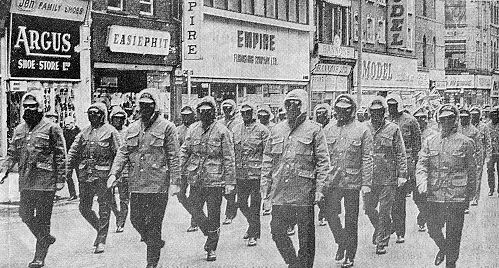
There was movement too in the political sphere. The Irish and British governments met in December 1973 in Sunningdale, Berkshire and created a power-sharing executive for the North. The new government came into place in 1974 but was immediately opposed by Protestant hardliners. Workers who ran the province’s economy and public utilities organised a general strike under the banner of the Ulster Workers Council. They manned barricades and intimidated opponents as well as shutting down the power grid. Prime Minister Harold Wilson vilified the strikers on TV which further hardened attitudes. Three days later the executive resigned and Direct Rule was re-introduced. The Sunningdale agreement was destroyed; the UWC had won.

While the strike was in progress, MI6 appointed a new man in Northern Ireland Michael Oatley who would become a key, if unrecognised, figure in the years to come. Oatley's job was to make contact with the IRA leadership. One contact was called a ‘pipe’ which linked with the IRA’s new leader Ruari O’Bradaigh. Through the pipe, the British were getting indications that the Provos wanted to talk.

The pressure was building as the UVF stepped up their anti-republican campaign. On 17 May 1974, they planted car bombs in rush hour in Dublin and Monaghan which exploded without warning. They killed 33 people and injured 160 others. The IRA was also active in England. They bombed two pubs in Guildford, Surrey used by off-duty soldiers. Four soldiers and a civilian were killed. They then bombed two pubs in Birmingham killing 21 and injuring 182. Britain was outraged and introduced the Prevention of Terrorism Act under which suspects could be held for seven days and ‘exclusion orders’ could keep people out of mainland Britain.

The IRA Active Service Unit continued to cause havoc in the 12 months that followed, bombing indiscriminate targets in London and causing terror in the population. They killed Guinness Book of Records founder and outspoken IRA critic Ross McWhirter before finally being caught in a siege in Balcombe St which lasted six days before they surrendered. The four members of the Balcombe St gang were released as part of the Good Friday agreement in 1998.

Harold Wilson sent in the SAS in a blaze of publicity in 1976. Their actions were immediately controversial as they followed suspects across the border. They also kept a covert observation post on the Irish side of the border. Eight SAS officers in two cars were arrested by Irish police in what the British authorities called as a “map reading error”. But it was their ‘shoot to kill’ policy which saw the IRA rename them as “Special Assassination Squad”. Among their victims was Patrick Duffy, an unarmed IRA man who was shot dead with a dozen bullets in his own home.

On 27 August 1979, the IRA struck two devastating blows in return. The Queen’s cousin, Earl Mountbatten, was blown up on a boat at his holiday home in Sligo. A few hours later two massive explosions at Warrenpoint, County Down they killed 18 soldiers, 16 of them members of the Parachute Regiment 2nd battalion. It was the regiment’s biggest loss since Arnhem in World War II.

Under Labour in 1976 the political status of IRA prisoners was revoked and they were to be treated as ordinary criminals. They were sent to the newly constructed H Blocks of the Maze Prison at Long Kesh. The prisoners launched a ‘dirty protest’ in response, refusing to wear prison issue clothes or leave their cells. They also smeared the walls of their cells with excrement.

By 1979, Margaret Thatcher was in power. She was disinclined to deal with the demands of the prisoners. The prisoners launched a hunger strike which ended without a deal. They launched a second hunger strike in which ten prisoners died. Bobby Sands, the first of those to die, was elected MP in a sudden by-election on the 40th day of his strike. The result gave the IRA a new political impetus it was to exploit in the decades to follow. 100,000 people attended Sands’ funeral. The IRA called off the strike after it was obvious it was not changing Thatcher’s mind. Within a few years they got all their demands anyway.

In October 1982, three RUC officers were killed in a bomb after they were called to investigate a suspicious hayshed. The shed was under surveillance by M15 but the officers had not spotted the bomb. An informer named the two IRA men responsible and they and another man were shot dead by police who were exonerated by the courts for ‘bringing three IRA men to the final court of justice’. After intelligence forces shot an innocent 16 year old at the same hayshed, John Stalker, deputy Chief Constable of Greater Manchester was brought in to investigate the shoot to kill policy. He wanted to see a copy of the tape at the hayshed but was denied access. He was removed from the inquiry due to his association with a Manchester businessman Kevin Taylor who was erroneously thought to be a criminal. Though Stalker’s replacement recommended charges be brought, Attorney-General Sir Patrick Mayhew said there would be no prosecutions “in the national interest”. The prospect of MI5 officers in the dock was avoided.

Throughout the eighties, the ‘Det’ continued their stranglehold on the IRA. The IRA was forced to act in Britain where the intelligence network wasn’t as strong. But the IRA needed to acknowledge a change. In 1981, Danny Morrison made a famous speech at a Sinn Fein conference that “with a ballot box in one hand and the Armalite in the other, we take power in Ireland”. His speech would define Sinn Fein policy for the next 15 years. Adams, McGuinness and Morrison all won seats in the new Northern Ireland Assembly in 1982 with 10 per cent of the vote. The main nationalist party the SDLP took 18.1 per cent.

In 1984, the IRA had its highest profile hit with the Brighton bombing. The ruling Tories were staying at the Grand Hotel for their annual conference. The IRA planted a 9kg bomb which exploded during the night collapsing four floors of the hotel. Five Tory party members were killed including Sir Anthony Berry MP. But Thatcher survived and received an eight minute ovation at the conference in the morning. The IRA issued a chilling message which read partially “Today we were unlucky, but remember we only have to be lucky once. You will have to be lucky always”. After an astonishing piece of detective work, the bomb was traced to Patrick Magee who was arrested in Glasgow ten months later. Magee was released as part of the Good Friday Agreement with a doctorate in Irish studies after a dissertation on how Gerald Seymour, Tom Clancy and others fictionalised the conflict.

The SAS continued their operation against the IRA with victories in Loughgall which killed an ASU about to hit a RUC station and then in Gibraltar where three IRA operatives were gunned down. At their funeral in Belfast, a Loyalist gunman Michael Stone opened fire and killed three mourners. British TV investigated the Gibraltar deaths and concluded the three had been shot with their hands up. Thames TV showed the program despite Thatcher’s fury.

The IRA received a boost in the late 1980s, when Libya’s Gaddafy donated four shipments of armaments such as surface-to-air missiles and Semtex high explosive. At Ballygawley village, the IRA detonated a Semtex bomb which killed eight soldiers in 1988. Home Secretary Douglas Hurd announced new restrictions to prevent broadcasters from transmitting voices of members of banned organisations or those that support them. Broadcasters got round this by lip-synching interviews using actors. One double of Gerry Adams made a small fortune during this time. The restrictions were useless and abandoned in 1994.

In any case, by the 1990s, the IRA were beginning to look to peaceful alternatives. Gerry Adams won the seat of West Belfast in 1983 and held it with an increased majority in 1987. In 1988 he held discussions with the SDLP’s John Hume which agreed on a common goal of ‘self determination’. Events elsewhere were also having an impact. The fall of the Berlin Wall gave the impression that Northern Ireland might be the last unsolved problem. While the IRA began to initiate talks, they also kept up the military pressure. During the Gulf War of 1991, they fired three mortars at Downing Street, one of which landed in the backyard of Number Ten while a cabinet meeting was in progress. In 1992, they killed eight Protestant workmen in a landmine explosion.

But the bomb with the largest economic impact was the Baltic exchange in the City of London. Three people were killed including a 15 year old schoolgirl. But the bomb caused £800 million of damage, eclipsing by £200 million the entire damage of the conflict to date since 1969. If repeated, it raised the prospect of devastating the British economy. The British made coded messages to the IRA that if they were prepared to call off the violence, anything might be possible. Through the early 1990s, there were talks and bombs in equal measure. In December 1993, Prime Minister John Major and Irish premier Albert Reynolds agreed the principles of what was called the Downing Street Declaration which insisted Britain had no interest in Northern Ireland but would only agree to a united Ireland if the majority of its citizens so wished.

In August 1994, the IRA announced a ceasefire. The Protestant paramilitaries followed suit. Talks got bogged down on the thorny issue of ‘decommissioning’, the process of what would happen to IRA guns. But it was progress. 1995 was the first year in a quarter of a century where no members of the security forces were killed. In February 1996, the IRA bombed Canary Wharf in London killing two in protest at what it saw as British intransigence in the peace process. They would launch further assaults on the mainland in the run-up to the 1997 election including a threat that caused the cancellation of the Grand National at Aintree.
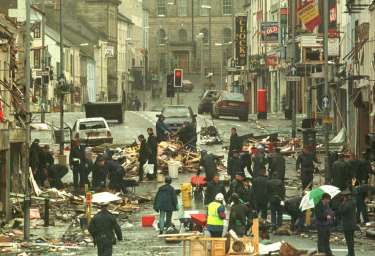
Tony Blair’s landslide win in that election gave the peace process new impetus. He offered talks once more and the IRA re-established a ceasefire in July 1997. At Easter 1998, Blair forced through the Good Friday Agreement where all parties agreed to share power in a devolved assembly. Extremists within the IRA were unhappy and splintered off. One of the splinter groups called the “Real” IRA exploded a bomb in Omagh that caused the single largest casualty list of the entire conflict. 29 people died and 300 were injured. No one was charged for the bombing.

But Omagh did strengthen the resolve of the Good Friday Agreement participants. Prisoners from both sides were released. The decommissioning argument put the assembly on hold. Worse was to follow for the unionists when an independent commission on policing led by Chris Patten recommended a new police authority to replace the sectarian RUC. Arguments raged back and forth until 9/11 threw a new spanner in the works. Nationalists were worried Bush would put the IRA back on his terror list. Meanwhile three IRA suspects were arrested in Colombia on charges of conspiring with rebel group FARC. The two events caused the Republican movement irreparable damage in the US. Despite this, they were now the leading Nationalist party in Northern Ireland after the June 2001 election. In October 2001, the IRA announced it had started the process to ‘put its weapons beyond commission’.

While the “farewell to arms” was not complete at the time of Taylor’s book, it was mostly complete by 2007. Last month saw a historic moment as bitter enemies Ian Paisley and Martin McGuinness sat down next to each other to do business in the new Northern Ireland assembly. The hatred continues but the war was officially over.