Friday, January 18, 2008

Bats: A secret success story

Californian authorities say that eight people have died in five years in accidents in the state’s 47,000 abandoned mines. Now state authorities are determined to make them some of them safer while providing a novel ecological niche for bats. Sited due east of San Francisco, the small town of Tracy is the home of several long-abandoned coal mining caves. Vandals recently made one of them unsafe by burning the beams supporting the entrance. Now authorities have barred off with a gate. It is the first step in a program to keep prying humans out and provide an ideal habitat for bats. The slates are wide enough for Townsend's big-eared bats and pallid bats to fly through. Both species hibernate and roost in the dank humidity of the Californian caves.

Cave colonies can become very large with many bats loving the stable microclimate. It is not unknown for colonies of hundreds of thousands of different species to share a cave site. Young bats congregate to in thick clusters to form crèches of 3,000 square meters. In Winter time hibernating bats reduce their body temperature to within a couple of degrees of the site temperature and live on their accumulated body fat. They cannot stand on their legs and so hang upside down, held in place with no effort by the clinging shape of the tendons of the foot.

The reason they cannot stand on their legs is that they have evolved into wings. The scientific name for bats is Chiroptera. The word is Latin for “hand wing” and describes the bats’ fingers which are connected by a stretchy membrane which make up the wings. The fragile nature of bats has not left much data in the fossil record so science does not give a good accounting of how the only flying mammals evolved. The likeliest explanation is that they were originally insect-eating tree creatures who scurried around on all fours until they became airborne. However the theory does not explain how partially successful fliers could survive well enough to produce another generation yet incredible this unlikely event happened twice.

The fact remains that the two types of bats evolved separately. The majority are the mostly insectivorous microbats and the rest are mostly fruit-eating megabats (or fruit bats). Megabats range in size from the Indian giant flying fox with a human-sized wingspan of 1.8 metres to the petite Malaysian flower bat with its 21cm wingspan. The splendidly named false vampire of American tropics (so called because they prefer to bite the prey's head and crush its skull rather than suck its blood) is the largest of the microbats with a 1 metre span which dwarfs the rare and tiny 1.5 gram Thai bumblebee bat, possibly the world’s smallest mammal. The microbats evolved from shrews possibly in a period of global warming 50 million years ago and the megabats evolved later either from microbats, or, more controversially, from early primates.

One of the shrew’s lesser known characteristics is echolocation which they passed on to the microbats. When Britain successfully developed radar in World War II, some scientists were scathing when it was suggested that nature had already beaten them to it. But by 1944, Donald Griffin at Harvard proved bat echolocation existed. Bats send bursts of high-pitched sounds as they fly. These sounds emerge from the larynx and are mostly emitted by mouth. The Egyptian rousette bat clicks its tongue whereas others such as horseshoe bats emit the noise through a complex noseleaf around the nostril that focuses the beam of sound.

Whatever way they are emitted, the sounds travel as air waves until they strike an object. Some of the energy in the sound wave is returned as an echo and the amount returned depends on such factors as distance, durability of the object and whether the object is moving or not. Bats quickly analyse the returned data and identify the object. In order to catch prey they need to locate the target precisely in three dimensions and they do this by measuring the time delay between signal emission and echo reception As it closes in, the bat increases the pulse rate of sound to track it down using the Doppler shift. At the point of contact, the calls are so fast they are known as a “feeding buzz”. Some bats can make an incredible 200 calls per second at the feeding buzz.

Megabats don’t use echolocation but contrary to the ‘blind as a bat’ myth, they have large well developed eyes for night vision and can see as well as owls or cats. In Australia, flying fox colonies are enormous and the animals are highly sociable. Bats can also claim to be the most successful mammals, representing a fifth of all mammalian species. As Sue Churchill says about them in “Australian Bats” they live in a dimension so different from human experience that “we cannot escape a sense of wonder of the precision of even the simplest aspect of their biology”.

Thursday, January 17, 2008

Southern Sudan looks towards its own independent future

Southern Sudanese leader Salva Kiir has used the third anniversary of the signing of the Comprehensive Peace Agreement to call on his people to support the national census next April. In a meeting with traditional chiefs in the Great Bahr el-Ghazal area of the south, Kiir said the census was linked to development and provision of services to all citizens. Kiir, who is both the President of the Government of Southern Sudan and first Vice-President of Sudan, said “enemies of peace” want to destabilise the CPA and stressed the need for disarmament in the south. Kiir also said the border between the two parts of Sudan would be demarcated by February and Sudanese president Omar al-Bashir asked him to withdraw SPLA forces south of the border.

In a major speech, Kiir renewed his call to all sectors of the Sudanese people to demonstrate tolerance, renounce violence and uphold the principle of justice. He urged his people to allow Arab nomads move south to pursue water and pasture and invited the Arab League, the AU and the international community to monitor implementation of the peace agreement and address its challenges. He reiterated the option for unity or separation is reserved for the people of the South by referendum. If separation takes place, he said, they will remain “two harmonious states”.

His speech came as the final peace talks were brokered in Kenya on 9 January to follow up on implementation aspects of the CPA. Southern Sudan is now planning a celebration to honour the anniversary as soon as Sudanese government forces and its own forces withdraw behind the agreed lines. According to local journalist Joseph Machok Makak in Khartoum, the only way to ensure peace in Sudan is by “fully implementing the CPA that forms the legal base for the resolution of Sudan's civil war, which claimed about two million innocent lives".

The Sudan CPA signed on 9 January 2005 contained a number of key resolutions. Firstly it insisted on separate armed forces for north and south with both sides withdrawing from each other's territory. Secondly the South would be autonomous for six years with a referendum in 2011 on total secession. Oil wealth would be split fifty-fifty. Two separate currencies are to be used within a dual banking system. Central government positions were to be split 70:30 in favour of Sudan and 55:45 in their favour in the contentious areas. Sharia law continues in the north but not in the south. Finally each area was to use its own emblems with the South to design a new flag.

The conflict between the sides is older than Sudan itself. Prior to independence in 1956, British rulers treated the north and south differently. They modernised northern Sudan by expanding rail and telegraph services but made little attempt to help the south. Believing the area was not ready for modernisation, they sealed off the area from outsiders and issued laws to discourage northerners from working or travelling there. They also kept the black Dinka tribesmen of the south from adopting Islam or speaking Arabic or dressing like northern Sudanese. Instead they encouraged Christianity and missionaries to establish churches and schools.

In the year before independence, a southern military unit mutinied at Torit and began to wage a guerrilla war campaign. It continued sporadically for 17 years. In 1971 new Sudanese leader Jaafar al-Nimeri met southern chief Joseph Lagu in a conference in Addis Ababa mediated by Ethiopian emperor Haile Selassie. The accords signed in 1972 gave the south some autonomy and ten years of peace followed. Nimeri ended the agreement by unilaterally imposing Sharia law on the south in 1983 in a vain attempt to head off fundamentalist opposition. Civil war broke out again coordinated by the Sudanese People’s Liberation Movement under the charismatic leadership of American educated John Garang.

Nimeri was deposed in a coup in 1989 which brought current leader Omar Hassan al-Bashir to power. Bashir declared martial law and all-out war against the south. But he was eventually forced to compromise and abolished Sharia for the south in 1991 (the SPLM wanted Sharia removed for all Sudan). In 1998 both sides agreed in principle for a referendum for the south but were unable to finalise the details until Intergovernmental Authority on Drought and Development leaders forced the CPA in 2005. Garang was killed in a plane crash barely weeks after finalising the peace agreement. His death brought Salva Kiir to the leadership of the SPLM and defacto leader of Southern Sudan.

Southern Sudan now has its own constitution and seems well on the way to negotiating its own future. Yet seasoned Sudan watchers wait pessimistically for President Bashir to weasel his way out of this latest agreement as he has done with so many in the past, both in Southern Sudan and Darfur. Kiir knows he has to tread delicately, hence the cautious speeches this week. Khartoum remains highly reluctant to give up its power in the margins of its British inheritance, particularly one with so much oil. The conflict has claimed the lives of two million people who have died directly of war, or of disease and famine. Another half a million have fled the country. The stakes are high for those who hope.

Wednesday, January 16, 2008

media creates underage party monster

On the weekend, a 16 year old year held a party at his parent’s outer Melbourne home while they were away on holidays. The party got somewhat out of control as over 500 people attended causing minor damage to nearby property and nuisance value to local police. There this minor story would have ended up but for the prurience of the local media and a vilification campaign that served only on to cement his “stardom”. The story has proved again the difference between stories in the public interest and stories the public are interested in. Despite having no importance whatsoever except perhaps to show the disaffection of modern teens, the boy is now an international media star, but who now officially can no longer be named in Australua due to a summons to a children’s court next month. However his name is in the public domain in the Sydney Morning Herald as well as in countless other places despite his arrest.

The media have created this monster. Today Crikey posted a detailed timeline of events. Local news first got wind of the story Sunday morning as rumours of a wild party filtered though. Cameras at the scene picked up drunken youths running partially naked near the scene. Channel Nine mentioned the boy’s name in the Sunday evening news. Then the Monday talkback lines predictably rang hot with angry finger-pointing parents. But as usual it was the evening Channels Nine and Seven laughably entitled “current affairs” show that were the worst offenders of manufactured outrage. Channel Seven found and badgered the parents on holidays on the Gold Coast who worried about their son's ego. Nine interviewed the youth himself who exasperated the host with his dress code, his lack of apology and the temerity to refuse to take off sunglasses when ordered to do so on camera. He then flabbergasted the host by suggesting it was the “best party ever” and suggested anyone who wanted to host a party should use his organising skills!

The media's obsession with his sunglasses theme continued yesterday when the youth fled the studio after a radio interview host Matt Tilley physically attempted to remove them. However, the youth is clearly getting media coaching from somewhere as he later returned to finish the interview in unruffled and presumably unmolested fashion. Tabloid newspapers and talk-show hosts continued to put the boot in about the “party monster” and “puffed up teen party pest”. The story went international as British newspapers reported on it and US news programs picked up the video footage. CNN said the story was the most downloaded from their website where it is trashily listed as “Aussie Party Teen in Child Porn Arrest”.

Meanwhile the attitude towards the youth is markedly different on the internet, where the demographic is presumably closer to the boy’s own age group. Here it has been described it as a battle between old media and new media and one which old media “lost”. TV and radio hosts “had no power over” the youth. Radar called him “Australia’s hottest party boy” and commenters wrote in to suggest someone should “get those famous sunglasses their own tv show!”

Aileron also noted that not only did he use text messages and Myspace and Facebook to send out invites to the party but the social network sites were crucial in providing the momentum for the post-party story. In the part of the story barely reported, the boy told media his invited guests had no part in the melee, and that it was the gatecrashers who had caused all the trouble. But that doesn’t set news directors' pulses raising. A photogenic rebellious youth does. And so on a busy US news day of presidential primaries, Bush’s glory dash in the Middle East, and Wall Street plummeting, a story of an unremarkable party in Melbourne that went awry has topped them all. Whatever of the boy's behaviour, the media priorities are badly skewed.

Sunday, January 13, 2008

Uganda bears the brunt of Kenyan crisis

Uganda is losing over a million dollars a day in revenues and exports as a result of the post-election violence in Kenya. The Uganda government and its farmers and traders are suffering as the landlocked country is unable to get its products out. Uganda is heavily reliant on the Kenyan port of Mombasa for the import of fuel and heavy goods, such as machinery, cars and generators, and also for the export of coffee, tea and tobacco.

In the fortnight since the violence began Ugandan government revenues have dropped by 78 per cent in the three border points with Kenya. Exporters too are feeling the pinch. "We have not been able to deliver our goods to the port since December 27 because of the violence", says David Barry of Kyagulanyi Coffee. "It is definitely a big loss for us, also in terms of fines and penalties for late delivery." Ugandan hopes of an early end to the Kenyan impasse following the collapse of efforts by Ghanaian president and AU mediator John Kufuor to secure a deal between President Mwai Kibaki and his opposition rival Raila Odinga.

Ugandan President Yoweri Museveni may now be regretting his early endorsement of a Kibaki victory. There have been allegations that the Ugandan government may have had a hand in securing the contested win. One week after the election on 2 January Museveni, in his capacity as current chairman of the East African Community, offered congratulations to Kibaki on his re-election. Other than Uganda, only Somalia, Kuwait and Swaziland have so far recognised the election result. Museveni was criticised internally for this move on the basis that his message could provoke attacks on Ugandans and Ugandan interests in Kenya. Others say he was “forced” to recognise the result to facilitate the movement of Ugandan goods in and out of the country.

If that was Museveni's plan, it has not proved successful. The only traffic coming into Uganda at the moment is a human one. According to the UN over 6,000 Kenyans have fled to eastern Uganda to flee the violence. They are finding shelter in school buildings, hospitals and in open places and UN agencies, government and the Uganda Red Cross are providing them food and other relief items. Over 500 have been registered at Bukwo and Kapchorwa districts. The Ugandan Red Cross has assessed another 3,500 refugees camped at the border towns of at Malaba, Busia and Lwakahkah. Red Cross official Alice Uwase Anukur said sanitation was the major challenge at the camps. "The only pit latrine at St. Jude Malaba Primary School is filled up," she said. She also said there was an urgent need for sanitary towels.

The general population is also suffering. Uganda continues to face shortages, and fuel prices have more than doubled since last week. In the longer term Uganda is hoping to reduce its dependency on road and rail for importing fuel products from Kenya by building an oil pipeline. The project will initially involve a $110 million 340-kilometer pipeline from Eldoret in western Kenya to the Uganda capital Kampala. The pipeline would subsequently be extended to Kigali and Bujumbura, the capitals of Rwanda and Burundi, respectively. Fuel supplies to all three countries have been erratic since the violence started.

But matters are unlikely to improve in the short term with Kenyan opposition forces planning further rounds of protest next week. The impact on the surrounding region is potentially devastating with the agricultural economies of Uganda, Rwanda, and Burundi all “throttled” by the violence. A quarter of the gross domestic product of Uganda and Rwanda and a third of Burundi's pass through Kenya. None of them have found a suitable alternative to the bottleneck port of Mombasa. According to Robert Shaw, a businessman and economic analyst, "If Kenya has got a cold, these countries get pneumonia.”

Saturday, January 12, 2008

The Pearly Gates of Cyberspace

The rise of online social networks continues unabated. Myspace has upward of a quarter million members. Facebook boasts another 60 million members storing 1.7 billion photographs. Meanwhile thousands of smaller sites have started to fill user niches to connect and talk about the most abstruse topics imaginable. All these sites promise a new cyberspace arena of equality and friendship.

In her book “The Pearly Gates of Cyberspace: A History of Space from Dante to the Internet” Australian philosopher Margaret Wertheim looks at the parallels between cyberspace and religion. As the subtitle suggests, the book looks at the way space has been treated through the centuries. She tracks how the “space” humans found for the religious soul was eventually squeezed out by science and the Enlightenment. Not until the advent of the internet and cyberspace does the soul have room to move again. The digital domain, argues Wertheim, is an attempt to realise a non-physical space for the ancient Christian concept of Heaven.

Wertheim quotes the similarities Umberto Eco saw between modern America and the last years of the Roman Empire. In both places strong government and social polity collapsed leaving society open to rupture and fragmentation. In Roman times, the feudal lords filled the gap, in modern times it is corporations. In Roman times the Christian religion emerged to fill a spiritual void. Today, Wertheim argues, cyberspace with its repackaged idea of Heaven fulfils the same need in a secular technological format.

The term “cyberspace” was invented by William Gibson in his 1984 sci-fi novel Neuromancer. For Gibson cyberspace was a “bodiless exaltation”. Others hailed the promise of cyberspace’s transcending possibilities. Psychologists suggest the disembodiment of the Internet appeals especially to young boys who are going through awkward physical transformations. The metaphor “surfing the net” conveys a real-world image of prowess and grace. Meanwhile the old Sanskrit word “avatar” (meaning the incarnation of a higher being) offers a whole new anonymous bodily experience in cyberspace in such domains as Second Life in what Wertheim calls an “outpouring of techno-religious dreaming”.

Wertheim traces the loss of a physical soul-space to the end of the Middle Ages. In his Divine Comedy, Florentine poet Dante Alighieri documented a trip to Hell, Purgatory and Heaven accompanied by Roman poet Virgil. This was a voyage through the Christian soul. Wertheim described it as a map of soul-space. Hell was in the centre of the earth (“abandon hope, all you who enter here”), Purgatory was an island in the southern hemisphere where people waited to be judged and Heaven was in the stars where the just ended up. Dante and Virgil wandered through all three kingdoms in a spiritual journey. All three are real places for Dante, even if it is only through his imagination he describes them.

Wertheim traces the victory of physical space to a contemporary of Dante, Giotto di Bondone. Giotto's mastery of perspective paintings gave the physical world a new splendour. His paintings allowed viewers to look through the physical space behind the picture plane. He created a virtual world for the subjects of his paintings. They reflected the changes in the Western zeitgeist that represented the world in a way that had no room for the ineffable Christian soul-space. In science Roger Bacon promoted the physical realm showing how it would lead to improvements in agriculture and medicine and could prolong human life.

The twofold reality of the Middle Ages was now under threat. Nicholas of Cusa laid out a new cosmology which unbounded space and insisted the Earth was not at the centre of the cosmos. Fifty years later obscure Polish priest Nicolaus Copernicus used his ample spare time to disprove the ancient Ptolemaic celestial clockwork model. Johannes Kepler took Copernicus’s work to demolish the distinction between celestial and terrestrial space. Everything in the sky, Kepler postulated, worked to the same natural physical laws as on Earth. Galileo proved Kepler right with his observational science. Descartes then gave infinite space a philosophical imprimatur that left no room for “God” to exist. It was up to Isaac Newton to synthesise the work of Copernicus, Kepler, Galileo and Descartes to state a universal law of gravitation that worked for celestial bodies as much as earthly ones.

In the 20th century, space became more relativistic. Edwin Hubble made two great findings: he found there were multiple galaxies and then he made the devastating discovery they were all moving away from each other. The universe was expanding. Hubble was uncomfortable with his own findings and the almost religious conclusion the universe had a beginning and an end. Einstein found a mathematical model to explain the “general theory of relativity”. The velocity of light was the same relative to everything. This meant space and time were not absolute. The theory explained gravity, which was a by-product of the shape of space. Einstein’s theory gave way to hyperspace and its postulation of ten or eleven dimensions of space, string theory, and the possibility of a theory of everything. In the new cosmology mathematics was all; anything that couldn’t be expressed in numbers did not exist.

Computers thrived on numbers (especially 0s and 1s). The Internet is growing at an astonishing rate. Written in the late 1990s, Wertheim’s “Cyberspace” talked about an expansion of a thousand host computers to 37 million in 15 years. Blogs were unheard of 1997 now there are 70 million or more. Cyberspace is a new place to socialise and play for billions of people. Most importantly to Wertheim, it is not subject to the laws of physics. It therefore returns us to a dualistic theory of reality. People create new identities which has the potential to split the self into a radical multiplicity. It is a new form of “self space” which exists independently of physical space.

In the final chapter, Wertheim returns to the religious theme of the title. She quotes a Virtual Reality guru Kevin Kelly who said the internet was a syncretic version of Christian ritual. In cyberspace, bodies do not age and perfection is possible. Sci-fi writers maintain cyber-immortality is possible. Freed from the prison of our bodies, our cyber-souls will soar into “the infinite space of the digital ether”. Yet it is the all-too-human communal aspect that gives the social network sites their attraction. The Internet becomes an “electronic agora” where people rebuild the communities lost in mall culture. It is a communal inner space of humanity’s own making.

Thursday, January 10, 2008

Magic Bullets v Encoding /Decoding: A comparison of media research theories

This post will define and place in historical context two media research theories: the “magic bullet” (“hypodermic”) model and the encoding/decoding model. It will then compare the theories in terms of their treatment of the audience and their relationship to power structures.

The earliest media research occurred in the 1920s and reflected the insecurities and paranoias of the time. In response to the pessimistic “mass society thesis” of the Frankfurt School, early researchers believed communication worked by injecting powerful messages into the minds of passive audiences. Theorists saw how both sides in the First World War used propaganda to such great effect that it acquired “a reputation of omnipotence”. The evolution of propaganda in radio and cinema encouraged Laswell and others to view mass media as having a powerful influence on public opinion. According to this notion, the media fired off “magic bullets” which merely had to hit their target to produce the desired effect. The theory was also called the “hypodermic model” which imagined the media as syringes able to “inject” narcotic propaganda directly into the veins of the audience. But by the 1940s and 1950s, researchers were beginning to rebuff the “pessimistic” thesis saying it proposed too powerful and unmediated an impact by the media. They began to look at the active role of the audience in the making of meaning.

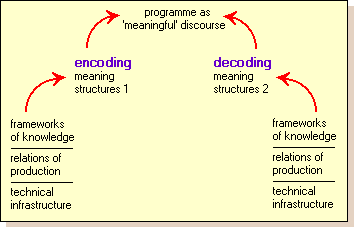
By the 1970s, alternative ideas were taking shape which placed communication in a wider socio-cultural context. Stuart Hall’s ‘encoding/decoding’ model emerged out of a British semiotic and cultural studies approach to media studies. Semiotics is a textual analysis of how meaning is created in language, non verbal codes and cultural “signs”. Audiences were no longer “empty vessels” to pour meaning into, they were considered culturally formed and situated. Hall called the phases of his model “moments” which he defined in Marxist terms as “production, circulation, distribution /consumption, reproduction”. Each “moment” played a role in the manufacture of meaning. Audiences could accept, negotiate, or reject the media texts they were presented with. Researchers now had a model to show what audiences did with media as opposed to what media did with audience.

A key difference, therefore, between the hypodermic and encoding/decoding models is how they view the role of the audience. Effects theorists believed that audiences were passive and culture could be imposed from above by an elite group of skilled manipulators. While the hypodermic theory has a psychological plausibility, it fails to take into account that communication is not just about sending messages, it is about the sharing of meaning. Hall’s model offers better insights into the way culture operates by demonstrating how various actors change communication at each step in the process. The model emphasises the discourse rather than the participants and examines how each of the “passage of forms” in the process flow provide meaning to the message. Encoding/decoding encouraged research to move away from media effects towards audience talk and increased focus on communities, particularly marginalised ones. Yet although the hypodermic theory is now academically discredited, it continues to have resonance in the wider community especially in the context of violent media effects on children. It also underpins the one-dimensional nature of the media’s own ratings measurement research.

The hypodermic and encoding/decoding models are also subtly different in their treatment of power structures. The simplistic linear Shannon-Weaver model of communication which fits the earlier theory is superseded by Hall’s more complex diagram of frameworks producing meaning which are mediated by the discursive elements of the broadcast programme. Whereas the earlier theory proposed a simplistic but all powerful media, the encoding/decoding model suggested a sophisticated hegemony existed which operated through popular culture. Hall demonstrated how the “professional codes” of the media integrate with the cultural and social order to become a bulwark of the power structure. Hall showed that power in communication is more likely to be transmitted by signification than by syringe.

Wednesday, January 09, 2008

Rating the ratings: a study of TV audience measurement

Ratings are the central means of mass audience measurement for the television industry. This post will define what ratings mean and then examine positives and negative aspects of ratings use. It will examine critical US research in the 1990s and conclude with a discussion of the ratings transition debate in Australia earlier this decade.

Ratings provide a quantitative measure of how many homes or people are viewing a program, advertisements, a station or the media itself. They are based on an audience snapshot using both geographical (multi-stage cluster) and characteristic (stratified) sampling techniques. Because of their feedback element, ratings largely control what is broadcast. The television industry uses audience ratings information to justify its broadcasting service performance as well as the cost of advertising spots and sponsorship deals. The ratings approach is based on “exposure” which measures a single audience behaviour: “open eyes facing a medium”. When counted and analysed, exposures allow the industry to predict audiences and pre-sell slots to advertisers. Ratings for a programme are compared against others in the same point in time to determine audience share. Ratings, therefore, create a manageable image of the public for television executives. It is the apparently neutral form of numbers that invest the ratings with so much power.

But there are issues with this blunt approach. Because ratings drive advertising revenue, broadcasters tended to treat audiences as commodities on the basis of their viewing consumption. The economic system of commercial television depends on the extraction of surplus value from an exploited audience. The pressure is therefore on broadcasting decision makers to pander to mass markets in order to continually win large portions of the audience share. Ratings are kept high by sticking to proven formulas. Therefore risk taking is rare because radically different programming may shift audiences in the opposite direction than intended. This means that specialist interests such as the poor, the aged, the intelligentsia and children are not catered for by commercial broadcasters because they know will get more advertising revenue from mass audiences. As a result, innovative programming remains the preserve of publicly funded broadcasters who are not as bound to ratings.

Audience ratings have been criticised from a qualitative perspective. Because exposure is the only data recorded for ratings, the industry only cares about the numbers involved in tuning in, staying tuned, changing channels and turning off. No other audience behaviour is relevant. This means ratings do not capture whether a programme is interesting to its audience. It also means that low ratings problems are generally solved by programming decisions rather than by audience research. Ratings, in effect, “take the side” of the broadcasters. Audience ratings measure only if the message is received and do not capture whether it has been registered or internalised. Broadcasters are not interested in the “lived reality behind the ratings”. The only problem that matters for broadcasters is how to get the audience to tune in.

In the 1990s, researchers such as Eileen Meehan and Ien Ang began to criticise the way audiences were manipulated by the ratings. Meehan noted that intellectuals simply didn’t count in decision-making due to their tiny numbers. TV programming reflected the “forced choice behaviours” of the masses. Ang argued the media didn’t want to know about their audience, but merely prove there was one. Ratings produce a ‘map’ of the audience which provides broadcasters and advertisers with neatly arranged and convenient information. This allows the industry to take decisions about the future what Ang calls a sense of “provisional certainty”. There inevitably follows the streamlining of television output into formulaic genres, the plethora of spin-offs and the rigid placing of programmes into fixed time slots. In a competitive environment each competitor will make its product more like the others rather than taking a chance on producing something different. The result is a remorseless repetitiveness at the heart of the American TV schedule.

The Australian broadcasting industry has also endured controversy as a result of ratings issues. In the early 2000s the apparent certainty of measurement provided by ratings was undermined by a change in the ratings regime. In 2001, OzTAM (and its Italian supplier ATR) won a lucrative contract to replace incumbent provider ACNielsen to provide Australian metropolitan TV ratings. Despite both parties using the same “people meter” technology in the six month overlap period, major discrepancies emerged between the two providers’ data. The discrepancies led to widespread unease in the $5 billion Australian TV industry. ATR boss Muir said the discrepancy was because that ratings were sample-based estimates and therefore subject to sampling and statistical error. But advertisers did not want to hear about sampling errors or issues with “psychological makeup” that a rating system cannot capture. What they wanted was certainty for their business decisions and demanded an unrealistic 100 per cent ratings accuracy. Eventually the two measurement systems came closer together to ease the fears of the advertisers. Nonetheless the controversy exposed the gulf between the questionable accuracy of ratings and the absolute faith put in the system by advertisers.

Tuesday, January 08, 2008

Labor says no to Stolen Generations compensation

The Australian government has ruled out compensation for members of the Aboriginal Stolen Generations despite pleas from Indigenous leaders and the recommendations of an enquiry into the issue. Indigenous affairs minister Jenny Macklin said Labor would not be creating a compensation fund. She said the way forward was to tackle the prevailing problems in the community, such as the massive gap in life expectancy between Aborigines and the rest of Australia. "The point of the national apology really is to provide a bridge of respect between indigenous and non-indigenous Australians.” She said.

The government statement runs counter to the view stated by Labor senators on the Stolen Generations enquiry who recommended a tribunal be established to look at reparation and monetary compensation. Democrat Senator Andrew Bartlett has asked what has changed their mind in Government and calls Macklin’s statement the most “unequivocal rejection” Labor has made on the issue in recent years. Bartlett said it was counter-productive to issue an apology without considering the other unimplemented recommendations of the enquiry.

Stolen Generations Victoria agrees a fund is needed. Chair Lyn Austin called on victims to consider suing the government if it failed to establish a compensation fund. She compared the Stolen Generations to victims of crime who get paid compensation "You are looking at the gross violation and the act of genocide and all the inhumane things that have happened to our people,” she said. "We are actually thinking that ourselves, myself and another five siblings that were adopted into a family, are considering a class action.”

The controversy occurs as the Prime Minister Kevin Rudd prepares to honour an election commitment by reading out an apology when federal parliament resumes next month. In 1997, the 700 page 'Bringing Them Home' report found the removal of Aboriginal children was a gross violation of human rights and that forcible removal amounted to an act of genocide. The then Howard government refused to consider compensation instead deciding to provide welfare measures to lift health and education standards for Australia's native communities.

Howard also refused to apologise for fear of opening the door to compensation claims. However as formal apologies were read out in various state parliaments, the pressure mounted on Howard to respond. In 1999 he drafted a motion expressing "deep and sincere regret" over the issue and called the stolen generation "the most blemished chapter" in Australia's history. However his government also called into question whether in fact the “stolen generation” actually existed saying there weren’t enough children taken to warrant the description.

This claim was hotly denied by historians and the Indigenous community. Aboriginal leaders had demanded a billion dollars in reparations for at least 100,000 children who were forcibly placed in orphanages or foster care between 1870 and 1967, with the intention of assimilating them into white Australia. The Bringing them Home report stated that almost every Aboriginal family in the country was affected by the policy.

In its address to readers, the report didn’t just expose the abuses of the past. It also asked that “the whole community listens with an open heart and mind to the stories of what has happened in the past and, having listened and understood, commit itself to reconciliation.” In this, the report was calling for an active ethical engagement on the part of its readers to become involved in the justice process by acknowledging the loss and harm that had been done to the Indigenous community. This latest decision from the newly installed Labor government shows Australia remains a long way short of that commitment.

Monday, January 07, 2008

Saudi blogger Fouad al-Farhan imprisoned without charge

The father-in-law of detained Saudi Arabian blogger Fouad al-Farhan has visited him in a Jeddah prison where he has been held for 27 days without charge. It was the first time Saudi authorities had allowed access to al-Farhan who runs a blog that discusses local political and social issues. The National Society for Human Rights (NSHR) has cited Saudi law saying he should now be given access to a lawyer. While authorities have not outlined the reason for his detention, the Saudi interior ministry said al-Farhan was being held for "interrogation for violating non-security regulations".

The Committee to Protect Journalists (CPJ) wrote a letter on 2 January to King Abdullah protesting against al-Farhan’s month-long detention without charges. The CPJ found it “deplorable that Saudi authorities would continue to hold our colleague in near secrecy after nearly a month” saying it violated the most basic norms for free expression. They also said the detention ran counter to official Saudi statements in support of reform and a more open press. They urged the king to “use all his influence” to ensure al-Farhan’s release.

Fouad al-Farhan took the dangerous step of refusing to hide behind a pseudonym. The 32 year old al-Farhan blogs in Arabic at “AlFarhan” and has also posted in the English-language group blog Good Morning Jeddah (though not since 2006). He describes his mission as "searching for freedom, dignity, justice, equality, public participation and other lost Islamic values.” The site has now been transformed into a campaign for his release. AlFarhan is one of the most widely read blogs in Saudi Arabia.

Fouad al-Farhan is one of the pioneers of Saudi blogging. He was born in 1975 in Taif, in western Saudi Arabia, and received his higher education in the US. Al-Farhan has been a reader of blogs since the beginning of the blogging revolution. With his own blog he wanted to express his “freedom, ideas, and hopes, publicly”. But he did it too publicly for authorities’ liking. On 10 December al-Farhan was detained by Saudi security agents at the Jeddah office of the IT company he owns. Security agents later visited al-Farhan’s home and confiscated his laptop. It is not known where he is being held and police have provided no reason for his arrest.

Al-Farhan was expecting to be arrested. He sent an email to friends in the week prior to his arrest where he said he received a phone call from the Saudi interior ministry. The call said to prepare himself “to be picked up in the coming two weeks” for an investigation by a high-ranking official. Al-Farhan wrote in the email why he thought he was about to be arrested: “The issue that caused all of this is because I wrote about the political prisoners here in Saudi Arabia and they think I’m running an online campaign promoting their issue.” The e-mail is now posted on his blog.

Al-Farhan is the first Saudi blogger to be arrested. There are an estimated 600 bloggers in Saudi Arabia writing in English and Arabic. They are male and female, conservative and liberal and mostly blog anonymously. The biggest problem writers in Saudi Arabia face is the country’s conservative religious establishment. They act as a powerful lobbying force against progressive coverage of social, cultural, and religious matters. Actors in this field include official clerics, religious scholars, the religious police, radical revivalist preachers, and their followers. Government officials will appease this religious constituency by dismissing editors, blacklisting dissident writers, ordering news blackouts, and admonishing independent columnists to deter undesirable criticism especially over religious issues. This is price Saudis pay for the long-term alliance between the ruling Al-Saud family and followers of the 18th-century cleric Muhammad Ibn Abdel Wahab, whose strict teachings form the basis of the country’s official Wahhabi doctrine. The Al-Sauds wield political power while the Wahhabi clergy provide spiritual authority in return for bestowing legitimacy to the Al-Sauds rule.

The result is that Saudis are free only to speak about religion and politics in non-Saudi publications or other venues. Because public gatherings and political parties are banned, Saudis need to be creative in order to speak candidly about the administration or the religious authorities. Therefore they discuss issues in venues such as private homes, in salons or discussion groups known as “diwaniyas”, in coffee shops, on satellite television, or increasingly, on blogs.

With its population of 23 million, Saudi Arabia has one of the highest internet penetration rates in the Arab world. Blogging provided a platform for women to criticise their male-dominated society. Meanwhile the now defunct Religious Policeman written by an anonymous Saudi living in Britain, exposed the hypocrisy of the kingdom's Commission for the Promotion of Virtue and Prevention of Vice, (religious police) who enforce the country's strict Islamic moral code. Unsurprisingly his blog was banned in his homeland. Appearing on Reporters Without Borders “internet enemies” list, Saudi Arabia’s censorship is rife and targets pornographic content, Israeli publications and homosexuality as well as opposition websites.

Saudi political censorship is in direct contravention of Article 19 of the UN's Universal Declaration of Human Rights which that all people have the right to freedom of opinion and expression including the right "to seek, receive, and impart information and ideas through any media and regardless of frontiers." Unsurprisingly the autocratic Saudi regime prefers the out clause that Islamic nations put into the 1990 “Cairo Declaration on Human Rights in Islam” which states that “everyone shall have the right to express his opinion freely in such manner as would not be contrary to the principles of the Shari’ah”. As Fouad al-Farhan has found out, there but for the grace of god goes free speech in Saudi Arabia.

Saturday, January 05, 2008

Kenyan violence affects aid programs

Up to 100,000 people are facing starvation in western Kenya due to election-related violence. While the leaders continue to be in stalemate in Nairobi, the World Food Program (WFP) has warned that 100,000 people in the Northern Rift Valley are in “critical need of food”. This part of Kenya has seen some of the worst violence including the burning of the church in Eldoret that killed 35 people seeking refuge. Trucks carrying WFP food remain stranded have been prevented for days from entering western Kenya because of insecurity. The violence is also affecting shipment of WFP food to Uganda, southern Sudan, Somalia and the eastern Democratic Republic of Congo.

Vigilantes have set up checkpoints and transporters in Mombasa refuse to move trucks out of the port without escorts. Fuel shortages have meant that UN humanitarian flights to Somalia carrying aid workers and cargo such as medicine have also been cancelled. Meanwhile in western Kenya the UN estimates 180,000 people have been displaced by the unrest which has officially killed 360 people so far. The violence flared up after the disputed election result which saw incumbent president Mwai Kibaki re-elected at the expense of opposition leader Raila Odinga.

Raila's party has demanded fresh presidential elections but may accept a coalition arrangement. "This is about a democracy and justice," said Anyang Nyongo, secretary-general of Odinga's Orange Democratic Movement. "We shall continue to defend and promote the right of Kenyans so that the democratic process should be fulfilled.” Kibaki has now said he will accept calls for a rerun of a disputed election but only if a court orders it. Kenya’s High Court could annul the vote as illegal, which would force a new vote. South African bishop Desmond Tutu held talks with both men last week and said they were both “open to the possibilities of negotiations."

For that to happen, however, the violence needs to stop. There are signs things are slowly coming back to normal. The overnight death toll on Friday was fewer than 10, compared with the more than 300 people killed in a few days earlier this week. The security ring around Nairobi was relaxed overnight allowing free movement of commuter buses, private vehicles and pedestrians for the first time since Sunday. Hundreds of Odinga’s supporters attempted to protest in the capital yesterday but were forced to disperse by paramilitary police using tear gas.

Many media accounts have focussed on the ethnic dimension in the violence. Kibeki and his hardcore supporters belong to the Kikuyu group while Odinga draws his support from the Luo group. The majority of the victims so far are Kikuyus who make up 22 per cent of the population and are Kenya’s largest ethnic group. However the Foreign Policy Watch blog warns that this aspect should not be exaggerated. They point out that Kikuyus and Luos (as well as other groups) cooperated in the National Rainbow Coalition that brought Kibaki to power in the first place. It places stronger blame on the endemic corruption at the heart of Kenyan society.

When Kibaki was elected in 2002, there were great hopes that Kenya had turned the corner and that he would be the man to reform the nation. But they proved to be false hopes. The opposition to Kibaki this time was especially intense among the poor jobless youths who had voted overwhelmingly for change. In their view, a ruling clique that had stolen billions of dollars in a period of five years had stolen the elections. According to Horace Campbell, this verdict was obscured by ethnic alienation and the constant refrain “that the crisis and killings emanated from deep 'tribal' hostilities.” Campbell argues this won’t change until there is a break from “looting, extra judicial killings, rape and violation of women, and general low respect for African lives.”

The poor state of Kenya’s prison system is symptomatic of wider ranging social, political, judicial and economic stagnation in the country. Prisoners are subject to dehumanising conditions and the remand system can leave the accused waiting for years for a trial. At Kamiti maximum security prison space is so tight that if one prisoner turns while sleeping, all must turn. Prison officer David Mwania said the situation was common in all Kenya jails. Mwania said the problems were due to lack of funds to provide for basic essentials for inmates. “Simply, the system cannot cope anymore,” he said.

Friday, January 04, 2008

Philippines: Estrada to ride into the sunset one more time

Convicted former Philippine president Joseph Estrada is planning a comeback, but he claims it is only as a movie star. He is planning a starring role in a film opposite one of the Philippines' leading comedy actresses saying he needs the money. Though still the defacto opposition leader, he has brushed off speculation he plans to return to politics. Estrada was released after six years in prison when granted a presidential pardon two months ago.

Estrada made his name in over a 100 movies before switching to politics, becoming vice-president to Fidel Ramos. Estrada won the 1998 presidential election in a landslide which was the biggest margin in Philippines history. Estrada lasted just 30 months in the top job, before he was accused of allegations of corruption and incompetence. He was impeached after a People Power protest. He was imprisoned for life in September 2007 after a six year trial only to be pardoned two months later by his successor Gloria Macapagal-Arroyo. Now his supporters are creating speculation Estrada will run again in the 2010 election. The current administration has warned him against it, saying the pardon specifically bans him from running again for the presidency.

Estrada’s overthrow in 2001 was the second people power revolution in the last 20 years and symptomatic of the Philippines torrid political history. The country was ruled for three hundred years by the Spanish in the wake of Ferdinand Magellan’s landing on the island of Cebu. Magellan himself was killed by local chieftain Lapu Lapu on the island on Mactan but the Spanish were undeterred and launched another assault from Mexico to claim the islands. They named Cebu the "Islas Filipinos" in honour of King Philip II.

The Spanish had two hopes, economic and religious, for their new south east Asian colony. Firstly, they hope to emulate the Portuguese who had turned the nearby Spice Islands (Moluccas) into a lucrative source of exotic spices. In this, they were to be disappointed. But they had better results with their second ambition. Spain hoped to convert the natives to Catholicism. They sent in a group of Augustinian, Dominican, and Franciscan missionaries collectively known as the Friars who carved out great secular power for themselves over the coming centuries. Their rule became known as the Friarocracy.

While the Philippines proved to be relatively spiceless, they discovered in the large northern island of Luzon an excellent deepwater port which could serve as a trade link between Asia and the Americas. Known as Manila, it quickly became the capital of the new colony. Galleons plied the route from Mexico and China exchanging gold and silver for silk. The Spanish fought off the Chinese, the British and the Dutch for control of Manila and ensured a compliant local population as Catholic priests established towns around churches and gave religious instruction.

By the early 19th century the galleon trade was in decline and Manila’s wealthier mestizos (descendents of the Spanish intermarried with locals and Chinese) began to turn their attention to the fertile lands of the highly volcanic islands. They grew sugar and hemp and as they grew rich, wanted a slice of the political power held firmly by Spanish officials and friars. Fillipinos educated in Europe came home resenting the power of the elite as well as noting Spain’s own backwardness compared to its European neighbours. Physician and writer Jose Rizal came home from Spain in 1892 and founded La Liga Filipina, intent on enacting political reform.

While Rizal wanted a peaceful transfer of power, others founded revolutionary societies dedicated to the violent overthrow of the Spanish. The Katipunan launched a bloody armed revolt in 1896 but was defeated by the stronger Spanish forces. Although Rizal was not involved, he was arrested and accused of insurgency before being executed by firing squad. His martyrdom inflamed Filipino passions and a stronger revolt launched in his name. Just when it seemed independence was on the cards, the Americans became involved, bringing their own brand of colonial rule.

In 1898 the US went to war with Spain over rights to Cuba. The war spread to the Pacific and US forces destroyed the Spanish fleet in Manila Bay. The Filipino rebels supported the Americans and took control of the country. In order to save face, the Spanish signed a secret deal with the US ceding rights to the Philippines for $20 million. The islanders had no say in the treaty and found themselves betrayed by their “allies”. The rebels continued to fight a war against their new rulers until they were defeated in 1902.

Nevertheless the Americans proved more benign rulers than the Spanish and encouraged Filipinos to become involved in their own political affairs. They wanted the Philippines to follow the US model of democracy. Under the Tydings-McDuffie Act, a commonwealth government was established in 1935 under the presidency of Manuel Quezon. Full independence was promised for 1946. But war intervened and the Japanese invaded Luzon just ten hours after attacking Pearl Harbor. They declared a puppet republic in 1943 under Jose Laurel. But General Douglas MacArthur made good on a promise to return a year later overturning the Japanese administration at a horrendous cost in Filipino lives.

In accordance with the previous agreement, Manuel Roxas was appointed first president of an independent Philippines in 1946. Landowners retained feudal control of the war-ravaged country and agrarian grievances triggered the Huk Rebellion which dragged on for almost two decades. Its end coincided with the rise to power of Ferdinand Marcos. Initially he was treated as a hero as he increased food production, financed public works and secured aid from the US. But as the tide turned against him in 1972, he declared martial law against what he saw as a Communist threat and a growing Muslim separatist movement in the south.

The Philippines settled into a pattern of corrupt and oppressive dictatorship, worsened by the assassination of popular opposition leader Benigno Aquino at Manila airport in 1983. Aquino’s funeral became the largest gathering in the nation’s history and ushered in a two year protest campaign that grew in intensity. Under pressure, Marcos declared a snap election in 1986. Aquino’s widow Corazon was put forward as opposition leader. Marcos’s handpicked scrutineers declared him the winner of a clearly fraudulent election. The announcement sparked four days of civilian unrest which became known as the EDSA Revolution (for the street Epifanio de los Santos Avenue which was the focal point of the demonstrations). Finally abandoned by his military, Marcos fled the country allowing Aquino to take power.

The 1990s began a new era of optimism which didn’t last long. Aquino’s regime was plagued by Marcos-supported coup attempts, leftist insurrections and constant electricity shortages. The massive volcanic eruption (the second largest on Earth in the 20th century) of Mount Pinatubo in 1991 was followed by the closure of the nearby American Clark Air Base which caused major economic hardship. Aquino was replaced by her military strongman Fidel Ramos who was elected president in 1992. Ramos surfed a wave of growth in the Asian economy until it collapsed in 1997. That market meltdown brought Estrada centre stage for the 1998 election.

Much of Estrada’s support came from the country’s poor who voted for him in record numbers. They remembered him from his movies as a defender of the downtrodden. But Estrada was unlike his screen persona. He did little to alleviate poverty and the economy stuttered. The negotiations that Ramos has instigated with Communist and Muslim rebels fell through. Then the corruption allegations began coming in 2000. An attempt to impeach him was squashed by his supporters. It was time for more people power. ESDA Mark II was launched as hundreds of thousands took to the streets. Once again, a president was deserted by his army and forced to stand down.

His vice-president and former opposition leader Gloria Macapagal-Arroyo was sworn in as president. Macapagal-Arroyo was born to rule. Her father Diosdado Macapagal was a one-term president who served from 1961 to 1965. His daughter gained a Ph D in economics at Georgetown University in Washington where she was a classmate of Bill Clinton. She served in Aquino’s government before running for senator in 1992 and rose to the vice presidency in Estrada’s election landslide. Macapagal-Arroyo cemented her presidency with a solid win in the 2004 election but under the Philippine constitution cannot run again in 2010.

Like Aquino before her, Macapagal-Arroyo has survived coup attempts, rebel activity and allegations of corruption. She is proving a solid financial manager. Economic growth has averaged 4.6 percent under her rule and inflation has been kept to under 3 percent. The Filipino peso was Asia's best performing currency in 2007 strengthening by almost 20 percent for the year. Analysts are now beginning to look at the 2010 campaign to replace her. Defence Secretary Gilbert Teodoro, Quezon City Mayor Feliciano "Sonny" Belmonte and Metro Manila Development Authority (MMDA) chairman Bayani Fernando are all early contenders. But Estrada can not be ruled out despite the official ban. His supporters are playing up his chances in the absence of a unifying figure among opposition candidates. Asked to confirm the report on Thursday, Estrada coyly replied: "That is just speculation right now, but who knows?"

Thursday, January 03, 2008

Warhola: Andy Warhol at Brisbane’s GOMA

According to Brisbane Gallery of Modern Art (GOMA), the Andy Warhol exhibition has been a big success with 36,000 people attending since it opened four weeks ago with big queues every day. The exhibition is Australia’s first Warhol retrospective and is exclusive to Brisbane. It is the largest ever loan of works from the Andy Warhol Museum in Pittsburgh and features 300 pieces spanning his career from the 1950s to his death in 1987. Woolly Days joined the queue today to check it out.

Warhol was a great exponent of hype in his lifetime and it was tempting to look at his art in the same light. But that does great disservice to his body of work. Warhol had incredible energy and crammed a great deal into his short 58 years. He was active across many areas of art including paintings, drawings, prints, sculptures, photographs, films, videos and installations. The GOMA exhibition celebrates all this with his cow wallpaper thrown in for good measure. Warhol’s understanding of mass culture, semiotics, and the power of the media is brought out brilliantly in this retrospective. His Pop Art celebrates the age of mass production in an unsettling fashion. Warhol’s work was the epitome of postmodernism.

The exhibition is organised chronologically in the main, beginning with his early commercial illustrations which include his extraordinary shoe drawings. It then moves on through his silkscreen works of the 1960s (with his trademark soup cans). We see his wonderful celebrity portraits including Marilyn Monroe and Jackie Onassis. These are part of his decidedly dark “Death and Disaster” series with its forensic examination of car crashes. The cropped images are taken out of a journalistic framework and placed repeatedly into the context Warhol wants for them.

Warhol’s work took some time to recover from the 1968 assassination attempt. The exhibition features his famous paintings of Mao Zedong with their rich overtones of the similarities between consumerism and communism (Warhol was also attracted to Mao’s personality cult). The contrast is also obvious between the iconography and commercialism in the religious pieces such as his Last Supper (his final painting in 1986).

Perhaps the most interesting work in the entire exhibition is the later semiological pieces including the dollar signs, crosses and the hammer and sickle series. Nevertheless the most popular items were his time capsules, thirty years of compulsive and compelling daily hoarding which presented fascinating insights to the man and his times.

Warhol was born Andrew Warhola in Pittsburgh, Pennsylvania on 6 August 1928. His Byzantine Christian parents Ondrej and Julia were ethnic Rusyns (Ruthenians) from Slovakia who emigrated to work in the mines in Pennsylvania. Aged 8 young Warhola was struck down with chorea (St Vitus Dance) a neurological disorder which led to blotchiness in skin pigmentation. He was a loner and a bedridden child who drew in bed and collected pictures of his favourite movie stars. Warhola studied commercial art at the School of Fine Arts at Carnegie Institute of Technology in Pittsburgh and then moved to New York in 1949.

His first job was as a commercial illustrator in which he was very successful. He did shoe ad jobs for I. Miller in a stylish blotty line. He also worked as an illustrator for several magazines including Vogue, Harper's Bazaar and The New Yorker. By the end of the fifties, he was one of the most sought after designers in New York. During this period he dropped off the final ‘a’ from his name to become Warhol.

He first exhibited in an art gallery in 1962, when the Ferus Gallery in Los Angeles showed his 32 Campbell's Soup Cans, 1961-62. Fascinated by mass production, Warhol tried to duplicate it in his art. In 1963 Warhol founded a studio at East 47th St known as “The Silver Factory” where he employed a cast of fashionable young people to help him work and play.

After Marilyn Monroe died in 1962, Warhol became infatuated by her and drew hundreds of drawings on the subject. During this period, he became associated with the movement known as Pop Art. Pop Art emerged in Britain and the US in the 1950s; its name derived from "popular mass culture". Some critics hated Warhol's open embrace of market culture. But Warhol didn’t care. As he became more successful, he branched out into other art forms, and became a key figure in New York’s underground art and cinema scene. He also brought Lou Reed and the Velvet Underground to world attention.

In 1968, Valerie Solanas, founder and sole member of SCUM (Society for Cutting Up Men) walked into the Factory, and shot Warhol. Earlier that day, Solanas had been turned away from the Factory after asking for the return of a misplaced script she had given to Warhol. The attack was nearly fatal and Warhol was in surgery for five hours. The attack profoundly impacted his work.

At the beginning of the 1970s, Warhol began publishing Interview magazine and renewed his focus on painting. Works created in this decade include Maos, Skulls, Hammer and Sickles, Torsos and Shadows and many commissioned portraits. By the end of the decade he was firmly established as a major 20th-century artist and international celebrity, and exhibited his work extensively in museums and galleries around the world.


In the 1980s, he created two cable television shows, "Andy Warhol's TV" and "Andy Warhol's Fifteen Minutes" for MTV in 1986. His paintings in this era include The Last Suppers, Rorschachs and, in a return to his Pop Art theme, a series called Ads. Warhol was admitted to hospital for routine gall bladder surgery but he died from complications a day later on 22 February, 1987. He was buried in Pittsburgh, and more than 2,000 people attended a memorial mass at St. Patrick's Cathedral in New York organised by his friends and associates. The Andy Warhol Museum was opened in Pittsburgh in 1994. It is the largest American art museum dedicated to a single artist, holding more than 12,000 works by the artist himself.

Wednesday, January 02, 2008

Radiohead declares war on the record industry

Radiohead front man Thom Yorke has hit back at record label EMI for suggesting the reason the band left the label because it refused to come to a $20 million deal. The spat comes in the wake of Radiohead’s independent release of its new album In Rainbows to huge acclaim. Speaking on the band’s website Yorke denied money was the reason for leaving EMI. “What we wanted was some control over our work and how it was used in the future by them,” he said “That seemed reasonable to us, as we cared about it a great deal”. Yorke also warned new bands not to sign a record contract that strips them of their digital rights.

The claims come as Radiohead finally releases the CD version of In Rainbows after releasing it three months ago online in what the New York Times called a ‘tip jar’ arrangement. The same article now questions whether anyone will fork out hard cash for the “material” version of the same product. But Radiohead have pre-empted the question by promoting the CD release with a “prerecording” of the band performing songs from “In Rainbows” on their own website and on Current Television as “Scotch Mist”.

This is extremely clever marketing by the band. On 10 October, Radiohead released In Rainbows as a digital download. For the next two months fans could download the album and pay whatever they wanted for it or indeed proffer no payment at all. The move caused a sensation in the music industry. No band as big as Radiohead had ever done such a thing. Besides the media hype, the music won the plaudits of critics as diverse as Pitchfork and Wired. The ploy also worked brilliantly from a public relations perspective, In Rainbows is the most talked about album of 2007. However the band has not released any figures about exactly how many downloads were made or how much people paid for them.

The band has recently celebrated its 21st anniversary. The original four members were all public schoolboys at Abingdon school in Oxford. Yorke (vocals), Ed O'Brien (guitar), Phil Selway (drums) and Colin Greenwood (bass) formed a band in 1986 called “On a Friday” celebrating the day on which the foursome got together to practice. Greenwood's brother Johnny soon joined on synths and guitars. But the band did not gain much momentum until after they completed their various degrees in the early 90s. They played in the indie scene in Oxford and eventually attracted the attention of the recording industry. They signed with EMI in 1991.

EMI’s first advice was to get the band to change their name. Singer Thom Yorke decided they would take their name from the Talking Heads’ song “Radio Head”. Radiohead’s first EP with EMI “Drill” in 1992 is now a sought-after collector’s item but at the time failed to break the British top 100. Their breakthrough came when their 1993 Creep EP reached number 2 in the Billboard Modern Rock Track Chart.

Despite this, the first album Pablo Honey (including the song “Creep”) failed to excite. While their 1995 second album The Bends got critical acclaim and some success, they had to wait until 1997 and the release of Ok Computer to really scale the musical heights. The album was a critical and commercial success and spent 71 consecutive weeks in the UK Charts. According to ‘reluctant fan’ Jon Lusk, the album captured the zeitgeist of the despairing-yet-hopeful dying days of the British Conservative administration. Others said the band had caught a wave of generational anxiety. Whatever it was, the album was quickly proclaimed one of the greatest albums of all time.

Radiohead found it difficult to work out what to do next after the plaudits of Ok Computer. They took a leisurely three years before they released Kid A. Without any proper marketing, Kid A went straight to number one. Fans were eager to soak up the new Radiohead experience. Critics raved; Pitchfork gave it ten out of ten. This new album was a stark, bleak experience and mostly synthesised. Brent DiCrescenzo perceptively called it the “sound of a band, and its leader, losing faith in themselves, destroying themselves and subsequently rebuilding a perfect entity.” But after the hype had calmed down, this perfect entity had infuriated as much as it inspired.

Amnesiac was released in 2001 comprising of additional tracks from the Kid A sessions. It too was successful but although displaying a more jazzy feel, it also suffered from the deep depressive attitudes that infused the earlier album. The more guitar oriented Hail to the Chief in 2003 represented in many ways a return to earlier form. Some critics were disappointed feeling that Radiohead had not evolved creatively with this new record. The band didn’t care. At the height of their fame, they launched a world tour headlining at Glastonbury and counting down the time to the end of their contract with EMI.

Finally free of the recording contract shackles in 2005, they began work on a new album. In an interview with Wired, Thom Yorke claimed EMI allowed no clauses for digital music rights as their contract was struck years before digital music stores were available. When In Rainbows was finally released in October 2006 it was the first real opportunity the group had to earn money on a digital offering. Yorke said the flexible price was manager Chris Hufford’s idea. “We all thought he was barmy. As we were putting up the site, we were still saying, "Are you sure about this?" But it was really good,” said Yorke “It released us from something. It wasn't nihilistic, implying that the music's not worth anything at all. It was the total opposite. And people took it as it was meant. Maybe that's just people having a little faith in what we're doing.”

Tuesday, January 01, 2008

A new regime of internet censorship in Australia

The NSW Council for Civil Liberties claimed today that Australia’s repressive new internet censorship laws will not stop computer-savvy children from looking at banned sites. Council vice-president, David Bernie called the plan “political grandstanding” and a “gimmick” which is being sold as protecting the public from pornography but will instead lull parents into a false sense of security. Bernie also said the legislation has serious implications for freedom of expression. “Only adults would be restricted by the filters," he said.

The new rules will come into force on 20 January and will restrict access to age restricted content (commercial MA15+ content and R18+ content) either hosted in Australia or provided from Australia. The framework will apply to most content service providers who supply content via a carriage service. Labor justified its new policy on the basis that the Howard Government’s proposed policy of providing free NetNanny software to all households who wanted it didn’t adequately protect children.

The onus will be on Internet Service Providers to provide so-called “clean feeds” and the program will be “opt out” which means that users can elect not to receive the censored feed. This puts the onus to act on those who don’t want censorship and is a change from Labor’s original position which was to make the policy “opt in”. Deliberately announcing the policy on New Years Eve (to minimise media scrutiny), new Telecommunications Minister Stephen Conroy claimed the scheme will better protect children from pornography and violent websites. He also said the Government will work with the industry to ensure the filters do not affect internet response times.

This latest clumsy attempt to regulate the internet by the newly elected Federal Labor Government has been roundly condemned in the internet community both inside and outside Australia. Blorge.com points out that Australia already has some of the most restrictive internet censorship in the western world with outlaws X-rated pornography, casino-style internet gambling, R-rated computer games, Bit torrents, and certain forms of “hate speech.” The new censorship broadens these wide laws to include “pornography and inappropriate material,” as well.

Techcrunch’s Duncan Riley said just how far “inappropriate material” may extend was not made clear. He offered the example that questioning Government policy about Aboriginal people could be deemed to be discrimination under Australian law and hence blocked by the censorship regime. He also suggested bloggers could be blocked if they allow inappropriate comments. He said the legislation meant Australia would be joining China as one of the few countries globally that broadly censor the internet. “If there is one certainty in any country that implements broadscale censorship, once they start blocking content it doesn’t stop,” said Riley. “And certainly every do-gooder group and special interest lobbyist will be wanting the Government to add to the list.”

Ars Technica said adults will have to give up a little privacy to opt out. Users will need prove their age by supplying their full names and either a credit card or digital signature approved for online use. Content publishers are also required by law to keep records of who accessed R18+ content and with what credentials for a period of two years. They wondered if the rules aren't a complete waste of time as Australia cannot enforce the rules in other countries.

These ineffective and wasteful laws are an example of “symbolic politics” on Labor’s part. It gives the impression they are active on an issue when they are not. The laws pander to hysteria and moral panics about access to internet for minors. It makes no cognisance that it is ultimately a parental responsibility for their children’s welfare and instead offers to cheaply assuage a guilt complex for not taking enough interest in their children’s affairs. The laws are also part of an ongoing battle between libertarianism and social conservatism.

But ultimately this is all about grubby dealmaking. By passing these new laws, Labor have one eye on conservative senator Steve Fielding whose support they will need to pass legislation in the senate post June 2008. The Family First senator also has his eye on Labor. Fielding, who has campaigned on ISP filtering, said he would be watching the government “like a hawk” on this issue. No doubt Labor will be wanting its pound of flesh on other big ticket items as a quid pro quo. In their minds, compromising freedom of expression on the internet is a small price to pay for getting an agenda through parliament.

Monday, December 31, 2007

Kenya media blackout greets disputed election result

The Kenyan government has ordered a broadcast media blackout in the wake of the riots that greeted the disputed election win of President Mwai Kibaki. The security ministry ordered the blackout “in the interest of public safety and tranquillity”. Journalists were also warned to stop broadcasting “inciting or alarming material” as supporters of defeated candidate Raila Odinga took to the streets in protest at the result. Plumes of smoke rose over the Kibari area of Nairobi, a stronghold of Odinga support for the opposition, where pitched battles occurred between rioters and police on Saturday.

Kibaki was controversially re-elected in Kenya’s fourth election since pluralism was introduced in 1992. Kibaki was sworn in less than an hour after the electoral commission declared he had defeated Odinga by a quarter of a million votes. The official commission result was that Kibaki won with 4,584,721 votes against Odinga's 4,352,993 votes. Odinga had led Kibaki in pre-election opinion polls and in early poll tallies released to the media. Odinga walked out of the press conference during which the results were announced, and claimed that Kibaki was stealing victory.

In his acceptance speech yesterday Kibaki said he was “humbled and grateful” to be offered a second five-year term of office. He acknowledged the closeness of the contest and said now should be a time for “healing and reconciliation among all Kenyans”. He pledged to serve for everyone and called for tolerance, peace and harmony. “I will shortly form a clean hands Government that represents the face of Kenya,” he said. “The new PNU Government will incorporate the affiliate parties as well as other friendly parties”.

However not everyone agrees with Kibaki that the elections were free and fair. British foreign minister David Miliband said he had real concerns about reported irregularities and promised to discuss the matter with international partners. He quoted EU observers who said they had not succeeded in establishing the credibility of the tallying process to the satisfaction of all parties and candidates. Miliband stopped short of declaring the result invalid. “Britain looked forward to working with a legitimately elected government of Kenya,” he said. But, he added ambiguously, “its outcome had to be seen by Kenyans to be fair.”

Despite 30,000 monitors on the ground, chief EU observer Alexander Graf Lambsdorff expressed regret that they had not able to address “irregularities”. Lambsdorff said presidential tallies announced in polling stations on the election were inflated by the time they were released by the electoral commission in Nairobi. “'Because of this and other observed irregularities, some doubt remains as to the accuracy of the result of the presidential election as announced today,” he said.

The 76 year old Kibaki has been in power since 2002 and is only Kenya’s third president since in the 43 years since independence. Jomo Kenyatta led the nation out of colonialism in 1964 and he ruled until his death in 1978. His vice-president Daniel arap Moi took the reins for the next 24 years. Initially popular, Moi won two elections in 1992 and 1997 but he was eventually viewed as a despot. Towards the end of his reign, allegations of electoral fraud and corruption took their toll. Moi was implicated in the Goldenberg scandal which saw Kenya lose $600 million in “fictitious” mineral exports in the 1990s.

Moi was forced to step down in 2002 as the constitution barred him from contesting a third election. In the election, Moi supported Jomo Kenyatta’s son Uhuru but he was defeated 2:1 by Kibaki. EU and UN observers declared the election free and fair. Like Moi, Mwai Kibaki had also served as vice president but he fell out of favour with Moi in 1988 and unsuccessfully contested the 1990s elections against him. He formed a rainbow alliance of opposition parties to combat the entrenched power of the Kenyan African National Union (KANU) party founded by Kenyatta and Moi.

Moi’s legacy to Kibaki was a nation racked by corruption. According to Human Rights Watch, Kenya’s system of governance is based on highly centralised and personalised executive power. The average Kenyan was poorer in 2002 than two decades earlier. Kibaki claimed his goal was reconciliation and rebuilding of the economy. The Kenyan economy grew strongly during his five year tenure. However his 2005 attempt to redraw the constitution to give stronger powers to the presidency was rejected by a plebiscite.

His opponent, the 62 year old Raila Odinga (pictured right) was a former cabinet colleague of Kibaki (pictured left). During the campaign he argued that few Kenyans have reaped the benefits of the country's economic successes. After unilaterally declaring he was the winner on Saturday, Odinga now claims he was robbed of victory. Police have warned Odinga that he faces arrest if he goes ahead with a protest tomorrow against the result. Odinga's Orange Democratic Movement planned to meet in Nairobi to present “the People's President” to the nation. The Police Commissioner has declared the meeting illegal “in view of the prevailing security situation” and cautioned that anyone who attends “will face the full force of the law.” It appears unlikely Odinga’s angry supporters will heed the warning.