Showing posts with label immigration. Show all posts

Monday, May 14, 2012

Releasing Ranjini: Why ASIO is wrong


Getup’s latest cause is the detention without trial of a Sri Lankan woman and her two small children.  The webpage “No Detention without appeal” says Ranjini and her six and eight year old sons have been detained indefinitely without charges for four days.  
Ranjini survived the Sri Lankan war but her first husband did not and was killed in 2006. She arrived on a boat with her children on Christmas Island in 2010. From there they were moved to Leonora in WA, then Inverbrackie, SA in 2011, and finally to community detention in Brisbane. 

Ranjini met Melbourne man Ganesh while he was in Brisbane on holiday late last year, and she moved to Melbourne with the children in order to wed him this year. The Department of Immigration verified her and the boys as refugees in September last year pending Australian Security Intelligence Organisation security clearance. If they could convince ASIO they could then obtain visas to enable them to stay in Australia.

After months of agonising wait, they fell at the last hurdle. On Thursday, Ranjini was told to pick up her kids from school in Melbourne and meet Department of officials. They had bad news for her. ASIO had done a security assessment on her and came up with a negative assessment. They put Ranjini and the children on a plane to Sydney and sent to Villawood detention centre. They are there indefinitely and have no right of appeal.

Media reports have not reported the surname of Ganesh or Ranjini. The Age said they got married last month with the approval of the Department of Immigration. The boys were enrolled at Mill Park Primary School. Ganesh told The Age he was allowed only five minutes to chat with them before they were taken away. "We were happy and the kids were even happier ... we wanted to start new life with hope. But now we are shocked...We are separated. There has been too much pain before. Are we going to be put through the same pain in Australia as well?"

On Friday Ganesh flew to Sydney and sent a text back to a family friend in Melbourne that the trio were okay but he didn’t understand why they were detained.  Now in Villawood, ABC Lateline says Ranjini and her family face a bleak future.
They and 46 other refugees with negative ASIO assessments are locked up indefinitely with no right of appeal,” Lateline said on Friday. “This morning one of the refugees attempted suicide at a detention facility in Melbourne.”

The program quoted the Refugee Action Coalition who spoke of fellow detainee Kumar who has been in detention for 35 months and was turned down by ASIO a year ago. With no recourse to legal means to end his incarceration and return to Sri Lanka impossible, the 36-year-old  Kumar attempted by hanging at the Melbourne immigration transit accommodation centre. He was dropped down by fellow refugees who found him at around 1.30am this morning.  He was the second inmate in a month to attempt suicide at the same facility. 

Currently there is no right of review or appeal against ASIO findings. The indefinite detention of ASIO negative refugees is the subject of a complaint by Australian refugees to the Geneva UN High Commission for Human Rights. The Australian government has been given until July to respond to a complaint. A Parliamentary Committee has also recommended that there should be an appeal process in a damning report on mandatory detention and Getup called it a basic principle of justice.  

A UNHCR policy document on Australia’s mandatory detention policy and reluctance to release asylum seekers to alternative measures has nothing to do with national security concerns either. On 22 August 2002, the Parliamentary Joint Standing Committee on Foreign Affairs, Defence and Trade asked the ASIO Director-General about the security screening of asylum seekers and learned that out of 5,986 screenings conducted since 2000, not one posed a national security risk. The same Committee also heard no evidence of a statistical linkage between asylum seekers and criminality (other than immigration violations).

But Ranjini, Kumar and the others have few political supporters in an era where a crude call to “stop the boats” is an electable mantra. Governments from Howard onwards have tried to demonise asylum seekers and maintain a wall between refugees and public sympathy. Crucially Getup has photos of Ranjini and the boys with which to humanise this campaign.  The test for Attorney-General Nicola Roxon will be to humanely deal with these cases without creating an electoral wedge for Labor’s already badly beaten back.  I don’t always agree with Getup, but they are right on the money with this. “No matter what,” Getup said. “We mustn't allow anyone - let alone children - to be detained indefinitely without charge, trial or appeal.”

Sunday, April 01, 2012

Le Havre and Greg Sheridan: wonder and wormholes

I saw a movie last night where the main character is one of the most reviled archetypes in Australia: a people smuggler. The film was Aki Kaurismaki’s Le Havre and the character was Marcel Marx, a Frenchman who aides an African boy on the run from immigration authorities.

Though the tone, characters and their dress suggest the film could be set 50 years ago, the subject matter and its undertones bring us straight in to the issues of the present. There is a newspaper report that suggests the missing boy might have links to Al Qaeda, which has no foundation. He stowed away with others in a container ship from Libreville, Gabon and is trying to get to London to be with his mother. The plan goes awry at Le Havre port and he is taken by Marx, a former writer and now shoe shiner. The boy, Idrissa, is no more a terrorist than Marx is a people smuggler. They are both adapting their lot to a broken world magically realised in Kaurismaki’s fond vision.

I was reminded of this in an article I read in yesterday’s Weekend Australian by the execrable Greg Sheridan who masquerades as the paper’s foreign correspondent. Sheridan brought his right-wing culture war world view to the mass killer Mohamed Merah in his article “We must avoid fatal folly that helped create Europe’s leaderless jihad".

Sheridan sees Merah’s murders as part of a giant French Muslim conspiracy, or as he quotes from Le Figaro (he was actually quoting a selected translation from Euro Topics) “the creation of a suburban counter-culture that is alienated from our country's legal basis.” Sheridan claims Merah was a terrorist on a different scale to fellow mass murderers Norwegian Anders Behring Brevik and Afghan killer Staff Sgt. Robert Bales (whom he carefully avoids naming). The reason? Merah’s actions are “part of a huge wave of anti-Semitic violence, virtually all of it originating in France's Muslim community.”

Sheridan doesn’t offer a shred of evidence to back this bold claim up. On the contrary, he admits “the vast majority of France's six million or so Muslims do not engage in anti-Semitic violence” and are law abiding. But the minority “attracted to a jihadist interpretation is disturbingly large.” How big exactly? We don’t know, Sheridan doesn’t offer any facts to back up his disturbances. Instead he rushes on towards a fait accompli discussion of Islam as anti-western religion.

Sheridan’s “leaderless jihad” is a variation on the “faceless men” beloved of those which to show conspirators acting with great intent when there is no evidence to support the suggestion. The fault of the jihad belongs to the civil libertarians for not allowing police to work out in advance Merah’s intentions from his friends or his internet behaviour. There follows some breathtaking conclusions. Merah was a fundamentalist ergo Africans have failed to integrate in Europe as have Pakistanis in the UK.

The lesson therefore for Australia, says Sheridan chutzpah intact, that Australia’s “legal and orderly” process (mandatory detention, temporary protection visas and off-shore processing) for accepting refugees should not be changed. The fear is the dismantling of Howard’s Pacific Solution is that “16,000 people have arrived in Australia in unlawful boats, the majority of them Muslim and from countries with strong traditions of Islamic extremism.” Sheridan doesn’t name those countries, Afghanistan and Iraq, because it would inconvenience his argument to remind his readers why those 16,000 are on the run: long wars in their country which Australia has been involved in.

As Kaurismaki and his honest and engaging characters in Le Havre remind us, refugees are not fundamentalists. They are people simply trying to find a better life in a more prosperous and peaceful country. Marcel Marx has cleaned enough shoes in his time not to forget this and he never for a moment questions Idrissa’s motives. Le Havre is magical realism but more grounded in the facts of human migration than Sheridan’s ponderous and sinister diatribe. If the Weekend Australian is serious about promoting public debate in this country then they should offer its opinion pages to those open up that debate not close it down in anachronistic ideological wormholes.

Sunday, April 11, 2010

Refugees as election pawns: Labor's immigration shame

In the minute or so it took to issue an infamous media release, the Rudd Labor Government blew away all the goodwill it generated with its previous attempts to undo the shabby Howard era treatment of refugees. On Friday, Labor went back to the future and tore shreds out of Australia’s already battered international reputation on the humane treatment of refugees.

The release began ominously with the words “effective immediately”. These two words had a double meaning. Firstly it showed Labor were not going to give anyone time to prepare, and secondly it was showing it was going to hide behind an instruction delivered in management-speak. The instruction itself was a knock-out blow “the Australian Government has today introduced a suspension of the processing of new asylum applications from Sri Lanka and Afghanistan.”

What did the unfortunate people of Sri Lanka and Afghanistan do to deserve this sudden treatment? Apparently, according to the breathtaking insouciance of the Government, there are “evolving circumstances” in these countries that “will mean that it is likely that, in the future, more asylum claims from Sri Lanka and Afghanistan will be refused.” Evolving circumstances is a fancy way of saying things have changed though even these weasel-words of this sentence did not dare claim circumstances have evolved necessarily for the better.

That arduous task was left to the sentences that followed. Looking through Asian politics with glasses so rose-tinted it matches their shameful embarrassment, the Labor Government has somehow concluded that wartorn Afghanistan is now safe for Hazaris and post-war Sri Lanka is safe for Tamils. Afghans will be surprised to hear about the “Taliban’s fall” and “durable security” (admittedly only “in parts of the country”). Meanwhile lucky Tamils have “hopes for further improvement and stabilisation in conditions.” Based on this flimsiest of evidence, the Australian Government has suspended the processing of new asylum claims by Sri Lankans for three months and Afghans for six months.

This is a breathtaking assumption for these “developments” that the facts on the ground simply do not support. In 2009, the worsening humanitarian crises caused by the American occupation and “surge” in Afghanistan and the Sri Lankan army’s brutal crushing of the Tamil independence movement has led to more desperate boatloads of Hazaris and Tamil refugees arriving. They will now be detained for three or six months as political pawns in an Australian game.

The blame for this shameful announcement can be shared equally between three pollyannas - Immigration Minister Senator Chris Evans, Foreign Minister Stephen Smith and Home Affairs Minister Brendan O’Connor. Nevertheless the release has the fingerprints of their mutual boss all over it. Kevin Rudd is enough of a foreign policy wonk to know this message about “evolving developments” is complete rubbish. But this announcement has nothing to do with the political situation in Afghanistan or Sri Lanka – even a cursory glance at either country would not support this spurious nonsense spouted by his three stooges Evans, Smith and O’Connor.

No, the real reason is that opinion polls are showing 64 percent of Australians are afraid of the refugee boats and want them “stopped”. These numbers are dangerous but not yet near Tampa territory and the last thing Kevin Rudd wants in an election year is an issue Tony Abbott can wedge him on. So his solution is breathtakingly efficient and hypocritical – Park the issue for six months until the election is over.

According to Evans et al’s presser, the Australian Government believes “asylum seekers should only be granted the right to live in Australia if they are genuinely in need of protection.” This has nothing to do with evolving circumstances and everything to do with treating every case on its merits. But the hysterical media reaction to a few dozen boats arriving on our northern shores has dusted off the fears that always seem to lie just under the surface of Australia’s fragile settler mentality. According to the UNHCR’s 2009 report, Australia / New Zealand had 6,500 asylum claims last year out of a worldwide total of 377,200 – barely 1.6 percent of the world’s refugees.

But this data is conveniently glossed over in the vapid heat over the asylum “debate”. Nor is the truth of conditions on the ground in Sri Lanka and Afghanistan of any local interest. Instead the agenda is set by dangerous stupidity from politicians such as Barnaby Joyce and fuelled by talk show hosts and tabloid editorials who speak only in the xenophobic language that panders to the fears of their readers and listeners. As a result, what we share as a people matters less than what we might lose as individuals. This is a human tragedy and not just for the asylum seekers. Kevin Rudd is to blame, but we are all indicted.

Saturday, April 18, 2009

An Uncertain Maritime Incident: boat explosion survivors arrive in Australia

31 casualties from yesterday's boat explosion of asylum seekers are now being treated in Australian hospitals. The boat carrying roughly 50 people exploded near Ashmore Reef after being intercepted by the Australian Navy the previous afternoon. Three people were killed and two more are missing. Another five of the injured are fighting for their lives having suffered burns to up to 70 per cent of their bodies. The incident was quickly politicised by WA Liberal Premier Colin Barnett and Federal Immigration spokeswoman Sharman Stone opening up a Pandora’s Box of anti-immigrant hysteria reminiscent of the unsavoury mood that enveloped Australia in 2001 in the wake of the Tampa crisis.

Prime Minister Kevin Rudd steered clear of the politics as he gave further information about the refugees at a doorstop in Sydney today. He said 31 passengers from the vessel were transferred from HMAS Childers and HMAS Albany by helicopter to Truscott in Western Australia. Eight refugees with serious injuries were sent to Darwin and another was sent to Broome while the rest were escorted to Perth. Another 13 passengers remain on HMAS Albury which is sailing to Darwin. However Rudd refused to speculate on the cause of the explosion. “[I]t’s still too early to confirm the cause of the explosion on the vessel in question,” he said. “In line with that advice I will not be speculating on the cause of the explosion today until that investigation is concluded.”

The government position on the cause of the blast is in stark contrast to that of WA Premier Colin Barnett. Within hours of the incident, he claimed the cause was sabotage. Barnett said refugees deliberately doused the deck with petrol before igniting it. However today he was in damage control mode saying his information was from the State's Emergency Operations Unit, which was relaying information from Northern Command. “I was asked a question on this, I had only 20 minutes earlier had a briefing on the situation and I simply conveyed in good faith the information that had been provided to me,” he said.

Opposition front bencher Sharman Stone went further than her state colleague and directly blamed the Government for the explosion saying “You can't announce a soft policy and expect people not to lose their lives through people smuggling efforts”. She told last night’s Lateline she stood by her remarks and said the Government had created a dangerous situation with its policy on asylum seekers. She said asylum seekers were coming in larger numbers by sea since the August 2008 changes which ended the so-called Pacific Solution and got rid of Temporary Protection Visas. Since then, she said, “a green light flashed in a lot of people smuggling business headquarters, and we saw these boats begin to come on down.”

Her comments set off a firestorm of radio talkback reaction mostly hostile to asylum seekers redolent of the 2001 days of the Dark Victory. But Stone’s complaint was contradictory as well as being plain wrong in many respects. Stone admitted she did not want to see a return to the Pacific Solution where detainees were held on Nauru and PNG’s Manos Island. Nor could she explain what a Liberal Government would do differently in the current situation other than telling Indonesia Australia was serious about people smuggling. Stone’s tirade was assisted by a series of articles in The Australian which sought to beat up the asylum issue.

Foreign editor Greg Sheridan agreed with Stone that it was a “softening Australian border controls” which had to “act as a magnet for illegal immigrants.” But in the next breath he also admitted there is a general rise in asylum seekers around the world. The UN High Commission for Refugees says there were 383,000 asylum applications worldwide in 2008 up 12 percent since 2007. Barely 4,700 of these came to Australia the vast majority of which arrived by air.

Perhaps surprisingly, the largest amount of these people are from China with 24 percent of the 2008 total (Sri Lanka and India are second and third respectively). However because they arrive by plane, the Chinese immigrant are not demonised by the media as Andrew Bartlett notes. A secondary reason, says Bartlett, is there are “diplomatic sensitivities in our politicians drawing too much attention to the fact, which would mainly serve to remind people of how appalling the human rights record of the Chinese government continues to be.”

But there appears to be no such sensitivities about those who take the perilous sea journey. In 2000, then PM John Howard successfully made them unpopular by calling them “queue jumpers” appealing to the Australian sense of order while waiting. The implication is that those who arrive without documentation take unfair advantage over those who have completed applications for refugee status overseas in order to enter Australia with a valid visa. However “queue jumpers” is an empty phrase. Many refugees (such as the Afghan Hazaras) come from places where there is no orderly process to asylum and risk imprisonment or death in leaving their own countries.

It is important to realise the small scale of the problem. Even with the increase in numbers, just 18 boats (including 6 this year) have been intercepted since 2005 carrying barely 300 passengers. To deal with this problem there is a new $400 million immigration detention centre at Christmas Island’s North West Cape while the government proposes to spend another $120 million on detention operations this calendar year. Refugee Council President John Gibson said it was important to learn from past mistakes before re-entering a debate on asylum seeker issues. Gibson also reminded commentators and the public that the act of seeking protection from persecution was sanctioned under Australian law. “As a mature democratic nation…we need to treat asylum seekers and handle their claims in a manner which is consistent with the ‘fair go’ ethos of which we are rightly proud”, he said.

Tuesday, November 20, 2007

Tony Tran: The culture of detention

Vietnamese born Binh (Tony) Tran is the latest victim of incompetence and arrogance in Australia’s troubled Immigration Department. Tran, now 35, was wrongfully detained and separated from his son for five and a half years between 1999 and 2005. He is now seeking compensation in the Victorian Supreme Court and his lawyers are saying the claim could reach into the millions of dollars. David Manne, from the Refugee & Immigration Legal Centre, said Tran had not yet received an apology and he had shown "extraordinary strength and dignity" since his release.

Tony Tran grew up in the US and entered Australia in 1992. He allowed his US re-entry permit to expire in 1994. In the meantime Tran married a Vietnamese Australian and applied for permanent residency. Because of this Tran believed he did not need to re-enter the US. Australia granted Tran a temporary spouse visa, and then a bridging visa. But while the Immigration Department was deciding whether he was eligible for a permanent spousal visa, he divorced, and his former wife withdrew her support for his permanent visa application. His application for a permanent spouse visa was rejected in 1996. He appealed but lost. However because of an “administrative error” Tran was never informed. The letter from Immigration never reached Tran – it was returned unopened to the Department.

ABC’s Lateline on 12 November took up the story in 1999. By then, Tran had re-married this time to a South Korean woman and they had an Australian-born son. The family lived in Brisbane where they owned a house. Tran had contacted Immigration to inquire about a spouse visa for his new wife. However instead of processing his wife’s application, they took an interest in Tran himself. While Tran believed he had a valid visa, Immigration told him he was an illegal immigrant. He was promptly handcuffed and taken into detention. Tran never saw his wife again. “I didn't expect to get locked up like that, so I never get to say goodbye or never get to kiss my son,” he said.

Meanwhile his wife and son were also threatened with detention and the department organised for them both to go to South Korea without his knowledge. They even provided the son an assumed South Korean name to facilitate entry to that country. After two years Tran’s wife returned to Queensland where she abandoned the son, Hai. Local child welfare authorities wrote to the department arguing the father should look after the son in the community. Immigration refused and Hai was assigned to foster care. Tony and Hai’s only contact was a weekly telephone call. While in prison, Tran was stabbed and bashed by an unstable inmate.

Finally in 2005, amid the scandals about the illegal detention of Cornelia Rau and deportation of Australian citizen Vivian Alvarez Solon, Tran was released without explanation and without apology. All he got was a letter saying his visa was valid since 1993. He was quickly reunited with Hai. But both and father and son remain without permanent residency and Minister Kevin Andrews has refused to make a decision on the matter prior to the election. Migration agent Libby Hogarth says the case has been before the minister for almost two years.

While he was still in detention, the Department told Hogarth Tran wasn't being very cooperative and hadn't taken much interest in his child's welfare. When she finally spoke to him, she was stunned to find out this was far from the truth. “It was very, very obvious to me that the major concern in his life was his young son who he hadn't seen for a number of years,” she said. Hogarth said immigration officials refused to pass on letters and photographs from Tran to his son, conduct she labelled "heartless and vicious".

In June, the Commonwealth Ombudsman John McMillan released a series of findings on the wrongful detention of 247 Australian citizens, all permanent residents and lawful visa holders between 1993 and 2007. He found that all Tran’s detention time was unlawful. Because a person must be properly notified before any action can be taken against them, it was unlawful for Immigration to act against him. McMillan recommended the Government “investigate a remedy”. The government refused and Tran is now seeking his own remedy in the Victorian Supreme Court.

On the night after Lateline revealed Tran’s story, the same program interviewed Labor spokesman for Immigration Tony Burke. Burke said Tran was one of “more than 200 cases” of unlawfully detained people. He blamed a “culture of assumption, a culture of denial - finally - a culture of cover-up” for the problems. But Burke was unable to get the details of the Tran case. Extraordinarily, with the government in caretaker mode, Burke did not get the briefings directly from departmental officials that would ordinarily be made available to a shadow minister. Immigration Minister Kevin Andrews has refused to speak to the media since the story broke. Tran now lives with his son in Melbourne, awaiting a final verdict on their fate. “For me my main focus is, like, my son, to hope that he can grow up and lead a normal life,” he said. “For me, I'm trying as well. It's not easy but I'm trying.”

Saturday, May 12, 2007

Refugees from decency

Sometime between the fourth of August and the eight of December 2007, Australia will go to the polls for the next federal election. Prime Minister John Howard will again most likely turn to his tough border policy to confirm his status in the community as strong on security. But the policy is becoming discredited. Security comes at too high a price.

Under Howard’s watch, Australia is well on its way to a status of international pariah. In ten years, Howard has closed doors and smashed windows on the world stage in order to win elections at home. His stridency is a hollow echo of the Bush doctrine. He has projected a pre-emptive strike policy that has enraged neighbours. He has reneged on the international rule of the UN to take part in an illegal and ill-conceived war in Iraq. He almost single-handedly rejected a world process for climate change (Clinton’s US agreed to sign Kyoto). Above all, he threw away human decency and locked the door on the very people that most needed his help. John Howard, with the help of a vigilant and compliant Navy, freed Australian waters from the fleeced and powerless refugees of the war-torn countries of the world.

Australians, alarmed by talk of being “swamped” by another Yellow Peril, supported this action, in the main. Howard used the confluence of 9/11 and a boatload of Afghans to tap the fearful mood of the country to devise a new immigration policy on the fly. Refugees were not wanted, unless invited. And in the homeland itself, Australia frittered away hard-won freedoms in name of Anti-Terrorism and the need to protect itself from invisible enemies. But staying in a fearful mood is not healthy over a long period of time. The moral panic of terrorism will pass and Australia will have to live with the consequences.

The new immigration policy was a mallet used to crush a peanut. Bill Heffernan, a farmer and the Government’s hatchet man with a penchant for homely metaphors, described it as a “firebreak”. He told Jesuit priest and author, Frank Brennan, “You have to choose someone’s property as a firebreak. In destroying their property, you will save the neighbourhood”. His Government chose the Tampa as the firebreak. But his cute analogy doesn’t stand up. Refugees are not property, the boats are not a bushfire and the only thing destroyed in the neighbourhood and the world at large is goodwill towards Australia.

It is not entirely the fault of the current Government. Labor in power been equally unsympathetic to refugees. Mandatory detention was introduced in 1992 under the Keating Labor Government. While they have softened this stance lately, they have not entirely renounced it. Yet they and the Liberals know mandatory detention is unnecessary. It is ineffective as a deterrent and merely clogs up prisons creating prologued human agony. It remains in place merely to "send a message" that Australia is not a soft touch.

The “Pacific Solution” was one of Howard’s addition to the hard touch. It was done to keep the boats and their human cargo out of reach of interfering lawyers. Australia outsources its immigration problems to poor and compliant countries such as Nauru and Papua New Guinea at great cost and with total loss of due process. The Australian locations are remote from the big cities and the overseas locations are almost inaccessible. Yet it too is a totally unnecessary action. It not only increases the tension between the executive and judicial branches of government, it denies the refugees any appeal process. Much to the Government's annoyance, the Australian courts rule fairly on most immigration matters before them.

The third plank of the strategy was the 1999 introduction of Temporary Protection Visas. This was a Pauline Hanson idea adopted by the Government to offer a three year visa that would not apply to family. The law’s failure to protect family members caused an increase in women and children in the 2000-2001 wave of boat people and explains why there were only 65 men among the 353 who died when SIEV X sank in October 2001. It also meant that of 1,609 people held offshore since Tampa, 368 of them have been children.

While such positions seem unfair, inhuman and abhorrent (not to mention expensive and inefficient), the hard stance played to the Government strengths on security. It also played on an almost feudal fear of invasion by boats. It failed to take into account that most overstaying immigrants arrive in Australia by air. But the wider community is unconcerned by an airborne invasion. Meanwhile Labor ducked for cover while the Government came down hard.

Australia’s three year election cycle means that governments spend almost as much time campaigning as governing. Governments turn to slick public relations, making themselves look good at taxpayer expense. Advertisers paint a picture of a prosperous nation, the lucky country. The people held in Nauru, Manus Island, Christmas Island, Port Hedland, Woomera and Baxter wanted a small slice of that luck. They wanted a safe environment free from trauma; they wanted medical treatment, schools, adequate water, food, toilets and housing. But Howard’s Australia just wanted them to go home and looked the other way. Australia now needs to face up its responsibilities. Its time to start acting like a decent neighbour again.

Friday, March 16, 2007

Australia lays out the unwelcome mat

Immigration Minister Kevin Andrews has turned down the asylum request of a group of 82 Sri Lankan men and instead sent them to Nauru. An 83rd man remains in hospital in Perth, but is likely to follow the others. The minister said yesterday the move was part of the government's policy to prevent any unauthorised landings on Australian soil. Andrews said the government was committed to “sending the strongest possible message of deterrence to people who would engage in the dangerous and unlawful activity of people smuggling”.

The men were on a boat which originated in Indonesia last month when it was intercepted by the Australian navy in international waters. The Australian Government tried to convince Indonesia to take them back on the condition they not be returned to Sri Lanka. But both Sri Lanka and Indonesia indicated if the boatpeople were sent to Indonesia, they'd be immediately deported back to Sri Lanka, an option Australia ruled out. The men are all Tamils fleeing from the civil war with the ruling Sinhalese. The asylum seekers reputedly paid people smugglers upwards of $US 5,000 each to make the boat journey.

After the boat was intercepted, the Australian navy took the group to a detention centre on Christmas Island. The choice of Christmas Island was deliberate. In 2001, the Australian government redefined Australia’s borders and excised 4,000 of its offshore islands such as Christmas Island, Ashmore Reef and Cocos (Keeling) island. The effect was to deny “unauthorised persons” the right to apply for an Australian visa unless the Immigration Minister exercises discretionary power.

In addition, Australia implemented its so-called ‘Pacific Solution’. Australia co-opted the impoverished tiny nation of Nauru to keep the refugees in detention beyond the access of the Australian legal system. The detention facility there was first ramped up after Nauru took in the refugees from the Norwegian MV Tampa in September 2001. Then a month later the Australian government signed a Memorandum of Understanding (MOU) with Papua New Guinea, to build a refugee processing centre on the remote island of Manus in return for an initial aid package worth AUS $1 million. While the Manus centre remained mostly empty, Australia paid Nauru $20 million to take in over a thousand refugees.

Of an initial group of 1,200 Nauru detainees, 480 were resettled in Australia and another 300 were resettled in New Zealand. The United Nations High Commissioner for Refugees (UNHCR) in Australia expressed concerns asylum seekers' claims would be processed without the safeguards of Australia's on-shore procedures. The UNHCR said only about 4 per cent of those processed on Nauru and Manus had been accepted by countries including Canada, Sweden, Norway and Denmark. "In our experience they largely only took those cases that already had family links in their respective territories," a UNHCR spokeswoman said. More than 50 asylum seekers spent more than 3½ years on Nauru. Twenty five were resettled in Australia in 2005 after a mental health team warned that several were suicidal.

NGOs such as the UNHCR and Amnesty have claimed that Australia is contravening its international obligations by refusing asylum seekers access to the refugee determination system. UNHCR are particularly concerned by Australia’s latest stated intentions to remove those who land on the Australian mainland – who should normally fall under the migration act and have their claims processed in Australia – and instead take them offshore for further assessment of their claims. This could leave Australia in breach of its requirements under the 1951 Refugee Convention which provides refugees access to a full and fair assessment with no possibility of refoulement.

Taking refugees to Nauru leaves Australia open to the refoulement charge. The cost is also questionable. NSW Greens Senator Kerry Nettles challenged the Government to reveal how much it would cost taxpayers to move the Sri Lankans to Nauru. Nettles quoted Departmental figures that showed the cost of keeping asylum seekers on Nauru was $30 million per year in 2003-04 when the Nauru camp last had a significant number of detainees. If the Sri Lankans are held there for two years it will cost Australian taxpayers at least $60 million, not to mention the long-term health implications to the 83 men.

Meanwhile, the two Indonesian crew members who piloted their boat did make it ashore to mainland Australia. They faced trial in Perth Magistrates' Court on Tuesday charged with people smuggling. ABC’s chief political correspondent Chris Ullman believes that based on similar cases in the past the two men “could face some very long jail sentences”.

Wednesday, October 18, 2006

Siev X: Five years on

Tomorrow is the fifth anniversary of the sinking of Siev X. Siev X was an Indonesian fishing boat loaded with asylum seekers from Iraq and Afghanistan bound for the Australian Indian Ocean territory of Christmas Island. The boat sunk in international waters on 19 October 2001 causing the death of 353 people, the majority of which were women and children. Just 45 people survived, rescued by Indonesian fishing boats after spending over 19 hours in the water.

The real name of the boat is unknown but Tony Kevin, an author and former Australian diplomat coined the name “Siev X” to stand for "Suspected Illegal Entry Vessel X” (X for Unknown). The day before the sinking, the boat left port in Bandar Lampung on the southern tip of the Indonesian island of Sumatra. It was a small boat barely measuring 80 square metres in size. It was a leaking hulk, unsafe and ill-equipped. Its cargo was humanity. The Egyptian people smuggler Mootaz Muhammad Hasan (aka Abu Quassey) had “chartered” the craft. On board were over 400 refugees prepared to put up with this hellish, cramped journey in order to gain access to a better life in Australia. They each paid Hasan $1,000 for the doubtful privilege. Ten people refused to board when they saw the condition of the craft but the remainder were forced on board at gunpoint by Indonesian officials.

The vessel stopped near the Karakatau islands where 24 passengers disembarked due to concerns about the boat’s seaworthiness. 397 passengers and crew remained onboard. 24 hours after leaving Bandar the two engines failed and the boat began to take on water. The boat listed violently to the side, capsized and sank within an hour. It was somewhere in the international waters of the Java Sea. The exact location is disputed but it is likely to be within Indonesia's zone of search and rescue responsibility but also inside the zone of Australia’s heavily patrolled border protection surveillance zone. The policing of this zone is known as Operation Relex. Operation Relex’s strategic aim was an extension of the Government’s new border protection policy: to prevent, in the first instance, the incursion of unauthorised vessels into Australian waters such that, ultimately, people smugglers and asylum seekers would be deterred from attempting to use Australia as a destination.

One of the few survivors, Hassan Jassem, from Basra in Southern Iraq, saw his wife and three children die. He and his family were in a room inside the boat when it started to sink. Many were sea sick. One of the boats two old engines wasn’t working and Hassan was trying to fix it. He watched in horror as the boat began to capsize. He saw his wife fall from the boat carrying their 20 day old baby. In the open water, Hassan searched desperately for his wife and family. “Every time I saw a child I could not differentiate between it and my children. My wife and children stayed under the boat - they never came out”, he said. He wasn’t wearing a lifejacket and was dragged under three times. “Anywhere I placed my arm, a drowned child or woman would emerge and lift my arm and the surviving women would cry more.”

Hassan was one of 44 survivors who survived the night and threat of sharks. They were rescued the following morning by an Indonesian fishing boat, the Indah Jaya Makmur. A 45th survivor was rescued about twelve hours later by another boat, the Surya Terang. He joined the other 44 in a holding centre 32km south of the Indonesian capital Jakarta. Eventually they were dispersed to many countries such as Finland, Sweden, Norway and Canada who afforded them permanent status. Just nine came to Australia where they were granted temporary protection visas.

The incident occurred during the highly-charged 2001 Australian federal election campaign. The terrorist attacks on New York were fresh in the memory. The election was dominated by the Tampa affair. MV Tampa was a Norwegian cargo boat which rescued stranded boatpeople in the Indian Ocean in August 2001. Australian authorities refused to allow to take them to the nearest landfall at Christmas Island. The Tampa captain asked Australia to send food and medical supplies urgently. Instead Australia sent five SAS commando troops onboard. The captain refused their request to move his ship back to international waters. The Norwegian government supported his decision. The Australian Navy eventually shipped the refugees to the Pacific island nation of Nauru. Prime Minister Howard’s strong stance won him great domestic support despite the international condemnation of Australia’s hard-hearted attitude.

In 2002 the Australian senate investigated the incident as part of its inquiry into the Children Overboard Affair. The Children Overboard incident happened around the same time. John Howard had claimed incorrectly that refugees had deliberately thrown their children overboard so that they would be rescued by the Australian Navy. The inquiry looked at Australian culpability in the Siev X incident and whether it could have done more to help the victims. The committee noted that Australian information on Siev X “mirrored the general pattern of the intelligence in this area in that it was indefinite and in a state of flux.” They were aware in advance that the boat was small and overcrowded. They knew about Abu Quassey’s operation but had no idea where the boat was or even if it had left port. The Committee found no negligence or dereliction of duty but recommended “operational orders and mission tasking statements for all ADF operations, including those involving whole of government approaches, explicitly incorporate relevant international and domestic obligations”.

The man responsible for the sailing of Siev X is now in an Egyptian prison. Abu Quassey was found guilty by Cairo court of "causing death by mistake" and of "aiding and abetting the entry of aliens without effective travel documents." He got seven years for the crime but was reduced to five years on appeal. Defence lawyers argued that he was nothing more than an interpreter for the real mastermind of the people smuggling - Khaled Sherif, an Iraqi, who was arrested in Sweden and since extradited to Australia.

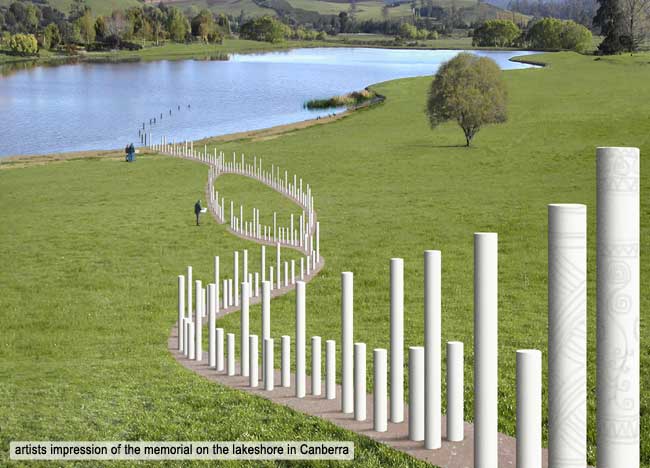
Plans to create a memorial for the Siev X victims have been thwarted by Australian government bureaucrats. On Sunday, hundres of people turned up to the shores of Canberra’s Lake Burley-Griffin to launch a permanent memorial of 353 white timber poles. However a month out from the launch date, organisers were told that it wouldn't be allowed. The National Capital Authority rejected the idea says following its mandatory guidelines saying 10 years must pass after an event, before a permanent memorial can be established. Event organiser Steve Biddulph told the ABC the decision was mean-spirited: “The Prime Minister is about to make a memorial to Steve Irwin. He made a memorial to the Bali bombing, 12 months after that happened and so there are many exceptions to the rule.” Instead the poles will be carried in a procession from the water's edge across a hillside, to show the planned design of a permanent memorial.

The ABC interviewed Siev X activist Tony Kevin on the first anniversary of the sinking. The interviewer asked him whether Australians care about the issue given the strong support for border protection policy. He responded eloquently: “Our government agencies and unfortunately many of our media keep using these bland Orwellian phrases that conceal the reality which is people dying and drowning in the water….these are human tragedies in our society and we have to stop talking in abstractions about policy and start remembering the people.” His words remain unheeded in Canberra.

Thursday, August 10, 2006

Howard gets ready to send the kids to prison

The controversial new Australian asylum seeker legislation passed its House of Representatives vote today 78 votes to 62. This was despite three Liberal MPs (Petro Georgiou, Russell Broadbent and Judi Moylan) voting against the bill and one other abstaining. The effect of the new legislation will be to automatically lock up the children of refugees who try to enter Australia illegally. The bill was gagged and guillotined through the House of Representatives will little time for debate but will receive a tougher time in the Senate next.

The new laws would mean Australia would send all boat people to islands like Nauru and Christmas Island for processing, even if they reach the Australian mainland. The laws were proposed in April to heal a diplomatic rift with Indonesia, sparked by Australia's decision to grant protection visas to a group of boat people from the troubled Indonesian province of Papua. The bill means that all people who arrived on the mainland (backdated by 13 April 2006) will be treated as if they arrived in so-called ‘excised’ places. This means that regardless of where refugees arrived, they would have no access to the Refugee Review Tribunal or Australian courts for judicial review.
43 asylum seekers left Papua in January and landed at Cape York peninsula. They alleged Indonesian human rights abuses and sought refugee status in Australia. The Indonesian government applied pressure on Australia to send them back. However the Australian did not intervene with the legal process and they were granted Temporary Protection Visas (TPVs) allowing them to stay for three years. This decision was seen as a snub by Indonesia and President Yudhoyono called it “incorrect, not realistic and unilateral”.

As well as a suspicion that Australia is being “dictated to” by Indonesia, the strongest concern over the bill domestically is about the detention of women and children in offshore centres. The community action group GetUp have conducted a media campaign against this provision. Jurists are also worried that Australia will not be fulfilling its obligations under international law. Barrister Julian Burnside QC said “There are going to legalise kidnapping….removing them from the protection of the Australian legal system and taking them to a place where they have virtually no rights at all”.

The ALP supported the original 2001 excise bill in the wake of the Tampa incident. Their position now is that if asylum seekers land in Australia, they should be assessed under Australian law. They, the Democrats and the Greens will vote against the new measure in the Senate. With National senator Barnaby yet to make up his mind, right wing Family First senator Steve Fielding becomes the crucial vote. Today, he meets the Prime Minister one-on-one to discuss the issue. Though Family First have stated they will not do a deal over the matter, it would be very tempting for Fielding to vote for the legislation if Howard makes concessions in Fielding’s key social constituencies.

Ironically, the legislation is being pushed through on the same day as the UNPFII (UN Permanent Forum on Indigenous Issues) proclaimed International Day of the World’s Indigenous People August 9 (US time). The tradition dates back to 1994 and the aim of the day is to further the "strengthening of international cooperation for the solution of problems faced by indigenous people in such areas as culture, education, health, human rights, the environment, and social and economic development, by means of action-oriented programs and specific projects, increase technical assistance, and relevant standard-setting activities".

It is unlikely that Howard’s “Pacific Solution” is quite the action-oriented program the UN had in mind. Howard is simply following his political instincts, thinking he can bring a “scared” population along with him. This is why in 2004 former UN High Commissioner on refugees Ruud Lubbers stated: “in the past few years, the politicisation of immigration, confusion between refugees and economic migrants, and fears of criminal and terrorist networks have combined to erode asylum legislation in many States. Paradoxically this has taken place against a backdrop of declining numbers of refugees and asylum seekers.”

Ultimately this bill is more about elections than immigrants.

Friday, February 17, 2006

Human Rights in Australia

The excellent website run by Human Rights Watch turns the spotlight on Australia and its Temporary Protection Visas for refugees.

The key points of the attack are: temporary status is inappropriate for fully adjusted refugees, there are procedural failings in TPVs and they create a misallocation of resources.

The first point (inappropriateness) is further divided into 3 parts.

They are
a) Australian policy has no international precedent. For instance in the US, temporary protection is an additional status to regular refugee status – not a replacement for it.
b) TPVs should have a finite duration. Without this, it means that despite growing significant ties to Australia during their stay, they may always remain on TPVs.
c) there is no jurisdiction in international law for re-proving refugee claims.

The procedural flaws include:
a) TPVs shift the burden of proof from the state to the migrants themselves. People who have been subject to gross human rights violations never want to return to their native country regardless of how conditions may have changed there in the interim.
b) “The 7 day rule” means that those on TPVs can be banned from ever applying for permanent protection visas.
c) There are limitations on judicial reviews. The misallocation of resources means that every individual claim is judged at least twice.

Refugees know better than any bureaucrat where is truly ‘home’ for them.

Still No #
So this is public property, I no longer own
These words…unless, unless they never leave me
Best lay in doubt and working it out
Find its time and measurements deceive me
People take comfort in truth
Nesting in a willing sanctuary
There was an asylum beside them
A people crushing factory
Laying awake at night afeared
Wondering what happened to Occam’s beard
Nutmeg omelettes at the Grand
Dynamite energy total fire banned
My reaction semi-equal and opposite
Friends and enemas becoming composite
Thus enamoured will defeat with ease
Under shower of cloud-cow faeces
Me I’m just making ends meet

Wednesday, February 15, 2006

Britain Takes a Lurch Towards Kafka

After a contentious parliamentary reading and much upper House debate, Britain passed the Prevention of Terrorism Bill 2005.

It is a modification of the already strong Anti-Terrorism, Crime and Security Act of 2001 which itself was knee-jerk policy in the wake of 9/11.

The problem with the new bill is that it crosses the line between the need to protect the public from the threat of terrorism and the need to protect the public from the loss of fundamental human rights.

The new bill superimposes sanctions based on traditional judicial reviews with executive branch orders. These orders can be based on ‘reasonable suspicion’ founded on secret evidence, subject to a limited and delayed judicial review.

There is also the provision of house arrest. This is a gross infringement of liberty of not only the person subject to the order but also anyone who might share the household.

Tony Blair’s government said such draconian actions were necessary as it was unable to prosecute suspects of terrorism because evidence cannot be used in court. Yet the bill has no provisions to loosen judicial procedures, say for example to remove the ban on intercept evidence.

The absence of such procedures in the bill make the government seem like they are trying to circumvent natural justice. The Bill allows for methods such as ‘control orders’ (similar to ASBOs – Anti Social Behavioural Orders). All the government requires is ‘reasonable grounds’ to impose such orders.

This falls far short of ‘beyond a reasonable doubt’ the standard required of criminal law. There is also the prospect that control orders could be carried out on the basis of secret evidence. Here is Kafka's Trial in action. Potential incarceration and no means of finding out why or for how long.

The control orders may be imposed for 12 months but can be renewed indefinitely. So why then is intercept evidence banned from criminal proceedings? The UK and Ireland are the only countries in the world with total bans on intercept evidence. Why?

It would seem foreign intercepts are admissible as evidence if obtained legally bugged communications and surveillance is also admissible even if unauthorised. The ban is in place due to a concern of disclosure of intelligence sources but a removal of the ban would make prosecution of terrorists suspects easier.

No #
I get the feeling that scripture hasn’t been written yet
Except that its all there, everything we have done to death
By the siren of the Roman candles,
Fires, passion, bedroom scandals
Rueful with our love, so fitfully dispersed
Back was turned on us, the winner gets there first
Glory in the three, babylon be burnoosed
Struck up in the Wests thirty at the sign of the truce
Hatching plans for old targets and new markets
Something big on the quiet, protected encryption
While any white coat can give you the prescription
Wake on the side of the mountain
Everything is in its place of ritual
Defensive fencing in each direction
Substantial fruit in olive complexion
Viral magnets stir in uneven keel
Suspicious in moments and leaving feel
Sepulchre handguns tabernacle ominous
From Ziggy Freud to all things Mormonous
We’re not quite ready to quit the planet
So please Mr Meteor Man don’t blow us away
Before its time to say our silly say
And then, but then, let them gainsay
A gain again against me
As Autumn falls down
And ends up around the head
Of a Winter’s talisman
Which they rip from the code
With pearls and pants round their ankles
Spank me Jennifer, through the goalposts of life
And save me from the some-one industry fishwife
Only fleeting enter the cell and the smell
Of any English speaking woman
Seek alternative in writing and
I see the power in industry but do not trust it
Glib hand of markets live in ideas
that take root in Richard Dawkins' head
spreading e-coli salami on sour bought bread
out of the splendour of what comes next
nervous in motion arrival on text
what I’d asked you to do least
not a question that is foremost established
Make me understand a queer querulous beast
Safari jackal, hysterical hyenas abolished
And dingo was his name
Earnestly important
Death and dying in either culture
So they don’t belong any more
Shut the window, open the trapfloor
Widows of warwounds of words
Collapsed ministers west in the surf
Sell copper, coal mine, accountants turf
After half a minute or a lifetime or so
95 canon Wittgenstein salute to go
Marco Polo has reached his market heaven
I’ve lost my way in hayseed tea Devon
Fillers with bootful mosque moments
Advertising space for a brain in need of work
Or a kind that leaves something in the basket
As he walks away with his balls in his hands
I’ve pumped my life with so much imaginary stuff
I doubt if I could pull the real rabbit from the hat
From the trill of the paranoid camera I keep
The idea imprisoned disappearing with a huge leap year
And an extra day for good luck
I might as well weep for spilled diary products
As I have for my unacted other
The future I did not carve
Plenty times I did not starve
Food none too far away in thought
Fish and chippaper conscience easily bought
Hills of bills dipped in vinegar
Komodo crisis marinated in goat
What is the earth but a collection of peas
Queued in a pod estimating your venal potential
‘your double-you’s ex’ why not..its boring
Rather you than me than stop