Showing posts with label Northern Ireland. Show all posts

Thursday, December 22, 2011

Charles Byrne's Body: A sorry science story

Back in the mid 18th century an oddity was born in Ireland who if he lived over 200 years later would have likely been one of Irish basketball’s best hopes. In a dwarfish country stunted by lack of access to nutritious foods, Charles Byrne stood out. He was believed by many to be over eight feet tall though skeletal evidence put him at 2.31m, which at seven foot seven was still head, shoulders and much of the upper torso over most of his contemporaries. Byrne did not have access to a better diet than others around him. It was a gene mutation caused by a pituitary tumour that caused the growth. He died in 1783 aged just 22 though it wasn’t the tumour that killed him.

Byrne lived 21 of those 22 years in Tyrone, born of unexceptional stock. The sly gossips said the reason for his height was his parents had a love affair on top of a huge haystack and this lofty situation somehow affected conception. No one said this to his face - if they could up into it. Although acknowledged as a freak of nature, Charles Byrne wasn’t generally treated as one. Australian historian Patrick O’Farrell said the Irish treated everyone on their merits. Writing about the Irish in Australia, O’Farrell noted that because they never tried to paternalise their relationship with Aborigines they never looked down on them as the WASPs did and instead treated them as equals. Byrne left Tyrone not ashamed of his freakdom but wanting to exploit it. His parents knew he could better capitalise on his status elsewhere.

His exceptional size had attracted a nearby carpetbagger named Joe Vance from Coagh. Vance wanted to astound Europe with Byrne. The pair arrived in London in 1782, and Byrne transfixed the capital as Vance’s creation “the Irish Giant”. He took a room next door to the fabled Cox’s Museum at Charing Cross. The choice was not accidental. James Cox was a jeweller and toy maker who exported luxury European items to the Far East. When China suddenly banned his goods, he turned his unsaleable cargo of exotic clocks, watches and earrings into a museum of “automata” which opened in 1772. This museum became known for its extravagant assemblage and quickly became “a seductive metaphor and a compelling stage for debating the troublesome issues of political and economic stability.”

While Cox had sold up by the time Byrne moved to London, his museum retained an aura that Vance knew he could capitalise on. Byrne entertained audiences next door for seven hours a day, six days a week. His gracious airs made him the talk of the town. Within a few weeks, Byrne was entertaining the Royal Family, members of the nobility and his baffling condition was examined by the Royal Society. When a fellow freak, Count Joseph Boruwlawski known as the “Polish Dwarf” met Byrne in London, their surprise was equal. As Boruwlawski remembered, Byrne was a moment speechless, “viewing me with looks of astonishment; then stooping very low to present me his hand, which easily have contained a dozen like mine, he made a very polite compliment. Had a painter been present, the contrast of our figures might have suggested to him the idea of an interesting picture; for having come very near him, the better to show the difference, it appeared that his knee was nearly upon level with the top of my head.”

Flushed with success, Byrne moved to Piccadilly where he continued to work six days a week (Sundays excepted). Admittance for ladies and gentlemen was 2s. 6d, children and “servants in livery” had to fork out a shilling. Vance and Byrne grew wealthy on the profits. By early 1783 the fickle public were tiring of the Irish Giant. News of his success drew other tall men to London including the Gigantic Twin Knipe brothers who were born only five miles away from Byrne in Tyrone. Another Irishman was advertised as a giant “upwards of Four Inches taller than the noted Burn”. Byrne’s problems were compounded by his love of gin and whiskey. He was frequently drunk on stage and cancelled many performances. Vance was forced to drop prices and soon everyone was paying the livery price of a shilling.

On 23 April 1783, Byrne went on a “lunar ramble” at the Black Horse public house. He fell asleep drunk and someone stole £700 from his pockets – his entire savings. Devastated, he redoubled his drinking and contracted tuberculosis. He deteriorated badly in May and died on 1 June 1783. In his final days his biggest fear was not death but the surgeons’ thirst for his body. His Irish Catholic upbringing gave him a horror of the coroner’s knife which he believed could deny his soul a place in heaven on Judgement Day.

One man had no time for Byrne’s scruples on the matter. His name was John Hunter, Surgeon Extraordinary to King George III. Hunter was a pivotal influence on modern surgery with his method and dissected thousands of cadavers he got from “resurrection men” – professional grave robbers. From the moment Hunter set eyes on Byrne he coveted his body for science. Byrne was aware of Hunter’s ambition and strove to thwart it in his dying days. His instructions were that his coffin should be guarded by Irish friends who would arrange to bury him at sea. Byrne scraped the last of his savings to the undertaker whom he entrusted to carry out the plan.

Hunter meanwhile was determined not to lose out. He employed a man named Howison to watch Byrne’s whereabouts at all times from a next door apartment. When Byrne died, a newspaper reported he wanted his bones “far out of the reach of the chirurgical fraternity”. The chirurgeons were in an arms race of demands for the body. One reportedly offered a ransom of 800 guineas to the undertakers. While the bidding went on, the promoters got one last meal ticket out of Byrne: they displayed his enormous coffin to the public for one shilling. Then on 6 June, the body was taken aboard a ship to Margate where it would be sunk in “20 fathoms of water” in the English Channel. At Margate another boat was chartered and the coffin was tipped into the sea.

But Byrne’s body was no longer in it. The Annual Register for 1873 said the sea burial report was “merely a tub thrown out to the whale.” While the whales had the tub, Hunter had the body. When Byrne died, Howison immediately told his paymaster. Hunter quickly bribed the undertaker for £500 who switched the body with paving stones while the oblivious funeral party was drunk. Hunter took the corpse back to his surgery but became terrified of the revenge of Byrne’s friends if they found out. There was no autopsy. Instead he He chopped up the body and boiled the pieces so only the bones were left. He then hid the huge skeleton for four years until Byrne’s name was forgotten. In his haste, it went brown.

Hunter displayed the Irish Giant in his anatomical collection and was later put it in the Hunterian Museum at the Royal College of Surgeons. In 1909 American neurosurgeon Harvey Cushing got permission to open Byrne’s skull and he diagnosed the pituitary tumour. Byrne’s discoloured skeleton remains today in the Hunterian where many visitors including the current monarch have been fascinated by his extraordinary size.

Hunter got his way but the fight continues today between his legacy and Byrne’s modern day family anxious to carry out his dying wish. One of those relatives, Brendan Holland said Byrne’s body has been on display for 200 years and it was time for him to receive a proper burial. "He was quite a celebrity and he made a lot of money out of exhibiting himself," Holland said. "It's the person within that's important. It's very unfortunate that he didn't live long enough to understand that." His enthusiasm for a sea burial is not shared by the Hunterian’s current director Sam Alberti. Alberti was reluctant to hand over his star attraction saying “researchers were excited about the potential for future research.”

But the British Medical Journal agrees with the family Byrne has done his time and should be buried at sea. Fellow Northern Irishman and researcher at the school of law at Queen’s University Belfast, Thomas Muinzer wrote in the Journal it was time to respect his memory and reputation. “What has been done cannot be undone but it can be morally rectified,” Muinzer wrote. Mr Muinzer added there was nothing of any more use that could be deduced scientifically from Byrne’s bones. “We have now a full record of Byrne’s DNA and we also have numerous examinations of the skeleton,” he wrote. “With burial law, when you or I stipulate burial wishes in life, we rely on those wishes to be respected. Those wishes don’t have legal force, they have moral force.”

Thursday, October 15, 2009

Brighton bombing - 25 years on

On the 25th anniversary of the Brighton Conservative Party conference bombing, British media announced that the man behind the attack would attend a reconciliation ceremony at the House of Commons. Patrick Magee served 14 years for the bombing before being released as part of the peace process. But he was now been invited to a reconciliation and forgiveness event at Westminster on the 84th birthday of former Conservative Prime Minister Margaret Thatcher a day later on 13 October. Baroness Thatcher would not be there but Magee would renew acquaintance with Jo Tufnell (nee Berry) the daughter of one of the five people killed in the explosion. (photo of Grand Hotel after the explosion from Wikipedia)

Patrick Magee is a former IRA operative who was born in Belfast in 1951 but moved with his family to Norwich when he was two. He returned to Belfast at the age of 18 in 1969 and joined the Provisional IRA soon afterwards just as the Troubles began to escalate. Magee had an aptitude for bomb making and rose to become the IRA's Chief Explosives Officer. He was imprisoned from 1973 to 1975 for being a member of the IRA before returning to active service and leading a massive mainland bombing campaign in 1978.

In 1979 Margaret Thatcher was elected Prime Minister in a landslide election win. Within two years she was deemed public enemy number 1 by the IRA for her strong stance against the Maze hunger strikes which led to the deaths of Bobby Sands and nine other prisoners. Brighton would be the IRA’s revenge dish served cold.

The then 34-year-old Magee planted the bomb three and a half weeks prior to the explosion. He checked into the Grand on 14 September 1984 under the name of “Roy Walsh” and stayed there for three days. The receptionist allocated him Room 629 “because it was a nice room facing the sea”. There he put his Libyan bomb making skills to good use and primed a 30 pound (13 kg) explosive. He hid the bomb in a bathroom wall with a timing device set for 24 days ahead during the Conservative Party annual conference held at the hotel.

At 2.54am on 12 October, the bomb went off and blasted a massive hole through the hotel's facade. Five people died in the blast. They were Sir Anthony Berry, 59, the MP for Enfield Southgate; Roberta Wakeham, 45, wife of Tory Chief Whip Lord Wakeham; Conservative North West Area Chairman Eric Taylor, 54; Muriel Maclean, 54, wife of Scottish Chairman Sir Donald Maclean (the Macleans were in room 629); and Jeanne Shattock, 52, wife of the Western Area Chairman. Secretary of State for Trade and Industry, Norman Tebbit, was rescued from the rubble but his wife was left paralysed for life.

Margaret Thatcher was awake and working on her conference speech at the time of the explosion. It was a day before her birthday. She was on the same floor as the blast but she and her husband Denis were uninjured. Afterwards, the IRA famously released their chilling message. "Today we were unlucky, but remember, we only have to be lucky once; you will have to be lucky always. Give Ireland peace and there will be no war."

But peace was the last thing on authorities’ minds. Sussex Police launched their biggest ever investigation to solve the crime. They meticulously tracked down 800 people from 50 countries who had stayed at the hotel in the month before the attack. Just one man could not be accounted for: Roy Walsh. The direction of the explosion pointed to his room. After three months, police finally matched a palm print on a hotel registration card to a print taken from Magee years earlier when he was arrested as a juvenile in Norwich. Police did not reveal their find hoping he would eventually return to the country.

But Magee did return to Britain without police knowledge. Their breakthrough came when Glasgow police tracked another IRA suspect Peter Sherry to an IRA safe house in the city. Magee was sprung. At his trial in June 1986 Justice Boreham recommended Magee serve a minimum of 35 years after an Old Bailey jury found him guilty. Boreham called him "a man of exceptional cruelty and inhumanity" who enjoyed "terrorist activities". In September Magee received eight life sentences, seven of them (planting the bomb, exploding it, and five counts of murder) were for Brighton.

Magee served thirteen years during which time he studied for two university degrees. He was transferred from Britain to the Maze jail in Northern Ireland in September l994, just after the start of the first IRA ceasefire. He was released in 1999 under the terms of the Good Friday Agreement after serving a third of his sentence. Then Prime Minister Tony Blair’s spokesman said early prisoner releases were "the most unpalatable and awkward part" of Northern Ireland's peace process. But they were crucial to its success and so Magee was released along with many others despite the howls of protest by Tories and Unionists.

Magee met Jo Tufnell a year later. Tufnell had been profoundly impacted by the death of her father Sir Anthony Berry in the blast and was determined to find out more about the Northern Ireland conflict. After recovering from the shock of Magee’s early release, she decided she had to meet him. They initially met in secret at the house of a friend of Magee, a woman who runs a Belfast peace group called Seeds of Hope. The pair started talking immediately and did not stop for three hours.

Tufnell described the reaction of her 7-year-old daughter: “[She] got very angry when she found out I was going to meet the man who had killed grandpa. She wanted to come too. When I wouldn't let her, she asked me to tell Patrick that he's a bad man. She later asked if he was sorry. When I said yes, she asked, 'Does that mean grandpa can come back now?'”

Tufnell and Magee have since met many times. Magee still believes in the justness of his cause but says Norman Tebbitt's continued crusade against him was "understandable". Tufnell said her meetings with Magee have put a human face on this conflict. “I now see men like him as people with their own struggles, no longer as a faceless enemy, and that helps me,” said Tufnell. “I think it's been quite a struggle for Patrick to see me and my dad as real people rather than as justified targets.”

Tuesday, July 14, 2009

Coagh and the Twelfth: A snapshot of Orangeism in Northern Ireland

One of Brisbane’s lesser known organisations is the “Somme Memorial – Brisbane” which meets every month in the city. It is a meeting of Orangemen, a Protestant fraternal order which takes its name from the Dutch-born British King William III. The Brisbane marchers gather at the Anzac War Memorial to commemorate the thousands of Ulster casualties in one of the First World War’s bloodiest battles. By wearing the sash and playing the fife, they follow a tradition that has been active in Australia since the earliest colonial days.

A sense of history is crucial to Orangeism and this applies as much to its farthest flung followers in the Sunshine State as much as does to its heartland in Northern Ireland. Brother William Wright, the former Grand Master of Australia, was in Northern Ireland to celebrate the Orange Order’s biggest day. This Sunday was 12 July, the 319th anniversary of the Battle of the Boyne which effectively destroyed King James II’s hopes of wresting away William III’s stranglehold on the British Crown. But because the battle took place north of Dublin and because James was a Catholic the event is primarily commemorated as a victory of the Protestant supremacy in Ireland.

12 July is a public holiday in Northern Ireland and a flashpoint for the tenuous relations between the religions in the province. This was true before the Troubles started and as events in Belfast showed is still true today after they have supposedly ended.

Outside Belfest, the event passed off peacefully. On Sunday, Brother Wright joined 10,000 people who lined the streets of the tiny market town of Coagh, Co Tyrone for the Orange Day parade. It was the first time in seven years the Twelfth of July parade had come to Coagh. It was the largest in the county with fifty-four bands, and an Ulster-Scots concert swelling the village that normally has 500 inhabitants.

It was a welcome change of fortune of a town that has seen its fair share of murder during the 30 year war. All sides suffered. Even in the midsixties, Coagh gave the province an ominous hint of what was to follow. In the winter of 1965, Northern Irish Prime Minister Terence O’Neill was keen to establish détente with the regime in Dublin. He caused consternation among hardline Protestants when he invited Taoiseach Sean Lemass to Stormont (among those offended was a rising star named Ian Paisley who threw snowballs at the visiting dignitary’s car). When Unionist Mid Ulster MP George Forrest addressed the Coagh 12 July march in 1967 he was jeered as he tried to pay tribute to O’Neill. The indignant Forrest threatened the crowd with his chair only to be dragged off the platform, kicked and left unconscious.

When full-scale violence did erupt across the province a couple of years later, it wasn’t long in coming to Coagh. In 1972 the Official IRA had declared a ceasefire but continued its attacks against the British for another 12 months in what it justified as “defensive actions”. In October that year, two of its veteran members John Pat Mullan and Hugh Herron were stopped at a British Army checkpoint in Ardboe near Coagh and arrested. According to IRA reports, the RUC advised the Army that the men were considered dangerous and should be “eliminated”. Herron was shot dead at point blank range and Mullan was shot while trying to escape.

The war mostly passed Coagh by for the next 17 years. On 7 March 1989 the peace was rudely shattered. Motor mechanic Leslie Dallas was at work in his garage in town talking to two men. Dallas was the closest thing the town had to a celebrity. He was a former European hot rod champion and still an active participant in the local hot rod circuit. His two visitors were a 72 year old pensioner and a 61 year retiree. The two men were chatting to Dallas about his second place finish in Ballymena that weekend. Their conversation was put to an end by a motorised IRA unit. They shot dead all three. The attack while shocking, wasn’t completely random. According to Brendan O’Brien’s "The Long War", Dallas had a shady alter ego and was a senior leader in the Protestant paramilitary group the Ulster Volunteer Force (UVF). The two pensioners were collateral damage.

The UVF retaliated six months later. The Battery Bar is a quiet pub a few miles out of Coagh at Moortown. It was the haunt of IRA member Liam Ryan. A UVF force ambushed the pub on 29 November and shot dead Ryan. Again there was collateral damage. A Catholic civilian Michael Devlin was standing too close to Ryan and he died of gunshot wounds.

More bloodshed followed in 1991. Three IRA members “on active service” (as a pro-IRA site describes it) were driving towards town when it was ambushed by an undercover British Army SAS operation. By then the technology, surveillance and undercover operations of the secret 14 Intelligence Company known as “The Det” (for detachment) was seriously undermining IRA capability. The SAS were expecting the IRA men in Coagh. They fired 200 rounds of ammunition into the car. All three died.

Incidents such as Coagh were instrumental in bringing the IRA to the negotiating table in the mid 1990s. The result was the Good Friday Agreement and the remarkable sight of a snowball-less Ian Paisley sitting down in Government with IRA members. But while political progress has been astounding, it is taking longer to bring the community out of the years of hate. The Orange Order with its strident triumphalism remains a lightning rod for Catholic rage. Coagh knows that only too well. Its Orange Hall was badly burned in an attack in November last year.

But cultural change is following political change. There are attempts to rebrand the marches as a tourist friendly “Orangefest”. Drew Nelson of the Orange Order of Ireland told The Independent that they wanted to turn it into a community festival. “"We went to Notting Hill Carnival, to learn from that,” he said.

If I presume he is not referring to the riots, I am being overly cynical. Writing in the Belfast Telegraph yesterday Ed Curran called Orangefest a step in the right direction. He asked who would have believed five years ago the EasyJet inflight magazine would promote the 12th as one of the Belfast’s attractions. “We need to leave behind the Julys of confrontation,” he wrote. “And, if we can, perhaps future Twelfths will be promoted in not just one airline’s travel guide but in many other international tourist brochures.”

Wednesday, March 11, 2009

RIRA and CIRA bring grief back to the front pages in Northern Ireland

Northern Irish police arrested two men, aged 17 and 37, yesterday in connection with Monday’s killing of a police officer blamed on IRA dissidents. Constable Stephen Carroll was shot dead in Craigavon, Co Armagh and his death followed the murder of two British soldiers as they collected pizzas at their army base northwest of Belfast. The incidents have rocked the province which has not seen violence on this scale in ten years. Two different IRA splinter groups claimed responsibility for the attacks; the Real IRA (RIRA) for the soldiers and the Continuity IRA (CIRA) for the policeman.

Stephen Carroll was shot in the back of the head when he responded to a distress call from a woman in the Lismore Manor area of Craigavon. A sniper in nearby Drumbeg estate executed him with a single bullet to the head. Drumbeg is a staunchly republican estate and the Northern Irish boom has largely passed by the place. On the walls nearby is a mural of a tricolour decorated with the letters CIRA and graffiti which reads “Don't join the Sinn Fein sell-out”. More graffiti announces that the Continuity IRA are “still at war”. The victim of their war, 48 year old Catholic Stephen Carroll was just two years away from his retirement.

Carroll’s death came just 48 hours after army sappers Mark Quinsey, 23, and Patrick Azimkar, 21, were gunned down in an attack on Massareene Barracks in Antrim on Saturday. Four others were injured when gunmen attacked members of 38 Engineer Regiment waiting at the front gate. The regiment was due to leave for Afghanistan within hours when the ambush occurred. The pair were the first British soldiers to be killed in Northern Ireland since 23-year-old Stephen Restorick was shot dead by a sniper as he manned a checkpoint in South Armagh in February 1997.

The Times claims that RIRA and CIRA co-operated over the two killings but offered no evidence to back up the claim other than a throwaway quote from an unnamed security official. The paper says the rifles used to murder the soldiers are newer, more sophisticated weapons imported illegally into the province. Of more interest was the fact that security forces have very little intelligence about the renegade organisations but do say there is “no unified command structure” linking the two groups.

The Real IRA are the most well-known of the two and were responsible for the 1998 Omagh bombing which killed 29 people. The group was born out of a split in the mainstream Provisional IRA in October 1997 over the direction of the peace process. The Continuity IRA is the smaller but older of the two. The group has a few dozen active members with its leadership based in Limerick. They split from the Provisional IRA in 1986 but did not come out in the open until the Provos declared a ceasefire in 1994. The day-to-day modus operandi of both groups is criminal activity such as assaults, drug dealing, robbery, kidnapping, extortion, and smuggling.

The Independent said the trigger for the latest burst of violence was the announcement the Armed Forces Special Reconnaissance Regiment (SRR) was returning to Northern Ireland. Founded in 2005 the SRR has a specific aim of targeting international terrorism. It is the inheritor force of the notorious secret 14 Intelligence Company known as “The Det” (for detachment) which was instrumental in undermining IRA activity in the 1980s and 1990s. According to the SocialistWorkeronline the SRR was involved in the 2005 London killing of Jean Charles de Menezes (mistakenly believed to be a 7/7 tube bomber) and also “ran death squads in Iraq targeting supporters of the resistance to the US-British occupation.”

The two incidents have spawned a series of rallies across the province of people determined to show their revulsion at the murders. A peace vigil will to be held in Craigavon and the Irish Congress of Trade Unions are organising silent protests in Belfast, Derry, Lisburn, Newry, and Downpatrick. Peter Bunting, the congress's assistant general secretary, said workers had to unite to ensure the peace process was not derailed by a sectarian agenda. "They must be faced down with a massive display of the unity of the people of Northern Ireland,” he said. “We are determined not to be assigned into tight sectarian boxes.”

Friday, December 21, 2007

Omagh: the search for justice goes on

Sean Hoey, the only man charged with a direct role in the 1998 Omagh bombing, has been found not guilty. Families of the 29 victims have called for a cross-border enquiry as the judge blamed police failures for the verdict in one of Northern Ireland’s largest ever trials. After a $32 million investigation that took nine years, Hoey was cleared on 56 counts relating to the Omagh bombing and several other attacks on police and military installations. Justice Reginald Weir, who conducted the case without a jury, said the police had a "slapdash approach" to evidence-gathering, which meant DNA evidence presented at the trial could not be relied upon. He also said police were guilty of a "deliberate and calculated deception" and ordered court transcripts be sent to the police ombudsman.

The judge said the people of Omagh and Northern Ireland community clearly wanted to convict the perpetrators of bombing. But he also said he had to bear firmly in mind the cardinal principle of the criminal law. He quoted a judgment by the Court of Appeal, which said justice demanded " proper evidence and not merely evidence which might be true to a considerable extent, probably is true, but which was so convincing in truth and manifestly reliable that it reached the standard of proof beyond reasonable doubt." The judge’s verdict was that “the evidence against the accused in this case did not reach that immutable standard.”

Hoey is a 38 year old electrician from Jonesborough, in County Armagh. His solicitor Peter Corrigan said his client was an innocent man who had been completely vindicated. "Today's judgement - a reasoned, lengthy and well considered judgement - completely vindicated this position that he maintained. Sean Hoey is an innocent man” Hoey's mother Rita also read out statement in which she described the police investigation into her son as a "witch-hunt". "I want the world to know that my son, Sean Hoey, is innocent," she said. "This is not a failure to bring those responsible to justice."

Her attitude was not shared by relatives of the victims. Victor Barker, whose 12-year-old son James died in the attack, blamed Sir Ronnie Flanagan, the former chief constable of the then Royal Ulster Constabulary, for the police's failure to convict anyone. Michael Gallagher, who lost his son Aidan in the bombing, also blamed Flanagan’s “appalling inefficiency”. He said the case had been a disaster for the Omagh families. "I think there has to be real questions why this was allowed to go through the system,” he said. "The police recommended the prosecution and the DPP allowed it to move forward, then they brought us all here for Christmas to get this news."

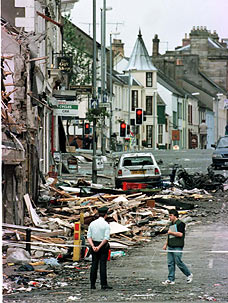
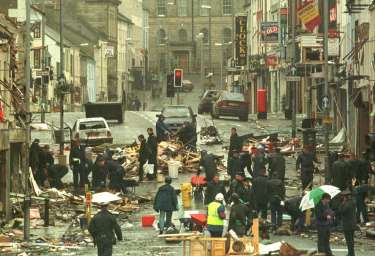
Omagh was a quiet Tyrone market town that was mostly spared the ravages of the 30 year Northern Irish strife. On 15 August 1998 a 225kg car bomb exploded in Omagh town centre after three warnings failed to give the exact location. It was a Saturday afternoon and the town was packed with shoppers. It was a particularly busy as women and children were in the town buying school uniforms and supplies at the end of the school holidays. The town was also hosting a cross-community carnival. Authorities believed the warnings were for the courthouse and shepherd people towards the site of the car bomb. The blast killed 29 people and two unborn children in what was to become the largest loss of life in Northern Ireland’s history. Another 220 were wounded.

While no one initially claimed responsibility for the bombing, suspicion immediately fell on the Real IRA, a small offshoot of the Irish Republican Army (IRA). The Real IRA had rejected the ceasefire the IRA had declared in 1997. The Real IRA finally claimed responsibility on the Tuesday after the attack. Their statement claimed there had been "three warnings put in, there were 40 minutes warning on each of them." They said they placed two warning calls to Ulster Television (UTV) and one to the Samaritans in Coleraine. "Each time the call was made it was very clear [where the bomb was] and the people talked back.” They said. "At no time was it said it was near the courthouse. It was a commercial target." They offered apologies to the “civilians”.

The following year, South Armagh republican Colm Murphy was the first to face charges relating to the bombing. He was charged with conspiring to cause an explosion. The judge at his trial in Dublin's special criminal court described him as a "service provider" for the Real IRA. He was convicted and sentenced to 14 years. However in 2005 his conviction was overturned and a new trial ordered, due to defects in the earlier trial with doubt cast on the evidence of two Irish police officers. His lawyers successfully fought this year to postpone the retrial indefinitely as Murphy is suffering from short-term memory loss resulting from a car accident and this condition will interfere with his right to a fair hearing.

Sean Hoey is Colm Murphy’s nephew. In September 2003 Hoey was arrested at home following a massive security operation involving 200 officers and soldiers. He had no past paramilitary or criminal convictions. His supporters claim Hoey is being framed in a conspiracy involving the Irish and British governments. A group called the Irish Freedom Committee say there were many irregularities surrounding the Omagh attack. They say authorities knew about the bomb two weeks in advance, and army and police were confined to barracks on the day and suffered no casualties.

However one major authoritarian casualty was police chief Ronnie Flanagan. He immediately announced a task force had been set up to investigate the bombing which would supplement the local police resources. Forensic scientists had examined the bomb timers for fibres and Low Copy Number (LCN) DNA. LCN is a new development which allows analysis of tiny samples of skin cells, sweat and other bodily fluids. Police matched the DNA to Hoey but the technique remains unreliable and scientists are divided over its efficacy.

In a 2001 ombudsman report, Flanagan was accused of "defective leadership, poor judgement and a lack of urgency" for his role in the bomb. English lawyer Victor Barker, whose son, James, died in the attack, said the initial investigation by Flanagan had been deeply flawed. "He [Flanagan] said he would fall on his sword if anything was wrong with this investigation,” said Barker. “I will give him the sword."

Monday, June 18, 2007

Scotland the Brave

Scotland’s First Minister Alex Salmond has begun discussions with the other two Celtic nations with a view towards joint UK governance in his visit to Belfast. The newly elected SNP leader will suggest to Northern Irish leaders that relations could be put on a “proper business-like basis” by resurrecting joint ministerial committees that will also including Wales. “It is not a question of ganging up, it is a question of formulating ideas in a constructive way,” he said. “And on many of these issues it will also be, in my opinion, in the interests of the Westminster Government.”

Salmond is travelling today to address the Northern Ireland Assembly and meet his Stormont government counterparts on his first official engagement outside of Scotland as First Minister. Salmond is attempting to improve the channels of communication between the devolved governments of Scotland, Wales and Northern Ireland and want to re-establish the Joint Ministerial Committees to discuss matters of common interests with colleagues in the devolved administrations which have been in abeyance since 2002.

Salmond flew to Belfast from Dundee in order to discuss with Northern Ireland's Democratic Unionist First Minister Ian Paisley and Sinn Fein Deputy First Minister Martin McGuinness the possibility of their forming a united Celtic front with Rhodri Morgan's administration in Wales. He will also discuss the economic and fishery links between the countries. Salmond will suggest to the joint heads of the Northern Irish Executive that relations could be put on a "proper business-like basis" by resurrecting joint ministerial committees.

Salmond is coming from a position of strength after the nationalist SNP won the election in May 2007 winning the largest number of seats without winning an outright majority. The nationalist SNP beat Labour by 47 votes to 46 on the election held on 3 May. Salmond was forced to form a minority government on a "policy by policy" basis. He was elected as the Scottish Parliament's nominee for First Minister on 16 May 2007, and was sworn in a day later. He is the first nationalist to hold the role following three Labour first Ministers Donald Dewar, Henry McLeish and Jack McConnell.

Salmond has the reputation of a Nationalist hard man. He is a former civil servant and banker who was expelled from the party in 1982 for being “too socialist” but re-admitted a year later. In 1987 he was elected for the Westminster seat of Banff and Buchan and more than doubled his majority in 1992.

He was elected leader of the SNP in 1990. He served as Leader of the Opposition and Shadow First Minister in the Scots Parliament before suddenly standing down as Party Leader in September 2000. In 2004 he was returned as SNP leader with 75% of the vote. He won the May 1997 election taking an additional 20 seats from the 2003 election. With the Tories winning 17 seats and the Lib Dems winning 16 and the Greens winning 2, the SNP surprisingly entered into an agreement with the Greens (pdf) on “how a new Government in Scotland will be established that pursues a progressive programme and which places addressing climate change at the heart of its agenda”. Nonetheless an alliance of the SNP and the Greens alone are not enough to form government. This is where the neglected Tories come in.

The unspoken agenda in Scotland is full independence. A Scottish Conservative spokesman has publicly backed a referendum on independence yesterday, sparking a major debate within his party which he hopes will lead to a change in Tory policy. Richard Cook, the vice-chairman of the Scottish Conservatives, said he wanted the referendum as soon as possible to "clear the air" over Scotland's constitutional future. Though Cook himself is against full independence, his parties 16 votes plus the SNP and the Greens would be enough to push the policy through parliament.

Though the Ulster Unionists are suspicious of Salmond’s nationalist agenda, the two administrations have much in common including the fact they both want money from the exchequer and increased flexibility to respond to local needs, including regional cuts in Corporation Tax. But some Unionists see Salmond as the enemy. Assembly member David Burnside said "I personally like Alex Salmond but I believe Ian Paisley is falling into a dangerous trap for unionism. He [Salmond] is a nationalist who wants to end the Union between England and Scotland.” He said “that has implications for Wales and Northern Ireland”.

Sunday, June 17, 2007

Brits – The war against the IRA

Former head of the British Army Sir Michael Jackson has admitted last month innocent people were killed in Derry’s Bloody Sunday massacre of 1972. Jackson made the admission in an interview with BBC Northern Ireland's flagship current affairs program, Spotlight. However the former army chief, who was a captain with the parachute regiment in Northern Ireland at the time, said people should wait for the outcome of the latest Saville Inquiry into Bloody Sunday before making judgements.

Bloody Sunday was one of the defining moments of Northern Ireland’s 30 year conflict. British troops shot dead 14 unarmed Catholic civilians (13 died immediately, and one later from injuries) on 30 January 1972 ending any lingering hopes in Nationalist community the British army were anything other than an occupying force. The incident is covered in detail in an excellent book “Brits: the War against the IRA” by British journalist Peter Taylor. Brits is the third book in his trilogy on the war. The first, “Provos”, told the story from the nationalist side, the second “Loyalists” told story of Protestant unionism and Brits takes the army perspective.

The book chronicles its involvement, and most intriguingly, its intelligence operation, during the 30 year conflict. The book tells how the army’s most secret undercover surveillance unit in the province, 14 Intelligence Company, known as the Detachment, or ‘Det’, played a major role in bringing the IRA to the negotiation table. With the help of technology, surveillance and undercover operators, the ‘Det’ almost crippled the IRA by the end of the 1980s and made its leadership see only a political settlement could win the war.

Northern Ireland was created by Westminster’s Government of Ireland Act 1920. Ireland was divided into two partitions each with its own home rule government. The north was to be a Protestant state for a Protestant people. A new boundary was drawn around the ancient province of Ulster but with the three Catholic majority counties (Donegal, Cavan and Monaghan) removed. In the new state of Northern Ireland, discrimination was endemic. Derry council was gerrymandered so 14,000 Catholic voters elected eight councillors while 9,000 Protestant voters elected 12. Harland & Wolff, builders of the Titanic, employed 10,000 workers on its Belfast dockyards but only 400 were Catholic. Northern Ireland had its own Protestant-dominated parliament at Stormont while Westminster devoted just two hours a year discussing Northern Irish issues.

Decades of Catholic resentment blew up in the seminal rebellion year of 1968. A new breed of charismatic leaders like Bernadette Devlin and John Hume demanded change and universal civil rights. The Protestants saw the civil rights movement as an IRA front and treated it with suspicion. In October, TV news brought pictures of a civil rights march baton charged by police. The incident confirmed the Catholic belief the Royal Ulster Constabulary were another sectarian force. Violence grew in Derry and spread to Belfast by the summer of 1969. The Protestant Apprentice Boys march in August caused a full scale riot in Derry that lasted three days and found the RUC ill-prepared to deal with the problem. With the situation deteriorating on the third day, the First Battalion of the Prince of Wales Own Regiment of Yorkshire was drafted in. It was the first deployment of troops on the street.

The troops were welcomed by the Catholics who saw the army was there to stop them from being bashed by police. But just as the situation calmed in Derry, large-scale violence broke out in Belfast along sectarian lines. Vicious street fights broke out between nationalists and police and nationalists and loyalists. The IRA got involved and shot dead a policeman Herbert Roy. The RUC shot dead three Catholics as loyalist mobs torched Catholic houses in streets they shared. After several days, police admitted defeat and called in the army. Troops were flown in and needed to buy maps of Belfast at the airport. Most soldiers saw their mission as stopping Protestants from burning out Catholic homes.

Meanwhile the IRA was in turmoil. While some members fought in the riots, the official line was to steer clear of the trouble having declared a ceasefire. Graffiti appeared saying “IRA – I Ran Away”. Divisions in the IRA hierarchy were formalised and a new group called the Provisional IRA (“Provos” for short) re-affirmed the right to achieve a united Ireland by violent means.

The army enforced an uneasy peace line between the Catholic and Protestant communities. But the marching season would change all that. At Easter 1970 a group of Orangemen began their day out by marching past the Catholic Belfast community of Ballymurphy. The Catholics were waiting for them and a two-hour full scale riot ensued. Confused soldiers stood hapless in the middle. The following day, the army decided on a show of force in expectation of a continuation of the riot. They arrived in armoured cars loaded with rifles, riot shields and CS gas. The Catholics redirected their missiles to this new enemy and the army hit back firing CS gas. With rioting continuing all night, the army baton-charged and the Protestants followed in their wake, confirming suspicions the army was on their side. Army leader General Sir Ian Freeland confirmed there was a ‘get tough’ policy. The Ballymurphy riots were the real starting point of the war. The provisional IRA now had an enemy they could fight.

On 27 June, they sprang into action after another Protestant march in Belfast. Missiles were exchanged and the IRA brought out their guns killing three Protestants. They fought a gun battle later that night in East Belfast and killed two more. They could now claim to be the defenders of Catholic areas. The new Tory government in Westminster demanded strong action and imposed a 35 hour curfew in the Falls area while the army conducted house-to-house searches. While the military objective was successful and discovered a hoard of weapons, the IRA had won the hearts and minds of the occupants who now knew the British Army as the sworn enemy.

The two sides kept up a dialogue despite the violence. In February 1971 Major-General Anthony Farrar-Hockley, the commander of British land forces, went on TV and named the leaders of the IRA as Billy McKee, Frank Card, Leo Martin and Liam and Kevin Hannaway. The “named and shamed” men immediately went into hiding. The day after, the IRA shot its first British soldier in a riot, Gunner Robert Curtis from Newcastle. On the day after, Stormont Premier James Chichester-Clark declared Northern Ireland was at war with the IRA. The IRA soon shot three more soldiers. They were off-duty, wearing civilian clothes and drinking at a bar. They were invited to a party and then shot on a lonely road. It was the end of détente between the army and the community.

By August 1971, ten soldiers were dead and the IRA had launched over 300 explosions. The government began to look at internment as a solution. They found an old army depot used to store Land Rovers and trucks at a place called “Long Kesh” outside Belfast. The place was spruced up and turned into an internment camp. Operation Demetrius was put into place to swoop through Nationalist areas in a dawn raid. Dustbin lids banged through the city as women warned the men the army was coming. The army arrested 341 republican suspects but no loyalists. The last vestige of even-handedness was shattered.

Some of those arrested were subject to torture. They were guinea pigs of what was called the Five Techniques, imported from the Army’s experience in counter-insurgency in the colonies and learned from the North Koreans. The techniques were: making suspects stand against a wall with arms spread-eagled for hours at a time, placing hoods over their heads to produce sensory deprivation, subjecting them to continuous ‘white noise’ to disorientate, and depriving them of sleep and food. But the problem was that although the techniques were successful, internment wasn’t – most of the IRA leadership had evaded the search.

The death toll soared. The IRA killed two people and the army killed 16. The army ended no-go areas in Belfast but they still existed in Derry. The IRA had 29 barricades set up, 16 of which were impassable to one-ton armoured vehicles. Despite Protestant outrage, the army maintained a policy of containment. But a secret army memo was about to change that. The army looked for a way to penetrate hostile areas and restore ‘the rule of law’. The excuse was an anti-internment march planned for Sunday 30 January 1972. 20,000 people marched into the city but was blocked from getting to city council buildings. Marchers threw missiles at the army; an IRA man fired one bullet and the army fought back. By the end of the day 13 unarmed Catholics were dead and another was dying. The soldiers’ actions were exonerated by the whitewashing of the Widgery Report and it wasn’t until 1998 that Tony Blair instituted the Saville Inquiry. That report has yet to be handed down.

Bloody Sunday was the pivotal event of the war. It gave the Provos a huge propaganda victory and a new moral authority to fight their war. It also ended the Protestant regime. In March 1972 Britain suspended Stormont and introduced Direct Rule. That same month, the IRA exploded its first car bomb in Belfast, a 112kg bomb which killed seven people in Donegall Street and injured 150. Yet the two sides also conducted talks. Gerry Adams was released from internment and he and fellow IRA man David O’Connell met two British intelligence officers in June. There followed a second meeting in London between top officers including IRA president Sean MacStiofain (originally an Englishman named John Stephenson), and the newly appointed Northern Ireland secretary Willie Whitelaw. The meeting was an impasse and the IRA re-intensified its campaign.

On 21 July, the IRA planted 22 bombs in Belfast and killed nine people on a day that became known as Bloody Friday. The army began a new campaign in response; an intelligence operation to get under the IRA’s skin. They ran a bogus laundry service known as “Four Square laundry”. Its drivers drove around republican areas and returned washing to its clients. While the laundry was genuine, other activities weren’t. Clothes were tested forensically for traces of explosives. The operation was undone when the IRA ‘turned over’ an informer who spilled the beans. They ambushed the van and killed the driver. The army knew it needed more sophisticated techniques to break the IRA.

The army began recruiting spies. The ‘Det’ was established with a hand-picked elite to staff it. There were three detachments, based in Belfast, Derry and Armagh. The ‘Det’ relies on paid informers from within the Nationalist community. The IRA was in crisis in 1973 as improved relations with Irish police saw the arrest of leaders such as MacStiofain, Martin McGuinness, Martin Meehan and John Kelly. The IRA planted its first bombs in England, exploding two car bombs in London after which one person died from a heart attack. The ‘Det’ had its first major victory when it arrested three leaders; Gerry Adams, Brendan Hughes and Tom Cahill in an IRA safe house. Hughes later escaped from prison wrapped up in a mattress left out for rubbish. He returned incognito to Belfast where he directed IRA operations until ‘Det’ surveillance nabbed him a second time.

There was movement too in the political sphere. The Irish and British governments met in December 1973 in Sunningdale, Berkshire and created a power-sharing executive for the North. The new government came into place in 1974 but was immediately opposed by Protestant hardliners. Workers who ran the province’s economy and public utilities organised a general strike under the banner of the Ulster Workers Council. They manned barricades and intimidated opponents as well as shutting down the power grid. Prime Minister Harold Wilson vilified the strikers on TV which further hardened attitudes. Three days later the executive resigned and Direct Rule was re-introduced. The Sunningdale agreement was destroyed; the UWC had won.

While the strike was in progress, MI6 appointed a new man in Northern Ireland Michael Oatley who would become a key, if unrecognised, figure in the years to come. Oatley's job was to make contact with the IRA leadership. One contact was called a ‘pipe’ which linked with the IRA’s new leader Ruari O’Bradaigh. Through the pipe, the British were getting indications that the Provos wanted to talk.

The pressure was building as the UVF stepped up their anti-republican campaign. On 17 May 1974, they planted car bombs in rush hour in Dublin and Monaghan which exploded without warning. They killed 33 people and injured 160 others. The IRA was also active in England. They bombed two pubs in Guildford, Surrey used by off-duty soldiers. Four soldiers and a civilian were killed. They then bombed two pubs in Birmingham killing 21 and injuring 182. Britain was outraged and introduced the Prevention of Terrorism Act under which suspects could be held for seven days and ‘exclusion orders’ could keep people out of mainland Britain.

The IRA Active Service Unit continued to cause havoc in the 12 months that followed, bombing indiscriminate targets in London and causing terror in the population. They killed Guinness Book of Records founder and outspoken IRA critic Ross McWhirter before finally being caught in a siege in Balcombe St which lasted six days before they surrendered. The four members of the Balcombe St gang were released as part of the Good Friday agreement in 1998.

Harold Wilson sent in the SAS in a blaze of publicity in 1976. Their actions were immediately controversial as they followed suspects across the border. They also kept a covert observation post on the Irish side of the border. Eight SAS officers in two cars were arrested by Irish police in what the British authorities called as a “map reading error”. But it was their ‘shoot to kill’ policy which saw the IRA rename them as “Special Assassination Squad”. Among their victims was Patrick Duffy, an unarmed IRA man who was shot dead with a dozen bullets in his own home.

On 27 August 1979, the IRA struck two devastating blows in return. The Queen’s cousin, Earl Mountbatten, was blown up on a boat at his holiday home in Sligo. A few hours later two massive explosions at Warrenpoint, County Down they killed 18 soldiers, 16 of them members of the Parachute Regiment 2nd battalion. It was the regiment’s biggest loss since Arnhem in World War II.

Under Labour in 1976 the political status of IRA prisoners was revoked and they were to be treated as ordinary criminals. They were sent to the newly constructed H Blocks of the Maze Prison at Long Kesh. The prisoners launched a ‘dirty protest’ in response, refusing to wear prison issue clothes or leave their cells. They also smeared the walls of their cells with excrement.

By 1979, Margaret Thatcher was in power. She was disinclined to deal with the demands of the prisoners. The prisoners launched a hunger strike which ended without a deal. They launched a second hunger strike in which ten prisoners died. Bobby Sands, the first of those to die, was elected MP in a sudden by-election on the 40th day of his strike. The result gave the IRA a new political impetus it was to exploit in the decades to follow. 100,000 people attended Sands’ funeral. The IRA called off the strike after it was obvious it was not changing Thatcher’s mind. Within a few years they got all their demands anyway.

In October 1982, three RUC officers were killed in a bomb after they were called to investigate a suspicious hayshed. The shed was under surveillance by M15 but the officers had not spotted the bomb. An informer named the two IRA men responsible and they and another man were shot dead by police who were exonerated by the courts for ‘bringing three IRA men to the final court of justice’. After intelligence forces shot an innocent 16 year old at the same hayshed, John Stalker, deputy Chief Constable of Greater Manchester was brought in to investigate the shoot to kill policy. He wanted to see a copy of the tape at the hayshed but was denied access. He was removed from the inquiry due to his association with a Manchester businessman Kevin Taylor who was erroneously thought to be a criminal. Though Stalker’s replacement recommended charges be brought, Attorney-General Sir Patrick Mayhew said there would be no prosecutions “in the national interest”. The prospect of MI5 officers in the dock was avoided.

Throughout the eighties, the ‘Det’ continued their stranglehold on the IRA. The IRA was forced to act in Britain where the intelligence network wasn’t as strong. But the IRA needed to acknowledge a change. In 1981, Danny Morrison made a famous speech at a Sinn Fein conference that “with a ballot box in one hand and the Armalite in the other, we take power in Ireland”. His speech would define Sinn Fein policy for the next 15 years. Adams, McGuinness and Morrison all won seats in the new Northern Ireland Assembly in 1982 with 10 per cent of the vote. The main nationalist party the SDLP took 18.1 per cent.

In 1984, the IRA had its highest profile hit with the Brighton bombing. The ruling Tories were staying at the Grand Hotel for their annual conference. The IRA planted a 9kg bomb which exploded during the night collapsing four floors of the hotel. Five Tory party members were killed including Sir Anthony Berry MP. But Thatcher survived and received an eight minute ovation at the conference in the morning. The IRA issued a chilling message which read partially “Today we were unlucky, but remember we only have to be lucky once. You will have to be lucky always”. After an astonishing piece of detective work, the bomb was traced to Patrick Magee who was arrested in Glasgow ten months later. Magee was released as part of the Good Friday Agreement with a doctorate in Irish studies after a dissertation on how Gerald Seymour, Tom Clancy and others fictionalised the conflict.

The SAS continued their operation against the IRA with victories in Loughgall which killed an ASU about to hit a RUC station and then in Gibraltar where three IRA operatives were gunned down. At their funeral in Belfast, a Loyalist gunman Michael Stone opened fire and killed three mourners. British TV investigated the Gibraltar deaths and concluded the three had been shot with their hands up. Thames TV showed the program despite Thatcher’s fury.

The IRA received a boost in the late 1980s, when Libya’s Gaddafy donated four shipments of armaments such as surface-to-air missiles and Semtex high explosive. At Ballygawley village, the IRA detonated a Semtex bomb which killed eight soldiers in 1988. Home Secretary Douglas Hurd announced new restrictions to prevent broadcasters from transmitting voices of members of banned organisations or those that support them. Broadcasters got round this by lip-synching interviews using actors. One double of Gerry Adams made a small fortune during this time. The restrictions were useless and abandoned in 1994.

In any case, by the 1990s, the IRA were beginning to look to peaceful alternatives. Gerry Adams won the seat of West Belfast in 1983 and held it with an increased majority in 1987. In 1988 he held discussions with the SDLP’s John Hume which agreed on a common goal of ‘self determination’. Events elsewhere were also having an impact. The fall of the Berlin Wall gave the impression that Northern Ireland might be the last unsolved problem. While the IRA began to initiate talks, they also kept up the military pressure. During the Gulf War of 1991, they fired three mortars at Downing Street, one of which landed in the backyard of Number Ten while a cabinet meeting was in progress. In 1992, they killed eight Protestant workmen in a landmine explosion.

But the bomb with the largest economic impact was the Baltic exchange in the City of London. Three people were killed including a 15 year old schoolgirl. But the bomb caused £800 million of damage, eclipsing by £200 million the entire damage of the conflict to date since 1969. If repeated, it raised the prospect of devastating the British economy. The British made coded messages to the IRA that if they were prepared to call off the violence, anything might be possible. Through the early 1990s, there were talks and bombs in equal measure. In December 1993, Prime Minister John Major and Irish premier Albert Reynolds agreed the principles of what was called the Downing Street Declaration which insisted Britain had no interest in Northern Ireland but would only agree to a united Ireland if the majority of its citizens so wished.

In August 1994, the IRA announced a ceasefire. The Protestant paramilitaries followed suit. Talks got bogged down on the thorny issue of ‘decommissioning’, the process of what would happen to IRA guns. But it was progress. 1995 was the first year in a quarter of a century where no members of the security forces were killed. In February 1996, the IRA bombed Canary Wharf in London killing two in protest at what it saw as British intransigence in the peace process. They would launch further assaults on the mainland in the run-up to the 1997 election including a threat that caused the cancellation of the Grand National at Aintree.

Tony Blair’s landslide win in that election gave the peace process new impetus. He offered talks once more and the IRA re-established a ceasefire in July 1997. At Easter 1998, Blair forced through the Good Friday Agreement where all parties agreed to share power in a devolved assembly. Extremists within the IRA were unhappy and splintered off. One of the splinter groups called the “Real” IRA exploded a bomb in Omagh that caused the single largest casualty list of the entire conflict. 29 people died and 300 were injured. No one was charged for the bombing.

But Omagh did strengthen the resolve of the Good Friday Agreement participants. Prisoners from both sides were released. The decommissioning argument put the assembly on hold. Worse was to follow for the unionists when an independent commission on policing led by Chris Patten recommended a new police authority to replace the sectarian RUC. Arguments raged back and forth until 9/11 threw a new spanner in the works. Nationalists were worried Bush would put the IRA back on his terror list. Meanwhile three IRA suspects were arrested in Colombia on charges of conspiring with rebel group FARC. The two events caused the Republican movement irreparable damage in the US. Despite this, they were now the leading Nationalist party in Northern Ireland after the June 2001 election. In October 2001, the IRA announced it had started the process to ‘put its weapons beyond commission’.

While the “farewell to arms” was not complete at the time of Taylor’s book, it was mostly complete by 2007. Last month saw a historic moment as bitter enemies Ian Paisley and Martin McGuinness sat down next to each other to do business in the new Northern Ireland assembly. The hatred continues but the war was officially over.

Wednesday, May 09, 2007

Northern Ireland's Long Good Friday

Northern Ireland power sharing began yesterday. Arch-loyalist and Democratic Union Party leader Ian Paisley was sworn in as Northern Ireland’s first minister yesterday with Sinn Fein’s deputy Martin McGuinness appointed as Paisley deputy (The deputy role did not suit the gravitas of Sinn Fein President Gerry Adams). Paisley and McGuinness now serve together in a compulsory coalition of local government that devolves some powers from London to Belfast. Tuesday’s ceremony at Belfast’s imposing Stormont Castle was witnessed by the British and Irish prime ministers, both of whom have their own agendas and needs from the occasion. But the day belongs to the North and was a crucial landmark along the long road to peace in Northern Ireland. "It's a sad day for the innocent victims of the trouble we have had, yet it is a special day because we are making a new beginning," said Paisley. "And I believe we are starting on a road that will bring us back to peace."

While Paisley was mapping out the road to peace, the Belfast Telegraph described the ceremony as the “last major set piece of the peace process”. The hard work of governing the province begins now. Both Paisley’s Democratic Unionist Party (DUP) and Sinn Fein are keen to hit the ground running and manage what is rapidly becoming a booming economy. The optimism in the economy is shared by the construction industry. UK house prices rose in March after recent falls and the recovery was led by Northern Ireland. There the big rise in prices was attributed to three factors: a rise in foreign workers; investors still keen on property ahead of pensions and shortage of housing stock leading to panic purchasers.

The set-up of the assembly is likely to be one of the last hurrahs of Tony Blair who has signalled he will quit 10 Downing St sometime in the next month. Blair’s reputation was badly sullied by the Iraq debacle but the official ending of Northern Ireland's 30 year war is likely to be seen as his greatest success. Blair himself has admitted he has staked much on the settlement. When asked whether it was Northern Ireland was his swansong, he told an interviewer “I think if I look at the ratio of time spent, I mean, this must have taken as much intensive amounts of my time as anything I have dealt with," he said during an interview.

The Northern Ireland Assembly was one of Blair’s earliest initiatives in office. He was in the job for less than a year when the assembly was established under the terms of the 1998 Good Friday Agreement. The agreement signed on 10 April 1998 was overwhelmingly endorsed by the people of Ireland, North and South, in referenda held simultaneously six weeks later on 22 May.

The agreement was also an early success for Blair’s Irish counterpart Bertie Ahern. Ahearn is also approaching his ten year anniversary in the job. He needs a boost from this process as he faces re-election amid low popularity ratings and political scandals later this month. Like Blair, he has committed a lot of personal energy to the issue. Unlike previous Irish leaders he remains welcome in Belfast. When then Taoiseach Sean Lemass drove to Stormont in the Winter of 1965, Ian Paisley threw snowballs at the car.

But despite Blair and Ahern’s best efforts it has been a bumpy ten year ride to get to yesterday’s swearing in. In the first post Good Friday election to the power-sharing assembly, the leader of the Ulster Unionist Party, David Trimble, was elected First Minister-designate. The assembly met in so-called “shadow” mode in July 1998. The Omagh bombing slowed momentum but the assembly eventually met for real in December 1999.

But it was suspended two months later as Ian Paisley threw more snowballs. This time the Unionists were protesting the IRA was not disarming. After another three months, the IRA agreed to put their weapons “out of commission” and an uneasy power was restored. A second election occurred in July 2001. The surprise here was a change of power on the Nationalist side. Sinn Fein was the clear winner deposing the more moderate Social Democratic Labour Party (SDLP). Meanwhile the row over IRA weapons rumbled on and Assembly leader David Trimble resigned in protest.

In October 2002, police acting on a tip-off raided Sinn Fein’s Stormont offices to investigate an alleged IRA spy ring. Sinn Fein rejected the accusations but Britain immediately suspended the assembly. Another election took place in November 2003 and again there was a ground shift, this time on the Loyalist side. Trimble suffered a humiliating defeat and Paisley’s extremist DUP were established as the largest party in Northern Ireland. Sinn Fein maintained their hold on the Nationalist side.

With hardliners winning the vote on both sides of the divide, talks stalled all through 2004. In April 2005, Catholic man Robert McCartney was killed after a barroom brawl. His family accused the IRA of the killing, thus breaking a longstanding code of omerta on the Nationalist side. The political fallout was massive, with Sinn Fein leader Gerry Adams publicly repudiating IRA hardliners. Within three months the IRA announced they would pursue their goals through purely peaceful means. The ceasefire watchdog, the Independent Monitoring Commission confirmed the IRA had finally decommissioned their weapons and the parties were ready to compromise again.

And it is a very unusual compromise. The 108 seat Assembly is a strange parliament because it forms a mandatory coalition that involves 90% of the parties. Ministerial seats were allocated using the D’Hondt Method stipulated by the Good Friday Agreement. Named for a Belgian mathematician, it is a highest averages method for allocating seats according to proportional representation and is aimed at ensuring cross-community representation. The method’s downside is that it favours larger parties.

The government positions were filled based on how many seats each party holds. The Protestant DUP (with 30% of the vote) took up five posts while the Catholic Sinn Fein (26%) took up four. The Protestant Ulster Unionists (15%) took two positions and the Catholic SDLP (also 15%) took one.

The Northern Ireland Act 1998 gave the new assembly some powers, kept others for Westminster and reserved a third set of powers for transfer at a later date. The assembly's initial powers include education, health and education. Powers that will stay in Westminster’s hands include matters of national importance including defence, taxation and foreign policy. The third “reserved” set include the thorny matters of police and criminal law which could be transferred to Belfast at a later date.

The challenges ahead are many not least the matter of sworn enemies agreeing to compromises. Sinn Fein’s sworn commitment to a 32 country united Ireland will be sorely tested. Paisley’s long standing bitter enmity to Sinn Fein as the mouthpiece of the IRA will also put pressure on the relationship. But Northern Ireland may well have set the template for defusing wars: take the extremists in from the cold, give them electoral clout and then tell them to make it work.

Tuesday, December 05, 2006

Sinn Fein get a taste for power

Sinn Fein is one of Ireland’s oldest political parties. And after a long spell in the electoral wilderness they are about to taste power, possibly on both sides of the border. As the largest Nationalist party in Northern Ireland, they are expected to take part in power sharing in the Northern Irish assembly in 2007. And now pundits are speculating on the possibility they may be involved in a coalition south of the border after the Republic’s election in 2007.

Current Taoiseach (Prime Minister) Bertie Ahern has consistently stated that his Fianna Fail party will not negotiate with Sinn Fein due to their continued links with the IRA. However if the Northern Irish power sharing arrangement holds and the election south of the border produces a hung parliament, then Ahern may be forced to rethink his options. Before Sinn Fein can consider its options in Dublin, it will firstly be concentrating on the Northern Ireland assembly elections to be held on 7 March 2007. That election is part of the St. Andrew's Agreement, published last month by Blair and Ahern to revive power sharing in Northern Ireland.

But there is no guarantee the north’s power sharing is going to go ahead. The Democratic Unionist Party (DUP) leader and proposed First Minister Ian Paisley is insisting that Sinn Fein issue a pledge of support for policing and for law and order is in place before then. BBC Northern Ireland political editor Mark Devenport said: "The DUP want Martin McGuinness to swear to support law and order and the PSNI (Police Service of Northern Ireland) when he is nominated as deputy first minister. However Sinn Fein has so far resisted the pledge until they hold a special party conference to decide their policing policy.

The power sharing arrangement is not without risk for Paisley and the DUP either. Two weeks ago, Ian Paisley said that if all his conditions were fulfilled he would accept the first minister's post after the March election. But he will have to work with Sinn Fein’s Martin McGuinness who was nominated as his deputy. Not everyone in the loyalist movement is happy about this. Last week uber-Loyalist Michael Stone of the Ulster Freedom Fighters launched an attack on the parliament buildings at Stormont but was foiled by security guards. Stone turned up with a replica pistol and explosive devices with the intention of assassinating McGuinness and Sinn Fein party leader Gerry Adams while they were in the assembly with Paisley. Stone has now been charged with attempted murder. In 1988, Stone killed three mourners at an IRA funeral and served 11 years in prison.

The Northern Ireland assembly is a legacy of the 1998 Good Friday Agreement. However the assembly was suspended in 2002 after serious disagreement between the loyalist and nationalist parties. The 2006 negotiations in the Scottish town of St. Andrews centred on the refusal of Sinn Fein to support policing in the province and the Democratic Unionist Party's opposition to joining a power- sharing local government. On 16 November Westminster passed a Northern Ireland bill requiring those elected to the assembly to pledge support for policing and courts in the province. The parties are now in Stormont for a transitional assembly which will wrap up on 30 January prior to the March election.

After these elections are complete, Sinn Fein can turn its attention to the South. There they currently only attract 7% of the vote but that may be enough to be a factor in the next election. Fianna Fail currently rules in coalition with the right-wing Progressive Democrats. Their new leader and Tanaiste (Deputy Prime Minister) Michael McDowell is an implacable foe of Sinn Fein. He has linked Sinn Fein to criminality in Belfast, including the massive Northern Bank heist two years ago and the murder of Robert McCartney. However with the PD’s polling at 4%, Sinn Fein may prove a more attractive coalition partner after the next election.

Wednesday, September 13, 2006

Breakfast on Barley

More by accident than design, Woolly Days has been movie-going in logical pairs of late. A couple of weeks ago, there was the air trouble double of United 93 followed by Snakes on a Plane. This week it is an Irish pair, a Cillian Murphy two-hander in films that approach the Irish wars from different historical angles, Neil Jordan’s Breakfast on Pluto and Ken Loach’s The Wind that Shakes the Barley.

Breakfast on Pluto is based on a novel by Patrick McCabe that was shortlisted for the Booker Prize in 1998. It is Jordan’s second adaptation of a McCabe book, having previously filmed The Butcher Boy which was also shortlisted for the Booker. Set in the 1970s in the border area of Ireland (where McCabe himself grew up,) Breakfast on Pluto tells the story of the orphaned and sexually ambiguous Patrick 'Kitten' Braden and his adventures in Ireland and London. Cillian Murphy plays the role of Braden, who prefers to be known as Patricia or better still Kitten. He is a transvestite rebelling in his own way and oblivious to the political turmoil growing around him. His open gayness would have put him beyond the Pale in Ireland of the 1970s and this may explain why he was such a survivor from scrapes with the IRA, the British Army and interrogation and torture at the hands of the London Metropolitan Police. Kitten escapes the drabness and sectarian politics of smalltown Ireland and goes to London to find his mother.

The film is played out in a series of adventures which begin when he hitchhikes with an Irish rock band “Billy Hatchet and the Mohawks.” He gets involved with the band, has a love affair with Billy (Gavin Friday) and joins them onstage in Indian costume as “Running Bear” until the band believes that “the squaw is not working out”. He is forced to leave the country after he destroys an IRA arms cache. In London he is employed as a Womble of Wimbledon before falling under the spell of a magician (Neil Jordan regular Stephen Rea) who employs him as an assistant. He is in a London nightclub when it is bombed and he is arrested afterwards as the chief suspect, an Irish cross-dressing terrorist. He survives the police beatings and is released (unlike the real-life Guildford and Birmingham suspects who were convicted for being Irish in the wrong place at the wrong time). He drifts into prostitution and working in a Soho sex club before returning to Ireland. There his house is firebombed by homophobes and he ends up in London one more time. Kitten’s trusting nature and optimism seem horribly misplaced in a dangerous world. The boyish (girlish?) Murphy doesn’t look his thirty years and somehow makes the whacky world of Braden real and believable, always kicking against the pricks armed with nothing more than his fierce native honesty.

Politics forms the backdrop to Kitten’s adventures, but they always stay at the forefront of Ken Loach’s The Wind That Shakes the Barley. The film is set against the backdrop of the Irish War of Independence and the Civil War that immediately followed it in the years between 1919 and 1923. In 1919, the first Irish parliament – the Dáil - convened illegally in Dublin and called on the "free nations of the world" to recognise Ireland's independence. They used the guerrilla tactics of the Boers, with lightning fast raids usually at night before disappearing into the community. The British responded by deploying the Royal Irish Constabulary Reserve Force (better known by the colour of their initial uniforms the “Black and Tans”.) Their arbitrary reprisals against the civilian population after IRA attacks had the effect of alienating many anti-IRA Irish who found the British response repugnant. The British government eventually realised this was an unwinnable war. The two sides declared a truce in July 1921 and negotiated the Anglo-Irish Treaty in December that year. Under the terms of the treaty, the south of Ireland would have economic independence and become a Free State (similar to Canada and Australia), Northern Ireland would withdraw and Britain would enforce an Oath of Allegiance and keep her navy in three Treaty Ports. The terms of the Treaty were narrowly approved by the Dáil and its opponents continued the old war against the new Free State. The Civil War was a bitter feud that split families and cost the lives of more than had died in the War of Independence that preceded it. It ended in inevitable failure for the revolutionaries who paradoxically won at the ballot box when they formed the Fianna Fail party. Ireland gradually became more independent with its own constitution in 1937 and becoming a fully-fledged republic in 1949.

The Wind That Shakes the Barley takes its name from a 19th century Irish ballad about a rebel leaving his lover to fight against the British. Cillian Murphy has another central role; he plays Damien, a young idealistic doctor who becomes involved in the conflict after witnessing British armed brutality against civilians. His brother Teddy (Padraic Delaney) is already an active IRA member. They form part of a successful West Cork flying squad until an informer betrays their position. Teddy is tortured by thumb screws but they escape prison before he reveals any useful information. The film shows how the men become steadily brutalised by their experiences. Damien is forced to execute one of his own men, a close friend who has become an informer. Eventually they hear the news of the Truce and the brothers split. Teddy is the political realist who supports the Treaty as a stepping stone to full Irish independence. Damien sees it as a betrayal of everything they fought for. They end up on opposite sides of civil conflict that followed with inevitable sad results.

The Wind That Shook the Barley is not a great film by Ken Loach standards. He tries to cover too much political ground in two hours and the film loses much of its emotional impact as a result. However it is still a very important film that takes an even-handed stance to what was a complex part of history. The histrionics shown by some British political commentators (not shared by its movie reviewers) on the release of the film shows how charged the material remains 85 years after the events. Cillian Murphy who hails from the part of Cork where filming of 'Barley' occurred, adds to his growing reputation in both these fine films.