Showing posts with label Barack Obama. Show all posts

Wednesday, May 04, 2011

Obama and Osamarama

The joke Donald Trump is demanding to see Osama’s death certificate will wear thin very quickly if the US doesn’t scuttle rumours he is still alive. According to the president, America finally got its man. The body of Osama Bin Laden was taken into “US custody” after a firefight in Pakistan on the weekend. After facial identification and DNA matching was confirmed, he was buried within 24 hours of his death which was according to Muslim tradition but the burial took place at sea, which wasn’t. Osama was responsible for thousands of deaths, but so were the people who killed him. The least the Americans could to do was to bury him with dignity.

I don’t jump for joy Bin Laden is dead but I don’t mourn him either. His 1998 US embassy bombings in Kenya and Tanzania showed no respect for neutrals in his war. His actions killed over 200 people mostly Kenyans and Tanzanians and were designed to do one thing: goad the US into retaliation by waging an unwinnable win in Afghanistan. Backed by Pakistan he succeeded handsomely, surviving ten years as the world hide-and-seek champion before intelligence possibly produced under torture finally gave the US enough clues to his whereabouts.

Born in Riyadh in 1957 of a Yemeni father and Syrian mother, Osama was the inauspicious forty-third of fifty-three siblings. His father Muhammad Bin Laden was a wealthy builder and the family was adopted by the Saudi Royal Family after Muhammad died in a plane crash. Osama was educated at King Abdulaziz University in Jeddah where he studied Islamic trends under Muhammad Qutb (brother of the Egyptian Father of Islamism Sayyid Qutb) and Abdullah Azzam. Azzam encouraged Osama to join the Afghan mujahideen in 1982 and fight against the Soviets. Osama set up a database of Arab fighters he called al qaeda – meaning the base or foundation.

Osama spoke out against the US invasion of Iraq in 1990 because it put troops on Saudi soil. It was a sacrilege to have the infidel so close to Mecca. He emigrated to Pakistan, Afghanistan and then Sudan to organise a new jihad against the foreign invader. From Sudan, Osama launched his first attack – on Yemen - and also fought against the Americans in Mogadishu in 1993. Under increasing international pressure in 1996, Sudan president Bashir told him he could no longer protect him from assassination. After meeting Mullah Omah, he moved to Afghanistan and threw his weight behind the Taliban. That year he also sent his declaration of war against Americans Occupying the Land of the Two Holiest Sites to British based Palestinian journalist Abdel Bari Atwan.

Atwan was one of the last to interview Bin Laden at the Tora Bora Caves in the winter of 1996. He was struck by how modestly Bin Laden lived. His austerity contributed to an air of a champion of revolution and rebellion to many Muslims. After the Taliban overran the Northern Alliance, they refused Americans demands to hand him over. These requests continued "until just days before” 9/11.

The Taliban wanted proof of his involvement in criminal offences; the US demurred. They would never offer the Taliban a face-saving way out of the impasse and continued to insist bin Laden face trial in the US justice system. Even after 9/11, the Taliban offered to handover Bin Laden. Spokesman Amir Khan Muttaqi said in late October 2001, "we do not want to fight. We will negotiate. But talk to us like a sovereign country. We are not a province of the United States, to be issued orders to. We have asked for proof of Osama’s involvement, but they have refused. Why?"

The answer was that Osama had nothing to do with the American demand, nor was there any convincing evidence linking him to 9/11. The PNAC had their sights set on war in Afghanistan and Iraq and capturing Osama would not aid that outcome. But the Americans seriously underestimated him. As Guy Rundle said, for Osama surviving the war by three months was an achievement, but 10 years was a major victory. “Bin Laden won this one, every year since 2001, a shelf of premierships, the phantom West versus the phantom al-Qaeda,” Rundle said. “If he lost in the Arab heartland, where it matters, it's because, as a conspiracy rather than a movement, it was always going to, as a real historical process took over there.”

Though many in the Arab world supported Bin Laden as a hero after 9/11, his reputation has been nosediving in recent years. Al Qaeda's indiscriminate attacks on civilians in Jordan and Iraq gradually alienated many Muslims as did his links to hardline Wahhabi extremism. The recent wave of Arab pro-democracy revolutions have also left the terror groups feeling irrelevant. Paul Mason at the BBC said Osama died politically on 25 January due to the events in Tahrir Square in Cairo.

His real death was not long in coming. The CIA found him through a Libyan named Abu al-Libi, who was with Bin Laden in Afghanistan. Al-Libi later fled to Peshawar. A courier named Maulawi Abd al-Khaliq Jan contacted al-Libi and asked him to work for Bin Laden. Jan wanted al-Libi to collect donations, organise travel and distribute funds for families in Pakistan. In 2003 al-Libi moved to Abbottabad and worked the link back to Peshawar. The US captured Al-Libi two years later and he was among a network of couriers the CIA interrogated to pin down Bin Laden’s whereabouts.

He was found in the flash suburb of Bilal in the city of Abbottabad named for British army officer General Sir James Abbott. Abbottabad is a military-cantonment city in the hills north of Islamabad, where much of the land is controlled or owned by the Pakistani Army and retired Army officers. Here Osama was housed under state control safe from international action, protected by the human shield of a sympathetic Pakistani military and ISI, or so he thought.

On Sunday, US helicopters stormed the area. One eye witness stood on his roof and saw people attacking a house where women and children could be heard screaming and crying. The women and children were loaded onto a chopper with “some other stuff” and flown away. “Geronimo EKIA,” the mission team reported back to the White House and Obama went on air at 11.55pm Eastern Time to tell Americans the news.

Obama said his troops had killed Osama. The justification was 9/11, “carried out by al Qaeda - an organization headed by Osama bin Laden, which had openly declared war on the United States and was committed to killing innocents in our country and around the globe." Death was the simplest solution, as Robert Fisk said a court would have worried more people than Bin Laden. America never wanted more than his body “in custody”.

Obama would never admit this but did say an intelligence lead in August led them to Osama in Abbottabad. “Last week, I determined that we had enough intelligence to take action, and authorized an operation to get Osama bin Laden and bring him to justice.” Leon Panetta, the head of the CIA who ran the mission, was rewarded with the Defence Secretary job to replace the retiring Republican appointee Robert Gates.

Now other Republicans want some of the credit for this “justice”. It was the strict laws and waterboarding Bush put in place, they argued, that laid the groundwork for the capture. As left-leaning Talking Points Memo acidly put it, the credit had to extend to two presidents: one who didn't find bin Laden, and one who did.

It is well Obama soak it up while he can. This was the night he probably won the 2012 election he was probably going to win any way. Or perhaps not. For everyone saying this was a massive boost for Obama there were others who said it was not. Of more importance is what does Osama’s death do Obama’s attitude to Afghanistan and Pakistan.

Salman Rushdie has called on the world to declare Pakistan a terrorist state. The narrative propelling the $1.3 trillion war on terror and the Western presence in Afghanistan will almost definitely prove harder to sustain. The truth of Bin Laden’s death will also struggle against the weight of conspiracy theories with Pakistan Taliban among those saying he is still alive.

It is not just the theorists having loopy moments, the media are too. There were fake pictures and a fake quote but Twitter bignoted itself best by breaking the news in “a CNN moment”. The firefight was live tweeted by someone who had no idea what he was seeing and then broken by Keith Urbahn, Rumsfeld’s chief of staff who heard rumours of the operation.

This is not the first time the activity has been conflated with the tool, but it was easily the biggest. Within hours, the Internet was awash with speculation and memes. If social media really is the future of news it is a serious worry. As Twin Laden pointed out (and I was guilty of several of these sins in the last 24 hours) we “only deal with news through a prism of pop culture references, manic hysteria and unfettered ego”. Osama’s death will end up adding to the myth of his life.

Tuesday, February 01, 2011

The US and Mubarak: Our sonofabitch

“The day is coming when the promise of a fully free and democratic world, once thought impossible, will also seem inevitable. The people of Egypt should be at the forefront of this great journey, just as you have led this region through the great journeys of the past.”

This extract from a stirring speech was not made in the last few days by Mohamed ElBaredi or Ayman Nour in an attempt to rouse the crowds to overthrow Mubarak. It was in fact spoken in 2005 by the then American Secretary of State Condoleezza Rice at the American University of Cairo. Rice told her audience this call for democracy marked a change from long-standing American policy. “For 60 years, my country pursued stability at the expense of democracy in the Middle East -- and we achieved neither,” she said. “Now, we are taking a different course. We are supporting the democratic aspirations of all people.”

Rice’s public demand for Hosni Mubarak to call elections was as startling as it was embarrassing for one of the US’s greatest allies. But in the end pragmatic priorities triumphed over promises. The US glossed over Mubarak’s sham poll victory later that year and the true state of affairs was shown by George W Bush when he met Mubarak at Sharm el Sheikh in January 2008. Bush spoke about building a “democratic future” in Egypt but problems elsewhere meant he had to rely on Mubarak’s support. “It's important for the people of Egypt to understand our nation respects you, respects your history, respects your traditions and respects your culture,” Bush said. “Our friendship is strong. It's one of the main cornerstones of our policy in this region, and it's based on our shared commitment to peace, security and prosperity.”

Bush’s blarney may have boosted Mubarak’s ego but did not fool ordinary Egyptians. Despite financial largesse of up to $33 billion in military aid in the last 25 years, opinion polls show anti-Americanism to be higher in Egypt than in any other Middle Eastern country. Egyptians are all too aware of the dirty work their government does on behalf of the US. Egypt was home to many American cases of extraordinary rendition.

Al Qaida camp commander Ibn-al Shaykh al-Libi, was captured by US forces in late 2001 and taken to a prison in Cairo where he was repeatedly tortured by Egyptian officials. Mamduh Habib, an Egyptian-born Australian citizen was apprehended in October 2001 in Pakistan and taken to a prison in Cairo where he was repeatedly tortured by Egyptian officials. Habib was beaten frequently with blunt instruments, including an object similar to an “electric prod.” His jailers told him if he did not confess to belonging to al-Qaida he would be anally raped by specially trained dogs. Habib was returned to later sent to Guantanamo after his stint in an Egyptian prison. The Mubarak regime’s contempt for due process was an ideal fit with Bush’s “war on terror”.

Condoleezza Rice’s own tune was changed just two years after she attempt to rouse the nation to democracy. As the New York Times noted, underground media were full of state-sanctioned atrocities in the weeks before Rice arrived in the country again in 2007. “Cellphone videos posted on the Internet showed the police sodomising a bus driver with a broomstick. Another showed the police hanging a woman by her knees and wrists from a pole for questioning. A company partly owned by a member of the governing party distributed tens of thousands of bags of contaminated blood to hospitals around the country,” the Times said. But faced with chaos in Iraq, rising Iranian influence and the escalating Israeli-Palestinian conflict, the US decided stability was a more important priority than encouraging freedoms for everyday Egyptians.

The Obama administration has shown an equal unwillingness to rock the boat. Obama did show Rice-like signs of bucking the trend when he went to Egypt in June 2009 and made a historic speech in Cairo about US-Muslim relations. He told his audience no system of government should be imposed by one nation by another. “That does not lessen my commitment, however, to governments that reflect the will of the people,” he continued. “Each nation gives life to this principle in its own way, grounded in the traditions of its own people. America does not presume to know what is best for everyone, just as we would not presume to pick the outcome of a peaceful election. But I do have an unyielding belief that all people yearn for certain things: the ability to speak your mind and have a say in how you are governed; confidence in the rule of law and the equal administration of justice; government that is transparent and doesn't steal from the people; the freedom to live as you choose.”

The crowd enthusiastically applauded Obama for his lesson on freedom but may not have been so happy with what he told Mubarak when they met at the White House two months later. “I want to thank the government of Egypt for being an Arab country that has moved forward to try to strengthen Iraq as it emerges from a wartime footing and a transition to a more stable democracy.” Once again, the needs of Egyptians played second fiddle to the Great Game of American oil security in the Middle East. As FDR said of Nicaraguan dictator Anastasio Somoza in the 1930s, “he may be a sonofabitch, but he's our sonofabitch." The now powerless Americans are now watching Al Jazeera like everyone else wondering whose sonofabitch will emerge victorious from Tahrir Square in the coming weeks.

Wednesday, April 14, 2010

Obama gets a good start in Nuclear Security Summit

The Washington Nuclear Security Summit ended yesterday after two days with a 12 point communiqué and an agreement to meet again in 2012 in South Korea. The 47-nation summit agreed to lock up the world's most vulnerable nuclear materials within four years to keep it out of terrorist hands. The communiqué said nuclear terrorism was one of the most challenging threats to international security and strong nuclear security measures were the most effective means to prevent “terrorist criminals or other unauthorized actors” from acquiring nuclear materials. The conference also issued a call to all nations to work collectively "to strengthen nuclear security and reduce the threat of nuclear terrorism."

The conference follows in the footsteps of the recent US-Russia agreement to reduce nuclear weapons. The outcome will see an renewed role for the International Atomic Energy agency who will inspect sites where fissile material is stored (including in the US). Other positive outcomes include Chile, Ukraine and Mexico agreeing to ship out their entire stock of highly enriched uranium, which can be used in weapons. The Guardian judged the summit a reasonable success, partly thanks to a narrow focus on a field that is more technical than political.

However, the Christian Science Monitor said while the conference objectives were reassuring, a “global reality” will make the goal difficult. It said worldwide production of highly enriched uranium and separated plutonium is going to increase in coming years as civilian nuclear programs grow. Experts such as David Albright, president of the Institute for Science and International Security in Washington see contradictions in the approach. Albright said France blocked limiting the production of separated plutonium, which is a core element of the French nuclear energy industry. But there were also successes including the US/Ukraine agreement to secure Kiev’s stockpile of highly enriched uranium and the North American agreement to remove Mexico’s supply of highly enriched uranium to the US for conversion to low-enriched uranium.

This was Obama’s first major international conference on home soil and he used the full force of his personality to bear on events. He held 15 bilateral meetings with regional leaders. Several European diplomats told the Washington Times the large number of attendees reflects Obama's popularity abroad. Nuclear weapons were not a huge issue for many of those leaders and Obama’s challenge was to make them care about securing the military sites, research reactors and universities where nuclear materials are stored. "Coming into this summit, there were a range of views on this danger," Obama said. "But at our dinner last night, and throughout the day, we developed a shared understanding of the risk."

In the president’s closing speech Obama outlines four major planks to the agreement that came out of the meeting. Firstly he declared nuclear terrorism to be one of the most challenging threats to international security. To stop this threat, Obama said, requires action to protect nuclear materials and prevent nuclear smuggling. Secondly he said the conference had endorsed the US position to secure the world’s vulnerable nuclear materials within four years. Thirdly the conference reaffirmed the fundamental responsibility of nations to secure its nuclear materials and facilities. Lastly it acknowledged international cooperation was required to maintain effective security.

Security was quite effective at the conference itself with almost 50 world leaders in attendance. However not everyone was happy about it, with Dana Milbank in the Washington Post complaining of excessive media management. Most sessions were closed to the press, foreign media were given short shrift and no questions were allowed in bilateral meetings with only anodyne readouts available. It wasn’t until the end of the conference that Obama allowed tough questions from his own media corps, including pointing out the nonproliferation agreements weren't binding, the failure to curb North Korea's weapons, and the notable absence from the conference of nuclear rogue state Israel.

But the most notable questions were about Iran. According to Tony Karon in Time the goals of the summit were so modest it could hardly have failed. Karon says the real action took place off the main stage with Obama doing one-on-one lobbying with world leaders over sanctions against Iran. Neither Russia nor China seem prepared to support the US on the matter. China in particular as Iran’s largest energy partner is reluctant to support measures such as shutting down investment in the energy sector, blocking access to international credit or punishing companies associated with the Revolutionary Guard. China and Russia’s veto powers seem destined to defeat any significant move to hobble Tehran’s nuclear ambitions.

Saturday, October 10, 2009

Obama’s No-Win Nobel

Either there hasn’t been much peace in the world this year or the 2009 Nobel Peace Prize committee is stacked with American Republicans. Because those scenarios would appear to be the only ones that make sense of Obama’s award. The president seemed almost embarrassed about it today and is unlikely to want to thank the Oslo committee for the honour. Domestically, many will see it as proof Obama is an unreconstructed European socialist. And coming so early in his presidency, it is only likely to undo the massive goodwill towards him in most parts of the globe. (photo by jlowe4obama)

It is an odd award in many respects, not least because of the timing. The decision-making for this year’s prize began in September 2008 when the committee invited nominations for the 2009 award. At the time Obama was on the hustings so was unlikely to have been in the frame at this stage. The nominations deadline closed in February so we must assume he had been nominated barely a few weeks after assuming the presidency.

This means the decision of the Oslo Nobel committee to award him the 2009 Peace Prize can only be for his intentions rather than his actions. According to the official communiqué, Obama won the award “for his extraordinary efforts to strengthen international diplomacy and cooperation between peoples”. The committee said President Obama has created a new climate of multilateral diplomacy in international politics with emphasis on the role of the UN and other international institutions. But the most obvious translation is he won it for not being George W. Bush.

Because he could not have won for his mixed foreign policy record. He ordered the closure of Guantanamo Bay prison (though that is proving more difficult than he thought) and prohibited the use of torture (again proving difficult to implement in practice). He is proceeding with a plan to exit Iraq but is increasing US involvement in Afghanistan and Pakistan. He has announced a strategy to address the international nuclear threat (but hasn’t reduced the US’s nuclear arsenal), and has established a new dialogue with China. Much of this is laudable, but hardly prize-winning.

Five Thirty-Eight has come up with a laundry list of other justifications even while admitting they are “a bit tenuous”. It praised his speech at the UN and said he has long been an advocate of non-proliferation. He has also taken a tough stance on climate change while also taking a softly-softly approach on Iran. It also praised the diplomacy of the re-elevation of the US Ambassador to the UN to a cabinet level post.

Obama has a lot of goodwill to work with - Crooked Timber calls him “global prozac”. He is a wonderful orator and may yet turn out to be the greatest US president in fifty years but he has a long way to go yet. Taking the lead at Copenhagen in December would be a good start. But he still has his training wheels on for now. Obama should follow the advice of both the right (former Bush UN ambassador John Bolton) and the left (Michael Tomasky in The Guardian) and decline the Prize.

Wednesday, January 21, 2009

President 2.0 – Obama gives whitehouse.gov a makeover

The new Obama administration has wasted little time in getting its agenda out. The whitehouse.gov website underwent a makeover at midday, the time of the inauguration. The site contained several pre-written blog posts, all date-stamped Tue, January 20, 12:01 p.m. EST. Jimmy Orr, who directed website operations during Bush 43’s first term, believes the site resembles Obama’s campaign site which he says is no bad thing. “President Obama ran an excellent e-campaign and his website was very user-friendly, as is this one,” he said. “The site is attractive, modern looking, easy to navigate, free of clutter, and makes an excellent use of photos.”

But what the site does not yet have is a personal Obama touch. In his influential PressThink blog NYU Professor of Journalism Jay Rosen advises Obama to write the blog himself. “Don’t start a blog and make it an extension of the press release,” cautioned Rosen. “You’d be worse off, with a lame blog and a blown start in the race to be smart online.”

But so far Obama has been silent online. One person who has introduced himself on the blog is Macon Phillips. Phillips described himself the Director of New Media for the White House. He says that the three new media priorities are communication, transparency and participation. To these ends, the new administration has set up a briefing room about presidential events and public statements, a policy agenda, and a feedback form for contact. Phillips says WhiteHouse.gov is “just the beginning of the new administration's efforts to expand and deepen this online engagement”.

According to LinkedIn, Macon Phillips is a director of Strategy & Communications at Washington DC-based Blue State Digital which specialises in Internet election strategies. The company has strong Democratic Party roots and was founded in 2004 by former staffers of Howard Dean’s presidential campaign that year. In early 2007 the Obama campaign hired the company to provide technology, communication and media services. They were instrumental in giving Obama the platform to attract a social network of 850,000 people and raise $200 million online. BusinessWeek called them “Obama’s secret digital weapon”.

And as the New York Times noted in December, Obama campaign’s communications strategy was predicated in part on what it called “an aggressive indifference” to the usual media insider set. The campaign mastered new political media including a vast database of e-mail addresses, discussion boards, web sites, blogs, YouTube videos and text messaging. It was reflected in the number of friends and followers Obama collected in social networks. In MySpace for instance, Obama held a clear lead, with 844,927 friends compared to McCain's 219,404 (up to November 2008). In the same period he also trounced McCain on Twitter with 118,108 followers compared to the Republican candidate’s 4,942. Blue State Digital could take a lot of credit for these results.

Although Macon Phillips wasn’t one of Blue State Digital’s founders, it is likely he will bring a lot of the company’s expertise to the White House’s online presence. Phillips says the goal of the revamped site is to give people a better view of the governing process and a greater opportunity to participate. As well as the blog and associated RSS feed, there will also be e-mail updates, and texts of executive orders and proclamations. “One significant addition to WhiteHouse.gov reflects a campaign promise from the President,” he said. “We will publish all non-emergency legislation to the website for five days, and allow the public to review and comment before the President signs it.”

These are bold claims and the project deserves respect as well as time to grow. In his inauguration speech, Obama referred to a need to “do our business in the light of day.” The new whitehouse.gov site will be an important source of that light. It will also be an antidote to the obsessive secrecy of the Bush regime. The makeover is needed because, as Obama noted, “only then can we restore the vital trust between a people and their government.” The people will be watching, and participating.

Sunday, January 18, 2009

Obama and Tocqueville: thoughts on the inaugural journey

Barack Obama’s inauguration train pulled into Washington overnight after a journey from Philadelphia that commemorated a similar ride by the first Republican president Abraham Lincoln. Well-wishers lined the route to greet the President-elect and the Obama family took in the scenery as the normally two hour journey took nine hours (it was still a big improvement on Lincoln’s 1861 trip from Ohio which took 12 days). The not-so-express stopped in Baltimore for a trip to the War Memorial and also in Wilmington, Delaware to pick up that state’s senator and vice-President elect Joe Biden.

Now that the administration team is in Washington, the world awaits as the wheels of American democracy turn and the free world gets new leadership. The US’s first black president carries a weight of expectations from his many constituencies but has a wealth of national and international goodwill behind him as he takes the Oath of office on Tuesday. It was the biographer of American democracy (ironically a freedom frying Frenchman) Alexis de Tocqueville who said that in America all men were “born equal". However Tocqueville wrote that before slavery ended in the south and he was only too aware that rule did not apply to blacks. “The negro,” he wrote in Democracy in America (1835), “cannot have any control over his own existence without committing a theft”.

Whether or not a black President can heel centuries of racial discrimination remains to be seen, but Obama’s victory was certainly no theft. It is also notable that Tocqueville framed the “negro” as a he, and writing in the 1830s, he wanted to extend suffrage rights to black and Native American men only. It was unthinkable that any woman would have the vote. (It makes me wonder which of our ‘self evident truths’ will seem backwards to our descendents a century from now?) But he was prescient to know that sooner or later, that the destiny of the world would be tied up with America.

And as in 2007, a Democrat presidential win became increasingly likely, it was equally obvious that the country would have its first black or female president. To that end, I actually wanted Hillary to win at first, as she represented an even large disenfranchised group than Obama (perhaps a Democrat Condoleezza Rice would have been ideal). But as Obama opened up through the campaign, it was clear he was the most striking and intelligent candidate. Those type of candidates don’t always win of course, and even less likely as a young black senator of less than four years standing in the Senate. He got the media onside with occasionally inspired oratory. But it was his use of "netroot" democracy which tore up the rules of campaign finance and enabled him to outspend Clinton in the long war of attrition in the primaries.

With Bush’s reputation in tatters, it was always likely that Obama would beat any Republican candidate once he’d seen off Clinton. The GOP chose the least Bush-a-like player in the party, but the base could never really get fully behind the maverick McCain despite his war hero status. They brought in Sarah Palin to compensate for his age, unattractiveness, and liberalism, but after brief stardom she was immolated in an orgy of Late Night Comedy. Dubya’s internal and international failures hung over the Republicans like a bad smell. Obama seized the metaphor for change and by end of the Democrat convention he was already the President-in-waiting just counting down the days to Dubya’s demise.

Curiously it is George W. Bush who claims his favourite political thinker was Alexis de Tocqueville. Bush liked Tocqueville’s description of a healthy America polity thanks to its ubiquitous "associations" or community groups. But there are pitfalls with pushing Tocqueville’s prescriptions. As Ted Widner points out in the International Herald Tribune, “the chief danger is that people will actually read him.”

Tocqueville accurately predicted the rise of the commercial classes that would eventually capture power in America. He knew even then that the country’s relentless conformity would mean that dissent and extremism would never become part of the political landscape. He knew Americans were not interested in other cultures. But none of that criticism seems to matter to his reputation in the US. This week alone, his words were not only quoted in the IHT but also by, among others, the Miami Herald's editorial about the inauguration, The Nation's story about Obama’s international impact, a letter to the Salt Lake Tribune about Abu Ghraib, The Baltimore Sun's story about the impact of TV, The Independent's (UK) story about Lincoln and even in the New York Times’s review of Slumdog Millionaire.

The humorist Russell Baker once suggested that of all the great unread writers, Alexis de Tocqueville is the most widely quoted. But it is true that for over a century and a half, his book has held up a mirror to Americans, allowing as Gerald Bevan puts it, “each generation to see themselves and their values in it”. What will Obama’s generation see in it?

Thursday, September 04, 2008

Tentative truce: Obama agrees to appear on Fox News

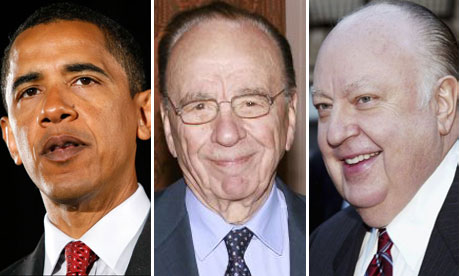
Rupert Murdoch has brokered a backroom deal that will see Barack Obama appear tomorrow on the Fox News show The O’Reilly Factor with its abrasive right-wing host Bill O’Reilly. The interview will end a long boycott of Obama appearances on the Murdoch-owned network. While many will question the wisdom of his appearance on a station that often appears to be a paid-advertorial for the Republican Party, the timing is crucial as it is designed to deflect attention from John McCain’s acceptance speech at the GOP Convention in St Paul. Fox news chief Roger Ailes confirmed the interview after a face-to-face meeting with Obama where he quoted the senator as saying "I just want to know if I'm going to get a fair shake from Fox News channel.”

Obama’s request for a "fair shake" was eminently reasonable as the station has been consistently hostile against the Democratic Presidential candidate. Fox has long been accused of conducting a campaign against him with frequent references to his middle name Hussein and their oft-repeated but incorrect allegation he was educated in an Indonesian madrassa. But with Obama still favourite to take the presidency, Murdoch was keen to broker a “tentative truce” between Obama and Ailes.

The three men met a couple of months ago at the New York Waldorf-Astoria Hotel. According to Vanity Fair’s media commentator Michael Wolff, who subsequently interviewed Murdoch, Obama was deferential to Murdoch but was highly critical of Ailes. "He said that he didn't want to waste his time talking to Ailes if Fox was just going to continue to abuse him and his wife,” said Wolff. “Fox had relentlessly portrayed him as suspicious, foreign, fearsome - just short of a terrorist.”

The question is now whether the interview means Murdoch is preparing to switch sides and support an Obama presidency. Such a move would not sit well with Roger Ailes, Bill O’Reilly or the many others that have given Fox such a Republican ideological slant over the last ten years. Fox News has been closely allied with the Bush Presidency and played a crucial role in his both his presidential victories in 2000 and 2004.

Such influence did not seem likely when Murdoch launched Fox on 7 October, 1996. At the time CNN was king of the news networks. Ted Turner set the template for 24 hours news coverage and CNN came into its own with viewers glued to its Baghdad-based reporters when the US bombed Iraq in 1991. But by 1996 Turner had sold out to Time Warner and the Republicans were complaining CNN stood for “Clinton News Network”. Even non-conservative viewers were finding its format predictable and no longer innovative. Fox News’s bright and sassy programming, modelled on the entertainment values of the Fox Network, began to slowly attract attention.

By 2000, it was regularly beating CNN in the ratings and Bill O’Reilly had overtaken CNN’s Larry King as the most popular presenter. Fox had charged ahead by changing the rules of news journalism. They were openly partisan, arrogant and pompous, sensationalistic, relied on style over substance, and openly supported the reigning government of the day and its wars. The station appealed to what the 2004 documentary Outfoxed called “the disgruntled, disillusioned and neutered male” by blaming everyone for his faults and failures except himself.

Fox also increased their popularity by vigorously attacking its critics. Bill O’Reilly became notorious for his on-air tactics. He yelled at guests whom he didn’t agree with, hectored and abused them, called them “idiots” and “boobs” and often cut off their mikes if they were becoming too “uppity”. But management never chastised O’Reilly for his heavy-handed tactics. On the contrary, Roger Ailes and his management team encouraged it. Ailes has deep roots in Republican politics (he was media advisor to three Republican presidents, Nixon, Reagan and Bush 41) and Murdoch drafted him in to run Fox News after he was sacked by rival station CNBC (now merged with MSNBC).

It was Ailes who recruited Bill O’Reilly to anchor Fox’s flagship show when the station started up. It didn’t take long for him to become the network’s biggest star. O’Reilly had been round the news traps, and was a multi-Emmy winning nomadic TV reporter and anchor of the syndicated show Inside Edition. When Inside Edition sacked him in 1995 he went back to university and got his second masters degree (to go with his earlier one in broadcast journalism) in public administration at Harvard’s Kennedy School of Government. Ailes gave O’Reilly free rein to do what he liked on his show The O’Reilly Factor. He was successful by not sounding or acting like a journalist.

O’Reilly courted controversy as a self-styled “culture warrior” and became the cornerstone of the network. He was rewarded by huge ratings, a syndicated radio show and several successful books. He quickly became loathed by the left as he cleverly conflated liberals with rapists, child molesters and murderers. Despite taking the high moral ground, O’Reilly has no manners and regularly operates outside traditional journalistic boundaries of decorum. He regularly rides roughshod over progressive voices while giving conservatives an easy ride. His audiences lapped this up.

Ahead of tomorrow’s interview with Obama, O’Reilly is conciliatory but continues to show a distinct preference for McCain. On Tuesday he called Obama “a charismatic man, he'll win among minority voters, and his entitlement message is powerful.” But, said O’Reilly, the US media are overselling him, and the voters “want their family safe and someone who will get control of the economy.” O’Reilly left his viewers in little doubt which candidate he believed would be better on those two issues.

But McCain does not fit the Bush ideological template that Fox has so assiduously nurtured over the last eight years. He is a renegade Republican. More importantly, he may not win and Murdoch does not like backing losers. According to Wolff, when Murdoch met Obama he had just one simple message to share with him. He had met every American president from Harry Truman on and believed none of them got much time to make an impression. Leadership, according to Murdoch, was about what you did in the first six months. The truce the two men subsequently declared, said Wolff, could be of “vast historical significance”. But even if this is true, can Murdoch drag his ideologically-heavy network with him towards the middle? The O’Reilly Factor will be the first test. As the Scotsman says, it could be a short truce.

Saturday, August 30, 2008

The 300 days war rumbles on: McCain chooses moose mate

When I heard it on the radio news this morning, I thought John McCain had selected Michael Palin as his running mate. When I heard the female voice it was clear I was wrong (though I think the Yorkshire man would be a useful addition to any ticket). No, it wasn’t a stiff upper lipped Limey, instead it was the little-known Governor of Alaska and “mom of five” Sarah Palin that was now a good shot for the Vice Presidency. Andy Borowitz explained best McCain’s reasoning in his imagination of the senator’s own in-no-way defamatory words. "Let's say a constituent calls you and says that a caribou has wandered onto his front lawn," he said. "My friends, Barack Obama wouldn't know what to do."

But Sarah Palin would indeed know what to do. She’d shoot it. The 44 year old cleanskin and winner of the Miss Wasilla pageant must be a very formidable woman to get to be governor of a wildcat alpha male state like Alaska. Nevertheless, Palin is a long shot; but interestingly now, the Republican package is a good mirror image of the Democrats one as this long electoral war of attrition nears its end.

The war is taking its toll on all the players. Obama has lost his near impregnable lead over the last few months and is hoping the Clinton fairie dust works its magic after the Democratic Convention. The elephants are slowly clawing their way into the contest as John McCain seems most intent on provided nothing more exciting than an error-free campaign. Perhaps the biggest error is the name at the top of the ticket. McCain is barely tolerated in the Republicans and may not even be the best candidate in his family. The UK Independent asks why isn’t Cindy McCain’s name the one on the ticket?

Of course, the rest of the media ran with glee the offering about the McCain’s inability to remember how many houses they have (ten, apparently), the donkeys hee-hawed in Denver. This was an important moment. The fourth anniversary of Obama’s coming out speech at the 2004 convention. This time round, he set a TV record as 38 million people watched what he had to say. That was more than watched the Olympics or American Idol. And well more than ten million up on either Bush or Kerry in 2004.

The four-night Democrat convention ranks as the most-watched convention of either party since ratings began watching Kennedy and Nixon in 1960. The party had rejoiced in the But while American were happy to watch the asses in action last week, the elephants outside the room were being ignored. The Grand Old Party’s convention begins Monday in Minneapolis Saint Paul (Actually its in the state capital Saint Paul, but its Minnesota twin city Minneapolis, like the elephants, must always be mentioned in dispatches).

There is talk that the start may be delayed if Hurricane Gustav strikes New Orleans. Apart from the potentially embarrassing memories of Katrina, profit-driven media units are full stretch to cover two major stories in the same timeframe. The Republicans are worried that their precious news time will be stolen by all those great pictures of heavy seas and rooves coming clean off. Hence the move to announce Palin early. The sheer novelty value alone will eat bandwidth, broadcasting spectrum and column inches for the whole weekend until the storm hits, as well as killing off the buzz created by Obama’s own convention speech.

Nonetheless it is important to consider what this black-and-white scion Barack Obama had to say. He began by reminding his audience of the speech he made four years earlier. This was the story about “the brief union between a young man from Kenya and a young woman from Kansas who weren't well-off or well-known.” The product of that union described the promise that set the US apart. Apart from what, he didn’t say. But the promise involved “individual dreams (that) still come together as one American family”.

Obama claimed we were in a defining moment – “a moment when our nation is at war, our economy is in turmoil, and the American promise has been threatened once more.” He claimed to speak for the unemployed, suffering home owners, those with credit card bills, and the poorly educated. While Obama said Bush was not to blame for all these people’s predicament, he said their lack of decency, generosity and compassion mean that America had to show it was “better than these last eight years”.

Many wonder whether Obama has the capability to match the fervour of his words. His extraordinary ratings numbers alone suggest this is a phenomenon that will be rewarded with victory in November. His voting record as a federal and an Illinois legislator shows him comfortably in the Democratic mainstream of sympathy for lower-income people. He has voted against Arctic and Gulf drilling and also against Bush’s choice for Chief Justice John Roberts. Obama was sceptical about Roberts’s deepest values and his “broader perspectives on how the world works” and his empathy. Why? “He has far more often used his formidable skills on behalf of the strong in opposition to the weak,” said Obama. Come November we will finally see who Obama’s own formidable skills will be used for.

Sunday, August 24, 2008

Doing Obama’s Biden: Delaware Senator is VP choice

Barack Obama formally announced Delaware Senator Joe Biden as his running mate at a rally in Springfield, Illinois yesterday. The news had first been released in the form of emails and text messages sent to millions of supporters earlier in the day with Obama hailing Biden as a “distinguished leader”. The 65 year old six-term senator offers an obvious differentiating factor to Obama with Democrats calling out his vast political experience especially in the field of foreign affairs.

The McCain campaign immediately went on the offensive calling the choice of Biden an admission that Obama was not ready to be president. While John McCain called Biden “a wise selection”, his spokesman Ben Porritt was less conciliatory saying Biden was a harsh critic of Obama. "Biden has denounced Barack Obama's poor foreign policy judgment and has strongly argued in his own words what Americans are quickly realising - that Barack Obama is not ready to be president,” he said. The McCain camp followed this up with an attack ad of footage of Biden criticising Obama.

Nevertheless, Biden is a carefully considered choice. With just three electoral college seats in a north-east state that were likely to go to the Democrats anyway, Delaware was not an obvious match for the Illinois presidential candidate. However Biden’s has three crucial aces in his pack that made him the stand-out choice to support Obama. Firstly his tenure as chair of the Foreign Affairs Select Committee gives him international gravitas sorely lacking in the younger man. Secondly his appeal to working-class Americans may see him pick up votes for the team that went to Hillary Clinton in the primary campaign. Thirdly is the fact that Biden is a native of Pennsylvania, one of the crucial swing states in the election.

Biden himself has run for President twice, firstly in 1988 and again this year. In 1988 his campaign was sensationally cut short when it was discovered one of his speeches was plagiarising British Labour leader Neil Kinnock. Just days later the New York Times reported Biden had also plagiarised a law review article in his first year university law course. When Biden compounded the problem by claiming his degree was better than it was, he was forced to withdraw from the campaign blaming “the exaggerated shadow” of his mistakes.

Biden came out of the shadows twenty years later and announced he would run again for president in early 2007. This brought him directly into contention against Barack Obama who, like Biden, was then seen as an outside chance compared to Hillary Clinton. Biden had just spearheaded the Democratic pushback against President Bush’s plan to increase troop levels in Iraq and was keen to establish his credentials in this area against the other candidates. In February 2007 he told the New York Observer that Obama was “articulate and bright and clean and a nice-looking guy” but doubted whether American voters are going to elect “a one-term, a guy who has served for four years in the Senate.”

But Biden’s own presidential campaign never got off the ground. Biden was a solid enough performer and avoided the mistakes of 1988. He probably had the best quip of the campaign when he said of Rudy Giuliani “there’s only three things he mentions in a sentence: a noun, a verb and 9-11.” He was also contemptuous of the neo-con agenda and called Bush “brain dead”. However he was forced to withdraw from the race after picking up just one percent of the Iowa caucus delegates.

Now it will be Biden’s job to sell Obama despite the inexperience problem he himself had diagnosed a year earlier. Plenty has changed since then including Biden’s own views. In June he told NBC’s Meet the Press he was interested in the Vice Presidential position. "If the presidential nominee thought I could help him win — am I going to say to the first African-American candidate about to make history in the world that, 'No, I will not help you out like you want me to'?” he said. “Of course...I'll say yes."

It will be Biden’s job now to heal the faultlines the primary campaign exposed in the Democrats. Obama drew on overwhelming support from blacks and his strengths are among well-educated and middle class voters. Primary exit polls also showed mass support among the under 30 year old voters. Biden can help with the white, ageing underclass that Hillary Clinton won and that might be otherwise tempted to sway to McCain. He will be an effective attack dog without being “all that exciting”. With the media parsing every utterance from the candidates from here to November, a safe and steady run-in is precisely what the Obama campaign needs now.

Sunday, August 03, 2008

Obamania: the making of a black president

Campaigning in Florida, Barack Obama refused to label John McCain’s new attack ads as racist, instead calling them cynical. McCain’s ad released earlier this week focussed on Obama’s celebrity status in Europe and compared him to Britney Spears and Paris Hilton. The ad got heavy airplay on the Internet and broadcast media. And as McCain struggles to get traction in opinion polls, there is little doubt that Obama’s background will play in an increasingly important in the campaign still to come.

There is also little doubt that Obama is the most “exotic” presidential candidate in living memory. Obama’s father, also called Barack Obama, was a Kenyan of the Luo tribe, born on the shores of Lake Victoria in the village of Alego. Obama senior was the son of a goat herder and attended the local school set up under the British colonial administration. The name Barack means “blessed” and the young man certainly seemed to live up to his name as he won a scholarship to study in Nairobi. On the eve of Kenyan independence, he was selected to study at a US university. In 1959, aged 23, he became the University of Hawaii’s first African student and emerged three years later top of the class with a degree in econometrics.

In a Russian language class at university, he met a shy 18 year-old American girl and they fell in love. The couple married and had a son Barack junior. But then Barack Obama snr won another scholarship to do a Ph D at Harvard. He was unable to take his young family with him. The separation became permanent as Obama went back to his native Kenya to fulfil his promise in the young black nation. Barack junior was just two years and he would see his father just once again in his life.

Obama’s mother Stanley Anne Dunham sought a divorce and stayed on in Hawaii with her son. She eventually met another foreign exchange student, Lolo Soetoro, an army geologist from Indonesia. Stanley Anne married Lolo and she followed him back to Djakarta with her young son a year after the brutal overthrow of the Sukarno regime. Under Lolo’s tutelage, young Barack learned the Indonesian language and the art of boxing. His local education was supplemented by a US correspondence course while his mother kept up his English lessons.

Stanley Anne decided it was time for her 10 year-old son to attend an American school. She sent Barack back to Hawaii to live with her parents. He was enrolled into the Punahou Academy, an elite school which traced its heritage to 1841 when it was started by missionaries. Meanwhile Barack’s mother had separated from Lolo and returned to Hawaii to pursue a master’s degree in anthropology. It was here also that Barack’s father paid him his one and only visit for a month. Barack snr returned to Kenya and was eventually killed in a car crash in 1982.

As a teenager, Barack Obama junior discovered black literature and began to read the works of Baldwin, Ellison, Hughes, Wright and DuBois. In his autobiography of his early years “Dreams from my Father”, Obama described these writers as “exhausted, bitter men, the devil at their heels”. Only Malcolm X’s biography appeared to offer a more positive message. The young Obama was impressed by his “repeated acts of self-creation” and was haunted by the similarities of their bloodline and the need to “expunge” his white heritage.

After high school, he moved to Los Angeles where he enrolled as “Barry Obama” at Occidental College near Pasadena. Here he fell in among the college’s large black population which was heavily politicised in an era when Ronald Reagan was about to inherit the US presidency. Obama joined a campaign to persuade African National Congress representatives to speak on campus. It quickly became apparent the young man was articulate and an excellent organiser.

But after two years, Obama had tired of L.A. When Barack learned about a transfer program with New York’s Columbia University, he quickly applied. Obama finished his studies here and emerged from Columbia clutching a degree in political science. In 1983 he decided his future lay in community organisation. In his own words he wanted to “organise black folks. At the grass roots. For change”. After applying to every civil rights organisation he could think of, he was eventually accepted by a consulting house on multinational corporations as a research assistant. He found the work boring and lasted only a few months. Obama drifted from job to job between being unemployed and broke.

In 1985, he was hired by an old friend Gerald Kellman (known as "Marty Kaufman" in Dreams of my Father) to come to Chicago to organise poor blacks save their manufacturing jobs. Although the city had a black mayor in Harold Washington, Chicago had the reputation of being the most segregated city in the US. With Kellman’s help, Obama began organising for a group called the Developing Communities Project (DCP) which was a church support group for blacks who were being squeezed out of their blue collar jobs and entitlements.

Obama started to interview his new constituents and began to understand their problems with unemployment, poor housing, police harassment and racism. He spoke to church groups and urged co-operation and the restoration of pride into battered communities. Obama recruited a team to help the DCP spread a message of hope. He found an issue he could tackle – the lack of training programs in the black suburbs – and formed alliances with local leaders, and lobbied the Chambers of Commerce and the Mayor’s office.

Gradually, Obama’s tireless energy turned the DCP into a superior lobbying organisation. His staff grew as more money entered the coffers and he was gaining a sense of political awareness. As well as setting up job programs, Obama started education programs for poor blacks and organised the tenants' rights group in the slum asbestos-ridden project of Altgeld Gardens. Here also he met the Reverend Jeremiah Wright who had similar ideas on community regeneration. Wright would become his mentor, marriage celebrant and a valued friend (until his comments in this year’s election campaign attracted the wrath of the right-wing media).

Barack Obama’s life-changing experience was his five-week visit to Kenya in 1988. There he met his father’s family including his own half brothers and sisters. He learned about his father’s role in KANU, the party run by the first Kenyan leader Jomo Kenyatta. Obama came away optimistic and convinced that the ties that bind wound prevail over expedience and greed. Crucially he also shed his belief in the importance of colour. On his return to the US, Obama went on to Harvard Law School where his glittering career really took off. He became president of the Law Review, published his memoir and taught law in Chicago. His election to the Illinois Senate in 1996 began a political career that, attack ads notwithstanding, appears to be taking him to the White House in November. As he wrote in “Dreams”, Obama still has the look of someone “mildly bewildered by the attention, and constantly aware of the gulf between the hard sheen of media reports and the messy, mundane realities of life as it is truly lived."

Saturday, January 06, 2007

Barack the Blessed

Everyone expects Barack Obama, the new golden boy of US politics, to comfortably overcome his own revelation he used cocaine and marijuana in high school and college. Obama made the confession in his memoir “Dreams of my Father.” The Illinois Democrat senator finally admitted recently he was considering a bid for presidential nomination. The book revelation offers him the chance to wash his dirty linen in public now so that it will not become an election issue in 2008. Given similar indiscretions in the past by Bill Clinton and George W Bush, the admission may even be an electoral plus.

Obama is the US’s hottest political phenomenon. He is now being seriously talked up as America’s first black president. His fresh-faced appeal, allied to his intelligence, charisma, and common touch are turning heads across the country. Though Obama has only been a senator for two years, a November 2006 poll for CNN placed him second only to Hillary Clinton on a list of potential Democrat candidates in 2008. The polls show he has 17% support of registered Democrats compared to Clinton’s 28%. He heads other potential nominees such as Al Gore and John Kerry and the one man who has formally put his hat in the ring, John Edwards. Obama’s increased support comes at the expense of Clinton and Gore. Clinton’s vote has dropped ten percentage points since the previous poll in September. The same poll shows John McCain and Rudy Giuliani running neck and neck on the Republican side.

The ambitious Obama is starting to work the marginal states. Virginia came into the picture after Democrat James Webb upset incumbent Republican George Allen in a race for senatorship in the 2006 midterm elections. Many believe that Obama’s turn at a Richmond fundraiser in February could be a keynote speech if he formally announces his presidential candidacy as expected this month. The Virginia primary is one of the earliest in the race (February 2008) and Kerry won it easily last time to effectively knock John Edwards and Wesley Clark out of the running.

Obama is 45 years old and the only African-American currently in the Senate. His father, also named Barack Obama (the word barack means “blessed” in the Central African language of Luo), was a goat-herder from Kenya and his mother, Ann Dunham was born in Kansas and moved to Honolulu. They met while studying at the University of Hawaii. Barack himself was born in Honolulu in 1961. His parents divorced when he was two and his father returned to Kenya. Ann remarried to another international student of the university. Barack's new stepfather was an Indonesian, Lolo Soetero. The family moved to Jakarta when Barack was six. Aged 10 he returned to Hawaii to live with his mother’s parents. He studied at New York’s Columbia University where he emerged with a degree in political science. After working for a communities project in Chicago, Barack went to Harvard law school and gained his doctorate in law in 1991. He returned to Chicago where he worked for a civil rights law firm and taught constitutional law at the University of Chicago.

In Clinton’s second election year of 1996, Obama was elected to the Illinois State Senate. He ran for the federal House of Representatives in 2000 but lost comfortably to incumbent Bobby Rush who was a member of the Black Panthers in the 1960s. Obama was re-elected to the Illinois senate in 2002 and the Democrats won control of the chamber. He was rewarded with the chair of the Senate Health and Human Services Committee. Obama quickly won a reputation as a consensus politician which won him support when he ran for the federal Senate. He secured his status as a rising star with a rousing speech at the Democratic National Convention in July 2004.

Aided by this publicity and support from two of Chicago’s most influential newspapers, the Tribune and the Sun-Times, Obama emerged from a crowded field to comfortable win the Democrat nomination. His republican opponent Jack Ryan withdrew due to sexual allegations and Obama easily beat Ryan’s late replacement by a margin of 43%. Obama spent his first year as senator building up his credentials. His first act was to sponsor a higher education bill for needy students. He has also been heavily involved in immigration, weapons non-proliferation, and funding accountability bills. He has been on international missions to Eastern Europe, the Middle East and Africa.

Enthusiastic crowds turned out to greet him in Kenya, his late father’s homeland. He was treated as a rock star by adoring crowds who followed his every move. Obama took a voluntary HIV test in a Kenyan clinic to encourage locals to do the same. He laid a wreath at the site of the US embassy bombing and he mad a major speech at Nairobi University where he accused Kenyan leaders of corruption and implored the country to rise beyond its ethnic tensions.

Back in the US thoughts have turned to 2008. After repeatedly denying interest in running for the top job throughout 2006, Obama left the door open in October. In an interview with Meet the Press he said “I don’t want to be coy about this, given the responses that I’ve been getting over the last several months, I have thought about the possibility”. Despite the favourable polls his thinking may well be to delay to 2012 when he will have 8 years as a senator under his belt. Even by 2016 he will only be 54, easily young enough to contest the presidency.

Obama often jokes that people are always getting his name wrong, calling him "Alabama" or "Yo Mama". However no mix-up has been quite as bad as CNN’s “The Situation Room” which last week confused Obama with Osama Bin Laden. A package promoting a story on the search for the al-Qaeda leader aired with the headline "Where's Obama?" CNN said the blunder was a "bad typographical error" by its graphics department. Senator Obama's press secretary, said: "Though I'd note that the 's' and 'b' keys aren't all that close to each other, I assume it was just an unfortunate mistake, and don't think there was any truly malicious intent." CNN won’t be making that mistake again. Osama may have disappeared off the radar, but Obama is here to stay.