Wednesday, November 15, 2006

The Also-Rangoon

Last Sunday the military rulers of Myanmar, otherwise known as the Union of Burma, held a ceremony to lay a foundation for a pagoda. The pagoda will be in their controversial new capital city Naypyidaw. It was breaking ground for a Buddhist temple that will be a replica of the golden Shwedagon pagoda in Rangoon. The timing of the ceremony was determined by a mixture of astrology and numerology. The head of Burma’s military Junta General Than Shwe started the mystical ceremony by striking a gong. They finished by sprinkling scented water on a hillside overlooking the new capital Naypyidaw. When complete, the 98m high pagoda will match the size of Rangoon’s one. It is designed to be visible from all roads in the capital.

The ceremony commemorates the first anniversary of its November 2005 sudden announcement that Burma was to have a new capital city. The newborn town would be in the centre of the country; 320km north from Rangoon. It was a remote rural area near the town of Pyinmana. The new greenfields township was officially named Naypyidaw in a ceremony in March this year. The name means "seat of kings" in Burmese. State television footage of the ceremony showed only the marching troops but none the construction-site capital itself. Few outsiders have been allowed to visit the site which lacks most of Rangoon's advantages. The official government position is that the new administrative hub is more centrally located than Rangoon, and therefore better able to serve the nation. Analysts say the real reasons are more likely to be a combination of fear of foreign attack, ease of dealing with border insurgents or even the advice of fortune-tellers.

The new capital is surrounded by mountains and dense jungle. Although construction had already been going on in secret for two years before the 2005 announcement, Government staff found out about the move at the same time as the rest of the world. Civil servants disgruntled at the prospect of moving out of the city were warned that they would face treason charges if they refused to relocate. The junta moved swiftly. They began moving government ministries immediately after the announcement. And because astrology plays an important role in the Burmese politics, they appointed a committee of astrologers to help draft policies and decide on what date a festival should be held.

Military experts say Pyinmana's central location will make the government better able to monitor the rebelling border regions such as ethnic minorities of Rakhine and Chin in the north-west, Kachin and Shan in the north and the Karen people in the east. The Karen National Union (KNU) has been fighting the Rangoon government since 1948. General Sarki of the KNU said there are two reasons for moving the capital: firstly, if the US did invade, the junta could seek refuge in the mountain forests; and secondly, Naypyidaw’s geographic location makes it easier for the military to control border regions inhabited by ethnic minorities such as the Karen.

The new capital will contain military headquarters, diplomatic quarters, a parliamentary building, government buildings, mansions for officials, national headquarters for ethnic groups, an airport, a military hospital, a golf course, bunkers and secret tunnels. What the city does lack are schools, housing and other critical services. An anonymous government official who fled the country said “those who are not able to go abroad have no choice, but if the government allowed resigning most of them would have gone.”
Those civil servants who were forced to move first are living as refugees in the concrete shells of unfinished buildings, mostly without running water or electricity. The major roads remain unpaved and malaria is rampant. Military headquarters will be separated from the government ministries, and civilians will be banned from entering either compound. Vendors will be restricted to a commercial zone near the government offices. The usage of mobile phones and satellite television will be curtailed.

Political analysts say the move is designed to further isolate Burma’s democratic opposition and limit the influence of Aung San Suu Kyi. In Rangoon, roadblocks remain in place outside her lakeside house. She remains a thorn in the side of the generals and her continued arrest has been condemned by many in the West. Burma is suffering tough US sanctions on textile exports and the banning of all new investment. Ever since the change in US foreign policy since 9/11, the generals have feared a foreign invasion. And because they are military men, they have been making serious contingency plans. One of the first bits of infrastructure built was a battery of anti-aircraft artillery and missile silos.

Astrology has played a large role in the decision to relocate. The current leader General Than Shwe is known to be extremely superstitious. The move was planned for a particularly auspicious date and a soothsayer recently proclaimed that Rangoon was on the verge of collapse. Than’s predecessor, General Ne Win, was equally superstitious and he once insisted that every denomination of the country’s currency be divisible by his lucky number nine.
Burmese exiles in Thailand have also claimed the new capital will be located conveniently close to a secret spot in the western Shan Hills. Here is where Burma’s nuclear programme is being developed with help from China and the A Q Khan network. This area is frequently shrouded by mist and is difficult to monitor by satellite. Burma may also have sought to buy nuclear weapons from North Korea.

Whatever the reason for the new capital, the move is hugely expensive in lives and money. 80,000 workers have toiled in miserable malarial conditions at a total annual labour cost of $32m. Meanwhile the ordinary people of Rangoon are cursing the disruption to their lives. "The government's crazy. Everybody hates this idea," said Soe an anonymous Rangoon man to the Washington Post. His cousin is a military officer who has been transferred to the new capital. "This Pyinmana, I wish I could blow the place up."

Tuesday, November 14, 2006

Killing Cars

Yesterday, General Motors announced the launch of a new H3 Hummer truck in 2009. The vehicle, which began life as a high-mobility vehicle (Humvee) for the US military, is key to GM’s strategy as it tries to recover from a $US10.6 billion 2005 loss. Global Hummer sales rose 54 per cent in the first nine months of 2006 despite high oil prices, while overall GM sales fell 2.5 per cent. Hummers have been roundly criticised for their low fuel economy, massive bulk and environment destructiveness when used as off-road vehicles.

The popularity of the Hummer is mainly due to favourable US tax breaks and lax emission standards. A $50,000 H2 attracts a federal tax deduction of $38,000. Owners take advantage of a loophole which allows tax breaks on vehicles with a gross weight of 6,000 pounds (2720 kg) or more which was meant to help farmers afford tractors, large trucks and other heavy equipment. But many SUVs, including the 2,900 kg H2, fall into that heavyweight category. Typical SUV owners include executives, doctors, real estate agents and lawyers are now all qualifying for the deduction. Truck-type vehicles are also held to weaker emissions standards than passenger cars.

The growth in the use of the H2 is in direct comparison to how General Motors treated the EV1 – the electric car. Filmmaker and ex EV1 driver Chris Paine made the feature length documentary “Who Killed the Electric Car?” The film documents the history of the electric car in the US focussing on GM’s EV1. GM built the EV1 in response to California’s Zero Emissions Vehicle (ZEV) Mandate of 1990. California specified that by 1998, 2% of all new cars sold were to have no emissions. GM spent over $1 billion developing and marketing the EV1 much of which was defrayed by the Clinton Administration's 1996 Partnership for a New Generation of Vehicles (PNGV) project.

The EV1 was first displayed as a concept at the 1990 Los Angeles Auto Show under the name of “Impact”. It took six years to get it onto the road. The first purpose built two-seater electric vehicles were made available in 1996 on three year leases to about a thousand drivers in California and Arizona. It could be plugged in for recharging at home and at a number of so-called battery parks. The first generation EV1 used a lead-acid battery which required re-charge after approximately 100kms. In 1999, a new car with a nickel metal hydride battery could run for approximately 200kms without charge. The EV1 had the lowest wind resistance of any production vehicle in history and the only audible noise was the whirr of the tyres, with nothing from wind or motors. The EV1 could accelerate from 0-100kph in under ten second and had a top speed of about 130kph.

In 2001, the California Air Resources Board (CARB) modified the ZEV Mandate to allow manufacturers to claim partial ZEV credit for hybrid vehicles. General Motors and Daimler Chrysler then sued the state of California and CARB, alleging the new rules violated a federal law barring states from regulating fuel economy. The oil companies Exxon and Mobil joined the suit as did the federal government under the new Bush administration. Vice President Cheney and Secretary of State Rice had major links to the oil industry. And ex-Chief of Staff Andrew Card came to the White House from GM where he was appointed Vice President of Government Relations in 1999.

But even before the Bush team was elected, GM was already scaling down their operation. Barely a month after releasing the second generation EV1 in 2000, the car manufacturer announced it was closing down the production line due to insufficient demand. They recalled all EV1 due to thermal problems and although they returned them to the original lessees, they told everyone on the waiting list they would no longer be able to lease a vehicle. Under the considerable external pressure of the law suit, CARB finally backed away from their ZEV mandate in 2003. GM’s response was swift. The entire program was cancelled. They claimed they halted production because there were only 800 paying customers. Activists contended GM ignored a waiting list of 5,000 because the EV1 threatened the future of the rest of GM’s fleet based on the internal combustion engine.

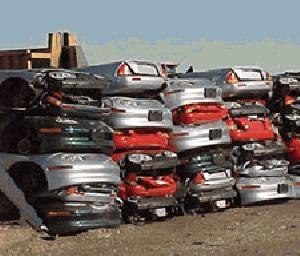
The last private lease expired in August 2004. The cars were stored at a facility in Burbank, California before being transferred to the GM Desert Proving Grounds in Mesa, Arizona. There they were crushed and recycled. GM refused all requests from lessees to purchase the vehicles. The reason GM gave for refusing was to avoid legal liabilities. GM claimed the EV1 was not a failure but that battery technology was not advanced enough to support it. Nearly all models have now been destroyed apart from a small amount of cars (minus working battery) GM donated to colleges and universities for engineering students. Several museums also have EV1s in their possession.

One of those museums is Washington’s esteemed Smithsonian Institution. However in June this year, the Institution pulled its model from display in advance of the release of “Who Killed the Electric Car?” GM is a donor to the museum but a spokesman claimed there was no conspiracy and it simply needed the space for another vehicle. Filmmaker Chris Paine said he was disappointed the EV1 was in the museum at all. "It's an example of what the 21st century can be in this country, if we had the willpower to do it," he said. "The Smithsonian should take the car out of the museum and put it back on the road."

Monday, November 13, 2006

unending hatred in Haiti

Two Jordanian UN peacekeepers were shot dead in Haiti on the weekend. Unidentified gunmen attack a UN convoy as peacekeepers were heading back to their base near a slum area of the capital Port-au-Prince. The 8,000 UN peacekeepers in the country are facing increasing slum violence. Many slum dwellers have accused them of firing indiscriminately into civilian crowds during gun battles with gangsters. Opposition is growing to the Brazilian-led force who were sent into the country to restore order after a bloody 2004 revolt ousted then-President Jean-Bertrand Aristide. The death of the two Jordanians brings the total UN dead to nine since the mission started in June 2004.

French-speaking Haiti occupies the western third of the island of Hispaniola. It shares a land border with the Spanish-speaking Dominican Republic. The island was initially inhabited by Taíno and Amarak Amerindians. The Taino called the island Quisqueya which means "mother of the earth" whereas the Arawak name, Ayiti, was reintroduced in 1804 as the name for independent Haiti. Columbus ran aground on the island in 1492 and claimed it for Spain. He named the island La Española for “the Spanish”. The name was eventually anglicised to Hispaniola. Columbus left a settlement on the island but when he returned a year later the settlers had all disappeared. He left his brother Bartholomew to start a new colony. The impact on the Taíno and Amarak was devastating and most died due to old world diseases and repression. French pirates established a toehold on the island in 1625. In 1664, the newly established French West India Company took control over the colony, and France formally claimed control of the western portion of the island of Hispaniola. Spain formally ceded control to France after the Treaty of Nijmegen ended the Franco-Dutch war in France’s favour.

Settlers begun to grow tobacco, indigo, cotton and cacao using African slave labour. An estimated 800,000 slaves were brought to work on sugarcane and coffee plantations which amounted to a third of the Atlantic slave trade. In 1681 Louis XVI enacted the code noir, which gave basis human rights to slaves and responsibilities to the master to feed and clothe them. The code sanctioned corporal punishment and many slaves escaped to the hills to avoid its harsh sanctions. The 1789 French Revolution had a powerful effect on the colony. Within two years, the slaves revolted. Over the next 12 years, slaves burnt plantations and killed their overseers. The French were weakened by a British naval blockade and Napoleon was unwilling to send reinforcements. Finally in 1804, Haiti declared independence from France, the first and only successful slave rebellion. The cost of freedom was high. Haiti was forced to make reparations to French slaveholders in 1825 in the amount of 90 million gold francs. It took 100 years to repay and turned Haiti into the poorest nation in the western hemisphere. And because of resistance from the US slave states, Haiti was not recognised by the US until 1862.

Haiti survived a period of rebellions until it achieved some stability with the constitution of 1867. This period of growth ended when in 1911 when revolution broke out and the country plunged into debt and anarchy. In four years there were six different Presidents, each of whom was killed or forced into exile. The US military occupied the island in 1915 due to threats to business interests in the country. They ruled Haiti for the next twenty years. Franklin Roosevelt removed the marines as one of his first acts of presidency. The US trained local military was only cohesive institution left in the wake of withdrawal. This resulted in a series of military-backed dictatorships over the next 50 years.

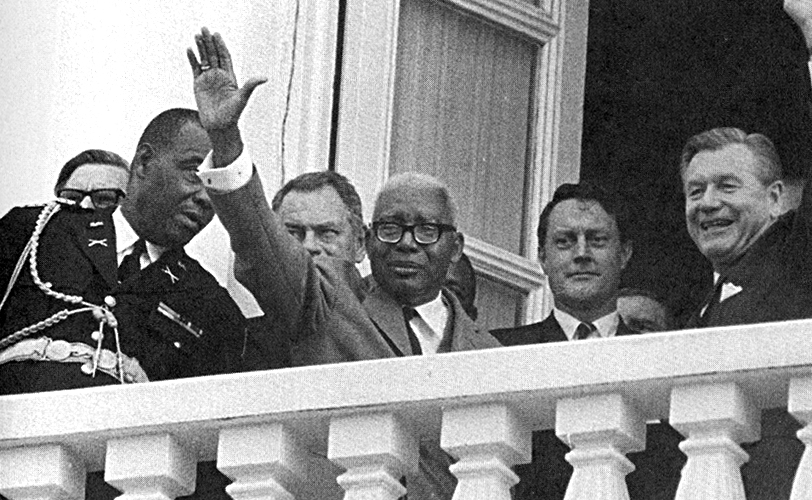
The most famous of these were the Duvaliers; Dr Francois Duvalier and his son Jean-Claude who between them ruled Haiti from 1957 to Jean-Claude’s overthrow in 1986. Francois, nicknamed Papa Doc, was a country doctor who won acclaim for his role in fighting typhus. He won office by presidential election but soon abandoned any notion of democracy. He enlisted the aid of a private army modelled on Mussolini’s Blackshirts known as the Tonton Macoute. The Tonton Macoutes were known for wearing dark glasses, wielding machetes, and leaving their victims hanging in a public place as a warning to others. Papa Doc revived the traditions of Haitian voodoo and killed nearly all of his political enemies during his 14 years in power.

He declared himself "president for life", and rewrote the constitution after a rigged election to pass power onto his overweight and dim-witted 19 year old son Jean-Claude upon his death. Known as Baby Doc he somehow managed to gain public affection and support from the US. His mistake was to marry a light-skinned mulatto and he lost much support in the black community. Pope John Paul II visited Haiti in 1983 and said “something must change here”. Within two years the country revolted. The game was up for Baby Doc when he lost the support of the US Reagan administration and he fled to France.

The charismatic Jean-Bertrand Aristide was elected president in 1991 and he ushered in a new period of optimism. It was short-lived. He was brutally deposed in yet military coup. The US invaded again in 1994 to overturn this coup and Aristide’s ally Rene Preval was elected president. Preval was the first democratically elected Haitian leader to serve out a full term. Aristide returned to power in 2001 but was overthrown by a 2004 coup after he attempted to disband Haiti’s feared and despised military. Aristide accused US President Bush of supporting the rebels. The US sent in marines again. Chief Justice Boniface Alexandre was appointed interim leader and he immediately asked the UN to intervene with an international peacekeeping force. Brazil leads the MINUSTAH (Mission des Nations Unies pour la stabilisation en Haïti) force with a mandate to “"to concentrate the use of its resources, including civilian police, towards increasing security and protection during the electoral period". In July 2005, MINUSTAH carried out a raid in a Port-au-Prince slum targeting a base of illegally armed rebels. Estimates of fatalities ranged from 5 to 80 but the incident served to harden resistance against the force.

Elections were finally held in February 2006, and the well-respected René Préval was elected president for a second term. But Preval is helpless to solve his country’s issues without external support. Yesterday, the president of the neighbouring Dominican Republic urged international help to solve the intractable problems of Haiti. On a visit to Washington, President Leonel Fernández urged President Bush to "help Haiti in any way you can." Asserting it "may have been a mistake" to disband the military, he said the police cannot handle the security challenges alone. Haiti remains one of the poorest countries in the world with about 80% of the population living in abject poverty.

Sunday, November 12, 2006

Clusters last stand?

There was a small victory today for that much-maligned force called international law. A Geneva conference led by Sweden announced a new law will soon come into force requiring countries to clear up unexploded bombs and mines or pay teams of de-miners to do it. Is this what they meant by carbon trading? The treaty covers ordnance such as land mines and cluster bombs. The US, China, Russia and the UK all oppose the outright banning of them at the moment or as Washington lawyer and leader of the US delegation to the Geneva conference Ronald Bettauer said the “time is not right to discuss a ban… because the bomb still plays an important military function”.

Simon Conway of the Landmine Action charity says the weapon is a redundant legacy of the Cold War, designed for use against mass Warsaw Pact army formations charging across the central European plain. The conference is taking place in Geneva as Switzerland and the UN back calls for cluster bombs to be outlawed. Debate over the use of the weapon intensified after Israel dropped them on southern Lebanon in its month-long war against Hezbollah militia earlier this year.

Cluster bombs are dispensed or dropped from an aircraft. Dropped ordnance is divided into three subgroups: bombs; dispensers, which contain submunitions; and submunitions. Submunitions are classified are “bomblets” , grenades, or mines. Some are very small and are delivered on known concentrations of enemy personnel, scattered across an area. They are used to primarily kill infantry. Cluster bombs were developed first by Germany in World War II with their "Butterfly Bomb." It was so called because it fluttered in flight. It was quckly copied by the Russians, US and Italians. They were used in 2003 in Iraq and earlier this year Israel used cluster bombs in several areas in South Lebanon, including the towns of Blida, Hebbariyeh and Kfarhamam.

The problem with cluster bombs is that some don’t explode immediately. Like land mines they leave a dubious legacy to the peacemakers after a war. It may seem puzzling that such an unreliable weapon, which makes no distinction between friend and enemy, is not banned. But as George Monbiot (via Taiwan!) said “The necessary resources, both economic and political, will always be found for the purpose of terminating life”.

Britain announced on 9 November is to phase out "dumb" cluster bombs and join negotiations aimed at imposing global limits on their use. That leaves the US, China and Russia to convince. And shame, if necessary.

Saturday, November 11, 2006

The Eleventh hour

Acting Queensland Premier Anna Bligh and Brisbane Lord Mayor Campbell Newman led the dignitaries at the Brisbane Remembrance Day commemorations in the city today. At 11 am local time, they laid wreaths at the Anzac Square shrine. The ceremony was repeated in cities and towns throughout Australia to mark the 88th observance of the end of World War I. One hour prior to the Brisbane event, the Prime Minister, Governor-General and Defence Minister attended the Canberra ceremony and observed a minute's silence at 11am Australian Eastern Daylight Time. 61,000 Australians died and another 150,000 were wounded in the so-called Great War, the war to end all wars.

The event commemorates the time of day the war ended. At 11am on 11 November 1918 the guns of the Western Front finally fell silent after more than four years of brutal trench warfare. The allied armies of Britain, France and the US had repelled the German invaders. With American tanks, the balance of war swayed towards them as they inflicted heavy defeats upon the Germans in the final four months of the war. In November the Germans accept terms of unconditional surrender and called for an armistice to end the war. The poetic timing of the event, the eleventh hour of the eleventh day of the eleventh month, helped to cement it in grateful public affections. Up to 13 million people died in the conflict that destroyed the empires of Germany, Austria, Russia and Turkey.

In May 1919, an Australian journalist Edward George Honey wrote a letter to the London Evening News in which he proposed a respectful silence to remember those who had given their lives in the war. The letter caught the attention of King George V and on 7 November he issued a proclamation which called for a two minute silence. On the first anniversary of the armistice four days later, the two minutes' silence was instituted as part of the main commemorative ceremony at the new Cenotaph in London. In Britain, the second Sunday of November is now known as Remembrance Sunday. At 11am on this day, a two minute silence is observed at war memorials, cenotaphs, religious services and shopping centres throughout the country.

11 November 1920 was the second anniversary of the armistice and the commemoration gained added significance when it became a funeral. Four years earlier a British chaplain at the Front in France noticed a make-shift grave marked by a rough wooden cross across which was written "An Unknown British Soldier". Four years later he wrote to the Dean of Westminster to convey a remembrance of that scene. The Dean was impressed by the story and led a campaign to honour the war dead in this fashion. As a result Britain buried the remains of an unknown soldier from the battlefields of the Western Front. He was interred with full military honours in Westminster Abbey. The French also buried an unknown soldier at the Arc de Triumph in Paris. The London entombment attracted over one million people within a week to pay their respects at the Unknown Soldier’s grave. On November 18 a temporary stone sealed the grave, inscribed with the words "A British Warrior Who Fell in the Great War 1914-1918 for King and Country. Greater Love Hath No Man Than This." Within ten years, most other allied nations adopted the tradition of entombing unknown soldiers.

The red poppy was a symbol for death, renewal and life long before the War that made it famous. The poppy’s seeds can remain dormant in the ground for many years, but will blossom spectacularly when the soil is churned. When the war got serious in the fields of Northern France and Belgium, the soil was badly churned by the violence of battle. It didn’t take long for red poppies to appear.

In 1915, the Canadian doctor Lt Col John McCrea was at the terrible battleground of Ypres when he wrote the poem “In Flanders Field” which starts
“In Flanders Field the poppies blow
Between the crosses row on row,
That mark our place…”
The poem has achieved near-mythical status in Canada, and is one of the nation's proudest symbols. The poem features on the Canadian $10 note and most Canadian Remembrance Day ceremonies will feature a reading of the poem. In 1918 the American Moira Michael wrote a poem in reply called “We shall keep the faith” in which she promised to wear a poppy 'in honour of our dead' and so began the tradition of wearing a poppy in remembrance. Poppies were first sold in England on Armistice Day in 1921 by members of the British Legion to raise money for war victims.

Poppies come in many different colours. But in Remembrance Day ceremonies, the poppies are almost always red to signify the blood sacrifice. A leading British religious think tank is now asking Christians to wear white poppies symbolising “Christ's peace” for the Armistice Day commemoration. Jonathan Bartley, director of Ekklesia, suggested that the white poppy is far more in keeping with Christianity than the red variety. Bartley went on to say while “the red poppy implies redemption can come through war, the Christian story implies that redemption comes through non-violent sacrifice.” The society stated they had no problem with the red poppy but asked that white ones be available too.

Friday, November 10, 2006

Tulips tiptoe again in Kyrgyzstan

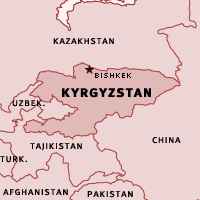
The president of Kyrgyzstan signed a new constitution on Wednesday to limit his power in a bid to defuse a political crisis. President Kurmanbek Bakiyev signed the document in the capital Bishkek in front of the parliamentary speaker, officials and journalists after a week of protests and tensions. Bakiyev is hoping that the move will prevent the ex-Soviet republic from descending into chaos less than two years after an uprising known as the Tulip Revolution drove long-time leader Askar Akayev from power. An opposition spokesman said “This is our victory, this is a step toward peace. We can avoid civil war, civil confrontation."

The Central Asian Islamic nation emerged as a distinct ethnic group in the 15th century. The Khanate of Kokand inherited the territory known as Kirgizia from the Mongols. Kirgizia was annexed into the Russian Empire in 1876 and quickly became assimilated. The Russians began large-scale housing, mining, and road construction projects and the construction of schools. But Kirgizia, like the other central Asian colonies, suffered from the negative effects of the Russian Empire's repressive policies. Kyrgyz nomads were used as slave labourers and had their lands confiscated for Russian settlers. In 1916, it joined a Central Asian revolt which was ruthlessly put down by the Tsar’s forces. Kyrgyzstan enjoyed a brief period of independence after the 1917 October Revolution but was eventually conquered by the Bolsheviks.

In 1926 the official name was changed to the Kyrgyz Autonomous Republic before the region achieved the status of a full republic of the Soviet Union in 1936. Although Stalin repressed local culture the Central Asian nationalist identities survived through the communist era. After the collapse of the Soviet Union, ethnic tensions erupted in Kyrgyzstan’s border Osh province between Uzbeks and Kirghiz. The majority ethnic Uzbek population were dissatisfied with what they saw as discrimination in official hiring policy and access to land and housing in favour of ethnic Kyrgyz. Despite this violence there was much optimism for the newly independent state. In 1991, Kyrgyz replaced Russian as the official language and the name of the capital, Frunze, was changed back to its pre-revolutionary name of Bishkek. Kyrgyzstan's relatively strong democratic credentials nosedived as corruption and nepotism took hold during President Akayev's years in office.

Askar Akayev ruled the country for 15 years between 1990 and 2005. He was trained as a scientist and a member of the old Supreme Soviet. He was elected leader as a compromise candidate to become the new country’s first president. Although initially seen as a libertarian, he quickly became autocratic and corrupt. Under his watch elections were flawed, opposition figures were arrested and newspapers were closed. His increasingly authoritarian regime was tolerated by the US when agreed to allow American forces to use Bishkek's Manas airport as a base for the attack on Afghanistan in 2001.

By 2005 he had made too many internal enemies. The trigger for his overthrow was yet another flawed election. Protests grew as it became apparent that election results would favour Akayev yet again. The Tulip Revolution grew from the violence that greeted those early protests. Activists seized government buildings throughout the country. The police eventually switched sides in favour of the demonstrators and a coalition united to unseat Akayev. He fled the country by helicopter as the protest movement gained unstoppable momentum. Imprisoned opposition leaders were freed and the Kyrgyz Supreme Court declared the election results invalid. The newly-elected parliament named the Southerner Kurmanbek Bakyiev as acting Prime Minister and President. Exiled in Moscow, Akayev agreed to resign. New presidential elections were held in July 2005 and Bakiyev won a landslide victory with 89% of the vote.

Bakiyev is an engineer who served with the Red Army in the 1970s. He became involved in local politics in 1990 and served as first secretary of the council in the small town of Kok-Yangak. He rose to provincial governor and eventually prime minister of his country in 2000. He was the right man in the right place to take advantage of Akeyev’s fall from power. After the usual hopes of his honeymoon period, many Kyrgyz have complained that they had seen no improvement in their standard of living since then. Bakiyev's term in office has been marred by the killing of several anti-corruption parliamentarians, prison riots, and widespread corruption. Wednesday’s constitutional changes strips his right to dissolve and parliament and limits his power in naming the prime minister. However it does not change his term of office which expires in 2010.

Thursday, November 09, 2006

Donkeys demolish elephants

The US ended its love affair with the Grand Old Party yesterday and handed the House to the Democrats in the mid-term elections. The Senate remains up for grabs with President Bush looking an increasingly isolated figure in his remaining two years in office. The fallout was immediate with Bush announcing the resignation of Defense Secretary Donald Rumsfeld. His replacement is 63 year old Robert Gates, Bush family friend and CIA director under Bush senior.

The senate race is particularly tight. At the time of writing, 99 of the 100 seats have been decided. 50 of these are Democrats (including two independents Connecticut’s Joe Lieberman and Vermont’s Bernie Sanders who will vote Democrat on caucus issues) and the other 49 are Republican. The one undecided seat is in Virginia. Democratic challenger Jim Webb holds a slight lead over incumbent Republican George Allen. The closeness of the vote means the final result may not be known until 27 November. At the moment Webb leads by 8,000 out of more than 2.3 million votes cast. Webb claimed victory last night but Allen refused today to concede. An Allen campaign adviser refused to say if the Republican candidate would ask for a recount if he loses. Under Virginia law, he will have 10 days after 27 November to ask for a recount. If a recount reverses Webb's apparent victory, the Senate would be split 50-50, leaving Vice President Dick Cheney with the deciding vote for Republicans.

The margin in the House of Representatives was more emphatic and gives the Democrats control of the House for the first time in 12 years. As reps are elected for just two years, all 435 seats were up for grabs. The Democrats needed to win 17 seats to take control and as of Wednesday (US time) appear to have gained 27 additional seats. The Republicans are heading for a net loss of 26 seats. The last seat to changes hands was from the House’s only independent to the Democrats. The main factors for the Democrat win were the public anger over the conduct of the war in Iraq as well as scandals that engulfed a number of high profile Republicans in recent months. Seats held by troubled ex-senators Tom DeLay, Bob Ney and Mark Foley all fell to the Democrats.

Aided by public dissatisfaction with President Bush, Democrats won gubernatorial races in New York, Ohio and Massachusetts for the first time in more than a decade, and also won in Colorado, Maryland and Arkansas. Several GOP officials said they expected outgoing Illinois Speaker Dennis Hastert to step down as party leader and possibly even retire from Congress. Massachusetts elected its first African-American governor and first Democratic governor in 16 years, Governor-elect Deval Patrick. And for the first time in over 50 years, Maryland voters unseated an incumbent governor. 36 governorships were decided this year and post election, 28 of the 50 states now have Democrat governors. Arnold Schwarzenegger bucked the trend and was one of the few high profile GOP successes. Although the Democrats hold both senate seats in California, Schwarzenegger easily accounted for his Democrat rival winning by 15%. His success is based on a recent conversion to consensual politics. He has impressed this year by enacting greenhouse gas-cutting legislation and by increasing the minimum wage. Meanwhile Hillary Clinton also easily secured re-election as New York senator heightening speculation about her as yet undeclared bid for the White House in 2008.

A less high profile woman, Nancy Pelosi, is the new Speaker of the House. She is the first woman to ever hold the role. The 66-year-old mother of five has served as representative for San Francisco since 1987, and became House minority leader in 2002. Pelosi learned her politics early in life - her father was a congressman for Maryland and also served as mayor of Baltimore. She is also independently wealthy; her husband Paul made a fortune of $25 million from portfolio and property investments. Her wealth has enabled her to finance other Democrats’ campaigns. In return she has demanded discipline and loyalty. Her relationship with Bush will be critical to their mutual fortunes over the next two years. Their relationship to date has been marked by mutual disdain. Bush regards her as a high taxing Democrat and Pelosi is on record describing Bush as an incompetent leader.

Incompetent or not, Bush bowed to the inevitable yesterday and announced the resignation of Donald Rumsfeld. Rumsfeld was one of the key architects of the Iraq war. Congress members welcomed his departure as a sign that Bush is open to new ideas on Iraq. Critics said the outgoing defense secretary ignored advice from his generals, encouraged the abuse of war captives and failed to develop a credible post-war plan. Delaware Democrat Senator Joseph Biden hailed the resignation as a “death knell of the neo-conservative approach”. In contrast to Rumsfeld, his replacement Bob Gates is considered to be pragmatic and a foreign policy realist. The appointment is likely to lead to a more conciliatory approach on Iraq and the first step towards a phased withdrawal of US forces.

Political analysts are still digesting the consequences of a Democrat controlled Capitol Hill. Nancy Pelosi has said her priorities will include a higher minimum wage, the promotion of stem-cell research and a push to enact the recommendations of the September 11 congressional report. She and the president will now have to learn to live together; any legislation passed by a Democratic House will need Bush's signature. And with Pelosi controlling the House, he will need her agreement to get a subject on to the political agenda. At this stage, no one can say if the result will be consensus or gridlock.

Wednesday, November 08, 2006

Just another day in Hicksville

U2 started their tour of Australia last night with a call to release David Hicks from Guantanamo. Speaking from the stage in Brisbane, Bono said, "We call for David Hicks to be brought back to Australia”. The South Australian Hicks has been detained for five years at Guantanamo Bay naval base in Cuba since he was captured with Taliban forces in Afghanistan. He is yet to face trial. Bono’s plea is the latest in a string of high profile calls to end a miscarriage of justice. Even the unsympathetic Australian government now concedes Hicks has been held by the US for too long.

David Hicks was born in Adelaide in 1975. His father Terry Hicks described his son as adventurous. As a young man, David worked on rural properties in the Australian outback, experimented with drugs and fathered two children. In 1999, aged 24, he left his home in Adelaide with a one-way ticket to Pakistan intending to travel the Silk Road. But he changed his plans after a spur of the moment decision. Kosovo was dominating media attention. By the time Hicks got to Albania the war between Serbia and Kosovo's Albanian majority was almost over. He trained for four weeks with the Kosovo Liberation Army (KLA) and signed up with NATO. Then a peace deal meant foreign volunteers were sent home under NATO orders. Hicks came back to Australia where he started to become interested in Islam. He converted and began to learn Arabic. For his next adventure he wanted to travel to Afghanistan. Hicks went back to Pakistan in 2001 where he worked in a madrassa (an Islamic school) and trained with Lashkar-e-Toiba.

He was in still in Pakistan on 11 September 2001. On hearing the news of 9/11, he immediately packed his bag and travelled to the Al Qaeda guesthouse in Kandahar, the Taliban capital of Southern Afghanistan. He crossed the border just before it was closed. After a few weeks, he was threatened with homelessness unless he volunteered to help the Taliban. David telephoned his father from Kandahar to tell him he was going to help the Taliban defend Kabul from the Northern Alliance. When the US air strikes started, he was told to guard a tank. When Afghanistan’s fourth largest city, Mazar-e-Sharif, fell to the Americans, Hicks went to the frontline. Within hours of arriving, the front collapsed. The few hundred foreign fighters fled and were chased by the Northern Alliance. After two weeks in hiding, Hicks was picked up at a taxi station, trying to leave the country. The Northern Alliance sold him to the Americans for $1,000.

In January 2002, the first of the prisoners from Afghanistan were loaded, hooded and shackled, on to a plane for Guantanamo Bay. David Hicks was among them. The Howard government was quick to echo American claims and publicly denounced Hicks as a “dangerous terrorist.” In July 2003, the US announced that Hicks would be among the first six Guantanamo detainees to be tried as terrorists. Immediately they were all put in solitary confinement. They were placed in tiny windowless cages about 2.5m by 1.8m. There was no natural light. They were let out of the cages for 15 minutes each week. In a 2004 affidavit, Hicks said he had been beaten with fists and rifle butts while blindfolded, subjected to extreme cold and strobe lights, and had his head rammed into asphalt on multiple occasions. Since 2002, David’s father Terry Hicks has been on a tireless one-man crusade to achieve justice for his son. The 2004 Curtis Levy film “The President Versus David Hicks” followed Hicks snr in his quest to find out the truth about his son. Terry retraced David’s travels through Pakistan and Afghanistan in an attempt to understand the motivations and the reason for his arrest.

After two-and-a-half years in custody, Hicks was finally charged in 2004. The charges were conspiracy, attempted murder and aiding the enemy. There was no allegation that Hicks killed or specifically harmed anyone. The charges repeated what was known; Hicks trained in Al Qaeda camps, defended a tank near Kandahar and travelled to the frontline with the intention of fighting US-led forces. More puzzling was the claim that Hicks translated al-Qaeda training material into English from Arabic. Hicks’ Arabic remained rudimentary at the time of his arrest.

Hicks and the other Guantanamo detainees remain in legal limbo; unable to invoke the writ of habeas corpus to test the legality of their imprisonment. The US has classified them as ‘enemy combatants’ not prisoners of war and therefore have denied them the protection of the Geneva Convention. Hicks’ military trial was initially set for January 2005. But in November 2004, the US Federal Court ruled that the military commissions were neither competent nor lawful. The Appeals Court overruled this decision in July 2005. But in June this year this US Supreme Court ruled the military tribunals were illegal under US law and the Geneva Conventions. The case against Hicks is now on hold while the US Supreme Court decides whether to hear a further appeal by a Yemeni detainee against the legitimacy of the trial process. An Australian senate hearing in October was told the current charges against Hicks have lapsed and the regulations governing the new military commissions will come into force in January. The long wait for justice continues.

Tuesday, November 07, 2006

Sandinista resurrection

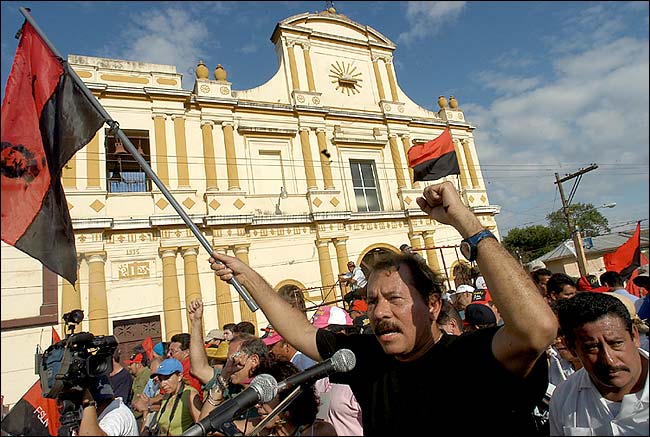
Daniel Ortega appears set to complete a remarkable political comeback and be installed as president of Nicaragua. The 1980s Sandinistan leader of the country polled 40% of the vote after this weekends elections. Although officials have yet to release the formal result, he appears likely to have beaten his four opponents and avoid a run-off against Harvard-educated banker Eduardo Montealegre, who trailed by at least seven percentage points. Ortega needs 35% of the vote and an advantage of 5 percentage points over his closest rival to avoid a second poll in December. The US has threatened to pull aid from an Ortega government and has also said it was too soon to declare him the winner.

Ortega has claimed he is a changed man from the bogey figure that the US attempted to overthrow in the 80s. He spent much of this campaign preaching harmony, love and reconciliation, often campaigning with John Lennon's Give Peace A Chance playing in the background. Now 60 years old, he has toned down his revolutionary rhetoric, promising to favour free trade policies as well as improve health care and education.

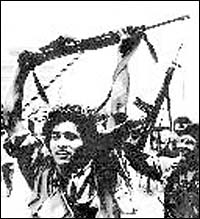
Jose Daniel Ortega Saavedra was born in November 1945 to a middle class family in the southern city of La Libertad. Both his parents were political activists opposed to the regime of the Somoza family who ruled the country between 1937 and 1979. Daniel Ortega learned early and was arrested aged 15 for political involvement. He joined the underground opposition movement the FSLN (Frente Sandinista de Liberación Nacional). By 1967 he had was a leader of the movement. The Sandinistas took their name from Augusto Sandino, a Nicaraguan revolutionary and charismatic leader of a guerrilla war against a US military presence until his murder by the Government in 1934. The FSLN was founded in 1961 but did not emerge as a serious opposition force until the following decade.

The trigger was the 1972 earthquake that levelled the capital city Managua. It killed 10,000 people, destroyed 80% of the buildings and left over half of its population homeless. Much of the subsequent international aid to the country was embezzled by Somoza’s National Guard. The president’s personal wealth soared to US$400 million in 1974. The Sandinistas gained much support as many middle-class Nicaraguans reacted against blatant corruption. In December that year, guerrillas seized government hostages at a private party. They received $1 million in ransom and had 14 prisoners released from jail. One of the prisoners was Daniel Ortega. He had been in jail since his arrest after a botched bank robbery in 1967. Ortega fled to Cuba while the Somoza government responded with further censorship, intimidation, torture, and murder.

Guerrilla warfare intensified in the capital and elsewhere for the remainder of the decade. In 1979 the Sandinistas called a general strike and launched a full-scale uprising. Somoza resigned and fled to Florida. On 19 July the FSLN army entered Managua in triumph. The insurrection left approximately 50,000 dead with another 150,000 Nicaraguans exiled. Ortega was installed on a five-person junta to lead the country. Ortega was the chief FSLN leader on the junta. They inherited a country in ruins with debts of $1.6 billion and a devastated economy. Their first major success was literacy. Within six months they brought the national illiteracy rate down from over 50% to just under 12%. But despite early advances, disputes emerged between pro and anti Sandinista forces in the junta. Two members resigned including Violetta Chamorro who would eventually succeed Ortega and lead the country.

The military opposition to the government became known as "Contras" (short for "contrarrevolucionarios"). When Ronald Reagan assumed power in 1981 he condemned Nicaragua for its links with Cuba authorised the CIA to begin financing, arming and training rebels. The Contras operated out of camps in the neighbouring countries of Honduras and Costa Rica. Although the US Congress prohibited federal funding of the Contras in 1983, the Reagan administration began to covertly sell arms to Iran and channel the proceeds to the Contras.

In November 1984, Nicaragua called national elections; Ortega won the presidency with 63% of the vote and took formal office in January 1985. While international observers declared the election to be free and fair, opposition parties boycotted it, and it was denounced as unfair by the Reagan administration. The US continued their economic embargo crippling the country’s growth prospects. By 1987 the war with the well-armed Contras was at a stalemate. Costa Rica brokered the Esquipulas II treaty between the sides. The treaty called for a ceasefire, freedom of expression, and national elections. The elections were called for 1990.

Ortega crashed to a stunning defeat in this election. His ex-junta partner Violetta Chamorro led a centre-right coalition to win the election as impoverished voters took out their frustrations of a long and costly war on their government. To many people’s surprise, the transition of power was smooth and without violence. The Sandinistas accepted the people’s vote and gave up power peacefully. Their price of power was “the Piñata”. These were estates valued in the millions seized by Sandinista officials including Ortega himself. Ortega remained leader of the FSLN and stood again for unsuccessfully for Nicaraguan president in 1996 and 2001. In both elections, allegations of corruption related to the Piñata during his final days as president came back to haunt him.

The FSLN remains the second largest political party in the country. Current president Enrique Bolaños is stepping down after almost five years in the job. In September last year, Bolaños was threatened with impeachment by the opposition but the US threatened to cut off aid and the move was defeated. The US still has not forgiven its old enemy and has threatened to cut off aid to the country if he wins again in 2006. Adolfo Franco, USAID's adjunct director for Latin America and the Caribbean, told La Prensa (the newpaper owned by Violetta Chamorra) "we don't support any candidate in Nicaragua's electoral process, but some of Ortega's declarations worry us." Franco said Ortega might try to undermine a free trade agreement between Washington and the nations of Central America. If that happens, he added ominously, "we are going to analyse aid assigned to Nicaragua”.

Monday, November 06, 2006

Father of the Islamic nuclear bomb in hospital

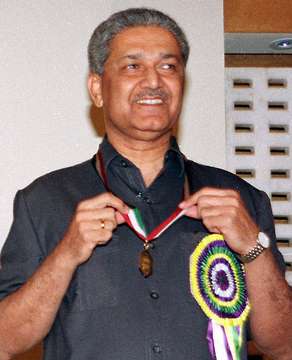
Abdul Qadeer Khan, the founder of Pakistan's nuclear programme, is stable in hospital after his health deteriorated last week. Pakistani army spokesman Major General Shaukat Sultan said. "Dr. Khan is in good health and there is nothing dangerous." Khan was detained in hospital after he complained about pain in the femoral vein. The 66 year old scientist underwent a successful prostate cancer operation at a private hospital in Karachi last month. It was the first time he was allowed out since his house arrest on 31 January 2004 imposed by President Pervez Musharraf after allegations of his involvement in the transfer of nuclear technology to North Korea, Iran and Libya.

A.Q. Khan was born in 1935 in Bhopal in what was then British India. The Muslim Pathan family migrated to newly independent Pakistan. Khan graduated with a degree in engineering from the University of Karachi. He studied further in West Germany and the Netherlands before gaining a Ph D from the Catholic University of Leuven in Belgium in 1972. His first job was with the Amsterdam based Physical Dynamics Research Laboratory (FDO). FDO was a subsidiary of Urenco a British-German-Dutch consortium that provides enriched uranium for European nuclear power stations. Urenco used a Zippe-type centrifuge to collect Uranium-235. Nazi scientist Gustav Zippe invented the Zippe-Type centrifuge during World War II and it is now the easiest way to make fuel for reactors as well as nuclear weapons. Zippe was captured by the Russians after the war and they forced him to reveal his method. After he was released, the Americans also ordered him to provide help for their nuclear program. Khan worked at the Urenco Dutch facility where the Zippe-type centrifuge was operational.

18 May 1974 was the festival of Buddha’s birthday in India. On that day India launched the “Smiling Buddha”, its first ever nuclear explosion. Pakistan was furious. In 1975, Khan went on holiday to Pakistan. He was asked by the then-prime minister Ali Bhutto to secretly take charge of Pakistan’s uranium-enrichment program. The Dutch were quickly aware they had a spy in their midst. Ruud Lubbers, who would later go on to become Prime Minister, was the Dutch Minister of Economic Affairs at the time. He later admitted he discussed the Khan case with US CIA officials. But the Americans advised against arrest and told him to merely block Khan's access to Urenco. The following year, Dr. Khan escaped from the Netherlands with two secret blueprints for uranium centrifuge. The Dutch convicted him in 1983 in absentia for stealing the designs but his conviction was later overturned on a technicality.

Back in Pakistan, Khan initially worked for Pakistan Atomic Energy Commission (PAEC). He created a new research lab which was later renamed Khan Research Lab (KRL) in his honour by new military president Mohammad Zia ul-Haq. Khan was charged with a five year task to enrich uranium to build the world's first Islamic nuclear bomb. As well as Khan’s brilliance, western intelligence inertia and weak export controls helped Pakistan made rapid progress in developing U-235 production capability. He convinced two Dutch firms to sell them over 6,200 unfinished steel rotor tubes. By 1987, a British newspaper reported that Dr. Khan had openly confirmed Pakistan had nuclear weapon capability. The US turned a blind eye as they needed Pakistan’s support against the Russians in neighbouring Afghanistan.

Khan’s DIY nuclear techniques caught the attention of other countries. First up was Islamic Iran as early as 1988. They began buying his drawings and parts and ended up with 500 centrifuges of its own. Meanwhile at home, his plans for the Islamic bomb were nearing fruition. In May 1998, Pakistan exploded a subterranean atomic bomb in the Chagai Hills in the desert of south-western Baluchistan province, barely 50 km from the border with Iran. Coming barely days after a similar bomb test from India, both countries in the sub-continent were now nuclear powers.

Over the years Pakistan had switched from an illegal importer of nuclear technology to an illegal exporter. Khan set up his supply headquarters in Dubai. He used a South African factory, imported centrifuge parts from Malaysia, electronics from Turkey, technology from Europe and a bomb design from China. This sophisticated and privatised black market became known as the Khan network and it was ready to do business with any customer. Ironically Saddam Hussein turned him down because he though Khan was an American front. Instead his most lucrative client became North Korea. In the late 1990s, Khan supplied uranium enrichment equipment and perhaps even warhead designs to North Korea.

The North Korean connection started to seriously alarm US security organisations. The CIA had cracked the network and was recommending its break-up. But after 9/11 the rules changed again. Once again the US turned to Pakistan as an ally and turned a blind eye to its nuclear programme. As a token gesture, Washington imposed sanctions in 2003 on Khan’s firm for the alleged transfer of missile technology from North Korea. Khan ignored the warnings and went on to do business with Libya. He showed them how to turn enriched yellowcake uranium into nuclear fuel and also provided Chinese 1980s nuclear bomb design. The US raided a ship bound for Libya and they caught the consignment red-handed. The US and Pakistan took the decision to turn Khan into a scapegoat. He was forced to publicly apologise by Musharraf and he announced on TV he was acting alone. Bush hailed Khan’s apology as a victory. Musharref made sure Khan could not tell his side of the story. He granted him a pardon but has since held him under loose house arrest allowing no questions from pesky outsiders.

Pakistan continues to deny culpability in the Khan network.

Sunday, November 05, 2006

No Stone unturned

This week the New York medical examiners office identified remains for three more victims of the 9/11 attacks. One of the remains identified belong to Karen Martin who was a flight attendant on Flight 11 which crashed into the North Tower. The second remains belong to Douglas Stone who was a passenger on the flight. The third person was not publicly identified. The victims were identified after families submitted additional DNA samples to the medical examiner's lab. The remains were recovered long ago and were not involved in recent discoveries that prompted renewed searches.

The identification and grim discovery of further body parts has forced Oliver Stone to defend the timing of his latest film World Trade Center. He told reporters in Beijing last week, “"It's a shame, but part of our life. Maybe there would be another movie about it (if I hadn't shot it). To see it can be painful, and you can cry in the movie, but pain and crying sometimes is good.” Stone’s movie concentrated on the stories of John McLoughlin and Will Jimeno. McLoughlin and Jimeno were officers working for the New York Port Authority Police Department (PAPD). McLoughlin led a team of four officers, including Jimeno, into the main concourse between the two towers.

They were wheeling rescue gear towards the North Tower when they heard a boom. A fireball the size of a house was heading towards them. It was the collapse of the South Tower. The five men ran toward a freight lift and were buried under concrete and steel. Two of the men died instantly. McLoughlin, Jimeno and a third officer Dominick Pezzulo survived the impact. Pezzulo was able to free himself and set about freeing the other two trapped men. But then the North Tower collapsed and Pezzulo was mortally injured by the resulting debris. Before dying, Pezzulo fired a single shot into the air to warn potential rescuers. McLoughlin's legs had been crushed fully in the second collapse. The two men could not see each other. The sergeant spoke into his radio. In response, he heard only static.

The two surviving men were trapped 9 metres from the surface of the rubble. The two men kept talking to each other urging each other to stay awake. McLoughlin wasn’t optimistic. He reminded Jimeno that the site was unstable and the light was fading. Rescue teams wouldn't be sent out until first light the next morning at the earliest. He was right; the site had been cleared because the adjacent 7 WTC building was in flames and in danger of falling. This 47 story steel frame building collapsed seven hours after the North Tower.

The heat was stifling in the debris, and Jimeno was drifting in and out of consciousness, struggling to stay awake. The rising temperature set off the dead Pezzulo’s gun and Jimeno was surrounded by a hail of gunfire. Finally all the bullets were spent and he was relieved to find himself unscathed. The two men kept up an incessant chatter to keep each other awake. Meanwhile although the official rescue effort was delayed, two men were searching the rubble. They were both ex US marines Dave Karnes and Jason Thomas. Contrary to the way he was portrayed in the movie, Thomas is a black man whose identity was unknown until this year. The two men searched the dangerous and dark landscape carrying little more than flashlights and an infantryman's shovel. They climbed the mountain of debris, skirting dangerous crevasses and shards of red-hot metal, calling out "Is anyone down there? United States Marines!"

Finally Jimeno heard the voices from above. "Yes!" Jimeno shouted. "Yes! PAPD officers down! Two of us! This is Officer Will Jimeno and Sergeant John McLoughlin is with me. He has four kids. I have a daughter and my wife is pregnant. Please don't leave. Please!" We're not leaving you," the man's voice assured him. "This is Marine Corps Staff Sergeant David Karnes and Sergeant Thomas is with me." Karnes promised Jimeno that they would get them out. He crawled into the rubble to get to Jimeno. He then called for help. He was unable to get through to New York authorities whose lines were jammed. He called his sister in Pittsburgh. She called her local police department and explained the emergency, and miraculously they were able to get through to officials in Manhattan.

Two emergency services officers, Paddy McGee and Scott Strauss followed a paramedic, Chuck Sereika. They were wedged into the pit with Sergeant Karnes while firefighter Tom Asher held off the flames. More officers rushed down to help. They freed Jimeno’s leg. Then he was eased out of the pit and put in a Stokes basket. He was passed hand-over-hand to safety. He had been trapped for 13 hours. Then a second rescue team was sent in to dig out McLoughlin. It would take eight more hours to free him. By dawn the next day he was being rushed to the hospital. McLoughlin spent six weeks in a medically induced coma while doctors performed 27 operations on his legs. Jimeno spent nearly three months in the hospital and rehabilitation. Will Jimeno and John McLoughlin were the last of 20 survivors pulled from the wreckage of the World Trade Centre.

The remains of about 40 percent of those killed at Ground Zero have not yet been identified.

Saturday, November 04, 2006

Warm and wet

Protesters who gathered in drought-stricken Brisbane today to march against climate change, had an immediate effect. The march took place in torrential rain (despite erroneous claims from News.com the march had been cancelled). While the weather was welcome to a parched city, the timing was disappointing for event organisers with the crowd well down on expectations of a dry day. The actual crowd was about 2,000 which was exceptional in the difficult circumstances. Those who did turn up struggled to hear Democrat senator Andrew Bartlett's speech before taking part in a drenched walk to Musgrave Park in South Brisbane. The heavy rain never let up and the post-march party had to be cancelled.

Despite Brisbane’s damp squib, the Walk Against Warming successfully took place in over 30 venues across Australia. It attracted national attendance measured in the ten of thousands. Melbourne drew the biggest crowd of 30,000 who marched from the city centre to the new park of Birrarung Marr near Federation Square. Sydney’s event was also marred by poor weather but 10,000 gathered to hear Greens leader Bob Brown address the crowd. Senator Brown told the crowd the Greens would introduce a bill forcing Australia to reduce greenhouse gas emissions by 90 per cent by 2050. Opposition Environment spokesman Anthony Albanese also told the crowd a Labor government would act immediately on climate change; ratifying the Kyoto Protocol would be its first act in office.

The events come exactly a year to the day after the first worldwide demonstration to press for action to combat global warming. More than 100,000 people took to the streets in more than 30 countries timed to coincide with the most important international climate change negotiations since the agreement of the Kyoto Protocol in 1997. The conference was held in Montreal and was the first meeting of the parties to the Kyoto Protocol since it came into force in February 2005. There is broad agreement among scientists that rich countries will need to reduce carbon emissions by 80 % by 2050 if there is to be any hope of stopping the climate change escalating out of control.

The Kyoto Protocol targets will reduce greenhouse gas emission by only 5% from 1990 levels. The Kyoto objective is the "stabilization of greenhouse gas concentrations in the atmosphere at a level that would prevent dangerous anthropogenic interference with the climate system”. The Protocol covers more than 160 countries globally and over 55% of global greenhouse gas (GHG) emissions. Governments are separated into two categories, developed countries (known as Annex 1) and developing countries (known as non-Annex 1). Non Annex 1 countries do not have GHG targets. Annex 1 countries that fail to meet their Kyoto target will be penalised by having their reduction targets decreased by 30% in the next period. But because the cost of meeting Kyoto is prohibitive for many countries, the protocol has “flexible mechanisms” which allow carbon trading to offset GHG targets. Countries can buy emissions reductions from either financial exchanges or from developing countries. The German based Clean Development Mechanism Executive Board will vet projects prior to accepting carbon trades.

All the Annex 1 and most non-Annex 1 countries have established Designated National Authorities to manage their GHG portfolios under Kyoto. The US, then led by President Clinton signed the protocol. The Bush administration neither ratified nor withdrew the US from the protocol. Bush has stated he supports the Kyoto principles but said in 2001, “the Protocol was fatally flawed in fundamental ways”. He will not commit the US while China, the world’s second largest emitter of carbons, is exempted. The US does not support the split between Annex 1 countries and others. It has also suppressed expert reports on global warming including a fact sheet by a panel of seven scientists at the National Oceanic and Atmospheric Administration that found that global warming is contributing to the frequency and strength of hurricanes.

The United Nations Framework Convention on Climate Change (UNFCCC) agreed to a set of a "common but differentiated responsibilities." These were: the developed world had the largest share of global emissions, per capita emissions in developing countries are still relatively low, and the share of global emissions originating in developing countries will grow to meet their social needs. As a result, China, India, and other developing countries were exempt from the requirements of the Kyoto Protocol because they were not the main contributors to the greenhouse gas emissions during the industrialisation period that is the cause of climate change. Kyoto critics argue that these countries will soon be the top contributors to greenhouse gases and also claim that industry in developed countries will move to non-restricted countries meaning there will no net carbon reduction.

There is also controversy about using 1990 as a base year. The former Soviet Union and Eastern Europe were in a shambles at that time and there was little or no energy efficiency in their infrastructure. Therefore Russia will have little difficulty in meeting the Kyoto targets. This positive side of Kyoto - a chance to modernise industry - is a major reason why Putin signed Russia up in 2004. Defenders of the Kyoto Protocol argue that while the initial greenhouse gas cuts may have little effect, they set the political precedent for bigger and more effective cuts in the future. Six Asia Pacific nations, US, Australia, China, India, Japan and South Korea have formed the Asia-Pacific Partnership on Clean Development and Climate (AP6) which aims to co-operate on development and transfer of technology to enables reduction of greenhouse gas emissions. They have agreed a Charter, Communiqué and Work Plan that "outline a ground-breaking new model of private-public taskforces to address climate change, energy security and air pollution”. The Stern Report released this week has now given impetus to push post-Kyoto talks with Germany urged to take the lead when it begins its presidency of the EU in 2007. The Kyoto Protocol expires in 2012.

Friday, November 03, 2006

defamation law in Australia

Defamation is a boundary where free speech and reputations collide. In Australian law, defamation is a tort, or in other words, a civil wrong. Whenever we say or write something that damages another person’s reputation, there is a possibility that we may infringe the law of defamation. For media practitioners the law is an unavoidable hazard when dealing with people whose livelihood depends on their reputation. However it may be possible to defame with “good reason”. The purpose of this essay will be to describe a brief history of how these law came into being, then show how the laws of defamation work, before showing what defences are plausible against defamation. The essay will conclude with a brief discussion on how the laws affect the Internet.

Historically, reputation was regarded as part of a person’s spiritual being and defamation proceedings were held by England’s ecclesiastical courts. It came under the ambit of the common law courts in the 16th century where the key principle was observed: defamation was something the defence needed to prove. Colonial NSW put the law in legislative form in the Defamation Act of 1847. Although Australia was federated in 1901 it was not granted the power to deal with defamation, therefore each state was at liberty to frame its own laws. It took the commonwealth 105 years to finally enact uniform defamation laws.

As well as eliminating the insidious practice of forum shopping, the defence need no longer prove it is a matter of “public interest” as was the case in NSW or “public benefit" as was the case in Queensland, Tasmania and the ACT. However the basic imputation of truth remains. While defendants must prove the words are true, plaintiffs must show that the published words would make others think less of them. Plaintiffs must also show that the publication referred to them. Even if plaintiffs are not explicit named, they can sue if they show they meet the description of the defamed person. The foundation case of E. Hulton and co v Jones proved that plaintiffs can be defamed unintentionally even when using a fictitious name. The lesson for journalists is that if you must defame, then name.

There are a number of valid defences to defamation. As well as truth, the 2006 laws establish defences based on justification, contextual truth, absolute privilege, fair reporting, qualified privilege, honest opinion, defence of innocent dissemination and triviality. Justification means that the defendant proves that the imputations are substantially true. Contextual truth means that a defendant can justify the publication of a defamation because a more important or related truth can be proven. Absolute privilege is available only to those speaking in court or parliament whereas those who report their statements “fairly and accurately” are covered by the fair reporting defence. Qualified privilege implies a reciprocal duty and assumes the defendant has a “reasonable interest” in publishing the material. Reporting on public meetings attracts qualified privilege. Political qualified privilege was established by the Theophanous v Herald & Weekly Times case and clarified by Lange v ABC that Australians should have an interest in information concerning political matters. The defence of innocent dissemination is designed to protect subordinate publishers such as Internet Service Providers (ISPs).

The innocent dissemination defence shows that the newer communication technologies are not immune from defamation laws. The Rindos v Hardwick case established a precedent to show that defamation laws apply on the internet. It is impossible for ISPs to be aware of information content prior to publication. Clause 91 (1) of Schedule 5 to the 1992 Broadcasting Services Act (Cth) provides a statutory defence for an ISP which hosts internet content in Australia and who was not aware they were hosting a defamatory publication. However liability in a defamation case attaches to everyone who takes part in a publication, whether intentional or not. The new uniform 2006 laws have adopted the English common law defence by protecting subordinate publishers.

Thursday, November 02, 2006

future imperfect

The average surface temperature of earth has increased by almost 1 degree Celsius since 1900 and the rate of warming has been nearly three times the century average since 1970. This Saturday 4 November GetUp Australia are organising national street events to put pressure on politicians to take global warming seriously. Walk against Warming is taking place in all eight state and territory capitals as well as another 19 provincial venues. In Brisbane the event starts at 2pm at Queens Park in the city and marches to West End. Speakers include writer Sam Watson, Queensland Green party leader Drew Hutton and Democrat senator Andrew Bartlett. Details of the Brisbane event can be found here.

These events are timely with the high-profile release of the Stern Review this week. More correctly, the Stern Review on the Economics of Climate Change, it is a report on the effect of climate change and global warming on the world economy. The document was commissioned by the UK government is named for its author British economist and academic Sir Nicholas Stern. Stern was the chief economist and vice-president of the World Bank between 2000 and 2003 and is now an economic adviser for the British Government.

The report is significant because it is the first major study of climate change to be conducted by a trained economist rather an atmospheric scientist. As such, it is more difficult for climate change sceptics to criticise on the basis that it is not grounded in economic fact rather than ecological woolliness. The report is 900 pages long but the executive summary paints a stark picture. Stern states baldly there is an urgent problem to solve which he attributes to market failure. The world needs to reduce its annual carbon emissions by more than 80% below current levels by 2050 if we are to have any chance of avoiding total catastrophe. But he argues that “there is still time to avoid the worst impacts of climate change, if we take strong action now.”

If no action is taken to reduce emissions, the concentration of greenhouse gases in the atmosphere could reach double its pre-industrial level as early as 2035. This will result in a global temperature rise of 2 degrees. Stern proposes environmental taxes (ecotaxes) as the way forward to solve global warming problems. Ecotaxes can be fiscal policies designed to promote sustainability through economic incentives or can be so called Pigovian taxes. Named for the English economist Arthur Cecil Pigou, these taxes are levied to correct negative consequences (called “externalities”) of a market activity. These could be taxes on polluters which would be turned into funds to counteract the negative effects of the pollution.

Stern assessed a wide range of evidence on the impact of global warming and also attempted to cost of not acting. His central argument is that spending large sums of money now on measures to reduce carbon emissions will bring dividends on a colossal scale. If we do not act, the cost will be a reduction of 5% of global GDP each year. That is compared to the cost of action which he asserts can be limited to 1% of global GDP each year. However the true cost of not act may be even higher than Stern is predicting. It does not include the financial cost of the direct impact on human health and the environment from global warming, or the disproportionate costs on poor regions of the world. If these factors are taken into account, the true cost could be a permanent reduction in consumption per head of 20% which means everyone in the world would be a fifth poorer than they would otherwise have been. Stern argues too that the poorer countries will bear a disproportionate share of the problem. Stern argues that the richer countries should take responsibility for up to 80% of reductions in emissions from 1990 levels by 2050.

Stern acknowledges that securing the requisite international government consensus on the way forward will not be simple. As well as taxation Stern encourages research and development of low-carbon technologies and also regulation to enforce behavioural change. This is not music to the ears of those Western Governments who have unbounding faith in the markets to correct themselves. The White House issued a statement welcoming the Stern review as a contribution to the body of knowledge on climate changing, but did not address its calls for fundamental change in policy. In an e-mailed statement, the White House Council on Environmental Quality said, "The U.S. government has produced an abundance of economic analysis on the issue of climate change. The Stern Report is another contribution to that effort." The US remains opposed to mandatory caps on greenhouse gas emissions and the carbon trading scheme outlined in the Stern report. The US is the biggest single source of greenhouse gas emissions in the world, producing 25% of greenhouse gases from 5% of the global population.

Meanwhile fellow first world objector to the Kyoto Proposal Australia is also reacting cautiously to the report. Prime Minister John Howard warned his back bench not to be "mesmerised" by the report. He said climate change was a serious challenge but the report exaggerated when it suggested it could be worse than both world wars and the Great Depression. Howard refuses to ratify Kyoto while China and India are not included in the protocol.

Wednesday, November 01, 2006

The Culture of Halloween

The French have declared Halloween dead. The major Parisian dailies Le Monde and Le Parisien reported this week the Halloween holiday has been "pretty much buried". In the latter years of the 20th century, the festival caught on in France with costume parties and trick-or-treating. Its recent demise is linked to a rise in anti-Americanism as major US brands such as McDonalds, Coke and Disney use pumpkins and other Halloween paraphernalia in their advertising. A French group called “Collectif Non a Halloween” (No To Halloween Collective) was set up to launch a boycott of the event. But the real culprits lie on their side of the Pond. Halloween is an old Celtic festival imported into the US by Irish immigrants after the potato famine of the 1840s.

1 November is the pagan festival of “Samhain” (pronounced sow’-en). It is a cross-quarter day, a day falling approximately halfway between a solstice and an equinox. The other three cross-quarter days are Imbolc (at the beginning of February), Beltane (Mayday), and Lunasa (August). The Celtic calendar was solar and lunar so the four festivals would have been celebrated at the nearest full moon. Like the other cross-quarter days, Samhain was co-opted by Christianity. In the 7th century, Pope Boniface IV replaced the pagan festival of the dead and 1 November is now known as All Saints Day. The day was also known as All Hallows Day from the Middle English word ‘halwen’ meaning holy. Hence the evening before is “Hallow e’en”.

The Irish word for Halloween is “Oíche Shamhna”, the night or eve of Samhain. It is the night before the start of winter and a time to take stock of the herd and grain supplies for the cold and barren days ahead. The feast celebrates the final harvest and is also dedicated to the dead. Villagers would gather together on Samhain and light a great fire on which they would throw the bones of slaughtered livestock. The Halloween “bone fire” (or bonfire) remains a tradition in Ireland. In 17th century England, the bonfire and other Halloween traditions were moved five days later to celebrate the failure of the Gunpowder Plot. In 1605, a group of conspirators angered by King James’ refusal to give equal rights to Catholics, planted gunpowder under the House of Lords. Guy Fawkes, an explosives expert with military experience, was hired to plant the powder. On 5 November, the plan was leaked and Fawkes was arrested and confessed to the crime. The date became a day of thanksgiving and was a fatal blow to Catholicism in England.

Celtic Ireland and Scotland held on to their Halloween traditions. In pagan days, villagers would dress up in “ghoulish” costumes and parade through the night in order to frighten away evil spirits. In the middle ages, people would travel from door to door singing prayers and carols for the dead in return for food. It was called “souling and people would beg for soul cakes (flat, square breads). In return they promised to offer up prayers for any dead family members. Though it probably evolved with Irish immigrants, the tradition was not noted in the US until the turn of the 20th century. Children would dress up as ghosts and tour the neighbourhood looking for candy or money. The term ‘trick or treat’ first appeared in print in 1934. It was deeply unpopular and often viewed as extortion - the "trick" part was a threat to play a prank on the victims. But by the 1950s it was firmly established in US culture with trick or treating in a Donald Duck cartoon and a campaign to raise funds for UNICEF.

Other popular ancient Irish Halloween traditions were bobbing for apples and wearing masks. Apples are placed in a large basin of water and children, sometimes blindfolded, try to catch one with their teeth. Apples were associated with gods of fertility; the first person to catch an apple would be the next one to marry. The wearing of masks is an old European tradition in times of drought. People believed the demons that had brought their misfortune would be frightened off by the hideous masks. When they started to go out at night souling, singers would wear masks to keep from being recognised.

The pumpkin is an American variant on the Halloween tradition. In 1584, French explorer Jacques Cartier explored the St. Lawrence region of North America. In his encounters with native Americans, he reported finding "gros melons". The name was translated into English as "pompions," which has since evolved into the modern "pumpkin". Planted in May or June (in the Northern Hemisphere), they take three to four months to grow and are picked in October when they turn bright orange. The Irish and Scots had the legend of Jack O’Lantern, a myth about a man nicknamed "Stingy Jack". The story goes that Stingy Jack convinced the devil to turn himself into a coin so that Jack could buy a drink. He eventually freed the devil on condition that he would not claim his soul. When Stingy Jack finally died, the Devil keeps his side of the bargain. However God has reservations accepting such a tricky character in Heaven. As a result, Stingy Jack is forced to roam the earth by night with only a burning coal to light his way. The Irish carved scary faces into potatoes and turnips to ward away Jack O’Lantern. They brought their tradition to the US. There they found “gros melons” were perfect making lanterns.

Which takes us back to the French. While Le Monde is worried about the cultural impact of Cartier’s pumpkins, France has been celebrating the ideas at the very heart of Halloween for centuries. The three days between 31 October to 2 November have traditionally been spent, especially by older generations, visiting cemeteries, honouring saints, and attending religious services. Family reunions honour the dead. Children beg for money to buy cakes at Madonna shrines. November 1 is called La Toussaint and is a public holiday in France. Plus ça change, plus c'est la même chose.