Thursday, June 15, 2006

The country craft of Charlie Haughey

Country Craft
An Irish joke
____________________

Q. What's the difference between Charlie Haughey and an Aran jumper?
A. One's a country craft.
____________________

Charlie Haughey is dead. Haughey, the one not a country craft, pretty much ruled Olde Irelande pre Tiger. Now he is dead at 80. Charles J. Haughey, or Haw hee as the British media learnt to call him, was a trained economist turned three times prime minister who ‘mastered his every brief.’ A politician and a crook like all of them. And a millionaire with an astute eye for the property market. He was a crafty cunt indeed. My apologies for use of the vulgarity. But obscenity it isn’t. Use of the word "cunt" here is a reflection of some clever ruse the Irish instinctive would be proud of in themselves, but recognise when it is done better by someone else. “Cute hoor” is another way of saying it.

Charles Haughey could certainly do it better than most. He will be buried with full Irish state honours on Friday. The Taoiseach Bertie Ahearn, his successor as leader of Fianna Fail, will deliver the funeral oration. Bertie will be sure to mention the good bits. And they were many. In his third term of office, he economically presided over an Irish perestroika. He was a strange breed with the ability to turn conventional wisdoms upside down. He attempted to implement “Irish solutions to Irish problems” (contraceptives could be provided legally under prescription to married couples.) He bought arms and he bought an island. But his people loved him. Giant screens will be installed outside Donnycarney church in North Dublin for the funeral. The church will be open on Thursday between 11.30am and 4pm so that members of the public can pay their respect.

Respect. Not something Haughey was ever short of during the tumultuous years of his government. Thatcher hated him but she could do business better with the taciturn Haughey than the trivia-obsessed Garret Fitzgerald. Fitzgerald was the man who kept him out of power between 1982 and 1987 and the alter-ego of Haughey. Fitzgerald was a doctor of economics and the leader of Fine Gael, the main opposition. There was a family slant. Haughey’s father was a staunch Fine Gaeler. There was even a personal slant. Haughey once dated Fitzgerald’s wife Joan O’Farrell.

Haughey was born in Castlebar, Co. Mayo on the 16th of September in 1925. So was B.B. King. King, of course, wasn’t born in Co. Mayo. But Haughey shouldn’t have been either. His parents were Catholics on the run from Northern Ireland. The family farm in Co Derry was burned in a sectarian attack. The Haugheys were disliked not only by Protestants by also by a significant Catholic population because Sean Haughey (Charlie's father) fought on the side of the Free State in the civil war. This war was the fulcrum of Irish politics. The main Irish political parties ignored social indicators as a reason for voting. They either aligned themselves as Free-Staters (Fine Gael) or Republicans (Fianna Fail). Though a nominal left voted Labour, neither Marx nor Adam Smith had a look in the decision of allegiance.

When the Republican leader De Valera came in from the cold in the late 1920s and decided he no longer wanted to be seen as a terrorist, he decided to install his version of Ireland by political means. He set up Fianna Fail “The Soldiers of the Fianna” Fianna is a complex term that can mean Ireland or Destiny. Fianna Fail are now aligned in the EU group known as the Union for Europe of the Nations. Other parties in this group such as the Danish Folksparti or the Italian Alleanza Nationale are either nationalist or euro-sceptic. In a sense Fianna Fail is neither. Fianna Fail is a populist chameleon. Edward George De Valera dominated the party until shortly before his death in 1975. In 1966 De Valera retained the presidency at an election but disliked his young campaign manager, the then government minister for Agriculture Charles Haughey.

Haughey graduated from Trinity College Dublin with an economics degree. He worked as an accountant and started his move into politics. He ignored his father’s Free Stater credentials. Instead he formed an alliance with one of Ireland’s patrician Fianna Fail families. In 1951, he married Maureen Lemass daughter of future Irish Taoiseach Sean Lemass. He was elected for Fianna Fail at the fourth attempt in for the seat of North Dublin six years later. His father-in-law offered him patronage with his first ministry role in 1961 as Minister for Justice. He became very busy in the role. He introduced legislation such as the Succession Act to protect the inheritance rights of wives, and the Extradition Act to remove the protection of criminals. Haughey also reactivated the Special Criminal Court and helped to defeat the IRA’s ill-fated border campaign of 1962.

His work got him a promotion to Agriculture. The farmers are a powerful force in Irish politics and Haughey was not as successful here. But his battles with farmers raised his profile and made him a very public figure. In 1966 his father-in-law Sean Lemass retired and Haughey applied for his job. Lemass advised him to bide his time and support Jack Lynch instead. Lynch rewarded Haughey by giving him the Ministry of Finance. Here he used his accountancy background and economic training to good effect. He presided over popular budgets with increased spending in an economic boom.
Northern Ireland was to burst its way back into the spotlight in 1969 with the start of the Troubles and the British Army on the street.

Members of the ruling Fianna Fail party wanted to support the Nationalist population in the North. They decided to arm the IRA in secret and a front organisation sent money to a Northern Irish aid agency. Haughey and Neil Blaney were the government ministers on the committee to make it happen. The scheme to import weapons was leaked to the opposition, Liam Cosgrave. Cosgrave exposed the scandal and Haughey and Blaney had to go to save the government. The scapegoats went to trial in 1970 but were acquitted of illegally acquiring weapons. It didn’t save the government in 1973 when Fine Gael took power. Haughey served his time in banishment and got back on the front bench of the opposition in 1975. The country forgave Fianna Fail its sins and Lynch won a landslide election in 1977. Haughey was now installed as the Minister for Health. The power behind the throne in this brief was the Roman Catholic Church. The church controlled Ireland's schools and hospitals. Haughey took them on in 1977 by slyly legalising contraceptives by prescription. He called it “an Irish solution to an Irish problem” but in truth it was a Haughey solution to a Haughey problem. Meanwhile Lynch was in political trouble with the economy in decline. Over in Health, Haughey’s hands were clean. He was in a good position to profit when Lynch resigned in 1979. The cabinet supported George Colley to replace Lynch but the back benches voted for Haughey. Charles Haughey was elected leader of the party and Taoiseach on 11 December 1979 exactly ten years after he was hung out to dry for the Arms Crisis.

Haughey inherited Lynch’s economic woes. The oil crisis had hit resource-poor Ireland. Haughey couldn’t do enough to stop it and was beaten at the polls by Fitzgerald’s Fine Gael in 1981. Though Haughey had a brief hiatus in power again a year later, his margin was knife-edge and lost a second election after the death of a Fianna Fail TD. The economy continued to spin out of control through the eighties until Fitzgerald lost the 1987 election. Fitzgerald ruled long enough to pass important social legislation but by the end of his watch Ireland was in danger of intervention from the IMF. Haughey was prime minister for the third time in 1987. In 1989, another tight election saw Haughey cling on to power at a price. The election had forced Fianna Fail into something they had never done before: form a coalition. Haughey formed an alliance with the Progressive Democrats, a new party not constrained by the bitter history of the Irish Civil war. The Progressive Democrats (PDs) were Ireland’s first free market Liberal Party and was founded by an ex-Fianna Fail renegade Desmond O’Malley. While this arrangement saved power for Haughey, it was too much for Fianna Fail traditionalists who saw him betraying their tradition. In 1990, Ireland was the head of the EU and Haughey served as chair with much distinction. While he basked in the role of world statesman, the knives were sharpening for him at home. His aura of invincibility slipped as a series of scandals embroiled his ministry. One of his ex-ministers Sean Doherty went public and stated Haughey had authorised him to conduct phone tapping. With a –gate just waiting to be put at the end of this scandal, the PDs pulled out of the government. Haughey resigned. His final speech to the Dáil echoed Othello: "I have done the state some service, and they know it, no more of that."

In retirement he was dogged by investigations and allegations. A tribunal under Justice Michael Moriarty looked at whether Haughey may have received “unethical payments” between 1979 and 1996. The tribunal never got anywhere. It was suspended in 2004 pending a High Court hearing that is now unlikely to happen. Those that followed Haughey, Albert Reynolds and now Bertie Ahern, have reaped the success of the Irish economic recovery. Ireland is now a vastly different place that the past of Haughey’s time. But he was the first quintessential modern politician in Ireland. He was driven by desire not by dogma.

Wednesday, June 14, 2006

They still call Kaiserslautern home

Its early doors. Barely four days in and this World Cup has already exploded into life. After many of the big guns such as Argentina, Netherlands, Mexico, Germany and even England have all started with wins. And yesterday's games were all of the highest quality. Two more big names, Italy and Czech Republic, set out their stall with excellent wins in a tough group. Both sides scored glorious goals and in Tomas Rosicky, the Czechs have a potential player of the tournament. And at 40/1 and with 2 goals already in the bank, he represents great value for the top scorer award, the “Golden Shoe” (surely they mean Golden Boot, given that a golden shoe is more like something Cinderella would wear?)

But it was the Australia-Japan game which took the plaudits for sheer drama. Woolly Days watched the game in the packed confines of the Pig & Whistle pub in Riverside in central Brisbane. The 3pm Kaiserslautern kickoff time meant an 11pm start in Brisbane. The pub started packing up after nine but with plenty of bars and a plethora of big screens to choose from, a good viewing spot wasn’t difficult. We must have been at the away end as there was a decent scattering of blue-clad Japanese around our TV. Many fans wore Australian shirts with a picture of the late Johnny Warren and his apparent mantra “I told you so.” SBS also have those four words as a backdrop to their Sydney set, and Woolly Days for one doesn’t like the arrogance and smarminess of the sentiments. Though it has to be said that Warren, a key player in the only previous Australian side to qualify for the World Cup in 1974, does have the right to be a little condescending to the doubters of Australian football.

Anyway, as 11pm approached the tensions increased in the pub. The SBS football pundits were talking up Australia’s chances. The magic of ‘Aussie Goos’ Hiddink was mentioned. Here was the man who ended 32 years of qualifying pain. But he has made a strange choice when the teams are announced. Tim Cahill is not in the starting eleven. Luke Wilkshire of English third tier team Bristol City is in instead. Let’s hope Guus knows what he’s doing. They cross to the stadium. Noisy and very colourful. Lots of Japanese in blue and Australians in green and gold.

Fill up with more beer just prior to kickoff. Jenny Craig have stated they are worried that men with turn to a high fat diet of beer, chips and pizza during the world cup. Health problems are a small price to pay for taking part in the carnival of nations. They’re off. Australia’s first world cup finals game in 32 years. They take a while to settle, Japan look quick and agile early. Japan wins a free kick on the edge of the Aussie box. Jesus, are they going one down in the first two minutes? Thankfully the wall does its job. After six minutes, Viduka has a double chance which forces two saves from keeper Kawaguchi. This is more like it.

The play is fast, very fast, given the 30 degree conditions. Viduka does a beautiful back heel jink to send the hero of Uruguay, Marco Bresciano, through on goal but Marco’s sidefoot shot isn’t strong enough to beat the keeper. A minute later, Japan scores. Unbelievable. A harmless cross floated in by Nakamura. It should be Schwarzer’s but the ball sails over his head as he falls out of the way and gently nestles in an empty net. What??? Replays show that Schwarzer was bundled out of the way by a Japanese player. Given that the Egyptian ref has already given two soft free kicks at corners when the goalkeeper is barely touched, it is impossible to believe he has left this one go. But he has. Japan 1, Australia 0. Hiddink is incensed. And one stage it looks as if he is having a heart attack on the sideline, as he is bent over double. But perhaps he is just giving the fourth official a free dramatic interpretation of the foul on Schwarzer. From the kickoff after the goal, Kewell - minus his two ponytails - bursts through forcefully and his vicious shot is barely a whisker away from being an immediate equaliser. Harry looks so much better with a hair cut.

Half time. Its 1-0. The Japanese in the pub are very happy and jumping around. The Aussies are going to the bar and grumbling about effing Egyptian refs. What do they know about football in Egypt? Bloody bunch of pyramid sellers. The goal doesn’t look any better on endless replay. Second half is underway. The breakneck pace has slowed down. Australia are struggling to refind their first half rhythm. Finally, Tim Cahill is brought on, Bresciano is off. Schwarzer almost blunders again, he rushes out of his area but heads the ball straight to a Japanese player. Luckily they also stuff it up. Six foot five forward and Jason Gillespie doppelganger Josh Kennedy comes on for defender Craig Moore. Poker-faced Hiddink has started to gamble. Kennedy is making himself awkward and causing trouble. Viduka blasts a great free kick but is splendidly saved. Last sub Aloisi is on for Wilkshire and is booked after just two minutes work.

84 minutes in and another free kick. This time Aloisi blasts it and the keeper makes another fine save. Its just not going to be Australia’s night. Ok, says a mate, so we lose this and then lose to Brazil, can we still qualify with only a win v Croatia? While we work out the maths, Kennedy is causing grief in the air again. The ball falls loose to Cahill and Timmy blasts home the equaliser. Yeeeaaas! The pub goes berserk. They’ve nicked a well deserved draw. Bloody Hell, Cahill then almost immediately undoes his good work by giving away a penalty when he hauls down a Jap-in-the-box. Luckily the ref point to the corner flag not the penalty spot. Just love those Egyptian referees! Then the aptly named Fukunishi prises open the Aussie defence and misses by inches. The heart just can’t stand up to this. Back come Australia. Here’s Cahill again…Cahill…Cahill….Yeeeeeeeaaaaaassss! he’s scored. 2-1. Two for Cahill. A stunning hit from the edge of the box in off both posts. Beer is flying everywhere. Australia are ahead with one minute to go!

Japan are all over the place. Aloisi has the ball, Viduka is ahead of him but offside. Who needs Viduka, Aloisi skips past the defender and slots it in the corner. 92 minutes and its 3-1. The game has been turned on its head. Beer has been spilled over my head. I don’t care. Grown men with mortgages and ulcers are jumping around and hugging complete strangers. Its all over. Australia 3, Japan 1. A scoreline impossible to imagine just 10 minutes ago.

The pub is awash with spilt beers, teary-eyed drunks and hoarse out-of-key singing. Bedlam had nothing on this place. Cheeky Australia have grabbed victory from the jowels of defeat to the Japanese. Changi is revenged. Australia are on the football map. Bring on Brazil!

Sunday, June 11, 2006

Enron: the smartest guys in Big House

The latest acts in the Enron tragedy were played out last month. The company’s leaders were found guilty after their protracted court cases. Chairman Kenneth Lay was found guilty on all charges and former CEO Jeffrey Skilling guilty on 19 of his 28 charges. Skilling faces up to 185 years in prison for the 19 counts of fraud, conspiracy, insider trading and lying to auditors. Lay has an equally absurd sentence. He faces up to 45 years in prison on the six counts of fraud and conspiracy in the Enron trial. In a separate bench trial for federal banking violations he was found also guilty and faces a maximum of 120 years in prison. That’s a total of 165 years all up.

Enron declared bankruptcy in 2001 after investigators uncovered accounting schemes that concealed billions of dollars of debt. They seemed to be at the top of their game. Earnings had increased 25%, and revenues more than doubled, to over $100 billion. Spectacular growth had turned an obscure energy company in the seventh largest business in the world. Nevertheless in March that year, Fortune magazine were starting to smell something fishy. It described their business as inscrutable, their debt strategy as dangerous. It concluded ominously, “Enron isn't leaving itself a lot of room for the normal wobbles and glitches that happen in any developing business”. By the end of that year, those wobbles and glitches had seriously derailed the company. Enron was brought down in America's largest ever financial scandal.

It is a true rags to riches and back to rags story. Enron Corporation was an energy company based in Houston, Texas. It was founded in 1930 as Northern Natural Gas Company, a consortium of three power companies. In 1979 they were reorganized as a holding company, InterNorth, which replaced Northern Natural Gas on the New York Stock Exchange. In 1985, InterNorth bought out the Houston Natural Gas Company in a transaction engineered by HNG CEO Kenneth Lay. Lay emerged as CEO and renamed the company as Enterone Corporation, with headquarters in Houston. When it was pointed out that enterone was a word referring to the intestine, it was quickly shortened to Enron. Enron was originally involved in the transmission and distribution of electricity and gas throughout the United States and the development, construction, and operation of power plants, pipelines, and other infrastructure worldwide. He appointed Jeffrey Skilling as COO in 1990. Skilling's big idea was that a company didn't need any assets.

Enron’s extraordinary growth was made through its pioneering marketing and promotion of power, communications bandwidth commodities and related derivatives. Derivatives are types of investments from which profits are derived over time from the performance of assets, rates or indexes. These included items such as weather derivatives. Weather derivatives are used as a risk management strategy for the likes of farmers to insure against frost-affected harvests and theme parks who hedge against rainy weekends in Summer. Enron used an index called ‘Heating Degree Days’ in their betting. Heating degree days are calculated annually by adding up the differences between each day's mean daily temperature and a so-called arbitrary "balance point" temperature of 18 °C above which buildings are assumed not to need heating.

Between 1995 and 2000 Enron were hailed as “the most innovative company in corporate America.” Weather was one of over 800 trading items Enron dealt in. Primary of these were trading in bandwidth, credit risk management, emission allowances, gas, lumber, power and steel. In the middle of the dotcom boom in 1999, they launched EnronOnline. It was the first web-based transaction system to allow consumers to trade commodity products globally. It proved to be a huge cash drain on Enron and forced the Finance department to dream up more creative activities to keep the company running.

Enron ran into major controversy when they signed a $3 billion contract with the Maharashtra State Electricity Board in Mumbai, India. Enron officials used its political clout in the Clinton and Bush administrations to exert pressure on the board. Ron Brown, the Commerce Secretary under Clinton, helped initiate the disastrous Dabhol power project, in which Enron saddled India's Maharashtra state with unneeded and expensive electricity. Kenneth Lay was one of George W Bush’s largest political donors and Bush used to refer to him as “Kenny Boy”. And when Bush became president, Enron persuaded Dick Cheney to pressurise India to go forward with the project. The World Bank refused to support the project. However. Pradyumna Kaul, a management consultant working for the Indian government said “they would have no alternative but to sign [Enron’s deal]. That was the only condition for the U.S. government to continue to support India on the foreign exchange financial front.” The project was halted by a local politician who was elected partly by promising to stop its construction.

Enron ran into further difficulties with its accounting firm Arthur Andersen. Andersen was one of the Big Five accounting firms but went belly-up after its association with Enron and others revealed flagrant irregularities. Arthur Andersen, the son of a Norwegian immigrant, founded the company in 1913 and ran it for 30 thirty years under the motto "Think straight, talk straight." However by 1980, they were no longer thinking or talking straight. In their cut-throat business they were forced to act fraudulently to protect greedy customers. The consulting wing had become more profitable and eventually split as Accenture in 2001. The wheels fell off completely in 2002 when Andersen was convicted of obstruction of justice for shredding documents related to its Enron audit. Although this ruling was overturned in 2005, the damage was long done and Andersen surrendered its licenses and its right to practice.

It was not long before Enron themselves faced their day in court. Much of its profits and revenue were the result of deals with special purpose entities. These are firms created by a company to fulfil narrow or temporary objectives to reduce financial risk. As a result, the core of Enron's debts and losses were not reported in its financial statements. It stood at the verge of undergoing the largest bankruptcy in history by mid-November 2001. Their shares plummeted from US $90.00 to US$0.30, an unprecedented and humiliating re-evaluation of blue chip stock. On January 9, 2002, the US Justice Department announced a decision to pursue a criminal investigation of Enron. Congressional hearings began on January 24. The result of those committee hearings saw Lay and Skilling indicted by the FBI for fraud. The other major outcome was the creation of the Sarbannes-Oxley (SOX) Act of 2002, a federal law that established stricter financial standards for all US public companies and accounting firms.

The shell of Enron still exists. Their home page states “Enron is in the midst of liquidating its remaining operations and distributing its assets to its creditors”. Lay and Skilling no longer appear on the board of directors and the chairman is now the grandiosely named but unknown John J Ray III of Wheaton, Indiana. He and his bemused staff must pick up the pieces. America is still reeling from the greatest financial hoax in history.

Saturday, June 10, 2006

Zarqawi joins the martyrs brigade

For the last few days, the Western media has exulted in the news of the death of Abu Musab al-Zarqawi. Over the past two years, Zarqawi had become the leading symbol of the struggle in Iraq, in the eyes of both the Americans and millions of his Muslim admirers. He was the acknowledged leader of Al-Qaeda in Iraq and thus one of the most wanted men in the world with US offering a $25 million reward for his arrest.

Al-Zarqawi was killed in a well-planned attack on Wednesday, June 7 near the Iraqi town of Baquba. US F-16 aircraft dropped two 500lb (230kg) bombs on Zarqawi's safe house. The militant leader was reportedly holding a meeting with associates, including spiritual adviser Sheikh Abd-al-Rahman. US Major General William Caldwell said that Al-Zarqawi survived the initial attack but died of his wounds shortly afterwards. Five others, including a child, were killed in the attack.

Some analysts, have hailed his death as being “more significant than the assassination of Osama bin Laden would be”. In Israel, the Haaretz website has stated Al Zarqawi is responsible for the most casualties in recent years whereas Bin Laden's “liquidation” would have only moral significance.

Those hoping for a reduction in the violence in Iraq may be sadly mistaken. Zarqawi headed only one of several radical Sunni organisations, and his assassination will have no impact on the others. He is also likely to inspire others to join the movement as a result of his ‘martyrdom’. Zarqawi's status in Iraq may have been on the wane in recent times, due to his sectarian war against the Shi'ites.

Zarqawi was born in 1966 with the name Ahmad Fadhil Nazzal al-Khalaylah. His nom de guerre is an amalgam of "Abu Musab" which means "Musab's father", while the surname "al-Zarqawi" translates as "man from Zarqa". And indeed, his place of birth was the Jordanian town of Zarqa. Situated north east of Amman, Zarqa is Jordan’s industrial heartland. More than 50% of its population are Palestinian refugees from the Israeli invasion of the West Bank. Zarqawi was born of a poverty-stricken native Jordanian family. He left school at 17 and was apparently jailed briefly in the eighties.

He travelled to Afghanistan to join the war against the Russian invasion. Back in 1979, the ruling pro-Soviet administration had invited the Russians into the country to assist in modernising its economic infrastructure. They also trained and equipped the Afghan army. This prompted a violent backlash and the government responded with a heavy handed military intervention and arrested, exiled and executed many mujahedin "holy Muslim warriors". Despite this the Afghan army was overwhelmed by the opposition and the Russians responded with a military invasion. For nine years the Soviet Army conducted military operations against the mujahedin rebels which were supported by Pakistan, Saudi Arabia and the CIA. Zarqawi came to the country at the end, when Soviet troops withdrew under the Geneva accords between Afghanistan and Pakistan reached in 1988.

Though Zarqawi arrived too late to see action, he did establish contact with and befriend Osama Bin Laden. Though his Saudi and CIA contacts, Bin Laden had established an organization named Maktab al-Khadamat (“Office of Order”), which funnelled money, arms and Muslim fighters from around the world into the war. Zarqawi took up work as a journalist for an Islamic newsletter. He returned to Jordan where he was arrested again in 1992. He spent seven years in prison for conspiring to overthrow the Jordanian monarchy. He was released in 1999 and was involved in an attempt to blow up the Radisson SAS Hotel in the capital Amman. He evaded capture and after an unknown period in Europe, he fled to Taliban controlled Afghanistan where he established a military camp. Jordan tried him in absentia and sentenced him to death for allegedly plotting attacks on American and Israeli tourists.

Unconfirmed reports suggest that he lost a leg in a missile attack on his base when the Americans attacked Afghanistan in October 2001. Zarqawi survived and moved on again, this time to Iraq. In October 2002, Zarqawi was linked with the assassination of US diplomat Laurence Foley in Amman. Meanwhile the US was building its case to invade Iraq. Then US State Secretary Colin Powell made a speech to the UN Security Council where he explicitly linked Iraq to Zarqawi. Powell said “Iraq today harbours a deadly terrorist network headed by Abu Musab Al-Zarqawi, an associated collaborator of Osama bin Laden and his Al Qaeda lieutenants.” Powell went on to state Zarqawi was developing the poisonous gas ricin and he showed pictures of his training camp. This tenuous Iraq/Al Qaeda link was as important as the supposed Weapons of Mass Destruction in America’s rationale for the war on Iraq. But just like the WMDs, this claim was false. The CIA admitted there was no conclusive evidence the Saddam regime had harboured Zarqawi. However King Abdullah of Jordan said in May 2005 that Saddam had rejected repeated requests from Jordan to hand over Abu Musab al-Zarqawi.

In 2004 Zarqawi was also rumoured to be the executioner of American businessman Nicholas Berg. A Malaysian hosted website of a militant group Muntada Al Ansar showed a videotape titled "Abu Musab al-Zarqawi shown slaughtering an American". The five minute video showed the beheading of Berg. Zarqawi is believed by many to be the executioner. Subsequently Zarqawi’s profile became increasingly high. He was alleged to have co-ordinated and fought in the second battle of Fallujah in November 2004 and masterminded the 2005 Amman hotel bombings that claimed 70 lives.

In April 2006 another video surfaced. This time it shows a man saying that holy warriors are fighting on despite a three-year "crusade." The recording shows someone bearing a strong resemblance to previous pictures of Zarqawi addressing a group of masked men. The US Army aired another tape of Zarqawi in May 2006. This was bizarrely presented by “YouTube” as a Zarqawi ‘blooper’ as it showed he did not know how to fix a jam on his automatic rifle.

There is substantial evidence to suggest that the American administration attributes to Zarqawi a ubiquitous, virtually demonic role in the anarchy that is now Iraq. According to unnamed US military sources who spoke to the Daily Telegraph in 2004,"he was almost certainly behind some of the kidnappings. But if there is a main leader of the insurgency he would be an Iraqi. The insurgency, though, is not nearly so centralised to talk of a structured leadership."

Opinion about his death has been predictably mixed. President Bush has led the chorus of praise. He said Zarqawi's death was "a severe blow to Al-Qaeda," a victory in the war against terrorism and "an opportunity for Iraq's new government to turn the tide in this struggle." Tony Blair echoed Bush’s comments but admitted violence would continue. London Arab newspaper Asharq al Awsat predicted that Abu Musab Al Zarqawi was so depraved that nobody would turn him into a martyr. The ruling Palestinian party Hamas called him a” casualty of a crusade against Arabs and Muslims” and the ex-leader of Taliban Afghanistan Mullah Omar said he was "deeply sad over the martyrdom."

There is little doubt that Iraq’s future is better without a killer like Zarqawi. But the US needs to understand that it will never win the battle of hearts and minds in that country. The sooner the West pulls out of Iraq, the sooner the country has a chance of healing from its protracted tragedy.

Thursday, June 08, 2006

FIFA Frenzy

One day to go. The world expectantly awaits the start of the 18th football World Cup. Hosts Germany kick it off on Friday June 9 with a game in Munich v Costa Rica. Well, most of the world is expectantly awaiting. The US and Canada will be notable exceptions. But for everyone else from Santiago to Sydney and from Dublin to Durban, the biggest sporting event of the year takes place for the next month in Germany.

Football is run under the auspices of FIFA (Fédération Internationale de Football Association) and it has a larger membership than the UN – 205 in FIFA compared to 191 in the UN. Headquartered in Zürich, it a very powerful international organisation. The current president of FIFA is also Swiss, Sepp Blatter. Blatter is an extremely controversial figure in the game, not least due to his call for women's football to become sexier. Born in the small town of Visp in the south-west canton of Valais, Blatter graduated with a Bachelor's degree in Business Administration and Economics from the Faculty of Law at Lausanne University. Working for Longines SA, he was involved in the organisation of the 1972 and 1976 Olympics. He was then hired by FIFA as as Technical Director (1975-1981) and then as General Secretary (1981-1998). He rose to the pinnacle of football administration in 1998 after a bitter election victory over the European federation (UEFA) boss Lennart Johansson. In the internecine struggles of high sports politics, Blatter is seen to owe his power to the Asia and African bloc of countries. He was instrumental in getting South Africa to host the finals in 2010.

FIFA was founded in Paris in 1904. The laws of football had been codified in the 1860s in public school England. Melvyn Bragg chose the Football Book of Laws, written in 1863, as one of his “12 Books That Changed The World.” As a result of the laws, the game saw a explosion of popularity in England, especially in working class areas. It had two advantages over its competitor, rugby: it could be played anywhere and it could be played by anybody, of any build. Factory teams sprang up across Britain as did pub, police and church teams. These games started to attract spectators. And with it the paraphenalia of spectator sports; tickets, turnstiles and telegraphic terminals for recording results. In 1872 England and Scotland played the first international game which ended 0-0. A scoreless outcome was set as a valid result. The same year, the knock-out Football Association (FA) Cup was first contested. Also in that year, English sailors in Le Havre introduced the game to France. The game quickly spread through that country. English travellers, migrants, embassy officials and colonial authorities took the game around the world where it quickly took root. An English professor at Montevideo University formed the first club in Uruguay in 1882 and British railway workers soon formed a second. The number of inter-nation matches increased as football spread and the need emerged for a global governing body. It was thought that this body should be based in Britain to reflect the origins of the game. But the inward looking football associations of the FA and the other three home nations (Scotland, Ireland and Wales) unanimously rejected such a body. Continental Europe decided to go ahead without Britain and FIFA was born in Paris in May 1904. It had an initial membership of seven countries; France, Belgium, Denmark, Netherlands, Spain, Sweden, and Switzerland. Germany joined up the same year.

Early attempts to form a tournament failed with no interest from Britain in the idea. Despite this, England joined FIFA as early as 1905. The FA organised the Olympic football tournaments in 1908 and 1912. By this time FIFA had gone inter-continental with South Africa, Argentine, Chile and the US joining up. FIFA was moribund during World War I and reconvened in 1919. Britain was not interested in renewing football ties with old enemies and boycotted FIFA until after the World War II. Frenchman Jules Rimet was elected chairman in 1921. He gave the movement new vigour. He was president for 33 years and the organisation expanded to 85 member countries under his watch. FIFA took over the Olympic Games football and ran the events in 1924 and 1928. 60,000 people watched the Uruguay beat Switzerland in the 1924 Olympic final in Paris. Buoyed by this success, Rimet wanted to stage a World Championship event. In 1929, the FIFA congress in Barcelona awarded the inaugural event of 1930 to Uruguay which would be celebrating its 100th anniversary of independence that year.

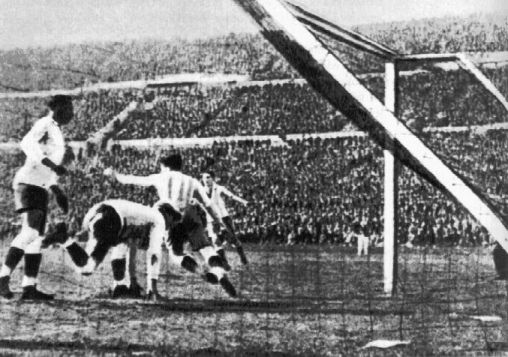
Unfortunately the 1929 stock market crash had international repercussions and Europe was in the middle of an economic crisis. All but four European countries pulled out as a result. The hosts Uruguay beat neighbours Argentina 4-2 in the first final. Mussolini’s Italy won the rights to host the next tournament in 1934. This was the first tournament to be broadcast by radio. Holders Uruguay returned the snub of 1930 and refused to participate. Italy, with the likely interference of Mussolini with the choice of referees, won on home soil. South America was outraged when the 1938 tournament was again awarded to Europe, this time France. Uruguay and Argentina boycotted again. Italy retained the title they won in 1934.

The tournament resumed after the war with the British nations finally taking part in 1950. It was held in Brazil and the trophy renamed the Jules Rimet Cup in honour of the 25th anniversary of his presidency of FIFA. India had qualified for the first (and only) time ever but withdrew because they were not allowed to play barefoot. England’s long awaited debut was inauspicious, they crashed out in the first round after an ignominious defeat to the part-time USA team 1-0. Uruguay went on to win their second championship beating the hosts in the de facto final 2-1. The attendance for the game is still a world record: 199,854 people in one sporting venue.

1954 was FIFA’s 50th anniversary and they celebrated it by playing the World Cup in its host country, Switzerland. The Marvellous Magyars, Hungary, were unbeaten in four years leading to the final but were shocked 3-2 in the final by West Germany in what became the ‘Miracle of Bern’. The victory gave pride back to a defeated nation and kick-started the German economic recovery of the fifties and sixties. Brazil began its domination of the modern game with victories in the 1958, 1962 and 1970 spearheaded by a young genius called Edson Arantes do Nascimento better known as Pelé. England interrupted the sequence and won their only trophy on home soil in 1966. Germany and Argentina did likewise in 1974 and 1978 respectively. Both sides beat the brilliant Dutch in the final. The Netherlands’ best player in 1974, Johan Cruyff refused to play in Argentina due to the military coup that took place there two years before the tournament. It is likely his attitude cost them the tournament.

The tournament became increasingly globalised and wealthy from the eighties onwards. Television audiences went into the billions. Players and teams were more technically proficient and it became harder for individual brilliance to dominate. 1986 was the last tournament which belonged to one player when Diego Maradona almost single-handedly brought victory to his beloved Argentina. Even Brazil, the samba kings, have succumbed to the trend and won in 1994 and 2002 with much more workmanlike teams than previously. Stars such Ronaldinho, Ronaldo, Kaka and Adriano will hoping to lead a more buccaneering Brazil to the title this time round. But Woolly Days is confident that history will ensure that a European team triumphs in their own continent again, possibly hosts Germany in a repeat of their famous final against the Netherlands of 1974.

But whoever wins it, I'll be enjoying it alongside five billion others. For football fans everywhere, this is as good as it gets. And for humanity, this is as inclusive as it gets.

Wednesday, June 07, 2006

Montenegro splits from Serbia

Montenegro is the world's newest independent nation and the last of the old Yugoslav states to split from Belgrade.

Brokered by the EU, the Union of Serbia and Montenegro was born in 2003. The aim was to settle Montenegrin independence demands and stabilise Balkan borders. The union deal also contained the seeds of its dissolution. After three years the two republics could hold referendums on whether to keep or scrap it. And so, on May 22, 2006 Montenegro narrowly voted for independence from the union with Serbia. 55.4% of the voters had voted to secede, just above the 55% required for victory. The turnout in the May 21 poll was 86.3%.

The issue of independence divided Montenegro, with opponents arguing that Montenegro had too much to lose with its broad economic, family and political ties with Serbia. The opposition movement was a loose coalition of Serb politicians, Orthodox Church leaders and Montenegrins from the mountainous inland regions near the Serbian border. The move to secede was supported by long-standing Prime Minister Milo Djukanovic who believes that independence will strengthen his country’s chance of joining the EU. He was supported by ethnic Montenegrins and Albanians from the coastal area who feared Serbian dominance of the union.

A Serbian Government press release on June 5 confirmed the decision to transfer jurisdiction. According to the release, the decision obliges Serbia to take the necessary measures within 45 days to make Serbia the international legal successor of Serbia-Montenegro. It affirmed also that association with the EU was Serbia’s ‘strategic and national goal.’

Montenegro’s position on the Adriatic Sea means that Serbia is now a landlocked country. This fact strengthens Montenegro’s position in negotiations with Serbia. It leaves Serbia in a similar position to Ethiopia who lost its coast in the 1990s to newly created Eritrea.

The last time Montenegro was independent was 90 years ago at the end of World War I, when it was absorbed into the newly formed Yugoslavia. Podgorica will become the world’s newest capital city. In 1946 Podgorica was renamed Titograd in honour of the post-war communist leader of the country. The name of Podgorica was reinstated on April 2, 1992.

Montenegro has a population of 700,000 people. The name Montenegro means “black mountain” in Venetian language. The Montenegrin word for their country "Crna Gora" also means black mountain. It is named for the dark forests that covered the slopes of the Dinaric Alps. The earliest known independent ruler of the area was the 11th century dukedom of Dukjla. They paid tribute to the Byzantine Empire and were replaced by the Zetans in the 14th century. The Ottoman Empire was now on the march but never fully conquered mountainous Zeta. From then on, the country was ruled by a series of "vladika," prince-bishops, who formed a theocratic state. It was transformed into a secular principality in 1852 and in 1910, Prince Nikola I became King of Montenegro. Nikola declared war on the Turks and precipitated the two Balkan Wars. Montenegro doubled in size as a result of these wars. It was allied with Serbia in World War I and was occupied by the Austrian Empire.

After the war, parliament voted for a union with Serbia which was finally ratified in 1924 after a bitter civil war against anti-unionists. It became part of the Kingdom of Serbs, Croats and Slovenes which renamed itself to Yugoslavia in 1929. During World War II, it was occupied by Italian and then German troops. It became a separate state of Yugoslavia after the war ended. War resistance leader Josip Broz Tito kept the federation together until he died in 1980. His death brought on a slow unravelling of the six states. When Yugoslavia finally broke up in 1992, Montenegro held a bitterly fought election which voted for federation with Serbia. The election was boycotted by pro-independence factions. Relations steadily soured with its major partner as Montenegro became more independent. In 1996, Djukanovic’s government severed de facto ties and adopted the Deutsche Mark as currency (since replaced by the Euro.) In 2003, the two sides agreed to replace the Yugoslav federation in favour of a looser state union named Serbia and Montenegro. The path was finally cleared for the independence referendum.

Though Montenegro is the last state to break free from Yugoslavia, it does not necessarily mean the end of the Balkan conflicts. The prime minister of Kosovo, Agim Çeku, has signalled that they would be next in the quest for independence, saying "This is the last act of the historic liquidation of Yugoslavia…this year Kosovo will follow in Montenegro's footsteps." Kosovo is currently administered by the UN, but is seen by Serbs as the historical and spiritual heart of Serbia. The status of Republica Srpska, the Serb-controlled enclave in Bosnia also remains on knife-edge, with ethnic Serbs looking for a referendum of their own to rejoin Serbia. Such a move could start another war in Bosnia as it has provoked widespread condemnation from the Muslim majority and the West. Permanent peace still eludes this beautiful but complex part of the world.

Although the future is likely to rain on its parade, right now Montenegro justly celebrates its new nationhood.

Tuesday, June 06, 2006

Cairns pilot for abortion pill

The controversial RU486 drug will be available in Queensland next month. The tourist town of Cairns in Far North Queensland will be the first place in Australia to trial the drug. RU486 is the so-called “morning after” abortion pill recently made available in Australia after a stormy and emotional parliamentary debate and conscience vote.

Cairns obstetrician Professor Caroline de Costa will be the first Australian doctor to prescribe the drug. She said she was expecting to issue RU486 to patients by July once the initial batch of 40 tablets is cleared by the Therapeutic Goods Administration (TGA).
Professor de Costa said the drug would be administered at a private clinic in Cairns to patients referred by locals GPs. Queensland Attorney-General Linda Lavarch said on Monday state law authorised doctors to prescribe the drug. The cost will be about $60 a tablet.

RU486 is the common name for the drug mifepristone. Mifepristone is a synthetic steroid with anti-progestagenic and anti-glucocorticoid effects. This means it can be used to induce what is known as medical abortion. During early trials, it was known as RU-486 after its designation at Roussel Uclaf, a French pharmaceutical company, which designed the drug. It is an alternative method to abortion.

RU486 is a medical procedure whereas abortion is a surgical procedure. It works by blocking the effects of the hormone progesterone, which is crucial to starting and maintaining pregnancy. Without progesterone, the lining that covers the walls of the uterus breaks down. In the absence of progesterone, the uterus cannot hold onto the fertilised egg, making it impossible for pregnancy to continue. Doctors will prescribe a specified dose of the drug to a pregnant woman. Two days later, the woman returns to the clinic to be administered another drug prostaglandin (usually misoprostol.) Misoprostol causes the uterus to contract, thereby expelling the foetus, usually within a few hours. According to the Royal Australian and New Zealand College of Obstetricians and Gynaecologists (RANZCOG), the experience for the woman ‘may be much like a spontaneous miscarriage, with some pain and bleeding to be expected.’

RU486 is approved for use in the US, the UK, much of Western Europe, Russia, China, Israel, New Zealand, Turkey and Tunisia. Despite the recent conscience vote, it was never actually banned in Australia. According to the Therapeutic Goods Act 1989, RU486 is in the category of ‘restricted goods’ which required the written permission of the Minister for Health to be registered or imported. The act specifies that only abortion drugs are in this restricted category. Medicines used for any other purpose are evaluated and regulated by the Therapeutic Goods Administration (TGA) without any requirement for approval from the Minister.

The restricted goods category was introduced in 1996 as an initiative of the independent Tasmanian Senator Brian Harradine, who had strong anti-abortion views. At the time, the Senator argued RU486 had serious side effects, and the amendment was needed to protect the health of Australian women. Liberal Government support was a trade-off for the Senator's support for a bill to allow the part sale of Telstra. And with Tony Abbott, another strong anti-abortion supporter as Health Minister, drug companies have decided it is not worth the bother of applying for the licence to import the drug.

The legislation was overturned by a private member’s bill in February 2006. The purpose of the bill was to remove the Minister’s override and return the approval to the TGA. The bill was a conscience vote and split the parties almost exactly along gender lines. The bill was passed in the Senate 45-28 and the Lower House passed it on a show of hands to avoid further political controversy.

RU486 is mainly used during the first nine weeks of pregnancy, though is also effective for second trimester termination. How safe is it? Supporters have pointed out its wide availability overseas, evidence of its safety and compared with abortion, and the fact that abortion may not be easily available to rural women and those for whom privacy is an issue for religious, ethnic or other reasons. Detractors have denied it is safe, and counter the rural argument by saying it is a high risk option for women without adequate levels of medical supervision. There have been reports of deaths in the US and Canada due to the drug. Six women in the US and one in Canada have died following medical abortions, causing some medical abortion providers to stop using the method of intra-vaginal placement of the second drug, misoprostol. However these incidents occurred due to the fact that women did not follow the FDA approved instructions for the use of the drug.

Professor of Obstetrics and Gynaecology at Monash University Medical Centre, David Healy, doesn’t share these concerns. He believes that RU486 is safe and psychologically a much better method than surgical abortion. He says that “for most women if taken early, this will be just like having a period, rather than having a miscarriage.” He points out that there are 75,000 abortions each year in Australia and anything that helps alleviate that number has to be supported by the wider community. He concludes “this medicine is safe when used under proper medical care. The rest of the world has really moved on. Surgical abortion is now something that is really becoming increasingly old fashioned and no longer the best treatment available for Australian women.”

Monday, June 05, 2006

Suu Kyi house arrest extended

Aung San Suu Kyi is the world’s most famous political prisoner. She has spent 11 of the past 18 years under house arrest in Rangoon, the capital of Burma. Last month, the country's military rulers decided to extend her house arrest when her confinement order expired on May 27, 2006. May 27 was sixteen years ago to the day when Suu Kyi and her National League for Democracy (NLD) party won a crushing 82 per cent of the vote in a general election, a majority that could not have sent a clearer message to the ruling military junta about what the nation thought of its 28-year dictatorship.

Nonetheless the government have ignored the world and indefinitely extended her detention. This was despite pleas such as the one from UN Secretary General Kofi Annan "I'm relying on you, General Than Shwe, to do the right thing," he said, in a direct appeal to the country's senior leader.

Now Annan is saying “despite this setback, the international community cannot abandon the search for improvements in the difficult situation in Myanmar.”

In 1989 the ruling junta renamed the English version of its name from Burma to Myanmar to denote the majority Bamar ethnic group. Myanmar was already the name in Burmese. The West has been slow to embrace the change and organisations such as the BBC and the New York Times still refer to it as Burma.

Burma was a series of independent kingdoms that evolved through the centuries. The Konbaung Dynasty ruled in the 18th and 19th century and fought a series of wars with British India. By the time of the third Anglo-Burmese war in 1885, the British had conquered the whole of the country and turned it into an Indian province. Burma was split from India and set up as a separate colony in 1937. When the Second World War broke out, some leaders such as Aung San (the father of Aung San Suu Kyi) called for a national uprising against the British. He fled to China but fell into Japanese hands. The Japanese offered him support to form the Burmese Independence Army (BIA).

The Japanese invaded Burma in 1942 and they allowed the BIA to form a provisional government. But the Japanese didn’t like how truly independent they were becoming. They disbanded the BIA and replaced it with the Burmese Defence Army still under Aung San. The Japanese trained this army and they appointed Ba Maw as puppet head of state. A disillusioned Aung San formed an anti-Japanese group and they rose up in rebellion in March 1945. The Japanese were routed and left the country in defeat in May. The British reinstalled a governor who convinced the hugely popular Aung Sun to join a ruling council. In 1947 his party won a landslide victory in Burma’s first election. Unfortunately for him, he and six of his newly formed cabinet members were assassinated on the orders of a conservative politician U Saw.

Despite the assassinations, Burma transitioned to become a democratic republic in 1948. The republic lasted until the military coup of 1962. General Ne Win took over. Ne Win was a contemporary of Aung Sun and one of the leaders who travelled to Toyko for wartime training. He cemented his reputation in the 1950s when he put down the Karen rebellion. Having taken power, he dissolved parliament and ruled alone for the next 26 years. In 1990, free elections were held but the landslide victory of the NLD, the party of Aung San’s daughter, Aung San Suu Kyi was voided by the military, which refused to step down.

Aung San Suu Kyi was only 2 years old when her father was killed. She was educated in English Catholic schools for much of her childhood in Burma. Her mother Khin Kyi was appointed as Burmese ambassador to India in 1960, and Suu Kyi followed, graduating in New Delhi in 1964. She then went to Oxford when she got a BA in Philosophy, Politics and Economics in 1967. She went to work for the UN in New York and married an Englishman, the Tibetan scholar Michael Aris, in 1972. She returned to her native country in 1988 to care for her ailing mother. In that year, the long-time leader General Ne Win stepped down among democracy demonstrations which were violently suppressed. A new military junta took power. Suu Kyi entered politics, influenced by Ghandi’s theories of non-violence. She founded the National League for Democracy (NLD) and was placed under house arrest in 1989. She was offered freedom in exchange for leaving the country but she refused.

The junta called elections in 1990 which the NLD won easily. However the military refused to hand over power which resulted in international outrage. Suu Kyi won the Nobel Peace Prize in 1991 for her “non-violent struggle for democracy and human rights". She was released from house arrest in 1995 but told she would not be allowed back in if she left the country. Her dying husband was not allowed an entry visa. They never saw each other again as he died in an Oxford hospital in 1999. She was repeatedly prevented from meeting with her party supporters, and in September 2000 was again put under house arrest. The UN negotiated for her release in 2002 and she proclaimed "a new dawn for the country". This dawn was short-lived. In May 2003, her entourage was attacked in a remote northern village by a government-sponsored mob that killed and wounded many of her supporters. Suu Kyi fled the scene but was arrested shortly after. She was imprisoned in Yangon and was again placed under house arrest in Yangon after a hysterectomy in September 2003.

The United Nations has continued to lobby Burma for her release. She is the subject of a high-profile international campaign by the US government, dignitaries and such musical artists as U2, REM and Coldplay. Nonetheless she remains imprisoned under the 1975 State Protection Act which grants the government the power to imprison persons for up to five years without a trial.

General Than Shwe remains implacably opposed to her release and with the support of China and the leadership of ASEAN, he is confident his position is strong enough to ride out the international condemnation. Drug money from the Golden Triangle is widely suspected of keeping the Burmese economy afloat. Shwe’s regime has profited from the flow of drugs across the border into Thailand. Most local investment in that country is laundered drug money. Some five-star hotels, many finance houses and a large percentage of all tourist facilities are built by money from druglords.

And while Suu Kyi remains locked up, none of that is likely to change any time soon.

Sigmund’s Schadenfreude?

Question: What’s the definition of a Freudian slip?

Answer: Someone who says one thing and means a mother.

May 6, 2006 was the 150th anniversary of the birth of Sigismund Schlomo Freud. At the age of 21, he shortened Sigismund to Sigmund and more or less ditched the Schlomo. As Sigmund Freud, he left a huge shadow of complexities over our modern world. His legacy is immense, not least his complexes. His theories are loved and despised in equal measure. And he smoked lots of cigars.

Though few people actually read Freud these days, we pepper everyday speech with his legacy. We talk of Freudian slips, the Oedipus Complex and anal retentiveness. If the question and answer that introduced this article appeared in a list of Freud jokes, it would have been an anal, oedipal, slip. The mother of all jokes about the father of psychoanalysis and the man who, among many other things, wrote a book called Jokes and Their Relation to the Unconscious. So who was Freud, why do we remember him with such controversy, and why would a father of psychoanalysis write a book about jokes?

To answer these question, we must first seek the help of history. Freud was born into a Jewish family in 1856 in Moravia. His native city is what was then Freiburg in the Austrian Empire and is now Příbor in the Czech Republic. Two things there, Moravia is still Moravia and Freud is Czech. His father Jakob was a successful wool merchant who had two children from an earlier marriage. At 40 years of age, Jakob married Amalie Nathanson. Sigi was the first and favourite of their eight children. Young Sigi’s bright, precocious nature was obvious from an early age and he excelled at school. He was a smart kid. At the age of eight, he was reading Shakespeare, and spoke several languages. His boyhood hero was Hannibal, who marched his elephants across the Alps. When his father asked him why Hannibal, the young boy replied “because he was a Semitic leader who fought the Romans.” From an early age Freud was acutely aware of his Jewishness in a predominantly Roman Catholic country.

Sigmund was just four years old when the family moved to Vienna, the capital and centre of the Hapsburg Empire. Vienna was an ancient Celtic settlement that was colonised by the Romans as Vindobona in 15 BC. Vienna was always on the frontline of Western Europe. It survived two sieges by the Ottomans and the Hapsburgs had inherited it from the Holy Roman Empire. By the end of the 19th century, Vienna was a sophisticated melting pot with a dark underside. Populist mayor Karl Lueger played up successfully to the anti-Semitic vote. Among the citizens listening to Lueger with varying degrees of enthusiasm were the Jewish journalist Theodore Herzl, the founder of Zionism and the Gentile painter Adolf Hitler, who’s idea of Lebensraum was drastically different to that of Herzl. Freud grew up in this foment of radical political ideas. He spent most of the 1870s in the medical school of the University of Vienna. There, he studied organic tissues and the nervous system under the influence of Ernst Brücke. Brücke was one of the founders of mechanism, the theory that believed physics and chemistry solved everything. Brücke was impressed by Freud’s pioneering work on nerve cells but offered him cruel fatherly advice: you will never succeed in academia due to your Jewishness, so turn to medicine. Freud reluctantly agreed. As well as difficult career choices, there was also love to contend with. Freud, now 26, met and married Martha Bernays in 1882. He returned to college and trained at Vienna General Hospital before starting up in private practice.

At medical school he fell under the influence of Theodore Meynert, the leading brain anatomist of the day. Meynert convinced Freud to specialise in neuropathology, the study of diseases of the nervous system. There he had easy access to medicine, and he fell under the influence of something else: cocaine. He saw cocaine as an anti-depressant and an anaesthetic. He himself took cocaine in small doses for about two years. He prescribed it to a friend as an antidote to his morphine addiction. He also assisted on an eye operation to his own father using cocaine as a local anaesthetic. This was ground-breaking work. However he was beaten to the credit by Carl Koller who claimed discovery of anaesthetic cocaine for himself. That this was a true blessing in disguise for Freud became apparent in 1886. Cocaine quickly lost its wonder drug status when its addiction properties were widely reported. In the same year, Freud received a grant to go to Paris and study with Jean Martin Charcot, a world famous neurologist. Charcot was also a brilliant teacher and he held court at Paris's Salpêtrière Hospital. Here he showed Freud the similarities between hypnotism and hysteria. Hysteria, the Latin for womb, was then seen as a "women’s ailment" which caused paralysis and convulsions in its victims. When he got back to Vienna, Freud noticed he could treat patients of both sexes who were showing these symptoms. A speech for his paper on ‘male hysteria’ caused hysteria of its own at the Vienna Medical Society. He was shouted down.

Undeterred by the medical outrage, Freud began to use hypnotism to treat his patients. He worked closely with his friend Josef Breuer who also used this technique. One day, Breuer mentioned a patient of his, a young lady known as “Anna O”. Anna showed symptoms of paralysis and hallucinations which Breuer treated by discussing the hallucinations. Because she felt better when discussing the problem, she called it the "talking cure." Breuer cured Anna completely by hypnotising her and thus teasing out the root cause under hypnosis. Freud was impressed by what Breuer called his cathartic method and began to use it himself. Freud made a few adjustments to the method. He found hypnotism didn’t work especially well for him. But one thing worked very well indeed. Patients talked a lot easier when placed on a couch. When they were relaxed, he allowed them to talk through their own cures by a mixture of free association and lack of censorship. He coined a name for this technique: psychoanalysis.

Here was another Freud theory not well received by the medical profession. The only person willing to listen to Freud was Wilhelm Fleiss. Fleiss was a Berlin nose-and-throat specialist with some radical ideas of his own. He believed that sexual illnesses were caused by disturbances in the nose. He operated twice on Freud for nasal infections. Nasal problems were not Freud’s only headaches. His father’s wool business had completely collapsed and he died broken and broke in 1896. Freud was now supporting the entire family as well as six children of his own. Nonetheless, he still found time that year to write his first book The Interpretation of Dreams. Freud proved to be a gifted writer and he cleverly exposed dream meaning with highly intriguing interpretations of nocturnal adventures.

Through his work on dreams, he discovered a complex which had striking parallels with a famous Greek legend. In the legend handed down by Sophocles’ play, King Laius and Queen Jocasta are warned by a soothsayer that their newly born son Oedipus will grow up to murder his father and marry his mother. They abandon the boy in the mountains where he is rescued by shepherds. As a young man, Oedipus hears the same warning and flees to avoid killing the shepherd he believes is his father. On the road, he meets a stranger (Laius) and kills him after a quarrel. In the royal capital he answers the riddle of the sphinx and is awarded the queen’s hand in marriage. It all goes pear shaped when the queen is revealed as his mother, Jocasta. Oedipus realises the prophecy has come true and blinds himself in punishment. His mother commits suicide. From this fascinating but grim tale, Freud extrapolated the Oedipus Complex, an incest fantasy that all children share.

Freud theorised that the mind had two parts. There was the preconscious containing ideas and memories. And then there was the unconscious with desires, impulses and wishes of a mostly sexual and sometimes destructive nature. In 1905 he published more horror on an unsuspecting public, his Three Essays on the Theory of Sexuality. He said that the basic sex drive, the libido, was formed at birth. Children went through three sexual stages, the oral (breastfeeding), the anal (toilet training) and the phallic stage (the discovery of the sex organs at aged five or six.) The phallic stage applied to males and females. Young boys suffered castration fantasies at the hands of their fathers whereas girls suffered penis envy when they realised they were already “castrated”. This phallic stage was where the Oedipus Complex was acted out. Children’s sexuality then went into latency before reawakening at puberty. Freud stated that this two-stage sexuality was uniquely human.

This was certainly a theory to turn heads. Society was outraged. He was accused of destroying childhood innocence and of turning everything into a tawdry matter of sexuality. As a blow to human pride, it ranked with Copernicus’s theory of the solar system and Darwin’s theory of evolution. Here was Freud saying that mind does not equal consciousness; instead, what is mental is mostly unconscious and involuntary. His radical views picked up some influential adherents. By the end of the first decade of the new century, Freud was internationally famous. The Vienna Psychoanalytical Society was born under Freud’s aegis. It included the luminaries of the field such as Otto Rank, Alfred Adler and Carl Jung. Initially the young Swiss Jung was Freud’s greatest disciple. Freud admitted Jung was like a son to him. But relations soured when Jung started to diverge from some of Freud’s basic ideas. He went to America and announced that Freud was over-emphasising the sexual aspects of the theory. Freud didn’t have much time for dissent and further arguments led to an irrevocable split in 1912.

Freud continued to explore his sexual theories in his next book Totem and Taboo. In it, he traced the Oedipus Complex back to its early human roots. He described the kinship systems where sex was outlawed between members of the same clan. In order to procreate, the clan would have to marry into another. Freud showed how sexual exchange was the basis of culture and communication between clans. Freud supported his own clan when Austria’s archduke Ferdinand was assassinated in Sarajevo and set in motion the First World War. Freud supported the Central Powers because his own sons were in the army. Freud was quickly disillusioned by the war which he saw as a ‘gigantic hypocrisy.’ Life in wartime was hard. He could not keep up his habit of one packet of cigars each day. His sons fought in vain to save the Hapsburg Empire and Freud lost all his savings in the galloping inflation that followed the war. The cigars that Freud did smoke gave him cancer of the jaw. Doctors had to replace the upper jaw and palate on the right jaw. A huge prosthetic denture was designed to shut off his mouth from the nasal cavity. He lived the last 16 years of his life in extreme pain and required 33 operations. Speaking caused him great agony. These dark times saw him develop another theory. This was ‘thanatos,’ the death drive. Thanatos is the Greek word for death and Freud saw it as an instinct within everyone. Paradoxically it could prolong life because the organism defends itself against all threats of death which are not appropriate to it.

Around the same era, he proposed a new map of the mind in his book Beyond the Pleasure Principle. This was the id, the ego and the superego. The id holds the primary urges of the unconscious mind. The superego is the home of our conscience, taboos and morality. The ego tiptoes uneasily between the other two to give rise to self. This dynamic turned morality upside down. Sometimes it was our actions that form morality and not the other way round. Religion had no place in the Freud pantheon. Though always Jewish, he was first and foremost a scientist.

Germany, meanwhile, was handing over its entire national superego to one Fuehrer. The Viennese artist Hitler had left Austria behind for the moment. In 1933, the Nazis publicly Freud’s books. His reaction was, “what progress! In the Middle Ages they would have burned me!” He was sadly mistaken about Nazi ‘progress.’ When Hitler claimed Vienna in the Anschluss of 1938, Freud’s life was in great danger. One of his wealthy patients Prince Marie Bonaparte, a descendent of Napoleon, arranged for his escape to Paris. After some cajoling he agreed to leave Vienna. The Germans let him go after he signed a statement to say they had treated him respectfully. He eventually settled in London for the last year of his life. Freud died on September 23, 1939 with the world at war again and Warsaw burning. Hitler had started to impose his own thanatos on the world.

Freud was to prove as controversial in death as he was in life. The philosopher Karl Popper challenged Freud’s theories as pseudo-scientific. Popper argued that a scientific theory should be able to specify the empirical observations that would falsify it. Psychoanalysis cannot be tested empirically and therefore was not science. “Freud or Fraud” was a common catchcry as critics sought to poke holes through his theories. Feminists too were outraged by his castration and penis envy theories and said he was misogynistic. Today opinion is still deeply divided; some psychiatrists regard him as a charlatan, but many others agree with the core of his work.

Others again like A.C. Grayling, Professor of Philosophy at the University of London, see both sides. "Freud," says Grayling, “was a gifted artist, a philosophical visionary who re-imagined human nature and helped us confront taboos, but whose theories, offered as science, fail under scrutiny.” Freud’s contemporary and friend of letters Albert Einstein also recognised the genius and the failings. He said of Freud, “he had a sharp vision; no illusions lulled him to sleep except for an often exaggerated faith in his own ideas.”

As for Freud’s book on jokes, he theorized that jokes have only two purposes: aggression and exposure. Here was a man who said many things and meant much more than a mother.

Friday, June 02, 2006

Candomblé

Candomblé is a Brazilian religion of African origin with over two million adherents.
Also called Macumba (though some see this as a pejorative term used only by non-adherents) in the Rio and Sao Paolo areas, it took root when black slaves were shipped to Brazil from the 16th century onwards bringing with them the worship of African orishas. The orisha or Orixá is commonly translated as "god". A more accurate representation would perhaps be "saint". Candomblé posits a monotheistic supreme being -- usually referred to as Olodumaré -- with the orixás being called upon as intermediaries between humans and God, much as Christians will pray for a saint's intercession on their behalf.

Derived from the Yoruba people of West Africa, Candomblé is a form of Vodun (“spirit”). Vodun is more commonly known as voodoo by the greater public. Vodun is the Haitian equivalent and like Candomblé can be directly traced to the West African Yoruba people who lived in the 18th and 19th century Kingdom of Dahomey (modern day Togo, Benin and Nigeria.) Its roots date back 6,000 years in Africa. The image of Vodun has been greatly tarnished by the imagination of Hollywood whose version of voodoo involving violence, bizarre rituals and pins in dolls has little basis in reality.

The home of Candomblé is the ancient Brazilian capital of Salvador (in Bahia state). The Spanish were the first Europeans to arrive here under the command of Vicente Yáñez Pinzón. On January 26, 1500, he landed to the north of Bahia, near present-day Recife. The Portuguese arrived later that year with the fleet of Pedro Álvares Cabral, on his way to India before heading east around Africa's Cape of Good Hope. Cabral claimed the area for Portugal. Salvador became Brazil's main sea port and was the colonial capital of Portuguese Brazil until 1763. The Portuguese set up a governorship for Brazil in the middle of the 16th century and institutionalised slavery to support the massive sugar plantations that proved to be the wealth of Brazil. Thus started a 300 year tradition of slavery. An estimated 1.3 million slaves were imported into Salvador before slavery was abolished in 1888, double the number of slaves imported into the US. The salves kept their African culture alive through their religion.

Candomblé is a syncretic religion and has incorporated many elements from Christianity. During the slavery days, the African religions were banned and often existed under the cover of Catholicism. Christian devotional altars were used in early slave houses to hide African cult icons and ritual objects. Although the practice came into the open after the end of slavery, some of the Christian aspects were maintained. Candomblé temples display crucifixes and many Orishas are identified with Catholic saints.

Although syncretism still seems to be prevalent, in recent years the lessening of religious and racial prejudices has given rise to a fundamentalist movement in Candomblé, that rejects the Christian elements and seeks to recreate a purer form based exclusively on its African roots.

Candomblé shares many characteristics with Umbanda, another syncretic Brazilian syncretic religion worshiping African spirits with some European influences. Apart from their geographic isolation, (Umbanda is more prevalent in Southern Brazil) Umbanda’s chief distinguishing characteristic from Candomblé is the added ingredient of spiritism also called Kardecism from its chief initiator, the 19th century Frenchman, Hippolyte Léon Denizard Rivail whose pseudonym was Allan Kardec. Besides coining well-known terms such as "reincarnation" and "spiritism", Kardec pioneered the conduct, documention and publication of scientific, evidence-based, systemized studies of the paranormal.

Though both religions have been legal since 1950 in Brazil, recent years have seen evangelical Christian groups attempting to persecute practitioners of Candomblé and Umbanda, sometimes with violence. Practitioners of these religions have taken cases to national courts and achieved a measure of success.

Candomblé seeks harmony with nature. Their ‘temple’ is the terreiro, led by a high priestess, (called a ‘mães de santo’ mother of saints) or priests, (called pais de santo father of saints). Similar to the liturgical cycle of the Catholic Church, adherents worship the pantheon of orixás in an annual cycle. In the religious ceremonies, they dress in the colours of the orixás and place food at the altar before singing and dancing choreographed steps to a sacred drumbeat. The highlight of the ceremony is the epiphany, the moment of possession, when the orixá takes over the believer's body.

This culture has given Black Brazil its heart. As Salvadorean Oni Kòwé puts it “The whites want to be Negroes..now the privilege is to be white with a Negro soul, to have ancestry, "to have a plot, a history with the Saint".

Thursday, June 01, 2006

The rise of Al Jazeera

Al-Jazeera is an Arabic word meaning ‘the island’ or ‘the peninsula.’ It is also the name of an Arabic television station based in the Gulf state of Qatar which has received international attention, plaudits and brickbats in equally large measure in the last ten years.

In a 2005 poll conducted by branding consultancy Interbrand, Al-Jazeera came out the No. 5 "brand with the most global impact," behind Apple, Google, Starbucks and Ikea. Al-Jazeera built its reputation as a genuine alternative to the global English-language networks and broke the West’s monopoly on news. It rivals the BBC in worldwide audiences with an estimated 50 million viewers.

Al-Jazeera has been a pioneer of free expression in a part of the world not renowned for it. It has taken on sacred cows both by criticising Arab regimes and interviewing Israelis. It has incurred the wrath of Gulf States such as Bahrain which banned it for supposed pro-Zionism and bias against Bahrain. The ban is more likely a result of Al-Jazeera airing footage without permission of anti-US protests in Bahrain which ironically were spurred by Israeli military action in the West Bank.

Al-Jazeera has several channels including sports and children’s channels. It also has English and Urdu language channels planned. But it is the main 24 hour news service for which it is most justly proud. It has an important presence on the internet. The station is most famous for its role as a conduit for Al Qaeda communiqués and videos to the Western World.

This fame is double edged, Al-Jazeera have become imprinted in the Western conscience as a result but are also sometimes seen as a mouthpiece for Osama Bin Laden and are thus greatly feared and mistrusted in the US. Defence Secretary Donald Rumsfeld has accused the network of lying and getting "advance notice" of attacks from terrorists. Al-Jazeera International (AJI) are hoping that their English language channel, with American backers, will change this perception. They have already signed a deal with satellite distributor BSkyB, which is partly owned by News Corporation.

The launch has not been without problems and they have already missed three deadlines to start the channel. There is a fight for identity between Western AJI and its Arabic parent channel. Critics, most notably on the Friends of Al-Jazeera website, have attacked the executive team for being overloaded with "ex-corporate" types. These include Sir David Frost who, by his own admission, sought a seal of approval from Washington and London before signing on.

Al-Jazeera is based in Doha, the capital of Qatar. Qatar is ruled by the Sandhurst educated Sheikh Hamad bin Khalifa Al-Thani. Sheikh Hamad is the staunchest ally of the United States in the Middle East. He has permitted the US to begin building military facilities within Qatar and has normalised relations with Israel. He overthrew his father who was vacationing in Switzerland in a bloodless coup in June 1995. The Al-Thani family is the only one off-limits from Al Jazeera criticism.

The origins of Al-Jazeera also date to the same year of Al Thani’s coup – 1995 - when the BBC signed a deal with the Saudi Orbit Communications to provide Arabic news for Orbit's main Middle East channel. However, the BBC's insisted on editorial independence which did not sit well with the Saudi government who baulked at reporting issues such as executions and the activities of prominent Saudi dissidents. It took only until April 1996, and a BBC story which showed footage of a Saudi beheading, for Orbit to kill the deal. A few months later, the then new Emir of Qatar, al-Thani, took advantage of this to hire most of the BBC Arabic Service's editors, reporters and technicians to form the nucleus of a new channel. The Emir, who had started a campaign to end censorship in Qatar and abolished its notorious “information ministry,” contributed $140 million to finance its operations for the first five years. It aimed to become self-sufficient through advertising by 2001. When that failed to transpire, the Emir committed to a further $30 million a year until further notice.

During the Iraq war, the US bombed the Al-Jazeera Baghdad office killing three journalists in a missile attack. The Daily Mirror published a story in which they claimed that President Bush had considered bombing Al-Jazeera's Doha headquarters in April 2004, when U.S. Marines were conducting an assault on Fallujah.It was intimated by the report that the Iraq war incident and other bombing of Al-Jazeera offices (such as Afghanistan 2001 and Basra 2003) were also deliberately targeted by presidential order. British Attorney-General Lord Goldsmith gagged the newspaper 24 hours after it published details of what it said was a transcript of talks between Bush and the British Prime Minister Tony Blair. Blair is said to have talked Bush out of launching "military action" on the television channel's headquarters.

Al Jazeera and one of its many new imitators, the Dubai based Al-Arabiya, both embarrassed the American funded Iraqi Al-Hurra channel ($60 million seed money plus $40 million added by Congress to reach 80 percent of Iraq's population with over-air transmitters) by broadcasting from inside the city during the siege of Fallujah. Al-Hurra has been exposed as an American propaganda exercise and is losing the battle of the airwaves as a result.

Al-Jazeera are annoying everyone which would most likely mean they are doing a very good job of reporting the truth.