Thursday, March 15, 2007

Black deeds

Jury selection has begun in the Chicago trial of Canadian media magnate Conrad Black. The 62 year old former CEO of Hollinger International is charged with three other ex-Hollinger executives of swindling the company out of $84 million through asset sales. Black is also accused of using company funds to finance a lavish lifestyle.

Also facing trial with Black are Canadians Jack Boultbee, Hollinger’s former Chief Financial Officer; Peter Atkinson, the company's former general counsel and American Mark Kipnis, an attorney who was corporate secretary at Hollinger’s Chicago headquarters. Black’s high powered legal team is led by his former law school friend Edward Greenspan. Worldwide media are salivating over a trial is expected to last several months.

The trial is a large fall from grace for one of international media’s biggest players. Conrad Black's newspaper empire was once the third largest in the world after Gannett and Murdoch's News Corporation. Black had 650 titles with a circulation of 10 million people. These titles included prestigious newspapers such as Britain's Daily Telegraph, Canada's National Post, the Jerusalem Post and the Chicago Sun-Times. He was also part of owner of the Fairfax empire in Australia. The problems started after Black sold most of the empire and diverted shareholder profits from the sales. He was forced to resign as Hollinger CEO in November 2003 amid charges of corruption. Two months later, he was fired as chairman.

He was born Conrad Moffat Black on 25 August 1944 in Montreal. His father George Montegu Black Jr was president of Canadian Breweries. Aged 14, Conrad was expelled from Toronto's elite Upper Canada College after making a $1,500 profit by selling stolen exam results to his classmates. Despite this setback, he went on academic success, completing a history degree at Carleton University, a law degree at Laval and gaining an MA from McGill. While still at university, Black and a friend began buying small Canadian newspapers, and in 1971 they co-founded the Sterling Newspapers Group.

In 1978 he took over the blue-chip Argus Corporation after he cajoled two elderly widows to sell their controlling stock. Black proceeded to sell off most of Argus’ holdings for a healthy profit in order to concentrate on the newspaper business. This business he called Hollinger, which was originally a Chicago-based mining offshoot of Argus.
By the early 1990s Hollinger owned 60% of Canada’s newspapers and expanded into US, Britain, Australia and Israel. At its peak in 1999, Hollinger had revenues of over $2 billion. His influence was such that Tony Blair offered Black a peerage in 1999.

However Jean Chrétien’s government opposed the title invoking the obscure 1919 Nickle Resolution which disallowed foreign governments from granting titles of honours to Canadians. Black challenged the ruling in court but lost. Black renounced his citizenship, became British and finally took his seat in the House of Lords in 2001. He became Lord Black of Crossharbour, named for a station on the light rail line near his Daily Telegraph headquarters in Canary Wharf.

But all was not well across the pond in Hollinger’s headquarters. Black was raiding the till to finance his lifestyle and his stable of titles was losing money. Mounting debt forced Black to sell his chain of Canadian newspapers to the Winnipeg Asper family’s CanWest Global in a deal worth $3.5 billion that was the largest in Canadian media history.

But what should have been a dream payout to shareholders was denied by Black and his associates who took for themselves the “non-compete” payments written into the sale of his publications in Canada and the US. The payments protect new owners from the launch of a rival publication and are typical in media transactions. The directors kept these payments rather than recycle them into the company. This matter is at the heart of the current case. Prosecution have won the right to introduce evidence that shows Black’s extravagant lifestyle which was partially funded by these payments; a birthday party for his wife Barbara Amiel, designer handbags, exercise equipment, opera tickets, a vacation in the South Pacific and the refurbishment of a Rolls-Royce.

The wheels began to fall off for Black in 2003 when a Hollinger internal inquiry alleged he had received more than $7 million in unauthorised payments of company funds. Black resigned as chairman in 2004 and the company filed a lawsuit for the recovery of the money. The US Securities and Exchange Commission (SEC) got involved and in November 2005 Black was charged with eight occurrences of criminal fraud. The SEC accused Black and his deputy David Radler of treating the company as if it was "their personal piggy bank". Four other federal charges were later added: racketeering, obstruction of justice, money laundering and wire fraud.

Black’s money laundering charges carry a maximum sentence of 10 years and a fine of twice the original amount, $4.3 million. The wire fraud charge carries a maximum penalty of five years in prison and a $250,000 fine. If convicted on all 12 charges he faces, Black could face a maximum prison term of 95 years. Conrad Black would be 157 years old on release.

Wednesday, March 14, 2007

Jean Baudrillard does not exist

One of France’s leading thinkers is dead. On 6 March, Jean Baudrillard died in Paris aged 77 after a long illness. Baudrillard was most associated with ideas of postmodernism and simulacra. His work achieved cult status and crossed boundaries of philosophy, social theory, and cultural metaphysics. Baudrillard once wrote “death is pointless…you have to know how to disappear”.

Before Baudrillard disappeared, he wore many hats. He was a thinker, academic, philosopher, sociologist, theorist, social critic, author, photographer, commentator, and semiotician. His ideas have resonated throughout the four decades of his public life. He is most associated with the argument that mass media and modern consumerist society had built up a complex structure of symbols and simulated experience which made it almost impossible to comprehend reality as it actually exists. Baudrillard described it as the virtual absorbing the real.

But Baudrillard had a concrete reality of his own as he proved in the prolific writing of more than 50 books. His theories about consumer culture and the manufactured nature of reality were intensely discussed in philosophical circles and even made their way into the popular culture of films such as “The Matrix”. In that film, Keanu Reeves' character "Neo" retrieves some computer discs hidden in a book. The title of the book becomes clearly visible. It is Baudrillard's Simulacra and Simulation.

In this book and others, Baudrillard defined four orders of simulation. In the first order signs reflect reality; in the second they mask reality; in the third they mask the absence of reality; and in the fourth the signs lose all relation to reality and become simulacra. This last order is hyperreality, a condition in which reality has been replaced by simulacra, a self-referential “Mobius strip” reality. Or, as Baudrillard put it, illusion is no longer possible, because the real is no longer possible.

The US with its Disneylands, Starbucks and Cheers bars was the archetypal environment of hyperreality. But he also described the country as "the only remaining primitive society" in his 1988 book "America" written in the tradition of Alexis de Tocqueville. Baudrillard then attracted controversy for his 1991 thesis called “The Gulf War Did Not Take Place”. While this argument may seem like an obvious denial of empirical events that Baudrillard was well aware of, he said the First Gulf War was conducted as a media spectacle which was enacted for the public as a simulation. Baudrillard had a very valid point and in truth nothing much changed as a result of that war in Iraq or elsewhere (other that the return to power of a Kuwaiti elite) but his ideas did not go over well in the US already suspicious of his apparent anti-Americanism.

Baudrillard also invited US wrath for his post 9/11 musings. In an essay titled "The Spirit of Terrorism" published in Le Monde in November 2001, he wrote that the terrorist attacks were the consequence of a "terrorist imagination" bred by an "insufferable superpower," the US. "In the end," he concluded, "it was they who did it, but we who wished it." His critics condemned his justification of destruction but he replied, "one should not confuse the messenger with his message."

This particular messenger was born in the cathedral town of Reims in 1929 into what he claimed was a “peasant family”. Baudrillard studied German at the Sorbonne and obtained a doctorate in sociology. His first job was in a lycée (high school) where he taught German for eight years. In 1966 he completed his PhD and began teaching in the University Paris X-Nanterre. His doctoral thesis was turned into a book called The System of Objects (1968) and he followed it up with The Consumer Society (1970) and For a Critique of the Political Economy of the Sign (1972). These books reflected his fascination with the signs and symbols of a commodity-driven world. Influenced by Roland Barthes, Baudrillard argued that fashion, sports, the media, and other modes of signification also produced systems of meaning articulated by specific rules, codes, and logics.

In the 1980s, Baudrillard changed tack and joined the Institut de Recherche sur l'Innovation Sociale where he rose to become scientific director. In this era he also became synonymous with the new idea of Postmodernism. He was soon proclaimed "the high priest of postmodernism" despite his own rejection of the concept. The force of his idea began to give him a major reputation in academic circles and he travelled the world discussing his ideas. Baudrillard moved beyond the postmodernist argument from the early 1980s to develop his own idiosyncratic mode of philosophical and cultural analysis.

Throughout this time, Baudrillard was an icon of the French left. The left-wing daily Liberation carried a full front page photograph of Baudrillard on the day after his death and covered the story over three pages inside. His university Paris X Nanterre was a hotbed of the 1968 student uprising and Baudrillard claimed to participate in these tumultuous events. He became associated with revolutionary Marxism until he broke with it in the early 1970s. He remained politically radical though unaffiliated to any party.

But Baudrillard was first and foremost a sociologist. His forte was the analysis of contemporary society, specifically the myths and structures of the consumer society. He had a prescient view of consumption as a "social language", something which tends to increase individual desires rather than satisfy them. Mayana Slobodian wrote that Baudrillard suffered from the same “problem” as Marshall McLuhan: “the ability to construct one-liners so powerful as to eclipse his entire point”.

Tuesday, March 13, 2007

BBC Journalist kidnapped in Gaza

The BBC’s correspondent in Gaza was kidnapped overnight. Alan Johnston was abducted as he drove his rented car to his office in Gaza City. Johnston was returning from the Erez checkpoint at the border between Israel and Palestine when four armed men in a white Subaru stopped the car, forced him out and drove away. Johnston’s car was left abandoned at the scene. The Palestinian interior ministry has ordered all security services and police to search for the missing journalist.

The 44 year old Johnston has been the BBC correspondent in Gaza City for the last three years. He is the only foreign journalist from a major media organisation based in Gaza. Alan Johnston was born in Tanzania and educated in Scotland. He joined the BBC World Service in 1991 and has spent eight of the last 16 years as a correspondent, including periods in Uzbekistan and Afghanistan. His term in Gaza was due to expire in April.

The Gaza Strip is a dangerous place for outsiders. There have been at least 20 cases of abduction of foreigners in Gaza in the last year. Kidnappers from a plethora of small and increasingly splintered militant groups use hostages as bargaining chips to gain concessions from the Palestinian Authority and usually release them unharmed after their demands are met.

The narrow 360 square kilometre strip of Gaza is home to 1.4 million Palestinians but is not officially part of any country. Gaza was part of the British mandate of Palestine after World War I ended Ottoman rule. According to the UN’s 1947 partition plan, the territory of Gaza was slated to become part of an independent Arab state. War broke out a year later after British troops left the country. Gaza’s population tripled as Palestinian refugees fled other parts of the country. Gaza remained under Egyptian military rule until Israel captured it during the 1967 Six Day War.

Growing Israeli settlements added to the tensions which finally exploded in the first Arab Intifada (uprising) of the late 1980s. Israeli influence continued to grow in the Strip despite the signing peace accords which called for the transfer of power in Gaza to a new Palestinian authority. In 1994, the two sides signed the Gaza-Jericho agreement. Israeli troops withdrew from most of the Strip but stayed to guard the Jewish settlements and the border itself. Hamas were unhappy with the terms of the agreement and within a year, suicide bombers began to carry out attacks against Israeli forces. Moves towards peace were abandoned once more.

Direct negotiations to determine the permanent status of Gaza and the West Bank began in September 1999 after a three-year gap, but were derailed by a second intifada that broke out a year later. Finally in 2005, Israel’s Knesset voted to implement Prime Minister Sharon’s plan for unilateral disengagement. All 21 Israeli settlements in the Gaza Strip were evacuated despite violent protests by settlers unwilling to leave. But hopes of a permanent peace between the sides were dashed a few months later with the election of Hamas as the Palestinian Government.

Hamas’ charter calls for the destruction of the Israel and its replacement with a Palestinian Islamic State. In June 2006, a stray Israeli shell killed eight people on a Gaza beach. Hamas immediately declared an end to a ceasefire with Israel and launched many homemade Qassam rocket attacks across the border. They also kidnapped an Israeli soldier, Corporal Gilad Shalit. Israel launched a major offensive to recover him and bombed Government buildings, bridges, roads and Gaza’s only power station. The violence petered out after several weeks and many deaths.

But tensions remain high in Gaza. Despite the Israeli army intervention, Corporal Shalit remains in custody. In September Egyptian mediators obtained a letter in Shalit’s handwriting stating he was still alive. The shadowy Popular Resistance Committee (made up of ex-Fatah militants) claimed they had Shalit and were prepared to do a swap deal for Palestinian prisoners. But in January, another of Gaza’s militant groups, the Army of Islam said that Hamas was holding Shalit, a claim that Hamas themselves deny.

Foreigners are also in the firing line, though tend to be released more quickly. Prior to Johnston’s capture, the most recent kidnapping of a foreign journalist was that of Peruvian photographer Jaime Razuri. Razuri who works for the Agence France-Press (AFP) was snatched by armed men outside the agency's offices in Gaza City on New Years Day. Although Razuri’s case was mostly ignored by North American and European media, he became a cause celebre in his home country and elsewhere. 200 Journalists in Palestine held a sit-in to protest attacks on members on the press. Razuri was released unharmed seven days later into the custody of President Mahmoud Abbas saying “I’m fine. I’m very happy to be released. They treated me well and gave me good food."

In August last year, two journalists from Fox News also spent two weeks in captivity before being released. Steve Centanni and Olaf Wiig were captured at gunpoint and held in a garage where they were forced to convert to Islam at gunpoint. Centanni spoke to reporters on his release "I hope that this never scares a single journalist away from coming to Gaza to cover the story because the Palestinian people are very beautiful and kind hearted," he said "The world needs to know more about them. Don't be discouraged."

Monday, March 12, 2007

Political blog catches Swedish media on the hop

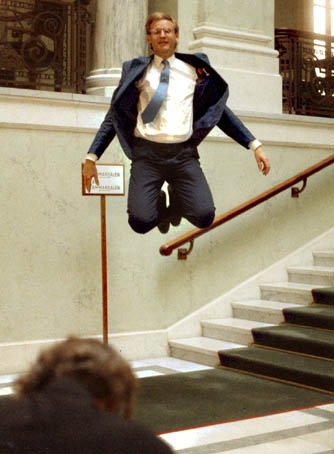
The Swedish Foreign Minister is currently copping severe criticism for posting “too much information” in his blog. Foreign Minister Carl Bildt has been getting large audiences with his Swedish language blog in which he diarises his days and offers his thoughts on a wide range of issues. But now Bildt’s opponents are saying this activity is incompatible with his high office.

Most of the criticism has come from Sweden’s mainstream media not from Bildt’s political opponents. A former newspaper editor, Bertil Torekull, wrote an opinion piece published in Sweden's largest morning daily, Dagens Nyheter which said "Members of the Government have a political mandate and everything they do therefore takes on a political dimension” he said, “a member of the Government is not just any 'chatter'." Expressen's Per Svensson wrote an article comparing Bildt to Nixon and saying he "uses his blog as a weapon against one of the institutions of the liberal democracy - investigative journalism".

The focus of all this hysterical hyperbole is a blog called “alla dessa daga” which means “All These Days” in Swedish. The latest entry on 11 March talks about his newfound world fame as the Middle East Times, Deutsche Welle and the Sydney Morning Herald which all syndicate the AFP same story about his blogging issues. Since the end of January, Bildt has been posting several messages a day and the site has had 400,000 visitors in that time and hundreds of user comments.

Gothenburg University journalism professor Kent Asp believes Bildt has a problem saying "he can't be just a private person when he talks about questions related to his field of work." But Peter Wolodarski, an editorialist at Dagens Nyheter, defended Bildt’s blog as "a welcome complement to the interviews and official commissions, not a substitute". Bildt himself denies there is a problem, "It's me writing. I'm a person who is also minister for foreign affairs," he said. Bildt is no newcomer to blogdom. He started an English language blog in September 2005 but it has been defunct since January with Bildt concentrating on his Swedish version.

Bildt, 57 is a senior member of the conservative Moderate Party. He was Prime Minister during Sweden’s last experiment of a centre-right Government between 1991 and 1994. During his tenure, his most important task was the negotiation of Sweden’s accession to the EU, which he successfully completed in June 1994. He was also behind the liberalisation and structural reforms which improved Sweden’s competitiveness of Sweden and to modernize its old-style welfare system. He served as the UN Secretary General’s Special Envoy for the Balkans between May 1999 and July 2001. He was surprisingly appointed foreign minister when his party rival Fredrik Reinfeldt won power for a liberal/left-conservative coalition in October last year.

While Bildt may be a political moderate, he has long been a technical radical. Bildt’s reputation as an electronic pioneer dates back to 4 February 1994 when he sent an email to Bill Clinton in which he praised the US president’s decision to end the trade embargo on Vietnam. While the content was unremarkable, the missive from Bildt to Bill was historic as it was the first ever email sent between heads of government. Bildt opened the email by saying he wanted test the connection on what he called, with a sense of novelty, “the global Internet system”. In the same year Bildt also started a weekly electronic newsletter, which he kept going for over ten years. He also launched and chaired the country’s IT Commission and now sits on the board of several Swedish IT companies.

Bildt has a long established reputation as a good communicator. However in the mainstream media's eyes he has committed the cardinal sin of communicating directly to the public and bypassing the mediation of the fourth estate. Bildt's frankness and desire to discuss the mechanics of politics with his audience have upset senior Swedish journalists who are used to having this field to themselves.

Sunday, March 11, 2007

Malcolm Exemplar

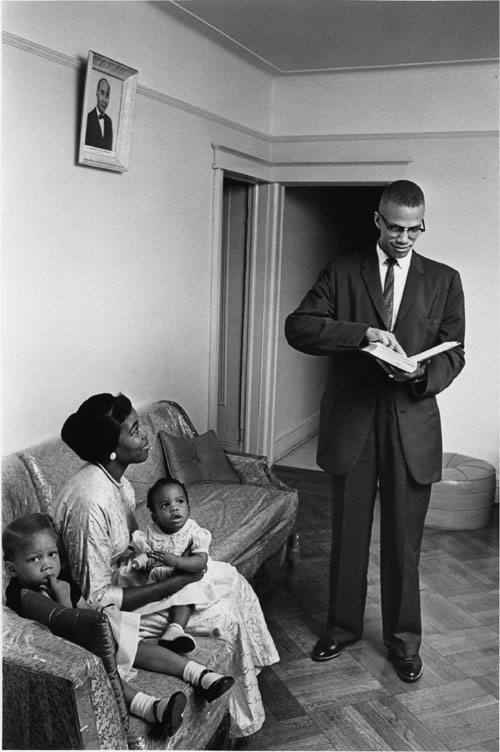
Black America is currently re-examining the legend of one of its most complex heroes. That man is Malcolm Little aka Malcolm X. In his brief 40 years, Malcolm X had an enormous impact on race relations and in his own way was as influential as his vastly different contemporary Martin Luther King. To understand why Malcolm X is significant, it is necessary to understand his past.

His story goes back to Christmas Eve 1924, when a gang of hooded Ku Klux Klansmen complete with trademark torches surrounded a house on the outskirts of Omaha, Nebraska. They were at the home of outspoken African-American leader Earl Little. White racists targeted his house because of his outspoken beliefs. Luckily, he was not at home. Instead the men threatened his pregnant wife Louise, smashed some windows and moved on. Five months later Louise gave birth to her third son, Malcolm.

Earl and Louise married in 1919 in Montreal. It was Earl’s second marriage. Louise grew up on the Caribbean island of Grenada. Her father was white and Louise was often taken for a White Briton. Earl Little was from Georgia and grew up in desperate poverty. As a young man, he heard Marcus Garvey speak. Little was impressed by what he heard and joined Garvey’s movement the Universal Negro Improvement Association (UNIA).

Young Malcolm grew up in Lansing, Michigan. The estate agent sold the Littles the house thinking Louise was white. When he discovered his “error”, he unearthed a document saying the house should not be sold to non-whites. They were told to move with no offer of a refund. But before they moved, the house was burned down in the night with the family just escaping the flames. Firefighters showed no interest in putting out the fire. The scarred (and scared) family moved to a new house outside Lansing.

In 1931 Earl stormed out of the house one night after an argument with his wife and failed to come home. He was later found dead crushed by a tram which cut his body in half. His insurers refused to pay out saying it was suicide but it was more likely to be murder. Malcolm was barely 7 years old. Louise struggled to raise her eight children and ended up on welfare. She eventually suffered a mental breakdown and the children were fostered out. A distressed Malcolm was expelled from school and sent to a juvenile detention home. He decided he wanted to become a lawyer but was told that was "no realistic goal for a nigger".

Aged 15, he moved to Boston to live with his half-sister Ella (one of three children from Earl’s first marriage). Here he got a job as a shoeshine boy and ended up as a drug supplier. Two years later Malcolm met a white women named Bea with whom he moved to Harlem in New York. There he got a job as a waiter. He worked as a drug dealer and lived as a criminal for the next three years ending up in a burglary gang. He was arrested in 1945 and sentenced to eight to ten years in Boston’s Charlestown prison. Malcolm believed the heaviness of the sentence was due to the fact that he was with a white woman. After two years he was transferred to Concord, MS where he first heard of a Muslim organisation called the Nation of Islam.

The Nation of Islam was founded in 1930 in Detroit by Wallace Fard Muhammad. It was a political religion which borrowed beliefs and practices from Islam but was specifically designed for black Americans to free themselves from white domination. Fard Muhammad mysteriously disappeared in 1934 and was replaced as leader by Elijah Muhammad. Elijah believed negros were descendents of the ‘original’ people who were advanced beings capable of communicating with another race on Mars.

Despite some of its more outlandish beliefs, Malcolm was entranced by his new religion. He got in touch with Elijah Muhammad and spent his remaining years in prison in self-education. He was released in 1952 aged 27. He went to Detroit and joined the Nation of Islam at the local temple. He finally met Elijah Muhammad at his headquarters in Chicago. Muhammad publicly praised Malcolm as a follower from prison. Shortly after, Malcolm changed his surname to X and renounced the name Little as a name a white man gave to one of his slave ancestors.

Back in Detroit, Malcolm started to find converts. He was a good and persuasive speaker. He was unafraid to express controversial opinions. “The white man was the devil” he told his crowd. He also spoke of the slave trade and white domination. “We didn’t land on Plymouth Rock,” he said, “Plymouth Rock landed on us!” Malcolm quickly rose through the ranks and was appointed the temple’s assistant minister in 1953. Then Elijah Muhammad sent him to Boston to recruit new members. He went on to Philadelphia and then to Harlem. This was his biggest challenge. Malcolm’s message of renunciation of alcohol, drugs, gambling and sex outside marriage was not popular. But he set up Nation of Islam businesses and gradually gained success. By 1956, he was Elijah’s unofficial deputy carrying his message across the country.

In 1956 he met and eventually married Betty Sanders. The Nation provided them a house in Queens and they soon had their first child. By now he was famous, writing a column in several newspapers and running the Nations own periodical “Muhammad Speaks”. He was invited onto TV shows where his ability to be articulate on controversial matters earned him a wide audience. In 1959, Mike Wallace produced a five-part TV series on him called “The Hate that Hate Produced”.

X’s anti-white diatribe shocked mainstream America. But the Nation of Islam expanded under his watch from 400 members in 1952 to 40,000 ten years later. The FBI started to pay attention to him after he met Fidel Castro who was in New York for a UN meeting. Meanwhile his extremism set him apart from fellow black leaders like Martin Luther King. Malcolm called King’s 1963 civil rights march the “farce on Washington”. The two men only met once (in 1964) and got on well despite their differences.

But Elijah Muhammad was jealous of the success of his protégé. He and X fought more often. Elijah asked his ministers to make no comments after the assassination of JFK but Malcolm couldn’t resist saying he thought “the chickens had come home to roost”. Finally Malcom X left the organisation in 1964 and founded a new group called Muslim Mosque Inc. He went on the Haj to Mecca and also went to Egypt.

His travels softened his opinions on race and he came back to the US no longer believing all whites were evil. In 1964 he founded the Organisation of Afro-American Unity dedicated to the interests of all blacks whether in the US or Africa. He travelled to Africa for five months on a successful tour of 11 countries. But when he returned home, he was faced with the same old bigotries.

His home was firebombed in February 1965. He and his family escaped through the windows. One week later he was scheduled to speak at Harlem’s Audubon Ballroom. He started his speech when he was interrupted by a scuffle in the front row. Malcolm shouted out “let’s cool it brothers”. But then three men in the front row armed with revolvers and a shotgun rose to their feet and opened fire. Malcolm died in a hail of bullets. He was 39 years old.

22,000 people attended his funeral five days later. Actor Ossie Davis delivered his eulogy: “Malcolm was our manhood” he said. “Our living black manhood!” Three members of Nation of Islam were charged with his murder. All were found guilty and sentenced to life imprisonment. One of the accused said they were hired but refused to reveal who hired them.

Malcolm’s death unleashed a wave of racial intolerance. Militant groups like the Black Panthers filled his void for a while. Martin Luther King fell to an assassin's bullet three years later. But Malcolm X’s lasting legacy is the truth he told about US race relations. He spoke for the disenfranchised urban poor and made many white Americans aware of a past they would have preferred to ignore. Not without justification, Time magazine chose his autobiography as one of the ten most important non-fiction works of the 20th century.

Saturday, March 10, 2007

Another Russian journalist is silenced

Ivan Safronov was buried on Wednesday after becoming the latest journalist to die in suspicious circumstances in Russia. On Friday 2 March he fell to his death from the fifth floor window of his Moscow apartment building. Prosecutors have opened an inquest into his death and police are investigating a case of ‘forcible suicide’.

His neighbours described Safranov as a jovial well-balanced family man but Russian police are saying they suspect his death was a suicide. Two neighbouring students witnessed his death. “My friend and I stepped out onto the balcony to smoke,” recounted Lena, a psychology student at the Sholokhov Pedagogical Institute. “Suddenly we heard a thud, like snow falling off the rooftop. It was almost empty in the courtyard, and we immediately noticed a man lying directly in front of the canopy”. The girls called an ambulance but their call was not accepted, however. “We cannot collect all the drunks in Moscow on Friday night,” they were told, along with the advice to call back in half an hour if he was still there. He did not go away.

The 51 year old Safranov was the military affairs writer for the daily Kommersant and had written exposes of abuses in the Russian Defence Ministry. The newspaper’s editor Andrei Vasilyev told CBC News in Moscow that the business newspaper is reviewing the circumstances surrounding his death. "There were no police for four hours, so he just lay there dead," Vasilyev said. "What do you think of that? So we decided to look at his cellphone records and text messages, the things the police should be doing."

According to Kommersant, Safronov was researching a story about Russian plans to sell weapons to Iran and Syria. Safranov had taken a sick day on the Friday and gone to a doctor. Although it was suggested he may have received bad news from the doctor, no suicide note was found in the apartment. Safronov was checking information on possible new deliveries of Russian weapons to the Middle East while at the February IDEX 2007 arms exhibition in the United Arab Emirates.

Safronov was interested in the sale of Su-30 fighter jets to Syria and S-300V missiles to Iran. He had information that those deals would be concluded through Belarus, in order for Moscow to avoid accusations in the West of selling weapons to pariah states. The US is leading international pressure against Iran’s nuclear program. In January they strongly resisted a Russian contract to sell arms to Iran and Syria and imposed sanctions against Russian jetmaker Sukhoi and arms exporter Rosoboronexport. So it is unlikely the Kremlin would have appreciated Safranov's latest investigation.

Safranov is the highest profile Russian journalist fatality since last October’s death of Anna Politkovskaya. Politkovskaya was slain in her apartment after a long history of vociferous criticism of the corruption in Russian society. The Kremlin strongly denied any involvement in her killing and the case remains unsolved. Her death was one of four killings of media workers in Russia in 2006 that added to at least another 255 killings of journalists and media staff in Russia since 1993.

Although Russian authorities have once again denied any involvement in the Safranov case, the fact remains that very nasty things happen to people who investigate state corruption, human-rights abuses or shady financial deals. Russia is the second-deadliest country for journalists after Iraq, according to a new study from the International News Safety Institute. In Russia, the FSB (ex-KGB) have gained enormous power under Putin and are notorious for their intimidation and violence against its perceived enemies. The Institute's survey has found that assassination has emerged as one of the most efficient tools for silencing journalists in Russia and elsewhere.

Since 2000, the worldwide journalist death toll has steadily increased, with 147 fatalities in 2005, followed by a record 168 dead in 2006. The report counted anyone involved in news gathering, from journalists to support employees such as translators. Richard Sambrook, chairman of the special inquiry and global news director for the BBC World said “The figures show that killing a journalist is virtually risk free. Nine out of 10 murderers in the past decade have never been prosecuted.”

Friday, March 09, 2007

Ansip wins Estonian e-vote

Prime Minister Andrus Ansip has extended his grip on power after Estonia’s general election last weekend. Ansip leads the centre-right Reform Party who won 31 seats of the 101 seat parliament, an increase of 12 from the previous election. While 31 seats is not enough for an outright majority, it does leave Ansip in a strong position to dictate terms with any potential coalition party. Ansip is keeping his options open and told Estonian TV “at this stage, you do not find a party leader who rules out cooperation with another party and I do not either”.

Ansip has been in power since April 2005. After that election, he formed a coalition with the Centre party and the small People’s Union. Despite the name, the Centre Party is left-leaning and now Ansip is thinking of switching partners to the more ideologically similar nationalist Pro Patria-Res Publica bloc. The Centre Party remains the second biggest party in the parliament with 29 seats but Pro Patria-Res Publica did better than expected to take 19 seats. The People’s Union took 6 seats and could still retain the balance of power in any coalition sharing arrangements.

The general elections were the first since Estonia joined the EU in 2004, but also marked a world first in that citizens were allowed to vote online. Internet polling ended on Wednesday and drew about 30,000 voters of the total of 940,000 Estonians which represents over 3% of the registered electorate. In response to fears from critics of external pressures on e-voters, the law provided a chance to override their internet vote on election day by filling in a paper ballot.

The electronic election marks the confidence of a nation that is enjoying an economic boom. EU membership has transformed the country. Rapid growth has been fuelled by low wages and low taxes, as well as a competitive zeal to make up for the 50 years of stultifying Communism. But there is a downside. Estonia had a record growth rate of 11.5% in 2006 but is grappling with 5% inflation rates. These rates have caused a delay in plans to join the euro this year.

Andrus Ansip is at the helm of this growth. Ansip was a trained chemist and gained his degree at the university of Tartu. He also studied agronomy at the Estonian Academy of Agriculture and did business management at York University in Toronto. After working in chemical labs, he became a private entrepreneur in banking and commerce and laid the foundation for Tartu Radio before entering into politics. He was mayor of Tartu for six years before entering parliament in 2004 as Minister of Economic Affairs and Communications. When prime minister Juhan Parts resigned in March 2005, Ansip was asked to form a government. Ansip is a keen long-distance skier and has been to Australia to take part in a 42km cross country skiing event known as the Kangaroo Hoppet.

But Ansip will more than kangaroos on his mind in the next few weeks as horse-trading begins over the shape of a new government. Whatever government emerges will be a rainbow coalition of competing interests. Res Publica is the party to watch having made a big comeback. Formed in 2001, Res Publica had a meteoric rise when it won its first contested parliamentary elections in 2003. Its leader Juhan Parts became prime minister. But their governing style became arrogant and they veered to the right, alienating their centrist core constituency. It lost the elections for the European Parliament in 2004 and was down to 5 % in opinion polls before conceding office in 2005. But their merger with the nationalist Pro Patria Union in 2006 has produced immediate results in the latest election.

Estonia has made a successful transformation to democracy since the break-up of the Soviet Union. The Russians have been the Estonian big brother since 1710 when they defeated Sweden in the Great Northern War. Estonia declared independence in 1918 after the Russian Revolution and kept the Russians out until Stalin invaded in 1940 after signing his secret non-agression pact with Nazi Germany. But he was betrayed by Hitler and his armies occupied Estonia after Operation Barbarossa. The Soviets reconquered the country in 1944. Estonia launched an armed resistance to Soviet re-occupation after the war which was brutally suppressed with 20,000 Estonians deported to Siberia.

The Gorbachev era saw the re-ignition of Estonian nationalism and Estonia elected its first parliament in 1990. Estonia, like the two other Baltic states, restored its independence peacefully during a short period of power vacuum in the former Soviet Union. But Estonia managed to avoid the violence which Latvia and Lithuania incurred in the bloody January 1991 crackdowns and retained crucial control of its own telecommunications facilities during the 1991 failed coup in Moscow. Once the coup collapsed, Estonia resumed its efforts to gain international recognition. Iceland was the first to acknowledge Estonian independence. Yeltsin's Russia was quick to follow as did the US The Soviet Union finally recognised Estonia on 6 September 1991. The intervening years have been a story of peaceful growth. By 2004 Estonia was finally able to come out of its Russian shadow with a double event: it was accepted into NATO and joined the EU.

Thursday, March 08, 2007

The rise of Crosby/Textor

The editorial in yesterday’s Crikey was a damning indictment of John Howard’s tactics in the Brian Burke affair. Crikey was critical of Howard’s statement there is no need for a register or code of conduct of lobbyists. It suggested the real reason that Howard was reluctant to introduce accountability into the $1 billion industry is due to his own allegiance to lobbying firm Crosby/Textor.

The Burke case has launched a public debate on the influence of lobbyists. But this is not a recent concern. In 1983, the new Hawke ALP government created a register of lobbyists, accessible only by ministers. But it fell into disuse and lobbyists can freely enter the parliament building if vouched for by two MPs. ALP supported a registration process in the 2004 election and new leader Kevin Rudd has stated Australia needs a comprehensive national register of lobbyists, listing their clients and the politicians they had met. Howard is resisting the change. "In the end it's a matter of judgement and it's a matter of personal responsibility. There is no instinct for proper behaviour in these matters, you can't legislate it," he said. “I’m not a great believer in substituting rules and regulations and registers for personal responsibility. It is all a matter of judgement."

Crosby/Textor would probably agree with Howard's judgement. It is a Canberra-based market research and communications company with close connections to the federal Liberal Party. According to their own blurb Crosby/Textor offers “an unmatched pedigree combining comprehensive experience in market research, strategic communications and campaign execution”. These skills have been honed by its two principals, Lynton Crosby and Mark Textor, in the last four elections. As well as the federal Government, their high powered clients include Telstra, British American Tobacco, Qantas and lately the Qantas takeover bid.

That latter role has brought accusations of conflict of interest over the privatisation of the national airline. The company was hired by the private equity consortium Airline Partners Australia (APA) for their inside knowledge and perceived influence with government ministers and backbenchers to convince them to accept the politically sensitive $11 billion Qantas takeover deal. The bid was accepted by the Government on Tuesday this week. Crosby/Textor is reputedly earning at least $50,000 a month for their work on the deal. Company spokesman John Kent brushed off media concerns by saying "we never talk to anyone about anything about clients."

The company was founded in 2003 by Crosby and Textor. Both men played key roles in the Liberal party’s four successive election victories. Lynton Crosby (pictured) rose through the ranks of the Liberal Party and was appointed Federal Director of the party in 1997. John Howard appointed Crosby as campaign director for his second victory in 1998. He is known for his mastery of dog whistle politics. Crosby was responsible for the 2001 wedge campaign which promoted fear and hatred of refugees in the wake of the Tampa crisis.

Mark Textor cut his teeth in his native Northern Territory when he was part of the successful Country-Liberal Party's election campaign committee in 1994. Buoyed by the success of this campaign, he went on to mastermind the strategy behind the breakthrough 1996 Liberal federal victory and became the principal Liberal pollster for the next three elections. Textor is notorious for his pull-polling techniques which are influential in changing the way people vote. Push-polling pretends to be a typical poll, gathering information about preferences, but quickly morphs into something more manipulative. The questioner will defame or sully reputations by implying drug use or improper behaviour and then asks the respondent whether they would still vote for that person regardless of that behaviour.

Textor and Crosby had immediate success in 2004 when they ran the Liberal federal re-election campaign. Then in 2005 their machine was behind another Howard election campaign. But this Howard was Michael Howard then-leader of Britain’s Conservative Party. Crosby was criticised by the British media for bringing many of their divisive tactics with them to the British campaign. Michael Howard used issues such as immigration, asylum seekers, gypsies, law and order and abortion to exploit fear and prejudice to win votes. The Tories paid the Australian firm a million dollars for their services and although Howard lost, blemishing their perfect record, the previously hapless Tories gained 36 seats to put them within reach of Government for the next election.

Crosby/Textor also advised the conservative National Party in New Zealand’s 2005 election. They used the same wedge issues as in Australia and Britain, playing the fear card especially on immigration and security. The tactics were exposed by journalist Danny Hager’s “Hollow Men - A study in the politics of deception” which led to the recent resignation of National Party leader Don Brash. According to Hager the Nationals claimed increased migration put pressure on NZ’s health system and migrants go “straight to the welfare queues”. Ultimately however, their divisive tactics failed in New Zealand as they did in Britain.

Here in Australia, their star still shines brightly in the upper echelons of the Liberal party and John Howard remains deeply indebted to both men. In particular Crosby’s ruthless targeting of key marginal constituencies with highly localised campaigning is more responsible than most for keeping Howard prime minister for 11 years. Howard is therefore unlikely to lead any charge to change the rules on regulations for lobbyists.

Not everyone in the industry is happy with the status quo. Danny Pearson, director of Labor-aligned lobby group Hawker Britton, is in favour of regulation but said lobbyists were a necessary part of the political landscape. "You are almost like a translator: you are translating to government the needs of a client or business more generally, but you are also translating to a client basically how government thinks and operates and works."

Wednesday, March 07, 2007

Mining lobbyists adrift on a Rising Tide

The NSW Mineral Council (NSWMC) has failed in their clumsy attempt to squash a small climate change advocacy group. Little known Newcastle protest group Rising Tide raised the hackles of the powerful Australian mining industry lobbyist over a parody of its recent mining PR campaign. When the NSWMC launched a website ad to promote mining, Rising Tide struck back with a parody website pointing out mining’s impact on climate change. The council were not impressed and forced Rising Tide’s ISP to shut down the website twice. Now Rising Tide have taken revenge by re-launching their site offshore and challenging the NSWMC to show just cause for their action.

Founded in 2004, Rising Tide is a small activist group based in Newcastle. They are part of a global grassroots movement campaigning against the root causes of human-induced climate change. Their real website states that Newcastle is “the largest coal port (by export volume) in the world”. Rising Tide is now campaigning against the proposed expansion of Newcastle coal exports. The heavy-handed action by the NSW Mineral Council has given them invaluable publicity and provided a useful filter for alternative opinions to enter the mainstream.

None of this would have happened if the NSW Mineral Council had ignored the parody site. But instead they claimed the site infringed their copyright and brought their full legal force to bear. Although Australian copyright law allows for fair use of an original work when mimicked for parody or caricature, it was modified in 2004 to forces ISP to remove potentially infringing sites whenever challenged.

But Rising Tide refused to be intimidated and moved the site to an off-shore host to keep the information in the public domain. The parody site is now on servers hosted in Afghanistan, which place it outside the jurisdiction of Australian law. The revamped website was officially relaunched yesterday to national media attention. Steve Phillips, spokesperson for Rising Tide Newcastle said, "we have issued a counter-notice rejecting the Minerals Council's spurious claims. The Minerals Council now has ten days in which to take the matter further."

Phillips told Woolly Days that NSWMC abused a clause in the copyright laws that were introduced by the 2004 Free Trade Agreement with the US. This clause is an automatic takedown procedure. If a website is accused of plagiarism, the ISP must remove the website even on suspicion of an infringement and before the claim can be validated by a court decision. In other words, Australian law says that any party accused of plagiarism is guilty until proven innocent.

The drama began on 19 February when the NSW Minerals Council launched an advertising campaign to promote the mining industry. Called “Life. Brought to you by Mining”, the campaign lauded the industry’s contribution to”modern life, from employment and the economy to electricity and consumer items”. NSW Minerals Council Chief Executive Dr Nikki Williams said the campaign would provide much needed balance to the intense debate around mining and the environment. Dr Williams claimed the public discussion on global warming has been “railroaded by agenda driven scaremongering, when what we desperately need is logic, innovation and collaboration”.

NSWMC’s idea of logic, innovation and collaboration was an advertising blitz in the mining regions of Newcastle and Wollongong. It featured billboards, TV commercials, press releases and a website. They used the symbol of an asterisk to highlight what they described as “the countless things which are created with a contribution from mining”. NSW Mineral council‘s website invited their audience to “dig a little deeper and find out all the great things that the mining industry has to offer”.

In response Rising Tide put up a parody site. The parody site was a mirror image of the NSWMC site except for some additional satirical text. Rising Tide’s site stated “the NSW Minerals Council is now running a spin campaign to fool you into thinking that we need the coal mining industry” and they invited their audience to “dig a little deeper and find out the real facts”.

NSWMC dug a little deeper themselves and within 24 hours their lawyers contacted the hosts of the parody website. They cited the relevant clause of the Commonwealth Copyright Regulations and forced the ISP to remove the site. Although the site is probably legal under the Copyright Act's Fair Dealing clause as a parody, the hosts were legally required to remove the site pending a response to the Minerals Council's claim of copyright infringement, which did not specify the articles of alleged copyright.

Rising Tide then relaunched the site with a new and original layout to remove the possibility of copyright infringement. Or so they thought. Once again council lawyers contacted the ISP within 24 hours with a similar claim letter that forced the hosts to remove the site a second time. Undaunted, Rising Tide relaunched their site a third time this week from Afghanistan. They also issued a counter-notice, rejecting the allegations of the council. If the NSWMC does not respond within 10 days, Rising Tide will be able to re-host the site in Australia.

NWSMC's best bet at this stage is to avoid all further response. This is proving a public relations nightmare for the mining lobbyists and any further action on their part will only serve to lift all boats of the Rising Tide.

Tuesday, March 06, 2007

CAAT gets BAE’s tongue

The High Court in London has ordered BAE Systems, Britain’s largest arms company, to produce a sworn affidavit divulging how it obtained a confidential and legally privileged document belonging to pressure group Campaign Against the Arms Trade (CAAT). CAAT successfully argued judicial review proceedings could be severely prejudiced if BAE had access to their confidential legal advice. CAAT are seeking to uncover the truth of the bribes BAE paid to Saudi Arabia to underwrite its arms dealing. The British Government shut down a fraud squad investigation into the dealings last year. The landmark ruling is a major victory for freedom of information and a body-blow to the highly secretive arms industry as well as an embarrassment to the British Government over its clandestine dealings with the Saudi Royal Family.

BAE Systems was formed in 1999 as the merger of British Aerospace and Marconi Electronic Systems. The merged company is very big business. They manufacture warplanes, avionics, submarines, surface ships, radar, electronics, and guided weapons systems. According to their own website, BAE is the fourth largest defence company in the world. It has 88,000 employees, annual sales exceeding $22 billion and is ranked as the number 1 European defence company and number 7 in the US.

George Monbiot described BAE last month as a “small but untouchable domain that appears to be subject to a different set of laws.” BAE have been the intermediary in Britain’s lucrative arms dealing with Saudi Arabia that dates back to Margaret Thatcher’s leadership. In 2003 the Sunday Times revealed how BAE paid a company to carry out an elaborate spying operation on its critics and infiltrate CAAT.

CAAT were investigating BAE since the British Government closed down a police investigation into BAE activities in Saudi Arabia. These activities go back to the 1980s. Oil rich Saudi Arabia was looking to expand its military and Prime Minister Margaret Thatcher successfully lobbied the Saudi Royal Family to buy British weapons. The British manufacture was contracted out to BAE, then known as British Aerospace.

The oil-for-arms deal known as Al Yamamah was born. Al Yamamah means ‘doves of peace’ in Arabic but this sale was all about war. In 1986 British Aerospace delivered the first weapons of Al Yamamah to the Saudis: 72 Tornado and 30 Hawk advanced fighter-bombers along with other tranches of military hardware. According to the terms of the sale, the Saudis were to purchase the armaments in payments of oil, over an unspecified period of time. The Saudis transferred the oil to BP and Shell, who paid the value of the oil into an escrow account where BAE received the money. 20 years later, the deals are still ongoing. And since the initial 1986 order, Saudi Arabia has purchased a staggering $33 billion worth of British arms. These massive deals (equivalent to the GDP of Cuba) have been fraught with bribery.

Much of the BAE profits from Al-Yamamah was recycled as kickbacks to members of the Saudi royal family and other intermediaries such as Wafic Said, the billionaire financier and benefactor of Oxford University’s business school. According to former CIA operative Robert Baer the deal was “a huge commission-generating machine”. He said British Aerospace overcharged for its hardware and spare parts and the difference went into the pockets of the Saudis.

But not all of the kickbacks stayed in Saudi Arabia. In 1994 MP Tam Dalyell produced a US intelligence report and an internal British Aircraft Corporation memo which revealed Margaret Thatcher’s son, Mark, had received a £12 million commission from Al-Yamamah. The then Tory government declined to investigate the charges. Less well protected was British Defence Procurement Minister Jonathan Aiken who played a key role in setting up Al-Yamamah II. He was jailed for 18 months in 1993 for letting the Saudis pay his bill at the Paris Ritz.

Aiken’s imprisonment didn’t stop the illegal flow of money and the Sunday Times began to report the allegations in 2003. The Serious Fraud Office (SFO) was finally forced to investigate a year later. The SFO were making slow but steady progress until late last year when they tried to gain access to Swiss bank accounts with Saudi links. The Saudis were aghast and threatened to withdraw co-operation on security and cancel a supply contract for new aircraft. Under instruction from Tony Blair, Attorney-General Lord Goldsmith immediately told the SFO to drop the investigation on the grounds that it “lacked evidence and threatened national security”.

The Government decision was attacked by City fund managers who said it could compromise London’s standing as a financial centre due to lack of corporate governance. Top fund manager Hermes wrote an open letter to the Prime Minister saying “lack of credibility in the regulation of one company can spread to the rest of the stock market, creating higher-risk premiums and cost of capital.”

CAAT were also unhappy with the decision. They instructed their lawyers, Leigh Day & Co, to seek a judicial review of the government’s decision to drop the corruption case against BAE. Leigh Day sent CAAT an email containing advice on costs and tactics. However that email ended up in the hands of BAE. The arms company argued it was an unwitting recipient but refused to reveal how they got it. Now the court has decided they must tell CAAT how they obtained the information.

CAAT are understandably delighted about the High Court’s ruling. Spokesman Symon Hill said “This is a victory not only for Campaign Against Arms Trade but for all who care about democracy. When Tony Blair ended the Saudi corruption inquiry, he implied that BAE Systems were above the law. But today BAE have been prevented from behaving as they like. We are a step closer to the day when BAE can no longer get away with calling the shots."

Monday, March 05, 2007

Ivory Coast tries to extend its Zone of Confidence

The president of Ivory Coast has signed a peace deal on the weekend with a rebel group in an effort to end a five-year long civil war. The deal will see the creation of a new government and calls for the departure of foreign troops from the troubled West African country. President Laurent Gbagbo signed the deal on Sunday with Guillaume Soro, head of the united rebel movement, the Forces Nouvelle. The peace deal will see a new transitional government established within five weeks and creates a new joint military command. The deal, brokered by neighbouring Burkina Faso President Blaise Compaore, also called for the removal of 9,000 UN troops and 4,000 French soldiers from the buffer zone called the "Zone of Confidence" that currently splits the country in two.

Ivory Coast has been divided between a loyalist Christian south and a rebel-held Muslim north since the war began in September 2002. The war started in Ivory Coast’s largest city, Abidjan but quickly spread to other cities. The two sides clashed for several months before they signed a peace deal signed in France in January 2003. However that accord was never implemented. Nor were follow-up deals in Ghana and South Africa. Talks stumbled repeatedly over disputes on disarmament and a national identity program to give immigrants the same rights as natives. The latest solution is a victory for long-term president Laurent Gbagbo at the cost of power-sharing with Soro's rebels.

Gbagbo has been president since 2000 although has never faced re-election since his initial victory, which itself was tainted by a northern boycott. He was born in 1945 into a Catholic family in the centre-west of the country in 1945. At school he was nicknamed “Cicero" because of his taste for Latin and he gained a PhD in history. He was employed as a university lecturer before being jailed for two years in 1971 for "subversive" teaching. He spent much of the 1980s in exile in Paris after challenging Houphouet-Boigny’s seemingly endless rule.

Félix Houphouët-Boigny was the father of independent Ivory Coast. He was a cocoa farmer who formed the country’s first agricultural trade union in 1944. He rose to prominence during the 1950s when he founded a multinational party Rassemblement Démocratique Africain which advocated independence for European colonies in Africa. Ivory Coast became independent in 1960 and Houphouët-Boigny was named first president. He would rule for the next 33 years until his death.

He cultivated political ties with West which insulated the Ivory Coast from the turmoil associated with the military uprisings that characterised the region. Ivory Coast would become one of the wealthiest countries in Africa under his guidance. But he also quashed all opposition and moved the country's capital from Abidjan to his hometown of Yamoussoukro where he also built Africa’s largest church modelled on St Peter’s in Rome at a cost of $300 million, the Basilica of Our Lady of Peace of Yamoussoukro. This colossal edifice was built as a personal gift from Houphouët-Boigny to the Vatican.

When Houphouët-Boigny died in 1993, he was succeeded by Henri Konan Bédié. Bedie’s rule faced a number of difficulties including economic pressure from falling world market prices for cocoa and coffee, internal corruption that steeply reduced foreign aid, and mounting political opposition. Bédié was accused of massive corruption and was overthrown in Ivory Coast’s first ever military coup in 1999. General Robert Guéï was persuaded to come out of retirement to lead the country. He led until the election the following year when Gbagbo was swept to power.

The civil war began two years later. The issue of voting rights was critical. Ex president Bédié had introduced a concept of "Ivoirite" (Ivorianness in English). A quarter of the population were immigrants, particularly from Burkina Faso, a poorer country to the north. Racial tensions bubbled to the surface after a 2000 law was drafted to ensure both parents of a presidential candidate to be born in Ivory Coast. This law expressly excluded presidential candidate Alassane Ouattara who represented the predominantly Muslim north, who were immigrant workers from Burkina and Mali working on the cocoa plantations.

Cocoa farmers have a lot of power in Ivory Coast. Cocoa is the dried and partially fermented fatty seed of the cacao tree that ends up being the key ingredient in chocolate. There are a lot of chocolate lovers and most of the planet’s cocoa is grown in West Africa and Ivory Coast is the world's leading cocoa producer and produces about 43 percent of the global crop. As a result of the civil war there, international cocoa prices rose sharply in 2002. As 20% of the price of chocolate is cocoa, eventually the price of the raw material will force its way into the product. Nestle kept a close eye on Ivory Coast. The war itself was a stalemate, Government forces maintained control of Abidjan and the south, but the rebels took the north and based themselves in Bouake.

Most of the fighting in the civil war ended by 2004 but it left the country split in half. The French sent in a force of 2,500 men to keep the peace and encouraged the groups to come to a compromise. The UN also sent in a peace mission called United Nations Operation in Côte d'Ivoire (UNOCI). The two sides signed an agreement in 2004 and agreed to set of a government of national reconciliation but the rebels pulled out shortly after. The atmosphere of distrust lingered into the following years and the situation worsened when the Government used Belarussian mercenaries to bomb the rebel capital Bouake. They also accidentally killed nine French soldiers and France retaliated by destroying a bomber base in the capital Yamoussoukro.

Meanwhile Gbagbo’s original mandate as president expired in 2005 but with the country in disarray it was deemed impossible to hold an election, and his term in office was extended for a maximum of one year. But the situation was no better a year later and the UN Security Council endorsed another one-year extension of Gbagbo's term in November 2006. Nonetheless there have been signs of improvement. Ivory Coast's successful world cup campaign in Germany 2006 was influential in bring the country together.

The impoverished north in particularly wants simply to be recognised as genuine Ivorians. Despite the ability and charismatic charm of rebel leader Guillaume Kigbafori Soro, there are little or no government-run health or education services in the rebel-held north and west. 750,000 people were uprooted by the fighting, and over a million children have been without schooling since the war started five years ago. The latest deal offers them a small slice of improvement.

This peace plan envisages a line of observation posts staffed by "impartial forces", running through the centre of the current buffer zone. The observation posts would be halved in number every two months. It offers citizenship to migrants and envisions elections within 10 months. French Aid and Cooperation Minister Brigitte Girardin has praised the accord and said that France would consider pulling out its troops deployed in Ivory Coast. The country's Cicero, President Gbagbo, sounded optimistic of success.
"This is peace in Africa, this is peace by Africa,” he said “"All the problems which are born in Africa can find their solution in Africa."

Sunday, March 04, 2007

Switzerland's accidental Anschluss

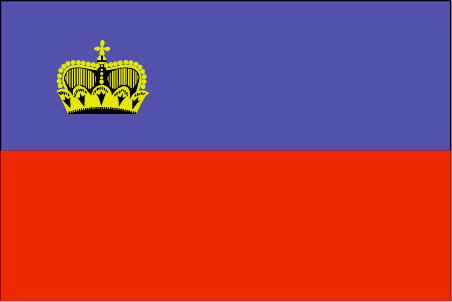
Swiss daily Blick has reported Switzerland invaded neighbouring Liechtenstein last week. However this was not the start of a new European war, it was a blunder. Blick reported 170 infantry soldiers from the Swiss Army strayed a couple of kilometres across an unmarked border into Liechtenstein early Thursday before realizing their mistake.

The tiny principality of Liechtenstein would have been unable to deal with the invasion were it a proper act of aggression. The 160 square kilometre country has a population of 34,000 people and has no standing army. In any case, the invasion went unnoticed. Liechtenstein Interior Ministry spokesman Markus Amman was keen to play down the incident and said nobody in Liechtenstein had even noticed the soldiers, who were carrying assault rifles but no ammunition. “It’s not like they stormed over here with attack helicopters or something,” he said.

What was a routine infantry training exercise in an Alpine forest became a PR disaster when bad weather struck and a company commander inadvertently led his men across the Liechtenstein border. As soon as he realised he had violated national sovereignty, he gave the order to retreat. One soldier was quoted as saying “It was all so dark”. They were carrying their signature Swiss Army knives but unfortunately they are yet to be issued a version with a compass or a GPS as part of their multi-purpose toolkit.

This is not Switzerland’s first accidental invasion of its miniscule neighbour. According to the BBC, Swiss Army rockets went astray in 1985 and set a protected forest on fire, resulting in a long dispute which ended in Switzerland paying Liechtenstein compensation. Nonetheless Switzerland can claim justification as it is responsible for Liechtenstein’s defence and foreign relations. Liechtenstein also uses the Swiss franc as its currency and earns about 8% of its budget from stamp sales.

Liechtenstein is also is one of the few countries in the world with more registered companies than citizens. Around 75,000 companies have their nominal "letter box" offices in Liechtenstein, where business tax rates are very favourable. A constitutional referendum in 2003 gave Crown Prince Hans-Adam sweeping new political powers and made Liechtenstein Europe’s only absolute monarchy. Switzerland is one of only two countries that border Liechtenstein; Austria is the other. Both countries are landlocked, making Liechtenstein one of the world's only two doubly-landlocked countries. However unlike Switzerland, Austria has shown no signs of wanting to invade.

This is not the only recent example of an accidental European invasion. In 2002, a unit of heavily armed British Royal Marines accidentally invaded Spain. They were in Gibraltar on a training mission when a platoon of 30 marines made a beach landing in the Spanish town of La Linea, carrying mortars and assault rifles, and proceeded to took up defensive positions on the sand. According to their war game, they then expected to be attacked by fellow British soldiers who were onshore and armed with blank rounds of ammunition. But instead of the army, they were greeted by bemused local fishermen and eventually two officers from La Linea's municipal police force who told the invaders they were in Spain not Gibraltar. The soldiers blamed bad weather, but it should have been obvious where they weren't by the fact that a 400 metre high rock was missing from the background picture. The marines bid a hasty retreat back to British soil.

The Swiss know how they feel.

Saturday, March 03, 2007

The Ghost of Mark Latham

Today’s Australian newspaper is painting the Brian Burke scandal as Labor leader Kevin Rudd’s Mark Latham moment. According to the Australian, Rudd is now “engulfed in the biggest scandal” of his short leadership of the party. The same paper may have helped his cause by pointing out Liberal Human Services Minister Ian Campbell also met with Burke in June 2006. Campbell was forced to resign this afternoon.

But the pressure remains on Rudd. The revelations regarding the 2005 Rudd meeting with disgraced Western Australian powerbroker Brian Burke have ended the new ALP leaders honeymoon period in the media. Former WA premier Geoff Gallop had banned state ministers associating with Burke due to his imprisonments for his involvement in the 1980s WA Inc scandal and the 1990s stealing of state campaign funds (the latter conviction was overturned on appeal).

However in 2005 Rudd was working on his Labor leadership challenge and went to WA on a number of occasions to seek Burke’s still influential support. The meetings were organised by Rudd’s friend WA MP Graham Edwards, but they occurred during the period of the Gallop ban. Treasurer Peter Costello dined out on the story this week saying "while a convicted criminal was under a ban from the Western Australian Government, the Leader of the Opposition flew into Perth to have breakfast, lunch and dinner with Mr Brian Burke"

The Government have launched many such attacks on Rudd since the news was made public. Ever since Rudd took the leadership in December, the Liberals have tried to draw parallels between Rudd and former Labor leader Mark Latham. Latham was successfully portrayed as immature and a politician greenhorn after he made a March 2004 pledge to bring Australian troops home from Iraq by Christmas. Although he made some gains, Latham easily lost the 2004 election after leading in the polls earlier in the year.

Latham’s political career was a roller-coaster ride that ended in disgruntled failure and a warts-and-all description of his former political allies in his infamous, but entertaining Latham Diaries. Latham grew up in the tough suburbs of Western Sydney and graduated from the University of Sydney with a degree in economics. His first job in politics was as a research assistant to Gough Whitlam. He then entered local politics, getting elected to Liverpool council and becoming mayor in 1991.

In 1994 federal minister John Kerin retired from politics and Latham was elected into Kerin’s seat of Werriwa (also formerly held by Whitlam). As a newly elected backbencher, Latham did not have any significant access to Keating’s Government decision making. In March 1996, John Howard routed Labor in the federal election. The ALP was reduced to 49 seats in a 148 parliament. Latham retained his seat despite a small swing against him. New leader Kim Beazley appointed Latham shadow minister for competition policy and local government and assistant to the shadow treasurer.

Latham’s early years were dominated by rift between him and his fellow frontbenchers over the tariff debate. Labor’s stance was strongly protectionist but Latham was a free trader. He became quickly disillusioned by Beazley’s opportunism and lack of political vision. Labor lost again in 1998 and Latham quit the front bench to write more freely about policy in newspapers and books. He published Civilising Global Capital, an economic tract that received good critical appraisal.

Latham went to the US where he met Clinton’s advisor Dick Morris and became immersed in the debate about Third Way politics advocated by Tony Blair. Other Labor figures criticised Latham for his maverick approach and unorthodox views. Beazley was trying to present a small target while hammering the Government on the introduction of the GST. This strategy seems like bringing success in the 2001 election until the 9/11 attacks and the Tampa controversy landed Howard another victory.

Beazley resigned after this defeat and Latham returned to the frontbench under Simon Crean. While Latham saw Crean as a big improvement over Beazley, the new leader failed to gain any traction in the opinion polls. Latham’s own profile grew hugely in this time. He was promoted into shadow cabinet and the media began to spoke of him as a future leader.

Crean’s opposition to the 2003 Iraqi war was not enough to get him ahead in the polls. Beazley challenged his leadership but was defeated. As a result, Latham was promoted to manager of opposition business. He was quickly elevated to shadow treasurer. Latham established a reputation as a Labor attack dog and made serious inroads on Government ministers. But the game was up for Crean who was eventually asked to step aside by nervous Labor powerbrokers. In an upset, Latham beat Beazley by 47 to 45 votes.

And so in December 2003 Mark Latham became the youngest Labor leader in over a century. 2004 was an election year. Latham was on election footing for most of the year waiting for Howard to make his move. Initially Latham did well, narrowing the gap as preferred PM and leading the Coalition on two Party Preferred.

But it didn’t last. Latham was hammered on his Iraq policy, accused of plagiarism of a Clinton speech, suffered allegations of sexual assault and the Government released a $52 billion pre-election budget. By August, the Labor poll lead was wiped away. At the end of the month, Howard called an election for 9 October to avoid parliamentary scrutiny of the Scrafton affair. Latham ran a good campaign, made few mistakes and was adjudged the winner in the one debate the two leaders had.

Yet the election ended up a 1.8% swing to the Government. Labor picked up 5 seats but lost another 7. Latham was re-elected party leader after the election. But the year ended with Latham totally disillusioned with the machinations of party politics. While on holidays at the end of the year, he decided to resign to concentrate on his health and his young family. On 18 January 2005, he resigned from the leadership and from parliament.

Many have compared the trajectory and commentary of Latham's leadership with Rudd's. Latham himself was no great fan of Kevin Rudd. In the diaries, Latham described Rudd as a careerist, a technocrat and “a fanatical media networker”. Rudd would probably see the latter trait as a positive. He will need all his skills in that area to undo the Burke damage from the last few days.

Friday, March 02, 2007

Madrid bomb trial continues

As the third anniversary of the Madrid train bombing approaches, jittery Spanish police arrested three people on Thursday it accuses of aiding the escape of Islamic militants after the bombing. Police arrested two Moroccans in Madrid and a local-born in the southern city of Algeciras. They join 29 others (15 Moroccans, 9 Spaniards, two Syrians, an Egyptian, a Lebanese and an Algerian) who have been on trial for the last two weeks for the largest terrorist attack on European soil since the Lockerbie bombing of 1988.

191 people were killed and more than 1,700 people were injured in multiple attacks on four morning rush-hour trains in Madrid on 11 March 2004. All four trains had departed the same station, Alcalá de Henares, in the fifteen minutes after 7am. The attacks happened a half hour later all within 3 minutes of each other. At 7.37am a train sitting at Atocha station was hit with three exploding bombs. A second train 800 metres away was approaching Atocha when four bombs struck it simultaneously. Meanwhile at the same time a train leaving El Pozo station was hit by two bombs and a fourth train at Santa Eugenia station suffered one hit. The numbers of dead and injured completely overwhelmed emergency services. Eventually they set up a field hospital at a sports facility near Atocha.

Initially Spanish Interior Minister Ángel Acebes held the Basque separatist organisation ETA responsible for the bombings. ETA spokesmen immediately denied any links to the bombings. It was wishful thinking on the Government’s part. Arab extremist groups had already warned Spain to withdraw its “crusader army” from Iraq or there would be consequences. The ETA theory began to unravel almost immediately. Instead the investigative trail led to Muslim extremists. Security forces in Madrid found an abandoned van near the initial station Alcala de Henares with timing devices for explosives. The van also had an audiotape with passages from the Koran. The next day, a videotape was found in the rubbish outside Madrid’s largest mosque after an Arabic-speaking man with a Moroccan accent led Madrid TV to that location. The tape said “We declare our responsibility for what happened in Madrid exactly two-and-a-half years after the attacks on New York and Washington. It is a response to your collaboration with the criminals Bush and his allies.”.

By the end of March, the investigating judge issued international arrest warrants for five suspects. The judge named Moroccan national Abdelkrim Mejjati as the mastermind of the attacks. Although Mejjati was never captured by the Spanish, he was shot and killed by Saudi forces in 2005. In April police trapped seven more suspects were trapped in a house in Leganes, a southern suburb of Madrid. However the men they blew themselves up rather than be arrested. They also killed one policeman in the explosion.

All the wanted men were members of the Moroccan Islamic Combatant Group (known as GICM from its French acronym) GICM were founded in the early 1990s by veteran mujahideen of the war against the Soviet occupation of Afghanistan. However they did not gain public prominence in Morocco until a year before the Madrid bombing when they detonated five simultaneous bombs in Casablanca, killing 45, including 12 bombers. They have links to Al-Qaeda. GICM member Mohamed Fizazi got 30 years for the Casablanca mosque preached in the same mosque that 9/11 leader Mohammed Atta attended during his stay in Germany.

So far only one person has been convicted for his part in the Madrid bombing. The sole conviction is that of a 16 year old nameless youth who authorities only refer to as El Gitanillo (Little Gypsy.) He was convicted of stealing and transporting the explosives used in the attack and was sentenced in 2004 to six years in a juvenile detention centre. The others have been detained on provisional charges. Spanish law requires a prosecution within two years of the arrest.

Jose Trashorras is the leading Spanish suspect in the current trial. Trashorras has denied selling the terrorists dynamite stolen from a northern mine where he worked. He admitted to buying hashish from one of the main suspects, Jamal Ahmidan (who killed himself in the Leganes bombing) but claimed he did so as a police informer helping to investigate the man’s criminal activities. Trashorras claims he did not know about the bombing plan, but he tipped off police about the house and showed it to them less than two weeks before the attack.

The last of the 29 accused were called to trial in the National Court on Thursday. Next week the laborious process of interviewing over 600 witnesses begins. The trial is expected to last for several weeks. The dead and injured were not the only casualties of the bombing. Within three days, Spain held a general election and the pro-American Jose Maria Aznar government was voted out of office. The new Socialist government soon fulfilled a pledge to withdraw Spanish soldiers from Iraq. With the crusader army now back home, there have been no more attacks on Spanish soil.