Showing posts with label mining. Show all posts

Tuesday, September 18, 2012

Clive Palmer: last sentry

Clive Palmer continues to hold a fascination for Australian politicians and the media alike. Prime Minister Julia Gillard invoked his name in her revenge attack on Campbell Newman's Queensland LNP Government. Gillard made a long speech to the Queensland ALP conference yesterday but it was the reference to Clive Palmer (curiously left out of the official transcript) that gave the Brisbane Times its lead. "Even Clive Palmer is having doubts," Gillard said. "You know the ship is going down pretty fast when the bloke who wants to resurrectthe Titanic is seen leaving it."

Gillard is referring to LNP life member Palmer dishing out on LNP leader Newman. Palmer has been on the attack since last week’s Queensland budget where the new government raised coal royalties. The near billionaire Palmer is directly affected through his China First coal project in the Galilee Basin which was cancelled in May though he cloaked his criticism in wider concerns. According to News Ltd, Palmer said “strikes, protest marches and royalty hikes were not good for the image of the state and would drive away investment.”

It is amusing to see Labor use Palmer as a tool of their propaganda after painting him so often as the bogey man. Wayne Swan was in his sights for much of that past 12 months, but the businessman has added the State Government to his grumbles. He is up in arms against both levels of government over his proposal to pump wastewater from his Yabulu nickel plant into the Great Barrier Reef protection zone.

Meanwhile the Queensland Government decision to award Gina Rinehart and an Indian consortium a rail corridor to the Galilee still rankles. Palmer and his Chinese partners have put their joint venture on hold due to the dropping price of coal. Luckily for Palmer, his enormous wealth is in iron ore not coal. His company Minerology painstakingly secured 160 billion tonnes of iron ore deposits south of Dampier in the Pilbara Ranges in Western Australia over 15 years.

Forbes estimates Palmer as being worth $795m making him the 29th richest person in Australia. Palmer said his father George, a successful silent movie star of the 1920s and radio pioneer, had the greatest influence on him. "Dad worked with the then Prime Minister Billy Lyons when he was in power, advising him on media stuff. He was probably the first of the spin doctors,” Palmer told the Gold Coast News. "He also set up train and buslines for transportation. He broke that monopoly that the state railways had. He was quite an amazing guy."

On leaving uni, George's son got a job in real estate in the Gold Coast. He quickly became their top marketing consultant, before setting up his own company, GSS Property Sales. With the Coast in the middle of a construction boom, Palmer thrived and was worth $40m before the age of 30. In 1986 he set up companies to buy iron ore deposits and trade oil. He became a close confidant of Joh Bjelke Petersen and an admirer of the way the Premier turned Queensland into a coal exporter. Palmer was considered the architect of Joh’s final election victory in 1986.

Palmer also met Soviet leader Mikhail Gorbachev and set up joint ventures with Russian companies that persist to this day. Palmer also greased the wheel with Chinese interests and had to be very patient to make the deals work over many years. The lesson was to treat everyone with respect. Palmer said their collective decision-making process often allowed middle management more power than the managing director. But Palmer’s key skill was his sense of timing. As Griffith Uni’s Jason West said, thermal coal prices spiked to unprecedented levels allowing the likes of Palmer, Hancock and Forrest to experience profit margins beyond their wildest expectations. “Instead of earning margins of $2 to $10 a tonne as they had for decades, coal miners were now earning margins of $50 to $100 a tonne which in turn increased asset values to levels rivalling well-established and brand name top 50 firms,” West said.

West said Palmer had one income-earning asset and a whole bunch of tenements offering nothing but promises of future wealth. But some of those promises are extremely lucrative. They include the massive $8 billion Sino Iron Project at Cape Preston, 100 km south west of Karratha, WA expected to deliver before the end of the year. Owned by Hong Kong-based CITIC Pacific, it is on Palmer’s tenements and will be the largest magnetite iron ore mining and processing operation in Australia. The Sydney Morning Herald estimates Palmer will rake in half a billion a year in royalties on Sino Iron.

These are impressive numbers for someone who is still mostly regarded as a joke. Much of this poor public profile is his own fault due to his buffoonish tendency to act as a walking headline. Palmer is not shy about self-promotion and prefers to call himself Professor Palmer, courtesy of an honorarium from Bond University. Somewhat bizarrely, he has also been officially listed as a "national living treasure" though the National Trust of Australia offers no reason for this accolade other than the incorrect statement “Palmer is a self–made billionaire”.

Whatever his status, there remains the unfinished business of political ambition. In a Lateline interview last week, he attacked Campbell Newman for his lack of experience in business. “I'm the most successful Queenslander in the commercial world that's ever lived, yet I'm not supposed to have any say and any knowledge about that,” Palmer said. But while he has flirted with Katter, he still wants change from inside his party. “I love the LNP and I've been a supporter of it for 43 years,” he said. “I remain the last sentry at the gate to protect democracy in this country.” The question remains whether the sentry is there to guard the gate or attack the castle.

Thursday, September 06, 2012

Going Platinum: Lonmin and the Marikana


The precious metal platinum is what catalytic converters use to convert the toxic by-products of petrol combustion to something less poisonous.  Platinum is not easy to find in the Earth’s crust and 80% of it is found in South African nickel and copper mines.  One of the earlier companies to see the value in these mines was Tiny Rowlands’ Lonrho. Rowlands was a classic self-made 20th century capitalist who turned Lonrho from an obscure farming and mining company into a multinational conglomerate.

Rowlands had no compunction with dealing with apartheid era South Africa for which hypocrite Prime Minister Ted Heath called Lonrho “the unacceptable face of capitalism." But while Rowland was making enemies in London, he knew how to do business in Africa. He made many friends among black African leaders including Nelson Mandela, Kenneth Kaunda and Muammar Gadhafi. When Mandela came to power, he didn’t throw out Lonrho but instead bestowed on Rowlands South Africa’s highest honour the Order of Good Hope in 1996. 

By then Rowlands was on the outer at Lonrho after he financed a film exonerating the Libyans of Lockerbie.  In 1999 Lonrho refocussed on its mining core business and renamed itself as Lonmin. The focus of that mining was the wealthy Bushveld Complex of northern South Africa around Johannesburg, home to the world’s largest collection of platinum group metals. It was a money-spinning venture as platinum prices soared. Xstrata saw the value and bought up 30% of the company. Of the 245 tonnes of platinum sold in 2010, almost half was used for vehicle emission control devices.

But by then the bottom was starting to fall out of Lonmin’s market. In March 2008 the global financial crisis was about to strike and platinum was one of the first casualties. The price started to plummet. Lonmin were never big fans of unions and suffered constant safety stoppages because of accidents, numerous labour strikes, and unplanned plant and equipment shutdowns. Yet they were also protected by an ANC-backed National Union of Mineworkers whose leader Cyril Ramaphosa ended up on the board of Lonmin.

But as the NUM flirted with management, its membership fled to more radical unions. There was also simmering resentment from locals who felt they were not getting their fair share of the mining boom. Social welfare organisation Bench Marks Foundation said low wages and social disintegration, crime, murder, rape and prostitution, unemployment and poverty amid the third richest platinum mine in the world, created an incubator rife for worker and community discontent.

On August 16, Lonmin shares plummeted 7 percent on news an illegal strike had paralysed all its South African operations. At its flagship operation in Marikana near Rustenburg, 100km north of Johannesburg,  Lonmin threatened to sack 3,000 rock drill operators if they fail to end a wildcat pay strike.  Clashes between unions claimed nine lives, including two police officers. 

Jeffrey Matunjwa of the Mineworkers and Construction Union defended the strike action. He told Al Jazeera they couldn’t stand by while bosses and senior management were getting fat cheques. "And these workers are subjected to poverty for life,” Matunjwa said. He said despite 18 years of post-apartheid democracy, most of the 28,000 mineworkers were still earning $360 a week “under those harsh conditions underground."

Matters came to a head on August 16. Members of an elite South African police unit were called into Marikana. They opened fire killing 34 strikers and wounding 78 others.  It was the largest single massacre on South African soil since Sharpeville in 1960 and a bloody reminder South African police had never departed from their apartheid-era role “as the brute enforcer of state power.” 

Police claim the strikers shot first, for which there is some evidence and many strikers were armed. But there is also evidence the return fire from police wasn’t indiscriminate. The Daily Maverick  estimated the majority of those who died were killed beyond the view of cameras at a nondescript collection of boulders some 300 metres away from the protest. They said heavily armed police hunted down and killed the miners in cold blood.

The only charges laid have been against 270 strikers initially charged with public violence and later murder. These charges were laid under the doctrine of ‘common purpose”, an apartheid era conceit kept by the new rulers.  Their lawyers write to Prime Minister Zuma saying it was inconceivable the strikers would have killed their own people.  Last Sunday the Director of Public Prosecutions for the North West dropped the common purpose charges.  They didn’t explain why but defended the initial decision on “a sound legal principle” and a “prosecution duty” to go for the highest charges. 

Yesterday a court released 100 of the 270 miners as most of the unions signed a peace pact with a Lonmin desperate to rid itself of the unwanted international attention. One union and non-union workers have not signed up to the deal so it remains a worrying time.  Lonmin has been losing 2,500 ounces of daily production since the strike started a month ago. With the price of platinum recovering since July to the point where only silver has gained more this year among precious metals, every day of lost production is costing them a lot of money.  The company will be looking for its state links to do whatever it takes to get their mines operational again.

Sunday, November 20, 2011

To CSG or not to CSG, that is the question for NSW

New South Wales is finally grappling with issues in its burgeoning coal seam gas industry that Queensland has had to deal with for several years. As early as 2008 Lucas Energy described NSW as “full of opportunity” for CSG companies. But the State was slow to catch on. Currently, gas makes up 10% of the NSW energy mix and more than 90% of that gas is imported from other states. But that is rapidly changing as companies attempt to exploit its rich resources to feed the Asian and local gas market. The State Government has approved exploration wells and extraction projects in Gunnedah, the Hunter Valley and Sydney’s southwest and applications are in place for the Illawarra and Gloucester. But as the industry flexes its muscles, it is beginning to run into some stern resistance.

The Greens’ Jeremy Buckingham has introduced a private member’s bill in the NSW Upper House which proposes a 12 month moratorium on “the granting of exploration licences for, and the production of, coal seam gas; and for other purposes”. It also wants an end to mining in the Sydney area.

NSW Labor has done a 180 degree turn in opposition and now supports Buckingham’s moratorium. Labor leader John Robertson announced a new policy this week of supporting a moratorium on coal seam gas licences, the issuing of extraction licenses and applications to expand existing operations. Robertson said the Government should not be allowing CSG extraction to proceed until a water-tight regulatory framework is in place based on “independent scientific research and conclusive evidence”.

Their party comrades north of the Tweed are still in Government but face opinion polls of 39-61 and are likely to lose next year’s election. With three major projects approved, the incoming Queensland LNP are unlikely to change their mind and support the ongoing moratorium calls from farm and environmental groups. And a NSW moratorium won’t succeed without the support of the NSW Liberal Government. The voters may be uneasy about CSG, but the new NSW Government is looking enviously at Queensland’s royalties.

When NSW Premier Barry O’Farrell was elected in March, he immediately announced a 60-day moratorium on CSG exploration licences citing concerns about the contamination of prime agricultural land. When that expired, NSW Resources and Energy Minister Chris Hartcher imposed further regulations on the industry including banning the BTEX chemicals banned by Queensland, a continued moratorium until the end of the year on fracking, the need for water licences, a ban on evaporation ponds and new public consultation guidelines. Hartcher continues to tiptoe around the issue. He said it was important the inquiry heard all views, including that of industry. "Everybody's interests need to be looked at and considered including those of landholders, the industry and the government,” he said.

But the Libs have constituted an Upper House Inquiry conducting statewide public hearings on August 5. It was tasked to “inquire into and report on the environmental, health, economic and social impacts of coal seam gas activities” and also examines CSG’s role in “meeting the future energy needs of NSW”. Its report is due on April 6, 2012.

Local government officials are telling the Inquiry they are unhappy with the industry. Lismore City Mayor Jennifer Dowell told the Inquiry her council was opposed to CSG developments. Dowell cited issues such as produced water, evaporation ponds, irrigation groundwater contamination, methane leakage, loss of prime agricultural land, landholder agreements and social impacts. At the same hearing Ballina Mayor and presidential of the regional group, Phillip Silver agreed with Lismore but recognised an inconsistency in that resolution; “Similar to climate change, fluoridation and other scientific matters there probably never will be a unanimous scientific view,” Silver said.

It is the proposed exploration well in the inner Sydney suburb of St Peters that is been particularly controversial because it is close to residential properties and the well would penetrate an aquifer. Dart Energy hold a Petroleum Exploration Licence for the Sydney Basin covering 2385 km2 of the Sydney Basin from Gosford on the Central Coast to Coalcliff south of Sydney. Sydney Mayor Clover Moore says they want a halt to the issuing of exploration licences. Sydney’s submission argues that aquifers and groundwater systems could be significantly impacted. "Gas can help us transition to a greener future, but that can't happen unless the environmental safeguards are in place," Moore said. "Gas is not greener if we destroy our farmlands to get there."

Major industry player Santos fronted the Inquiry on Thursday. They have been producing CSG in Queensland since 1995. Not surprisingly their submission is in favour of coal seam gas mining. They said the practice was safe and environmentally sustainable. Of importance is the fact Santos have bought NSW leading player Eastern Gas for just under $1 billion which builds on Santos’ existing interests in the Gunnedah Basin. Eastern Star Gas Limited's Narrabri Power Project supplies gas from the 11.3 PJ Proved and Probable gas reserves at the Coonarah Gas Field, (12 km west of Narrabri), to the Wilga Park Power Station under a 10 year agreement with Country Energy.

The word is that Santos needs NSW gas to meet their first train commitments in 2014-2015. Santos vice president for eastern Australia James Baulderstone told the hearing on Thursday Santos's acquisition of Eastern Star made it the principal CSG exploration and ultimately production business in NSW. Baulderstone said Santos have withdrawn the controversial 270km Mullaley pipeline from Narrabri to the Wellington power station.

However he argued strongly against issuing a moratorium on CSG exploration until more scientific data is available, as CSG opponents have requested. "Let's be frank, many of those that oppose our industry know that stopping exploration now will stop the long-term development of the industry in NSW," Baulderstone said. "Ongoing exploration activity provides the additional scientific data and knowledge of the geology and water resource that everyone agrees is needed." Barry O'Farrell will have to decide come April, if as is likely, the Government doesn't support the private member's bill.

Tuesday, November 15, 2011

Too Much Luck: Paul Cleary skewers Australia's mining boom

Eight years into a seemingly never ending resource boom, Australia is now plundering a million tones of minerals every year from the ground. New industries such as LNG have signed contracts to quadruple exports in the next 10 years and will soon rival coal and iron ore in export earnings. It is a vast and vital natural resource that governments appear to be willing to fritter away frivolously at disgracefully low tax rates. That is the central thesis of Paul Cleary’s new book “Too Much Luck: The Mining Boom and Australia's Future”. Cleary was at QUT in Brisbane last Wednesday to speak about the problems his book addresses.

Paul Cleary is a senior writer with The Australian newspaper and a researcher in Indigenous development at the Australian National University. In a career spanning 20 years he has reported on politics and economics in the Canberra press gallery and worked as a correspondent in Southeast Asia and as a political adviser. He was awarded a Chevening fellowship by the UK Foreign Office to study at the University of London’s School of Oriental and African Studies and became an adviser to government of newly-independent East Timor in the early 2000s.

Cleary says Australia could learn from East Timor in how to deal with mining companies who have undue influence on public policy. Australia needs to make changes in savings, taxation and regulation if it is to make the most of the boom. East Timor has an oil resource fund as has Norway with its North Sea Oil Fund and Chile with its Pension Reserve Fund based on copper profits. This fund is critical for infrastructure, schools and health needs when the boom finally ends and Australia will have considerably less by way of natural resources to pay for them.

That will require a change of thinking and a way of “pollie proofing” the profits, as Cleary puts it. In the last 3 years leading up to the GFC, the Howard Government blew $334 billion in additional revenues on needless tax cuts and middle class welfare. The result was a spending binge that forced interest rates up by 3 percent. The new Labor Government was forced to borrow $106b to stave off recession. Similarly the Queensland Government was forced to borrow big to pay for the flood and cyclone recovery this year. By contrast Chile used its foreign currency wealth funds to avoid recession and rebuild after a massive earthquake “without racking up a single peso of debt.”

Australia is heading towards the bottom of the quarry with no plans for what to do when it empties, Cleary said. The high dollar is killing off other export industries and tourism which employs far more people than the mining companies. This eventually leads to Dutch disease and the paradox of the two-speed economy. But those industries don’t have the political power of the resource lobby who work on politicians devoted to the quick fix of mining royalties. The State Governments in particularly are hooked on these royalties which make a mockery of their dual role of industry regulator. Cleary said Australia plans to be world’s second largest exporter of coal seam gas (via LNG) despite only having the world’s 12th largest gas reserves and despite the fact that impacts on salinity and groundwater reserves are not fully known.

Cleary said if the States were less cash strapped, they would not be in such an unseemly rush to approve mining developments. He said reforms were needed to share the profits and remove the disincentive to wait for the production revenues. The “third world” taxation system also needed to be fixed to create a future fund and to ensure that governments only spend the average revenue. As Cleary explained to ABC PM that means, taking the 20 year average of mineral revenue as a spending limit and anything above that gets locked away and gets saved into these funds. As Cleary says, failure to do so is effectively stealing from our grandchildren. “We are enjoying an inflated standard of living based on running down an entirely finite amount of non-renewable resources,” he said.

Wednesday, September 30, 2009

Massacre in Guinea: Putting down the bauxite rebellion

Guinean army forces have massacred over 150 unarmed people who were protesting on Monday against the country’s unelected leader. The head of the military Moussa Dadis Camara leads the Western African country. He seized power in a coup following the death of longtime dictator Lansana Conté in December. Protests broke out in the capital Conakry after it seemed likely that Camara would stand as a candidate in a presidential election postponed to January. Opponents are demanding he honour a longstanding pledge to stand aside and transition Guinea to civilian rule (photo of arrest in Conakry by AFP via Al Jazeera).

Though Camara has not formally declared his candidacy, his supporters have been actively promoting his chances. They were allowed a peaceful rally on Saturday in the city of Labe. But when the opposition tried to launch their rally on Monday, all hell broke loose. Political and civil society leaders had called the rally at Conakry’s main football stadium two weeks ago but authorities banned the meeting.

Despite the ban, thousands assembled at the 25,000 seater stadium pushing past military to gain entrance to the ground. They carried placards reading "No to Dadis" and "Down with the army in power" before police eventually stopped the crowds from gaining entry. Suddenly soldiers drove into the stadium. They descended from their vehicles and shot first into the air. Then they began to open fire on demonstrators and beat them up.

By the middle of the afternoon Donka Hospital in Conakry had admitted hundreds of people with bullet wounds and injuries from beatings. A number of women taking part in the demonstration were stripped naked and sexually assaulted by security forces who also went on a looting rampage across town. The usual suspects such as the UN, the EU, the AU and the US all expressed their condemnation of the massacre but none are likely to act against what is usually deemed "a domestic matter". Of more interest is the attitude of the the international mining companies who stand to make large amounts of money in the country.

Guinea has the world’s largest concentration of bauxite (aluminium ore) with 30 percent of the world’s reserves. US Giant Alcoa in partnership with Canadian Alcan have exclusive rights to mine bauxite in Guinea's Sangaredi Plateau. Together they run Cie des Bauxites de Guinée (CBG) the world’s largest bauxite mine. Bauxite is used in cement, chemicals, face makeup, soda cans, dishwashers, siding for houses, and other aluminum products and is highly profitable industry for the two multi-nationals.

But Guinea’s relationship with the Russian giant UC RUSAL is not so healthy. Russian billionaire Oleg Deripaska’s company are in a row with a Guinean court which has taken ownership of a mine away from them. The court cancelled the sale in 2006 of the Friguia refinery which UC RUSAL had bought for $20 million, far below independent valuations of $250 million. Russia is claiming the refinery is now their legitimate property.

Rio Tinto is also in trouble with Guinea. It is still challenging a decision the government made last year to take away control of an important iron ore project. Government told Rio its licence to mine has been rescinded. The mine at Simandou is one of the world's largest undeveloped iron ore deposits, with the potential to generate more than $10 billion a year. The mine is crucial to Rio to ward off takeover threats from BHP Billiton and analysts say Guinea’s move is an attempt to get a better bargaining position at a vulnerable time for the buyer.

But the latest protests have made Guinea vulnerable too. Camara is playing for high stakes. Though the country remains an economic basket case, he and his cronies can earn millions in company kickbacks. But he needs the big companies to stay. If he cannot control the streets they will take their mining dollars elsewhere. For Guinea’s millions of desperately poor neither outcome will help them much.

Wednesday, July 22, 2009

ACF calls for public to oppose Olympic Dam uranium expansion

The Australian Conservation Environment is calling on Australians to challenge BHP Billiton’s (BHPB) uranium expansion plan at Olympic Dam by making public submissions in the next two weeks. The proposal will represent another difficult decision on uranium mining for Environment Minister Peter Garrett. Having approved the new Four Mile mine last week, it will be his job to make the final decision on BPHB’s Environmental Impact Statement (EIS) for the project. The ACF says Australia should not become the uranium quarry to the global nuclear industry. “Our uranium exports fuel unacceptable nuclear risks and unresolved nuclear waste management around the globe,” says its statement calling for public submissions.

The ACF call is supported by local indigenous groups who have labelled the expansion “environmental genocide”. Rebecca Wingfield is a Kokatha custodian and an international human rights campaigner for Aboriginal people. She is also a traditional owner of the land around the Olympic Dam site. Wingfield disputes the claim of the SA government and BHPB that there is no scientific research proving the environmental harm of uranium mining. She also referred to the Manila Declaration signed by Indigenous organisations from 35 countries which says that mining exploitation without consent has led to “the worst forms of environmental degradation, human rights violations and land dispossession and is contributing to climate change.”

Unsurprisingly BHPB don’t quite see it that way. Their Olympic Dam is already a massive copper, uranium, gold and silver mine situated south of Lake Eyre in remote northern South Australia, about five hour s drive north of Adelaide. According to the Draft EIS for the expansion project, Olympic Dam is the world’s largest known uranium deposit and world' fourth largest reserve of copper. The massive 11 year expansion project involves the creation of a new open pit mine, an upgrade of the smelter and new concentrator and hydrometallurgical plants to process the additional ore. There would also be a desalination plant at Whyalla, a new rail network, a new airport, a new port at Darwin, a new barge landing facility at Port Augusta, and 270kms of additional electricity transmission lines also from Port Augusta.

The company town 14km from the mine will also be expanded. Roxby Downs was established in 1988 by Western Mining Corporation to service the uranium mine. BHPB bought out the mine in 2005 and with it the town. According to the 2006 census 4,054 now live there with continued growth expected. It is a young population – only 150 are over 55 and the town’s cemetery is empty. The residential population is supplemented by a fly-in/ fly-out workforce which brings the population up to 5,000. The local council claims that theirs is the most affluent postcode in the state: in 2006, the median individual weekly income was $1,103, more than double the national average.

But not everyone there seems very interested in the plans BHPB have for the town. The blog Stories from a Communist Lemon Factory reported that at the end of May the company held an EIS information session at the Roxby Downs leisure centre. However hardly anyone from the community attended. But the town won’t escape the development. The expansion will double the workforce to 8,000 and the new arrivals will need homes, shops, schools and other infrastructure.

Pro-development South Australian Premier Mike Rann also says the mining expansion will have big flow-on effects for the Roxby Downs community. “From the childcare to the local school, to a big increase in the size of the police station, particularly to do with the construction camp that will be part of the process of shifting a million tonnes of rock a day,” he said. The South Australian government is keen for the plan to go ahead. Rann has already given a go-ahead for a $10 million police station for an extra 30 officers to be operational by September.

The ACF does not dispute the economic growth the new project brings to Roxby but says that uranium is not the only option. ACF Nuclear Free Campaigner David Noonan says that the mine should expand with copper. “Setting out a path for Olympic Dam to process all its copper products in South Australia, instead of processing a bulk radioactive copper concentrate in China, would boost local jobs and be much better for the global environment,” he said. Noonan says the risks associated with uranium mining are too great. He says the EIS must explain how BHPB will manage the expanded mine’s bulk radioactive tailings waste for the 10,000 years they remain a radiological hazard. The writer behind the Communist Lemon Factory had similar concerns. “I have to wonder if Olympic Dam will become the next Woomera, forever haunted by its relationship with radiation,” she said.

Public submissions on the EIS must be in by Friday 7 August.

Friday, May 15, 2009

Chinalco moves closer to doubling its stake in Rio Tinto

Chinalco moved a step closer to doubling its stake in Rio Tinto today when the US foreign investment regulator has given clearance for the planned $US 19.5 billion investment. The two companies released a joint statement today saying they obtained clearance from the Committee on Foreign Investment in the United States (CFIUS) for Rio to issue convertible bonds to Chinalco and also allow the Chinese company indirect minority investment in Rio’s Kennecott Utah Copper Corporation, the world’s largest copper mine. The US approval follows similar approvals from the Australian Competition and Consumer Commission (ACCC) on 25 March and the German Federal Cartel Office on 31 March.

However, two important final hurdles remain: Australian foreign investment approval and approval from Rio shareholders, neither of which can be taken for granted. In March, the Foreign Investment Review Board (FIRB) requested a 90-day extension due to the deal’s complexity of the deal and the number of other applications by Chinese state-owned groups for Australian investments. Meanwhile shareholders are angry Rio is favouring Chinese money over their rights to buy more of the company's shares.

Chinalco (an acronym for the Aluminium Corporation of China Ltd) is already Rio Tinto’s largest shareholder with 9 percent of the company and the proposed deal would double their investment to 18 percent. Founded in 2001, the Chinese government majority owned company has 200,000 employees and has interests in Australia, Peru and Vietnam. On 1 February it made its bid to increase its Rio Tinto share (with US giant Alcoa putting up roughly 10 percent of the money). China watchers say the government put up the money to avoid a BHP takeover of Rio. A merged BHP/Rio would have become the largest single producer of iron ore, aluminium and other resources with immense pricing power over its Chinese customers.

However Chinalco deny this is the reason for the deal and have been keen to stress it is independent from the government. It hired public relations firm FD Third Person to address shareholder concerns about a Chinese state-owned enterprise controlling Australia’s natural resources. Their strategy has been undermined somewhat with the news chief executive Xiao Yaqing has recently taken a role with the Chinese State Council which is the de facto government cabinet.

Nationals Senator Barnaby Joyce has been in the forefront of Australian opposition to the deal. He has been seen on television advertisements in Queensland and the ACT for the last two months in what was initially a one man campaign (though South Australian independent Nick Xenophon has now joined him) against the merger. Joyce’s ads warn against “foreigners” buying "the source of [Australian] wealth" and he exhorts his audience to “stop the Rudd Government from selling Australia”. The adverts were paid for by Perth-based businessman and political activist Ian Melrose who says his motivation was annoyance about China “buying parts of Australia.” Melrose and Joyce have been backed up by an Essential research poll in March which found 57 percent of Australians were wary of Chinese investment in resource companies.

The question is whether the poll feelings are pro-Australian or merely anti-Chinese. Given that Rio Tinto is a multinational company with joint headquarters in London and Melbourne, it is debatable whether it is a truly Australian asset. The company has made fabulous profits throughout the mining boom, but it was undone in 2007 by the questionable $44 billion purchase of Canadian aluminium company Alcan which left it with substantial debts. Rio is now trying to convince investors and regulators that the accord signed in February with Chinalco is the best way to slash the company’s $38.9 billion debt mountain.

The deal is not yet set in stone. Doubts remain over the terms of the convertible bonds, which is currently worth $7.2 billion. With a recent rebound in metal prices, there is speculation Rio would change the bonds issue to make it available to all Rio shareholders (not just Chinalco) or even scrap the deal entirely and bring in another strategic investor such as rival miner BHP Billiton. Chinalco’s position is that the terms of the convertible bonds are negotiable, but the other major element of the deal ($12.3 billion in direct investments in mining assets such as Kennecott) should remain as agreed. Then assuming the shareholders can be mollified, it still needs final political approval. FIRB has until 14 June to make its recommendation on the matter to Treasurer Wayne Swan. The final decision belongs to the Australian Government.

Monday, June 09, 2008

Morocco under pressure over Western Sahara's phosphate mining

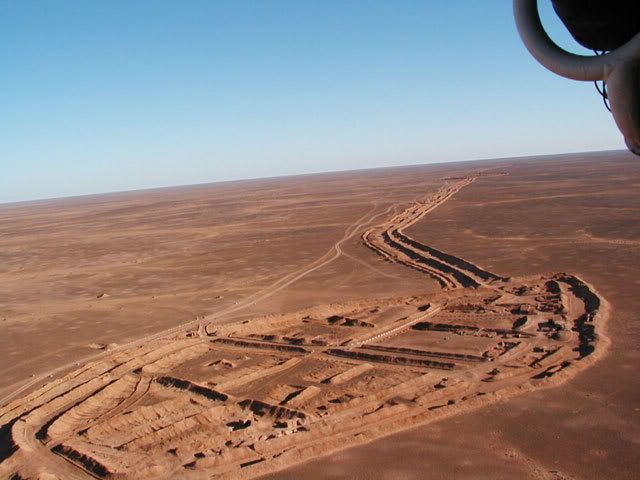
A third international shipping company has bowed to pressure in the last week to quit economic activity in ports in occupied Western Sahara. A Hong Kong-based company Jinhui Shipping has followed two Norwegian companies Arnesen Shipbrokers and R-Bulk, which stopped shipping out phosphates from the territory last year. All three have stopped their exports after pressure from Pro-Sahrawi groups and more companies are expected to follow. This sophisticated pressure is being brought to bear worldwide with spokesman Malainan Lakhal currently in Australia to promote the anti-Moroccan phosphate cause.

Western Sahara is a small barren North-African nation on the Atlantic coast, bordered by Algeria, Mauritania and Morocco. It is also the last colony in Africa. The country has been in political limbo since 1976. The independence group Polisario fought a war with Morocco until a 1991 ceasefire. Since then, the country’s Sahrawi population have been waiting for a UN-sponsored referendum to allow them to vote for either independence or continued integration with Morocco. However with Morocco considered an important ally of the US because of its cooperation in fighting terrorism and its generally pro-West policies, the Sahrawis may be waiting a while.

Western Sahara was a former Spanish colony known as Spanish Sahara. After Spain withdrew when Franco died, it was invaded by Morocco with the implicit support of the US in 1976. Today Morocco illegally earns billions of dollars each year from the rich fishing off the coast and as well as inheriting Spain’s interests in phosphate. It also continues to rely on US support to hose down any nasty UN Security Council resolutions forcing them to comply with the referendum request.

Phosphate mining began under the Spanish administration in the 1950s and was responsible for bringing many nomadic Sahrawis into the sedentary life of towns. In 1976 the International Court of Justice found overwhelming support for Polisario and ruled that the people of Western Sahara had a right to determine their own future. But when Morocco invaded despite the ruling, the majority of the population fled across the borders ahead of Moroccan attacks. The local population are called “Ahel es-Sahel” or Sahrawi people and are a mix of Berber, Bedouin and black African tribes.

Almost a quarter of the population (over 80,000 people) still live in refugee camps in neighbouring Algeria. Those that remain in Western Sahara are subject to Moroccan law. In Morocco, both the law and tradition prohibit criticism on three topics: the monarch; the sanctity of Islam; and Morocco's claim to the Western Sahara. Security surveillance is tight and harassment of domestic and foreign human rights workers is common. Police also routinely repress public protest using excessive force against demonstrators, some of whom threw rocks and Molotov cocktails.

Morocco is the world’s leading exporter of phosphates which are used in the fertilising industry. Through internal and Western Saharan mines, it controls an estimated 75 per cent of the world market. Their exporting process was greatly facilitated by a Free Trade Agreement with the US in 2004 (though the US explicitly excluded Western Sahara from the FTA). But with Morocco signing partnerships with several North American mining companies such as Canadian firms PCS and Agrium, and US-based Mosaic, Agrifos and Innophos, there is strong commercial pressure to support the Moroccan presence in the colony.

Last week, an UN envoy for the territory delivered a blow to Polisario supporters when he said that the Moroccan presence would not be ending any time soon. The UN mediator for the territory, Peter van Walsum, told the Security Council that independence was unrealistic. Van Walsum had concluded “there was no pressure on Morocco to abandon its claim of sovereignty over the territory and, therefore, that an independent Western Sahara was not a realistic proposition." Van Walsum, a Dutch diplomat, later said his comments were a "gamble" to break the negotiating logjam. But the only player happy with his gamble was Morocco. As Reuters point out, van Walsum’s gamble was a recognition of a diplomatic reality – “that Rabat can and will reject independence as long as its control has the quiet backing of big powers like the United States and France.”

Tuesday, June 12, 2007

Congo reviews its wartime mineral contracts

The Democratic Republic of Congo (DRC) has launched a “fairness” review this week of 60 mining contracts signed during the last Congolese war of 1998-2003. With relative stability returned to the DRC, the mining industry is booming and metal prices are on the rise. However the government now believes that the terms and conditions of these contracts are unfair to the state and need revision. They have been supported by advocacy groups who say the contracts were signed without sufficient transparency and don't provide enough benefits to the local population. Big companies affected include the world’s largest miner BHP Billiton, the world's third-biggest gold producer AngloGold Ashanti, and U.S. major Phelps Dodge.

Mines Minister Martin Kabwelulu has launched a commission which will report to Prime Minister Antoine Gizenga in three months. Experts warn the task will much more daunting than the government realise and will take longer than expected. Carter Centre lawyer Peter Rosenblum is advising the commission and he believes it is a larger scale review than anything he has seen elsewhere.

The DRC suspended all negotiations on future mining deals in March pending the completion of the review. A two year UN Security Council investigation recommended the review of all wartime contracts. In 2003, the UN linked the war with exploitation of Congo’s resources saying that "illegal exploitation remains one of the main sources of funding for groups involved in perpetuating conflict."

After the war ended, the transitional government established a commission to look at the problem. Congolese lawmaker Christophe Lutundula headed the investigation, which came to be known as the Lutundula Commission. Its 50-page report showed how the DRC was often cheated by international mining companies. Private partners in joint ventures did not have to provide capital, which left the DRC carrying the debt. There was also a large smuggling culture with many minerals leaving the country unregistered, unrecorded and untaxed. The Lutundula report recommended many contracts should be renegotiated, or cancelled.

Congo holds one third of the world’s cobalt and one tenth of the world’s copper. It also has abundant reserves of gold, diamonds, tin, uranium and coltan. A group of NGOs launched an international appeal called "A Fair Share for Congo!" to ensure the profits of these minerals benefit the Congolese people. The rainbow group called on the new Congolese government and its international partners to "clarify and revise all mining contracts inherited from the past, set up an independent mechanism to monitor the implementation of contracts, and ensure transparent and fair management of mining resources”. The group said that after 30 years of dictatorship and more than 15 years of war and transition, the needs of the Congolese people are immense.

The most recent and more devastating of these wars left 4 million dead. But political tensions are now starting to ease. In December 2005, a nationwide referendum backed a UN-drafted constitution. The current government was elected in 2006 in first democratic polls in 40 years. Major problems remain to be solved. The DRC has one of the world's most dysfunctional economies, with a fragile government, little in the way of basic infrastructure and widespread poverty and desperation. Average income per person is less than $120 a year. There is still widespread conflict in the resource-rich border areas near Uganda and Rwanda. Corruption is widespread and there are few basic amenities.

But despite these daunting conditions and a World Bank warning that rates the DRC as the world’s worst country to do business, interest in mining in the country has soared since the election. Companies are prepared to take any risk to feed China’s apparently endless commodity boom. US company Phelps Dodge approved the building of a copper and cobalt mine in December 2006 at the provincial capital of Lubumbashi. This $600 million mine will yield 112 million kilos of copper a year with production starting as early as 2009. John Fenn, Phelps Dodge's senior vice president for Africa, acknowledges that doing business in the Congo is "especially challenging." But he adds, "the way you grow is you have to go after the resources."

Wednesday, March 07, 2007

Mining lobbyists adrift on a Rising Tide

The NSW Mineral Council (NSWMC) has failed in their clumsy attempt to squash a small climate change advocacy group. Little known Newcastle protest group Rising Tide raised the hackles of the powerful Australian mining industry lobbyist over a parody of its recent mining PR campaign. When the NSWMC launched a website ad to promote mining, Rising Tide struck back with a parody website pointing out mining’s impact on climate change. The council were not impressed and forced Rising Tide’s ISP to shut down the website twice. Now Rising Tide have taken revenge by re-launching their site offshore and challenging the NSWMC to show just cause for their action.

Founded in 2004, Rising Tide is a small activist group based in Newcastle. They are part of a global grassroots movement campaigning against the root causes of human-induced climate change. Their real website states that Newcastle is “the largest coal port (by export volume) in the world”. Rising Tide is now campaigning against the proposed expansion of Newcastle coal exports. The heavy-handed action by the NSW Mineral Council has given them invaluable publicity and provided a useful filter for alternative opinions to enter the mainstream.

None of this would have happened if the NSW Mineral Council had ignored the parody site. But instead they claimed the site infringed their copyright and brought their full legal force to bear. Although Australian copyright law allows for fair use of an original work when mimicked for parody or caricature, it was modified in 2004 to forces ISP to remove potentially infringing sites whenever challenged.

But Rising Tide refused to be intimidated and moved the site to an off-shore host to keep the information in the public domain. The parody site is now on servers hosted in Afghanistan, which place it outside the jurisdiction of Australian law. The revamped website was officially relaunched yesterday to national media attention. Steve Phillips, spokesperson for Rising Tide Newcastle said, "we have issued a counter-notice rejecting the Minerals Council's spurious claims. The Minerals Council now has ten days in which to take the matter further."

Phillips told Woolly Days that NSWMC abused a clause in the copyright laws that were introduced by the 2004 Free Trade Agreement with the US. This clause is an automatic takedown procedure. If a website is accused of plagiarism, the ISP must remove the website even on suspicion of an infringement and before the claim can be validated by a court decision. In other words, Australian law says that any party accused of plagiarism is guilty until proven innocent.

The drama began on 19 February when the NSW Minerals Council launched an advertising campaign to promote the mining industry. Called “Life. Brought to you by Mining”, the campaign lauded the industry’s contribution to”modern life, from employment and the economy to electricity and consumer items”. NSW Minerals Council Chief Executive Dr Nikki Williams said the campaign would provide much needed balance to the intense debate around mining and the environment. Dr Williams claimed the public discussion on global warming has been “railroaded by agenda driven scaremongering, when what we desperately need is logic, innovation and collaboration”.

NSWMC’s idea of logic, innovation and collaboration was an advertising blitz in the mining regions of Newcastle and Wollongong. It featured billboards, TV commercials, press releases and a website. They used the symbol of an asterisk to highlight what they described as “the countless things which are created with a contribution from mining”. NSW Mineral council‘s website invited their audience to “dig a little deeper and find out all the great things that the mining industry has to offer”.

In response Rising Tide put up a parody site. The parody site was a mirror image of the NSWMC site except for some additional satirical text. Rising Tide’s site stated “the NSW Minerals Council is now running a spin campaign to fool you into thinking that we need the coal mining industry” and they invited their audience to “dig a little deeper and find out the real facts”.

NSWMC dug a little deeper themselves and within 24 hours their lawyers contacted the hosts of the parody website. They cited the relevant clause of the Commonwealth Copyright Regulations and forced the ISP to remove the site. Although the site is probably legal under the Copyright Act's Fair Dealing clause as a parody, the hosts were legally required to remove the site pending a response to the Minerals Council's claim of copyright infringement, which did not specify the articles of alleged copyright.

Rising Tide then relaunched the site with a new and original layout to remove the possibility of copyright infringement. Or so they thought. Once again council lawyers contacted the ISP within 24 hours with a similar claim letter that forced the hosts to remove the site a second time. Undaunted, Rising Tide relaunched their site a third time this week from Afghanistan. They also issued a counter-notice, rejecting the allegations of the council. If the NSWMC does not respond within 10 days, Rising Tide will be able to re-host the site in Australia.

NWSMC's best bet at this stage is to avoid all further response. This is proving a public relations nightmare for the mining lobbyists and any further action on their part will only serve to lift all boats of the Rising Tide.

Saturday, May 13, 2006

The dust settles in Beaconsfield

Until Anzac Day 2006, the primary claim to fame of the mining town of Beaconsfield, Tasmania was that it was the first place in Australia to introduce fluoridation in the water. That occurred in 1953. The town had to wait another 50 years before some serious seismic activity made it famous again.

Beaconsfield is on the north coast of Tasmania some 40km north of Launceston on the Tamar coast. Gold was first discovered on the eastern slopes of Cabbage Tree Hill, west of the current township of Beaconsfield, in 1877. An underground mine, known as the Tasmania Gold Mine, operated between 1877 and 1914. Water was the main enemy, the pumps could not keep up with the floods in the mines and this, plus the shortage of labour and materials at the onset of World War I, forced its closure and the flooding of the mine. Drilling in the 1980s discovered a new high grade lode underneath the old mine called the Tasmanian Reef. The mine reopened in 1999 after the flood damage was fixed.

Drilling below the 1000 metre level has shown that the Tasmania Reef is still regarded as the best in Australia and perhaps even the world. The quality of the lode guarantees a future for the mine. The Beaconsfield mine has been high on the crest of the gold boom posting an after-tax profit of $7.5 million last financial year.

Or at least it rode high until hit by two earthquakes. Although the Beaconsfield mine is not in active seismic zone, the April 25 incident was the second earthquake in less than six months. Leading seismologists say it is a well-established scientific fact that sustained mining induces earthquakes. The first quake occurred in October 2005 which caused a rock fall and temporary halting of operations. But there were no casualties. The April quake was roughly the same strength – 2.1 on the Richter scale. But the impact was much greater. On the evening of Anzac Day, 17 miners had been digging for ore in one of the tunnels about 925 metres below when an earthquake shattered rock around them. 14 men made it out safely, but three remained unaccounted for among the underground debris.

On the following day mine manager Matthew Gill held out hope that the trapped trio might still be alive saying “there's every reason to believe that in the general area, ventilation is reasonable”. His optimism seemed unfounded when one day later, rescuers found the body of Larry Knight, one of three men unaccounted for. Here the story looked like it was petering out. It was surely only a matter of time when the other two bodies would be recovered. Then on Sunday the 30th, the extraordinary but sketchy news that "some form of radio monitoring and communication" had shown the two miners Todd Russell and Brant Webb were still alive. They had survived by drinking drips of rancid and mineralised water that run through the mine. On the Monday morning, the town erupted. Kaye Russell, Todd’s wife, enthused “They're alive, they're talking to us, they're in contact, and they're gonna get 'em out.” They had survived the rockfall thanks to the protection of a small cherry picker cage. The miners were in good spirits but they used “quite a few swear words - get us out of here, you know, it's fucking cold and cramped in here, I want to get out.”

But that wasn’t going to be easy. Rescuers were less than 12 metres from them, but had to abandon the blasting technique they had been using because of safety concerns.

Enter a new player Australian Workers' Union (AWU) national secretary and soon-to-be federal ALP MP Bill Shorten. Shorten is being groomed by Labor as the Bob Hawke of the noughties and he was onsite to co-ordinate the union response to the disaster. And because of his media skills he shared the limelight with the mine manager Gill. Shorten announced on May 1 the drilling was going slowly but surely, and could take up to another 48 hours.

“Another 48 hours” was to become the mantra of the mission. And this was to become a major mission. The announcement that the miners were alive meant that an armada of Australia’s big media guns descended on Beaconsfield.

They were there so that they could celebrate the rescue in “another 48 hours” with their audiences. And so on Wednesday May 3 they could now begin the risky process of creating a tunnel through the final 12 metres or so of solid rock standing between the men and freedom. That would take another 48 hours.

The men were provided with protein drinks, vitamin capsules, biscuits, glow-sticks, space blankets, cameras, magazines and ipods via a nine-centimetre pipe.

On Friday May 5 it was announced that a rock barrier had slowed progress and the rescue would stretch into the weekend.

The media contingent was becoming restless and decided to eat its own. The Sydney Daily Telegraph reported a story about the Channel 7 “Today Tonight” host Naomi Robson saying she was “doing nothing but hair and make-up" since arriving at the site on Monday night. Ms Robson denied the allegation in her high rating program citing jealousy from the other media.

On Sunday May 7 as the mine manager Matthew Gill gloomily announced another delay, he was asked a question on mine safety by veteran Channel 9 reporter Richard Carleton. His question was: "On the 26th of October last year, not 10 metres from where these men are now entombed, you had a 400-tonne rock fall. Why is it -- is it the strength of the seam, or the wealth of the seam -- that you continue to send men in to work in such a dangerous environment?"
Gill refused to answer citing the recovery effort instead. Carleton left the conference and collapsed and died of a heart attack some twenty metres away.

After yet another 48 hours, Russell and Webb were finally freed in the early hours of Tuesday May 9. This was the same day of Larry Knight’s funeral. Graham Mulligan, spokesman for a Christian motorcycle club which escorted Larry Knight’s coffin from the church to a nearby cemetery said “This whole ordeal has taken us from horror to shock, grief, sadness, joy and happiness and then back to sadness again.”

Now the media scrum gathers around the survivors in order to buy their stories. Millions of dollars will change hands. Bill Shorten wants an independent inquiry into the disaster. The mine has deferred the interim 2006 dividend until further notice. No one knows whether the mine will re-open though there is much goodwill to make it happen. Beaconsfield Benefit Concerts and Footy Shows from the town have been arranged.

Everyone feels good about themselves in this sensational story. However at the other end of Australia, a similar story occurred with precious little media attention. Three Torres Strait islanders lost at sea for 22 days switched their mobile phones off to conserve the batteries before finally getting enough of a signal to text message for help. They were found on the same day as the miners.

The Islanders were black and didn’t attract the same attention as two white men in Tasmania. This story also shows the media's obsession with crisis, drama and emotion-packed stories like Beaconsfield. The story had blanket coverage (and therefore other events did not get a look in.) All the media were involved and jostled with each other for exclusive angles. The media sent its biggest players to cover it. And this caused the sideshow mentioned earlier.

The Torres rescue did not have the same drama. A helicopter fished them out of the water with no network cameras in tow. It did not have sustained media drama.

The islanders survived the same length of time without the little luxuries that the miners had. They had no contact with the outside world, no dry clothes, no water, no magazines and no ipods. But the sad truth is their story will never have the value to mainstream advertisers that the Tasmanian story will offer.