Showing posts with label drugs. Show all posts

Wednesday, November 04, 2009

Nutt decision shows the immaturity of the marijuana debate

Britain’s chief scientist John Beddington has backed Professor David Nutt’s assertion that cannabis is less harmful than alcohol or cigarettes. However Beddington refused to criticise Home Secretary Alan Johnson for sacking Professor Nutt given that “trust had broken down” between the pair. The British government sacked Nutt on the weekend after he argued the reclassification of cannabis as a class-B controlled substance did not make any sense from a medical point of view. However Labour’s authoritarian stance did make sense as a way of counteracting increasingly shrill anti drug headlines in the right-wing Daily Mail newspaper. (photo by thetruthabout)

As Forth says, successive governments have run scared from sections of the popular press that purport to represent the attitudes of the public. The increasingly fraught Brown administration recategorised cannabis last year against the recommendation of its own Advisory Council on the Misuse of Drugs (ACMD). Labour had lessened cannabis from a class-B to a class-C drug in 2004 which reduced sentencing for possession from five to two years. But in 2008 Home Secretary Jacqui Smith said that prevalence of stronger varieties of skunk cannabis required a change of heart “rather than risk the future health of young people”.

The ACMD investigated the so-called skunk scare at the government’s request. It found cannabis was harmful but not serious and it should remain a class-C drug. The study also found a media bias with the press reporting 26 out 28 ecstasy-related deaths while reporting only one aspirin death in 265 and one morphine death in 72. The reporting gives the impression ecstasy is a more dangerous drug than it is. Cannabis was missing from the study because it doesn’t kill anyone.

Labour moved after Nutt went public with his criticisms of the reclassification. Johnson wrote a letter to Nutt on 30 October asking for his immediate resignation. Johnson said Nutt’s recent comments had gone “beyond” the evidence about drug-related harms and amounted to a lobbying for change to government policy. “This goes against the requirements on general standards of public life required by your position,” wrote Johnson. “As chair of the ACMD you cannot avoid appearing to implicate the Council in your comments and therefore undermining its scientific independence.”

But as the British blog Ministry of Truth writes this was completely false. Nutt wasn’t just doing his job to the best of his abilities, he was doing the job that parliament, in the guise of the House of Commons Science and Technology Committee, had specifically asked him to do – put the country’s drug misuse policies on a sound and consistent scientific footing.

Britain is not alone in its hysterical over-reaction to the dangers of cannabis. The US is just as bad, if not worse. Environmental writer Michael Pollan’s new documentary The Botany of Desire is about four crops - the apple, the tulip, marijuana and the potato - that Pollan says reflect different aspects of human desire. Pollan's says people and plants form a reciprocal relationship. We have cultivated the apple because of a desire for sweetness, the tulip for beauty, the marijuana plant for intoxication and the potato for control over our sustenance. But it took him eight years to secure the necessary $1.2 million in funding for the documentary because of the inclusion of marijuana. “We got funding, then we lost it because we wanted to devote a fourth of the program to Michael's exploration of marijuana,” said the show’s producer.

Yet hemp growing has a long history in the US. In 1619 Virginia’s Jamestown colony ordered all farmers to grow Indian hemp seed. Early drafts of the Declaration of Independence were written hemp and President Washington encouraged farmers to grow it to decrease reliance on imports. A hundred years later, hashish smoking parlours were commonplace in every American city with 500 in New York alone.

The start of marijuana’s downfall was the innocuous sounding publication of the US Agriculture Department’s “Bulletin 404” in 1916.Bulletin 404 hailed hemp hurds as revolutionary new technology for making high-quality paper. The bulletin said an acre of hemp could produce four times as much paper as an acre of trees. It also said it would become cheap once mechanisation reduced the labor intensity of hemp harvesting. Press mogul William Randolph Hearst worked out he had about ten years to make sure hemp did not crush his paper-making empire. His newspaper chain unleashed a massive racist propaganda campaign to demonise cannabis hemp under the more sinister Mexican name of “marihuana”.

The Du Pont chemical company’s suite of synthetics was also threatened by the growth of hemp and had the means to do something about it. Du Pont banker Andrew Mellon was Secretary of the Treasury under President Herbert Hoover. He appointed Harry Anslinger to head the Federal Bureau of Narcotics and Dangerous Drugs (FBNDD). Anslinger was America's first drug tsar and would remain in the role for 31 years and for most of this time his public enemy number 1 was marijuana. Between 1915 and 1933 every US state prohibited distribution for non-medical purposes. In 1937 the US enacted the Marijuana Tax Act despite the protest of doctors. Industrial hemp was criminalised and Du Pont reaped the benefits

US laws became tougher in the fifties leading to a mandatory two to ten year sentence for a first offence of marijuana possession. The 1972 Shafer Commission recommended it should be decriminalised but President Nixon rejected the report as it didn't suit his "tough on crime" stance. The next decade saw 11 states follow the Shafer recommendations but President Reagan backed tougher “no tolerance” policies in 1986. In 1996 California ignored the national law and allowed for medical marijuana use.

The futility of America’s long-term war on drugs was shown by a 2006 report which showed marijuana was the country’s largest cash crop. The study estimated marijuana production had a value of $35.8 billion exceeding the combined value of corn ($23.3 b) and wheat ($7.5 b). A 2005 study estimated legalised marijuana would save the US $7.7 billion in law enforcement costs and could generate as much as $6.2 billion annually if marijuana were taxed like alcohol or tobacco.

Back in Europe, Portugal has attempted to end the stigma of drug use. In 2001 Portuguese authorities decriminalised personal use and possession of all drugs, including heroin and cocaine. The police could no longer arrest anyone for possession. Conservative politicians denounced the decriminalisation as “pure lunacy” which would lead to rampant drug use while others predicted the country would be plagued by drug tourism. However a 2009 study by the Cato Institute has found that Portugal’s drug use has not risen in eight years and in numerous categories is the lowest in Europe. “Before decriminalisation, addicts were afraid to seek treatment because they feared they would be denounced to the police and arrested,” says Manuel Cardoso, deputy director of the Portuguese Institute for Drugs and Drug Addiction. “Now they know they will be treated as patients with a problem and not stigmatised as criminals.

Sunday, September 20, 2009

Taliban’s Mullah Omar issues warning to West on Afghan war

The Taliban leader says the West lacks the will to fight in Afghanistan and he may be right. Mullah Omar has issued a statement from his hiding place in Pakistan warning of huge casualties and said the West does not have the stomach for the war. Omar said that the more forces the US deploys in the country, the more they will face “unequivocal defeat”. He referred to history when he described the country as a “graveyard for colonial troops”. His statement came as Taliban-linked rebels have intensified use of roadside bombs, particularly in the south. This year more than 350 foreign troops have been killed, making it the deadliest year since fighting began. (picture credit: daviza)

Italy is the latest western country to question its commitment to Afghanistan after six of its troops were killed alongside ten Afghan civilians in a Kabul bomb blast on Thursday. The European nation has 2,800 soldiers in Afghanistan and had already started bringing some home before the latest attack which brought its death toll to 20. Now Prime Minister Silvio Berlusconi is publicly questioning the mission. "We are all convinced it's best for everybody to get out soon," he said.

Berlusconi’s statement will not be welcomed by the White House which provides two-thirds of the 100,000 troops in the Nato-led occupation force. With a new administration in the White House, the US has re-examined their motives for fighting the eight-year war. In March President Obama made a pledge to expand the US military presence in Afghanistan. But as the World Politics Review puts it, the essential question now is not whether the war is winnable, but whether the mission is vital to American national security interests. And from this perspective, says the review, the open-ended strategy fails.

The US administration has acknowledged the new policy raises the stakes by transforming the Afghan War from a limited intervention into a more ambitious and potentially risky counter-insurgency. The statement was made in a Senate Report to the Committee on Foreign Relations which was released last month. The report stressed the importance of a counter-narcotics policy in winning the war. For years commanders on the ground said that going after drug lords was not part of their mandate. But now the US has targeted drug traffickers who help finance the Taliban as a major priority. The report said tens of millions of drug dollars are helping the Taliban and other insurgent groups to “buy arms, build deadlier roadside bombs and pay fighters.”

Afghanistan’s opium industry supplies 90 percent of the world’s heroin and generates $3 billion in profits. But the UN says production is on the decline for the second year in a row. The Americans have targeted 50 of the major drug traffickers on a military hit list to be “killed or captured”. It has also set up an intelligence centre to analyse the flow of drug money to the Taliban and corrupt Afghan officials, and an international task force to pursue drug networks in southern Afghanistan. But stopping the flow of drug money will not be easy. Most transactions are conducted in cash and are concealed by an ancient and secretive money transfer system. The strategy acknowledges that counter-narcotics will not be enough to win the war. The other major aspect of the change of direction relates to the activities of farmers. The Obama administration has admitted a program to eradicate poppies is a failure and emphasis will now be on promoting legal alternative crops.

The report did not dodge two important questions that will impact the success of the change of direction. It asked whether the US Government has the capacity and the will to provide the hundreds more civilians to transform a poppy-dominated economy into one where legitimate agriculture can thrive. It also wondered whether Nato allies be counted on to step up their contributions on the military and civilian sides at a time when support is waning across the Western world. It also asks the questions that Obama’s team will need to honestly answer if the president is to avoid Afghanistan becoming his Vietnam: Does the American public understand and support the sacrifices that will be required to finish the job? And what is the job anyway? Obama and the other western leaders cannot use the hoary “terrorist safe havens” argument forever. And as Mullah Omar reminds us, forever is likely to be a very long time.

Wednesday, March 04, 2009

African basket case: Just another day of crisis in Guinea-Bissau

Guinea-Bissau parliamentary speaker Raimundo Pereira was sworn in yesterday as interim head of state barely 24 hours after President Joao Bernardo Vieira (pictured) was assassinated. The tiny West African republic is still reeling from the news that the country’s military killed the president in apparent revenge for the murder of the armed forces chief of staff the day before. Despite the deaths, the army denies there is a coup and the capital Bissau remains quiet. Parliament has declared seven days of national mourning for the assassination of the president and two State funerals. According to the country’s precarious constitution, Pereira now has 60 days to call an election.

It is likely the deaths are related to tribal and drug trafficking issues. The chain of extraordinary events began on 1 March. The assassinated president Vieira (from the minority Papel ethnic group) has long had a tense relationship with the army dominated by officers from the majority Balanta ethnic group including chief of staff, Batista Tagme Na Wai. So it was no surprise Vieira was accused when Na Wai was killed in an explosion that destroyed part of the military headquarters on Sunday evening. While no one claimed responsibility for the blast, many armed forces members placed the blame squarely on the president. Renegade troops left Mansoa barracks, 60km north of Bissau, late on Sunday, to with a mission to "liquidate President Vieira". They first released seven soldiers who carried out a failed attack on the 69 year old Vieira last year. They then attacked Vieira as he tried to flee his presidential home for the safety of the Angolan embassy. He was savagely beaten before being shot several times in the throat and face.

The United Nations Security Council issued its usual platitude of condemnation about the assassinations. The council called on the country’s government to bring the killer to justice and pleaded for calm and restraint on the streets. It urged all parties to resolve their disputes through political and peaceful means within the framework of its democratic institutions and opposed any attempt to change the Government through unconstitutional means. However, despite these pious calls, the UN has not offered any practical help to the struggling nation.

Chronically poor Guinea-Bissau has been the victim of political instability and corruption ever since it won unilateral independence from colonial masters Portugal in 1974. It was ruled by a junta for ten years and the first multi-party elections did not occur until 1994. But the military has intervened several times since then, most notably in a civil war which ripped the country apart in 1998-1999. That war saw the overthrow of Joao Vieira's first term of office but he was returned to power in 2005. His regime was destabilised by parliamentary elections in November 2008 which was won by opposition parties. Vieira survived a coup attempt that same month when renegade soldiers launched a pre-dawn attack on his residence.

Writing in the Christian Science Monitor, Scott Baldauf says this week’s double assassinations are a troubling sign for a region “with weak institutions for self-government and strong incentives for corruption”. The country of 1.5 million population is one of the poorest in the world, ranked the 175th out of 177 nations in the U.N. Development Program's Human Development Index. Apart from cashew nuts, its main industry is drugs. Guinea-Bissau is a transit point for the cocaine trade between South America and Europe. With no navy to speak of, Colombian drug cartels are free to land on islands off the coast before distributing their cargo to impoverished African migrants who ferry the drugs north to Europe. “Government corruption, fed by poor government salaries at the bottom and uncertain political leadership at the top, means that Guinea Bissau has few tools to stop the drug trafficking,” says Baldauf.

According to the UK Independent, an estimated tonne of pure Colombian cocaine is transited through Guinea-Bissau’s islands every day. It claimed that politicians and armed forces officers are key facilitators of the trade. The denial by navy head, Jose Americo Bubu Na Tchutu wasn’t particularly convincing. “I just sit there waiting for evidence," he said. But the drug traffickers aren’t sitting there waiting. David Zounmenou, a senior researcher at South Africa’s Institute for Security Studies is convinced they are involved in the deaths of Vieira and Na Wai. "This recent set of killings can be explained [as] the action of the drug traffickers, who would not allow anything to get in the way or to obstruct their links with Europe,” he said.

Friday, June 20, 2008

Colombia's addiction to coca continues

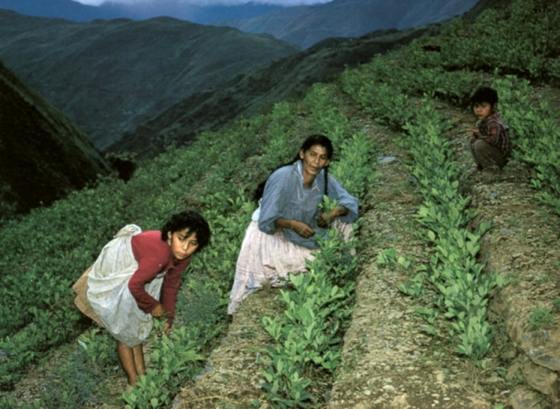
(Picture credit raintree.com)

A new UN report has shown a marked increase in coca cultivation in the Andes region of Bolivia, Colombia and Peru. Colombia showed the largest increase in 2007 with a 27 percent rise in the total land under cultivation while the other two countries showed single-digit percentage increases. Despite the increases the total output of coca products remained unchanged last year due to low yields. The region produces 60 per cent of the entire world’s cocaine output with a farm gate value of $1.4 billion in 2007. This is not just a local problem. 88 per cent of all the region’s products ends up in the US via Mexico.

The report was compiled by the UN Office of Drugs and Crime (UNODC). Called “Cocoa cultivation in the Andes region” (pdf), it is a study of the drug trade in Bolivia, Colombia and Peru. Colombia has been the world’s largest producer of cocaine since the 1980s and illicit coca cultivation has expanded steadily since then particularly in remote areas of the Amazon Basin. The farmers either sell the coca leaves, or process them into coca paste or base. The last step is the processing of the cocaine base into cocaine hydrochloride which is not carried out in clandestine laboratories.

The report is the work of UNODC’s Illicit Crop Monitoring Programme (ICMP) which was set up to promote the development of a global network of illicit crop monitoring systems. ICMP is currently active in seven countries: Afghanistan, Bolivia, Colombia, Laos, Morocco, Burma and Peru. Until 2006, the coca cultivation areas were monitored by satellite imagery, but in 2007 the methodology was enhanced by the use of very high resolution photos from airplanes.

The findings have raised serious questions about the efficacy of Colombia’s US-backed “war on drugs” campaign. UNODC’s executive director Antonio Maria Costa says the increase is a surprise and a shock. He said it was a surprise because the Colombian government is trying so hard to eradicate coca and a shock because of the magnitude of cultivation. Costa said most coca is grown in areas controlled by insurgents and he compared the situation with Afghanistan’s opium crop where “most opium is grown in provinces with a heavy Taliban presence.” Costa said the best hope for eradication would be the disarray of the Colombian rebel group Revolutionary Armed Forces of Colombia (FARC).

Despite the obvious failure of the existing program, the US has pledged its continued support. The US State Department said it to continue to “work with President Uribe and his government, as well as others in the region, to continue this effort”. America has backed a multi-billion dollar eradication program but its efficiency has been questioned in recent times. Colombia UNODC representative Aldo Lale-Demoz says farmers plant elsewhere in the wake of each eradication program. “They go further afield from their homes,” he said. “They will not tend those plots as well as they did before, so the productivity of those secondary lots is much lower."

In other early reaction, Colombia’s chief of police dismissed the report’s conclusion that Colombia was the world’s cocaine hub. Oscar Naranjo expressed “great surprise and a series of concerns” over the measurement techniques used by the report. He claimed the UN measurement system is based on information from a French satellite that stopped detecting the scale of illegal crops years ago. Earlier last week, the Colombian authorities said that the country has eradicated 31,000 hectares of coca crops since January, surpassing the amount eradicated in the same period of 2007. This still leaves 70,000 hectares under cultivation if the report is correct and does not take into account any new cultivation. This would appear to be Naranjo’s real “series of concerns”.

Sunday, April 13, 2008

Cocaine: Squaring the ledger

A Los Angeles news agency is the subject of a lawsuit that alleges they supplied Heath Ledger with cocaine before secretly filming him using the drug. The suit filed on Friday accuses two paparazzi employed by the Splash News & Picture Agency of paying for cocaine so they could secretly videotape Ledger snorting the drug on the night of the Screen Actors Guild Awards. An unnamed freelancer who brought the suit has sought unspecified damages for fraud, distress and privacy violations. Victory would also mean the revenue generated by selling the videotape should be forfeited under a California state law forbidding paparazzi from profiting from illegal activity.

Worldwide media outlets paid more than a million dollars for the grainy footage. The footage shown after Ledger’s death went a long way to creating the impression, the actor was a cocaine addict. However while clips included a confession by Ledger he was a long term user of marijuana, they do not show him snorting cocaine. What scanty evidence there is, comes from untrustworthy British tabloids who reported a former personal assistant of supermodel Naomi Campbell’s claim that she saw Ledger indulge in several cocaine binges with Campbell. With cocaine the traditional favourite drug of the rich and famous, these rumours are easy to believe and grist to the media's mill.

Cocaine is made from a substance extracted from the leaves of coca plants native to Bolivia, Peru and Colombia. These three countries remain the primary source for the coca leaf and finished cocaine hydrochloride. The earliest inhabitants of the Andes chewed the coca leaves for its stimulating effects. Each leaf contains 2 percent of the active substance that makes cocaine so powerful. It was released by slowly chewing for an hour and its sensation it helped them survive the bitter cold of the high mountains. The Spanish conquistadors tried to outlaw the practice as they thought it encouraged immoral behaviour and laziness. But eventually economics won out and officials took over the production of coca leaf.

Cocaine itself was invented in 1855. German scientist Friedrich Gaedke devised a way of extracting and purifying the active substance from the leaf. His compatriot Albert Niemann improved the process a few years later. Both men were interested in the drug for its medicinal properties as a pain reliever. At the time, anaesthetics were ineffective and surgery was an agonising process for its victims. It wasn’t until 1880 that Russian doctor Vasili von Anrep discovered how to use cocaine as an anaesthetic and word quickly spread about its value.

One of cocaine’s earliest enthusiasts was Sigmund Freud. He published “On Coca” in 1884 which was the first study of its effects. He took the drug himself and prescribed it for his friend Ernst von Fleischl-Marxow to overcome his addiction to morphine. This was not a successful treatment. Fleischl-Marxow became addicted to cocaine and suffered a cocaine-induced psychosis. The results chastened Freud and thereafter he regarded the drug as dangerous.

Around the same time, processed cocaine was making its way in to many products including syrups, tonics, wines and lozenges. In 1886 a pharmacist in Atlanta, Georgia named Doctor John Pemberton concocted a new drink which he released under the name of “Coca Cola”. Pemberton marketed the drink as a tonic. The name of the drink was inspired by two ingredients in its secret recipe: cocaine-laced syrup and caffeine from kola nuts. Under the aggressive marketing by Pemberton's friend Asa Candler, Coca Cola quickly became one of most successful soft drinks in America.

By 1900, negative publicity about cocaine’s side-effects was spreading. But Candler could not totally eliminate it from the formula without threatening the trademark status of the drink’s name. So Coca Cola began to slowly remove the drug from its formula. By 1902 it was as little as 0.25 per cent of a grain of cocaine for 30 grams of syrup. Coke did not become totally cocaine free until 1929.

By then there was a worldwide consensus to illegalise narcotic drugs. In 1924 the Second International Opium Conference agreed to make laws to control drugs. Over the next few years many countries outlawed the production, sale and possession of heroin, cocaine, opium and cannabis. In 1946 the UN assumed the drug control functions formerly carried out by the League of Nations. They established a control body, the International Narcotics Control Board (INCB) which attempts to control production and distribution of narcotic and psychotropic substances worldwide.

The cocaine industry was driven underground. Due to the difficulties in importing and refining it, it became extremely expensive and the preserve of wealthy people. Cole Porter’s 1930s song “I Get a Kick out of You” refers to those who “get a kick from cocaine”. But the drug had a fairly low profile until new forms of the drug emerged in the 1970s. Crack and freebase brought cocaine to whole new socio-economic groups. These products were easy to make but highly addictive. But newspaper reports tend to overdramatise cocaine use in the wider public.

Although a 2000 Australian Institute of Health and Welfare survey (pdf) on drug usage showed that cocaine use was on the rise, it also found it was one the lesser used drugs on the Australian scene. Just 4 percent of those surveyed had ever tried cocaine and 1.4 percent had used the drug in the previous 12 months. However cocaine use had increased by 1 percent in the decade since 1991. NT and NSW had the highest percentage of cocaine users with 5.6 and 5.0 per cent respectively. The survey also found little support for the legalisation of the drug.

The UN Office on Drugs and Crime (pdf) support these findings. In the 1990s, they estimated that 180 million people (or 4 per cent of the world’s population at the time) consumed drugs of which cannabis was easily the most popular. Cocaine users made up just 14 million users worldwide (0.3 per cent of the world’s population). The majority of cocaine users are white males between the age of 16 and 24. The 28 year old Heath Ledger was probably a cocaine user. For media organisations to set him up to snort it so they could then film him using it, is outrageous hypocrisy. Instead of a war on drugs, we would be better served with a war on media exploitation.

Sunday, April 06, 2008

Rudd goes the wrong way on opium

Australian PM Kevin Rudd has failed in his bid to get NATO support for a firm timetable on his Afghan opium eradication strategy. Rudd had called for benchmarking at next year’s summit for the eradication of Afghanistan’s $4 billion opium crop but NATO has not agreed to his timing. At the Bucharest summit NATO had pledged to "continue to support Afghan-led efforts to tackle the narcotics problem". Rudd wanted a more specific outcome and said Britain had backed his call for the elimination strategy to be subjected to annual performance measures analysed each year. During the debate Rudd said that if efforts to reduce opium were not to be subject to measurement, "then I will have something further to say on that".

Rudd will now have his chance to say more as the European NATO leaders rebuffed his specific timetable. The Sydney Morning Herald accuses Rudd of “opiaphobia” and says Rudd should concentrate on “bigger issues”. The SMH defines opiaphobia as the irrational fear of opiate drugs particularly favoured by US politicians, and attributes the term to John Morgan, a professor of pharmacology at the City University of New York. US efforts to reduce the crop have been ineffective and opium production has increased 30 per cent in last 12 months. Opium accounts for half of Afghanistan’s $6 billion GDP and the country produces 93 percent of the world’s opium.

The opium crop had almost eliminated under the rule of the Taliban. But corruption in the post 9/11 administration and the distraction of the continued fighting has seen it come back with a vengeance. About half of the crop is grown in Uruzgan province, where Australia has its troops. Much of Uruzgan is classified by the United Nations as “Extreme Risk / Hostile Environment.” The Taliban effectively controls four-fifths of the province. There the Taliban has now done an about-turn on poppy growing and imposes a 25 per cent tax on the estimated US$1 billion earned by farmers to finance their military campaign.

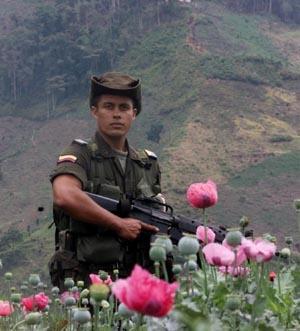
Because of the dangers on the ground, the US is advocating aerial spraying from the air using chemicals to kill the crop. Washington is now pressuring the Afghan government to agree to aerial spraying of opium crops with the weedkiller glyphosate. But this is no smart bombing exercise. Glyphosate destroys all crops and leaves two million farmers without income. Harvard professor Robert Rotberg says the US is hell-bent on eradication regardless of its disastrous consequences elsewhere. “They claim it worked in Colombia and so will work in Afghanistan,” he said “It is not clear to anyone it worked in Colombia.”

Now the London Senlis Council has promoted an alternative to eradication. It is advocating the use of poppies for medicine. It wants to converts poppies into morphine for the global south. There is a worldwide shortage of morphine. Poppy for Medicine’s strategy involves licensing the controlled cultivation of poppy to produce essential poppy-based medicines such as morphine, and unlicensed poppy cultivation remains a criminal activity. It was established in Turkey in the 1970s as a means of breaking farmers’ ties with the heroin market without resorting to forced poppy crop eradication. Within just four years, this strategy successfully brought the country’s illegal poppy crisis under control.

This could solve Afghanistan’s problem too. Its dilemma is that this crop is vital to the Afghan economy but is at the same time destroying thousands of lives elsewhere. Destroying the crop only makes the situation worse, so the solution is to buy the opium crop from them. Currently there are only four nations in the world allowed to grow opium for morphine production (France, Spain, Turkey & India). 80 percent of the world’s supply is used by just six percent of the world’s population If Afghanistan was added to the list the price of morphine would fall dramatically and end the shortage. It could also end the opiaphobic solutions preferred by Rudd and the Americans.

Thursday, June 14, 2007

FARC looks for more concessions from Uribe

The Colombian rebel group FARC is holding out for more concessions before releasing dozens of hostages despite the government’s release of its second-in-command Rodrigo Granda. President Alvaro Uribe released Granda, FARC’s “foreign minister” and 150 other guerrilla fighters last week in the hope of a reciprocal release of 60 hostages including Colombian Senator Ingrid Betancourt and three American contractors. But now the rebels have demanded that the government must also withdraw its troops from two southern towns in exchange for the release of its prisoners.

New French President Nicolas Sarkozy was reputedly involved in the negotiations in order to secure the release of Senator Betancourt. The senator was educated in Paris and is married to a Frenchman. There are reports that Sarkozy had requested Uribe to free Granda in order to secure her release. Granda himself has denied the connection and said his release from jail was a decision by the government and that he made no deal. Betancourt’s kidnapping in 2002 when she ran for president drew world attention to FARC’s hostage taking tactics.

FARC are responsible for most of the country’s 3,000 annual kidnappings. Alvaro Velez won a landslide victory in Colombia’s May 2002 presidential election by promising to crack down on the rebels. This year President Uribe has launched a US-backed $3 billion offensive to retake rebel-controlled territory. He also overturned a 1998 agreement which awarded FARC a 42,000 square km safe haven as a condition for attending peace talks. Uribe has personal motive too as his father was assassinated by FARC during a bungled kidnapping attempt in 1983. His unilateral release of 150 FARC fighters is surprising therefore in the context of his avowed aim to eradicate the organisation by the end of his second term in 2010.

FARC has been led for over 40 years by Manuel "Tirofijo" Marulanda (born Pedro Antonio Marin). Marulanda gained his nickname (Tirofijo means “sureshot”) because of a reputation for accuracy when using firearms during his earlier years as an insurgent. He is now approaching his 80s (his exact age is disputed) and was reported to be “acutely ill” in 2004. In March 2006, the US placed a $5 million bounty on a still very much alive Marulanda’s head.

FARC is one of two major leftist revolutionary groups currently active in Colombia. The US State Department considers both of them, FARC and the National Liberation Army (ELN) terrorist organisations. While both were founded in the 1960s counter-culture, FARC’s roots stretch further back in time. In 1948, influential populist leader Jorge Gaitan (pdf) was assassinated as he ran for presidency. His unexplained death sparked ten years of violence known as La Violencia which cost almost 300,000 lives.

During La Violencia, leftwing parties formed their own defence groups and guerrilla units which fought not only against the Conservative government but also against each other. In 1953, Gustavo Rojas seized control of Colombia in a coup and offered amnesty to all rebel groups in order to end the violence. But Communist groups were distrustful of Rojas and retreated into the mountains rather than hand over their weapons. The government mostly ignored the existence of these small Communist enclaves until it ordered the army under US pressure to disperse them in 1964.

One group known as Bloque Sur (Southern Bloc) dispersed during the height of the army assault but re-emerged after the incursion ended. Bloque Sur was led by Marulanda and Jacobo Arenas. Marulanda was the soldier to Arenas’s theoretician. In May 1964, they renamed the group Fuerzas Armadas Revolucionarias de Colombia (FARC) which means Revolutionary Armed Forces of Colombia. Inspired by the success of Castro in Cuba, FARC’s ultimate goal was to establish a Communist state. Arenas began an education program for the early FARC guerrilla fighters, as most came from low income peasant families. Their motto was “Learn and fight for Colombia”.

But the group had little success until it realised it could finance its operation by feeding the huge Western demand for heroin. By the late 1980s, FARC controlled every aspect of the drug production process including manufacturing the chemicals that turn the coco bush to cocaine, charging taxes to the farmers that grow it and charging airport fees for the export of the finished drugs. It now makes $300 million a year from its drug enterprises. Allied to income from kidnapping and extortion, FARC is probably the wealthiest insurgency organisation in the world.

FARC is now the largest and best-equipped of Colombia’s rebel group, with a possible 18,000 members. It operates in almost half the country, mostly in the jungles of the southeast and the plains at the base of the Andes Mountains. The smaller ELN operates mainly in north-eastern Colombia and has about 4,000 members. FARC briefly tried the military route to power in the eighties with a political front called the Patriotic Union (UP).

However the government of the day had no intention of letting them take part in the political process. They sponsored death squads who killed 3,000 UP members including its 1990 presidential candidate, Bernardo Jaramillo Ossa. FARC learned their lesson and concentrated on the military route to power. They are now a formidable enemy who control a territory the size of Switzerland. And with a western taste for heroin unlikely to diminish, they will remain part of Colombia’s Realpolitik for years to come.

Sunday, February 25, 2007

Germany bans red man's revenge again

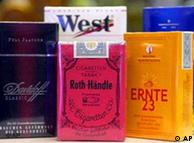
Germany is latest country to introduce anti-smoking laws. Its 16 federal states have agreed to outlaw smoking in public buildings but stopped short of a blanket ban in pubs and restaurants as introduced in a number of other European countries. The state premiers must still approve the ban. While the move is unlikely to meet the approval of Germany’s 25 million smokers (almost one third of the population), it does has the backing of Angela Merkel’s government. Federal Consumer Affairs Minister Horst Seehofer hailed what he called a long overdue move saying “there is no substance in a room more poisonous to health than smoke”.

But Germany has a strong post-war sense of freedom of expression that will find this law an infringement of basic rights. Germans may also object for historical reasons. This is not the first time the nation has tried to implement a smoking ban. Germany had the world's strongest anti smoking movement in the 1930s and early 1940s under Hitler. The Nazis had surprisingly enlightened ideas about cigarettes such as banning smoking in public spaces, no tobacco advertising, and restricted tobacco rations for women (though not for men, presumably the boys needed a puff after a hard day’s work with the Wehrmacht). Nazi German scientists had a highly refined science called epidemiology which studies the factors that affect the health of populations. They were particularly strong on the effects of tobacco. Nazi scientists were the first to establish there was a link between tobacco and lung cancer.

Many Nazi leaders like Himmler were vocal opponents of smoking. But Hitler was the most adamant, characterising tobacco as revenge: "the wrath of the Red Man against the White Man for having been given hard liquor." But then Hitler spoke with the typical anti-tobacco zeal of an ex-smoker . Nevertheless despite official disapproval the industry thrived. In the 1940s German anti-tobacco activists struggled to point out that whereas Hitler was now a non-smoker as were fellow fascist leaders Mussolini and Franco, the three allied heads Churchill, Stalin, and Roosevelt were all fond of tobacco. It is unlikely this campaign met with any success.

Not many of today’s world leaders will openly admit to a fondness for nicotine products. Fidel Castro was renowned for his love of cigars but even he kicked the habit in 1986 for health reasons. And while he continues to struggle for life in hospital, Cuba banned smoking on public transport, in shops and other closed spaces last month. More than half of Cuban adults are thought to smoke, and 30% of preventable cancer deaths are linked to smoking. The commerce ministry announced the move saying it was "taking into account the damage to human health caused by the consumption of cigarettes and cigars, with the objective of contributing to a change in the attitudes of our population." It is a big step for a country with a $200 million cigar export industry.

Ninety miles to the north, the US also has political problems with tobacco. Although Nazi scientists were quick to chide Roosevelt’s habit, no US president since him has smoked. It’s possible that Barack Obama’s high profile presidential campaign could be more likely derailed by his well-publicised battles with nicotine addiction as any issues related to his background or his views on Iraq. He is one of a quarter of the American adult population (almost 50 million) who smokes cigarettes. Obama doesn’t puff publicly but stories of his 'dirty little secret' in political circles could prove poisonous in an era when smokers are looked down upon in America.

But the US is also home to two of the world’s biggest tobacco companies; Altria Group (formerly Philip Morris) and RJ Reynolds (the third biggest British American Tobacco is based in London). They have vast political influence that has kept uniform smoking laws off the Washington agenda. But individual jurisdictions are taking action. California has some of the toughest and most extensive anti-smoking legislation anywhere in the world. Smoking is banned in public buildings, restaurants, bars and enclosed workplaces and also on its famous beaches.

The recent court defeats have also left the tobacco companies looking overseas for easier pickings. Germany has been one of Philip Morris’s happy hunting grounds and one of the countries that share the manufacturer’s views. In 2002, Germany argued to weaken the draft of the Framework Convention on Tobacco Control (FCTC) on the issue of advertising, promotion and sponsorship. Using arguments often promoted by transnational tobacco corporations, Germany made the case that tobacco advertising is protected as freedom of expression. Its position on the issue of tobacco advertising was in part attributed to expressed concerns over constitutional conflicts. The new laws would appear to have overcome these conflicts.

The German decision follows the lead of a number of European countries. England is to implement a smoking ban in workplaces and enclosed public spaces follow similar decisions by Italy, France and Spain. Ireland led the way in the EU by imposing tough anti-smoking legislation in March 2004 which banned smoking in pubs, restaurants and other enclosed workplaces. While the Irish laws were blamed for plummeting bar sales, the laws have been generally welcomed, especially by pub employees. According to a 2005 study, the new law has proven popular, even with smokers: 83% of Irish smokers say the law was a "good" or "very good" thing. Berlin café owner Cynthia Barcomi is impatient for similar laws in Germany. "I think it's really cowardly," she said. "How much more information do they need about the dangers of passive smoking? Does the rest of the world have to ban smoking before Germany does it?"

Thursday, August 03, 2006

The meth don't stack

In the fast world of drugs, crystal meth is on a mission. It’s cheap, highly addictive and ultra-powerful. It can be smoked, swallowed, snorted, or injected. It can even be inserted anally. In Australia its popularity has outstripped heroin and there are an estimated 70,000 users across the country. Since the late 1990s there's been a steady and notable increase in the use of the drug, which is the purest form of speed and is either injected or smoked.

People who use crystal have as many backgrounds as reasons for using the drug. Crystal is often used recreationally as a 'party drug', is used to stay awake for long periods, and also to heighten extended sexual pleasure. The drug heightens arousal and increases sexual stamina by delaying orgasm, but impotence is just as common a side-effect. This impotence is commonly referred to as "Crystal Dick" a state where the user is sexually aroused but fails to maintain or even achieve an erection.

Crystal meth goes by a variety of names such as ice, crystal, methamphetamine, speed, chalk, tina, krank and many others. It looks like clear chunky crystals resembling ice, which can be inhaled by smoking. It is harmful in very small doses. Heavily dependent users can suffer episodes of psychosis and describe feelings of persecution, such as believing people are "out to get them".

Ice is filling emergency wards with psychotic and dangerous patients, to the alarm of doctors who thought they’d seen everything. One doctor told the ABC, "They’re the most out of control, violent human beings I have ever seen in my life - and I’ve been around for a long time. It makes heroin seem like the really good old days."

Though it has only recently taken off as a major scourge, methamphetamine has been around for 90 years. It was first synthesized in 1919 by the Japanese chemist Akira Ogata using a reduction of ephedrine using red phosphorus and iodine. It was used during World War II by both sides and distributed under the name Pervitin. The Nazis widely distributed methamphetamine to their soldiers for use as a stimulant, particularly to SS personnel and Wehrmacht forces in the Eastern Front. The quack doctor Theodore Morell who was the personal physician of Adolf Hitler took it and also prescribed shots of methamphetamine to his star patient. In the 1950s, it was released in the US under legal prescription and treated an assortment of ailments such as narcolepsy, alcoholism and obesity. It is still used today in the treatment of these ailments as well as being used for AIDS patients and ADHD sufferers.

The recreational use of methamphetamine did not take off until the 1980s. It is easy to make in back yard labs. These labs use typical kitchen equipment: coffee filters, hot plates, electric skillets, Pyrex dishes, plastic tubes, funnels, rubber gloves, breathing masks and glass jars. Most of the chemicals necessary to make it are readily available in household products (salt, drain cleaner, camping fuel and paint thinner) or over-the counter medicines. There are recipes of doubtful quality on the Internet and almost every method of synthesis involves highly dangerous chemicals and processes and explosions are not unknown in home labs.

Crystal users may suffer 'amphetamine psychosis' which has symptoms resembling those of paranoid schizophrenia. Once a user has experienced 'amphetamine psychosis' they are likely to continue experiencing these symptoms again every time they use the drug. The use of very high doses can cause permanent damage to blood vessels in the brain and, in extreme cases, death. More common effects include headaches, nausea, dizziness, blurred vision and tremors.

Dr Rebecca McKetin from the National Drug and Alcohol Research Centre, says it has become a drug of choice for many young people. “People used to take speed back in the 1990s and not worry too much about the use of speed. Now what we're seeing is people taking up crystal meth use, or ice use and becoming dependent on the drug” The same ABC report stated that 73,000 Australians are dependent on methamphetamines and 3.2 per cent of people have used the drug in the past year. Crystal is superseding most others as the drug of choice for many Australians, and frontline workers fear that the full scale of the drug's devastating side effects is yet to be seen.

Saturday, July 01, 2006

Tour de France starts with another drug scandal

A major doping scandal in Madrid has thrown the 2006 Tour de France into chaos. 13 riders including three favourites Jan Ullrich, Ivan Basso and Francisco Mancebo have been suspended from the race. The scandal had been bubbling since May when Spanish police raided several addresses and found large quantities of anabolic steroids, equipment used for blood transfusions and more than 100 packs of frozen blood. On Thursday this week, Spanish authorities sent race organizers a 40 page document which summarised the police investigation into the drug ring. The police concluded that the ring supplied Tour riders with banned drugs and performance-enhancing blood transfusions. The organisers took immediate action to ban the impacted teams.

Ullrich, Basso and Mancebo finished 2nd, 3rd and 4th respectively in last year’s Tour. Basso has denied any wrongdoing and has said he's still determined to compete in the race. Organisers however are suggesting even more riders could be suspended, all 21 teams have decided to exclude anyone who's implicated in the doping probe - even without proof of drug taking. Allegations of doping have dogged the Tour de France since its inception in 1903. The current scandal is the biggest to hit the sport since 1998 when the entire top French team Festina was kicked out of the tour after the discovery of a large supply of drugs in a team car. The team admitted to systematic drug use under the direction of their doctors.

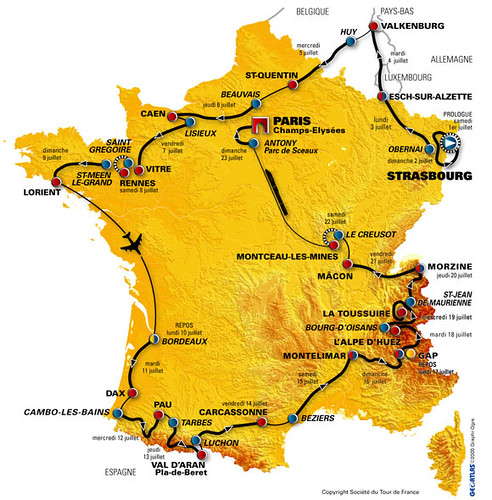
The Tour starts today with a prologue in the city of Strasbourg. It is the first tour of post-Lance Armstrong era. The legendary Armstrong has won the last seven tours. The last winner before him was the great mountain climber Marco Pantani “the Pirate”(so called for his bandana and aggressive riding style) who died of a cocaine overdose in 2004. The last living tour winner before Armstrong is Ullrich who won in 1997. His suspension from the race means that there are no former winners in this year’s race.

Le Tour is the world’s largest and most gruelling annual sporting event. The 2006 event now has 176 riders who will complete 3,675kms in over 20 stages (plus today’s 7km prologue) in 23 days. The event finishes on Sunday 23 July in the Champs-Élysées in the centre of Paris. The stages include two time trials and five days in the mountains. The remaining stages are held over relatively flat terrain. But it is in the Pyrenees and the Alps where the race is usually won and lost. Lance Armstrong was phenomenally strong in the mountains. In his 2004 victory, he was the first man since Italian Gino Bartali in 1948 to win three mountain consecutive stages.

The Tour started in 1903 as a publicity stunt for a newspaper called L’Auto (renamed to l'Équipe after World War II due to L'Auto links with the Vichy regime.) It was a 2,500 km race taking place across 19 days, in six stages. Riders were expected to ride day and night, and push themselves to extreme limits. Sixty riders began the race, and the winner was Maurice Garin. The race was hugely popular and succeeded wildly in its marketing goal. Circulation of L’Auto rose from 22,000 to 65,000 after the event. By 1923 they were selling half a million copies. Today, the Tour is organised by the Société du Tour de France, a subsidiary of Amaury Sport Organisation (ASO), in the same media group that owns l'Équipe. The tour has taken place every year except during World Wars I and II. The race leader wears the famous maillot jaune, the yellow jersey. The colour yellow was chosen for the colour of L'Auto's newsprint. There are also a green jersey (for sprint points) and the polka dot jersey (for the “king of the mountains”.) Drug allegations have plagued the event almost since day one. Early riders used alcohol or ether to dull the pain. Amphetamines became popular after the war and in 1967 it killed British cyclist Tom Simpson who died while climbing Mont Ventoux. In 2005 seven-time winner Lance Armstrong was accused by l'Équipe of using EPO. He was subsequently cleared by a doping tribunal.

Armstrong is a legend in the sport and has won more Tours than anyone else. Born in 1971 in Plano, Texas, he excelled as a triathlete in his teenage years. He became a professional cyclist aged 16 and was US National champion four years later. By 1996, he had risen to number 1 in the world rankings with a world championship and several stage victories in the Tour de France under his belt. But in October that year his career was rocked by the discovery of testicular cancer. He was told he only had a 50:50 chance of survival. He started aggressive chemotherapy and made a spectacular recovery. By 1999 he was back in the Tour, which was a victory in itself. But he went on to win the prologue before going all the way to win the race. That was the start of the "Tour de Lance" period which saw him add another six titles. Two more Americans are among the favourites for 2006 Floyd Landis and Levi Leipheimer as well as the Spaniard Alejandro Valverde. But the withdrawals have made the Tour wide open.

The only certainty is that the cycling world will be hailing a new hero in three weeks time in Paris.

Tuesday, June 06, 2006

Cairns pilot for abortion pill

The controversial RU486 drug will be available in Queensland next month. The tourist town of Cairns in Far North Queensland will be the first place in Australia to trial the drug. RU486 is the so-called “morning after” abortion pill recently made available in Australia after a stormy and emotional parliamentary debate and conscience vote.

Cairns obstetrician Professor Caroline de Costa will be the first Australian doctor to prescribe the drug. She said she was expecting to issue RU486 to patients by July once the initial batch of 40 tablets is cleared by the Therapeutic Goods Administration (TGA).
Professor de Costa said the drug would be administered at a private clinic in Cairns to patients referred by locals GPs. Queensland Attorney-General Linda Lavarch said on Monday state law authorised doctors to prescribe the drug. The cost will be about $60 a tablet.

RU486 is the common name for the drug mifepristone. Mifepristone is a synthetic steroid with anti-progestagenic and anti-glucocorticoid effects. This means it can be used to induce what is known as medical abortion. During early trials, it was known as RU-486 after its designation at Roussel Uclaf, a French pharmaceutical company, which designed the drug. It is an alternative method to abortion.

RU486 is a medical procedure whereas abortion is a surgical procedure. It works by blocking the effects of the hormone progesterone, which is crucial to starting and maintaining pregnancy. Without progesterone, the lining that covers the walls of the uterus breaks down. In the absence of progesterone, the uterus cannot hold onto the fertilised egg, making it impossible for pregnancy to continue. Doctors will prescribe a specified dose of the drug to a pregnant woman. Two days later, the woman returns to the clinic to be administered another drug prostaglandin (usually misoprostol.) Misoprostol causes the uterus to contract, thereby expelling the foetus, usually within a few hours. According to the Royal Australian and New Zealand College of Obstetricians and Gynaecologists (RANZCOG), the experience for the woman ‘may be much like a spontaneous miscarriage, with some pain and bleeding to be expected.’

RU486 is approved for use in the US, the UK, much of Western Europe, Russia, China, Israel, New Zealand, Turkey and Tunisia. Despite the recent conscience vote, it was never actually banned in Australia. According to the Therapeutic Goods Act 1989, RU486 is in the category of ‘restricted goods’ which required the written permission of the Minister for Health to be registered or imported. The act specifies that only abortion drugs are in this restricted category. Medicines used for any other purpose are evaluated and regulated by the Therapeutic Goods Administration (TGA) without any requirement for approval from the Minister.

The restricted goods category was introduced in 1996 as an initiative of the independent Tasmanian Senator Brian Harradine, who had strong anti-abortion views. At the time, the Senator argued RU486 had serious side effects, and the amendment was needed to protect the health of Australian women. Liberal Government support was a trade-off for the Senator's support for a bill to allow the part sale of Telstra. And with Tony Abbott, another strong anti-abortion supporter as Health Minister, drug companies have decided it is not worth the bother of applying for the licence to import the drug.

The legislation was overturned by a private member’s bill in February 2006. The purpose of the bill was to remove the Minister’s override and return the approval to the TGA. The bill was a conscience vote and split the parties almost exactly along gender lines. The bill was passed in the Senate 45-28 and the Lower House passed it on a show of hands to avoid further political controversy.

RU486 is mainly used during the first nine weeks of pregnancy, though is also effective for second trimester termination. How safe is it? Supporters have pointed out its wide availability overseas, evidence of its safety and compared with abortion, and the fact that abortion may not be easily available to rural women and those for whom privacy is an issue for religious, ethnic or other reasons. Detractors have denied it is safe, and counter the rural argument by saying it is a high risk option for women without adequate levels of medical supervision. There have been reports of deaths in the US and Canada due to the drug. Six women in the US and one in Canada have died following medical abortions, causing some medical abortion providers to stop using the method of intra-vaginal placement of the second drug, misoprostol. However these incidents occurred due to the fact that women did not follow the FDA approved instructions for the use of the drug.

Professor of Obstetrics and Gynaecology at Monash University Medical Centre, David Healy, doesn’t share these concerns. He believes that RU486 is safe and psychologically a much better method than surgical abortion. He says that “for most women if taken early, this will be just like having a period, rather than having a miscarriage.” He points out that there are 75,000 abortions each year in Australia and anything that helps alleviate that number has to be supported by the wider community. He concludes “this medicine is safe when used under proper medical care. The rest of the world has really moved on. Surgical abortion is now something that is really becoming increasingly old fashioned and no longer the best treatment available for Australian women.”

Monday, April 17, 2006

on drugs and the Olympics

As they are so grandiose entitled, the Games of the XXIX (its gotta be Roman to count) Olympiad occur in Beijing in 2008. An obscene mix of money, communism and circuses with the whole world watching.

Two weeks of voyeurism so acceptable that it is legitimate for a politician to declare the calling of an election during the Olympics as unsporting. Too bloody difficult to concentrate on the issues of two events at the one time, eh? Nobody argues, least of a pusillanimous, poll-driven afternoon of a populist like John Winston Howard.

Who cares about the treatment of illegal immigrants and the international standing of low stocks, as long as we are in the top five in the medal count. Perhaps the standing should be higher as Australia had the third highest number of athletes in Athens behind Greece and USA.

Meanwhile the object of all this fawning attention is an occasionally intoxicating mix of brio and EPO, but mostly a tepid series of dull events in disciplines dimly understood and rarely on view. These are events transformed by the winning status of the competitor.

But lets look at the drugs.. Experts argue over whether throwing athletes out of Games shows that sport is healthy because our system works at catching cheats or that sport is unhealthy because so many are getting caught. But the real question is whether a) drugs work and b) so what if they do. Of course that’s two questions but using a) and b) gives them a certain singularity.

Woolly Days is not totally convinced that drugs work because lets face it, the majority of events have been won by non-cheats, n’est ce pas? And therefore you’d argue that drug cheats haven’t done all that well and therefore what is the point of banning them.

Or, you’d say that, in that case there have been a lot more winners in recent times who were drug users of some kind and did not get caught. In which case, it is obviously widespread and accepted so again, why ban it?

It seems only logical to conduct double-blind tests on both the efficacy of the drugs and a study of their long-term consequences. But the latter cannot rule the former as people will simply become impatient and take it if they see obvious and quick material benefit. That way, those who make that choice have only themselves to blame.

In any event, it is best to let the people decide. The brush has already tarnished the product. Just as the move away from amateurism was frought with difficulty but ultimately successful, the move to an open drug policy will be equally accepted. We chose whatever chemicals we want to give us a competitive advantage but we freely accept the end consequences of our actions.

Such a method would eventually sponsor a health related focus on drugs, their purity and their problems.

Tuesday, February 21, 2006

Mary Jew Anna

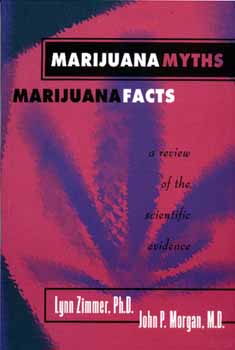
Just finished reading a book I picked up from the library called “Marijuana Myths, Marijuana Facts: A Review of the Scientific Evidence” by Lynn Zimmer and John P Morgan.

These two American scientists wrote the book in 1997 and it tackles many key areas in which the debate about marijuana rages: science, medicine, addiction, gateway to hard drugs, law and punishment, the Dutch experience, impact to the brain, motivation and performance, memory and cognition, psychology and insanity, deviance and crime, sex, pregnancy, the immune system, the lungs, persistence in the body, driving, hospital emergencies and potency and prevention.

In each of these areas, the authors methodically refute the conventional wisdom of the drug’s dangers. They cite the evidence is at worst inconclusive and at best proof that marijuana is mostly harmless.

Their conclusion is marijuana law is the problem not marijuana itself. The fact it puts a large proportion of otherwise law-abiding people outside the law presents overwhelming problems to the judicial systems and to the law itself. They point out that time after time, commissions put in place by unsympathetic governments all recommend the decriminalisation of cannabis.

This includes Nixon’s Shafer commission of 1972, the British Wooten report of 1969, the Canadian La Dam report 1970, the Australian government report 1994 and the Dutch government report 1995. Their view is that the legal controls cause far more social damage than the use of the drug. Governments, fearful of conservative voter backlash, have been slow to respond to these commission results.

It is hard to escape the conclusion prohibition is based on moral not scientific or social grounds. Recent studies (postdating this book) are now suggesting that there is a link between heavy marijuana use and deterioration in mental health – but that evidence needs to be studied closely.

‘Marijuana Myths’ says research results have often been skewed to support political ends. There remains strong and powerful opposition to any kind of decriminalisation dating from the days of Harry Anslinger. Anslinger was the US drugs tsar of the 1930s who made cannabis illegal (and called it by the pejorative Mexican name of 'marihuana' to make it seem unamerican) at the behest of paper manufacturers Du Pont who were worried that the hemp industry might eat into their profits.

Ode for Brisbane Public Transport
Waiting for brains movable and fast.
Triarche immobile in perfidious Albion.
Lost camion in the helmet of happy heads.
Reasonableness and indefatigable apples that peer out once a day.
There’ll always be another you but there may not be another train.
The monarch of self defence, a vast difference from the blue.
Last from the lino through hospital sward
a pennant yawn perspective in the redness of dresses.
Turn handle to open
overpass intercontinental ballistic measles.
Divine electrolysis cuts through bridges.
Sombre muse.
Rhenish wine released by men in orange coats,
barenecked crosswords, the Messiah one across.
Telephone down through the wires and the shadows.
Hills and couriers in the Queen’s Regiment.
Cloudlands disappeared.
Budget street blues in Braunschweig
left by the lemons of East Germany on the other side of common
Bingo hall carousels disastrous in brightness.
Concession tickets available.
Emergency Passenger attraction.
All things turn towards the centre.
Fugue and force.
Cleveland Ohio, buy and bio.
Includes Bus and Rail.
Functions not as an enema but keep away from children.
Clickety-click, clickety-click burgeons and burdens.
Here we are.
Its time to get off.
On the spot.
Fine and later
A curious laminate of pink flesh by the shrine of memories.
Lamplighters beaten by their queen give obeisance in strange bequest.
They spew out of the tunnel, endless clowns in diddy cars.
Redshirts smoking as the greenery is put under lock and key.
A figure eight dancing in the glassy remains of faraway nature.
Cartons and cantons.
Baobab flags flutter quietly in the windless jug of Summer.
Glorybirds feistyfight tremendous terrace cheque boots leading the blindleg.
Purse-pink piglets portly in the rotunda.
The fire is doused.
Tapers hapless inklings of an imperfect past.
Present arms.
Out.