Showing posts with label South America. Show all posts

Monday, January 25, 2010

Sebastian Pinera leads Chile's loaded tilt to the right

Chile’s new billionaire leader has just gotten substantially wealthier after the value of shares soared in the wake of his election victory. Sebastian Pinera won the country’s run-off election last weekend and since then his 25 percent shareholding in Chile’s LAN Airlines SA have increased in value by two fifths giving the company a value of over $1.5 billion. Stock market officials halted trade and triggered an automatic investigation which happens whenever share prices increases by more than 20 per cent in one day's trading. Pinera refused calls to sell the shares before the election.

Outgoing president Michelle Bachelet, who was constitutionally barred from seeking re-election, had raised conflict-of-interest questions over Pinera's LAN stake during the presidential campaign. He did however promise he would divest the shares after the election and he reaffirmed that promise last week. He has also set up a blind trust to manage $500m of his fortune including ownership of the country's four television networks and Chile’s biggest football club Colo-Colo.

The obvious comparison for Pinera is with Italian leader Silvio Berlusconi. Both are right-wing wealthy businessmen who won their countries' elections with the help of their media empires and soccer teams. However Andres Oppenheimer says the comparisons are facile and notes five significant differences. Pinera has a PhD and taught economics at Harvard, he has been a senator for 20 years, his business record is free from scandal, he is a family man married for 36 years and he may be less of a right-winger than many think. Oppenheimer said Pinera opposed Pinochet in the 1980s (though others dispute this) and is liberal on social issues.

But there is no doubting his huge war chest helped him win the election. By last week’s runoff election with former president Eduardo Frei, Pinera had spent at least $13.6 million on the campaign. His victory marked a political shift as candidates of the governing Concertacion coalition had won all four presidential elections since 1989 on pledges of eradicating all traces of Pinochet’s leadership. Although 73 percent of Chileans still despise the former dictator, Pinera won because the coalition was split between two presidential candidates.

In the first vote on 13 December, Pinera took 44 percent of the vote with Frei second on 29 percent. Frei might have expected to pick up the remaining left-wing vote in the second ballot. After all, Concertacion had succeeded in reducing Chile’s poverty rate from over 40 percent to approximately 15 percent, while boasting the region’s most impressive growth rate since 1990. Former president Bachelet left office with an approval rate of over 80 percent. Yet Frei could not galvanise that support and his campaign slogan of “a vote for Pinera is a vote for Pinochet” fell flat. Frei did succeed in closing the gap as the run-off date came closer. But when Chile’s voters went to the polls on 17 January just enough of them decided they wanted to see change. Pinera won by 52 percent to 48.

There is at least one leftwing leader in the region who is unperturbed by Pinera’s win. Bolivian president Evo Morales, who himself was recently re-elected president (after changing the country’s constitution to allow him to stand), saluted the new Chilean leader and said he hopes he can continue the improvement in Bolivian-Chilean relations. Morales said he hoped Pinera will continue the bi-national dialogue started by “compañera” Michelle Bachelet. Relations between the two nations has been historically frosty since Chile won the War of the Pacific against Peru and Bolivia in the late 1800s, taking control of nitrate and mineral-rich lands and forcing Bolivia to lose its access to the Pacific Ocean. Bachelet was the first Chilean leader willing to discuss the issue with Bolivia and Morales hopes Pinera will continue the dialogue.

Saturday, January 02, 2010

Problems of Geography and Branding: Dakar in South America

The so-called Dakar Rally got off to a “symbolic start” in Buenos Aires today and for the second year in a row the event has now switched to Argentina and Chile. Quite how symbolic that was, seems to have been lost on most western media. The official symbol of the rally remains a (faceless) person in North African dress but the challenges now for the riders is the Andes not the Sahara. Given the widespread interest and money generated from the South American venue and the continued security fears of the original route, it is unlikely the rally will ever return to Africa. This is a mixed blessing. The event was often seen as a triumph of colonialism that cared little for the impact on the lands it travelled through or the faceless people. But it also was a strong boost to the economies of the likes of Mauritania, Mali and Senegal bringing in badly needed foreign revenue. And no one involved with the race sees an issue with stealing an African name for a South American context.

The idea for a race from Europe to Africa began in 1977 when French rider Thierry Sabine got lost on his motorcycle in the Libyan desert during the Abidjan-Nice rally. After being rescued from the sands he came up with the idea for a rally to cross the Sahara. The first Paris-Dakar rally started on 26 December 1978 with 175 competitors travelling across the Mediterranean and down through Algeria, Niger, Mali, Upper Volta (now Burkina Faso) and ending in Senegal’s capital Dakar. The danger and exotic nature of the route meant it captured the public imagination and quickly became a household name through most of Europe.

Over the years the route varied and the number of competitors doubled and then trebled. The race went through Gaddafy’s Libya in 1989. In 1992 it went all the way to Cape Town. But that year’s race route through wartorn Chad reminded organisers that politics was never far away. It returned to Dakar in 1993 but the race ended its association with Paris in 1995 when it started from Spain. In 2000 competitors started in Dakar and drove to Egypt but terrorist threats forced them to fly over Algeria. The 2006 death of two young spectators in Guinea and Senegal drew criticism across Africa for the lack of sensitivity shown by the organisers.

In 2007 two planned stages between Nema and Timbuktu were cancelled because Mali authorities could not guarantee the safety of competitors. However, the transformation of the Dakar rally from a destination to a brand began in earnest a year later when the entire event was cancelled a day before it was due to start. On Christmas Eve 2007, a French family of five were having a picnic by the side of a road in the Southern Mauretania town of Aleg when they were attacked by gunmen. After robbing the family, the gunmen opened fire killing four and wounding the other before fleeing into neighbouring Senegal. The attacks were a rare event in Mauritania and government blamed it on a terrorist sleeper cell from Algerian Al Qaeda.

When the organisers of the rally sent team to examine conditions on the ground in Mauritania, they found out that three soldiers had been killed in an ambush in the north of the country on the day they arrived. Nevertheless the French director of the rally Étienne Lavigne said the deaths would not affect the running of the race. Lavigne decided to scrap the two Mali legs again but both he and Mauritanian Interior Minister Yall Zakaria said all other necessary precautions had been taken and security was on track including a 3,000 man security force. But on 29 December Al Qaeda used a website to criticise Mauritania's government for "providing suitable environments to the infidels for the rally." While it did not directly call for attacks on the race or its participants, it was enough to spook Lavigne. He called off the race a day before it was due to start on 5 January 2008.

The Mauritanian president complained that the cancellation was an overreaction. But white western lives always take priority over black African ones and there was no real criticism of the cancellation in western media other than to over-dramatically refer to it as a “death sentence” for the event. But what the media were not taking into account was that the Dakar was now a lucrative brand that could easily be de-coupled from its African location. Other countries in Europe and South America queued up to offer their services to host the event and Argentina and Chile won the rights to host it in 2009. There was little doubt that they would win it again this year. Dominique Serieys, head of Mitsubishi Motorsport saw it purely in sporting terms. "It was necessary to take a break in Africa given the geopolitical context there,” he said. “The fact the resumption is on a new continent is good news."

Serieys is right from a motoring perspective and a race of cars, trucks, motorbikes and quads across the rugged terrain of the Andes will be enjoyable for fans. It may even be more difficult than the Sahara in parts. But this hardly makes it a “Dakar Rally”. The race was born of Sabine’s vision of a trek across the sands of the Sahara and while it did not always (or even often) have the interests of Africans in mind, at least it was a rare opportunity for Africa to star on the world stage. The ease of which the race left Africa and the theft of its name are a shameful reminder of the cravenness of western interests ahead of the Third World.

Friday, June 19, 2009

Peru revokes Amazon land laws after massive protests

Peru's Congress revoked two controversial land decrees yesterday to exploit virgin rainforest after protests that left dozens dead in the Amazon region. Congress voted 82-12 to revoke two decrees that indigenous groups said would encourage oil and gas exploitation on their ancestral lands. Native Indians had been in conflict with the government for two months and had paralysed the nation’s highways with roadblocks while thousands marched in support on the streets of Lima. Peruvian President Alan Garcia was forced to admit that indigenous communities were not consulted in the original decision to open up large areas of the Amazon basin to logging, dams and oil drilling.

The vice president of the Amazon Indian confederation immediately called off the protest after the Congress vote. Garcia had issued the original decrees in 2007 to give the state powers to regulate investment in the Amazon as part of a free trade deal with the US. Indigenous groups were outraged and said the decrees would affect their ancestral lands and threaten their way of life. According to Amnesty International, Peru breached their obligations under the International Labour Organisation Convention on Indigenous and Tribal Peoples in failing to consult.

In response, Indigenous leader Alberto Pizango, head of Asociacion Interetnica de Desarrollo de la Selva Peruana (Aidesep), called for a general strike. The government declared a curfew but tens of thousands marched in defiance in Lima. On 5 June the violence became deadly near the jungle town of Bagua, about 1,000km north of the capital when police tried to break up a road blockade manned by activists. 650 Peruvian National Police and Special Forces officers launched a pre-dawn raid on the blockade which was manned by Awajun and Wambis indigenous people. Some protesters had wooden spears but most were unarmed. Police attacked from both sides with automatic fire, teargas grenades and live rounds from helicopters.

Death figures are disputed. The government says 23 police and 10 civilians were killed, with another one police officer missing. The Huffington Post accused the police of ignoring civilian deaths while conflating their own dead with numbers from a separate incident elsewhere. According to Indian leaders at least 30 civilians died and there are varied reports that between 100 and 150 people died in the attack.

The dispute became international when Peru accused neighbouring Bolivia of being behind the riots. In return Bolivian president Evo Morales said the US-Peru Free Trade Agreement (FTA) was to blame for the violence. Morales said that the FTA promoted privatisation and handed the Amazons forests to transnational companies. The Bolivian leader said US FTA practices amounted to “genocide in Latin America” with the Indigenous worst affected.

Alberto Pizango accused the Peruvian government of genocide over the Bagua clashes. After talks with the government broke down, he called for an uprising. That was the cue for Peruvian authorities to charge Pizango with sedition. Nicaragua granted him political asylum and he arrived in Managua on Wednesday where he blamed Garcia’s administration for the Bagua massacre. “The results were disastrous, and even the government can't deny it any more,” he said.

Just 400,000 of Peru’s 28 million are Amazonian Indians. But the protests have united many of Peru's non Indigenous citizens behind their claims. According to the Council on Hemispheric Affairs, President Garcia is “no friend of the indigenous”. He colluded with multinational companies to tread on indigenous constitutionally protected rights. His position was weak with the global financial crisis as Peruvian economic growth stalled due to a decline in commodities prices. He also knows that in conceding defeat to the indigenous demands, international investors may take their complaints to a free trade dispute board. That outcome could yet be the Achilles heel of Garcia’s apparent agreement to revoke the laws.

Wednesday, April 08, 2009

The demise of El Chino: Peruvian court jails Fujimori for 25 years

A special court in Lima has sentenced former Peruvian president Alberto Fujimori to 25 years imprisonment for human rights. A three-judge panel found him guilty yesterday of ordering death squads to carry out two separate massacres of civilians during the early 1990s. Fujimori is the first ever democratically elected president to be found guilty in his own country of rights abuses. He was convicted of the killings of 25 people in two separate massacres, in 1991 and 1992, and also for the kidnappings of journalist Gustavo Gorriti and businessman Samuel Dyer in 1992. The massacres were carried out by the Grupo Colina unit, a squad of military intelligence officers under the then-president’s orders. He is already serving a six year sentence for abuse of power and the 70 year old could now spend the rest of his life in prison.

Alberto Fujimori ruled Peru for the decade between 1990 and 2000. Despite being the son of Japanese immigrants, the Peruvian media nicknamed him “El Chino” (the Chinaman). After a career as an academic specialising in engineering and mathematics, he was the surprise winner of the presidential election in 1990. He defeated the favourite, renowned novelist Mario Vargas Llosa by successfully portraying the writer as the candidate of the Peruvian elite. At the time Peru suffered from severe hyperinflation and political violence. Fujimori succeeded in fixing both problems but at a major cost of abandoning human rights. He temporarily assumed dictatorial powers in 1992 closing the opposition-controlled Congress and courts. Critically however, most Peruvians approved his actions.

Around this time, he also led the government through a bloody internal war with the Maoist rebel group, the Shining Path. In 1995 he won a second term of office defeating another high profile candidate former United Nations secretary-general Javier Perez de Cuellar. According to Time, Fujimori's success was based on an image of the populist caudillo “just as the continent was ridding itself of the legacy of dictators who had turned ‘disappear’ into a verb when dealing with their political opponents.” The war with the Shining Path led to the deaths of 70,000 people and Peru's Truth and Reconciliation Commission has estimated that 37 per cent of those were killed by armed forces.

Nevertheless Fujimori remained popular and won a third term in 2000. This time there were strong suspicions of election irregularities. The new government did not last long and was overthrown in the wake of a corruption scandal involving the head of Peru’s intelligence service, Vladimiro Montesinos. In 2000, secret videos showed Montesinos bribing opposition congressman Alberto Kouri to join Fujimori’s party. Montesinos was forced to flee the country and his boss Fujimori followed him shortly after. The disgraced president fled to his ancestral home of Japan, where faxed in his resignation.

In 2005, Fujimori took a gamble on resurrecting his political career. He flew to Chile where he was promptly arrested. After a two year court battle, he was extradited back to Peru to face human rights and corruption charges. In December that year he was is sentenced to six years for ordering the illegal search of the apartment of Montesinos's wife in 2000. The separate human rights trial continued all through 2008. The prosecution successfully linked him with the Grupo Colina, a top-secret army death squad whose mission was to suppress any activity the regime thought subversive. Grupo members testified that they were following Fujimori’s orders in the two massacres.

Human Rights Watch called yesterday’s eventual conviction a “major advance for human rights accountability” in Latin America. HRW said Peru's national court system demonstrated “the will, capacity, and independence” to try its former president. Maria McFarland, senior Americas researcher at the New York-based rights body said the ruling showed that “even former heads of state cannot expect to get away with serious crimes.”

Fujimori’s daughter Keiko continues to maintain her father’s innocence saying she was “a direct witness to his work and his accomplishments”. She told Al Jazeera there was no proof of any dirty war and the government’s strategy was to get the support of the people whom they provided basic infrastructure to improve quality of life. “We created this group called ‘ronderos’ or ‘comites autodefence’”, she said. “We provided the poor people with small guns to protect themselves from terrorism.”

However, other Peruvians were less forgiving of the president and preferred to praise the justice system. Political activist Monica Miranda told the BBC that Fujimori had committed many crimes and violated human rights and she was proud that Peru tried him while he was still alive. She also said Fujimori violated the constitution, and committed crimes of corruption and embezzlement. “I understand he did positive things for many Peruvians who had been abandoned by all the previous governments, but that doesn't absolve him of his crimes now and it never will,” she said.

Monday, March 23, 2009

Chavez-Vous? Hugo dances with democracy

If the Western media is to be believed, Hugo Chavez is making a strong application for membership of the axis of evil. In the last 48 hours alone, he “seized control” of Venezuelan ports, announced a visit to Iran, nationalised cement companies and called Obama a “poor ignoramus”.

Yet while the media denounce him as a Bolivarian socialist, many US right-wingers might agree with the assessment of Obama. A larger proportion of fiscal conservatives still would also applaud another one of his announcements to reduce government spending by 7 per cent to avoid recession. And his nationalisations are being copied by Western leaders frazzled by the failure of their financial systems.

Chavez may sound like a mass of contradictions but of one thing there is little doubt: he loves power. He has been in power for ten years, won two elections, and last year he won a referendum eliminating term limits which opened a way for him run again as president in 2012 and beyond. Here are the actions of a president-for-life.

As such, he is now keen to eliminate opposition. On Thursday a prosecutor called for the arrest of Manuel Rosales. Rosales is the mayor of Maracaibo, Venezuela's second-largest city, and is a leading opponent of President Chavez. The 56 year old Rosales ran off against Chavez in the 1996 election and lost in a 3:2 margin but established himself as the leader of the Opposition in the process.

The prosecutor Katiuska Plaza said she was seeking the custody order for Rosales on the basis of accusations of corruption levelled in the national assembly (parliament) against him. Rosales could face 3 to 10 years if proven guilty of the charges. Rosales called the charges as “an order from Chavez” and said it was “a way of criminalizing politics and also to crush those of us who have dissident voices in this country”. Rosales was referring to 2007 when Chavez shut down one of those dissident voices when he took over a private TV station. Chavez annexed Telesur in revenge for supporting the 2002 coup against him.

In a strange but absorbing interview, writer Tariq Ali (whom the interviewer Jorge Sotirios called “the thinking woman’s Omar Sharif') defended Chavez's stance on Telesur. Sotirios noted how Ali is no stranger to South America and was once detained in Bolivia for his likeness to Che Guavara’s offsider “Pombo”. Ali said the government takeover of Telesur wouldn’t change the station which has always taken a Latin American view. He says the network is similar to the BBC and the CNN. While the British and American stations defend the “Washington consensus”, they defend the opposition to the “Washington Consensus”. And, says Ali, they are very open about it: “If we act in concert, we can do lot more things for our people, instead of constantly seeing ourselves through a mirror lifted up by the United States.”

But while this is a laudable aim, Chavez’s control of the media is making it easier for him to be always seen in the mirror. In their annual report for 2008 Reporters San Frontieres says Chavez now controls nearly all the country’s broadcasting - a score of radio stations, the state-owned TV stations Venezolana de Televisión, Telesur, Vive TV, Asemblea Nacional and Tves, as well as the national phone company CANTV.

Yet there is still hope. Venezuela still enjoys a vibrant public debate in which anti-government and pro-government media are equally vocal in their criticism and defence of Chavez. One can ask for little more in a democracy – even one where a long-term government is looking to change the rules in their favour; just ask Queensland Labor. The Chavez paradox shows little sign of unravelling.

Monday, April 21, 2008

Lugo's election win ends Colorado Party's long reign in Paraguay

A former Catholic bishop has ended Paraguay’s 60 year reign of one party rule by the right-wing Colorado Party after elections on the weekend. The electoral tribunal has declared 56 year old leftist Fernando Lugo Méndez the winner with 13,000 of the 14,000 ballot stations counted. Lugo, from the Patriotic Alliance for Change, took 41 percent of the vote, ten points clear of Colorado’s Blanca Ovelar who had hoped to become Paraguay’s first female president. Local analysts are putting down Lugo’s victory to a mix of poor policies and division within the Colorado Party and Lugo’s own personal charisma.

Lugo joined 80,000 of his supporters who rallied in the “Pantheon of Heroes” central square of the capital Asunción to celebrate his victory. The scenes of joy are captured in videos captured by the Spanish language Ultima Hora (Asunción’s main newspaper). Supporters lit firecrackers while cars clogged streets honking their horns. One Lugo supporter said "We are confident he will govern with hand of God. He represents hope ... something new for our country." Another supporter had gone to the polls fearing his vote would not be respected, but he was more certain about what he though Lugo could deliver. "Many things ... jobs, health, education ... not for me but for the future of my three children," he said. Lugo himself said "Today we can affirm that the little ones can also win.” But the real hard work will begin after the celebrations end.

Despite ruling since the 1940s, the Colorado Party have not brought prosperity to go with their electoral stability. Paraguay is one of the least developed nations (see pdf report) in Latin America with 43 percent of its 6.5 million population living in poverty and the gap between rich and poor still rising. Paraguay is a landlocked agrarian nation relying on soybean, cotton and other farm exports. More than a quarter of its population have been forced to emigrate to earn a living. Ninety percent of the nation's land is owned by less than two percent of the population, and drug trafficking, crime and the black market are rampant. Periodic political unrest and chronic economic malaise have continually shaken its fragile democracy.

The country endured a victorious but unsatisfactory Chaco War (a territorial dispute with Bolivia) in the 1930s and then a Civil War in the 1940s before General Alfredo Stroessner took power in a military coup in May 1954. He was re-elected president seven times ruling almost continuously with support from the military and the Colorado Party. During his 34-year reign political freedoms were severely limited and opponents of the regime were persecuted in the name of national security and anti-communism. In 1989 Stroessner was overthrown in a military coup headed by General Andres Rodriguez. Presidential and congressional elections were held on May 1 1989. Rodriguez easily won the Presidency as the Colorado Party candidate with a reform agenda.

While a succession of Colorado Party candidates (Wasmosy, Cubas, Macchi, and retiring incumbent Nicanor Duarte) followed in Rodriguez’s steps as president, none followed up his reforms. For the 2008 election, the Patriotic Front for Change emerged as a pluralist coalition of about 20 Indian, peasant and union organisations. They range from leftist groups to the conservative Radical Authentic party, Paraguay's largest opposition group. Lugo himself has tried to distance himself from the more leftwing elements of his coalition "The world 'leftist' is being used lately in Latin America and possibly with mistaken concepts," he said. "I believe in the self-determination of the people, in recovering one's sovereignty and independence."

Lugo was ordained a Catholic priest in 1977 as a member of the Society of the Divine Word. He was appointed Bishop of San Pedro in 1994. Lugo gained a reputation as “Bishop of the Poor” became renowned for speaking out on behalf of Paraguay’s lower classes. In 2005 he announced his desire to pursue his political ambitions. His actions prompted a warning from the Vatican which said his candidacy was “in clear contrast” to his responsibilities as a bishop and threatened suspension. Lugo stood down from his religious role but also still had a congressional impediment to confront as Paraguay’s constitution banned members of the clergy from seeking political office.

But after decades of rule by the Colorados enriching the wealthy at the expense of the indigenous population and poor Paraguayans, Lugo was ready to ride the winds of change. In 2006, over 50,000 demonstrators including unions and indigenous movements took over the capital, Asunción, to protest against Colorado rule. Lugo, who is from one of Paraguay’s poorest areas and who has often spoken out forcefully against poverty and inequality. Opinion polls since then have kept Lugo consistently 10 percent ahead of his rivals. Speaking after his victory last night, Lugo said the result showed this was the Paraguay he had dreamt about - a country for everyone. "I invite Paraguayans of all political types, even the ones who don't share our ideals, to help this country that was once great be great again,” he said.

Monday, November 26, 2007

Sucre riots test Morales' resolve for change in Bolivia

A power struggle between Bolivian president Evo Morales and his conservative opponents has now erupted on a new front: the status of the country’s constitutional capital Sucre. Police fired rubber bullets and tear gas on protesters in Sucre on the weekend. The protesters were demanding the full relocation of the country’s legislature and seat of government from La Paz.

So far two civilians and one policeman have died and a further 130 people have been injured in street clashes that have gone in the third day. Protesters hurled rocks, Molotov cocktails and dynamite at police. Morales blamed former president Jorge Quiroga and “criminal groups” for the riots. Morales easily defeated Quiroga in the last election and he (Quiroga) leads the right-wing coalition known as the Social and Democratic Power. Morales said some groups don’t accept an indigenous leader.

Morales was speaking in the wake of the Bolivian parliament approval of a new constitution. The controversial changes would permit his indefinite re-election and would give central authorities greater control over public revenue at the expense of state governments. Morales’s opponents still control the Senate and boycotted the vote. They say the new constitution unfairly reduces the power of Bolivia's nine states. Wealthy Sucre has become a fulcrum for opposition demands for civil disobedience in the regions they govern.

Land redistribution has been a key issue in Bolivia for the last fifty years. Morales’s Movement towards Socialism (MAS) party made a comprehensive agrarian reform plan a central plank of the new constitution. Morales and MAS is trying to overturn decades of land redistribution which has ended up with 4 percent of the landowners possessing 82 per cent of the land. The government believes the constitutional changes will fulfil economic and social provisions aimed righting injustices against the indigenous population.

Bolivia remains the poorest country in South America. The poverty is concentrated in the Indian population which makes up 60 percent of the population. Infant mortality has halved to 60 deaths per thousand due to recent improvements on health and education but remains one of the highest in the western hemisphere. The country’s best hope to alleviate poverty is in the growing oil and gas industry. Morales initially threatened to nationalise the industry but so far has just increased taxes. With high oil and gas prices, the government’s income from the industry has increased nine fold between 2002 and 2007.

Evo Morales is relying on his own high personal popularity to get his constitutional amendments through. In 2005 he was the first elected indigenous president in Bolivia’s history. His election prompted fears of a civil war between the Indian and the wealthy white population which did not eventuate. The opposition is backed by the Bush administration who have attacked Morales regime as “undemocratic” and a “champion of false populism”. Morales is unconcerned by attacks from Washington and plans to press ahead with his changes. “The constitution will be approved in a referendum by the people, which is the most democratic,” he said.

Tuesday, October 30, 2007

Cristina Fernandez Kirchner: neither Evita nor Hillary

Cristina Fernandez de Kirchner has declared outright victory in the first-round election to succeed her husband Nestor Kirschner as president of Argentina. Fernandez took 45 percent of the vote and becomes the country’s first elected female president. Fernandez needed either 45 per cent of the full vote, or 40 per cent with a 10 point lead over the next nearest candidate, to win the presidency at the first stage. She met the criteria twice, avoiding the need for a run-off election.

Fernandez is a former Senator and a leading adviser to her husband during his four year reign as leader. She and Kirchner are now about to take each other's role. The swap between husband and wife has raised inevitable comparisons with the Clintons. And there are many superficially attractive similarities. Both couples met in law school, both men became presidents, both women became senators, and while Hillary is the favourite in the race to White House, Fernandez has now claimed Argentina’s equivalent, “La Casa Rosada”, the Pink House.

The second obvious influence are two former wives of Juan Peron. His third wife and Argentina’s only other female leader, Isabel Peron, inherited power from her husband Juan after he died in 1974. Peron was overthrown in a military coup two years later. Eva "Evita" Peron was Juan's inspirational second wife who died of cancer in 1952. Fernandez acknowledged a debt to Eva Peron in an interview with Time Magazine last month saying Eva was a “unique phenomenon in Argentine history”. Women of my generation owe her a debt,” she said. “When we came of age during the [military] dictatorship of the 1970s, we had her example of passion and combativeness to get us through.”

Nevertheless Fernandez has rejected comparisons with both Clinton (who has yet to ascend to the top post) and Evita Peron (who was never president). In a rare radio interview with Buenos Aires La Red last week, she said the similarity with Hillary did not stretch beyond the fact they were both senators, attorneys and presidential wives. “I don't want them to identify me either with Hillary Clinton or with Eva Peron, or with anyone,” she said. “There's nothing better than just being oneself.”

Many in Argentina are wondering exactly how Fernandez will go about “being oneself.” With no effective opposition, Fernandez was able to run a media-shy campaign. She said little by way of her policies were if elected and she spent a great deal of the last two months abroad. She refused to debate her opponents and only gave two interviews to local media in the final days before the vote. She did back her husband’s recent call for Argentina to reclaim the Falklands and South Georgia, a nationalistic move that remains popular.

Analysts believe that not much will change with the handover of power from husband to wife. She has pledged to maintain his high growth rates while keeping inflation under control. Nestor Kirchner had several impressive achievements in his reign. The poverty rate has fallen from over 50 per cent to 23.4 per cent and unemployment has dropped to a 15-year low. Under the constitution he could have run again, but instead announced in the summer he was stepping aside in favour of Fernandez as the leftist Peronist party candidate. The opposition Radical Party has been in disarray since it was blamed for the Argentine economic collapse in 2001-2002, so a Fernandez victory was assured.

The biggest issue facing Fernandez is likely to be inflation. It is officially measured at 8.6 per cent, but some economists say it could be twice as much. Trade unions leaders closely-allied to the Kirchners are pressing for wage increases, raising fears of a “wage-price” spiral that devastated the Argentinean economy in the 1980s. The country also has $20bn in defaulted debt, a problem that has to be resolved if the country is to have access again to international credit markets.

Cristina Fernandez, now 54, has been longer in the public eye longer than her husband. The pair married in 1953 when Fernandez was 22 years old. Trained as a lawyer she was elected in 1989 to serve as a deputy in the provincial legislature of Santa Cruz in Patagonia. Two years later Nestor was elected governor of the same province. Since 1995 Fernandez has represented Santa Cruz in the national senate. Finally in 2003 Nestor Kirchner, with the key support of his wife, emerged from the chaos of a financial bankrupt Argentina to win the Presidency. Nestor is now returning the favour as his wife claims the plaudits.

Thursday, June 14, 2007

FARC looks for more concessions from Uribe

The Colombian rebel group FARC is holding out for more concessions before releasing dozens of hostages despite the government’s release of its second-in-command Rodrigo Granda. President Alvaro Uribe released Granda, FARC’s “foreign minister” and 150 other guerrilla fighters last week in the hope of a reciprocal release of 60 hostages including Colombian Senator Ingrid Betancourt and three American contractors. But now the rebels have demanded that the government must also withdraw its troops from two southern towns in exchange for the release of its prisoners.

New French President Nicolas Sarkozy was reputedly involved in the negotiations in order to secure the release of Senator Betancourt. The senator was educated in Paris and is married to a Frenchman. There are reports that Sarkozy had requested Uribe to free Granda in order to secure her release. Granda himself has denied the connection and said his release from jail was a decision by the government and that he made no deal. Betancourt’s kidnapping in 2002 when she ran for president drew world attention to FARC’s hostage taking tactics.

FARC are responsible for most of the country’s 3,000 annual kidnappings. Alvaro Velez won a landslide victory in Colombia’s May 2002 presidential election by promising to crack down on the rebels. This year President Uribe has launched a US-backed $3 billion offensive to retake rebel-controlled territory. He also overturned a 1998 agreement which awarded FARC a 42,000 square km safe haven as a condition for attending peace talks. Uribe has personal motive too as his father was assassinated by FARC during a bungled kidnapping attempt in 1983. His unilateral release of 150 FARC fighters is surprising therefore in the context of his avowed aim to eradicate the organisation by the end of his second term in 2010.

FARC has been led for over 40 years by Manuel "Tirofijo" Marulanda (born Pedro Antonio Marin). Marulanda gained his nickname (Tirofijo means “sureshot”) because of a reputation for accuracy when using firearms during his earlier years as an insurgent. He is now approaching his 80s (his exact age is disputed) and was reported to be “acutely ill” in 2004. In March 2006, the US placed a $5 million bounty on a still very much alive Marulanda’s head.

FARC is one of two major leftist revolutionary groups currently active in Colombia. The US State Department considers both of them, FARC and the National Liberation Army (ELN) terrorist organisations. While both were founded in the 1960s counter-culture, FARC’s roots stretch further back in time. In 1948, influential populist leader Jorge Gaitan (pdf) was assassinated as he ran for presidency. His unexplained death sparked ten years of violence known as La Violencia which cost almost 300,000 lives.

During La Violencia, leftwing parties formed their own defence groups and guerrilla units which fought not only against the Conservative government but also against each other. In 1953, Gustavo Rojas seized control of Colombia in a coup and offered amnesty to all rebel groups in order to end the violence. But Communist groups were distrustful of Rojas and retreated into the mountains rather than hand over their weapons. The government mostly ignored the existence of these small Communist enclaves until it ordered the army under US pressure to disperse them in 1964.

One group known as Bloque Sur (Southern Bloc) dispersed during the height of the army assault but re-emerged after the incursion ended. Bloque Sur was led by Marulanda and Jacobo Arenas. Marulanda was the soldier to Arenas’s theoretician. In May 1964, they renamed the group Fuerzas Armadas Revolucionarias de Colombia (FARC) which means Revolutionary Armed Forces of Colombia. Inspired by the success of Castro in Cuba, FARC’s ultimate goal was to establish a Communist state. Arenas began an education program for the early FARC guerrilla fighters, as most came from low income peasant families. Their motto was “Learn and fight for Colombia”.

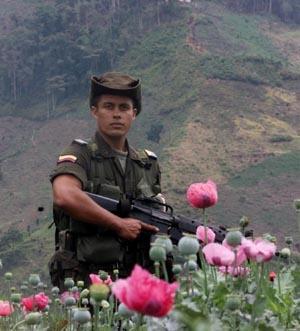
But the group had little success until it realised it could finance its operation by feeding the huge Western demand for heroin. By the late 1980s, FARC controlled every aspect of the drug production process including manufacturing the chemicals that turn the coco bush to cocaine, charging taxes to the farmers that grow it and charging airport fees for the export of the finished drugs. It now makes $300 million a year from its drug enterprises. Allied to income from kidnapping and extortion, FARC is probably the wealthiest insurgency organisation in the world.

FARC is now the largest and best-equipped of Colombia’s rebel group, with a possible 18,000 members. It operates in almost half the country, mostly in the jungles of the southeast and the plains at the base of the Andes Mountains. The smaller ELN operates mainly in north-eastern Colombia and has about 4,000 members. FARC briefly tried the military route to power in the eighties with a political front called the Patriotic Union (UP).

However the government of the day had no intention of letting them take part in the political process. They sponsored death squads who killed 3,000 UP members including its 1990 presidential candidate, Bernardo Jaramillo Ossa. FARC learned their lesson and concentrated on the military route to power. They are now a formidable enemy who control a territory the size of Switzerland. And with a western taste for heroin unlikely to diminish, they will remain part of Colombia’s Realpolitik for years to come.

Monday, December 11, 2006

The Passing of Pinochet

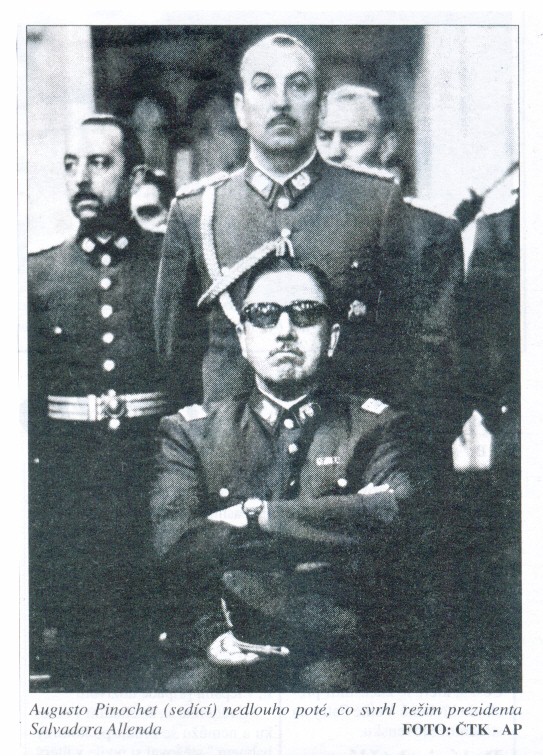
The polarising influence of Auguste Pinochet is as evident in his death as in his life. Barely hours after he died, thousands took to the streets of Chile’s capital Santiago both to celebrate and mourn his passing. There was a carnival atmosphere in the centre of town where cheering opponents waved flags and sang celebratory songs. But later, clashes broke out when a group of a thousand people marched towards the city's presidential palace. Police fired water cannon and tear gas, while fires raged along one of Santiago's main avenues. Meanwhile Pinochet’s supporters held a vigil outside the hospital where the 91 year old died. One of his supporters told AFP news "it is very sad, because it is as if we were left orphans”.

Pinochet died after a suffering a heart attack last week. He underwent a procedure to unblock an artery at Santiago Military Hospital. He had appeared to be recovering until yesterday afternoon when he was rushed into intensive care. He died of heart failure at 14:15 local time, Sunday. "He died surrounded by his family," Dr Juan Ignacio Vergara told reporters. Outside the hospital, his supporters lit candles, waved Chilean flags and held photos of the general. The wake and funeral Mass will be held at a Santiago military academy tomorrow before his remains are cremated. By dying Pinochet has cheated court charges to the last.

In the past year, he was charged with crimes related to his 17 year reign of Chile. He was also charged last with evading taxes on $26 million an investigating judge said he hid in foreign bank accounts. Pinochet had denied defrauding the state during his regime. His lawyers denied in court he had any connection to crimes of violence and also said he deposited his life savings in bank accounts abroad to avoid political persecution in Chile.

Augusto Jose Ramon Pinochet Ugarte was born in the port city of Valparaiso in 1915. He was the son of a Breton immigrant who was a Chilean customs official. He was educated in Valparaiso before entering military school aged 18. After four years of study he graduated with the rank of sub-Lieutenant in the Infantry. In 1943 he married Lucía Hiriart Rodríguez. Together they had five children. Pinochet spent most of the forties slowly rising through the ranks of the army.

In 1951 he returned to Military School this time as a teacher. He also became editor of Cien Águilas ("One Hundred Eagles") a magazine for army officers. By 1953, he was becoming important. He was now a major and stationed in Santiago as a professor of Chile’s War Academy. He was stationed in Ecuador, obtained a degree and continued to impress his superiors. In 1968 he was promoted to Brigadier General. He joined the masons and was in the same lodge as Salvador Allende. His fellowship with Allende would prove crucial. Allende was elected president in 1970 and Pinochet became General Chief of Staff of the Army one year later. With the US pulling strings in the background, Allende’s government plunged into crisis in 1973. On the day parliament called for his removal, Allende turned to his Masonic brother and appointed Pinochet Army Commander in Chief. Barely three weeks later Pinochet had betrayed his brother and deposed him in a bloody coup d’etat that cost Allende his life.

Pinochet was suddenly in power, the head of a military junta. But he was there at the behest of the US. A CIA document released in 2000 showed that the agency actively supported the military Junta after the overthrow of Allende. Within a year of the coup CIA was aware of bilateral arrangements between the Pinochet regime and intelligence services to track and kill opponents - an arrangement that developed into Operation Condor.

Pinochet soon consolidated his control of the junta and was proclaimed President in June 1974. The early years of his reign was marked by brutal repression. The socialist, Marxist and other leftist parties that had constituted former President Allende's Popular Unity coalition were all banned. Human rights groups estimate that more than 3,000 people were killed in the first 12 months of the junta’s regime. Santiago's National Stadium was turned into a detention and torture centre. Meanwhile the grim “Caravan of Death” toured the country; it was a euphemism for the mass execution of at least 75 of the junta's highest profile political opponents.

But with the aid of the US, Chile started to prosper economically. Pinochet relied on a group of US trained Chilean economists known as the Chicago Boys. They were market reformers who were trained at the University of Chicago by Milton Friedman. Friedman came down to Chile to preach the values of a free market. But he also told the junta that a free market comes with political freedom. Pinochet ignore that advice, but Chile did push through reforms at a massive price. They privatised the pension system, state industries, and banks, and lowered taxes on income. The country had 30% unemployment but ended up with the fastest growing economy in Latin America.

In 1980, Pinochet approved a new constitution which prescribed a single-candidate presidential plebiscite in 1988, and a return to civilian rule in 1990. Dissatisfied with the long-term promise of democracy, the opposition and trade unions began to organize demonstrations and strikes against the regime in 1983 which provoked a violent response from the government. Pinochet’s leadership survived through the eighties including a failed assassination attempt in 1986 in which five of his bodyguards were killed.

Finally it was time for the long-awaited 1988 plebiscite. In theory this was a rubberstamp vote on a new eight-year presidential term for Pinochet. But a Constitutional Tribunal bravely ruled that the plebiscite should be carried out as stipulated by the Law of Elections. This gave the opposition valuable media space and the President of the Democratic Alliance, Ricardo Lagos, called publicly for Pinochet to account for all the "disappeared" persons. Pinochet lost the plebiscite with 55% voting against him. The result was the beginning of the end for his regime. Pinochet saw that he had no chance of winning an open election and he resigned in 1990. Lagos was appointed president but Pinochet retained his role as the head of the army. He then swore himself in as senator-for-life which offered him immunity from any subsequent prosecution in Chile.

This immunity was put to the test in 1998. An ailing Pinochet travelled to the UK for medical treatment. While he was there, a Spanish judge put out a warrant for his arrest. The charges included 94 counts of torture of Spanish citizens, and one count of conspiracy to commit torture. The government of Chile vehemently opposed his arrest. Pinochet claimed immunity as a former head of state. The case made legal history in the UK going all the way to the House of Lords and making many international law precedents in the process. 16 months later, they decided that extradition could proceed. They decided that former heads of government are not immune from prosecution for crimes committed while in office. The court also affirmed that people accused of crimes such as torture can be prosecuted anywhere in the world But Jack Straw, then Home Secretary made the fateful decision to release him on medical grounds. He returned to Chile and resigned his senatorial seat in 2002, after a Supreme Court ruling that he suffered from "vascular dementia". The ruling was convenient – it meant he could not stand trial for human rights abuses.

Two years later, the Chilean Court of Appeals voted 14 to 9 to revoke Pinochet's dementia status and, consequently, his immunity from prosecution. The decision was confirmed by Chile’s Supreme Court in August this year. But his support at home never eroded until 2005, when undeclared bank accounts held in secret offshore bank accounts containing $US27 million were traced to him and members of his family. But his frail health ultimately came to his rescue. Pinochet died as he lived, untried. Human rights lawyer Hugo Gutierrez told the Chilean newspaper La Tercera Online: "What saddens me is that this criminal has died without having been sentenced and I believe the responsibility the state bears in this has to be considered".

Wednesday, November 29, 2006

A Correa change for Ecuador

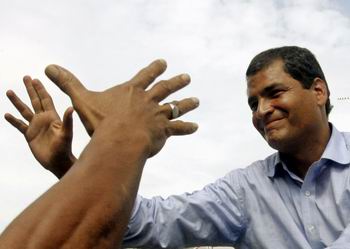
The leftist democratic revolution continues in South America. The 43-year old Rafael Correa was pronounced winner of Sunday’s Ecuadorian run-off election. Correa held 57 % of the vote after 96 % of ballot boxes had been tallied. His rival, the banana magnate Alvaro Noboa has refused to accept defeat and has threatened to challenge the election result. However Correa’s victory was confirmed by one of Ecuador’s seven Supreme Electoral Tribunal judges Narciza Subia who said “Rafael Correa is the new president of Ecuador. The trend is not going to change.”

Correa celebrated in his home town by saying "the people have given us a clear mandate, with the second-largest margin in the last 30 years of democracy”. He will now push for reforms which include re-negotiating debt agreements, opposing a US free-trade pact and re-writing the constitution. Correa says the constitutional rewrite is needed to bypass a corrupt congress and curb political party influence in the courts. As it stands, opposition parties can appoint sympathetic judges to the electoral and supreme courts to stymie Correa. Political tumult is the norm in Ecuador and there have been 11 presidents in the last decade, three of whom were overthrown by politically-motivated lawmakers.

Correa, a trained economist describes himself as "left-wing - not from the Marxist left, but rather a Christian left". He was born in Ecuador’s largest city Guayaquil in 1963. He studied economics in Guayaquil Catholic University and gained his Masters' degrees in Belgium. By 2001, he gained a second masters and a doctorate in economics from the University of Illinois in the US. He is married with three children and is fluent in four languages: Spanish, English, French and Quechua. Quecha is the local indigenous language which Correa learned while doing volunteer work in his student days.

In 2005, Ecuador was plunged into a constitutional crisis after President Lucio Gutiérrez was driven from power by a 60-2 vote in Congress. He was replaced by Alfredo Palacio who appointed Correa as his finance and economy minister. However Correa only last four months in the job. During this time he tried to push through a program of poverty reduction and economic sovereignty. But he made powerful enemies when he defied IMF advice and publicly questioned the wisdom of a free trade agreement with the US. He thumbed his nose at the World Bank when he wound up a government debt reduction fund against their wishes as part of a program of measures to redistribute Ecuador's oil wealth more equitably. The Bank promptly cancelled a scheduled loan of US$100 million tied to maintenance of the fund. Correa turned to his friend Hugo Chavez for help. Palacio forced Correa to resign under intense pressure from the US. The official reason was due to his alleged failure to consult about the sale of US$300 million of sovereign debt to Venezuela. Correa claimed in his resignation letter that Palacio was aware of the sale. After quitting the ministry, he became economics professor at the San Francisco University of Quito. Meanwhile he founded his own party Alianza PAIS and prepared for this year’s presidential election.

In the first round of voting in October, Correa picked up 23% of the vote which left him second behind Noboa who picked up 27%. But Correa comfortably won the run-off due to his considerable personal appeal and enthusiastic campaign. He appeared at rallies brandishing a leather belt (correa is the Spanish word for belt) to show how he would deal with corruption. His campaign slogan was "dale correa" (give them a belting). Alianza PAIS did not run any other candidates in the election and Correa now plans to seek a referendum to rewrite the constitution and restructure Congress. He attacked Ecuador's Congress as a "sewer" of corruption and will rely on the support of the Ecuadorian Socialist Party to push his reforms through the parliament.

Oil is Ecuador’s major export and fifty percent of Ecuador's national budget is funded by petroleum earnings. Indigenous tribes of Ecuador are fighting for land rights, which have been jeopardised for over two decades years by Texaco and Ecuador's state-run company Petroecuador drilling in the Amazon rainforest Eastern part of the country. Correa said he would renegotiate contracts with foreign oil companies to raise the state’s share of crude oil volume. With the addition funds, Correa will prioritise social and infrastructure spending over paying off the country's $10 billion foreign debt.

Tuesday, October 31, 2006

Lula wins again

Brazilian President Luiz Inacio Lula da Silva has won a second term of office. He retained his position in a landslide election win on Sunday. Silva beat his challenger Geraldo Alckmin in a run-off election after no candidate achieved a majority in the first election on 1 October. In a victory speech, Lula said he would govern for all Brazilians and intensify efforts to alleviate poverty during his second four-year term. "We will give attention to the most needy. The poor will have preference in our government," he said.

Popularly known as “Lula” (a nickname he acquired in childhood) he was first elected to the post in October 2002. The latest victory represents a great comeback for the President who was staring defeat in the face after a cash-for-votes scandal last year and allegations in this election that his Workers Party had engaged in dirty tricks.

Luiz Inácio da Silva was born in October 1945 to a poor family in the town of Garanhuns in the north-east Brazilian state of Pernambuco. The name Lula, in Portuguese, means “squid”, but is also a common nickname for people called Luiz. Soon after Lula was born, his father moved south in search of work. He settled in the coastal city of Guarujá, a holiday resort one hour’s drive from Sao Paolo. His wife and eight children joined him six years later. Lula had a tough upbringing and quit school after the fourth grade. By age 12 he was a shoeshine boy and street vendor and two years later he got a job in a copper factory. Lula eventually went back to night school to get his high school diploma. By age 19, he was working in Brazil’s largest metropolis, São Paulo. He became involved with unions in the factories he worked in and risked the wrath of the authorities who clamped down on union activities.

Silva’s first wife died in childbirth in 1969 and he remarried five years later. He rose through the ranks of the unions and was elected president of the Steel Workers Union by the end of the decade. He also travelled to the US during this period to attend trade union courses sponsored by American anti-Communist unions. Lula was jailed briefly in 1979 after organising a massive strike of 170,000 metal workers.

He formed a new political party “the Workers Party” (PT - Partido dos Trabalhadores) and spent much of the 1980s getting involved more involved politically and campaigning for more democracy in Brazil. The campaign culminated with free presidential elections in 1989, the first to be elected by popular vote in 29 years. Lula himself ran for president in that election having already won a seat in Congress in 1986. He was popular but lost narrowly in the second round after vote-rigging and biased media sunk his chances. He ran another two times unsuccessfully during the nineties.

In June 2002, the Workers Party formed a broad-based alliance with a number of other parties under a platform of social inclusion. And at the age of 57 Lula was elected president with almost 53 million votes (61%). The major program of his first administration was “fome zero” (zero hunger) with an objective to relieve hunger and extreme poverty in the country. This initiative allocates a $20 allowance per month to each undernourished Brazilian household and aims to cut the number of people living in extreme poverty in half by 2015. The US based Council on Hemispheric Affairs has criticised the program for not providing the promised funds to make it successful.

Despite Fome Zero, fears that Lula would embark on major and costly social re-engineering projects proved unfounded. Brazil re-signed its agreements with the IMF and achieved budget surplus in the first two years of his administration. His finance minister Antonio Palocci gained the confidence of the markets and he kept the inflation rate low. Brazil paid off all its IMF debts by 2005. However, that year’s Mensalão scandal claimed the political scalp of Palocci as well as jeopardising Lula’s own chances of re-election. Mensalão means “big monthly” and refers to secret monthly payments that Lula’s Workers’ Party gave to a number of Congressional reps in order to vote for government legislation. However the Brazilian economy was not affected by the scandal and Lula weathered the storm.

In foreign relations Lula is seen as a shrewd negotiator and manages to retain friendly relations with both the US and Venezuela. He was a key figure in the collapse of the 2003 World Trade Organisation (WTO) negotiations in Cancun, Mexico. Brazil leads a group of 22 developing countries (G22) that challenged the one-sided nature of globalisation and attacked the agricultural subsidies of the wealthier nations. The US tried unsuccessfully to break up G22 in Cancun by offering bribes and issuing threats to smaller members. It was the first time that the global south had resisted the blandishments of the north and Lula was a major stakeholder.

Lula will face some massive challenges in his second term primarily in the area of environment. The impacts of Amazonian devastation will need to be seriously tackled. Environmentalists say interests of agribusiness seem to be trumping any hope of a sustainable future in the Amazon. Brazil is pushing ahead with the plan to pave the Trans-Amazon Highway BR-163 which local media have dubbed “the soybean highway”. Soybeans are a major export and the new road will allow the crop (much of it GM) to be quickly and cheaply loaded onto barges from the Amazon to the Atlantic. Meanwhile pace of deforestation has increased every year for the last decade. Lula argues that he has created new reserves cover more than 80,000 square kms, but critics say it is not enough. Most rainforest clearance is illegal; farmers and loggers either exceed their allocation or they raid public land. The Amazon problem is not the laws, but the lack of resources to enforce them. Lula now has the mandate, but will he have the political will to effect real change?

Saturday, October 07, 2006

Morales mauls the media

Bolivian President Evo Morales showed the international media a clean pair of heels on Wednesday. The fit and avid football player and his team of former Bolivian world cup players recorded a 12-1 victory over a team of journalists from The Associated Press, Efe, Reuters and other foreign groups. Morales added to the damage by converting a penalty. While Morales won this time, he hasn't always had it his own way in his battles against Bolivia’s international press corps. "Some journalists treat me as if I'm ignorant, or crazy, and the press never reports this," Morales said. "Some foreign journalists come here just to offend me." Morales has often expressed his desire to open more government-friendly media outlets, and has announced plans to create numerous community radio stations in small towns throughout Bolivia.

Juan Evo Morales Ayma turns 47 on 26 October. Popularly known simply as Evo, he claims to be Bolivia’s first indigenous leader since before the Spanish Conquest 470 years ago. His political party Movimento Al Socialismo (known as MAS which is also Spanish for ‘more’) was founded in 1997 and has had a spectacular rise to power. It came from nowhere to come second in the 2002 elections with 19.4 % of the valid presidential vote and 14.6% of the valid uninominal vote, which gave it 27 out of 130 seats in the Chamber of Deputies and eight out of 27 seats in the Senate. Morales credited then U.S. ambassador Manuel Rocha for the success of MAS: "Every statement [Rocha] made against us helped us to grow and awaken the conscience of the people." None of the other candidates would agree to enter a debate with Morales and his “minor party”. Morales turned that into a positive by saying “"The one who I want to debate is Ambassador Rocha — I prefer to argue with the owner of the circus, not the clowns."

Rocha and the US State Department cautioned the other parties not to enter a coalition with MAS. Instead they became the strongest opposition party. In October 2003, Evo played a central role in the violent demonstrations demanding the nationalisation of the energy sector that led to the resignation of President Gonzalo Sanchez de Lozada. The cause was the Bolivian Gas War, a huge social conflict based on the exploitation of the country’s vast natural gas reserves. In the 1990s, the government had awarded generous contracts to 26 foreign companies in a consortium called Pacific LNG. The plan called for a pipeline to the Chilean coast where the gas would be exported to the US and elsewhere. Opponents argued that exporting the gas as a raw material would give Bolivia only 18% of the profits. When the army killed seven protesters against the plan in September 2003, the Bolivian Workers Confederation and the leader of the indigenous party declared an indefinite general strike. Morales and MAS eventually took part and organised the protests in the capital in 2005.

Morales was well prepared for the December 2005 election. He formed a ticket with Alvaro Garcia Linera whose elegance and middle class background formed a striking contrast with the Aymara Indian common look of Morales. The combination was a success. Morales won 54% of the vote and was declared outright winner without a congressional vote. The new president has been openly hostile to US and foreign interests.

In May this year he fulfilled on an election pledge and signed a decree nationalising the gas industry. He threatened to evict foreign companies unless they sign new contracts within six months giving Bolivia majority control over the entire production chain. The decree impacts about 20 foreign oil companies, including Spain's Repsol, Petrobras of Brazil, Britain's BP and French group Total.

Morales’ power base is Bolivia's cocalero movement – a loose federation of coca leaf-growing campesinos who are resisting the efforts of the US to eradicate coca in the province of Chapare in southeastern Bolivia. In front of an audience of 20,000 cocaleros shortly after his election win, Morales told them ,"the fight for coca symbolises our fight for freedom. Coca growers will continue to grow coca. There will never be zero coca." This was a reference to the US backed “Plan Dignidad” (Dignity Plan) which the 2000 Bolivian government supply-side exercised to rid the rid the country of illegal coca which is a key ingredient of cocaine. However the indigenous Aymara and Quechua peoples have traditionally chewed coca leaves as a dietary supplement. Its consumption in the form of leaves and tea is part of daily life for Bolivia's peasants, miners and workers. They saw Plan Dignidad as an attack on their way of life. Morales says he supports an anti-drug policy but not an anti-coca policy, "there will be zero cocaine, zero drug trafficking, but not zero coca".

Monday, September 11, 2006

The Other September 11

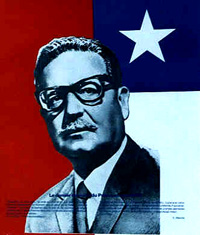
Today is the 33rd anniversary of the Chilean coup that brought military dictator Auguste Pinochet to power. On this day in 1973, a US backed armed uprising overthrew the regime of a democratically elected president. Salvador Allende Gossens was the first socialist to be elected president in South America and he was killed on the day of the coup. A march on the eve of the 33rd anniversary in Santiago ended in clouds of tear gas as police dispersed demonstrators throwing rocks and bottles at government buildings, including the presidential palace.

Allende was born in the port city of Valparaiso in 1908. He graduated in medicine from the University of Chile in Santiago in 1933. That same year he was a co-founder of the Chilean Socialist Party. Five years later, Pedro Aguirre Cerda led a Popular Front government to victory and Allende was appointed Minister for Health. After Cerda died in 1941, Allende returned to his parliamentary career and served as a senator throughout the 1940s and 1950s. In 1952, Allende made his first run for the presidency, finishing well back in fourth. The same year, he was suspended from his party because of his support for the outlawed Communist Party of Chile. He ran for president twice more and failed in 1958 and 1964.

Allende became a person of interest to the Americans after he established a friendship with Fidel Castro. The Nixon administration, newly elected in 1968, feared that US corporations active in Chile might be nationalised by a socialist government and so became openly hostile. Nixon acknowledged that he had given instructions to "do anything short of a Dominican-type action" to keep the democratically elected president of Chile from assuming office. Allende put his name forward for a fourth presidential election in September 1970. Although he only received 36% of the popular vote (down 3% from his 1964 figure), he was 1% ahead of his main rightist opponent. The closeness of the result sent the election to the National Congress for a vote. In the six weeks waiting for this vote to occur, the CIA supported the assassination of General René Schneider Chereau, the armed forces Commander-in-Chief. His murder influenced the congress which voted 153 to 35 in favour of Allende. He was declared president of Chile on 24 October.

In office, Allende pursued a leftist program and his government established diplomatic relations with Cuba. He also moved Chile closer to communist countries such as China, North Korea and North Vietnam. At home, the new regime began to nationalise various industries, several of which had significant U.S. business interests. This line of action quickly cost the president the support of Chile's business community. The Allende government announced it would default on debts owed to international creditors and foreign governments. Allende also froze all prices while raising salaries. By early 1972, United States was working seriously to destabilise the country. It supported the opposition and worked systematically to weaken Chile's economy. Chile’s chief export was copper and prices declined on the international market. As a result, the government began to lose control. In order to control a strike by shopkeepers and truck owners, Allende temporarily brought senior military officers into his cabinet. With inflation out of control and his country becoming polarized between the extreme left and the extreme right, Allende slowly lost his grip.

On 29 June 1973, Colonel Roberto Souper led El Tanquetazo (the tank putsch) against Allende’s government. But his tank-led coup was put down by forces loyal to the regime. But less than three months later it was all over. In August, Chile was lurching towards a constitutional crisis as the Supreme Court complained that Allende could not govern. Early in the morning of 11 September, sections of the Chilean navy seized the port city of Valparaiso, Allende’s home town. The President went to his La Moneda palace when he heard the news. He tried in vain to contact senior military officers and concluded they were all in on the coup. Allende made a radio address "Confirmed reports indicate that a sector of the Navy has rebelled and is occupying Valparaiso. Santiago is normal and [the soldiers are] in their barracks. I'm here defending the government that I represent by the will of the people. Be alert and vigilant...I wait for the soldiers of Chile to respond positively and defend the laws and the Constitution. Workers must go to their workplace and wait for new instructions.”

Then the military junta made its own radio broadcast which called for the immediate resignation of Allende. The broadcast was signed by most of Chile’s leading generals. They offered a plane to take Allende out of the country but he refused. Allende made one last desperate address to the nation by telephone to another radio station which commenced “This will surely be the last time I speak to you”. The military surrounded the presidential palace with tanks. The air force circled the building. Forces loyal to Allende inside the building opened fire and started a fierce gun battle. The jets opened fire on the palace and unleashed twenty minutes of rocket attacks that destroyed the building. The army invade the wrecked palace. Allende was with his supporters on the second floor and ordered them to leave. He committed suicide when alone. General Palacios arrived at the scene of the suicide with his soldiers and ordered them to block the entrance to the room where Allende lay, except to forensic personnel. He then sent the following brief message to the generals assembled at the Ministry of Defence: "Mission accomplished. Moneda taken. President dead."

Some 3,000 people died in this September 11. General Pinochet led the new government and the US moved quickly to support the legitimacy of the new regime. Declassified US government documents showed how in the months and years following the 1973 coup, Henry Kissinger covered up US information about atrocities in Chile and sought to persuade Pinochet that the US did not consider his behavior a major problem.

Monday, May 15, 2006

Chavez, the new Bolivar

On May 14 this year, Hugo Chavez, the president of Venezuela, addressed an adoring crowd at the Camden Town Hall, London. The Independent newspaper described the event as a “mixture of a Latin American populist rally, an evangelical meeting and a football match.”

London is the latest stop on his European tour which has taken him to the Vatican and Vienna. In his rambling two hour speech without notes at Camden, he quoted Rosa Luxembourg, Pythagoras, Karl Marx and George Bernard Shaw. He attacked US foreign policy on Iran and Iraq. He claims, not without reason, that the US government are plotting to assassinate him. “I know there are plans to kill me, but I really don't care. It will not stop me,” he said to the crowd.

On August 22, 2005, influential right wing demagogue Pat Robertson openly called for his assassination on television. He told the Christian Broadcasting Network’s “The 700 Club” that “I don't know about this doctrine of assassination, but if he thinks we're trying to assassinate him, I think that we really ought to go ahead and do it. It's a whole lot cheaper than starting a war”. He went on to say “It's a whole lot easier to have some of the covert operatives do the job and then get it over with.”

And indeed Chavez would not be first Latin American president that the US has forcibly removed from office. The Monroe Doctrine is not idle theory. In December 1823 US president James Monroe issued a statement of intent to European governments of America’s growing power, “the American continents were no longer open to European colonization, and that any effort to extend European political influence into the New World would be considered by the United States as dangerous to our peace and safety." From then on, this cornerstone of American foreign policy meant they would reserve the right to interfere with domestic affairs in Latin American countries whenever it felt their interests were being threatened.

In more recent times, leaders such as Salvador Allende and Manuel Noriega have been ousted from power through overt or covert American involvement. Allende was the first democratically elected Marxist leader in the world when he won the Chilean presidential election in 1970. His regime and life were brought to a spectacular end on September 11, 1973 when General Pinochet led a military coup and bombed the presidential palace with the implicit backing of US State Secretary, Henry Kissinger. Noriega was a CIA operative in the 1970s and de facto military leader of Panama in the 1980s. His relationship with his ex-bosses turned sour in 1989 and the Americans invaded in “Operation Just Cause.” Noriega was arrested and imprisoned in Florida for drug trafficking.

Chavez is a major problem for America because of its large dependence on Venezuelan oil in the middle of a supply crisis. So the US is now trying to turn Chavez into another Noriega. They have accused him of supporting and supplying weapons to the FARC, Colombia's largest revolutionary guerrilla movement. FARC is also accused of drug smuggling and terrorist activities. US newspapers such as the New York Times are fanning the links between Chavez, FARC and drugs in a similar manner to the way Noriega was demonised prior to the 1989 invasion.

Hugo Chavez will be fifty years old on July, 28 this year. He was the second son of schoolteachers in the town of Sabaneta in the Western state of Barinas. His father is now the governor of that state. At 17, Chavez joined the Venezuelan academy of Military Sciences where he achieved Master’s degrees in military science and engineering. Chavez remained in the army and gradually worked his way through the ranks to become lieutenant colonel.

While a student, he developed his key philosophy: Bolivarianism. It is named for the greatest of South America’s generals and fellow Venezuelan Simon Bolivar. Bolivar proclaimed Venezuelan independence from Spain in 1810. He fought running battles with the Spanish over the next 11 years before emerging as president of the original republic of Colombia (now Ecuador, Colombia, Panama, and Venezuela). He also took Peru and upper Peru was renamed Bolivia in his honour. Chavez saw Bolivarianism as promoting the unification of Latin America. As president he changed the constitution and name of the country in 1999 to the Bolivarian Republic of Venezuela.

Chavez first came to national prominence in 1992. Venezuela was undergoing a crisis under neo-liberal Carlos Andres Perez who was serving his second term as leader. Venezuela’s economic stability was under threat when the Arab countries raised their oil production quotas to aid the collapse of the oil-dependent Soviet Union. Prices plummeted and Venezuela had to introduce austerity measures. Chavez and fellow army officer Francisco Arias Cardenas founded the MBR-200 (Movimiento Bolivariano Revolucionaro 200) and plotted to overthrow the government. The coup of February 4 failed. Chavez only had the loyalty of 10% of the armed forces and failed to take the national TV station. Perez eluded capture and Chavez surrendered. He was sent to prison but many poor Venezuelans saw him as a victim who had stood up against government corruption. Perez was ousted in 1993 and Chavez was pardoned by the new president Rafael Caldera in 1994. In 1998 Chavez campaigned for the presidency and gained significant support from Venezuela’s two largest banks. He won the December election with 56% of the popular vote.

He immediately got to work on his sweeping changes which included road building, housing construction and mass vaccination. He also halted planned privatisations of the national social security system, the aluminium industry and the oil sector. He lobbied OPEC to reduce oil production to increase revenues. He was re-elected with an increased majority in 2000. In 2002 his reform of the state oil company precipitated a military coup.

He was replaced and arrested on April 11, 2002. This event sparked massive pro-Chavez protests and universal condemnation from the rest of South America. Chavez was restored to the leadership in triumph two days later. Only then did the US condemn the coup. The British Sunday broadsheet, The Observer, reported that the coup was linked to three senior US government officials, national security adviser Elliot Abrams, special envoy Otto Reich and intelligence chief John Negroponte.

Internal opposition to Chavez continues to be fierce. In 2004, Sumate (Spanish for “Join in”), a shadowy volunteer civil association funded by the US State Department collected millions of signatures and activated the 1999 Constitution's presidential recall provision. Chavez survived this with a 60% ‘no’ vote against the measure.

Chavez continues to use Venezuela's increasing oil revenues to focus on expanding social programs. Economic activity has also picked up markedly, reaching double-digit growth in 2004. He has forged links with Argentina’s president Kirchner, China’s Jintao, Cuba’s Castro and Iran’s Admadinejad. He ordered US troops and Christian missions out of his country in 2005 and gave away almost seven thousand square kilometres of land to Amazonian tribes. He has denounced US foreign policy but was the first leader to offer assistance to America after Cyclone Katrina. He told AP "We place at the disposition of the people of the United States in the event of shortages we have drinking water, food, we can provide fuel”. His offer was turned down.

Chavez continues to polarise world opinion. It is probably too early to judge his impact on his country. But he remains a refreshing different voice on the world scene. It is no wonder the crowd at Camden Town Hall gave him a superstar reception.