Showing posts with label Iraq. Show all posts

Thursday, September 02, 2010

A Journey into Tony Blair's Brutopia

In his just published autobiography, Tony Blair tells the story of a passenger jet that breached closed British airspace in the immediate aftermath of 9/11. A senior RAF commander was following the plane which was out of contact and heading towards London. The commander was awaiting instruction from Downing St to shoot it down. As recounted in "A Journey" (published yesterday) Blair said he talked with his advisors for several minutes “trying desperately to get an instinct as to whether this was threat or mishap”. When the deadline came, Blair decided to wait. “Moments later the plane regained contact. It had been a technical error,” Blair wrote. “I needed to sit down and thank God for that one.”

Blair’s desperation for a sign of “instinct” is almost as telling a factor as his gratitude to “God” for the way it eventually passed without incident. Blair is ultimate proof of John Gray’s suggestion in Black Mass modern politics is merely a chapter in the history of religion. While Blair initially recoiled with desperate horror against the possibility of making a preemptive strike against someone who may or may not be a threat, such decisions grew a lot easier for him in the years that followed. 9/11 was a watershed moment for Blair, as much as it was for the Bush administration as it marked a time when Gray said foreign policy would be shaped by Utopian thinking.

Blair always had a strong dash of neo-liberalism to go with his strong powers of faith. He came to the Labour leadership in 1994 when the party had been out of office for 15 years. He inherited Margaret Thatcher’s total belief in the power of the markets. John Gray said Thatcher’s aim of destroying socialism in Britain assisted Blair in his political rise. By dismantling the Labour settlement that had served Britain since the end of World War II, she removed the chief reason for the existence of the Conservative Party. Without an enemy, it lacked identity. Blair’s “New Labour” easily stepped into its shoes and deprived them of relevance for a decade.

As the 1997 British election proved, strategy and organisation were more important than policy. Once he won, Blair carried on Thatcher’s privatisation agenda moving it into the justice system and prison service while also making the NHS and schools subject to market forces. In his early international dealings he advocated a “doctrine of international community” which reflected the “end of history” thesis that infected much 1990s intellectual thought. It was destroyed with the towers on 11 September 2001 and exposed Blair’s more naked belief in the power of good intentions to triumph regardless of flaw in the execution.

Like Bush, Blair saw his destiny as the unfolding of providential design. The neocons in the White House made it abundantly clear to him on a Camp David visit in April 2002 the Afghan War would be a sideshow and Iraq was the real target. The Foreign Office knew the case for war was a thin one; Saddam was little threat and had no weapons to speak of. Yet by the time of the 23 July Downing Street Memo, he accepted the advice of MI6 war was inevitable and “intelligence and facts were being fixed around the policy”.

He cautioned Bush to seek UN support but in January 2003 Bush told him plainly the US was invading with or without a resolution. Bush offered Blair the opportunity to pull out given the strong anti-war rhetoric in the UK but Blair pledged his support. Blair actively covered up any intelligence that contradicted the official line Iraq was a major threat that had to be stopped. The March 2002 Iraq Options paper produced by the Cabinet Office and the February 2003 Defence Intelligence Staff document both said there was no justification for invasion. All they succeeded in doing was to get Blair to shift the case to arguments about WMDs where intelligence could be more easily manipulated.

Blair wasn’t interested in the facts. Armed with his dogged Utopian belief in the ineluctable nature of progress, he screened out inconvenient data. Blair was only interested in faith-based intelligence that supported his moral imperative. As the disasters unfolded in the aftermath of invasion such as Abu Ghraib and extraordinary rendition, Blair kept silent. Again Gray: “Deception is justified if it advances human progress...Blair’s untruths are not true lies. They are prophetic glimpses of the future course of history and they carry the hazards of all such revelations.”

Blair’s militant faith in human progress brought him eventually to the political abyss. His was a true enlightenment view of unending human progress. In his ten years as Prime Minister his overriding concern was the shaping of public opinion to support his beliefs and his lies became an integral feature of government function. Despite winning three elections, he is remembered only as a Bush lackey. Both men practiced missionary politics and saw their goal as the salvation of humankind.

The difference was Bush could do faith better than Blair in a country with a lot more millenarian tendencies than the UK. An American Lt Col in Fallujah could get away with saying the war was “battle against Satan”; a British General in Basrah could not. But both Britain and the US have now left the country. Iraq turned out not to be a Utopian project after all.

Saturday, May 15, 2010

Iraq trapped inside the Hurt Locker

Iraq was reminded this week the country is still not an entirely safe place for civilians. Yesterday a bomb exploded at a football match in the northern city of Mosul killing 25 people and injuring another 120. The carnage was caused by a car bomb quickly followed by a suicide bomber. The incident came four days after a series of attacks in five cities killed 110 people in the bloodiest violence this year. Politicians have blamed Al Qaeda as the country struggled to form a government two months after an indecisive general election. The formation of a stable government is a crucial step in ensuring US combat troops leave the country by 31 August – almost seven and a half years since the Bush Administration launched its invasion.

I was reminded of all these things as I went to watch The Hurt Locker last night. The film tells the story of a US bomb disposal team in the early years after the invasion. The title of the film refers to the place where an explosion sends you to – a private world of pain. It is a fitting allegory for the film because despite the fact it was filmed on near-location (Jordan) using many Iraqi refugees in minor parts, it fails to humanise anyone other than the three American participants of the bomb squad.

This is hardly unusual in American war films. But The Hurt Locker is a particular disappointment given the positive critical reception it has received. It was based on the Iraqi accounts of embedded freelance journalist Mark Boal, who also wrote the screenplay. As a journalist Boal should have been honest enough to look at the conflict from both sides. But the film never rises above a depiction of Iraqis as “the other”.

Director Kathryn Bigelow’s stated desire was to immerse the audience into something that was “raw, immediate and visceral” and to some extent she succeeded. But ultimately her movie put us in the position of the “fourth man in the humvee” and not the women looking fearfully out the window, or the boys in the alley or the men at the mosque or the souk. The Iraqis were never humanised. Significantly one of few Iraqis to be named was the boy called “Beckham” in honour of a footballer of a country that was also at war in Iraq. The name “Beckham” was a mask, and even peeled off it was never fully resolved as the American protagonist mistakenly believes he is dead. All these native boys look alike.

The film reveals the massive problem the US faced in its invasion of Iraq and still does in its Afghan incursion. There is a local lack of empathy with the people whose lives they have interrupted. Hardly any of the invaders speak Arabic (even less so Pashto and Dari), and no one has any cultural affinity with the places they must serve in. Yes, their job was difficult and they faced hostility but nowhere in the film did anyone ask what they were doing in Iraq in the first place. There is no political context and not even a hint of the role oil played in the invasion.

The Hurt Locker does a wonderful white knuckle job of getting into the day to day stresses of a bomb disposal squad. But it offered no insight to American audiences on why the bombs were there in the first place. Saddam Hussein was a cruel and vicious tyrant but he was created in America’s image. When the Republican Guard crumbled in 2003, the US was unprepared for what might follow. A county that had suffered almost continual war or sanctions since 1980 was on the brink of collapse and many desperate people had nothing to lose by declaring jihad on the invaders. “The poor man’s air force” did much to harden opinion against the invasion in both Iraq and the US. The nasty legacy is that many will remain attracted to the violence well after Obama has withdrawn the troops. Iraq has a long way to go before it can escape the Hurt Locker.

Thursday, December 10, 2009

Another massive Baghdad explosion tests al-Maliki's resolve

127 people died and more than 500 were injured in five coordinated suicide bombing attacks on Tuesday targetting government buildings in Baghdad. The Islamic State of Iraq, a group with links to Al Qaeda, claimed responsibility for the blasts in an online statement. The statement said the attack was on "the bastions of evil and dens of apostates," and the Islamic State of Iraq is "determined to uproot the pillars of this government" in Iraq."The list of targets will not end until the flag of unification is raised again in Baghdad,” it read.(Photo credit: Bassim Shati/Reuters)

The attacks were the worst since late October when twin car bombs killed 140 people and wounded 700 more outside Baghdad’s Justice Ministry. The Islamic State of Iraq also claimed responsibility for this atrocity as they did another major attack on government installations on 19 August. In the latest bombing, the five targets were the finance ministry office, the labour ministry, the interior minister, a courthouse and a police patrol. The bombs all exploded within minutes of each other on Tuesday morning.

While violence in Iraq has fallen in the past 18 months, these incidents question the state of Iraq's security as US troops prepare to leave the country after the March 2010 elections. In the wake of the latest bombing Iraqi PM Nouri Al-Maliki sacked the head of the Baghdad Operations Command. Lieutenant General Abboud Qanbar had been a close ally of al-Maliki who was appointed in 2007 to lead that year’s crackdown of Baghdad. But now he was made the scapegoat, as al-Maliki dodged the flak of angry MPs and asked for patience while he plans a further shake-up within the military.

Al-Maliki has been at pains to show the country is now much safer in the lead-up to the 2010 election. But he is gradually being undermined by the well planned and strategic attacks by the Islamic State of Iraq. Formed in 2006, the Islamic State of Iraq is a front group for Al Qaeda with the intention of establishing a Sunni Islamic fundamentalist state in Iraq. A 2007 Times article quoted US intelligence fears that that the Islamic State of Iraq planned to turn Iraq’s Sunni heartland into a militant Islamic state once the Americans left. They quoted the organisation’s draft constitution “Notifying Mankind of the Birth of the Islamic State” posted on a British website that outlined their plans to take over the provinces of Baghdad, Anbar, Diyala, Salah al-Din, Nineveh and parts of Babil. They were also identified as being behind the deadliest roadside bombs for American casualties that year.

While US deaths have decreased, Iraq remains a dangerous place today with far more civilian casualties than occur in Afghanistan. According to Nir Rosen, the US surge in Iraq only worked because the Shiites had already won the civil war with the Sunnis. Rosen says Iraq is ruled by an “incredibly corrupt government, weak, oppressive and this so-called success in Iraq which we’re using as a model for Afghanistan, success that included the deaths of hundreds of thousands of Iraqis, the displacement of millions of Iraqis, the devastation of a country, [and] the spread throughout the region of sectarianism and instability.”

Writing on the ABC Unleashed site yesterday, Antony Loewenstein said the Iraq war had dropped off the media radar despite still being a far more dangerous place than Afghanistan. Loewenstein quoted a study by the American media watchdog Fairness and Accuracy in Reporting which found that while opinion polls were divided on the Afghan war this year, this diversity of opinion was not reflected in the pro-war The New York Times and The Washington Post. While the FAIR report did not examine the Iraqi campaign, Loewenstein says the issues are similar. Despite US plans to drawdown its troops by 2011 a large number of “private contractors” will remain. “No American official has ever answered the basic question of how many US troops or military trainers will remain in Iraq beyond 2011,” said Loewenstein. “Indeed, permanent bases in Iraq suggest a long-term presence.”

Tuesday, October 27, 2009

Baghdad bombing is a reminder that Iraq is a fiction

Yesterday’s explosion in Baghdad was a reminder that Iraq’s problems have not gone away. Opponents of the state launched two massive suicide bombs outside Justice Ministry and the council buildings with vehicles loaded with 68 kgs of explosives. It was the deadliest attack in two years and occurred two months ahead of planned elections. At least 147 people were killed and another 500 injured in a soft and indiscriminate attack on the centre of the capital just outside the heavily secured Green Zone. (photo of a 2005 Baghdad bombing by controlarms)

No one has claimed responsibility but there are plenty of enemies to al-Maliki’s Shi’ite regime with reasons to carry out the atrocity. Al-Qaeda, the Sunni Sons of Iraq, ex-Ba'athists, Kurds, Shi’ite extremists all had motives to discredit a government looking for credit for Iraq’s increasing independence. The still-large American military presence also rankles with many Iraqis. The government was due to meet yesterday to discuss laws to govern January’s proposed general election. The meeting did not happen and the blast has put further doubt on whether the poll will take place.

The street where the blasts occurred had just been reopened to vehicle traffic six months ago as the regime attempts show Iraq is getting back to normal. But this new “normal” is very different than what passed for run-of-the-mill in Baghdad prior to 2003. The US has turned the old order upside down. Democracy has given the more numerous Shi’ites power and the old Sunni Ba’athist elite are disgruntled. They boycotted the 2005 election and may do again in 2010. There are also issues on the Kirkuk faultline of Arab-Kurdish relations. The International Crisis Group has nominated Ninewa as the new flashpoint with violent sectarian attacks common-place in a town which is mainly Arab but with a large Kurdish minority.

Finding a sustainable solution to Kurdish disputed borders is one the fundamental problems threatening Iraq. The country was founded as an artificial construct after Britain cobbled together three Ottoman provinces to give to a deposed Saudi king after World War One. Strong Sunni leaders papered over the cracks for 70 years but its future is less certain. ICG’s Middle East Program Director Robert Malley says a compromise won’t happen without an assertive American role. “The US might be on its way out, but its hands will be full even as it heads for the exit,” he said.

As Vice President Biden reiterated in September, the US “recognises and supports” a united Iraq. But from a US policy perspective, Afghanistan is the now only overseas war-game in town and are anxious to withdraw large-scale forces from Iraq. There are still more US troops in Iraq than there are in Afghanistan and General McChrystal wants them badly. For the first time since the Iraqi war started, US Coalition forces deaths are going to be higher in Afghanistan than in Iraq this year with three times as many casualties to October. The Afghan numbers are not yet as high as figures for the early years of the Iraq war but have been on the increase since 2003 so it is safe to assume things will get worse there.

The Afghan presidential run-off election will dominate headlines but the Iraqi poll has the potential to be even more traumatic. As The Guardian puts it, politics of compromise and national unity in Iraq are fragile and slow-moving. The political system has been simply been unable to overcome traditional challenges leading to an inevitable consequence of violence. Iraq’s same old “issues of oil, federalism, provincial borders and reconciliation [are] still festering”, says The Guardian. Expect more bombs in Baghdad and elsewhere until these challenges are addressed.

Monday, June 15, 2009

Life on three continents: Of Ahmadinejad, Peter Costello and Omar Bongo

I was determined to write about Gabon today. After all, the West African nation has installed a female president Rose Francine Rogombé as an interim replacement for Africa’s longest serving dictator Omar Bongo Ondimba. And I will write about Rogombé and Bongo later in this article. However, a couple of other matters in Iran and Australia have grabbed my more immediate attention.

The biggest news worldwide is the continuing fall-out from the Iran election. Mousavi supporters are continuing a violent protest against what they say was a rigged election. Yet while the uniformity of the results does look suspicious, the wide margin suggests that Ahmadinejad probably did win. As the BBC’s John Simpson said “This was not, of course, the result the West was hoping for.” Of course. But the West needs to come to some rapprochement with Ahmadinejad (and his boss the Ayatollah Khamenei) if they are to end Iran’s international isolation. As Simpson said, Obama and the EU will “surely prefer President Ahmadinejad, with his reputation tarnished” than support the riots that have crippled the streets of Tehran since the result was announced.

The communication of those riots also became the news of the day. The revolution may not be televised but it could very well be Twittered. Ahmadinejad claimed that Western media are behind the protests against him but the fact is that CNN simply weren’t interested. It was Twitter where the action was both in #CNNFail US and opposition Iran. After being silent for several hours, defeated leader Mir Hussein Mousavi’s twitterstream announced on Sunday morning “Dear Iranian People, Mousavi has not left you alone, he has been put under house arrest by Ministry of Intelligence.” It was confusingly later updated to say the BBC confirmed that Mousavi is NOT under house arrest. As of today the man is free and is on the way to a protest where he is asking his followers for calm.

Back in the more rarefied atmosphere of Australian federal politics, one man did exhibit a Zen-like calm today. Peter Costello finally hung up his Overshadow and walked off the Canberra stage today with his decision to retire from politics. The actual end date for the meddlesome member for Higgins is not immediate; it will be effective next election. But the news means that Malcolm Turnbull will now probably lead the Liberals to the next two elections. Former Treasurer Costello was relaxed and joking as he spoke at Parliament House today. When he said his announcement would be welcomed by “both sides of the dispatch box”, everyone laughed knowingly. It was funny because it was an obvious truth and one that could not be admitted beforehand by Costello, the Liberals or indeed, by Labor.

While I paused to consider what that breathtaking insouciance says about the Australian polity, I cast my eyes back to Gabon. Situated on Africa’s west coast between Cameroon and Congo Republic, Gabon doesn’t get much press in the west. Nothing much happens in this small country of 1.5 million. It had known only one leader for 41 years. Omar Bongo was Africa’s longest serving head of state but died of cancer in Spain last week aged 73.

No one was terribly upset by his death. The Kenyan Standard called the diminutive Bongo “a pint-sized dinosaur who stifled Gabon”. He stole millions from his country in offshore oil revenues. Allafrica.com called him “a notorious looter-for-life” who spent $800 million on his palace while the capital Libreville did without a major hospital. But Bongo got away with his crimes because he was protected by former colonial power France. Nicolas Sarkozy will be one of ten heads of state to attend his funeral on Thursday.

Meanwhile Rose Francine Rogombé was sworn in overnight as Gabon’s interim president. The 66 year old Rogombé is Gabon’s first female president. Rogombé is a member of the Gabonese Democratic Party (PDG) founded by Bongo, was speaker of Gabon’s senate and is a human rights lawyer. She has been given all an elected president’s powers apart from authority to dissolve parliament or to hold referendums. Rogombé will be a breath of fresh air for a nation that has been used to Bongo's absolute power for almost half a century. The downside is that Rogombé doesn't have much time to make an impression. She will be ineligible to contest the presidential poll for a permanent replacement constitutionally due in the next two months.

The longer-term prognosis is not good. The favourite for the election is Bongo’s son and Gabon's Defence Minister Ali Ben Bongo. The 50 year old was parachuted into the role in 1999 as a move to pre-empt coups against the dictator while grooming the son to succeed. Ben Bongo is of the same corrupt cut as his father and enjoys conspicuous spending. In 2003 executives of French oil company Elf paid the pair $16.7 million in bribes to allow them pillage the nation’s oil wealth. Meanwhile, his wife Inge has been busy buying a $25 million mansion in LA’s most exclusive neighbourhood Malibu. But watch out for Ali Ben to resuscitate the party motto that only a Bongo can unify the country’s ethnic groups.

With Omar Bongo’s death, the mantle for the longest serving dictator in Africa now passes on to the estimable Muamar Gaddafy. The Colonel launched his Libyan revolution on 1 September 1969 meaning he is almost 40 years in power. He is currently being feted in Italy by Silvio Berluscone who will probably appreciate Gaddafy’s request to meet 1,000 prominent Italian women on the trip. And new president Gabonese Rogombé would be impressed by his all female bodyguard. Yet the man himself is as inscrutable as ever. "There is no difference between men and women on a human level," he exclaimed. "God made men and women, we must respect the differences between the sexes."

Thursday, March 12, 2009

Muntadhar al-Zaidi: a farewell kiss from the Iraqi people

You are an Iraqi press corp reporter. You are in a privileged position; among the elite of your society. You are at a press conference at the Prime Minister's Palace in Baghdad. Nouri Al-Maliki, the Prime Minister of your nation and George W. Bush, the president of the United States are holding a joint conference. The US President is speaking. The professional ethics of your craft and common courtesy would demand that you sit quietly, listen and be respectful. If you hear things you do not agree with, ask a question. The president may, or may not answer. Nevertheless, you must at all times be civil.

But last December, Muntadhar al-Zaidi didn’t want to play by the rules anymore. When he got face time in front of his country's occupier for five years, he didn’t want to ask a question, he wanted to make a statement. “I saw only Bush and it was like something black in my eyes,” he told the court in February.

And today he got a sentence of three years for shoeing a head of state.

Though I can’t be sure, I haven’t seen anyone ask him if he was fond of those Size Tens. We also don’t know for certain if it was it a spontaneous act or careful planning. But what is clear is that al-Zaidi certainly wasn’t fond of President Bush.

The video of the incident is always good for a laugh:


Bush shows good reflexes as the first shoe sails over his head. Al-Zaidi then uses the stunned silence to throw another shoe and shout out "this is a farewell kiss from the Iraqi people, you dog!" The head of that people, Al-Maliki, makes a half-hearted attempt to catch the second gift. Al-Zaidi is wrestled to the ground by journalists and security and finally the heavy brass enters the room just after the nick of time. No-one is hurt in the entire episode except perhaps al-Zaidi himself. The whole plot is translated by the media as “Breaking News: President forced to duck.”

The video was hugely popular. It was soundbyte perfect and made for great news footage that played endlessly across the globe. Within the Arab world, al-Zaidi became both instant hero and cult figure. He hit the jackpot by using the cultural act of shoe-throwing to send a powerful message of disrespect. Even the shoe company did well out of Al-Zaidi. The reaction of Jordanian businessman Samer Tabalat was typical: "Al Zaidi is the man. He did what Arab leaders failed to do."

Tabalat meant Arab leaders had failed to stand up to the US, not failed to throw shoes at its leader. But now Muntadhar al-Zaidi has made a meme extraordinarily popular and the tactic du jour of protesters everywhere. Throwing footwear is an excellent low-harm way of expressing political displeasure. Figures as diverse as the Mayor of Ithaca NY, the Israeli ambassador to Sweden, Chinese Premier Wen Jiabao and Bush again have all copped brogues from copycat offenders. Somewhat ironically, Brazilian president Luiz da Silva went on the front foot when he threatened to throw his shoes at unfriendly journalists.

But the Committee to Protect Journalists (CPJ) noted hypocrisy. They say that many government officials in the Middle East have come out in support of al-Zaidi while their own countries have a long and thoroughly documented history of repressing journalists. The CPJ also says the case is not about press freedoms but legal freedoms. “Al-Zaidi was not acting as a journalist when he threw his shoes at Bush, [but] he is entitled due process and the full protection of the law.”

Al-Zaidi should have known this. He was a Shia graduate from Baghdad University with a degree in communications. He is a reporter for al-Baghdadia, a Cairo-based satellite network. In 2007, he was kidnapped by gunmen and released unhurt after three days. In January 2008, US troops detained him overnight and searched his flat before releasing him with an apology. His older brother Dargham said both experiences fuelled Muntadhar’s resentment against the US military presence in Iraq. "He hate[d] the American physical occupation as much as he hate[d] the Iranian moral occupation," he said.

Last month, Al-Zaidi pleaded not guilty but his Defence lawyer Yahia Attabi expected today’s decision. He told reporters outside the Baghdad court that under the Iraqi criminal code al-Zaidi was charged with assaulting a foreign leader on an official visit. His lawyers tried to argue that his shoe-throwing did not cause any injury or damage.

Judge Abdulamir Hassan al-Rubaie did not agree and today dished out three years. But given that the maximum sentence for this type of assault is fifteen years, there is reason to believe this is a good outcome. Al-Zaidi will probably be out of prison in twelve months. While it is always foolish to predict, it is difficult not to believe he will profit from his newly acquired cachet.

Tuesday, February 10, 2009

Iraq local elections successful but leaves Kirkuk question unanswered

With 90 percent of the vote counted, Prime Minister Nuri al-Maliki is claiming victory in this weekend’s Iraqi local elections. 51 percent of the population voted in the ballot. Although official results won’t be released until Thursday and full results will take several weeks to process, preliminary results show that al-Maliki’s State of Law coalition has won significant victories in the two biggest cities Baghdad and Basra. The Times claims al-Maliki is “reaping the benefits of successful operations to combat Shia militias in Baghdad and the south.” However the Kurdish-dominated North is a different story with four of the country’s 18 provinces not taking part in the ballot.

Nevertheless, Lebanon’s Daily Star says the vote was a positive sign for Iraqi nationalism and a remarkable recovery from the full-scale civil war that existed barely two years ago. “The Iraqi people who went to the polls last week rejected the paradigm of ethnic and sectarian identity politics that was imposed on them by outsiders and put the interests of the nation above those of their various tribes and sects,” said the Star.

One notable casualty of the election is the extremist religious parties. The Pro-Iranian Islamic Supreme Council of Iraq (ISCI) did not win a single province. They lost their stronghold of Najaf to al-Maliki’s State of Law coalition and also lost significant support in the two big cities. In Baghdad in 2005 it won 54.9 percent of the vote; this time round it got just 5.4 percent. In Basra, it had 48.7 percent in 2005, now it won 11.6 percent. The US site Foreign Policy says ISCI’s links to Iran proved deeply unpopular and is now tarred as a religious party with a rural rump. “The big cities are voting for Iraqi nationalism and centralism,” it said.

The Sunni parties also did well in the election but remain highly fractured. In Anbar province Abu Risha's Awakening Council is hoping to form a Sunni coalition after taking 17 percent of the vote. But there are allegations of vote rigging and both Sunni and Shia groups have disputed the results. The Awakening Council claims they were ahead in the count until the late addition of an extra 100,000 ballot papers swung the results in favour of the Shia Islamic Party. The Islamic Party gained controlled of the local provincial council in 2005 when the Sunnis boycotted the election. They deny Sunni allegations of vote rigging this time round and have threatened court action.

But the troubles in Anbar are the exception to the peaceful rule in the 14 voting provinces. Nevertheless attention will eventually have to be paid to the four provinces that did not vote. Control of these provinces is disputed by the central government in Baghdad and the Kurdistan Regional Government which wants to establish an autonomous Kurdish region. The most important of the four is Kirkuk, 250km north of the capital, which has 13 percent of the country’s oil reserves. Kirkuk was a former Kurdish stronghold which was emptied by Saddam in a bout of ethnic cleansing in the 1970s. They returned to the city after Saddam was deposed and are an increasingly strident lobby in the power-sharing council set up by the Americans in 2003.

Now the Kurds want the city recognised as part of Kurdistan and vetoed a 2008 Baghdad decision for continued power sharing in the city. As a result Iraq’s election law was delayed putting the whole provincial election process in jeopardy. After months of negotiation, the parliament passed the law establishing voting quotas in September 2008, but only by setting aside the thorny issue of Kirkuk, which was excluded from the vote. The International Crisis Group has long criticised the Bush administration ‘bystander’ approach to the disputed city and recommends the international community should encourage the Kurds to embrace “peace and stability in a shared Kirkuk”.

The new US administration is also quickly finding out how difficult a problem Kirkuk could be to resolve. Obama sent Joe Biden to the city in mid January on a fact-finding mission. There he attended meetings with al-Maliki’s government and the Kurdish administration. According to one insider, Biden warned both parties that the US would withdraw “billions of dollars” from Iraq in order to address the global financial meltdown and insisted both sides solve their disputes through concessions and compromise. Despite the threats both sides were unmoved. The Kurds repeated their demands that Kirkuk be incorporated into their self-ruled region, while Baghdad insisted the city remain under central government control. While it remains unresolved, the Kirkuk issue may yet be Obama’s biggest difficulty in fully removing US military involvement from Iraq.

Saturday, January 31, 2009

Abu Ghraib set to re-open

The Iraqi government has announced it will be re-opening the Abu Ghraib prison next month under a new name. The prison was closed in 2006 after a string of controversial incidents where Iraqi war prisoners were tortured and humiliated by American military personnel. Busho Ibrahim, Iraq’s deputy justice minister made the announcement last week and said the renovated facility will be renamed as Baghdad Central Prison. "We have named it Baghdad Central Prison because of its bad reputation as Abu Ghraib prison,” said Ibrahim, “not just because of what the Americans did there but also because of what the regime of Saddam has done.”

Located 32km out of the capital, Abu Ghraib means “place of ravens” in Arabic. The raven has long been considered a bird of ill omen and the prison was infamous in Iraq well before the Americans invaded. During the Saddam era the facility held thousands of inmates. The legal scholar Robert Alt noted in 2004 that it may have held as many as 400,000 people and was a place where Iraqis were detained for crimes that caused offence to the leader. He says it was a place where torture was the rule and not the exception; and a place that Iraqis feared worse than death itself. He quoted Abu Ghraib survivor Ala’a Abdul Hussien Hassan who said "I don’t believe that anybody can imagine what we’ve been through. We’ve been oppressed on all levels."

However it was its use in the post-Saddam era that made Abu Ghraib’s notoriety in the wider world. By the time that Alt wrote his piece about the Saddam era prison, US soldiers were already creating a new nightmare of oppression for its post-invasion inmates. When US forces arrived in Baghdad the previous April, Abu Ghraib was empty. Saddam released all the prisoners in one of last acts as dictator. US commanders on the ground were slow to adapt to the insurgency that erupted in the Summer and Autumn of 2003. As they began detaining thousands of Iraqis suspected of involvement, the problem of what to doing with them quickly spiralled out of control.

Around the same time, evidence began to emerge of torture at the facility. The CBS program 60 Minutes broadcast pictures of male and female US soldiers grinning and pointing at the genitals of naked prisoners. Others showed a naked and hooded inmate placed on a box with wires attached to his body. There were allegations of sexual abuses and attacks by dogs. The authorities quickly acted to court martial the offenders and tried to limit the damage by calling them “bad apples”. Bush apologised for “the humiliation suffered by Iraqi prisoners and..their families” but refused calls to sack Defence Secretary Rumsfeld.

But the politicians were the real culprits. Before the war General Eric K Shinseki estimated that several hundred thousand troops would be needed to occupy Iraq. Rumsfeld’s deputy Paul Wolfowitz called this estimate “wildly off the mark”. The Pentagon expected things to calm down and planned for just 100,000 troops. A spokesman for Shinseki (a former commander of the peacekeeping operation in Bosnia) said simply: "He was asked a question and he responded with his best military judgement."

Of course, time proved Shinseki's best military judgement right and Wolfowitz “wildly wrong”. This became apparent even in the early days of occupation. The army committee of inquiry found that the brigade in charge of Abu Ghraib was inadequately trained for its mission. Morale was also low. Most soldiers expected to go home after the occupation of Baghdad and became demoralised when he had to stay on to guard an influx of thousands of detainees. It didn’t help that heavy fighting took place in and around Abu Ghraib during the early years of the US invasion in Iraq. The prison was overcrowded, under-resourced and under continuous attack.

But while the chaotic conditions allowed corrupt and unsupervised behaviour to thrive, once again in it was the directive of politicians that lay at the heart of what went wrong. Back in 2002, President Bush issued a memorandum stating that the Geneva Convention did not apply to Al-Qaeda and that Taliban combatants were also not entitled to prisoner of war status. This new category of “unlawful combatants” would have far-reaching consequences even though it was never intended to apply to Iraq.

The inquiry noted that military intelligence personnel at Abu Ghraib had previously worked in Afghanistan and Guantanamo and believed the presidential order gave them permission to apply additional interrogation techniques. The abuses, the final report of the inquiry found, “would have been avoided with proper training, leadership and oversight”.

After the report was issued, the Americans moved to shut down the facility. President Bush announced in May 2004 said Abu Ghraib would be destroyed and replaced by” the construction of a modern, maximum security prison.” However the Iraqis opposed this plan and the Americans began gradually moving prisoners to Camp Bucca near the Kuwait border. By 2006 it was emptied of detainees and the US handed the facility over to the Iraqi government. Now the country’s deputy justice minister Ibrahim says the prison will house 3,500 inmates when it reopens in mid-February and will have a capacity for at least 15,000 by the end of this year. "This prison will solve many problems for us - huge problems," he said. The ghosts of the place of ravens may not agree.

Saturday, August 23, 2008

Iraqi end games: Shia Government says US troops out by 2011

Though it is hazardous exercise setting a military withdrawal timetable three months before a US presidential election, Iraq says it has signed a deal that could see all US troops out of the country by 2011. As well as the doubts on the US side, Chief negotiator Mohammed al-Haj Hammoud and Iraq’s Deputy Minister for Foreign Affairs also has to sell the so-called “27 point deal” to his own parliament but it may be the best chance to lock the US into a timetable for withdrawal. Hammoud said Baghdad and Washington had agreed to "withdraw the US troops from Iraq by end of 2011." The US is refusing to confirm the deal is finalised, but it is there for negotiation even if no-one is mentioning the agenda of where Iraq’s oil goes.

But if the US troops leave, the contest will go on in Baghdad and Basra as the consequences of the genie Saddam’s removal from power continue to be felt. The clash of whether Sunnis or Shias inherit his kingdom is a battle the US can no longer manage. During his long regime Saddam was a political opportunist who was quick to bend in what favourable wind was blowing. But he was also a Sunni and when US tanks rolled into Baghdad in April 2003, the long Sunni reign in Mesopotamia was over. According to Vali Nasr’s theory in “The Shia Revival”, Iraq is now the vanguard of a new Shia power, subtly different from the more theocratical version next door in Iran.

Hussein was deeply hostile of Iraqi Shias whom he believed were in secret allegiance with their co-religionists in Iran. Shia were also a majority in his own country. But they were concentrated in the south around Basra. Hussein’s clan was from the Sunni north where power was concentrated. When the British left the “mandate” of Iraq they handed over power to the Sunni. Senior diplomat Gertrude Bell, the “uncrowned queen of Iraq” and “daughter of the desert”, harboured suspicions of the prickly Shia mullahs and ayatollahs whom she believed were behind the revolt against the British at the end of World War I. The Shia uluma reciprocated and watched in bitterness as Bell handed power to the Sunnis.

The subsequent Sunni 80 year reign was only briefly punctuated by the 1958 coup in which Colonel Qasim overthrew and murdered Iraq’s last king Faisal II. Qasim was nominally Sunni but his mother was Shia and he had close ties to Iraq’s Communist Party which was also Shia. But Qasim lasted only five years before he was himself was deposed. The subsequent rise of Arab nationalism and Ba’thism kept the Shia further out of the picture.

When Saddam came to power, he ruthlessly suppressed any hint of Shia revolt against his regime. According to Vali Nasr, he systematically neglected the cities of the south and starved them of services. He caused the environmental catastrophe of the draining of riparian wetlands so they could no longer shelter anti-Saddam rebels. One million poverty-stricken Shia were forced to seek homes in the slums that surround Baghdad and Basra. As well, Saddam banned public Shia festivals such as Ashoura and murdered popular religious leaders. He also discouraged pilgrimages to shrine cities of Najaf and Karbala, the two holiest places of Shia orthodoxy.

Despite a litany of oppression, the Shia remained generally mute and mostly loyal. It was not until George Bush Snr’s false call to rebellion in 1991, that they lashed out. A riot in Basra rapidly spread north to Karbala and Najaf boosted by Bush 41's call for Iraqis to overthrow Saddam. But when a horrified Saudi Arabia saw the extent of the Shia uprising, they influenced the US to stay out of the resulting conflict. US forces in the Euphrates Valley merely watched on as Saddam crushed the revolt with the tanks of his praetorian division he had kept out of the war – the dreaded Republican Guard.

And while the Americans fiddled, Shia towns burned and the shrines at Karbala and Najaf were shelled. No one lifted a finger to help as tens of thousands of Shias died. One Iraqi general told the New Yorker he had captured many people whom he divided into three groups; those whom he knew were involved in the rebellion, those he wasn’t sure about, and those he knew had no involvement. He telephone High Command to ask what to do with them. “They said we should kill them all,” said the general, “and that’s what we did.”

Many mass graves would not be found until after the fall of Saddam. And it wasn’t until 30 January 2005 when Iraqis went to the polls that Sunni dominance would finally end. The hugely influential Ayatollah Sistani brokered a truce between Shia factions to present a united face. Only after Shia majority rule had been won, argued Sistani, could the Shia quibble about who precisely rules and under what system. The Shia House took 48 percent of the vote and almost half the seats in the new parliament. They did better again in the December elections that year and won 46 percent of all the seats, more than the Sunni and Kurdish blocks put together.

But the Shia alliance is an artificial one and remains fraught with hazard. There are three big power blocks. Firstly there is Sistani himself allied with the other grand ayatollahs of Najaf. Unlike their Iranian counterparts they have not been inclined to turn Iraq into an Islamic Republic. But they remain hugely influential. The second power block is the slum rebellion in Baghdad, Basra and Kirkuk led by Muqtada al-Sadr. Sadr is the scion of a prominent Shia family who inherited a huge flock of urban poor from his cleric father who was murdered by Saddam. He is now trying to turn his Mahdi Army into a political machine.

The third element in Iraqi Shia politics is the Supreme Islamic Iraqi Council (SIIC). SIIC and its military wing, the Badr Brigade, straddle the boundary between Sistani and Sadr. Founded as the Supreme Council for the Islamic Revolution in Iraq (SCIRI) by the Hakim Brothers, their father was a Najaf Ayatollah. The Hakims fled to Qom in Iran in the 1980s and their Badr Brigade fought in the war against Saddam. When Sunni extremists killed one brother in 2003, the other, Abdul-Aziz Hakim became SIIC’s leader.

The current Prime Minister Nouri al-Maliki is from none of these three factions. He represents the nonclerical Islamic Da’wa Party but as the name would suggest it too has Islamists roots, dating back to a Saddam-era party dedicated to the establishment of an Islamic state in Iraq. Dawa and Maliki now depend on a coalition of Sadr and SIIC to rule. Sadr will not be happy with the timescale of the US withdrawal nor the vague conditions of “security” that might delay it. SIIC will proceed cautiously but Hakim is proving to be a surprisingly gifted operator and far from being an Iranian stooge.

Hakim’s political front the “United Arab Alliance” is the largest single party in parliament. In 2006 he met George W Bush at the Oval Office where he claimed the Iraqi situation has been “subjected to a great deal of defamation”. Hakim said US, Iraqi, and regional interests were are all linked. But he made it clear Iraq was going to go its own way. “We believe that the Iraqi issue should be solved by the Iraqis with the help of friends everywhere,” he told Bush 43. “But we reject any attempts to have a regional or international role in solving the Iraqi issue.” With an 2011 agenda now in place, McCain or Obama will have to take this man on his own merits.

Friday, April 11, 2008

One Hundred Years of Solitude: McCain and Iraq

A statement made to an obscure meeting in New Hampshire three months ago, now has the potential to derail John McCain’s presidential campaign. On 3 January the Republican nominee spoke about a possible US presence in Iraq for a hundred years. Now Democratic National Committee chair Howard Dean said the Republicans were trying to deceive voters about what McCain really meant that night. "We honour John McCain's military service, but not every war hero ought to end up in the presidency of the United States," Dean said. "If you can't tell the difference between the Shia and the Sunnis, then America ought not to be in Iraq for 100 years."

McCain made the original comment at a town hall meeting in Derry, New Hampshire five days before that state’s primary. That night the Arizona senator told an audience of 200 people he didn’t mind if the US military stayed in Iraq for “a hundred years“. When a questioner began a question by saying “President Bush has talked about our staying in Iraq for 50 years”, McCain interrupted him by saying “make it a hundred”. He continued: We’ve been in South Korea … we’ve been in Japan for 60 years. We’ve been in South Korea 50 years or so. That would be fine with me.”

The exchange was captured in this Youtube video:


The backlash wasn’t long in coming. The two main Democrat candidates gleefully seized on the McCain remarks saying he would continue to implement President Bush’s failed policies in Iraq. Hillary Clinton said the timeframe for American troops to return home should be 60 days not 100 years. Barack Obama was similarly scathing. He said the US should be spending “billions of dollars in Baghdad” and instead spend the money on schools, hospitals, roads and bridges. "Senator McCain said the other day that we might be mired for 100 years in Iraq,” he said “Which is reason enough not to give him four years in the White House”.

In February, McCain went on Larry King’s CNN show to defend his statement. He said he was referring to a military presence similar to what the US already has in Japan, Germany and South Korea. He said the Democrats’ desire to set a date for troop withdrawal would lead to chaos and genocide and would undo “all the success we've achieved and al Qaeda tells the world they defeated the United States of America.” McCain said he wouldn’t let that happen.

Of course what McCain really meant was keeping a garrison force in Iraq, not continuing the type of war America is now fighting. He suggests it would be acceptable to "maintain a presence in a very volatile part of the world" similar to that in Japan and Korea. He argues that Obama "has been knowingly twisting” his (McCain's) words. Right-of-centre commentator Clifford May agrees with McCain and says the Arizona senator’s point was that the presence of American forces promotes stability as it does in Europe and Asia for the last fifty years. However May also warned that the US could perhaps still be fighting militant Islamists in a hundred years. “What could be worse than that?” he asked. His answer: “A hundred years from now, America and the West could have been defeated by militant Islamists.”

The Huffington Post’s Ilyse Hogue suggests that no matter what happens in Iraq, the strategy of both Bush and McCain all boils down to one phrase: “six more months”. Hogue says that when the "surge" began a year ago, the politicians and generals told America things would get better by September. When September arrived, the improvement was predicted for the Northern Spring. Now this week General Petraeus has told Congress he needs another six months. Hogue calls it “selling an endless war on the instalment plan.”

Monday, March 31, 2008

Basra ceasefire leaves Mahdi Army unbowed

Muqtada al-Sada has ordered his Shia militia Mahdi Army off the streets of Basra after a six day battle in which 163 people were killed and about 500 injured. Al Sada’s militiamen had engaged in long running gun battles with the Iraqi Army and police and the violence has spread to other southern cities and Baghdad. Sami al-Askari, an adviser to Iraqi Prime Minister Nouri al-Maliki, claims most of the Basra area is now under government control. Prime Minister Nouri al-Maliki is now in Basra and had vowed to stay there until the militia was crushed. But now al-Askari said al-Maliki will return “soon” to Baghdad.

But even members of al-Maliki’s own government say that the Mahdi Army has withstood the US-supported Iraqi assault. Last week, Iraq’s defence minister, Abdul Kadir al-Obeidi, conceded that the government’s military efforts in Basra have met with far more resistance than was expected. Muqtada al-Sada has now demanded concessions in return for his ceasefire call. These include the government granting a general amnesty for his followers, releasing all his imprisoned members who have not been convicted of crimes and bringing back who he calls “the displaced people who have fled their homes as a result of military operations.”

The Iraqi Army started their assault on Basra on Tuesday. An eye witness account by former Iraqi captain Qais Mizher shows that the Mahdis had gained effective control of the city. He said the Iraqi Army assault initially appeared to have backfired as many neighbourhoods were deserted or overrun by the Mahdi Army despite military curfews. He saw scattered Iraqi Army and police checkpoints, but no place seemed to be truly under government control. In addition, travelling around the Shiite south of Iraq has been problematic since the Basra violence erupted.

While the Iraqi are mired in Basra, they were backed up by US fighter planes and helicopter gunships who struck the city and also the Baghdad’s Sadr City with bombs and missiles. The Sadr city slum is home to two million people and is considered Mahdi Army heartland. US helicopters fired missiles at Sadr while planes bombed Basra. Fighting has raged across much of the country with battles reported in Kut, Hilla, Amara, Kirkuk, and Baquba. Both Baghdad and Basra have been placed under a 24-hour curfew for the last three days.

The current violence has a political aim. It intends to severely weaken the Sadrists to the benefit of their political rivals, al-Maliki’s Dawa party and its principal government ally, the Islamic Supreme Council of Iraq (ISCI). The ISCI is led by Shia cleric Abdul Aziz al-Hakim, whose own militia, the Badr Brigade, is well represented in the government’s security forces. The Badr Brigade has strong links to the Iranian Government and its secret Quds Force which equips foreign Islamic revolutionary movements.

Some have questioned Prime Minister Nurik al-Maliki’s timing of the Basra assault. Kevin Drum has speculated that his actions got the green light from the Bush regime because of their liking of quick and decisive action, regardless of the consequences. He says Maliki may have calculated this would be a speedy mopping-up operation that would provide General Petraeus with good news ahead of his congressional testimony for his proposal on continued troop deployments. Alternatively it may be a chance to explain the bad news elsewhere with rising violence throughout Iraq at the moment. Lastly, the Basra operation offers another excuse not to withdraw troops.

While the Iraqi army are embarrassed on the streets of Basra, the well-trained 4,000 British army troops remain idly ensconced at Basra airport. They formally returned control of the city to the Iraqis in December but much of Basra has remained under the control of a combination of Iranian-backed militias and criminal gangs. The British retreat from Basra masterminded by Gordon Brown on his visit there in September last year is now looking short-sighted as the army sit helplessly by watching the city disintegrate into anarchic violence.

Wednesday, March 12, 2008

Fallon Gone

The head of US Central Command, which controls the theatre of operations in both Iraq and Afghanistan, resigned overnight after a dispute with the White House. 63 year old Admiral William Fallon Long was long critical of the administration’s hardline stance on Iran, and matters came to head last week in a magazine article portrayed him as challenging President George W. Bush’s Iranian policy. Defence Secretary Robert Gates mentioned the magazine article and quoted a letter from Fallon announcing his resignation which blamed it on “public perception of differences between my views and administration policy”.

Fallon resigned after a 41 year career in the military which also included head of Pacific Command. He began as a fighter pilot and flew missions in Vietnam. Appointed to his current role this time last year, he told his confirmation hearing by Senate Armed Service Committee that the US might have to lower expectations in Iraq. Fallon’s career ended publicly by what Time called “jumping onto a hand grenade to take the explosion and save his buddies' lives” when a magazine article portrayed him as the one man standing in the way of Bush in the escalating tension about Iran.

That public cause of Fallon’s resignation was Thomas P.M. Barnett’s 11 March article in Esquire magazine. The article claimed Fallon talked down conflict with Iran while his political bosses talked it up. Barnett, a former professor at the Naval War College, called him the “good cop on Iran” who has openly disagreed with the hawkish sentiments on Iraq from Bush and Cheney. They quoted his speech to Al Jazeera last year "This constant drumbeat of conflict...is not helpful and not useful,” he said. “I expect that there will be no war, and that is what we ought to be working for.”

Fallon was picked out to head Central Command as one of the first acts of Secretary of Defence Robert Gates when he replaced Donald Rumsfeld. At the time Gates described Fallon as “one of the most brilliant strategic minds in the military.” Fallon’s previous role was as head of Pacific Command where he earned a reputation as a peacemaker with China. While Gates now denies Fallon was acting against the president, he acknowledged that the mere talk of a rift had made his job impossible.

Gates has also dismissed as “ridiculous” the suggestion that Fallon’s departure is a signal the US is planning to go to war with Iran. However, he did not expand on why he thought it was ridiculous. While the Bush administration accuses Iran of trying to develop nuclear weapons, Fallon talked up dialogue and resolution but also said the US would be prepared to enforce the Carter Doctrine and would “take steps” if Tehran were to attempt to block the Strait of Hormuz, the outlet of the Persian Gulf and much of the world's oil. Meanwhile, Democratic Senate Majority Leader Harry Reid said Fallon's resignation showed that independent views "are not welcomed in this administration."

The resignation comes in the wake of news that violence in neighbouring Iraq has picked up sharply in 2008. The rise follows a significant decline in attacks in the previous six months of 2007. Tuesday was the deadliest day in Iraq for six months with 42 people killed. Eight US troops were killed on Monday, the worst single day for the military since 10 September. Morale on the ground may be shaky following the latest events. "I guess it will never end," one US soldier in Baghdad told the Washington Post. "Such evil." Fallon’s resignation may spread that evil next door.

Sunday, February 03, 2008

KBR in the kickback wars again

A former KBR contractor pleaded guilty last week to allegations that he conspired to receive bribes while working in Afghanistan. The contractor Wallace A. Ward was among KBR employees who conspired to receive bribes from drivers hired by the British Red Star Enterprises Limited. The drivers were supposed to deliver jet fuel to the airfield but were instead selling it. The drivers then bribed the KBR employees to prove documents falsely showing that the truckloads of fuel had been delivered to the airfield. Ward now faces a five year sentence while KBR issued a statement saying the company doesn't condone or tolerate unethical behaviour. The scandal is the latest to dog the former Halliburton offshoot which has been mired in controversy over its cosy long-term contractual arrangements with the US military.

KBR (formerly Kellogg Brown Root) rocketed to world attention thanks to its massive $2 billion plus contract to rebuild Iraq’s oil infrastructure. KBR’s massive army logistical support contract known as LOGCAP makes it virtually the newest branch of the US military. It is almost impossible to pick apart the boundary between the two and it is likely that no other company will again be able to compete with KBR for military logistic support given the vastness of the way it become intricately connected with the army, navy and air force.

It was founded in 1919 as a Texas road building company called Brown and Root. Its founding brothers Herman and George Root learned early in life how to influence public officials in order to get lucrative county contracts. They grew steadily in influence culminating in a long relationship with Lyndon Johnson that proved richly rewarded for both the Browns and Johnson. KBR moved from building roads to ships and then began supporting the war effort in World War II. They made big profits in Vietnam but it took its Iraqi involvement to put KBR in the public spotlight for controversy. Taken over by the oil company Halliburton in 1962, its political influence continued when Dick Cheney was appointed CEO in 1995. Cheney had no business experience – he was brought in purely for his influence in Washington.

In 1917 Herman Brown started his business in Texas with a couple of mules moving dirt and grading and paving roads. The demand for road was fuelled by the emergence of cheap cars. Determined to expand, he tapped his brother-in-law Dan Root for a loan. After paying off his creditors, Brown thanked his benefactor by renaming his company Brown & Root. Brown was joined in the business by his younger brother George who was a gifted salesman. Together the brothers lobbied the Texas Highway Department and used payoffs and kickbacks to get themselves a slice of the action.

Brown & Root became masters of a type of contract they were to perfect in Iraq. They would submit a low-bid contract and then having won, ratchet up the costs over time. The brothers moved the business to Houston where they survived the 1929 stock market crash by liquidating their promissory notes. The Depression brought a halt to road building and so Brown & Root had to expand to other unskilled labour tasks to survive. They did everything from repurposing war surplus equipment to hauling garbage for the city of Houston.

The company’s big break was the contract it won for the Marshall Ford Dam. Although the company had no dam building expertise and the dam itself was improperly sold as a flood relief exercise, Brown & Root won the contract by wooing the young local congressman Lyndon Baines Johnson who had the ear of President Franklin Roosevelt. The brothers used non-union labour on an illegal appropriation but relied on its lawyers and influence in Washington to push it through. The eventually dam contract of $17 million was the making of Brown & Root. In return Brown & Root funded Johnson’s initially unsuccessful Senate run and again his ultimate Senate success after World War II. A political and business alliance was formed.

Brown & Root won their first military contract as America headed towards war again. In 1940 they built a Naval Air Station in Corpus Christi, Texas on a “cost-plus” contract which guaranteed profits based on a pre-negotiated percentage. But while Brown & Root’s profits were high, they also gained a reputation for delivery, regardless of whether they were building a dam or a naval base. The end of the war saw a mad scramble firesale of surplus government assets and a consortium led by Brown & Root outbid the oil companies to buy massive pipelines known as Big and Little Inch that ran from the Texas oilfields to the East coast. Brown and Root diversified into natural gas and held a monopoly on supply to the east.

Brown and Root became instrumental in leading a group of Houston businessmen and politicians known as Suite 8F named for the room in the Lamar Hotel where the claque met. For more than twenty years nothing could be done in Houston without the support of this shadowy group. As well as the Brown brothers, the group contained Texan millionaire Jesse H Jones, real estate magnate Gus Wortham, banker James Elkins and iron manufacturer James Abercrombie. Lyndon Johnson was a regular visitor. This was an oil industry lobby group which became a genuine force in Washington. George Brown was appointed to the Space Council and he played a major role in convincing NASA to build its Manned Spacecraft Centre in Houston. Not surprisingly Brown & Root won the contract to build the centre.

Suite 8F suffered a rare defeat when it failed to put Lyndon Johnson into the White House in the 1960 Democratic race. He eventually agreed to become Kennedy’s running mate and became Vice President. Herman Brown died two years later aged 72 and Johnson eulogised that him as a “builder of his community, his country and his world”. Before his death, Herman had started talks with Halliburton to take over the company. The two companies seemed a natural fit and complemented each other’s strengths. Even though it was now a subsidiary Brown & Root fiercely maintained its independence.


With Johnson in the White House after Kennedy’s assassination, Brown & Root won a contract to do $400 million worth of military construction work in Vietnam clearing out the jungle, creating landing strips, dredging channels, and building bases. Brown and Root became a symbol of war profiteering with anti-war protesters. They could afford the criticism. By now they were the number one construction company in the US with sales of $1.6 billion. But the retirement of Johnson and the death of George Brown saw a downturn in their fortunes. In the 1980s the workforce declined from 80,000 to 20,000. They needed another war to turn around their fortunes. Iraq was to provide the excuse in 1990.

Halliburton won a Kuwaiti oil cleanup contract and Brown & Root won an additional $3 million contract to assess war damage. Back in the good graces of the government, Brown & Root found further work in Somalia in 1993. Their big pay day arrived in Clinton era with the Logistics Civil Augmentation Program (LOGCAP) Logistics Civil Augmentation Program (LOGCAP). A report commissioned by the Pentagon (and written by Brown & Root) suggested they use one contractor to handle all of its contingencies to provide logistical support in case of further military action. The authors of the report went on to win the bid called “the mother of all service contracts”.

Brown & Root became so integral to the army’s operations that when they lost the contract in 1997 to rivals Dyncorp the army found it impossible to dislodge Brown & Root from its work in the Balkans and carved out a new contract specifically for the area. In 2001 Brown & Root won the overall LOGCAP contract again, this time for ten years. By now it was known as Kellogg Brown Root (KBR) after it was merged with engineering company M. W. Kellogg Company which was also purchased by Halliburton in a merger with Kellogg’s parent company Dresser.

In his previous role of Defence Secretary under George Bush snr, Dick Cheney had created the conditions for KBR’s massive defence contract by pairing down the logistical wing of the armed forces. This not only freed up troops to do the fighting, it was also a handy PR tool whenever the US sent forces abroad as more contractors meant a more palatable troop number count. When appointed CEO, he got the company into the Balkans theatre of operations and earned $2 billion for the company. In his tenure, KBR’s government contracts doubled. But he also left problems. He claimed ignorance of the merger partner Dresser’s entanglement in Iraq’s Oil for Food program. When he left to become Bush jnr’s running mate, he left with a golden parachute payment and cashed in stock options of more than $30 million.

By 2001, KBR had their second Vice President in their pocket. They won the contract to build Guantanamo Bay detention centre, built Afghan bases in Kandahar and Bagram and were ready to follow the troops into Iraq. Unsurprisingly they won a $1.2 billion contract to repair the southern Iraqi oilfields. But there was trouble brewing. A Dresser subsidiary was fighting off bankruptcy over asbestos claims. KBR was under fire for its huge ‘no bid’ contracts and Cheney’s lingering ties to the company. They were accused in congress of inflating prices for importing gasoline into Iraq.

Halliburton responded to the crisis by moving their corporate HQ to Dubai and divesting ownership of KBR. In February 2007, Halliburton announced it had approved the plan to dispose of its KBR assets through a split-off exchange offer to Halliburton’s stockholders. Today KBR employs 50,000 people worldwide and remains the world’s largest defence services providers. Bush and Cheney’s “wargasms” have been very good for business.

Monday, October 15, 2007

Kurds Turkey shoot

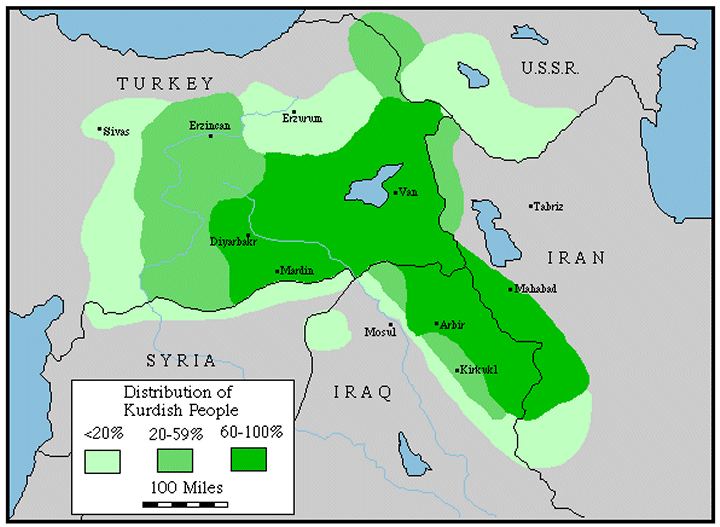
With Turkey on the brink of attacking Iraqi Kurdistan, one of the potentially great faultlines of the 21st century could be opened. There are 25 to 40 million people that call themselves Kurds. Their misfortune is to be scattered over rugged terrain in some of the most important countries of the Middle East. A Kurdish proverb says 'the Kurds have no friends but the mountains'. This is particularly true today when there is little enthusiasm in the wider world to support the merits of a separate Kurdish nation. The Kurdish nationalist party PKK is declared a terrorist organisation in the US, Europe and Australia.

While Kurds have some autonomy within Iraq, they remain a disadvantaged minority group in Iran, Syria, Armenia and Turkey. Although Iranian troops invaded Iraqi Kurdistan last year, it is the Turks who feel most vulnerable to the Kurdish threat. Turkey does not recognise its Kurdish minority and simply calls them “Mountain Turks”. Turkish Prime Minister Recep Tayyip Erdogan is now seeking approval from his parliament to launch an “incursion” into Iraq any time in the next 12 months.

This is no idle threat. In May, Erdogan called for an invasion of Iraq to seek out Kurdish militants and take what the Turkish foreign ministry calls “urgent and resolute measures”. It was in response to a suicide bombing in Ankara which killed six people and injured more than 100. The Turks identified Guven Akkus from Turkish Kurdistan as the culprit and said his methods were similar to those of Kurdish militants. The PKK have copped much of the blame even though there is no link between it and Akkus and it denied responsibility. One Turkish commentator described Akkus as a “Communist”.

While Turkey may be looking for an excuse to punish Kurdish militia, locals have promised a tough reception if they invade. A Kurdish rebel commander told AP on Saturday Turkey would face a long and bloody conflict if it launched an attack. Murat Karayilan, head of the armed wing of the PKK, said an invasion would "make Turkey experience a Vietnam war." "Iraq's Kurds will not support the Turkish army," he said. "If Turkey starts its attack, we will swing the Turkish public opinion by political, civil and military struggle."

The PKK was founded in 1973 and gets its initials from its Kurdish name, Partiya Karkeren Kurdistan (Kurdistan Workers Party). They first launched an armed independence campaign in Turkey’s southeast almost 25 years ago. More than 37,000 people have died in the ongoing violence with deaths spread evenly between the two sides. Turkey launched a major military crackdown in 1999 and captured PKK leader Abdullah Ocalan causing 5,000 fighters to flee to Iraq. The PKK is not entirely welcome in Iraqi Kurdistan. There are already two Kurdish factions in Iraq which exist in an uneasy power-sharing relationship. The PKK operates as a Pan-Kurdish organisation that rejects Iraqi Kurdish efforts to remain within Iraq.

The 25 million Kurds are not necessarily politically united. They are spread across eastern Turkey, northern Iraq, western Iran, and parts of Syria and Armenia. 12 million live in Turkey. The 1920 Treaty of Sevres which fixed Turkey’s border after World War I included the “possibility” of a Kurdish state but Turkish leader Kemal Ataturk rejected it three years later. From the 1980s, the PKK spearheaded a bitter armed resistance in Turkey's Kurdish southeastern provinces.

The PKK gained momentum in the 1990s with the rise of charismatic leader Abdullah Ocalan. But while his supporters call him "Apo" (Kurdish for "uncle"), the Turkish state calls him "child murderer" and "terrorist". Ocalan studied political science at Ankara university where he set up the PKK with fellow students. He left Turkey before the September 1980 military coup and remained in exile until 1999. He was controversially captured in Kenya, with the suspected help of Israel’s intelligence service Mossad. Turkey triumphantly paraded their prisoner in blindfold for the world’s media.

Since 1999, Ocalan has been held in solitary confinement as the only prisoner on Imrali Island in the Sea of Marmara, guarded by a thousand Turkish military personnel. He was found guilty of treason and sentenced to death. The sentence was commuted to life imprisonment in 2001. Ocalan appealed to the European Court of Human Rights. Turkey, mindful of the impact to its possible EU membership, agreed to await the court’s judgment. In 2005 the European Court of Human Rights decided Ocalan’s trial was unfair. However Turkey dismissed a retrial request last year.

While Ocalan festers on Imrali, his homeland is about to take a greater role on the world stage. Turkey has used the US congress stand on the Armenian genocide as an excuse to ignore calls for caution in Kurdistan. Now the price of oil has surged to a new record high of $84 a barrel as the crisis threatens some of the nearby oilfields. Analysts are worried that if Turkey attacks Iraq, the PKK will target the Iraq to Ceyhan oil pipeline and the Baku-Ceyhan pipeline. The “Mountain Turks” will soon find out how many friends they have.

Saturday, October 13, 2007

A history of the media in Iraq

Iraq celebrated Eid al-Fitr today, as did the rest of the Muslim world, to mark the end of Ramadan. The news of the day in Iraq sees the US defending its actions in a military airstrike on Thursday evening that killed 15 civilians in addition to the 19 insurgents it attacked near Tharthar Lake, about 120km north of Baghdad. US forces claim they were attacked first and “had no option but to return fire”. Rear Admiral Greg Smith said the killings were “regrettable” but defended the actions in fluent military language: “A ground element came under fire from that building that we had to neutralize”.

Or so Greg Smith’s words were reported in the New York Times. We only have the American side of this story. Iraq is used to a compliant media. For 23 years before the invasion, its state-controlled daily newspapers always had a photo of Saddam Hussein on the front and featured a paean of op-eds in praise of his policies by party apparatchiks. The story of Iraq’s press is examined in a chapter of a lively book about modern Iraq called “The New Iraq” by controversial young US academic Joseph Braude. Braude is of Iraqi-Jewish background and speaks Hebrew, Arabic, and Persian. He has lived and worked in Tehran, Dubai, and Egypt and spent extensive time in most Middle Eastern capitals. He studied Near Eastern languages at Yale and Arabic and Islamic history at Princeton. He is also an accomplished player of the Oud, a thirteen-string Iraqi version of the lute.

From 2000 to 2003, Joseph Braude served as Senior Middle East Analyst for Pyramid Research, a global consulting firm specializing in the telecommunications industry. He published “The New Iraq” in 2003 around the time of the invasion. In Slate’s review of the book, the magazine described him as a “carpetbagger” and a “breed of civilian who arrives in a newly occupied nation…sniffing around after the money to be made amid all the flux and ferment”.

While it is true that “A New Iraq” takes an ambivalent stand to the US invasion, Braude's critique of Iraq’s media is pertinent. He began by discussing one of Iraq’s unspoken problems: the sex trade. Many Iraqi girls have ended up in Amman, Jerusalem, Damascus and other Middle Eastern capitals where they are rented out by the hour. It has been a story studiously ignored by the Iraqi media. The only time it ever made front page headlines was in 1990 on the eve of the Kuwait invasion when Saddam himself declared that country had enslaved Iraqi women. “The glorious Iraqi woman has come to be sold for one dirham,” he said.

But it wasn’t until after the hyperinflation that followed the 1991 Gulf War that the sex trade really took off. In 2002, Qatari station Al Jazeera broke open this taboo subject across the Gulf in its weekly show “Just For Women”. But it only covered the situation in Turkey and only obliquely discussed the problems in the “granteur states” which was shorthand for the Arab peninsula. Braude said that as of 2003, Saddam remains the only Arab ruler to ever shame a Gulf country by name for the practice.

Braude then harked back to a 9th century Basra born social commentator and essayist called Al-Jahiz. When al-Jahiz moved to Baghdad, the then capital of the Abbasid Empire, he acquired a reputation as a gifted writer and intellectual. He was an independent voice on local politics and expressed an embryonic theory of evolution about a thousand years before Darwin. He also wrote “The Book of Singing Slave Girls” which talked about the ancient trade from both the points of view of the masters and the slaves.

If Al-Jahiz was a proto-journalist, the first real newspapers existed in Iraq by 1816. In that year, westerners first reported the existence of a local news bulletin called “Jurnal al-Iraq” printed in both Arabic and Turkish. It discussed mostly local affairs and survived probably because it took a pro-Ottoman stance. If true, the Journal of Iraq would be the world’s first Arabic newspaper but unfortunately no copies of the bulletin survive to prove the theory.

The first newspaper in Iraq for which there are extant copies is the 1869 weekly called “al-Zawra” (Arabic for “The curved [city]”). The then Pasha of Baghdad had previously been the Ottoman ambassador to Paris and he took back a printing press to Iraq. Like the earlier "Jurnal", it too was a mouthpiece for the administration but also had stories about the advent of electricity and the importance of eating fruit and vegetables. Today Iraqi journalists celebrate “press day” on 15 June each year, which marks the first issue of Al-Zawra in the year 1869.

The first signs of press independence occurred after the Young Turks had shaken up the decaying Ottoman Empire with a new constitution in 1908. By 1914, 70 publications arose in Iraq to take advantage of the new press freedoms, many critical of the regime. This permissive policy did not last and first the Ottomans, and the British (who inherited the Iraqi mandate after World War I) closed nearly all of these newspapers.

There was also antagonism from the mullahs. Several preachers railed against the media citing Muhammad calling on believers to “avoid gossip, wasting money and asking too many questions” which seemed to describe journalists to a tee. But they needed not have worried too greatly about press influence. As late as 1947, Iraq had a literacy rate of just 11 percent. It wasn’t until Saddam’s regime that this problem was fully addressed.

The British used their time in Iraq to start newspapers of their own and explain their reasons for occupation. In opposition, a paper appeared in the Shi’ite holy city of Najaf with a mission to “respond to the occupiers’ deception, to disquiet them, [and] to reveal their barbaric misdeeds”. Al-Istiqlal (“Independence”) would remain a thorn in the side of the British until they relinquished their claim to the country in 1932.

In the newly formed Iraq, al-Zarman (“Time”) founded in 1937 won a quick reputation for objectivity. But after the assassination of King Faisal II and the consolidation of one-party rule in 1958, Iraq brought an end to press freedoms. Censorship escalated through the 1960s and in 1969 the media (now complete with state television) was formally co-opted as a fourth branch of government. With deputy president Saddam pulling the strings in the background, the media was given a new purpose: to win over the hearts and minds of the masses to Ba’athism.

Top journalists quickly climbed the ranks of the administration. Iraq’s foreign minister during the 1991 war, Tariq Aziz, was a previous editor of al-Thawra (“the revolution”). But Iraqis themselves grew to distrust the ceaseless propaganda coming from their state-run media. During the 1991 bombing of Baghdad, Iraqi radio played a constant stream of music and worried citizens had to turn to American Radio Liberty and the BBC Arabic service to find out what was happening.

Saddam also tried to limit the spread of satellite dishes and the Internet in Iraq. To be caught with a satellite dish could invite a five-year jail sentence. Internet access was limited to a few cafés in three major centres of Baghdad, Basra and Mosul and priced beyond the means of most Iraqis. Braude expressed the hope that returning Iraqis would lead an information revolution in the time beyond Saddam. That hope remains forlorn while journalists are in the frontline of the war. The 2007 Reporters Without Borders annual report for Iraq made 2006 the bloodiest year yet for media workers since the war with at least 65 dead. And the culture of blaming the messenger continues: the al-Maliki government regularly threatens to shut down media outlets it blames for “inciting violence.”