Showing posts with label Mexico. Show all posts

Tuesday, September 15, 2009

Norman Borlaug: forgotten benefactor of humanity is dead

The father of the green revolution, Norman Borlaug, has died in Texas. He died at his home in Dallas on Saturday due to cancer complications. He was 95. Borlaug was an agricultural scientist who won a Nobel Peace Prize for his role in combating world hunger and saving hundreds of millions of lives. Thanks to the green revolution, world food production more than doubled between 1960 and 1990 and his work was feted in a 2006 book entitled The Man Who Fed the World.

Borlaug was no great fan of the phrase Green Revolution which he described as a “miserable term” but his high-yielding crops saved many parts of the world from famine in the 1960s. Kenneth Quinn, President of the World Food Prize, said the world had lost a great hero. “Dr. Borlaug’s tireless commitment to ending hunger had an enormous impact on the course of history,” he said. “He will be remembered with love and appreciation around the globe.”

Norman Ernest Borlaug was born in Saude, Iowa in 1914 to parents of Norwegian stock. Borlaug left the family farm to study at the University of Minnesota where he obtained a Bachelor of Science degree in 1937 and gained some fame as a champion wrestler. Borlaug continued studying and got a PhD in plant pathology and genetics in 1942. During the war, Borlaug worked at a military lab where he helped develop a glue that stopped food containers rotting in saltwater.

In 1944 he went to Mexico to work for an agricultural development program run by the Mexican government with support from Washington and the Rockefeller Foundation. He would spend the next 40 years of his life on this project. Borlaug looked at the problem of cultivating wheat which was susceptible to the parasitic fungus known as rust. He experimented with double wheat seasons and dwarf plants which were disease resistant and gave higher yield. By 1963 nearly all of Mexico’s wheat came from Borlaug varieties. The harvest had grown sixfold in two decades and Mexico was now a net exporter of wheat.

Borlaug’s success attracted interest in the sub-continent. At the time India and Pakistan were at war with each other and both were close to widescale famine. India was importing huge quantities of food grains from the US. In 1965 Mexico exported a large quantity of wheat to both countries with almost immediate effect. Pakistan’s wheat yield doubled in five years and India became self-sufficient in ten. He then took those varieties, and improved strains of rice and corn, to Asia, the Middle East, South America and Africa.

For his work, his ancestral nation of Norway awarded him the Nobel Peace Prize in 1970. Accepting the honour, he said the destiny of world civilization depended upon providing a decent standard of living for all. He said "green revolution” was too broad in scope and only wheat, rice, and maize yields had increased. He compared the forgetfulness of the West and its abundance with the underprivileged billions in the Third World for whom “hunger has been a constant companion, and starvation has all too often lurked in the nearby shadows.”

With his reputation safely established, Borlaug continued to press for improvements across the developing world, especially Africa. He helped found the Sasakawa Africa Association in the early 1980s to improve African food production. With the help of local researchers he concluded that the existing products and information could greatly expand the African food production, but the improved technologies were not reaching the smallholders who produced most of Africa's food, and the extension systems were failing to link research to farmers.

But while his work was greatly respected in Africa and Asia, he remained almost unknown in his homeland. Writing in 1997 in The Atlantic Online, Gregg Easterbrook said that the US had three living Peace Prize winners of which two were household names (Elie Wiesel and Henry Kissinger) and the other was Borlaug. Easterbrook suggested that one reason for Borlaug’s anonymity was the fact that his life and work were done in developing nations far from the media spotlight. But he added a second more sinister reason: “More food sustains human population growth, which [critics] see as antithetical to the natural world.” Most of the criticism of Borlaug’s work has been around environmental concerns not humanitarian. These relate to large-scale factory farming which is biased towards agribusinesses as well as issues with inorganic fertilisers and controlled irrigation causing environmental stress. Borlaug never resiled from these arguments and said high-yield farming actually helps preserve natural habitats.

Borlaug remained active in his older years. In 2006 he was awarded America’s highest civilian honour, the Congressional Gold Medal. His long-time colleague and friend Professor M.S. Swaminathan called him one of the greatest Americans and humanists of all times. In his acceptance speech, Borlaug stressed the importance of continuing the fight against hunger. "We need better and more technology, for hunger and poverty and misery are very fertile soils into which to plant all kinds of 'isms,' including terrorism," he said.

Wednesday, July 04, 2007

Carlos Slim: world’s first trillionaire?

Carlos Slim has replaced Bill Gates as the world’s richest man, according to a Mexican financial journal. Online financial publication "Sentido Comun" (Common Sense) claims that businessman Slim is now worth an estimated $US67.8 billion. In 2006 Forbes rated Slim, who controls most of Mexico’s telecommunications industry, as the world’s third richest man however Sentido Comun now says that a 27 per cent surge in the share price of his telecommunications company America Movil has pushed him ahead of both Gates and Warren Buffett. At his current rate of financial expansion, Slim could be the world's first trillionaire as early as next year.

Slim has had a stellar year so far increasing his wealth by a staggering $3.5 billion each month. As well as seeing success with America Movil which is the predominant wireless operator in Latin America, his other main company Telmex (which has cornered the Mexican market in fixed line telephones) is up 34 per cent this year. His bank Inbursa also saw its stock jump by 20 per cent.

Carlos Slim Helu is a 67 year old native of Mexico City. His father Julián Slim Haddad Aglamaz was a Lebanese Maronite refugee who fled to Mexico in 1902. Julián established a dry goods store and prospered in real estate. When he died, he left a large inheritance to his six children. Carlos was born in 1940, the youngest of the six. He used his share of his father’s money to enter business after graduating from the Universidad Nacional Autónoma de México in 1961 with a degree in engineering. Slim dabbled in a number of different companies across many industries including telecommunications, retail, banking and insurance, technology, and auto parts manufacturing.

Slim had the happy knack of finding undervalued companies and making them profitable. This ability earned him the tag of "Warren Buffett of Latin America." When he bought Telmex he was criticised for immediately raising phone costs. However he also improved phone services by offering local and long distance calls, mobile phone services, internet services, and a telephone directory. His empire now includes telephones, cigarettes and parts for crude oil platforms.

It is difficult to live a day in Mexico without buying one of his products. Mexicans use electricity carried by his Condumex brand cables, drive on roads paved by his CILSA construction company firm and burn fuels pumped from his Swecomex drilling platforms. They communicate through Telmex phone lines, smoke Slim's tobacco sold under the Marlboro brand, and shop at Sears Roebuck of Mexico, a subsidiary of his Carso Group.

Slim’s wealth is now worth 6.3 percent of Mexico's annual economic output. This in a nation where per capita income is less than $6,800 a year and half the population lives in poverty. His critics describe him as rapacious monopolist who built his empire on suspicious ties to Mexican presidents and other politicians. He owns 90 percent of the landline phone business, and 73 per cent of the mobile market. Although often portrayed by Mexican media as a gluttonous, insatiable tyrant, his supporters counter these claims by pointing out he has never been investigated or charged of bribery, peddling influence or any other scandal.

Nonetheless Slim has faced increasing criticism from many quarters in Mexican society In Mexico’s 2006 federal election, the leftwing candidate Andrés Manuel López Obrador claimed he would remove unfair privileges of elites such as Slim. Some doubted Obrador’s claim given that he had worked closely with Slim to re-generate Mexico City’s central district when he (Obrador) was mayor. In any case, Obrador lost the election. Of perhaps more concern to Slim was the criticism by Mexico's Central Bank chief Guillermo Ortiz. Ortiz complained that despite ten years of deregulation, Slim’s monopolistic telephone company cramped the nation's competitiveness by charging some of the world's highest rates.

Like fellow multi-billionaires Gates and Buffett, Slim will now face even greater pressure to give away more of his wealth. Slim has responded with a PR campaign centred around $4 billion in charitable donations and scholarships. Slim is also developing a plan for propelling Mexico out of economic stagnation called the Chapultepec Accord. His idea is to push "the development of Latin America through the development of human capital and structural investment." Damien Fraser, chief Latin America equity strategist at UBS Warburg, says the move is half altruistic and half self serving. “Mexico has become a much more democratic country, so it's no longer sufficient to have a good relationship with the president and the finance minister to make things work the way you want,” he said. “You need to have many more levers of power."

Wednesday, June 27, 2007

Oaxaca Rising

The Mexican Supreme Court has appointed a second commission this week to investigate over a thousand human rights violations in last year’s uprising in the Southern state of Oaxaca. This commission will examine armed attacks that occurred between May 2006 to January 2007 in which at least two dozen people were killed, 300 people wounded and 575 arbitrarily detained. It will act on the results of the first commission which received 1,352 justified complaints of rights violations, mainly for excessive use of force or improper treatment of suspects by local and federal police.

The uprising started out as a strike by teachers who were later joined by hundreds of social organisations in a mass demonstration against the State’s Governor and his irregular army. Together they formed an alternative government called the Popular Assembly of the People of Oaxaca (APPO). Demonstrators hijacked and burned buses to create roadblocks and barricades and chased police out of the city. The Oaxaca uprising brought economic and tourist activity virtually to a halt for months.

Oaxaca has been the personal fiefdom of Ulises Ruiz Ortiz (also known as “URO”) since he became governor of Oaxaca in 2004. He tried to prevent the commission from being instituted and is now the subject of renewed protests. Hundreds of delegates of social movements in the state have occupied the central square of the state capital (also called Oaxaca) in a week-long vigil, and are now threatening to take more radical actions if their demands are not addressed.

Those demands include URO’s resignation and the release of dozens of activists from the first uprising who remain in jail on charges that include property damage. URO has refused to accede to any demands so far. The latest protests have not appeared to interfere with the slowly recovering tourism trade, the city's lifeblood.

The current protest resembles how the first one started. Back in May 2006, the teachers’ strike began and some of them brought their protest to the central city square which they occupied. URO refused to accede to their demands. Instead he counter-attacked. The protesters were sleeping in the square on the night of 14 June when he sent riot police to smash the protest.

They were accompanied by dogs who viciously attacked the sleeping teachers and supporters. Police tear-gassed everyone in the vicinity, including pregnant women and children; one woman miscarried as a result. Ninety-two people were wounded. Members of the community reacted with outrage, fighting back with anything they could find. They chased the police from the square, and re-established the camp. The incident became the spark for the creation of APPO, which comprised almost 350 different civil organizations working in areas of indigenous issues, sustainable community development, human rights, and social justice.

After 14 June, the protest escalated as did the body count. URO then sent heavily armed police officers dressed as civilians to attack protestors throughout the capital. Video footage identified assailants as municipal police officers and ruling party officials. No-one was charged for any crimes. Among the dead was a 36 year old US journalist and activist named Bradley Roland Will.

Brad Will was an Indymedia filmmaker from New York who was killed while filming a clash between demonstrators and gunmen. Will travelled to Mexico on a tourist visa which violated Mexican law. In October he was videotaping near a pro-strike barricade when gunmen approached shot him and two local protesters Esteban López and Emilio Fabián. Will died while he was being carried away from the area. The Committee to Protect Journalists sent an open letter to the Mexican attorney general calling on the federal government to launch an official investigation into Will's death.

Oaxaca has 3.5 million people and is Mexico’s second poorest state (just ahead of its neighbour Chiapas). According to the United Nations Development Programme (UNDP), has poverty levels similar to that of the Occupied Palestinian Territories. The state is governed by the Institutional Revolutionary Party (PRI) which ruled the country for most of the last 80 years. Mexican economic development policies have entrenched Oaxacan communities in a cycle of bare subsistence and poverty. Conditions on US bank loans and bailouts have seen drastic cuts in expenditures intended to raise rural incomes. Subsidies were slashed for necessities like electricity, bus fares, tortillas, petrol and milk.

The protests were mostly ended in November when Police (now under Federal control) again went on the offensive, making many arrests and clearing away APPO's last encampment in the city. While the teachers that started the strike are now back at work, their complaints remain. As well as pay and conditions, education in Oaxaca students presents peculiar obstacles for schools. Many natives speak only indigenous languages such as Mixteco and Zapoteco. Schools often rely on students who speak Spanish and a Oaxacan dialect to act as translators.

Saturday, August 12, 2006

Mexican election result still in doubt

Mexico’s federal political system remains in chaos waiting for the partial recount of the Presidential election. The official result of the July 2 election gave a narrow victory to the conservative Felipe Calderón (pictured left) over his left-wing rival Andres Manuel Lopez Obrador. On 6 July 2006 the Federal Electoral Institute (IFE) announced the final vote count resulting in the victory for Calderón over the PRD candidate Obrador. Calderón had won by a difference of 243,934 votes (or 0.58%)

However, under Mexican electoral law, only the Federal Electoral Tribunal (TEPJF) can declare who will serve as Mexico's next president. Lopez Obrador alleged electoral fraud and has led a mass civil disobedience campaign to demand a full recount. However independent and international observers said the election was fair. The TEPJF has declared a full recount as impossible by law, and has ordered a recount of about 9% of the total votes. Meanwhile thousands of Obrador’s supporters have been demonstrating for more than a week on the streets of Mexico City. Incumbent President Vicente Fox said Thursday that he is confident the country's disputed presidential election will be resolved peacefully and Mexican democracy will emerge stronger after its greatest test yet. The new president will serve a six-year term replacing Fox who could not constitutionally stand for re-election. Vincente Fox (whose father is of Irish descent) was the first president since Francisco Madero in 1910 to be elected from an opposition party. Fox and Calderon are both from the same party the National Action Party (PAN).

Felipe de Jesús Calderón Hinojosa will be 44 years old on August 18. He has three children under ten years old. He has a law degree and a masters in economics from Mexican universities and a master of Public Administration from Kennedy Business School at Harvard. He ran for governor of the Pacific state of Michoacán de Ocampo in 1995 and was PAN party president between 1996-1999. When Fox became president, Calderón was appointed director of a national development bank and later joined the Cabinet as Energy Secretary. He left the post in 2004 after Fox indicated his preference for a different candidate to replace him. However Calderón won the battle to become the PAN presidential candidate by a comfortable margin. He was forced to deny charges of corruption from his days as bank director. Although this hurt him in the polls, he recovered sufficiently to record a narrow lead on election day.

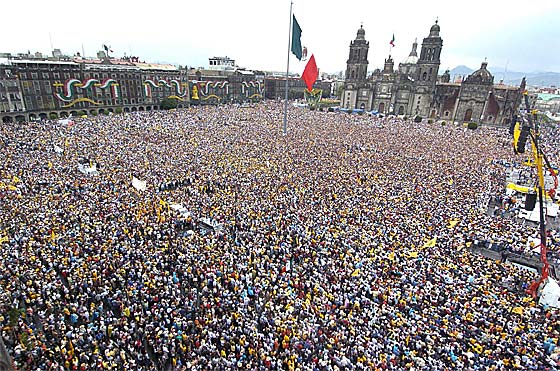
Soon after it was clear that the "Official Count" would result with Felipe Calderón ahead, Andrés Manuel López Obrador stated that he and his party, the Party of the Democratic Revolution (PRD), would fight for a "vote-by-vote" general recount. His party organised mass protests, marches, and civil disobedience which culminated in a massive rally in Mexico City's historic Plaza de la Constitución on 30 July. Estimates of the crowd at the rally range from 500,000 to 3 million. Obrador is 52 years old and comes from the southern state of Tabasco. He graduated from the most important university in Mexico, the National Autonomous University of Mexico, with a major in political and social sciences. In 1994, he ran for the governorship of his oil-rich home state, but lost to the PRI's Roberto Madrazo in a highly controversial election. The election was plagued by allegations of fraud. Then-President Ernesto Zedillo sent a committee led by lawyer Santiago Creel to investigate and investigators found irregularities at 78 percent of polling stations. Obrador recovered from this setback and he was mayor of Mexico City between 2000 and 2005. During this period he built up a major public profile which became the platform for his election campaign.

The election was also important because for the first time, Mexicans living abroad were allowed to vote by mail. However it is estimated that of the more than 11 million Mexicans living abroad, only four million have a voter identification card, a requirement that leaves out millions of potential Mexican voters, who reside in the United States illegally. Dr. Todd Eisenstadt, a visiting fellow at the Center for U.S.-Mexico Studies at the University of California-San Diego has claimed that only about 400,000 US votes will be cast in the 2006 election. If the recount does not change the result, Calderón will be formally proclaimed as president elect before serving for the period 1 December 2006 to 1 December 2012.