Showing posts with label Revolution. Show all posts

Monday, August 22, 2011

The fall of Muammar Gaddafi

“While it is democratically not permissible for an individual to own any information or publishing medium, all individuals have a natural right to self-expression by any means, even if such means were insane and meant to prove a person's insanity” – Muammar Gaddafi, The Green Book
(photo: @Politisite)

The Arab Spring has delivered a rich summer harvest. Libya is the latest domino to tumble joining his neighbours in Egypt and Tunisia and it not hard to believe Syria and Yemen might be far behind, despite the grandstanding of their own long-standing leaders. For now, it is difficult not to feel almost universal joy at the astonishing fall of Gaddafi. With the exception of members of the regime and maybe Hugo Chavez and Mahmoud Ahmadinejad, the world is rejoicing Gaddafi’s 42 year reign is over. It's a big moment. Gaddafi has been in power since man first landed on the moon, and of civilian leaders in the last century only Fidel Castro, Chiang Kai-Shek and Kim Il-Sung have lasted longer.

His overthrow has been supported by the left and the right though some on the left agonised hard over the NATO bombing campaign. That campaign now looks to be the crucial turning point when Gaddafi threatened to crush the rebellion in March. Then when matters drifted into a three month stalemate, NATO’s bombing of Tripoli in May proved the spark for the revolution. Gaddafi had lost the support of people on the ground, a mood the rebels sensed as they moved eastwards.

It was a long fall from grace. Gaddafi was reasonably popular at home in the 1970s and 1980s and loved among the European left for the way in which he thumbed his nose at the western establishment. Few loved him for his own eccentric political philosophies. Gaddafi’s Third International Theory was taken from the mishmash of aphorisms that is the Green Book which prognosticated on matters as diverse as breast feeding and genetic differences and attempted to steer the country in a middle (or muddle) path between capitalism and communism.

In the 1980s his willingness to help western resistance organisations such as the IRA and Red Brigades put him more on the outer leading to pariah status after the 1986 Berlin disco bombing and 1988 Lockerbie bombing. Yet his power internally was never threatened. By the 2000s, he was making a remarkable international comeback. In 2008 200 African kings and tribal leaders pronounced him “king of kings” and then more importantly African leaders and presidents (many of whom he trained in Libyan camps) made him head of the AU in 2009.

The West was also having a rapprochement with Gaddafi. Bush’s wars after 9/11 left the west needing allies wherever they could find them. Tony Blair killed two birds with one stone when he praised Gaddafi in 2004 for his support in the War while lobbying for a half billion dollar investment in Libya for Shell. In the end it was the oceans of oil that brought Gaddafi back in from the cold. Never anxious to give Britain a leg up when it comes to petroleum deals, the US normalised relations for the first time in 28 years under President Bush in 2008.

The west finally felt they could do business with Gaddafi. But it seems the Libyan public did not agree. Gaddafi stifled resistance by ensuring almost one in five Libyans worked as informants. Surveillance was a normal part of every workplace. Military service has been compulsory since 1984. Gaddafi has survived coup attempts in 1969 (barely two months into the job), 1975, 1977, 1985 and 1993 and having emerged from the military in a coup himself has abolished traditional military rank to avoid having to deal with a powerful leader caste.

Ultimately Gaddafi made enough enemies who just needed an excuse to act. The Tunisian actions lit the tinder and sparked a civil war that took the east easily but which met sterner resistance on the road to Tripoli. Gaddafi’s willingness to bomb his own people showed his tenacity to survive above all else. But as Juan Cole notes, once enough of his heavy weapons capability was disrupted and his fuel and ammunition supplies blocked, the underlying hostility of the common people to the regime could again manifest itself, as it had in February. While his exact fate remains unknown at the time of writing, Gaddafi is a dead man walking. It is a triumph for NATO. The template for military action should now be used in Syria which has also turned its military against its own population.

Saturday, August 13, 2011

Assad's moment of truth or dare

The Syrian city of Hama remains defiant despite a week-long assault by President Bashar al-Assad’s troops. On Thursday Syrian forces took Turkish journalists around the city to show them they were back in control. While the government claimed it was ridding Hama of “terrorists”, residents had a different story. They told of told of indiscriminate shelling by the army, snipers aiming at civilians and corpses piling up in the streets. Human rights groups say 1,700 people have died so far in the crackdown with casualties highest in Hama. (photo of Hama July protest:Wikipedia)

It is little surprise Hama should be at the heart of the revolution as it has long been a hotbed of anti-Ba’athist activity. Shortly after the Ba’athists first seized power in Syria in 1963, Islamic groups in Hama rose against the new secular regime. That rebellion was crushed as was another in 1982. Tens of thousands were killed in what became known as the Hama Massacre and parts of the city were flattened. There were echoes of that in July when 136 people were killed in Hama in the “Ramadan Massacre”. Syrian forces attacked demonstrators using tanks, artillery, and snipers.

Hama and Homs were among the earliest city to join this year’s Arab Spring but the two biggest cities Damascus and Aleppo (home to half the country’s population) have been mostly quiet. But that may be about to change. Reports just in from Al Jazeera north east Damascus is the focus of a major government offensive. As one protester puts it, the regime is feeling time is against it after strong Arab and international reaction against the crackdown. The security forces want to end anti-Assad protests within one or two weeks.

Assad belongs to the minority Alawite sect which has ties to Shia Islam. Alawites are 12 percent of Syria’s 22 million people but hold a vastly outsized portion of the high-ranking positions in the government and the military. Sunnis consider them heretics. When the French ruled in the early 20th century, they granted the Alawites their own state and they were autonomous Syrian independence in 1946. In the 1930s, the French rejected calls from Sulayman Al Assad against union with Syria. Since then, the Assad family has built its power in the Alawite political movement in Syria. When Hafez Al Assad seized power in an intra-party coup in 1970, most of the Alawite community lined up behind him. Hafez was a hardline ruler and it was he who authorised the 1982 Hama massacre. Bashar al Assad absorbed the lessons well after becoming president in 2000 on his father’s death.

Bashar was an accidental president. When his father died in June 2000, it only took hours for the Syrian parliament to vote to amend the country's constitution to allow al-Assad to become president lowering the age of eligibility of the president from 40 to 34. It had been elder brother Basil who was originally groomed as Hafez’s successor, and was chief of security. Meanwhile Bashar studied medicine in Britain, receiving a degree in ophthalmology, and headed the Syrian Computer Society. But in 1994 Basil was driving his Mercedes to the airport at high speed during a fog. He slammed into a roundabout and died instantly. Bashar was rushed home from London to rejoin the army.

The army remains Bashar’s greatest ally today. Like the president, most of the top brass are Alawite. Assad's brother Maher controls key military units packed with Alawite soldiers. One security expert told Reuters the regime had been careful about placing Alawite loyalists in all key positions. Some Sunni officers have risen to high ranks but have very little power to command troops. It is unlikely the army will switch sides any time soon.

If pressure has to be brought to bear, it must come from outside. The US added to its sanctions on Syria on 10 August to blacklist telco Syriatel and the Commercial Bank of Syria, a Syrian state-owned institution and its Lebanon-based subsidiary, Syrian Lebanese Commercial Bank. They add to existing sanctions including freezing assets and bans on business dealings, personal sanctions on Assad, as well as Syria's vice president, prime minister, interior and defence ministers, the head of military intelligence and director of the political security branch. Internally, the protests have reached a point of no return. As the Economist puts it, the savagery of the regime’s response has convinced protesters that the movement has to continue or face revenge of unimaginable proportions.

Tuesday, March 29, 2011

Whither Bahrain?

Libya is not the only Arabic revolution where outside forces have intervened; there are also foreign troops on the streets of Bahrain. But unlike Libya, the foreigners in Bahrain have come in on the side of the discredited regime. Occupying forces from Saudi Arabia and the UAE are helping the monarchy put down a rebellion with only a few hypocritical murmurs from the West and no sign of any UN-sponsored intervention in the rebels’ favour. With martial law in place after almost two months of protests, Bahrain has today brushed off a Kuwaiti offer to mediate with the rebels saying it wasn’t necessary. The detested al-Khalifa regime is set on a path of destroying the opposition while hoping the rest of the world is too distracted by events in Libya to do anything about it. (photo:AFP)

The Sunni Al Khalifa tribe has ruled Bahrain for almost 200 years, a rule cemented by British overlords and trade-based wealth in the 1800s. The majority Shia did not share in the general prosperity and remained second class citizens despite the implicit and sometimes explicit support of Iran. The discovery of oil ensured British meddling would continue for much of the 20th century. The struggle for supremacy in Bahraini affairs by both Britain and Iran continued until the country gained full independence in 1971. A 1973 constitution promised free elections (though for men only) but this was thrown out two years later by the then-emir Salman al Khalifa.

In the 1990s opposition forces came together to demand reforms from the ageing emir and a return to the 1973 constitution. For six years the streets were plagued with riots which were met by suppression by the regime The intifada did not end until the death of Salman in March 1999. Hamad bin Isa Al-Khalifa succeeded his father and immediately promised to carry out political reforms. On 14 February 2001 a referendum to carry out the National Action Charter to return the country to constitutional rule was overwhelming supported by 98.4 percent of the voters. The 2000s saw important progress including the enfranchisement of women and parliamentary elections in 2006 and 2010. But key problems remain including discrimination against the Shia and the all pervasive power of the al Khalifa caste.

Problems of powersharing were thrown firmly into the spotlight after pro-democracy demonstrations in Tunisia and Egypt hit the headlines in January. In Bahrain opposition was mobilised to demonstrate on the 10th anniversary of the signing of the National Action Charter on 14 February. Pearl Square in the capital Manama became the epicentre of resistance with protesters calling for political reform and equalisation of the economic benefits of Bahrain’s oil-rich economy. The reaction from the alarmed administration was swift. On 17 February a pre-dawn tank raid on the square killed 5 and injured 230 others. Soldiers placed roadblocks and barbed wire around the centre of town and leaders banned public gatherings.

The effect was to harden resistance. Talk of reform was replaced by talk of overthrow of the al Khalifas. The funerals of the dead turned into shrines of martyrdom with talk of 100,000 on the streets – about one eighth of the country’s population. Unity of opposition forces was marred by sectarian clashes between Sunni and Shia. Meanwhile panicky leadership cadres made some concessions by sacking extremist ministers while still authorising a shoot to kill policy on the streets.

On 14 March, the Emir had enough and called for support from his Sunni allies. Led by Saudi Arabia they answered the call. A thousand Saudi troops and 500 UAE police officers crossed the bridge to Manama. The invaders were part of a deployment by the Gulf Co-operation Council, a six-nation regional grouping of Bahrain, Saudi Arabia, Kuwait, Oman, Qatar and UAE. The force immediately set about protecting the oil and gas plants and financial institutions. According to al Khalifa, the troops were there “to look at ways to help them to defuse the tension in Bahrain.” But no one in the country was under any illusion this was anything but an occupation force to crush the revolution.

There was the inevitable bleating from the West but no sign of action to back it up. Hillary Clinton said Bahrain and its GCC allies were "on the wrong track” but mentioned nothing about the 5th fleet that remains in its Bahrain base protecting US oil wealth in the greater region. The Khalifas may not be loved by their subjects but the White House know a Shia government in Manama would not be accommodating to 4,500 US military personnel in the city. The Americans have nailed their colours to the mast. The Fifth Fleet is not there to create disorder but to preserve it. When the regime does fall, as it inevitably will, the Americans can have no complaints when they are kicked out.

Tuesday, March 15, 2011

Saleh becomining increasingly desperate in Yemen

Embattled Yemeni president Ali Abdullah Saleh has sacked one of his ministers as the month-long protests against his 32-year rule shows no sign of ending. Hamoud al-Hattar is the scapegoat for failing to find a way to deal with opponents who are demanding Saleh step down. Protesters in the capital Sana’a are fed up with a lack of democratic reform, widespread corruption and human rights abuses by Saleh, his family and allies. Saleh refuses to step down until his term of office expires in 2013. (photo:STR/ AFP/ Getty Images)

Yemeni authorities have deported four western journalists over their coverage of the protests. Security forces raided an apartment and arrested two British and two American journalists and kicked them out of the country. They follow the deporting of an American journalist and Italian photographer a day earlier. Briton Oliver Holmes said that said that one of the agents told him they were all being kicked out because of their coverage of the protests. “We have all been reporting on the use of violence by the police,” Holmes told Al Jazeera.

The flashpoint has moved to the north eastern Marib province where the governor was stabbed, police have opened fire on protesters, and rebels have blown up an important oil pipeline. Marib is a predominantly tribal area implacably opposed to Saleh’s regime. Saleh’s man in the province Governor Naji al-Zaidi was caught up in a large demonstration outside the local government building yesterday. Security troops fired live ammunition and tear gas, injuring around 37 people. In the melee, a group of men stabbed al-Zaidi and four bodyguards with daggers before he was flown by helicopter to a military hospital in the capital.

Meanwhil tribal fighters sabotaged an oil pipeline this morning and cut the road between the Marib’s gas fields and the capital. Local police said the pipeline connecting Marib's oil fields to the Red Sea was ablaze and the main road between Sanaa and Safer was cut off disrupting tanker traffic and jeopardising gas supplies to the capital.
There have been grumblings in the Arab world’s poorest country for several years over Saleh’s autocratic regime and the likelihood of an eventual transfer of power to his son Ahmed Saleh. His troubles are compounded by an insurgency by Houthi rebels in the north, a separatist movement in the south and a large Al Qaeda threat. But it took January’s Tunisian revolution to galvanise the opposition into action. Large street protests flooded the capital and Saleh offered reforms including presidential term limits and voter registration. The opposition and protesters rejected the proposals saying the reforms did not ensure that Saleh could not run again.

Emboldened by success in Tunisia and the overthrow of Hosni Mubarak in Egypt, protesters held a “day of rage” in early February. Unlike events in Egypt, the 20,000 strong Yemeni protest ended peacefully, though Saleh did make efforts to stifle them and his forces shot dead protesters in Aden. Protests continued through the month, gradually increasing in size and scope. Yemeni soldiers fired artillery at anti-government protesters in the northern village of Semla in Amran, killing two and wounding seven.

After his offer to form a national unity government was rejected, Saleh imposed a tight security cordon around Sana’a. His objective now is to stop more protesters joining 150,000 in the main square. They include tribesmen from Hamdan tribe who were angered when police killed one of their kinsmen. The Hamdan are not Saleh’s only headache. Sheikh Ameen al-Okaimi, chieftain of northern largest powerful tribe Bakil, staged a sit-in in Sana’a with a sign emblazoned "Welcome to the Liberation Land."

Where the protests have been most successful is in bringing Yemen’s deeply fractured opposition movements together. In the last election in 2006, Saleh’s ruling General People’s Congress took 76 percent of the vote with the umbrella group Joint Meeting Parties taking 21 percent. Now the JMP has united with the tribal and Islamist Islah party bringing most of the anti-Saleh forces under one banner. But the Hashid tribal confederation and Houthi rebellion forces remain outside the tent and it would be unclear what role if any they would have in any post-Saleh government. Indeed it is likely secessionist movements will continue to agitate regardless of who reigns in Sana’a.

Tuesday, March 08, 2011

The Ghost of Omar al-Mukhtar haunts Gaddafy

When Muamar Gaddafy made his first ever visit to Italy in 2009, he wore a ill-fitting, gold braided military uniform with an image of Omar al Mukhtar pinned to his chest. It was a pointed borrowing of the legacy of an older Libyan hero, whose face still adorns the Libyan ten-dinar note. Al Mukhtar was the Lion of the Desert, the Libyan resistance leader who fought a brutal Italian regime for 20 years and was hanged by colonial forces in 1931. (picture of the arrest of Omar al-Mukhtar from Wikipedia)

Like the current insurgents, al Mukhtar came from the east of the country, Cyrenaica, named for the city of Cyrene, the oldest and most important of the five Greek cities in the region. Cyrenaica was a part of the Ottoman Empire as al Mukhtar grew up but was claimed by Italy with Tripolitana and Fezzan who together formed modern Libya. The Italians launched an invasion of Libya in 1911 under the bogus claim of liberating it from the rule of the Sultans.

The Libyans weren’t fooled and organised by al-Mukhtar they fought a resistance that would last until World War II. For 20 years he was a thorn in the colonists side until Mussolini placed 100,000 Libyans in internment camps and closed the borders preventing foreign aid. In September 1931 Al-Mukhtar, then aged 70, was wounded in battle in the eastern town of Slonta and captured by the Italians. After a three-day trial, he was hanged and his last words were “to God we belong and to Him we shall return.”

After the war, Italy relinquished all claims to Libya which was one of the first African countries to gain independence in 1951. The former Emir of Cyrenaica, Sayyid Muhammad Idris was anointed as King Idris, head of a constitutional monarchy as the Libyan economy prospered with oil wealth. But Idris was increasingly disliked at home for his close ties to the US and UK. His vulnerability increased due to ill-health and the death in childhood of all of his male heirs (a female monarch was unthinkable). Purges against Palestinians, Jordanians, Lebanese and Syrians and internal Baathists did little to endear him to his people. On 1 September 1969, a group of officers acting under the name of the Revolutionary Command Council launched a coup while Idris was recuperating in Turkey.

Seven days later the new cabinet was announced. The commander in chief of the armed forces was named as Colonel Muammar Gaddafy, then 27. The monarchy was abolished and the Libyan Arab Republic was proclaimed. Initially the Americans believed they could work with the new ruler and killed a secret British plan to restore the king with the aid of mercenaries. Slowly the cult of personality took over. The Idris portraits were banished and even the worshipped iconography of al-Mukhtar took a back seat to the new Lion of the Desert. Gaddafy was supported by Nasser as Egypt provided advisers and advice on media, propaganda and use of the security apparatus.

As Mohamed Eljahmi noted in the Middle East Quarterly in 2006, Gaddafy used various means to hold on to power. He made it a criminal offense to proselytise against the state, to arouse class hatred, to spread falsehood, or to participate in strikes and demonstrations. He instituted an Islamisation and Arabisation campaign to rid the country of Western influence. He removed European street signs, banned alcohol, closed US and UK bases, and expelled foreigners and Jews. He converted Tripoli's cathedral to a mosque and Benghazi's cathedral to a headquarters for the Arab Socialist Union. He even forced the Italian community to exhume the remains of their dead to take back to Italy, an event he televised live.

Gaddafy’s sponsorship of international terrorism brought the wrath of the Reagan administration in 1986. He narrowly survived the bombing of Libya after being tipped by the Prime Minister of Malta who told him unauthorised aircraft were flying over Maltese airspace heading south towards Tripoli. He also won the subsequent propaganda war inventing the death of an adopted daughter which was swallowed whole by western media. Libyan isolation grew in the 1990s after Gaddafy’s agents were blamed for the Lockerbie disaster.

It wasn’t until George W Bush’s executive order 13477 in October 2008 the Gaddafy regime finally came in from the cold. Libyan oil revenues were too lucrative to ignore and American and European energy companies lined up to do business with him. The West ignored the fact his behaviour was becoming increasingly erratic. No one paid attention to the growing internal grumblings. The National Conference for the Libyan Opposition was founded in 2005 in London but could not mobilise in Libya until the protests started last month. Then the people power revolutions spread across the border from Tunisia and Egypt and quickly escalated into civil war.

Gaddafy claims he is fighting against Al Qaeda, though in truth Al Qaeda were caught as flatfooted as Western leaders by the speed of the revolution. The wheel has now come full circle with Omar al-Mukhtar’s 90-year-old son coming out in support of the opposition. “I was proud to be there. I went to help raise their morale,” he told the Irish Times. “There was a lot of cheering when they saw me because of my father’s legacy.” Asked how his father might view the situation if he were alive today, his son replied: “[He] loved Libya. He would have a similar position to mine for the benefit of the country.”

Wednesday, June 27, 2007

Oaxaca Rising

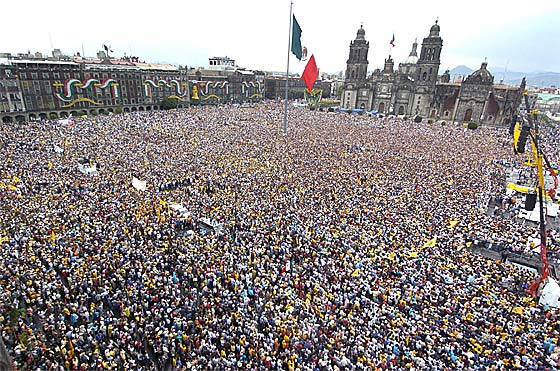
The Mexican Supreme Court has appointed a second commission this week to investigate over a thousand human rights violations in last year’s uprising in the Southern state of Oaxaca. This commission will examine armed attacks that occurred between May 2006 to January 2007 in which at least two dozen people were killed, 300 people wounded and 575 arbitrarily detained. It will act on the results of the first commission which received 1,352 justified complaints of rights violations, mainly for excessive use of force or improper treatment of suspects by local and federal police.

The uprising started out as a strike by teachers who were later joined by hundreds of social organisations in a mass demonstration against the State’s Governor and his irregular army. Together they formed an alternative government called the Popular Assembly of the People of Oaxaca (APPO). Demonstrators hijacked and burned buses to create roadblocks and barricades and chased police out of the city. The Oaxaca uprising brought economic and tourist activity virtually to a halt for months.

Oaxaca has been the personal fiefdom of Ulises Ruiz Ortiz (also known as “URO”) since he became governor of Oaxaca in 2004. He tried to prevent the commission from being instituted and is now the subject of renewed protests. Hundreds of delegates of social movements in the state have occupied the central square of the state capital (also called Oaxaca) in a week-long vigil, and are now threatening to take more radical actions if their demands are not addressed.

Those demands include URO’s resignation and the release of dozens of activists from the first uprising who remain in jail on charges that include property damage. URO has refused to accede to any demands so far. The latest protests have not appeared to interfere with the slowly recovering tourism trade, the city's lifeblood.

The current protest resembles how the first one started. Back in May 2006, the teachers’ strike began and some of them brought their protest to the central city square which they occupied. URO refused to accede to their demands. Instead he counter-attacked. The protesters were sleeping in the square on the night of 14 June when he sent riot police to smash the protest.

They were accompanied by dogs who viciously attacked the sleeping teachers and supporters. Police tear-gassed everyone in the vicinity, including pregnant women and children; one woman miscarried as a result. Ninety-two people were wounded. Members of the community reacted with outrage, fighting back with anything they could find. They chased the police from the square, and re-established the camp. The incident became the spark for the creation of APPO, which comprised almost 350 different civil organizations working in areas of indigenous issues, sustainable community development, human rights, and social justice.

After 14 June, the protest escalated as did the body count. URO then sent heavily armed police officers dressed as civilians to attack protestors throughout the capital. Video footage identified assailants as municipal police officers and ruling party officials. No-one was charged for any crimes. Among the dead was a 36 year old US journalist and activist named Bradley Roland Will.

Brad Will was an Indymedia filmmaker from New York who was killed while filming a clash between demonstrators and gunmen. Will travelled to Mexico on a tourist visa which violated Mexican law. In October he was videotaping near a pro-strike barricade when gunmen approached shot him and two local protesters Esteban López and Emilio Fabián. Will died while he was being carried away from the area. The Committee to Protect Journalists sent an open letter to the Mexican attorney general calling on the federal government to launch an official investigation into Will's death.

Oaxaca has 3.5 million people and is Mexico’s second poorest state (just ahead of its neighbour Chiapas). According to the United Nations Development Programme (UNDP), has poverty levels similar to that of the Occupied Palestinian Territories. The state is governed by the Institutional Revolutionary Party (PRI) which ruled the country for most of the last 80 years. Mexican economic development policies have entrenched Oaxacan communities in a cycle of bare subsistence and poverty. Conditions on US bank loans and bailouts have seen drastic cuts in expenditures intended to raise rural incomes. Subsidies were slashed for necessities like electricity, bus fares, tortillas, petrol and milk.

The protests were mostly ended in November when Police (now under Federal control) again went on the offensive, making many arrests and clearing away APPO's last encampment in the city. While the teachers that started the strike are now back at work, their complaints remain. As well as pay and conditions, education in Oaxaca students presents peculiar obstacles for schools. Many natives speak only indigenous languages such as Mixteco and Zapoteco. Schools often rely on students who speak Spanish and a Oaxacan dialect to act as translators.