Showing posts with label Malaysia. Show all posts

Sunday, July 26, 2009

Citizens bite: Part 2

“Everyone, from journalists to the people we cover to our sources and the former audience, must change their ways. The alternative is just more of the same” – Dan Gillmor (We the Media).

And speaking of changing ways, I must begin with a correction. I gave the impression that Brisbane media did not attend the Citizen Byte new media symposium in Brisbane yesterday. That simply wasn't true. Graham Young (OnLine Opinion, Ambit Gambit, What the People Want) was an invited speaker and there was also Wotnews.com.au and Woolly Days. I have since found out that other journalists and academics would have attended with more notice. In any case, the proceedings were filmed and I hope will be available in the public domain soon enough.

Citizen Byte is a community research project whose stated purpose is to “examine what the implications of the new media environment are on politics and the political sphere both in Australia and in Malaysia.” One of those implications was that new media was having a bigger impact in Malaysia than it was in Australia. Last night I discussed the role of keynote speaker Steven Gan. The editor of Malaysiakini is the “new media” go-to person for the White House and the New York Times and he has transformed a small online venture into Malaysia’s most popular news site. But tonight I want to discuss some of the other Malaysian wisdom on offer at the symposium. Tomorrow I will conclude with some great observations by the conference’s only Australian speaker, Graham Young.

Not the least wisdom came from a member of Malaysia’s media elite: Datuk Azman Ujang. Datuk Azman is chair of the Malaysian Press Institute and the Editorial Adviser at both national news agency Bernama and its broadcasting arm Bernama TV. He took up the latter two jobs having retired as overall GM of Bernama. Datuk Azman is an experienced powerful insider who can get away with calling a spade a spade in the corridors of power. He told his Brisbane audience how the government admonishes him for being “too honest” but it does not dare censure him further. Yet even he was disturbed by the last election result which he said was a wake-up call for the media as well the government. Datuk Azman said that entrenched government support within the media has resulted in biased news for 50 years. The arrival of new media suddenly made their credibility a marketplace issue for urban voters. Malaysiakini took up the challenge and inspired other news portals. Meanwhile opposition politicians took to blogging in numbers to enhance their appeal with younger audiences and crash through their lack of coverage in the MSM. They also used the world’s highest mobile penetration to good effect to spread viral political messages.

But most of the villages don’t have the Internet or mobile phones and the government won the election overall 60:40. The poorer states, particularly East Malaysia voted for BN. There is entrenched corruption in Sabah and Sarawak that has survived for half a century which KL turns a blind eye to. And the government uses regulation of the broadcast spectrum and annual licensing of newspapers to keep the media in check. Datuk Azman said there were “unwritten laws” which depended on the circumstances and mood and attitude of the government at a particular time.

Mohd. Zulkifli was the next to speak. Zulkifli is a content manager at Media Prima Berhad. Media Prima Berhad is Malaysia’s largest media company with a diversified portfolio of assets including four free-to-air TV channels. Zulkifli is bringing the power of new media to bear on many of those assets. He said audiences had to register to his websites but the content was free. 838,000 Malaysians have signed up.

Zulkifli says their biggest differentiator is video content but they are also providing Tweetdecks, SMS alerts (with video alerts starting next month), streaming content on mobiles, as well as interacting with television shows in innovative ways that would please fan theorists like Henry Jenkins.

Their websites are full of blogs and online discussions with network stars and there are discussion rooms where audiences can go to have their say and possibly affect the plots of soap operas. There is also an “Indie showcase” channel that deliberately attempts to “push the boundaries of censorship”. In 2007 Berhad released Malaysia’s first made-for-web drama. “Kerana Karina” or KK tells the story of overnight pop star Karina in 20 four-minute episodes. Though he didn’t mention in the speech, Zulkifli took time out from his day job to write the lyrics to the KK theme song.

What he did mention was that Berhad’s investment in new media (including 60 staff) is starting to pay off. The most popular site TV3.com gets 41 million hits each month. His job is to keep the revenue high otherwise, he said, he “wouldn’t be here next year”. Zulkifli says that social media is the big challenge of the next couple of years. Somehow, I don’t expect him to fail this challenge - Mohd. Zulkifli is definitely not “more of the same”.

Friday, July 24, 2009

Malaysiakini editor speaks in Brisbane

When Barack Obama’s campaign team and the New York Times online editor were scouring Asia-Pacific for innovative ways to harness the power of new media, they avoided Australia. There was little going on here they did not already know. Where they did go to was Kuala Lumpur, Malaysia, which is home to some of the most cutting-edge use of media in the world. The person both organisations sought out was journalist and editor Steven Gan. Gan is the editor of Malaysiakini (MK) an online citizen news service that has become the most trusted media organisation in the peninsula. MK publishes in Malay, Chinese, English and Tamil and has also expanded into video.

Today, Brisbane was fortunate enough to host Gan and several other key Malaysian new media players at an all-day symposium called “New Media and the Informed Citizen” at the Queensland Conservatorium of Music in Brisbane’s South Bank. The conference outlined the vibrancy of the industry in Malaysia in front of audience of about thirty people and it was a shame more people in Brisbane didn’t get the chance to listen to how the media is being shaped in new directions in our part of the world.

“Malaysiakini” means Malaysia Now and celebrates its tenth anniversary in November. Up to around 1998 the Malaysian Barisan National (BN) government (which has ruled since independence in 1957) had a monopoly on news in cyberspace. But after visiting Silicon Valley, Prime Minister Mahathir Mohamad introduced the Multimedia Super Corridor (now MSC Malaysia) to kickstart the local IT industry. One of things Bill Gates and others told Mahathir was that he should not censor the Internet. While Mahathir had misgivings (particularly over pornography) he saw the business benefit and agreed. Malaysiakini rose to exploit the loophole, starting up with just four journalists.

But despite the liberal censorship rules (by Malaysian standards) the new publication still attracted the unwelcome attention of authorities. In January 2003, police raided the offices of MK looking for details of an anonymous letter writer who satirically compared a politician to the Ku Klux Klan. The politician was not amused and sent police in to find out the identity of the letter writer. Gan, as any good journalist would do, refused to divulge his source. Police seized four servers and 15 central processing units from its office and interrogated Gan and senior staff. The move provoked an outcry with spontaneous protests outside the office and led to a coalition of groups condemning the raid. Police never formally raised charges and returned the now obsolete boxes two years later.

MK continued to grow as its attacks on government corruption attracted a new readership unhappy with the servile nature of Malaysia’s mainstream press. In 2006 they broke the Petronas story over lies the oil company boss told about its activities in Sabah. The following year they took on Abdul Taib Mahmud the long-term corrupt leader of Sarawak over logging kickbacks to Japanese shipping firms. And last year MK played a pivotal rule in the general election (where the MSM all supported the government) and BN had its worst result in 50 years, losing control of five states.

MK now employs 30 journalists and has moved into video at www. malaysiakini.tv. They have also trained up a team of citizen journalists and provided them with video cameras to report on local news across East and West Malaysia. MK grew steadily with a subscription only model ("go subscription" was the advice he gave the NYT) and a large bed of content.

As the election got closer in 2008, Gan made an important decision. He opened up the site for free for the entire period of the election. By the time of the vote on 8 March it had overtaken The Star newspaper as Malaysia’s most popular political site. Gan called the election a tsunami that almost completely overturned Malaysia’s political system (a later speaker said it wasn’t a new chapter in Malaysian politics – it was a new book).

Thanks to a corrupt government and the biased MSM, Malaysiakini has now established itself as the most trusted media brand. It brought in thousands of new subscribers after the election. The badly shaken BN government admitted they lost the Internet war and have now started to negotiate with MK and the other online outlets.

MK is now a thriving media organisation that has made a profit in each of the last four years. Gan says they were lucky they started their subscription model early. And after the election he says that big advertisers have started to take notice. He described one of his proudest moments as a video they released of a “nude ear-squat” form of prisoner punishment the government claimed had not been used in decades. The video scandal caused a Royal Commission to be set up to investigate the affair. “A half minute video changed practices that were going on for years," he said.

Tuesday, June 23, 2009

From Burma to Brisbane: A tale of Rohingya resilience

Sujauddin Karimuddin apologised unnecessarily for being late meeting me for a coffee. He was delayed next door at the Mater Hospital where a woman was having complications after the birth of her baby. The woman was a Burmese refugee and it was Sujauddin’s job to translate symptoms and orders between doctor and patient. All in a days work for a remarkable young man who himself was a refugee for many years.

Both Sujauddin and the woman in the hospital are Rohingyas, a mostly Muslim people that have been persecuted for decades by Buddhist Burmese military rulers. The notorious 1982 Citizenship Act stripped them of their right to be Burmese. At a stroke of dictator Ne Win’s pen, a people who had lived in north-west Rakhine (formerly Arakan) province for centuries were declared unpeople who had no right to jobs, land, marriage or travel papers.

Sujauddin went to High School in the early 1990s suffering under this injustice. As he admits, he was one of the lucky ones. His father was a wealthy businessman in the sugar town of Kyauktaw and could bribe his way out of most problems. But even he had been arrested on several occasions for minor misdemeanours. Sajuaddin became involved in Rohingya support groups at school and wrote complaint letters to school and government authorities. He was arrested by military intelligence and charged with raising funds for armed groups in Bangladesh. His father came to the rescue and bribed authorities to get him out. But his mother could see the writing on the wall. She advised her son to get out while he could.

Sujauddin left his home town in 1998 and has never been back. Travelling without papers, he made the dangerous journey to the capital Rangoon by boat and truck. Hundreds were arrested on this known refugee route and Sujauddin was picked up at a military checkpoint 100km from Rangoon and sent to a prison camp. Here he had a stroke of good fortune. A new commander from up north was unaware he was a Rohingya and asked him why he was travelling without papers. Sujauddin told him he was just a poor person looking for a job in Rangoon. The commander admonished him and then freed him with a note saying “this boy is respectable”.

The respectable boy’s father had business interests in the capital. The plan was for Sujauddin to stay and manage the business. But he was defeated by Rangoon’s repressive laws. Citizens must report visitors on a daily basis with a penalty of two years imprisonment for non-compliance. After six dangerous months moving from friends to friends, Sujauddin admitted defeat. He hired an "agent” (what Australians pejoratively call “people smugglers”) and took a bus to Thailand. He arrived in Bangkok and sold roti on the streets to survive.

Inevitably he was caught and sent to an Immigration Detention Centre. Here they served him rice and pork. As a Muslim, Sujauddin could not eat the pork, but as there was no other food he starved. He had no energy to walk and was eventually dragged into a truck and deposited on the Thai-Burmese border with orders not to return. He ignored the order. Instead he contacted a cousin in Malaysia and asked him to send him money to come south to Malaysia. He got back to Bangkok where he contacted another “agent” to take him south to the Malay border. After an all night walk across the jungle, Sujauddin arrived in Malaysia in November 1999.

He took the train to Kuala Lumpur where he found a factory job. Because he was illegal, the conditions were pitiless. He earned just 20 ringgits a day for 12 hours work. He worked seven days a week and hid for a year. Eventually every Sunday he managed to escape to the university where he found a Rohingyan professor who taught him English. He would study for three hours before returning to work. He got a better job in a shopping centre but lasted just two months before being arrested for a third time in a third country.

Once again he was taken to a detention centre. On arrival he was ordered to strip naked in front of two thousand inmates. Sujauddin refused. “I am a Muslim,” he said. “I have my dignity”. The prison officers beat him up but he refused to obey the order. Fellow prisoners shouted out for him to obey but despite the kicking and the bleeding, he refused obstinately. “I would rather die,” he said. He did not die, but he did not take off his clothes either. The camp foreman ordered he be dragged away.

After three months imprisonment he was put on a bus with other detainees and driven to a river on the Thai border. The prisoners were loaded onto a boat and pushed off shore with orders not to come back. On the other side they were picked up by Thai gangs who worked with police. They demanded 200 ringgits or else they would sell them for 200 ringgits to local fisherman. Those that were sold into slavery rarely made it out alive. Sujauddin promised to ring his cousin in the morning to pay the ransom. In the middle of the night he escaped his captors and led them on a scary chase through the jungle. Sujauddin could hear his pursuers following on motorbikes but eventually found a highway petrol station where a couple helped him escape back to Malaysia.

He made his way back to Kuala Lumpur where he got another job. This time he struck it lucky and got a job with a fashion designer. He used his English to good effect and gradually made himself indispensable to his employers. Finally having some fixity of tenure, he resumed his activism and helped found the National Council of Rohingyas with his former English teacher. They succeeded in getting the UN High Commission of Refugees to issue a document to allow Rohingyas to get medical treatment in Malaysia. But while doctors recognised the document, the police would not. 12,000 Rohingyan refugees in Malaysia remained vulnerable to arrest at any minute.

In August 2005 Sujauddin arrived in Sydney on a 6 month 309 spouse temporary visa. He then applied for a refugee visa which took another 9 months to process. In the meantime, Sujauddin was keeping himself busy. He joined the local Rohingya support group and became secretary of the Sydney branch. He also became involved in wider Burmese issues. He joined the Burma Campaign Australian and also worked with the Burmese Democratic Movement Association. During the Saffron Revolution he organised support rallies in Sydney.

He moved to Brisbane where he now provides new Rohingyan refugees with cultural and language support. The love for his Rakhine homeland still shines brightly in his eyes and his biggest task now is to be re-united with his family who are now in refugee camps in Bangladesh. He wants the Australian Government to do more to help his repressed people. “I want them to put pressure on the Burmese Government and raise the issue in the UN Security Council,” he said. “Enough is enough. Australia is the western country closest to Burma and should take more responsibility to solve the problem. It’s bad enough for the half million Rohingya in the camps but its worse for the several million still in Burma. It’s our job to provide awareness to the international community so that people know what’s going on”. With that, Sujauddin apologised once more and disappeared into the Brisbane rain. I cycled home, oblivious to the wet, pondering on what it meant to live in a world where freedom could not be taken for granted.

Thursday, April 02, 2009

Najib replaces Badawi as Malaysian Prime Minister

Malaysian Prime Minister Abdullah Badawi officially stepped down today leaving the way open for his deputy Najib Razak to be appointed in his place tomorrow. The unpopular Badawi formally resigned this morning after five and half years in the top job. In preparation for the transfer of power, last week Najib Razak was confirmed as the unopposed leader of the United Malays National Organisation (UMNO) - the dominant party in the ruling Barisan National (BN) coalition. He will be now be sworn in as Malaysia’s sixth Prime Minister at 10am local time Friday.

Speaking today, Najib called on all Malaysians to support him in his new role. He said he wants to expand on the "One Malaysia" concept, which calls for mutual trust and respect. He said these were important elements for national unity. “We must start by having respect for each other and once this has been developed consciously, we will be more open in trusting one another,” he said. "Of course, this will not happen overnight but it has to be consciously developed."

Najib Razak is the 55-year-old British-educated son of Malaysia's second prime minister Abdul Razak. He is a highly experienced campaigner with 32 years in parliament behind him. Aged 29, he was appointed chief minister of his home state of Pahang and has served as a federal government minister since 1987 in a variety of positions including finance, defence and deputy PM. Najib has fought off a host of corruption charges. The most serious allegation links him to the 2006 murder of a 28 year old Mongolian woman Altantuya Shaariibuu who was the mistress of Najib’s foreign policy adviser.

The murder allegation refuses to go away and as recently as last weekend 10,000 opposition supporters protested and sung songs linking Najib to Altantuya’s death. And he takes power at a difficult time for his party and his country. Voters are disillusioned with UMNO while Malaysia is not immune from the global financial crisis. Southeast Asia's third largest economy has been hit by a slump in exports and manufacturing, and at least 26,000 people have lost their jobs so far this year. In his role as finance minister, Najib unveiled a $16.4 billion stimulus package last month, but conceded Malaysia’s economy could still shrink by a further one percent this year. Najib wants steer the economy away from its manufacturing dependence towards services in a "new economic model". He says his medium-term goal is to raise the share of the services sector from 54 to 70 percent of GDP and establish a knowledge-based economy.

The BN coalition has ruled Malaysia since independence from Britain in 1957 but had its worst ever election result last year losing a third of the parliament to an opposition coalition led by former deputy PM Anwar Ibrahim. For the second time in ten years, the government is trying to stop Anwar’s rise by charging him with sodomy and he stands trial in July.

Meanwhile, the government is using draconian laws to prosecute other opposition figures. Last week it suspended an MP for one year when Opposition member Lim Kit Siang openly called Najib a murderer. They also banned two leading opposition newspapers for three months and police broke up an opposition rally in Kedah, one of three states that will hold by-elections next week. And the state legislature in Perak has been paralysed for six weeks by a dispute over who should govern with Najib also implicated in the impasse having plotted the downfall of the opposition government.

One Malaysian expert says Najib won’t have time for a honeymoon period in the top job. Professor Clive Kessler from the University of New South Wales told the ABC earlier this week that his UNMO has reputation for being high handed, arrogant, and revengeful whenever it gets into trouble and Najib embodies that problem for many people. Kessler says Najib and his likely deputy Muhyiddin Yassin have the economic experience literacy and credibility to deal with the financial crisis but lack authority, credibility and legitimacy to carry their agenda through. “Any political setback will only go to further diminish [that] confidence,” he said.

Friday, August 31, 2007

Malaysia turns 50 today, mostly

Thousands celebrated today in the Malaysian capital, Kuala Lumpur, as the country marks 50 years of nationhood. Prime Minister Abdullah Badawi used an anniversary speech to urge people to unify as a nation. "We must ensure that no region or community is left behind," he said. "We will hold true to the concept of justice and fairness for all citizens." The celebrations mask a debate which is growing about what it means to be Malaysian in the ethnically diverse nation.

Ethnic Malays make up slightly more than half of the 27 million population but control less than 20 per cent of the economy. There is significant resentment of the 24 percent Chinese minority who control 40 percent of the economy. There is simmering resentment under the surface that occasionally manifests as race riots. However a now prosperous Malaysia is hoping the anniversary will usher in a new era of tolerance

The anniversary is not a true commemoration of the federation of Malaysia – that did not occur until 1963. The 1957 event was the independence of peninsular Malaysia only or Malaya as it was then known. The nation had a torrid birth occurring as it did before the Malaya Emergency had come to an end. The emergency lasted from 1948 to 1960 and was a war between an Anglo-Malay force and a Chinese backed Communist insurgency. The Communist force was made up overwhelmingly of Malaya’s Chinese population, a matter that still causes resentment today.

Despite the emergency, Britain handed over power to Kuala Lumpur on 31 August 1957 on a night of pomp and circumstance to first Prime Minister Tengku (Prince) Abdul Rahman. Amid shouts of “merdeka” (freedom) Rahman pledged to defeat the Communists. The British withdrawal proved a shrewd move as the insurgency lost much of its motivation with the colonial power out of the picture. The last serious resistance from the Communist guerrillas ended with a surrender at Telok Anson marsh in 1958. The remaining rebel forces fled to the Thai border and further east.

In 1963 the Malayan federation was renamed Malaysia with the admission of the then-British crown colonies of Singapore, Sabah (British North Borneo) and Sarawak. Brunei was also due to enter the federation but withdrew after a revolt in December 1962. The Brunei revolt caused Indonesian president Sukarno to announce his opposition and he called on the Indonesian people to adopt a policy of Konfrontasi against the proposed new state. Indonesian volunteers infiltrated Sarawak and Sabah and engaged in raids and sabotage and spread propaganda. They also attacked the Malay peninsula which was defended by the British navy. The attacks went on until 1966 when Sukarno lost power in a coup d’etat.

While Malaysia successfully held on to Sarawak and Sabah, they lost Singapore. The island state was expelled in 1965 after a heated ideological conflict between the state's government and the federal Kuala Lumpur government. The more racially diverse Singapore objected to the new Malay policy of “bumiputra” - racial discrimination in favour of the native Malays. Now constitutionally enshrined and supported by the New Economic Policy, Bumiputra means “sons of the soil” and was seen as a necessary policy of affirmative action for Malays who were supposedly disadvantaged by the heavy presence of immigrants in the Malay Archipelago during colonial rule.

The legacy of bumiputra affects Malaysia today. The government does not impose any restrictions on minority races, who are free to practice their own culture, religion and education. Nevertheless, the races that make up its multicultural population remain poles apart. They have separate friends and lead separate social lives. Most Chinese and Indians send their children to Mandarin and Tamil language schools while the Malays attend national institutions. Former deputy prime minister Anwar Ibrahim now proposes to reform the political landscape to promote national harmony. "We need to appeal to the Malays, Chinese and the Indians and the rest that we need to go beyond race-based politics,” he said. “If you continue to harp and support this racial equation, you will never be able to overcome racial divisions”.

Monday, April 30, 2007

Underwhelming Anwar

Anwar Ibrahim's hopes of returning to the summit of Malaysian politics crashed when his Keadilan party lost a state assembly by-election on the weekend. The ruling coalition of Prime Minister Abdullah Ahmad Badawi won the election by 5,884 votes to 4,034 to retain a legislative seat in Ijok, central Selangor. The vote was seen as a test of support for the national elections which must be held before 2009.

The result is a massive blow to Anwar’s comeback hopes. But he alleged the poll was fraudulent and irregular. Speaking from Kuala Lumpur, he said "I am sad for Malaysia. I've been talking about fraudulent process all this while, but I didn't think it was going to be so bad ... the intimidation, the blatant bribery and the whole conduct of the election today”. Nonetheless he claimed the defeat would not impact his political comeback.

Selangor surrounds the federal territory of the capital KL and is Malaysia’s most prosperous state. The election was viewed as a barometer of Keadilan’s support. Keadilan is a centrist party founded by Wan Azizah Wan Ismail, Anwar’s wife while he languished in prison. His release in 2004 has revived the party’s fortunes which flagged while Anwar was out of the limelight in jail.

Anwar Ibrahim has long been one of Malaysia’s most controversial politicians who spent two separate terms in prison. Now approaching 70 years, he was once seen as a future prime minister. Anwar was educated at the University of Malaya where he did Malay studies and became active in student politics. He was arrested in 1974 during student protests against poverty. He was detained for 12 months under the Internal Security Act (ISA) without trial at the Kamunting detention camp for political prisoners.

Anwar also founded a student movement Persatuan Kebangsaan Pelajar Islam Malaysia (PKPIM). After his imprisonment, Anwar became a symbol for the student movement and a thorn in the official government’s side. In 1982, he surprised everyone by switching sides and joining Mahathir Mohamad’s United Malays National Organisation (UMNO). Mohamad had been made Prime Minister the year before and under his tutelage Anwar quickly climbed the ranks of the organisation. He moved through a succession of ministries in the eighties. By 1993 he was deputy Prime Minister and it was clear he was being groomed to eventually replace Mahathir in the top job.

But things started to go wrong for Anwar in 1997. In July that year the East Asian economy went into sudden meltdown. Financial collapses in Thailand and South Korea affected local currencies and the stock markets. Malaysia was one many countries impacted. Mahathir blamed the West for the crisis and accused George Soros of ruining the Malaysian economy by currency speculation. Finance minister Anwar meanwhile, agreed to an IMF plan to implement an austerity package, end corruption, and open the economy to competition. His free market approach won him many plaudits including Newsweek’s magazine’s Asian of the Year in 1998. But his anti-corruption moves brought many Malaysian companies to the brink of bankruptcy and was opposed by his boss under pressure from business allies.

Anwar then became the target of sexual innuendos and corruption hints. With the help of the Mahathir administration, journalist Khalid Jafri spread the rumours in a book called “50 Reasons Why Anwar Cannot Become Prime Minister”. Although Anwar obtained a court injunction against its publication, the book caused Anwar irreparable damage. Mahathir fired him from the Cabinet in September 1998 on allegations of misconduct. Anwar hit back and launched a massive rally of 100,000 people to the Prime Minister’s residence in KL demanding reforms.

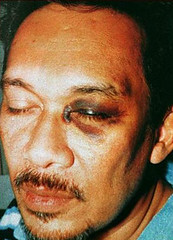
That evening Anwar was arrested. He appeared in court a week later with a black eye that the Government insisted was “self inflicted”. Anwar was tried and convicted of corruption and sodomy and sentenced to 15 years in prison despite the protests of worldwide human rights groups. He was freed in 2004 after Malaysia's top court overturned the sodomy conviction. Anwar has said the charges were fabricated.

Due to the terms of his expired corruption charges, Anwar must remain out of politics until 2008. He has announced his intention to return when his period of disqualification ends. In the meantime he has held teaching positions in Oxford and Washington and joined the board of several international organisations such as AccountAbility and Foundation for the Future.

Anwar fancies his chances against Mahathir’s handpicked replacement. Abdullah Ahmad Badawi has been Prime Minister since 2003 and is in a strong position after winning 198 out of 220 seats in the 2004 election. But his old mentor Mahathir has publicly criticised his replacement alleging freedom of the press has diminished under Badawi’s watch. There are also allegations of cronyism and charges that Badawi sleeps through important meetings. Despite his weaknesses, this week’s state by-election leaves him in a strong position to retain Malaysia’s leadership in 2008.