Monday, May 08, 2006

Iran joins the nuclear club

At the beginning of March 2006, Iran announced that it intends to activate a uranium conversion facility near Isfahan (under IAEA safeguards), a step that produces the uranium hexafluoride gas used in the enrichment process. The IAEA concluded that Iran introduced this gas into some centrifuges (used to enrich uranium) at a secret location to test the process. This is a violation of the Nuclear Non-Proliferation Treaty, to which Iran is a signatory.

Iran first attempted to develop nuclear technology under the Shah in the 1950s as part of the “Atoms for peace” program. Eisenhower was the force behind this program which got its name from a 1953 speech he made to the UN. Under this program, large quantities of fissionable material was shifted from military to civilian stockpiles in the form of a ‘nuclear bank’.

The Americans supplied the Shah with a reactor fuelled with enriched uranium at the Gulf port of Bushehr. US support continued right up to the 1979 revolution. Afterwards Iran under the mullahs tried to go it alone but the program lapsed without US and European support. It stalled completely after reactors were damaged by Iraqi air attacks during the Iran-Iraq war. In 1995 Iran signed a contract with Russia to rebuild the Bushehr complex. A year later, the Chinese sold Iran a conversion plant and gas to enrich uranium despite US disapproval. When the ex-mayor of Tehran Mahmoud Ahmadinejad was elected president, the program took on a new zeal and he resumed conversion of uranium which had been halted while the EU were investigating.

The stand-off tension increased in February this year when the International Atomic Energy Agency (IAEA) reported Iran to the UN security council. In April, Ahmadinejad announced that Iran joined the group of those countries which have nuclear technology.

The U.S., U.K. and France proposed a resolution in the United Nations Security Council on May 3 demanding Iran cease uranium enrichment, and said they would seek sanctions should the government in Tehran fail to comply. The U.S. claims Iran plans to build a nuclear bomb, while Iran says its program is for generating electricity. Russia and China are currently opposed to the resolution.

Mohamed El-Baradei is Director General of the IAEA. The IAEA is a non-subsidiary body of the UN whose mandate is to “promote safe, secure and peaceful nuclear technologies.” The US government has accused El-Baradei of having a lenient approach in dealing with the Iranian nuclear program. He argues that his stance is more likely to keep Iran under the umbrella of the Nuclear Non Proliferation Treaty.

The Egyptian El-Baradei is serving his third term as director-general and won the Nobel peace prize with the IAEA in 2005. As well as his softly-softly approach on Iran, he incurred American wrath when he questioned US intelligence on Iraq prior to the invasion. The US opposed his third term and tapped the telephones in 2004 at his Vienna headquarters in search of ammunition to oust him. However he is well respected by the IAEA board and faces no likely challengers. The US failed in a bid to get the Australian foreign minister Alexander Downer to take the role in 2004!

So the question, if as is likely China and Russia veto a security resolution to impose sanctions on Iran, will the US or Israel mount a pre-emptive strike?

There are three facilities; Bushehr, Natanz and Arak, which are hundreds of kilometres away from each other. Israel destroyed an Iraqi nuclear facility in 1981 but this would represent a much bigger challenge at greater distance. And because so much of the program is home-grown, the industry could survive an attack on all three facilities. The Russians would also become involved as they have many people working on the Bushehr facility. Iran would also seek revenge for such an attack. They have missiles which could reach Israel or any of the many American targets now in the region. Iran would also be likely to work to destabilise Iraq further. The impact on oil prices is impossible to calculate but is hardly likely to be pretty.

It is difficult to see how an attack on the facilities would have anything other than devastating consequences for the region and the world. And yet given 25 years of animosity between US and Iran with both Bush and Ahmadinejad issuing fighting words, this situation is only likely to deteriorate further.

Sunday, May 07, 2006

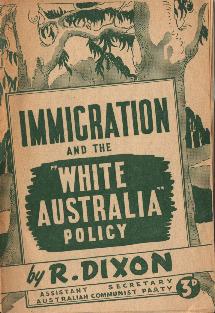
The White Australia Policy

The White Australia Policy was an Australia commonwealth law between 1901 and 1973. Though it has been off the books now for over thirty years it still has the ability to generate controversy. Keith Windschuttle, the leading player on the right in the Australian history wars debate, wrote what was a brilliant history called “The White Australia Policy” in 2004.

The problem is that this subject is so politicised, it is sometimes very difficult to see the history "would" from the history "truth". Windschuttle impressively presents his information with an avalanche of footnotes and a forest of references in a document that is never less than excellent scholarship.

But the Age critic Marilyn Lake gives the book an awful caning in her review. She says the book is a deeply political work, "combative in tone, often contemptuous of other people's work, passionate and polemical in argument”.

And she should know, being one of the victims of Windschuttle’s contempt in the book. Marilyn Lake is a historiographer at Melbourne’s La Trobe University and is the biographer of civil rights activist Faith Bandler. Bandler wrote a book called Wacvie in 1977 purporting to be the story of her father Wacvie Mussingkon, a Kanaka who was kidnapped into working on a Queensland sugar plantation. Bandler’s tale is about a form of slavery that existed in Australia in the late 19th century. The process was called by a poetic name ‘blackbirding’. In 1883 Wacvie was taken from his home of Ambrym, a volcanic island off the coast of what was then known as the New Hebrides and is now called Vanuatu. Enter into the story another historian Peter Corris. He complicates matters by describing Bandler’s story of her father’s kidnap as a fabrication. Wacvie may be about her father, but Bandler’s work was fiction. By 1880, the Ambrym trade with Queensland was legal and the islanders were making a lot of money from indentured labour. Corris’s exposure hurt Bandler. Bandler complained to Lake that she thought she was being patronised. Lake justifies Wacvie as a work of history because ‘stories about the past do not all speak the same language or follow the same rules’. But Keith Windschuttle’s sees it as ‘inventing facts to mislead her readers’.

As well as dispelling myths about blackbirders, Windschuttle is also applying a very different attribution to the White Australia Policy itself. The six Australian colonies that came together in 1901 are traditionally have said to have instigated the policy out of fear of invasion and the concern for the purity of the white race. The White Australia Policy of that year was the federal government’s first substantial legislation. Richard White described how 19th century Australians saw themselves as similar to the South African ‘uitlanders’, the white English who tried to bring order to the decaying Boer regime. They were the King’s men alright but brought a new zealous outback version of imperialism. Great Britain itself could not condone this action, they had a multi-racial empire to maintain. But the country they created as a dump for prisoners was now trying its damnest to be British in a part of the world where they were in a severe minority. Where Windschuttle disagrees with accepted wisdom on the policy is in understanding its cultural causes.

Charles Pearson’s "National Life and Character" was a hugely influential book in 1893. His book was a forecast to a time when the whites would be overrun by other races. It gave rise to the fear of the Yellow Peril. It gave Theodore Roosevelt the excuse to go on his wars of American expansion. Pearson was British but emigrated to Australia in 1871. He was a close friend and major influence on Alfred Deakin, Australia’s second prime minister and most influential post-commonwealth politician. Darwin’s name was dragged into the argument as a spurious re-reading of his theories led to Social Darwinism. Darwin’s scientific views were twisted into a social context by the Prussian academic Heinrich Von Treitschke. Though Von Treitschke was fervently anti-British some of his ideas on race translated well across the North Sea and thence to its white colonies.

Windschuttle rejects the notion that Social Darwinism, so admired by Hitler, was the cause of the Policy. Instead, he ascribes the major influence to the Scottish Enlightenment. Scotland was governed from Westminster since the Act of Union of 1707 and the Scots spent much of the 18th century wondering whether the country would “become prosperous like England, or would it descend into dependent pauperism like Ireland?” The enlightenment lasted roughly 50 years from about 1740. Scotland produced a stellar list of intellectuals in this era. It was led by David Hume, Adam Smith and Adam Ferguson. The Scottish view was based on observation of their own highlanders and it proposed that human society had developed in four stages: hunting, pastoral, agricultural and commercial. Each society was somewhere along this scale. The Scottish highlanders were believed not to have progressed beyond the pastoral stage.

Windschuttle argues persuasively that enlightenment views on civil society were what dominated Australian political thinking at the start of the 20th century. The reason it was accepted was that it was a racial theory that found acceptance with the established churches. Unlike Darwinism or its twisted sister Social Darwinism, it posed no conflicts to Christianity and aroused no opposition from the clergy.

All three Australian parties accepted the Policy although many individual politicians spoke against it. The labour groups were most in favour as it ensured that trade unions would not be undercut by imported scab workers. There was also a strong and genuine racist element who supported it. Edmund Barton, the first Australian Prime Minister made a speech during the Policy debate which oozed white supremacy.

But on the whole, Windschuttle is probably correct. The policy was more about realpolitik and cultural views not racist ones. That meant that when the time came to remove it, it was done gradually but without violent opposition at each step. The kind of violence that would undoubtably have occurred if it were racially motivated. All that remains now is a political consensus about the past.

Saturday, May 06, 2006

Woollygathering on a Bribie beach

The newspaper flutters in the sandy breeze. Headlines of American threats. Who is next in line for a dose of the coalition of the wilting? Who wants a hearty dose of shock and awe? Muzzle the mullahs or gamble on Gaddafy? Whither Syria…who is to be thrown out with the Baath water?

It all seems like an alien nightmare on the clean warm beaches of Bribie. The girls muck around in the shadow of Moreton Island and the withered flesh of middle-aged women walking their manicured dogs. Cargo ship speed on in their passage to the Port of Brisbane while the towers of the fugitive coast beck in another direction.

“Keep off the dunes" is the ignored sign, boys and toys glide down the side, and hide and seek and trod on spiky grasses. Next to me is an empty can of Dulux trade semi Gloss enamel. It’s the “professionals Choice” and it is detritus of Sinead’s profiteering. White sandy paint drips from the sides like fossilised stalagmites. Inside are a cigarette butt and two unknown bush seeds.

The speedboat trundles around the buoy and the man with the boy takes off his white t-shirt and contemplates a dip in the water. The girls remind me of their presence, squealing and shouting further down the beach, their path from me stretched by the effect of the prevailing current.

A long and pretty girl breaks the spell of the sutured flesh and leaves the beach for the benefit of fogies. The surf rescue boat does a slow yellow and orange patrol along the shoreline. My girls stop their play to check out the craft and its orange tonsured occupants.

A nearby beach tent is turned into a noisy Persian bazaar complete with howling hounds, whinging tots and colourful holiday towels flapping in the breeze. I’d haggle with the occupants if I had any dinar. Eventually their dogs cease their yapping, worn out by the sun and the lack of attention.

I check the girls hidden by a dip in the sand but they are sitting pretty at the water’s edge. Girls and boys pass by, cosseted by their parents. A backpacking man walks past with his sandals under his arms. A couple with dog pass in the other direction. The two tented dogs look up briefly in mutual canine interest but they are all barked out. Only then do I see the “no dogs” sign at the entrance to the beach. It clearly doesn’t matter what officialdom thinks out here.

The fluttering paper reminds me of its presence. A random page opens up on the poultry and birds for sale section.

Here I have bargains for you. Day Old Meat, Chicken India Rednecks, proven breeder. Green cheek conure five months old and very friendly. 1 Female Indian Runner duck, Harlequin cross NOT FOR EATING. Major Mitchell mature male, four hand-raised cockatiels, budgie babies, red rump hens, fisher Latino blues, surgically sexed pair of blue quakers, white-faced cinnamon, eclectus parrot, tumbler pigeons, sussex roosters, Ancona, Belgian, Silky Whyndotte, Plymouth Rock and Wheaton bantams. Guaranteed pilkington stock, charolais calf one hundred and eighty dollars, long billed corella (white and pink). Quiet bird in a cage. Super tame rainbow lorikeet. Great companion. Cannot be held responsible for errors or subsequent effects.

No more time for ducks and drakes, I'm getting sunburned.

Friday, May 05, 2006

Shannon-Weaver model of communication

Claude Shannon (1916-2001) is considered one of the founding fathers of the communications age.

Shannon's 1937 master’s thesis on enabling electrical switches to do logic was the foundation of digital circuit design. He became a mathematical engineer and research scientist at the Bell Telephone Company. During the war he worked on fire-control systems and cryptography. In 1948 he worked on the problem of achieving maximum telephone line capacity with minimum distortion. As a result, he developed a mathematical theory of signal transmission which he published in the article "A Mathematical Theory of Communication".

The theory was intended purely for telephones. But when fellow American scientist Warren Weaver (1894-1978) applied Shannon's concept of information loss to interpersonal communication, an ingenuously effective model of communication was created.


The model expands on Harold Laswell’s theory of communication which states:
"Who (says) What (to) Whom (in) What Channel (with) What Effect"

The Shannon-Weaver model deconstructs communication into the following six elements:
1. a source
2. an encoder
3. a message
4. a channel
5. a decoder
6. a receiver
There are also three other factors: physical noise, semantic noise and feedback.

The source is the sender of the message; someone with a purpose of communication. The communicator wants to achieve some end: to show friendship, give information, ask for something, convince or simply share something. The communicator’s message is the code and the encoder turns a purpose into a something that can be delivered as a message. Human encoders include the human larynx, facial muscles, arm movements. Examples of non-human encoders are telephones, alphabets and modems.

The message is the centrepiece of communication. A simple definition of communication is “to consider it as the sending from one person to another of meaningful messages”. In a sense, the message is not an element but merely the combination of all the other elements. The key question is: is the message received the same as the message sent?

Shannon was unfussed about message meaning because it was irrelevant to his engineering problem. As a result the model does not deal effectively with issues such as assumptions, social context, or the impact of knowledge and memory. See the Berlo SMCR model for a more detailed look at these complexities.

The Channel is a path; it is the medium on which the message travels. Marshall McLuhan observed the path is all with his dictum "the medium is the message". In the model, this can be read as the journey being more important than the destination. This is borne out in the real world where communication companies such as News Corp, AOL Time Warner and Disney are among the world’s most powerful organisations.

The existence of physical noise is the problem that Shannon was trying to solve in the first place. But noise is not just an audible sensation. The roar of passing traffic, interference on a radio broadcast, poor TV reception and fog on glasses are all examples of physical noise. As is channel overload due to lack of bandwidth.

If Shannon’s engineering problem was physical noise, the biggest problem of human communication is the existence of semantic noise. Semantic noise occurs when there is a mismatch between the encoder and the decoder. Examples include distraction, inability to translate the message, incorrect emphasis, attitude to the sender and attitude to the message.

It is easy to see how being distracted is an impediment to communication. There may not be any physical noise, but for some reason the receiver is not paying attention. “You weren’t listening!” is a common complaint of message senders. The receiver was present but was distracted by something else.

If the message is not delivered in the lingua franca, then the receiver is not going to understand, regardless of distractions. And even if they are speaking the same language, the message may be missed if the wrong part of it is emphasised. People may remember a wonderfully inventive ad but not the product it was spruiking. A biased attitude to either the sender or the message is also likely to produce semantic noise. Consider the responses: "What would he know?" or "I don’t believe in that mumbo-jumbo!"

Assuming the message gets past all these noises, a decoder is needed to retranslate at the other end. It could be an answering machine, a TV screen, ears or a mobile phone. But it is more than equipment. There are endless cultural factors that also influence how the message is translated. Here is where assumptions made by the sender are tested.

The destination is the receiver. Without a receiver, there is no-one to communicate with.

But the destination is not the final step. The final step goes back to the start. The receiver provides feedback. This is the heartbeat of communication. Without it, communication is a very dull affair. Lack of feedback explains why most people are awkward talking to answering machines. Mathematician Norbert Wiener (who coined the word ‘cybernetics’) defined the feedback principle to mean “behaviour is tested with reference to its result and success or failure of this result influences the future behaviour”.

End of message. Any comments?

Thursday, May 04, 2006

Galloway exposes the Fake Sheik!

The "Fake Sheik" is the nom de guerre of English undercover reporter Mazher Mahmood. Mahmood uses his swarthy Arabic appearance to effect his modus operandi: making fools of the rich and famous. Among his victims are Sven-Goren Eriksson, Princess Michael of Kent, and George Galloway. However, the latter would appear to have turned the scales on Mahmood.

His alter ego, the Fake Sheik, gains the trust of his victims by portraying himself as an oilrich Arab before getting them to commit indiscretions that are splashed as "scoops" on the front pages of the Rupert Murdoch-owned British Sunday tabloid, the News of the World.

In April 2006, Galloway said he had decided to expose Mahmood after the journalist tried to trick him into discreditable conduct. According to Galloway, "Mahmood sought to implicate me in what would be illegal political funding and sought my agreement to anti-Semitic views, including Holocaust denial."

Galloway responded by publishing pictures of Mahmood on his Respect Party website despite an unsuccessful an attempt by News International to prevent it.

Mahmood’s picture is also on the Wikipedia page named for him. The normally open source Wikipedia page on Mahmood is currently locked from updates due to a dispute among Wikipedians as to the veracity of the data about him on the site. One user complained about the photo of Mahmood on the talk page of the Mahmood entry claiming that “by publishing the photo, you are helping paedophiles and other nasty villains from being exposed by Mahmood.”

Controversy has always followed Mahmood. In November 2002 the News of the World printed a page one Mahmood story “Posh kidnap - we stop £5m ransom gang". It discussed an alleged plot to kidnap Victoria Beckham. The News of the World was on hand to photograph the arrest of the five suspects. However the court case against the suspects collapsed when the chief prosecution witness was revealed as an unreliable convicted criminal who was paid £10,000 for his story by the News of the World.

In 2005 Princess Michael of Kent revealed family secrets and used her royal connections to try to sell a property when Mahmood rolled up posing as a prospective Arab buyer. She also offered to do a lecture tour in Dubai on his behalf telling him: "It's a one-hour, one woman show, but I'm very good as you can imagine. I can write anything. I don't usually discuss fees. But it's £25,000 to speak. Is that not enough? Shall I do more? And expenses?"

She should have known better. She was not the first member of the Windsor clan to fall for a Mahmood “sting”. Princess Sophie, the Countess of Wessex, was another minor royal who fell victim to Mahmood’s fake sheikery. In 2001, the so-called "Sophie Tapes" had her making critical remarks about the government and using her royal status as a business tool to gain clients.

But probably the single most famous “sting” involved Sven-Goren Eriksson and cost him his £4 million pound a year job as England’s football manager. In January 2006 he was invited to Dubai to discuss a supposed football academy. There he was feted by Mahmood in full sheik regalia. Mahmood proposed a plan to him that his consortium were planning to take over Aston Villa football club and suggested Eriksson should become manager. Eriksson agreed saying he would be available after the World Cup (he is now!) to take on the job and intimated that England captain David Beckham might be persuaded to join him. He also made disparaging remarks about some of his other players, describing Rio Ferdinand as lazy, Michael Owen as only being with Newcastle for the money and blamed Wayne Rooney’s temper on his poor upbringing. The game was up for Sven after the News of the World revealed the hoax.

Very little is known about Mahmood himself. He was born in Birmingham to Pakistani parents. He was reputedly dismissed from the Sunday Times as a cub reporter 17 years ago for attempting to cover up a mistake in one of his reports. Despite this he was hired by the News of the World after a short stint in TV producton. The paper which has a circulation of four millions copies each week, boasts that Mahmood's investigations have led to over 120 criminal convictions.

About his disguise he said “The only reason I'm alive is because I'm Asian, because I can be a Pakistani market trader, a minicab driver - because of my colour. If I don't speak English properly, nobody would ever think that I'm a reporter."

If Arabs in the US are unfairly targeted as potential terrorist suspects, ones in England are more likely to be suspected of being journalists. Although the publication of his photo offers some respite to the wealthy, the famous, the royals and the child molesters.

Wednesday, May 03, 2006

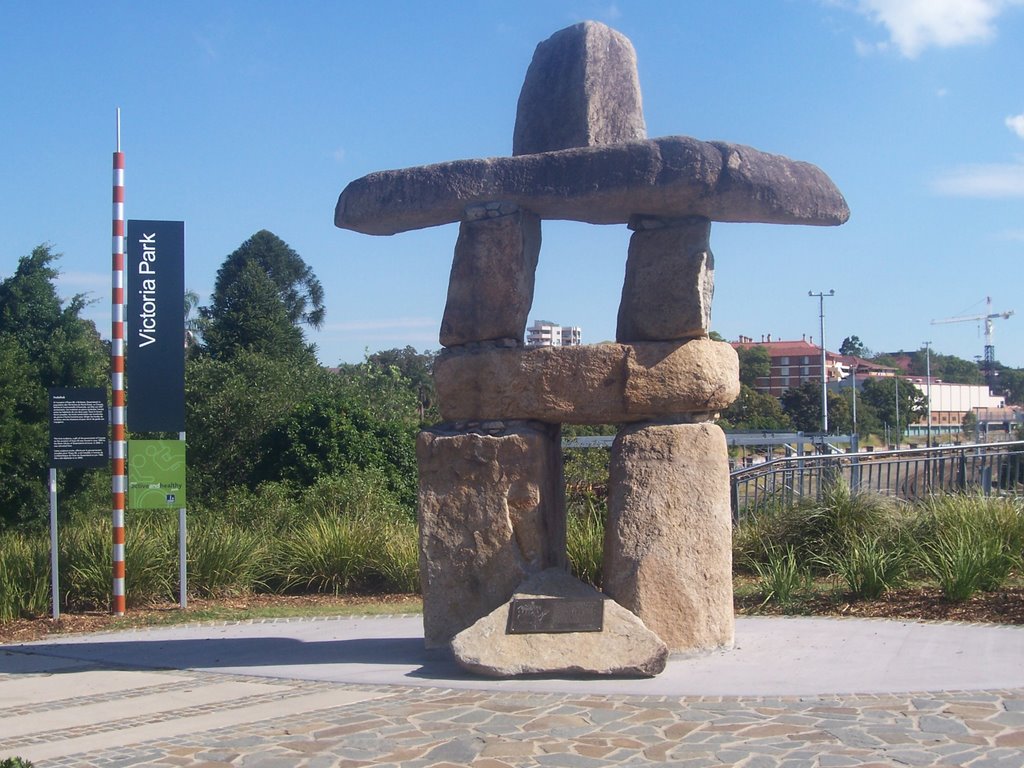
New Home for Brisbane Inukshuk

A Canadian replica directional marker was recently dedicated in its new home in Victoria Park, in the suburb of Herston.

It is the third home in 18 years for the Brisbane monument which is known by its Inuit name of “inukshuk”.

The Canadian High Commissioner, Mr Michael Leir attended the re-dedication ceremony on Thursday, April 6, this year.

The monument weighs 19 tonnes and was created for the Canadian stand at Brisbane’s Expo 88 by indigenous artists of Nunavut, a territory in Arctic Canada.

In his re-dedication speech, Mr Leir said the inukshuk is easily one of Canada’s most recognizable symbols.

It is a traditional stone sculpture of the Inuit people of north-west Canada and inukshuk translates roughly into English as "likeness of person."

The Inuit used inukshuks to show directions to travellers, to warn of impending danger, to mark a place of respect, or to act as helpers in the hunting of caribou.

The sculpture was presented as a gift to Brisbane when Expo 88 concluded and it sat outside the entrance to the Queensland State Library for the next 15 years.

In 2004, extensions to the new State Library meant it needed to be moved again.

The new site is the pedestrian bridge on the Great Northern Greenway at Victoria Park, Herston.

Queensland Arts Minister Rod Welford said he was delighted a new home had been found for the important sculpture, which will now be enjoyed by more than 800 cyclists and pedestrians who pass the site each weekday.

According to a Canadian embassy media release, the High Commissioner Mr Leir said the inukshuk would become an important stop on the tourist trail for the 175,000 Canadians who travel to Australia each year.

The inukshuk appears on the flag of Nunavut and has also been chosen as the official symbol for the Vancouver 2010 Winter Olympics.

Oil for fools

The Australian academic Paul Chadwick wrote a book in 1988 called "FOI – How to use the Freedom of Information Laws". It's a handbook for journalists and interested citizens on how to get information out of heeldragging, suspicious bureaucrats and politicians. The law was drafted in the early 1980s by the Fraser Liberal government and passed by the Labor Hawke Government elected in 1983. There are several groups that don't have to comply with FOI, they include the usual suspects like the security organisations ASIO and ASIS. But there is also a less obvious group immune from prying eyes. This group is the "single desk" export bodies such as the Egg Board, the Dairy Corp, the Meat and Livestock Board and the Australian Wheat Board, now known more simply as the AWB.

The principle of “single desk” was, and still is, to prevent Australian primary producers from being played off against each other by large corporate customers. In AWB’s case those competitors were the US conglomerates Conagra and Cargill.

It was rather prescient that the Australian Wheat Board (AWB) be included on this list because they are now the subject of what is commonly called the Cole Inquiry (named for Terence Cole QC, an ex-appeal judge in the NSW Supreme Court). This inquiry is more properly known as the Inquiry into certain Australian companies in relation to the UN Iraqi Oil-For-Food Programme.

Previously a low profile organisation, the AWB made headlines in late 2005 when it was alleged that it had knowingly paid kickbacks to the Iraq Government, defrauding the UN and violating sanctions. The allegations were made by the Voelker report commissioned by the UN. Kofi Annan, the UN secretary-general asked Australia to investigate the allegations in a statement issued in October 2005.

The Australian government limited the terms of reference of the Cole inquiry to investigating the role of three Australian companies (AWB was the main player but there were supporting roles for the little known companies Alkaloids of Australia plc and Rhine Ruhr plc) in paying kickbacks to Saddam Hussein.

Saddam’s regime had been the subject of UN sanctions since the time of the 1991 Gulf War. The sanctions did not particularly hurt the government but they caused a humanitarian crisis. Clinton’s response was Oil for Food.

And so in December 1996 the UN allowed Iraq to begin selling limited amounts of oil for food and medicine. The program was escrow (a legal arrangement where an asset is delivered to a third party to be held in trust pending fulfilment of a contract.) The people that bought Iraqi oil put it in a BNP Paribas account. BNP is trusted by both sides because the major shareholder is Anglo-Iraqi business man Nadhmi Auchi. He didn’t do too badly either. The bank received more than $700 million in fees under the program. Auchi is listed as Britian’s 7th wealthiest man according to the Guardian and 10th richest according to Forbes. In 2003 he was jailed for two years for paying out bribes to expand his empire.

The oil for food program was ended shortly before the 2003 invasion of Iraq. However, it is alleged that, due to corruption on both sides, very little food and medicine was actually delivered to the Iraqi people. In the 2004 a US Subcommittee on investigations claimed that the Iraqi government paid $600,000 of kickbacks from the oil fund. They accused British maverick politician George Galloway as one of the recipients.

AWB became the single biggest seller of wheat to Iraq in the last years of Saddam's regime. Under UN Security Council Resolution 661, Australia was responsible for seeing that no cargo left its shores in breach of sanctions.

The Cole Inquiry held closed hearings in December 2005 and January 2006. Public hearings started in January. As each of the leading AWB executives were interviewed, they all produced a litany of excuses such as memory loss, inability to locate diaries and notes and loss of hearing (the latter being gun-toting ex-chairman Trevor Flugge’s problem.)

In February this year Cole added the activities of BHP Billiton into the terms of reference of the inquiry. The bribes were side payments made from falsely inflated contracts. The money was all coming out of the escrow account. The only problem was how to get the cash into Iraq undetected. The solution was a Jordanian company “Alia for Transportation and General Trade.” Alia was well connected in Iraqi political circles and had proved to be very well informed about key issues inside Baghdad during the last few years of the Saddam regime.

Under the oil-for-food program, no wheat could leave without a tick from the Department of Foreign Affairs, headed by minister Alexander Downer. Downer was called in to give evidence as to what he knew about the scandal.

Here are the unexpurgated statements he made to the Cole enquiry in precisely the order he made them:

"It could have been It may have been I don't specifically recall I can't precisely remember I don't recall I don't recall I couldn't rule out It is possible I don't know I'm not sure I have only a very distant recollection I don't recall I don't think I did I'm pretty sure I didn't make a note I don't recall I could have done I don't recall it….” and on and on it went for 80 different statements of forgetfulness. In fact his testimony has been set to music.

Downer doesn’t have too much to worry about. His boss John Howard, who was also interviewed by Cole (and also didn’t see any evidence of wrongdoing) made sure he set the terms of the inquiry so that AWB will take the rap not their political masters.

Which will probably happen when Cole hands down his findings in June. Australia’s wheat farmers will also suffer. They will see their Iraqi market share heading off into the eager hands of Conagra and Cargill.

Monday, May 01, 2006

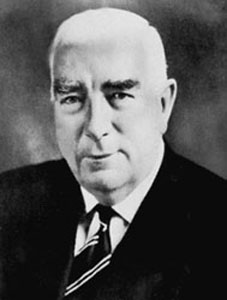
Menzies and Horne

Robert Menzies wrote the Forgotten People in 1942. Donald Horne wrote the Lucky Country in 1964. In the intervening twenty years or so, much of the moral certainties that sustained the country in the early part of the century were blown away by a devastating world war. It was a war that lapped Australia’s shores and confirmed the United States as the dominant western power. The decades that followed saw the emergence of new Australian values. It became a stable, secular and wealthy society driven by conservative mores. The aim of this essay is to examine the factors that contributed to the versions of national identity on view in the Menzies and Horne documents. This essay will examine the similarities and differences in the documents and will show how Australian values changed in the decades between the writing of the documents.

The Second World War changed the world’s political landscape and Australia was not immune from the upheaval. The British Empire was permanently crippled. Curtin’s 1941 SOS call to America was answered at a great price. In the post war era “economic, cultural and military dependence on Britain was replaced by a similar dependence on America” (White 1981, p162.) Though Menzies remained a staunch supporter of empire, Horne wrote that Britain’s collapse had perplexed many Australians for whom it was “easier to feel self-important as an imperialist than as a nationalist." Horne was making the point that Australia should now look both harder at itself as well as its local neighbours to better understand the new geopolitical realities around it.

Menzies wrote his Forgotten People radio broadcast during the darkest hours of that war but his subject matter was about the post-war direction of Australian values. The values Menzies favoured were “self-help, independence, freedom, ‘lifters’ rather than ‘leaners’” (Murphy 2000, p137.) These values would be underpinned by Menzies’ motto which was “to strive, to seek, to find and not to yield.” Menzies was describing a spirit of independence, the prototype of what was to be become idealised in the post-war vision of the “Australian way of life.”

The centrepiece of this way of life would be the Australian home. Menzies imagined three types: “homes material, homes human, homes spiritual." The stone walls of the houses were of no use to Menzies unless populated by warm and loving families who combine “dependence upon God with independence of man.” Horne too saw the importance of home in creating a self-satisfied, stable society. But rather than as a result of spirituality, he put it down to the “strong materialistic streak in Australians.” Home ownership was “both a bulwark against communism and the site for happy domesticity” (Murphy 2000, p137.) Both Menzies and Horne construct an Australian identity that the idea of home was the central force in the creation of a stable and conservative nation. Australia embraced this by handing twenty-three years of power to Menzies’s Liberals.

The cultural homogeneity embodied in the idea of universal home ownership led to the embracing of the slogan “the Australian way of life”. Rather than something tangible, it was “a nationalist narrative that served to articulate the various aspirations, values and anxieties” (Tavan 1997, p82) in Australia. Horne recognised the materialistic aspect of these aspirations. Australia was “one of the first nations to find part of the meaning of life in the purchase of consumer goods.” It was an imitation of America which had the way of life which was the “most glamorous, the best publicised” (White 1981, p162.) Horne, who was an admirer of American values, saw this as a positive step. He constructs an image of the growing confidence and sophistication of Australia in the post-imperial world.

Outside this materialism lay a thin veneer of spirituality. Even in Menzies’s “home spiritual”, God had to share half of this domain with man’s independence. Menzies was sensibly Presbyterian enough not to foist his brand of religion on the people. And even though Anzac Day had its religious aspect, the new religion that most Australians shared was worship of the motor car. The Holden was the first locally built car. Essington Lewis, the wartime minister for munitions and visionary head of BHP, was given the honour of buying the first Holden (White 1981, p164). Homes were an anchor, but it was the growing road network and the cars it supported that gave Australians access to their own country. Motels, imitating the style of their American cousins, started to dot the landscape. Despite the lofty spirituality inherent in Menzies’ speech, it was Horne who best articulated what the Australians were most passionate about: a “pantheist love of outdoor activity.”

Menzies created the Liberal Party in 1944 from the ashes of the United Australia Party (Clark 1969, p255). With the rise of the Cold War, it found its ideological feet with a strenuous opposition to the "officialdom of organised masses." Communists controlled much of the union structure, the state Labor councils and the ACTU (Horne 1965, p.167.) Menzies tried twice to ban the Communist Party but failed both times in referendums. Despite this, the ALP was unable to seize the initiative. It was riven by internal struggles. Bob Santamaria and the Catholic wing broke away to form the anti-communist DLP. The ogre of communism cemented the left in opposition for a generation. Both Menzies and Horne espouse Western values and construct images of Australia which used the mythical way of life to support the conservative status quo.

Since the time of Federation, one of the pillars of that status quo was the White Australia Policy. Keith Windschuttle may well be correct in his assertion that the policy was influenced more by the cultural theories of the Scottish Enlightenment than the racist ones of Social Darwinism (Windschuttle 2004, pp 66-67.) However it was the discrediting of racist ideas after the war that led the policy to fall into disrepair. Immigrants fleeing from the “overt racism” (Murphy 2000, p155) of Nazism could warn Australians of the folly of a race based ethos. The definition of suitable Australians was broadened to include southern, eastern and central Europeans. Further dismantling occurred with the removal of the odious dictation test in 1958. Horne constructs a new idea of Australia, a “suburban nation” where the lifestyle is important, not the racial mix.

In summary, Menzies’s vision for Australia was only partially realised. He brilliantly articulates the community values of a self-help attitude underpinned by the power of the homestead. Alongside a strident anti-communism, it was to be the blueprint for Liberal Party success throughout the fifties and sixties. However, Horne could see other factors changing Australian identity: the decline of empire, the rise of American values, Australia’s growing materialism, the importance of the car and the impact of immigrants. Through the looking glass of these factors it is possible to see a modern Australia slowly emerging.

References
Clark, Manning 1969, A short history of Australia, Mentor, New York
Horne, Donald 1965, The lucky country, Penguin, Ringwood, Victoria
Murphy, John 2000, Imagining the Fifties: Private Sentiments and Political Culture in Australia, University of NSW Press, Sydney
Tavan, Gwenda 1997, "Good Neighbours" in The Forgotten Fifties: Aspects of Australian Society and Culture in the 1950s, Melbourne University Press, Melbourne
White, Richard 1981, Inventing Australia: Images and Identity 1688-1980, Unwin & Allen, Sydney
Windschuttle, Keith 2004, The white Australia policy, Macleay Press, Sydney

Sunday, April 30, 2006

a history of Wicca

Wicca is both an ancient feminine earthly religion and also a newly-minted 20th century faith. Wicca is a neo-pagan religion which was reconstructed from beliefs, deities, symbols, practices and other elements of an ancient religion. Unlike Christianity it is not based on the value of the human word, but on the impact of the elements.

This is demonstrated by the words of a native American Indian Wiccan: "If you take the Christian Bible and put it out in the wind and the rain, soon the paper on which the words are printed will disintegrate and the words will be gone. Our bible IS the wind and the rain."

Wiccans believe in a dual deity structure: a Goddess and a God. Furthermore, the Goddess has three aspects of different ages: the Maiden for sexuality, the Mother for fertility and the Crone for wisdom. The Wiccan golden rule is the Rede, which states “Harm None, do what thou wilt”.

There are many who dispute this type of worship is a religion. Many people are frightened by the idea of Wicca and its more pejorative incarnation “witchcraft.” They judge it on moral grounds as an evil force. Why would a religion that on face value that is so respectful of the world be the object of great fear and dislike? The answer goes back many centuries.

Britain had anti-witchcraft acts on its books dating back to 1401. The Church was suspicious of supernatural and magical events that it did not control. Henry VIII, as part of his appropriation of the powers of the English Catholic Church, instituted the death penalty for witchcraft. Elizabeth I took matters further making it an offence against common law not ecclesiastical law. This gave officials a financial incentive to prosecute them. Witches would forfeit their lands to the Crown if they were convicted. The end result was an open season for witchhunts. The pursuit of witchcraft was exported to America with the Mayfair. The Pilgrim Fathers were also keen to keep their communities free from those found guilty of “invoking or conjuring an evil spirit."

Back in England witchhunting became associated with the Puritans and they were out of favour after the restoration of the throne under Charles II in 1660. The Puritans were out of power, but their laws remained quietly on the books. Witchcraft was still an offence at the end of World War Two. In 1941, Scottish psychic Helen Duncan was arrested after she passed on classified defence knowledge in a séance. Duncan told her audience that the British ship HMS Barham had been sunk by the Germans. That was true but the British had concealed this fact at the time to hoodwink the Germans. The Germans eventually found out and the British announced the loss in 1942. Two years later, the paranoid planners of D-Day used the Witchcraft Act to arrest Duncan out of fear she might reveal the landing plans. She was found guilty and imprisoned for nine months. She was the last person to be tried and convicted under the law. The act was repealed in 1951.

An eccentric British civil servant named Gerald Gardner was the first person to take advantage of the relaxed law. Gardner was also an amateur anthropologist, author and a student of the occult. In 1954 he published a tract called ‘Witchcraft Today’ where he produced the definitive texts for those who practiced ‘Wica’ or ‘the Craft'. Gardner documented the religious aspects of what was to become known as Wicca.

This book was based on the writings of Aleister Crowley, Doreen Valiente and others. Crowley was infamous in his own lifetime despite a stellar Renaissance Man career. He was a author, occultist, mountaineer, chess master, painter and critic. Crowley fused his studies of mysticism and Eastern religion into a system he called "Thelema". Doreen Valiente was a self-proclaimed witch who provided the feminist influence on Gardner’s philosophy. These two influenced the Wiccan Rede in Gardner’s book which said “do no harm to others and do what thou wilt”. The Rede is now the prayer that sums up Wiccan ethics.

Gardner had two other key influences from history. The first was the American folklorist Charles Leland. Leland travelled vastly in Europe and made a detailed study on gypsy lifestyle. He wrote a book in 1899 called “Aradia, or the Gospel of the Witches”. Its first five chapters were about a mythical document called the Vangelo (which may or may not been a figment of Leland’s fiction.) The Vangelo, the origins of which Leland never revealed, outlined the practices of witchcraft.

The second influence was the British anthropologist and Egyptologist Margaret Murray. She was a fervent women’s rights campaigner and a veteran of many archaeological expeditions to Egypt. She took a break from this work to write “Witch cult in Western Europe” in 1921. In this she exaggerated the scale of the underground pagan resistance to Christianity that existed across the centuries. But she did alert the world to its existence.

Gardner’s tract is credited with the re-introduction of the word Wicca into English. The word itself is a multi-purpose Old English word which could mean wizard, soothsayer, sorcerer or magician. This old meaning of the word has affected public acceptance and the word Wicca retains a strong pejorative meaning. The pentacle is still not recognised by the US Department of Veterans Affairs as a religious symbol in military cemeteries. However Wiccans won a major victory in Virginia in 1985 with the ruling that it is a legal recognised religion and therefore afforded all the benefits accorded to religion by law.

Conservative Christian groups in the US, led by politicians such as Jesse Helms and Bob Barr are fighting to overrule this decision and see Wicca as analogous to Satanism. Wiccans reject this comparison as they also reject allegations of black magic. To them, Wicca is the opposite of everything its opponents fear. They say that Wicca is a very peaceful, harmonious and balanced way of thinking and life which promotes oneness with the divine and all which exists.

It has interesting parallels and overlaps with the Green movement. “As ye harm none, do what you wilt” could be a credo of either movement. As could the Gaia hypothesis. But it is not all sweetness and light in the garden of Wicca. There are arguments as to whether ‘hereditary witches’ are better than ‘book witches’. The question is how will the political glare and the environmental overlaps mutate the public face of Wicca in the coming years?

Saturday, April 29, 2006

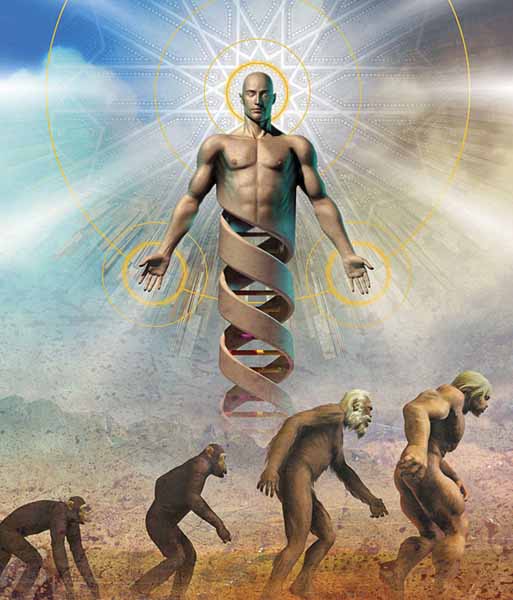
The Intelligent Design hoax

In the 19th century science was posing a huge threat to religion. Biblical authority and church teachings which had first taken a hammering with Galileo’s theories were now under siege. Geologists had shown that the Earth was very old indeed. Darwin’s Origin of Species in 1859 was followed by the Descent of Man in 1871 and both books advanced a theory of evolution that was at serious odds with the established view of a Creationist world.

By the 1870s, nearly all biologists agreed that life had evolved, and by the time of the Second World War most agreed that natural selection was a key force driving this evolution.

The churches and the powers-that-were didn’t take this challenge lying down. There was always the view that Darwinism represents a thinly veiled attempt to foist a secular religion—godless materialism—on Western culture.

According to a 2001 Gallop poll 45% of Americans concurred with the statement that "God created man in his present form within the last 10,000 years”. But it is harder to sustain outright belief in Creationism in the face of increasing scrutiny of biblical evidence.

In recent years, the Creationists have taken a new tack and have come up with a more sophisticated, pseudo-scientific and beguilingly named product called Intelligent Design. Slickly marketed, it is now the front face of creationism. It has very powerful friends.

US President Bush supported teaching alternatives to evolution in public schools with remarks such as schoolchildren should be taught about intelligent design as well as evolution. He said in August 2005 "Both sides ought to be properly taught . . . so people can understand what the debate is about. Part of education is to expose people to different schools of thought. . . . You're asking me whether or not people ought to be exposed to different ideas, and the answer is yes.”

The theory of intelligent design holds that life and the universe are best explained by an intelligent cause rather than an undirected process such as natural selection. It deliberately does not try to identify or name the specific creation but many of its proponents state that the designer is the Christian god.

The idea is far older than Darwinian evolution. The first recorded arguments for a natural designer come from Greek philosophy. Heraclitus is associated with the philosophy of Logos which describes human knowledge and the inherent rationality of the universe. Plato spoke of a “demiurge”, a deity of supreme wisdom and intelligence who created of the cosmos. Aquinas posited the supernatural designer of the universe in the 13th century. In 1802, English theologian William Paley wrote “If we find a pocket watch in a field, we immediately infer that it was produced not by natural processes acting blindly but by a designing human intellect.” It arose again in the early 1980s with the publication of The Mystery of Life's Origin by creationist chemist Charles Thaxton.

The leading proponent of Intelligent Design today is American biochemist Michael Behe. He advocates the idea that life is too complex at the biochemical level to have evolved. The trigger for his involvement was the 1987 decision in the U.S. Supreme Court barring the teaching of Scientific Creationism from public schools. In his book “Darwin’s Black Box,” Behe maintained that irreducible complexity presents Darwinism with “unbridgeable chasms”.

The Christian think-tank The Discovery Institute was set up in 1990 and is a driving force behind Intelligent Design. Their mission statement is “to make a positive vision of the future practical”. Their agendas are to promote public awareness, lobby for teaching in high schools and instigating pro Design legal actions. They have powerful friends. The Gates foundation has pledged $10 million since 2000. Its major contributors are also the same major contributors to George W. Bush.

The idea is to present evolution as a ‘theory in crisis’ and to poke as many holes in it as possible. The mathematician William Demski, another proponent of ID, holds the concept of specified complexity. When something is both complex and specified, one can infer that it was produced by an intelligent cause. He provides the following example: "A single letter of the alphabet is specified without being complex. A long sentence of random letters is complex without being specified. A Shakespearean sonnet is both complex and specified”.

Despite the rhetoric, many critics say that intelligent design has not presented a credible scientific case. Instead it is seen as an attempt to teach religion in public schools and intelligent design has substituted public support for scientific research. The theory has little support in the scientific community. In October 2005 a coalition of 70,000 Australian scientists and teachers stated "intelligent design is not science" and called on "all schools not to teach Intelligent Design (ID) as science, because it fails to qualify on every count as a scientific theory”.

To date, the intelligent design movement has yet to have an article published in a peer-reviewed scientific journal.

In 2004, the school board of Dover, Pennsylvania, voted to require the teaching of intelligent design alongside evolution in science classrooms. On December 20, 2005, U.S. District Court Judge John Jones ruled that the school district cannot follow through with its plan because it would violate the Constitutional separation of church and state. In his opinion Judge Jones wrote, "We have concluded that it is not [science], and moreover that ID cannot uncouple itself from its creationist, and thus religious, antecedents".

It remains a dangerously powerful and popular bunkum. Intelligent Design is science’s equivalent of junk food. It is the newest evolution of Creationism and teaches us more about politics and religion than science.

It is no more scientific than those who write to the Kansas School board which was leaning towards Intelligent Design. The protesters state that they are of the strong belief that the universe was created by a Flying Spaghetti Monster and it too should be considered for the curriculum. It is as scientific and more amusing.

References

Church of the Flying Spaghetti Monster
Discovery Institute
How Intelligent Design Works
Intelligent Design Network
National Centre for Science Education
Natural History Magazine
New Yorker magazine: devolution
Talk Design
Washington Post: Bush Remarks On 'Intelligent Design' Theory Fuel Debate

Friday, April 28, 2006

Depleted Uranium

Depleted Uranium is a radioactive and toxic killer. It is highly prized by the military and was used extensively in both Gulf Wars against Iraq. It is the ‘dirty bomb’ of choice for both the US and Britain. As a weapon, it is a relatively new choice so there is no international treaty in place to ban it.

Depleted Uranium (DU) is what is left over when most of the highly radioactive types (isotopes) of uranium are removed for use as nuclear weapons or fuel. Because of its high density, DU is used in armour-piercing munitions and armoured protection for tanks and is also used in to build stabilisers in airplanes and boats. Like uranium, lead and tungsten, DU has a chemical toxicity can cause health problems in high doses (though outside the body cannot cause harm.) There are two types of DU: clean and dirty. Clean DU is a by-product of Uranium-235 from the production of fuel or weapons. Dirty DU is the detritus of reprocessed reactor fuel. It is called dirty because it is likely to have been contaminated with plutonium.

Uranium was discovered in 1789 by Martin Klaproth, a German chemist, in the mineral called pitchblende. It was named after the planet Uranus, which had been discovered eight years earlier. Uranium was apparently formed in supernovae over 6 billion years ago (the Earth itself is a mere 4 billion years old). While it is not common in the solar system, its radioactive decay provides the main source of heat inside the earth. It is also known to be the cause of planetary wide phenomena such as convection and continental drift.

Australia is the leading producer of uranium with approximately 30 percent of the world’s resources. The other major exporting countries are Canada, Kazakhstan, South Africa, Namibia, Brazil and the USA. Uranium averages about 2.8 parts per million of the earth's crust. Traces of it occur almost everywhere. It is more abundant than gold, silver or mercury, about the same as tin and slightly less abundant than lead. It was first discovered in Australia in the 1890s but it was not until seventy years later that Australia began to emerge as a potential major source of uranium for the world's nuclear electricity production. Uranium is sold only to countries which are signatories of the Nuclear Non-Proliferation Treaty (NNPT) and so the main export markets are the US, the EU and Japan. John Howard's government is currently negotiating to sell uranium to India despite it not being a signatory to the NNPT.

Depleted uranium was first stored in stockpiles after the Second World War when the US and the USSR were getting serious about nuclear production. In the 1970s, the Russians had developed new armour plating for tanks which western weapons could not penetrate. The Americans decided DU would be just the solution to the problem. Not only was it effective, but thanks to the stockpile, it was cheap and readily available. Its first use in war was probably the 1973 Arab-Israeli conflict. It was used extensively in the 1991 Gulf War and it was at this time that the health consequences of DU were becoming apparent.

Inside the human body, it forms into soluble uranium salts. They are excreted in urine but some of it accumulates in the lungs, bones and tissues. It can cause kidney damage. Scientists believe it is a contributing factor in Gulf War Syndrome whose symptoms include immune order deficiencies, chronic fatigue and birth defects. The British medical journal, the Lancet, has reported an eightfold increase in the death rate of Iraqi children since 1993 (though mustard gas might also be a culprit). The UN Human Rights Commission passed motions in 1996 and 1997 to urge all countries to stop producing weapons of mass destruction. DU weaponry was on the list.

The US position is to continue to use DU where necessary. A factsheet from the US “Deployment Health Support Directorate” states that the health risks from DU are due to its properties as a heavy metal and not due to its ‘low’ radioactivity. Its official position is that "no human cancer of any type has ever been seen as a result of exposure to natural or depleted uranium".

Professor Doug Rokke disagrees. He is the ex-director of the Pentagon's depleted uranium project and he now calls for the banning of DU. He told the Guardian "a nation's military personnel cannot wilfully contaminate any other nation, cause harm to persons and the environment and then ignore the consequences of their actions". He called it a crime against humanity and said the US and the UK should recognise the immoral consequences of their actions and assume responsibility for medical care and thorough environmental remediation. "We can't just use munitions which leave a toxic wasteland behind them and kill indiscriminately," he said. “It is equivalent to a war crime.”

Thursday, April 27, 2006

Football and the Holy Roman Emperor

Arsenal are through to the Champions league final for the first time. But only because Juan Roman Riquelme missed a last minute penalty that would have taken Villarreal Club de Fútbol SAD (SAD indeed!) into extra time at least, with the momentum clearly in their favour.

The periscope's miss sent El Submarino Amarillo out of the competition they, representing a team from a city of 48,000 inhabitants, had apparently no right to get so far. The miss was made more poignant because Riquelme was clearly their best player. But he was so stunned by the miss that he completely failed to react to the rebound. The ball came back so close to him that it was entirely possible that like Xabi Alonso in the Champions league final of last season, he could redeem himself immediately. But no, Riquelme was a stunned mullet and instead we have a likely Arsa / Barca final (Barcelona defend a 1-0 lead over Milan at the Nou Camp in the early hours of the morning, Woolly Days time.)

The one good thing about that outcome is that Chelsea aren't there. And for the second year in a row that's Liverpool's fault. Last year, it was a direct result of Javier Sanz Luis Garcia's shot that may or may not have crossed the line. This year the two European 0-0 draws sent an underdone Chelsea in the direction of Ronaldinho and failure. Just for good measure Luis Garcia was there again to apply the finish to demolish Chelsea's double in the FA Cup semi final.

One wonders what Roman Abramovich makes of it all. Woolly Days would like to ask him but doesn't have the required contacts. It also wonders why those who do have the contacts don't talk to him. Why not? Don't tell me it's because he is not interesting.

How could anyone with the cyrillic name Рома́н Арка́дьевич Абрамо́вич not be interesting? Forbes magazine has him 25th richest person in the world. He was the saviour for Ken Bates who was floundering as the Chelsea chairman. When Abramovich took over, he wiped out Chelsea's debts and gave Bates £17 million to buy him out. He also promised a further £30million each on new players and training facilities.

Chelsea fans were wetting themselves. And sure enough, within two years he won the English premiership under the guidance of the impossibly conceited Jose Mourinho. Now in his third year of tenure a second title is almost assured.

So what is Abramovich's background? And why does he get away with nil media scrutiny? Can't be simply because the News of the World doesn't speak Russian? Niet? Spasibo.

Roman Abramovich is a Russian oil billionaire. He is worth at least $10 billion (some say $18 billion but lets not quibble over the odd eight billion dollars or so.) He'll be 40 years old on the 24th of October this year. He is Jewish and funds many Israeli enterprises. Despite his high profile around the world, Abramovich makes virtually no public statements about his activities.

Abramovich got his start in the Gorbachev era opening up a "co-operative" (late 80s Russian speak for a private enterprise). By 1995 Abramovich had founded five intermediary companies trading in oil products.

But even before then, he was in trouble. In July, 1992, the Moscow deputy prosecutor approved the questioning of Abramovich under article 90 of the Russian criminal code. He was accused of stealing diesel fuel worth 4 million rubles from an Ukhta (a city in north west Russia) enterprise. The investigation determined that this fuel was transported to Riga using forged documents but no-one could pin the blame on Abramovich.

Boris Yeltsin's privatised state companies in the mid-90's. With the help of his then-partner Boris Berezovsky, Abramovich became the majority shareholder in the oil company Sibneft and acquired various metals merging with Oleg Deripaska to form Russian Aluminium, the world's second-largest aluminium producer.

Abramovich and Berezovsky acquired half their shares in Sibneft through the "loans for shares" program, in which the state mortgaged and later sold shares in several major enterprises to obtain loans for the government. The other half of the company was privatized through a series of auctions in the mid-1990s.

In 1999 Abramovich, the youngest and the most secretive of Russia’s oligarch clan was elected to the Russian Duma for the impoverished Siberian region of Chukotka. His charity Pole of Hope enabled him to be elected governor of Chukotka in December 2000. Abramovich said that he would not run again in 2005, as it is "too expensive". Luckily for him, Putin changed the law to abolish elections for regional governors, and in October 2005 Abramovich was reappointed governor for another term despite rarely visiting the region.

In June 2003 he took over Chelsea. He has poured approximately half a billion dollars into the club since. His company Sibneft also took a controlling share in CSKA Moscow one year later. He is a family friend of the Yeltsins and Boris is alleged to have provided Abramovich with protection from any attempt of prosecution for criminal activities. In September 2005 he sold over 70% of Sibneft to the Russian government, thus keeping on the right side of Yeltsin's successor Putin so that he will never end up like his fellow oligarch Mikhail Khodorkhovsky who is languishing in a Russian prison. British citizenship might help here too.

In 2000, he gained a law degree from Moscow State Law Academy in less than a year. Abramovich is the protege of Boris Berezovsky, a maths professor turned car dealership tycoon, who helped him secure a hold over Sibneft in 1995. But then Putin turned the heat on Berezovsky and he fled to Britain in 2000.

Abramovich has earned the title "Stealth Oligarch". His state of Chutotka remains off limits to visitors unless in possession of a permit from the governor. Abramovich's assets are managed offshore through his investment fund Millhouse Capital, located in Britain, which Abramovich seems to be calling home.

He remains an enigmatic figure. According to Jonathan Clare, deputy chairman of Citigate Dewe Rogerson, public relations advisers for Mr Abramovich,"Roman gives few interviews, he is a quiet, self-deprecating man but he loves the game."

"He watches games and watches Chelsea as well as watching football all over the world."

Fair enough, maybe. But who is watching Roman Abramovich?

Wednesday, April 26, 2006

Noosa North Shore and Dohles Rocks

Memories of midwinter solstice on the beach at Noosa North Shore, camping in Cooloola shire.

A day of magical choices. What to do, swim or sink, clamber up the dunes, read a book, apprendez le francais, sit and chat or stare at the ocean and watch the parade of whales, dolphins and cargo ships. All accompanied by an icecold beer. Well fed and happy. Like milch cows. Ranger Bob has just been through and he has charged us $4 each a night for the camping privilege. I don’t know if his name is really Bob but if it isn't, it should be.

Camp discussion centres around the brown scum at the top of the big seawaves and whether or not it might be whale poo. Another swig of Victorian bitter. The sun shines brightly today after yesterday’s showers. My small bubble tent has just about kept the rain out of my sleep.

I’ve moved from the campsite onto the beach itself to hear better the clatter of the surf and spy upon a frollocking pod of dolphins, cruising in the waters beyond. The beach disappears behind seaspray for miles in either direction. The cliffs of Cooloola national park buttress us from behind. The hills of Noosa gleam at us from the south. Out there straight ahead is the limitless blue of the Pacific. A 4 wheel drive breaks the spell by rumbling down the beach southwards towards the Noosa river ferry, fishing rods dangling precariously from the front. A blue helicopter rudely clatters its way north above the waterline. I stare at sandstained hands.

Time shudders. Another wave of life had brushed past my shoulder. We’re back at Dolly’s. The rocks that matter. Dohles Rocks, peacefully peering out at the Redcliffe bridge near the mouth of the Pine River. Near me are twin reading girls. Backs getting sore. Ice cream on their minds. Because I’m like a magpie of print, seeking from whatever source is handy. A long session in the Kin Kin pub, a lime green stubbie holder.

Daddy, a big smile tells me its time to give the girls a swing push. A four a.m. drive. A week of work. Chaos and men without pasts. Thorn birds, tabernacle choirs and bears, boats and tractors. Legs raised in the air, on parle francais, land cruisers and pellies (the conquerors). There's Bear behind banana trackers and axle grinders, low tide after four, top canoes buckle my shoes. Sound recordings available for use, helmets flash by, arguments about the best way to attract dogs (high-pitched, crinkle palmed, tsk tsk). There. Boy.

Nice cream next. Barking triangles, suttee swingers on the mayor’s walk. Best chips in town. Johnny Walker’s jumbo portions collapse and hit death. The heat borers in the wet, no refunds collidible rights and singdong struggles for supremacy, phone numbers pinkos holding hands soft lights flooding out of t-bone hearts. Demeter twist the black feathered mudgoats. Futu Terita. Paragulls hibba serenely subhuman sounds. Nebos and Gloriouses skin the west. Awake in glockenspiel bastards. Triumph of dogtired wormbaiters originally donated by J & N Dohle.

He-di-hi Kathy 1. Ech. We’ve got the same nombres, hombres. The guillotine of love in the shoreline with yellow petals and beetle combies. Going down to the minuet of muck. Starving glands, nervous herds. Sunday stalls.

Time to take the girls home.

Tuesday, April 25, 2006

Anzac Day 2006

Today is the 91th anniversary of the Allied landings at Gallipoli, the failed attempt to take Turkey out of the First World War. The Gallipoli peninsula is a place where legend has always been more important than truth since Homer's Iliad tore apart nearby Troy.

During the 1983 America’s Cup, the Australian syndicate was 3-1 down in the race series, when Alan Bond invoked Gallipoli's modern mythology. “We had our backs to the wall there (Gallipoli), and we won that one," Bond said. The interviewer took pains to point out to him that “we” didn’t win that one though Bond's team did come back to win.

Bond is not alone in adapting the myth to his purposes. The Turks themselves also twist it to their purpose. Islamist scholars who lead tours to Gallipoli minimise the role played by the secular military leader Mustapha Kemal, the future Ataturk ("Father of the Turks"). Instead the tell their audiences the campaign was won by Allah and his Turkish martyrs.

The peninsula itself is on the European side of the Dardenelles, the Gibraltar of the eastern Mediterranean. Here the Aegean meets the Sea of Marmara. Further upstream, the Marmara meets the Black Sea at the Bosphorus. A victory at Gallipoli would not only cripple Constantinople but would bring the Russian Black Sea fleet into the war.

In 1915 Constantinople (later Istanbul) was the capital of the 600 year old Ottoman Empire which was on its last legs. At the peak of its power in 1683, the Ottomans and their feared infantry units, the Janissaries, controlled the entire North African coast, all of Europe east of the Danube, the Crimea and much of the Middle East. The next two centuries saw a long slow and painful decline as nationalism rose in the Balkan peninsula and new nations were created. The other great European empires slowly bit away at the rest of its possessions. The Ottoman treasury went bankrupt in 1875 and Tsar Nicholas I called Turkey the Sick Man of Europe.

Internal strife was also tearing the empire apart from the inside. The Young Turks emerged from the Committee of Union and Progress and succeeded in overthrowing the Sultan. Before the First World War, a triumvirate called the Three Pashas were in power. Enver, Djemal and Talat would all meet violent ends in exile after the war, two of them at the hands of assassins in revenge for the Armenian genocide that occurred during the war. Back in 1914, they were courted by both sides and allied with Germany.

The Germans dealt Russia a colossal defeat at Tannenberg early in the war. Russia was threatened by a Turkish advance through the Caucasus and gaining control of the Dardanelles would re-establish western communications with Russia via the Black Sea.

After early salvos from the British Navy, the Turks mined the straits . In March 1915, under the direction of the First Lord of the Admiralty Winston Churchill, the British and French sent a fleet of 18 ships to force open the strait. Six ships were either sunk or badly damaged by mines in this failed naval attack.

The Army was then sent in to occupy the Gallipoli peninsula to nullify the Turkish guns defending the strait. It was to be a combined French and British operation. The whole of the British empire contributed forces: English, Scottish, Welsh, Irish, Canadian, Newfoundlanders, Indians, Australians and New Zealanders. The latter two were joined together in the Australian and New Zealand Army Corps which was shortened to Anzacs. The cross-eyed War Minister Kitchener appointed his Sudan campaign protégé Sir Ian Hamilton commander of the operation. Hamilton would face formidable opposition in German general Otto Liman Von Sanders and local hero Mustafa Kemal.

The invasion was planned for April 24 but bad weather delayed the landing by 24 hours. The landing spot was on the Aegean side of the peninsula. But the boats dropped the forces at the wrong beach and instead of the wide open beach they were supposed to be at, the invaders ended up in an unnamed cove. They were confronted by a tangle of ravines and spurs and sheer cliff faces that descended from the Sarı Bayır range to the sea. The landing spot finally got a name: Anzac Cove.

The area was lightly defended but combination of the tough terrain and poor communication of orders meant that the British lost the race to the high Quickly roused, Kemal got there first. Positions on the key hill Baby 700 (so named because it was slightly smaller than another 700 feet hill in the area) changed hands several times in the first few days before the Turks secured it for good. The campaign then transformed into the stalemate of trench warfare. The Turks did not have the navy nor the calibre of equipment but the higher ground proved decisive throughout the campaign.

On the southern tip of the peninsula was Cape Helles. This was the site of the second landing of mostly British, Irish and French troops. They suffered massive casualties from machine guns at Seddulbahir fort. Only 11 out of 1,012 Royal Dublin Fusiliers survived the campaign. The few that made it ashore were besieged three days after the landing.

Both sides launched suicidal offensives throughout May but very little ground changed hands. The British brass would not divert heavy artillery from the Western Front that might have wrested the initiative. And so the Dardanelles gridlock resembled the bloody fields of Flanders.

In August, Hamilton launched a second offensive 8km north of Anzac Cove. The leader of this landing at Suvla Bay, Sir Frederick Stopford, was ineffective and botched the landing despite encountering little Turkish resistance. Instead of storming up the mountain, Stopford slept for the night without issuing any orders. Again the Turks won the race for the high ground and Suvla turned into a second defensive stalemate.

Up to now, Hamilton’s sanguine dispatches back to Kitchener concealed the true state of affairs. But the truth was seeping through and the work of journalists Ellis Ashmead-Bartlett and Keith Murdoch turned the tide in Whitehall.

Kitchener sacked Hamilton in October and appointed Sir Charles Munro to look at whether they should evacuate. Munro's mind was made up when Bulgaria came into the war on the side of the Central Powers and opened up a new front near Salonika in Greece. This also meant Germany had a land route to supply Turkey with heavy artillery. The writing was on the wall for Gallipoli. Munro recommended evacuation.

Heavy casualties were expected in the evacuation but it was the only truly successful part of the campaign. The army stealthily reduced ranks through December so the Turks wouldn't notice and evacuated the last batch from Anzac Cove during the early hours of December 20, 1915. The last soldiers left Helles in early January. There were no casualties in either evacuation.

The Turks celebrated a great victory. Mustapha Kemal’s star was on the rise and he went on to transform the country into a modern European state in the 1920s. But the Ottoman empire itself was destroyed by Allenby’s armies advancing from Arabia.

In Turkey the Gallipoli campaign, is known as Çanakkale Savaşları. Canakkale (named for the main town on the Asian side of the peninsula) is still feted as a great victory.

But it was also making a huge impact on the other side of the world. Within a few weeks of campaign starting, Ashmead-Bartlett’s vivid and heroic account of the Anzac landing was printed in Australian newspapers. What captured the imagination of the public was the fact the article was particularly favourable to the “thrilling deeds of heroism” of Australian and New Zealand troops. As an immediate result both countries had little trouble finding new volunteers. Both countries sustained enormous casualties which neither had previously experienced in this war or any other. 500 Australians died on the first day. 9,000 died overall. This trauma added to the mystique of the campaign. It was a nationally defining event for country that had existed as a Federation for just 14 years and was still grappling with its dual British and Australian identity. Before Anzac, Australian history was a dull matter “of commerce and cricket, of wool and wickets.” Now, they could say “we know what nations know”. On the first anniversary in 1916 there were already commemoration ceremonies in some parts of Australia despite the ignoble retreat in December. This began the institutionalisation of Anzac Day.

Groups were set up all over Australia and New Zealand which lobbied for the day to be given a ‘sacred’ meaning. The churches and military co-presided at the ceremonies that sprang up to celebrate the day. Legislation set aside the day for solemn remembrance and Anzac Day became a public holiday. But it took on the look of Good Friday “holiday” - which it often followed swiftly in the calendar. Pubs, sporting venues and shops would be closed on the day. April 25 would become the nation’s day of remembrance for all wars and the itinerary of rituals was established. The day is now an uneasy mix of military and religious tradition, both sacred and profane.


Other sources:

Sydney Morning Herald, 25 April 2006 "Gallipoli: A Contested Ground Still"

"The Anzac landing"

Moses, John A 2002, The Struggle for Anzac Day 1916-1930 Journal of the Royal Australian Historical Society v88 no 1

Carlyon, Les 2001, Gallipoli, Pan Macmillan, Sydney

The Michelangelus


'Portrait of Michelangelo',
Marcello Venusti, 1535.
Casa Buonarroti, Florence.


Michelangelo Buonarroti is unique. He is in a category of one to have achieved immortality in all three visual arts fields: painting, sculpture and architecture. His name is synonymous with “masterpiece”.

Michelangelo was born of minor nobility. His father was the podesta (chief magistrate) in Caprese, Tuscany. The second of five brothers, he was born 6 March 1475. His father noted in what could have been his blog "Today, a child of the male sex has been born to me and I have named him Michelangelo. He was born on Monday between 4 and 5 in the morning”. Despite his birthplace, Michelangelo always considered himself a "son and citizen of Florence.” Florence was where Michelangelo grew up.

His mother was too sick to nurse him so he was placed with a wet nurse in a family of stone cutters. In his own words he “sucked in the craft of hammer and chisel with my foster mother's milk”. His real mother died when he was six years old.

At age 13, he was apprenticed to Florentine painter Domenico Ghirlandaio who was renowned for his chiaroscuro and perspective techniques. Michelangelo also learnt to sculpt and his early talent got him an invite into the school of design (and eventually the household) of Lorenzo de Medici, the ruler of Florence. Lorenzo was known as Il Magnifico and a great patron of the arts as well as an astute politician. His support for Ghirlandaio, Leonardo, Botticelli, del Verocchio as well as Michelangelo made Florence the centre of the Italian Renaissance in the 15th century. Michelangelo lived and dined with the Medici family. Here he created his earliest known reliefs, the Madonna of the Steps and Battle of the Centaurs.

Lorenzo died in 1492 when Michelangelo was 17 years old. With his death, the centre of the Renaissance switched to Rome and the ambitions of the popes. The Medici family were expelled from Florence in 1494 by the Dominican priest Savonarola who turned the city into a theocracy. His followers carried out the Bonfire of the Vanities in 1497, burning artwork, cosmetics, mirrors and books. He went too far and was hanged and burned that same year after an excommunication order from the pope.

Florence under Savonarola was no safe place for a radical artist. Michelangelo fled to Venice and then to Bologna before landing in Rome in 1497. There he made his marble sculpture the Pietà which now adorns its own chapel in St Peter’s Basilica. The Pietà is a masterpiece of classical harmony, beauty and restraint. It is the only work with his signature. Enraged that someone thought it a fake, he carved MICHAELA[N]GELUS BONAROTUS FLORENTIN[US] FACIEBAT (Michelangelo Buonarroti, Florentine, made this) on the sash running across Mary's breast. It was the only work he ever signed. He later regretted his petulance and swore never to sign another.

Michelangelo returned to Florence after the fall of Savonarola and was commissioned by the Wool Guild to do a colossal statue of David as a symbol of Florentine freedom, to be placed in the Piazza della Signoria. Arguably his greatest sculpture, David took three years to complete, and was finished in 1504. It was unique among representations of the biblical David in that it shows him tensed and ready for combat rather than victorious and standing over Goliath as in most other depictions. The sculpture was moved indoors in 1873 to preserve it from the weather and a replica now stands in the Piazza.

On completion, Michelangelo was summoned back to Rome by the new pope Julius II. Known as “the Warrior Pope”, Julius took the papacy out of the shackles of the Borgias and had great plans to rebuild the Vatican. He laid the foundation stone of the new St Peter's in 1506. Michelangelo was commissioned to design the Pope’s tomb. Due to constant interruptions, this took the next 40 years and was never finished.

One such interruption was the request to paint the ceiling of the Sistine Chapel. This was a great fresco work which took four years. Fresco means fresh in Italian and artists race against time to paint before it dries on freshly laid plaster. Michelangelo worked with the greatest fresco artists of the day to complete the painting. The detail on the ceiling is astonishing. There are nine scenes from the book of Genesis. These are surrounded by a vast cast of prophets, sibyls and the ancestors of Christ. Immediately celebrated, the Sistine Chapel ceiling, with its innumerable figures in complex, twisting poses and its exuberant use of colour, became the chief source of inspiration for the style that became known as Mannerism. In this period, he also found time to sculpt his magnificently muscular Moses which was meant for the Vatican but is now the pride and joy of the otherwise modest church of San Pietro in Vincoli (St Peter in Chains).

Michelangelo returned to Florence in the 1520s where he received his first great commission as an architect for the facade of the Church of San Lorenzo. But his life was about to be complicated by European politics. In 1527 Rome was sacked in the War of the League of Cognac by the Spanish emperor Charles V. Charles formed an unholy alliance between Spain and the Holy Roman Empire (which confusingly was nowhere near Rome) to defeat France and the Italian city states including those of Pope Clement VII.

In response to these turbulent times, the republic of Florence was created. The city was besieged by the Medici (now working for Charles V) for two years. Michelangelo was a passionate supporter of the republic and helped to build the city fortifications. They held out for two years. When the Medici reign was restored in 1530, Michelangelo left the city, disillusioned by the great family that succoured his youth but was now just another repressive regime. He went back to Rome to work on the fresco of the Last Judgement in the Sistine Chapel before designing the dome for the new St Peter’s basilica.

The Last Judgement was condemned for its nudity and Michelangelo was called the "inventor delle porcherie" (the inventor of porky things, the twee local word for obscenities.) But it is a truly remarkable work well beyond the euphemisms of scandalised friars. It depicts an awesome event. We are taken to the end of the world, and Christ the God stands in the centre dispensing his favours. With an out-raised arm, he directs the traffic. Those on the left are condemned downwards to the Hells of Charon and Minos while he subtly blesses the chosen ones on the right with his lower arm. For this work Michelangelo did not choose one set point from which it should be viewed and it has a multitude of foregrounds and backgrounds. He got his revenge on the purveyors of porcherie by portraying the Pope's Master of Ceremonies, Biagio da Cesena (who was the chief complainant of blasphemy), as Minos. Minos was the judge who, according to Dante’s Inferno, guarded the entrance to the second circle of Hell.

When Michelangelo was appointed chief architect for St Peter’s, he was into his seventies but showed no let-up in his workload. He sacked the fraudulent suppliers and contractors fiddling the Vatican's books. He changed the previous design of the extravagantly titled Antonio da Sangallo The Younger. He was responsible for the altar end of the building on the exterior and also for the final form of its dome, the single-most dominant feature of Rome's remarkable landscape.

Michelangelo Buonarroti died on February 18th, 1564, just shy of his 89th year, after what his doctors called a "slow fever." In his will, he left "his soul to God, his body to the earth, and his material possessions to his nearest relations." He was buried in Rome but his nephew Lionardo Buonarotti stole the corpse (concealed in a bale of hay) and took it back to Florence for re-interral. The Florentines came out in great numbers to venerate their illustrious fellow citizen, the "father and master of all the arts".

A genius of the highest order, he left an astonishing body of artistic work the like of which is incomparable before or since.

References
"Last judgement"
"Biography of Michelangelo"
and many,many pages in Wikipedia.

Monday, April 24, 2006

Katzenjamming


Woolly Days took away the local Airlie newspaper "The Proserpine Guardian" (no relation to its illustrious Manchester namesake, one presumes) for later reading. The page one headline tells of a plane that had to land on the beach. The pilot escaped uninjured but his lady passenger suffered minor bruises. She is quoted by the paper that her particular beach landing does not cause her undue distress. When the pilot informed her that they had to make an emergency landing, she replied “I’m a Nicherin Daishona buddhist and I have every confidence in you”. Must have been some kind of astral plane she was on....

Nicherin was a 13th century Japanese priest whose philosophy centered around the final teaching of Siddartha Gautama, the Buddha. This teaching, called the Lotus Sutra, declares that all living beings have the potential to attain enlightenment or Buddhahood.

Buddha, can you spare me a paradigm? Car hangovers are the worst to bear. The sun and my head are stretched. Glowering hard against each other. From some primitive recess I engage in the motors of birdsqueaks, glass and kendall green.

Avast, the uncertain outdoors. A jerrybuilt future made from hottentottering materials. It may land hard here soon. Seeping cracks gasping for faraway rain with torn hats bearing witness to the possibilities of meddlesome times.

I thought too blandly of what each generation owes each other. The right to respectfully observed survival. Selfhelp and the turgid guts of the dietwise slimbering through paths of pilgrimage and pious fast. Until, like Dante, they dance in Infernos when they find out they are just on another limb of the circle. Blind to the slowturning, they arrive back at themselves warped by the coming beauty of time.

Indigent. Indignant. The mellow fury of the despised and the dispossessed. Creepers learning of ways to modify the world in their favour. Force of imagination and personality. Credo of wealth creation and libido dispensation. Large gaps to fill when they die, those tigerish soulsharpening cribkillers when bolted and alive. The reason I am so spuffed is the comic charm and lava energy that flurries forth bowed and unbending from the quill. Why and what it says is for the curse of the dice gods throwing sickness and feigning the will of God. Insh'Allah. I’d lief as much learn as die.

Woolly Days stops the car and stares at a copy of Peter Pinney “Signaller Johnstons Secret War” on the passenger seat. How bad are my problems compared to his? Johnston was plunged into the middle of a ringworm and leech infested guerilla campaign in the New Guinea highlands in 1943.

It's laced with traditional Digger self-sufficiency, full of distrust of authority and battling against "boongs, murries, and burries." Pinney captures the tedium of waiting in base camps and punctuates it with chaotic action in steaming jungles. Fear, fatigue and boredom are his three constant friends.

I can only conjure up a mild ennui envy in retaliation.