Showing posts with label creationism. Show all posts

Monday, May 21, 2007

Richard Dawkins: Evolution and Creationism

In the first part of The God Delusion, Richard Dawkins looked at the phenomenon of Lourdes. Dawkins describes religion as turning untested belief into unshakable truth through the power of institutions and the passage of time. According to Dawkins, this was testament to the power of tradition in religion.

Dawkins examined the Assumption of Mary to hammer home his point. According to Catholic theology, Jesus’ mother Mary did not die, she ascended directly into heaven at the end of her life. There is no evidence for this; it is not mentioned in the bible. The belief she ascended into Heaven emerged in the 6th century AD. The story spread by word of mouth and became established tradition. The longer it kept going, the more it was taken seriously. In 1950 it became authority. The Vatican decreed Catholics must believe in the doctrine of the Assumption of the Virgin. This doctrine was ‘revealed’ to Pope Pius XII by God.

While Catholic doctrine over the assumption of Mary is not in itself harmful, the Pope’s personal convictions about discouraging the use of condoms in Aids-ridden Africa is another story. Here there is an appalling human cost. The Church uses its authority to issue edicts to the faithful without a shred of evidence to back their claims. But Dawkins is at pains not just to blame the Catholics. Fatwas by Muslim imams follow the same trajectory.

Religion thrives on unsolved mysteries. For early humanity what was mysterious and unexplained was so vast, it needed a higher being an ‘alpha male in the sky’ to explain it all. Scientific investigation has rolled back many mysteries. Where once were Sun Gods, science now tells us the Sun is middle-sized star halfway through its 10 billion year life. Revolving round it is the 4.5 billion year old Earth. Science has used evidence, comparing and corroborating evidence, to update old theories about how things work.

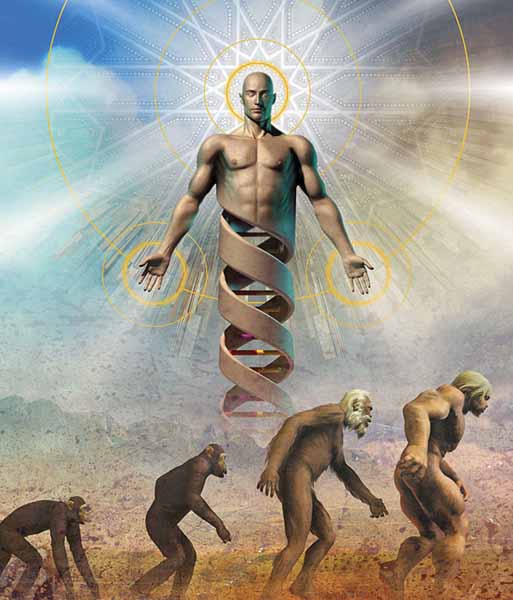
Humanity used to resort to supernatural hypotheses for creation myths. Genesis is one of many such myths. God fashioned the world in six days. In the 19th century Charles Darwin hit on what really happened, without any need to invoke the supernatural or the divine. Evolution is a gentle slope; Darwin’s great insight was that life evolved steadily and slowly over four billion years. Natural selection not a divine designer was the sculptor of life. The design hypothesis raises an even bigger problem than it solves: who designed the designer?

Dawkins thought that in his lifetime evolution would be accepted as fact everywhere, backed up as it is by overwhelming evidence. But this evidence cuts no ice with many. Evolution today is under threat. In the bible belt of Middle America, evangelicals are fighting back against science. In the new world, religion is free enterprise. Rival groups set up shop competing against each other to save souls. Fundamentalist Christianity is on the rise in the world’s only superpower. Its power spreads up to and including the president. 135,000 million Americans believe the universe is less than 10 thousand years old.

Dawkins goes to the New Life Church in Colorado Springs where conservative Christians have built an $18 million Church. New Life isn’t just a church but a social network. A 12,000 congregation attend 1,300 organised programs which guide them on everything from marriage to dog walking. It is a New Jerusalem in the foothills of the Rocky Mountains. While it lacks the tradition of Lourdes, it makes up for it in swaggering authority.

Evangelical churches like this have become enormously powerful in the US influencing everything from the teaching of science in schools to foreign policy. New Life Church Pastor Ted Haggard was a powerful man, chairman of the National Association of Evangelicals. Haggard had a hot line not only to God but also to President Bush. He is a staunch Republican. He had also rubbed shoulders with Tony Blair and Ariel Sharon. Dawkins was not to know that Haggart was forced to resign in November 2006 after paying for sex with a gay prostitute and admitting he bought drugs.

When Dawkins and Haggart met, they clashed on the Bible. Dawkins wanted to understand what he called ‘irrational faith’ is spreading and attacking science. In their interview Dawkins began by complimenting Haggart and suggested a lot of money was spent here. Haggard said “I wanted people to be able to worship and enjoy it and be in a setting where the speaker is close to them…so I can look at them”. Dawkins said this was effective and said the sermon reminded him of the Nazi Nuremburg rallies. Haggard laughed and said lots of Americans think of it more as a rock concert.

Dawkins acknowledged that every person needs at the centre some sense of meaning about existence. But most accept that life is complex not the childish certainties of God. Dawkins biggest concern is that evangelicals like Haggart are foisting falsehoods on their flock. They deny scientific evidence just to support a Bronze Age myth. Haggart hit back by accusing “people like Dawkins” of intellectual arrogance and air of superiority because “they know so much more”.

Haggart’s approach is to lets teach evolution as just another theory alongside creationism and intelligent design, which sounds reasonable on first impression. But whereas evolution by natural selection is supported by mountains of evidence, creationism exists on a flimsy base; self-contradictory and supported only by what Dawkins contempuously calls "ancient scribblings".

Saturday, April 29, 2006

The Intelligent Design hoax

In the 19th century science was posing a huge threat to religion. Biblical authority and church teachings which had first taken a hammering with Galileo’s theories were now under siege. Geologists had shown that the Earth was very old indeed. Darwin’s Origin of Species in 1859 was followed by the Descent of Man in 1871 and both books advanced a theory of evolution that was at serious odds with the established view of a Creationist world.

By the 1870s, nearly all biologists agreed that life had evolved, and by the time of the Second World War most agreed that natural selection was a key force driving this evolution.

The churches and the powers-that-were didn’t take this challenge lying down. There was always the view that Darwinism represents a thinly veiled attempt to foist a secular religion—godless materialism—on Western culture.

According to a 2001 Gallop poll 45% of Americans concurred with the statement that "God created man in his present form within the last 10,000 years”. But it is harder to sustain outright belief in Creationism in the face of increasing scrutiny of biblical evidence.

In recent years, the Creationists have taken a new tack and have come up with a more sophisticated, pseudo-scientific and beguilingly named product called Intelligent Design. Slickly marketed, it is now the front face of creationism. It has very powerful friends.

US President Bush supported teaching alternatives to evolution in public schools with remarks such as schoolchildren should be taught about intelligent design as well as evolution. He said in August 2005 "Both sides ought to be properly taught . . . so people can understand what the debate is about. Part of education is to expose people to different schools of thought. . . . You're asking me whether or not people ought to be exposed to different ideas, and the answer is yes.”

The theory of intelligent design holds that life and the universe are best explained by an intelligent cause rather than an undirected process such as natural selection. It deliberately does not try to identify or name the specific creation but many of its proponents state that the designer is the Christian god.

The idea is far older than Darwinian evolution. The first recorded arguments for a natural designer come from Greek philosophy. Heraclitus is associated with the philosophy of Logos which describes human knowledge and the inherent rationality of the universe. Plato spoke of a “demiurge”, a deity of supreme wisdom and intelligence who created of the cosmos. Aquinas posited the supernatural designer of the universe in the 13th century. In 1802, English theologian William Paley wrote “If we find a pocket watch in a field, we immediately infer that it was produced not by natural processes acting blindly but by a designing human intellect.” It arose again in the early 1980s with the publication of The Mystery of Life's Origin by creationist chemist Charles Thaxton.

The leading proponent of Intelligent Design today is American biochemist Michael Behe. He advocates the idea that life is too complex at the biochemical level to have evolved. The trigger for his involvement was the 1987 decision in the U.S. Supreme Court barring the teaching of Scientific Creationism from public schools. In his book “Darwin’s Black Box,” Behe maintained that irreducible complexity presents Darwinism with “unbridgeable chasms”.

The Christian think-tank The Discovery Institute was set up in 1990 and is a driving force behind Intelligent Design. Their mission statement is “to make a positive vision of the future practical”. Their agendas are to promote public awareness, lobby for teaching in high schools and instigating pro Design legal actions. They have powerful friends. The Gates foundation has pledged $10 million since 2000. Its major contributors are also the same major contributors to George W. Bush.

The idea is to present evolution as a ‘theory in crisis’ and to poke as many holes in it as possible. The mathematician William Demski, another proponent of ID, holds the concept of specified complexity. When something is both complex and specified, one can infer that it was produced by an intelligent cause. He provides the following example: "A single letter of the alphabet is specified without being complex. A long sentence of random letters is complex without being specified. A Shakespearean sonnet is both complex and specified”.

Despite the rhetoric, many critics say that intelligent design has not presented a credible scientific case. Instead it is seen as an attempt to teach religion in public schools and intelligent design has substituted public support for scientific research. The theory has little support in the scientific community. In October 2005 a coalition of 70,000 Australian scientists and teachers stated "intelligent design is not science" and called on "all schools not to teach Intelligent Design (ID) as science, because it fails to qualify on every count as a scientific theory”.

To date, the intelligent design movement has yet to have an article published in a peer-reviewed scientific journal.

In 2004, the school board of Dover, Pennsylvania, voted to require the teaching of intelligent design alongside evolution in science classrooms. On December 20, 2005, U.S. District Court Judge John Jones ruled that the school district cannot follow through with its plan because it would violate the Constitutional separation of church and state. In his opinion Judge Jones wrote, "We have concluded that it is not [science], and moreover that ID cannot uncouple itself from its creationist, and thus religious, antecedents".

It remains a dangerously powerful and popular bunkum. Intelligent Design is science’s equivalent of junk food. It is the newest evolution of Creationism and teaches us more about politics and religion than science.

It is no more scientific than those who write to the Kansas School board which was leaning towards Intelligent Design. The protesters state that they are of the strong belief that the universe was created by a Flying Spaghetti Monster and it too should be considered for the curriculum. It is as scientific and more amusing.

References

Church of the Flying Spaghetti Monster
Discovery Institute
How Intelligent Design Works
Intelligent Design Network
National Centre for Science Education
Natural History Magazine
New Yorker magazine: devolution
Talk Design
Washington Post: Bush Remarks On 'Intelligent Design' Theory Fuel Debate

Thursday, April 06, 2006

Bellybutton

Omphalos is the Greek word for navel.

According to the ancient Greeks, Zeus sent out two eagles to fly across the world to meet at its center, the "navel" of the world. Omphalos stones to denote this point were erected in several areas surrounding the Mediterranean Sea, the most famous of those was at the oracle in Delphi.

The omphalos hypothesis was named after the title of an 1857 book, Omphalos by Philip Henry Gosse. In this book Gosse argued that in order for the world to be "functional", God must have created the Earth with mountains, canyons, trees with growth rings, Adam and Eve with hair, fingernails and navels, and that therefore no evidence we can see of the presumed age of the earth and universe can be taken as reliable.

The idea has seen some revival in the twentieth century by some modern creationists, who have extended the argument to light that appears to originate in far-off stars and galaxies, although many other creationists reject this explanation and also cantankerously believe that Adam and Eve had no navels.

Bertrand Russell, influenced by Gosse, discussed the ramifications of such a theory in his 1921 work, The Analysis of Mind, stating:

"There is no logical impossibility in the hypothesis that the world sprang into being five minutes ago, exactly as it then was, with a population that 'remembered' a wholly unreal past. There is no logically necessary connection between events at different times; therefore nothing that is happening now or will happen in the future can disprove the hypothesis that the world began five minutes ago."

Jorge Luis Borges, in his 1940 work, Tlön, Uqbar, Orbis Tertius, describes a fictional world in which some essentially follow as a religious belief a philosophy much like Russell's discussion on the logical extreme of Gosse's theory:

"One of the schools of Tlön goes so far as to negate time: it reasons that the present is indefinite, that the future has no reality other than as a present memory."

Last Thursdayism (sometimes Last Tuesdayism or Last Wednesdayism) is a whimsical version of omphalism. It is the idea that the world was created last Thursday, but with the appearance of age: people's memories, history books, fossils, light already on the way from distant stars, and so forth.

This parody has been taken further, with claims that the Universe was created Last Thursday by Queen Maeve the housecat, who would destroy the world Next Thursday, keeping a Heaven of sorts for those who were nice to cats and damning evildoers to the Hell of the the never-cleaned Eternal Litterbox.

Such navel gazing is probably no more illogical a belief than the complex modelling required to show that the Big Bang created time and space. Though admittedly, we are still eagerly awaiting the mathematical proofs for omphalism and its derivatives.