On May 14 this year, Hugo Chavez, the president of Venezuela, addressed an adoring crowd at the Camden Town Hall, London. The
Independent newspaper described the event as a “mixture of a Latin American populist rally, an evangelical meeting and a football match.”
London is the latest stop on his European tour which has taken him to the Vatican and Vienna. In his rambling two hour speech without notes at Camden, he quoted Rosa Luxembourg, Pythagoras, Karl Marx and George Bernard Shaw. He attacked US foreign policy on Iran and Iraq. He claims, not without reason, that the US government are plotting to assassinate him. “I know there are plans to kill me, but I really don't care. It will not stop me,” he said to the crowd.
On August 22, 2005, influential right wing demagogue
Pat Robertson openly called for his assassination on television. He told the Christian Broadcasting Network’s “The 700 Club” that “I don't know about this doctrine of assassination, but if he thinks we're trying to assassinate him, I think that we really ought to go ahead and do it. It's a whole lot cheaper than starting a war”. He went on to say “It's a whole lot easier to have some of the covert operatives do the job and then get it over with.”
And indeed Chavez would not be first Latin American president that the US has forcibly removed from office. The
Monroe Doctrine is not idle theory. In December 1823 US president James Monroe issued a statement of intent to European governments of America’s growing power, “the American continents were no longer open to European colonization, and that any effort to extend European political influence into the New World would be considered by the United States as dangerous to our peace and safety." From then on, this cornerstone of American foreign policy meant they would reserve the right to interfere with domestic affairs in Latin American countries whenever it felt their interests were being threatened.
In more recent times, leaders such as Salvador Allende and Manuel Noriega have been ousted from power through overt or covert American involvement. Allende was the first democratically elected Marxist leader in the world when he won the Chilean presidential election in 1970. His regime and life were brought to a spectacular end on
September 11, 1973 when General Pinochet led a military coup and bombed the presidential palace with the implicit backing of US State Secretary, Henry Kissinger.
Noriega was a CIA operative in the 1970s and de facto military leader of Panama in the 1980s. His relationship with his ex-bosses turned sour in 1989 and the Americans invaded in “
Operation Just Cause.” Noriega was arrested and imprisoned in Florida for drug trafficking.
Chavez is a major problem for America because of its large dependence on Venezuelan oil in the middle of a supply crisis. So the US is now trying to turn Chavez into another
Noriega. They have accused him of supporting and supplying weapons to the FARC, Colombia's largest revolutionary guerrilla movement. FARC is also accused of drug smuggling and terrorist activities. US newspapers such as the
New York Times are fanning the links between Chavez, FARC and drugs in a similar manner to the way Noriega was demonised prior to the 1989 invasion.
Hugo Chavez will be fifty years old on July, 28 this year. He was the second son of schoolteachers in the town of Sabaneta in the Western state of Barinas. His father is now the governor of that state. At 17, Chavez joined the Venezuelan academy of Military Sciences where he achieved Master’s degrees in military science and engineering. Chavez remained in the army and gradually worked his way through the ranks to become lieutenant colonel.

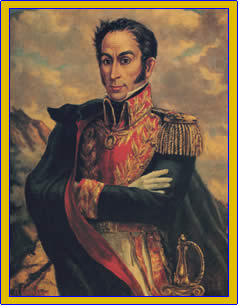
While a student, he developed his key philosophy: Bolivarianism. It is named for the greatest of South America’s generals and fellow Venezuelan
Simon Bolivar. Bolivar proclaimed Venezuelan independence from Spain in 1810. He fought running battles with the Spanish over the next 11 years before emerging as president of the original republic of Colombia (now Ecuador, Colombia, Panama, and Venezuela). He also took Peru and upper Peru was renamed Bolivia in his honour. Chavez saw Bolivarianism as promoting the unification of Latin America. As president he changed the constitution and name of the country in 1999 to the Bolivarian Republic of Venezuela.
Chavez first came to national prominence in 1992. Venezuela was undergoing a crisis under neo-liberal
Carlos Andres Perez who was serving his second term as leader. Venezuela’s economic stability was under threat when the Arab countries raised their oil production quotas to aid the collapse of the oil-dependent Soviet Union. Prices plummeted and Venezuela had to introduce austerity measures. Chavez and fellow army officer Francisco Arias Cardenas founded the MBR-200 (Movimiento Bolivariano Revolucionaro 200) and plotted to overthrow the government. The coup of February 4 failed. Chavez only had the loyalty of 10% of the armed forces and failed to take the national TV station. Perez eluded capture and Chavez surrendered. He was sent to prison but many poor Venezuelans saw him as a victim who had stood up against government corruption. Perez was ousted in 1993 and Chavez was pardoned by the new president Rafael Caldera in 1994. In 1998 Chavez campaigned for the presidency and gained significant support from Venezuela’s two largest banks. He won the
December election with 56% of the popular vote.
He immediately got to work on his sweeping changes which included road building, housing construction and mass vaccination. He also halted planned privatisations of the national social security system, the aluminium industry and the oil sector. He lobbied OPEC to reduce oil production to increase revenues. He was re-elected with an increased majority in 2000. In 2002 his reform of the state oil company precipitated a military coup.

He was replaced and arrested on April 11, 2002. This event sparked massive pro-Chavez protests and universal condemnation from the rest of South America. Chavez was restored to the leadership in triumph two days later. Only then did the US condemn the coup. The British Sunday broadsheet,
The Observer, reported that the coup was linked to three senior US government officials, national security adviser
Elliot Abrams, special envoy
Otto Reich and intelligence chief
John Negroponte.
Internal opposition to Chavez continues to be fierce. In 2004,
Sumate (Spanish for “Join in”), a shadowy volunteer civil association funded by the US State Department collected millions of signatures and activated the 1999 Constitution's presidential recall provision. Chavez survived this with a 60% ‘no’ vote against the measure.
Chavez continues to use Venezuela's increasing oil revenues to focus on expanding social programs. Economic activity has also picked up markedly, reaching double-digit growth in 2004. He has forged links with Argentina’s president Kirchner, China’s Jintao, Cuba’s Castro and Iran’s Admadinejad. He ordered US troops and Christian missions out of his country in 2005 and gave away almost seven thousand square kilometres of land to Amazonian tribes. He has denounced US foreign policy but was the first leader to offer assistance to America after
Cyclone Katrina. He told AP "We place at the disposition of the people of the United States in the event of shortages we have drinking water, food, we can provide fuel”. His offer was turned down.
Chavez continues to polarise world opinion. It is probably too early to judge his impact on his country. But he remains a refreshing different voice on the world scene. It is no wonder the crowd at Camden Town Hall gave him a superstar reception.
 If the Western media is to be believed, Hugo Chavez is making a strong application for membership of the axis of evil. In the last 48 hours alone, he “seized control” of Venezuelan ports, announced a visit to Iran, nationalised cement companies and called Obama a “poor ignoramus”.
  Yet there is still hope. Venezuela still enjoys a vibrant public debate in which anti-government and pro-government media are equally vocal in their criticism and defence of Chavez. One can ask for little more in a democracy – even one where a long-term government is looking to change the rules in their favour; just ask Queensland Labor. The Chavez paradox shows little sign of unravelling.