Showing posts with label Hamas. Show all posts

Monday, May 31, 2010

Israel massacres peace activists in the Mediterranean

The Israel Defence Force has murdered at least 16 people after storming ships on the high sea bound for Gaza. The six ships of the flotilla were carrying 10,000 tonnes of aid and around 600 human right activists from around the world who were determined to break Israel’s three year long blockade of the Palestinian territory. Israel had repeatedly said it would not let them in and IDF forces boarded the boats around 65km off Gaza before beginning their killing spree. Free Gaza Movement, the organisers of the flotilla, said the troops opened fire as soon as they stormed the convoy despite the raising of a white flag.

With the flotilla carrying mainly medical and food supplies, most of the world’s governments have condemned Israel’s provocative actions. Israeli police are on high alert across the country to prevent any civil disturbances. Meanwhile in Gaza, the Hamas government held an emergency meeting chaired by premier Ismail Haneya, following the Israeli Television Channel 10 report that 16 activists on the ships were killed and 30 wounded, including the Israeli-Arab Islamic activist Sheikh Raed Sallah (though the Jerusalem Post said he is injured not dead).

The IDF version of events needs to be treated with extreme caution but they said soldiers were attacked with knives and clubs as they boarded the six vessels. It said the violence turned deadly when an activist grabbed a weapon from one of the commandos. “The weapon discharged,” they said ambiguously not making it clear whether the activist fired it or if it went off accidentally.

The six ships of the flotilla sailed under Turkish and American flags and set off from Cyprus yesterday. Israeli forces said they would not allow them to land and the flotilla deliberated slowed down so that any forced landing would happen in daylight hours to maximize the media exposure. Meanwhile at the port in Gaza City, Hamas prepared a welcoming party with marquees and a buffet to greet the flotilla which was expected mid-afternoon today.

The first contact happened 200 kms off the Gaza shore. The IDF contacted the flotilla by radio and told them the Gaza Strip was a closed military zone. They offered them two options either follow the navy to Ashdod Port in Israel or else be commandeered by commandos. "If you ignore this order and enter the blockaded area, the Israeli navy will be forced to take all the necessary measures in order to enforce this blockade,” the IDF told them. The flotilla radar detected three Israeli ships in the area. After boarding the vessels and going on a shooting spree, the IDF towed the vessels to Ashdod.

The Hamas Government in Gaza said it considered the dead activists "as the martyrs of the Freedom Flotilla, adding that "the world should put an end to the biggest country of pirates.” Meanwhile Gaza premier Ismail Hanaya called the attack an international crime and a political scandal carried out according to an Israeli military order. “I call on the Palestinian Authority to immediately suspend its negotiations with Israel,” he said. He also called for street protects and the Arab states to respond to “end the unfair Israeli siege."

Israel justified its actions saying it already allows 15,000 tonnes of aid into Gaza each week. However the UN said this is just a quarter of what the Gaza Strip needs. Somewhere between 35 and 60 percent of Gaza’s agriculture industry was destroyed by Israel’s three week long invasion in 2008-2009 which left the land contaminated and cratered. This is the ninth time that the Free Gaza movement has tried to ship in humanitarian aid to Gaza since August 2008 but only five have been successful and none since Operation Cast Lead turned Gaza into a wasteland. The latest action confirms Israel is prepared to thumb its nose at international criticism as it lurches further into right-wing extremist nationalism.

Sunday, February 28, 2010

Europe and Australia more worried about passport fraud than Mossad murderers

While the much-publicised hunt continues into the Dubai fake passports affair, no European country has yet launched a manhunt for the killers of the Hamas man slain in the Gulf state despite an Interpol investigation into the crime. Mahmoud al-Mabhouh was murdered in Dubai on 19 January by Mossad operatives who then fled across Europe. The men are believed to have flown to Switzerland, Italy, France, Germany and the Netherlands but none of the authorities of these countries have launched investigations. AP say this is because the hit was carried out by a friendly country and arresting Israeli agents or even digging up evidence that Israel was involved could be politically costly. "I would guess that it's in the political interest of certain countries not to get proactive in this case," said Victor Mauer, deputy director of the Centre for Security Studies at Zurich's Federal Institute of Technology.

The countries also say they have yet to receive a request of help from Dubai about the case. The murdered man Mahmoud al-Mabhouh was a senior Hamas commander. He was also one of the founders of the Qassam brigades which were responsible for the capture of Israeli soldier Gilad Shalit, and in the subsequent heavy fighting in the Gaza Strip following Israel’s incursion in December 2008. Al-Mabhouh was born in Gaza in 1960 and has been known to Israeli authorities since as far back as 1989 when he was involved in the abduction and murder of two IDF members. He has been the target of two previous assassination attempts: a car bombing and a poisoning. The poisoning took place in Beirut just six months ago and rendered him unconscious for 30 hours.

In recent years al-Mabhouh was a key negotiator between Hamas and Iran. On 19 January he flew from Syria to Dubai stopping off there on his way to Bangkok. He arrived in the early afternoon without bodyguards and booked into the Al Bustan Rotana hotel using a false identity. He left the hotel an hour later and returned around 8.25pm that evening. It was likely he was being tailed during his absence. His wife rang a half hour later but there was no answer. Israeli news agency Inyan Merkazi reported a four-member squad of Shin Bet and Mossad agents interrogated al-Mabhouh before executing him. Dubai Police say he was dead by 9pm. Hotel footage show suspects following him to his room in the afternoon before checking into the room opposite. Around 8pm they gained entry to his room and waited for his return.

Al-Mahmoud’s body was found the following morning and taken for a police examination. Burns from a stun gun were found under his ear, in his groin and on his chest. Pathologists discovered his nose bled before death. They found blood on a pillow they believe was placed over his nose and mouth to suffocate him. Results from a preliminary forensic report by the Dubai police found that al-Mabhouh was first paralysed via electric shock to his ears, legs, heart and genitals and then suffocated. Dubai police identified 11 people they suspected of involvement in the murder. Five of them carried out the crime while the remaining six served as lookouts. Another four were later added to the list and they all travelled on fake Western passports, six UK, five Irish, three Australian, one French and one German. The fact that many of the passports share names with people living in Israel reinforced widespread suspicion about Mossad involvement.

Reaction in the west to al-Mahmoud’s killing was initially muted. The subtext was here was a known terrorist who was simply getting his just desserts. But reaction quickly changed once it became apparent that Israeli agents used western passports in the hit. Foreign ministers of all the countries involved complained to Israel about the identity theft involved. The EU called the nature of the killing “profoundly disturbing”. Australian Foreign Minister Stephen Smith was also distinctly uneasy in criticising Israel but said it would not be considered the "act of a friend.”

UK Police are now in Israel investigating the passport theft. There they will interview six British-Israeli nationals whose identities were stolen by the suspected killers. Officers say they are being viewed as potential witnesses to a crime, which is the fraudulent use of a passport, and will not be questioned or interviewed as suspects. British authorities say they believe the Israeli secret service Mossad was involved which Israel has refused to confirm or deny.

In a penetrating article in New Matilda last week, Mark Steven skewered western reaction to the crime. Steven said the West’s response to the assassination was simply the result of their principal and shared interest in the expropriation of national identities rather than a horror of al-Mahmoud’s death.” While assassination is condemnable, it seems the requisition of a European or an Australian identity is utterly unforgivable,” he wrote. Stevens asked the question: “While life that coheres behind names printed on European passports is to be valued highly, what is the worth of life that only exists under collective labels, such as ‘Israel’ or ‘Palestine’?”

Sunday, January 04, 2009

Defiant Hamas continue rocket attacks under Israeli assault

Gaza militants have defied the Israeli ground invasion and have fired dozens of rockets across the border in the last 24 hours. Five Qassam rockets struck the town of Sderot causing one minor injury and another struck Ashdod but caused no known damage or casualties. A house in Ashkelon took a hit from a more powerful Grad rocket but there were no fatalities. 12 Qassam rockets hit the Sdot Negev area on Saturday; all landed in open fields and caused no injuries. The main impact of these strikes continues to be psychological, as it has been for the last seven years.

The Gaza Strip has been separated from Israel by a security barrier since 1996. In 2005 Israel withdrew its civilian and military presence according to its unilateral disengagement plan, but retained control over airspace and maritime access. The attacks began after the outbreak of the Al-Aqsa Intifada. The rockets were the only way that Gaza Palestinians could continue to carry the war into Israel. After Hamas won control of Gaza in June 2007 elections, Israel imposed a blockade on the Strip and its 1.5 million inhabitants. They allowed only basic humanitarian items in and permitted no exports paralysing the economy. The Israeli government declared Gaza a "hostile entity" in response to continued rocket attacks, and said it would start cutting fuel imports. The reduction in fuel supplies and a chronic lack of spare parts has severely impacted sewage treatment, waste collection, water supply and medical facilities. Aid agencies said the situation had become a humanitarian crisis.

Gaza began launching Qassam rockets in 2001. As of February 2008, they have killed 13 people, mostly in the nearby border town of Sderot. There has been no effort at negotiation in that time. Israel refuses to talk to Gaza’s rulers because Hamas in turn refuses to acknowledge the Jewish state's right to exist, will not renounce violence and doesn’t adhere to previous peace agreements signed by Yasser Arafat’s Fatah faction. Nevertheless as recently as February 2008, Israel’s public attitude was that a large scale ground operation would not put an end to the rocket fire.

But as the frequency has increased, Israeli public pressure had been mounting on the government to stop the rockets. With an Israeli election and a less friendly US administration in the wings, the Israeli government finally believed the time was right to react. In the past week, IDF artillery bombs have killed more than 480 Palestinians and injured 3,000 in Gaza. In same period, four Israelis have been killed and 59 wounded in Hamas rocket attacks. The rockets remain the Palestinians most potent, albeit random, weapon of retaliation.

Qassam rockets
are named for the Izz ad-Din al-Qassam Brigades (Hamas’s military wing) which in turn was named for the 1930s Palestinian leader Mojahed Izz ad-Din al-Qassam. Bombmakers supplied the first prototype in 2001 and a year later produced the Qassam 2, an improved version which attacked nearby Israeli settlements and towns. The rockets consist of a warhead, an engine and a tail segment. The warhead is filled with TNT and urea nitrate. They are fuelled by mixture of sugar and potassium nitrate (which is widely available as a fertiliser). Often they are crudely made explosives-packed pipes with metal fins welded onto the end. Qassam rockets are free-flying and lack any guidance system. As a result, they are notoriously inaccurate and many fail to even cross the border into Israel.

The rockets have a range of four to forty kilometres and spread their submunitions over a broad area. A large number remain unexploded and become defacto landmines. But they rarely cause any injuries, and they did not kill an Israeli until 28 June, 2004. The main success of the rockets has been psychological and has created an atmosphere of fear in all of the Southern Israeli border towns. The number of attacks has increased dramatically in recent years. By November, Israel had indicated it had lost patience: PM Ehud Olmert ominously told his audience "The question is not whether there will be a confrontation, but when it will take place, under what circumstances, and who will control these circumstances, who will dictate them, and who will know to exploit the time from the beginning of the ceasefire until the moment of confrontation in the best possible way.” Israel has begun the confrontation but the question will be whether it can control the consequences.

Saturday, June 16, 2007

Israel's bastard children: Hamastan and Fatahland

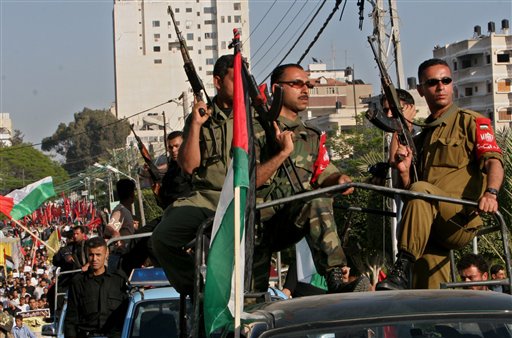
The world is now trying to make sense of the new political reality in Palestine which has Fatah running the West Bank and Hamas now in firm control of the Gaza Strip. In Gaza City yesterday, the green flag of Hamas flew over public buildings where last week the Palestinian flag had been. Over a hundred people have been killed in the violence that enveloped the coastal strip for five days.

The cause of the Gaza violence is threefold. The most proximate cause is access to financial control of Gaza. Hamas was desperate to bring the Fatah-led security force under its control. Its leader Muhammad Dahlan, a former protégé of Yasser Arafat, wanted to use the force to bolster his own presidential bid. Dahlan ran a highly profitable protection racket which will now fall under the control of Hamas. Looters stripped his villa yesterday as well as attacking the presidential compound left vacant by Mahmoud Abbas.

The second reason was to kill off the struggling 1993 Oslo Accords which first gave voice to the ‘two state’ proposal for Israel and Palestine. Fatah under Arafat agreed to the Accords believing it could make a state out of the West Bank and Gaza. Out of the accords was born the Palestinian Authority. Hamas, however, has a mandate for a single contiguous Palestine that has no place for the Jewish state of Israel. It wants to see a country that inherits the 22,000 square kms of the old British Palestine mandate, not the 5,000 square kms as accepted by Fatah.

The third underlying reason for the violence is the deep-rooted philosophical difference between Fatah and Hamas. The secular Fatah’s vision for a democratic Palestine is radically different from the theocratic entity prescribed by Hamas. It wants Sharia Law not Western civil law. In the 18 months since it won the election, Hamas has attempted to “Islamise” Gaza with beards compulsory for men and hijabs for women.

In the West Bank, President Abbas sacked Hamas Prime Minister Ismail Haniya on Thursday and replaced him with Salam Fayyad, an independent lawmaker and former World Bank economist. The appointment is likely to strengthen Abbas’s case to get international aid sent to a PLO account to avoid it coming into the hands of Hamas. Fatah also began rounding up Hamas members and sympathisers in the West Bank. They also burned and looted Hamas offices and killed at least one of their leaders.

Amnesty International has condemned Hamas and Fatah for their actions during the week’s violence. In a statement yesterday, it said both groups have shown utter disregard for fundamental principles of international law and have committed grave human rights abuses. It condemned indiscriminate attacks and “reckless gun battles” in residential neighbourhoods that left beleaguered occupants prisoners in their own homes. People protesting against the violence have also been targeted. Gunmen in Gaza City and Khan Younes fired on unarmed demonstrators who were calling for an end to the armed clashes, killing one protester and injuring several others.

The two groups have been in an uneasy power sharing arrangement since Hamas had a breakthrough win in the legislative elections in January 2006. Fatah leader Mamoud Abbas remained President leading to an effective stalemate. Due to Hamas’s refusal to recognise Israel, the mediating Quartet (EU, US, Russia and the UN) threatened to cut off funds to the Palestinian Authority. In June 2006 it appeared as if the two groups were moving towards an agreement on Israel in the face of international pressure. However Hamas dashed these hopes by saying their political settlement with Fatah did not contain an implicit recognition of Israel. That settlement too was short-lived.

Hamas will now rule Gaza alone although with significant help from Syria and Iran as well as moral support from Hezbollah in Lebanon. Hamas’s Covenant which was established in 1988 states that the organization's goal is to "raise the banner of God over every inch of Palestine”. It promises to obliterate Israel and believes that Palestine is an Islamic Trust (“Waqf” in Arabic) which cannot be negotiated away by political leaders. However Israel still has immense power over the strip. It controls the borders and has the power to cut off water and power.

During the second Intifada of 2001, Yasser Arafat told an Italian newspaper Corriere della Sera that Hamas was a creation of Israel. He blamed Hamas for the violence and claimed that then-Israeli Prime Minister Yitzhak Shamir gave them money and “more than 700 institutions, among them schools, universities and mosques” in the late 1980s. Arafat went on to say Hamas was constituted with the support of Israel. "The aim was to create an organisation antagonistic to the PLO,” he said.

Arafat was not alone in this view. Several former US intelligence officials say that Israel gave direct and indirect financial aid to Hamas over a period of years. Tony Cordesman, Middle East analyst for the Center for Strategic Studies says the Israelis wanted to use it as a counterbalance to the PLO and a former CIA operative said Israel's support for Hamas "was a direct attempt to divide and dilute support for a strong, secular PLO by using a competing religious alternative". Israel’s long cherished dream has now turned into a reality of three states: a Jewish one in Israel, a secular Arab one in the West Bank, and an Islamist one in Gaza.

Monday, June 19, 2006

Fatah v Hamas

The two main Palestinian factions announced yesterday that they were moving closer to an agreement that would implicitly recognise Israel. It is an attempt to end international sanctions and seen as a response to the plan whereby the US, UN, and Russia endorsed an EU plan to funnel humanitarian aid to the Palestinians while bypassing the anti-Israeli government. Parallel to the Palestinian armed struggle against Israel is a power struggle between the two main political parties; Hamas and Fatah.

Fatah, the inheritors of Yasser Arafat’s power, have been the long-standing power in Palestinian politics. They have dominated elections since 1996, when Hamas boycotted the poll, allowing Fatah to sweep to victory over a handful of independents. Hamas came in from the political cold this year and contested the January 2006 elections. They capitalised on corruption within the Palestinian Authority (PA) and beat Fatah in a stunning landslide election victory. Hamas now have 76 of the 132 seats compared to Fatah’s 43. Fatah still control the presidency under Mahmoud Abbas. Crucially he retains official control over the Palestinian security services.

Since then tensions have increased between the two factions. In early May, three people were killed in clashes between the groups. A spate of tit-for-tat kidnappings led to the death of a Hamas member and as a result Hamas gunman fired a shoulder-held missile into a government vehicle, killing two Fatah members of the security forces.

Fatah is a reverse acronym of Harakat al-Tahrir al-Filistiniya (Palestinian Liberation Movement) and means "conquest" in Arabic. Arafat founded the party in the 1950s to promote the armed struggle to liberate Palestine from Israeli control. It led the peace process in the 1990s after recognising Israel’s right to exist. Most of the bureaucrats in the Palestinian Authority are Fatah members and they also control the 70,000 strong police and security forces. Abbas is leading the fight to gain recognition of the West Bank and incorporate it with Gaza into a Greater Palestine. Their militant wing the al-Aqsa Martyrs Brigades has held an informal ceasefire since 2005 but has breached it on occasions which it calls retaliatory attacks against Israel.

Hamas is an acronym for Harakat al-Muqawama al-Islamiya (Islamic Resistance Movement) and means "zeal" in Arabic. They were formed in 1987 with a dual purpose: social welfare and armed resistance against Israel. These goals have earned the support of the Palestinian oppressed but saw them designated a terrorist organisation by the West. Their charter seeks Israel's destruction. Hamas’s Ismail Haniya, the Palestinian prime minister, has said that a long-term truce with Israel possible if Israel withdraws from territory occupied in 1967. Their armed wing is called Izzedine al-Qassam brigades and they too have a ceasefire in operation but they also claim the right to retaliate against Israeli attacks. According to the U.S. State Dept, Hamas is funded by Iran, Palestinian expatriates, and private benefactors in Saudi Arabia and other Arab states. Because of Hamas’s status, outside funds to the PA have dried up. Banks refuse to handle emergency donations fearing US penalties. An impending financial meltdown of the PA is possible which could cause a major humanitarian crisis. As the police force is controlled by Fatah, Hamas has deployed a 3,000-strong shadow security force including its supporters to tackle lawlessness in Gaza. The move exacerbated tensions with pro-Fatah security agencies sparking gunfights between the groups.

The Palestinian Authority was set up as a direct result of the Oslo peace accords signed by in 1993 between Israel and the PLO under the auspices of US President Clinton. Initially the Accords gave the Gaza Strip and the city of Jericho in the West Bank to the PA. The aim was to set up a Palestinian state covering Gaza and the West Bank. The status of Jerusalem was not addressed. The 2000 Palestinian Intifada known as the Al-Aqsa Intifada caused the Oslo Accords to be seen as increasingly irrelevant.

It has been superseded by the so-called “Road Map for Peace” in 2002. The road map set out by President Bush called for an end to Palestinian violence, political reform and Israeli withdrawal from the occupied territories. This would be followed by an internationally led Palestinian economy recovery leading to the establishment of a Palestinian state. In August 2005, Israeli troops disengaged from the Gaza Strip and in June this year Israeli PM Ehud Olmert announced he will meet Mahmoud Abbas to resume peace talks.

Abbas remains the key. In May 2006 he took the initiative back from Hamas by proposing a referendum to accept an independent state in the West Bank and the Gaza Strip. If he can get Hamas to accept this, then Palestine stands a chance to exist. If Hamas turns its back on the proposal, they will remain outcasts and, although electorally popular, they will leave Palestine as an international pariah. Israel can only stand to gain from this outcome.