Showing posts with label LRA. Show all posts

Sunday, March 28, 2010

HRW uncovers LRA massacre in Congo

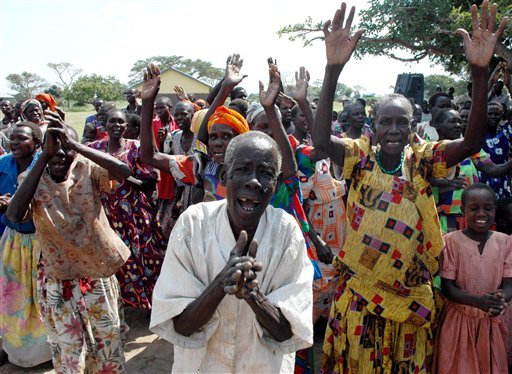
A new Human Rights Watch report has given details of a large scale massacre of civilians in north-eastern Congo by the Ugandan rebel group the Lords Resistance Army in December last year. In a well-planned operation, the LRA killed more than 321 civilians and abducted more than 250 others, including at least 80 children in northeastern DRC near the border with Sudan. The attack was one of the largest single massacres in the LRA’s 23-year history and witnesses said for days afterwards the remote area was filled with the “stench of death.” (photo © 2009 Reuters)

The horrific nature of the attack is outlined in HRW 67-page report “Trail of Death: LRA atrocities in Northeastern Congo” (pdf version).It was one of a series of assaults in the Haut-Uele and Makombo regions of DRC late last year during a vicious four-day operation to abduct child soldiers for their operations. In each town they arrived in, the LRA pretended to be Congolese and Ugandan army soldiers on patrol, and spoke in broken Lingala (the common language of northern Congo) to reassure locals. Then they tied them up with ropes or metal wire at the waist, often in human chains of five to 15 people and dragged them away. The victims included many children aged 10 to 15 years old who were made to carry pillaged goods. Anyone who refused, or who walked too slowly, or who tried to escape was killed. Hundreds were hacked to death with machetes or had their skulls crushed with axes and heavy wooden sticks.

Both the Congolese and Ugandan governments had previously claimed the LRA was no longer a threat to the DRC. HRW says embarrassment over these claims contributed to the lack of news of the massacre reaching the outside world. A DRC army investigation unit arrived in the area a week later and concluded the LRA had carried out the attacks but no further action was taken. Ugandan soldiers attempted to pursue the assailants but without success.

It wasn’t until the end of December that news filtered through to MONUC, the UN peacekeeping mission in Congo. Though it regarded the LRA as the enemy, MONUC did not have the resources to investigate. Its priorities were to defend the district capital Dungu from LRA attack, and attend to the long-running crisis in Kivu. However after a HRW briefing in March, MONUC sent a team of human-rights specialists to the area to investigate.

The attack was coordinated by General Dominic Ongwen, commander of LRA forces in northeastern Congo. Ongwen is wanted by the International Criminal Court for crimes committed in Uganda and he divvied up the abductees among the LRA commanders and separated into multiple smaller groups, each heading in a different direction. HRW has now called on the ICC and the DRC to investigate Ongwen and his two most senior commanders for their role in the massacre.

It will be a task easier to ask than answer. Originally restricted to Uganda, the LRA has now evolved into a regional power causing deadly mayhem in Uganda, southern Sudan, CAR, and Congo. They were pushed out of Uganda in 2005 and now operate in the remote border areas between southern Sudan, Congo and CAR. Despite continual attacks from multiple directions, including the 2008 US-logistics backed Operation Lightning Thunder, the LRA has proven remarkably resilient and able to regroup to continue their attacks against and abductions of civilians. In retaliation for Operation Lightning Thunder the LRA attacked numerous Congolese villages around the end of 2008 killing almost a thousand civilians and abducting hundreds more.

HRW says one hope of defeating the LRA comes from the US government. On 24 February, US Secretary of State Hillary Clinton Senate told the Foreign Relations Committee “I have been following the Lord’s Resistance Army for more than 15 years. I just don’t understand why we cannot end this scourge. And we [the US government] are going to do everything we can to provide support we believe will enable us to do that.” Three weeks ago the Senate unanimously passed the Lord’s Resistance Army Disarmament and Northern Uganda Recovery Act. The bill is now before the US House of Representatives and if enacted into law requires the Obama administration to develop a regional strategy to stop LRA attacks, LRA, work to apprehend their leadership, and support economic recovery for northern Uganda.

HRW says the people of northeastern Congo and other LRA-affected areas across the central African region have suffered for far too long. “They are waiting for strong, effective action to end the LRA’s atrocities,” said the report. “[And also] to see the safe return of their children and other loved ones who remain with the LRA, and to let them know they are not forgotten.”

Sunday, February 24, 2008

Uganda signs permanent ceasefire with LRA

After 18 months of discussion, the Ugandan government has signed a permanent ceasefire with the rebel Lord’s Resistance Army (LRA). The two sides signed the agreement on Friday at talks in Juba, Southern Sudan. The Ugandan government has described it as a “major breakthrough” and former President of Mozambique, Joachim Chissano, who is mediating the talks called it “the end of the war”. The deal will come into effect 24 hours after both sides sign a comprehensive peace deal, which Chissano hopes will be achieved later this week.

The ceasefire terms prohibit LRA recruitment or rearmament and movement beyond the Southern Sudanese assembly area. It also creates a 10km buffer-zone around the assembly area, guarded by southern Sudanese troops. The last remaining issue to be dealt with is the demobilisation of LRA fighters and their integration into the Ugandan army. This may still be tricky as LRA leaders walked out of the talks just a day before signing the agreement after the Ugandans turned down their request for monetary compensation.

In August 2006, Uganda signed a truce with the LRA. That truce committed both sides to end the bloodshed and cease hostile propaganda. The rebels were given three weeks to leave their hideouts in Uganda and northern Congo and assemble at two south Sudanese camps. Though the ceasefire was later renewed, negotiations brokered by south Sudanese mediators frequently stalled.

The 20-year rebellion by the LRA in northern Uganda left tens of thousands of people dead and nearly two million displaced. The LRA became infamous for their brutal methods, killing of civilians, kidnapping children for use as soldiers and porters, and their mutilation of victims. Leader and self proclaimed mystic Joseph Kony began one of a series of initially popular uprisings in northern Uganda after President Yoweri Museveni seized power in 1986.

Kony claimed the Lord's Resistance Army was fighting to defend the Biblical Ten Commandments, although they also had more prosaic demands such as stopping the looting of cattle by Museveni’s troops and wanting a greater share of political power for his Acholi people. Kony was originally supported by the Sudanese (Khartoum) government though they cut ties with the LRA in 1999 in exchange for Uganda dropping support for Southern Sudanese rebels. Since then Kony has been on the run in the DRC and desperate to sign a deal.

One sticking point in the current deal is the outstanding matter of international warrants for Kony’s arrest. The LRA has said it will never sign a final peace deal unless the International Criminal Court (ICC) drops indictments against its leaders for atrocities. They have now been supported by Uganda which has agreed to set up a special division of the Ugandan High Court. The LRA is now relying on Uganda’s ability to persuade the ICC to drop the charges. Kony and two of his commanders are wanted by the ICC for war crimes and crimes against humanity.

Last week, the ICC issued a statement saying that the arrest warrants still stand. The office of the prosecutor is not a party to the peace process," it said. "The arrest warrants against the LRA commanders were issued by the court and remain in effect.” However the statement did offer a way forward by saying the indictments could be lifted if the ICC judges decide whether national trials are an adequate alternative to prosecution. "A challenge to the admissibility of the case remains hypothetical and, in any event, would be a matter for the judges of the court to decide upon,” said the ICC. Some difficult negotiation remains ahead to prove Chissano’s optimism that the war is indeed, ended.

Friday, April 27, 2007

Uganda ready to drop ICC warrant to make peace with Kony

After three months of stalled talks, the Lord's Resistance Army (LRA) has re-opened negotiations to end its 20 year war with Uganda. The LRA agreed to come back to the talks under the auspices of UN Special Envoy Joaquim Chissano, ex-president of Mozambique. Discussions resumed yesterday in Juba, the capital of Southern Sudan. Chissano pleaded with the LRA to make a go of it saying it was a last chance.

Both sides seem to be keen to make the most of the opportunity with conciliatory gestures apparent prior to the talks. Peace negotiations began in the middle of last year but broke down after three months because the rebels feared for their safety. The problem was caused by International Criminal Court warrants issued against several senior LRA leaders including Joseph Kony. Those warrants remain a sticking point. The LRA are demanding they be dropped as a precursor to any settlement while Uganda will only agree to an amnesty if a peace deal is signed.

The host of the current talks, South Sudan president Salva Kiir, has urged both sides to put aside their differences. At the opening of the talks at Juba Raha Hotel he said “The problems you are attempting to solve are not so deep rooted as we had in Sudan”. Kiir has vested interests in the settlement of the dispute as the battlefield has spread across his border into the newly autonomous South Sudan.

A report published by USAID’s Famine Early Warning System Network stated LRA attacks on civilian populations in southern Sudan pose a significant threat to food security and overall stability in the Equatoria states. After the last peace talks broke down, the LRA retreated to the Central African Republic (CAR), attacking and looting South Sudanese communities on their way. LRA activity is also hampering the return of 250,000 Sudanese refugees who fled into northern Uganda to escape the Sudanese civil war.

In October, the ICC issued a warrant against five LRA leaders including Joseph Kony. The arrest warrants of arrest are historic as they are the first to be issued by the ICC since its creation by the Rome Statute in 1998. According to the warrants, the LRA has established a pattern of brutalisation of the civilian population “by acts including murder, abduction, sexual enslavement, mutilation, as well as mass burnings of houses and looting of camp settlements”. Kony is wanted for the most serious charges, 33 counts in all including 12 crimes against humanity and 21 charges of murder. His deputy Vincent Otti is also wanted on 33 similar charges. Otti is believed to be hiding in the Democratic Republic of Congo.

Because the ICC does not have its own military or police force, it relies on support from the Ugandan government and the international community at large for assistance with arrest and evidence proceedings. Before the meeting Ugandan defence minister Amama Mbabazi said the warrants had been passed on to the country’s Director of Public Prosecutions in accordance with procedure. He also said
believes that one of the other men charged Dominic Ongwen was killed by Ugandan troops in September during an LRA incursion.

Kony, meanwhile, remains in hiding in Sudan, while the ICC warrant stands. He is represented in Jube by Martin Ojul. Captain Barigye Bakoku, the spokesman for the Ugandan delegation has described the start of the meeting as "cordial and brotherly”. He told AFP “I hope we are going to move smoothly up to the end because I saw seriousness in both delegations." But human rights bodies are watching Uganda carefully and are fearful Uganda will drop the criminal charges. HRW estimate Kony’s group has kidnapped 25,000 children.

But President Museveni will face pressure to come to a deal with Kony. A coalition of more than 40 local and international non-governmental organisations known as Civil Society Organisations for Peace in Northern Uganda (CSOPNU) has estimated the persistent conflict in the North has constrained economic and social development across the whole of Uganda. CSOPNU estimated the conflict has cost at least US$1.33 billion over the last 16 years - 3% of Uganda’s GDP over the period. The war has displaced half a million people, schooling is rare in the north, and HIV is rampant. The country desperately needs peace, and Museveni may be ready to pay a high price for it.

Thursday, August 31, 2006

Uganda signs truce with LRA

On Saturday, there was a breakthrough in one of Africa’s most intractable and bizarre wars. Uganda’s government signed a deal with the Lord's Resistance Army (LRA) that commits both sides to end the bloodshed and cease hostile propaganda. The LRA rebels have now three weeks to leave their hideouts in Uganda and northern Congo and assemble at two south Sudanese camps. The deal offers the best chance yet of ending the 20 year old war.

Thousands have died during the conflict in northern Uganda, and more than one million have fled their homes. The chief mediator, southern Sudan's Vice-President Riek Machar said he hoped the two principals will take action so that the guns can go silent. The two principals that Machar is referring to are the two towering figures of Ugandan politics, President Yoweri Museveni and LRA commander Joseph Kony.

The conflict in Northern Uganda began shortly after Museveni took power in 1986. Remnants of the previous government fled north and formed the Ugandan People’s Democratic Army (UPDA). The UPDA were routed but formed several splinter groups. One of these groups was led by the ‘spirit moved’ Alice Lakwena. Her 3,000 strong army was defeated and she fled to Kenya. But her nephew Joseph Kony re-mobilised the Acholi opposition and renamed the movement the Lord’s Resistance Army. Kony also claims to be a “spirit lead”. His apocalyptic spiritualism gives him Stockholm Syndrome powers over the young boys he has abducted into his army. He also claimed clairvoyant powers that allowed him to predict attacks, or detect attempts by abductees to escape. Former fighters describe how he would appear in a blue cassock or white robe to conduct nocturnal rituals by the light of flickering charcoal fires, or speak in tongues in a special yard reserved for communion with the spirits. The LRA rebels say they are fighting for the establishment of a government based on the biblical Ten Commandments. Kony practices a strategically syncretic religion and celebrates the Islamic holy day of Friday as well as the Christian Sunday. Many believe this is deliberate to broaden his appeal to the Islamists in Sudan as well as the Christians in Uganda.

The LRA is notorious for targeting civilians, mutilating survivors -- often by cutting off their lips or ears -- and for kidnapping over 30,000 children to serve the cult-like movement as fighters, porters or sex slaves. Kony is an Acholi tribesman who was born in 1962 in a small village near the town of Gulu. The town of Gulu is now the site of a major child refugee crisis. He has been supported by the Arab Sudanese government in Khartoum who used him to fight their own southern rebels, the Sudan People's Liberation Army (SPLA). This was in revenge for the Ugandan support of the SPLA. Sudan equipped Kony with Soviet-made anti-tank weapons, machine-guns and mines and his fighters engaged both the south Sudanese rebels and the Ugandan army. But it was civilians in northern Uganda who bore the brunt of their attacks. There are signs that the LRA may now be moving away from their call to overthrow the Kampala government. Their demands now include a negotiated solution to the conflict, an end to Acholi marginalisation, and reparations for cattle rustled by pro-government factions shortly after Museveni took power. There is an another external stumbling block to peace. Kony and his senior leaders were indicted by the International Criminal Court in October 2005. Kony told reporters on 1 August this year that he would not be willing to stand trial at the ICC because he had not done anything wrong.

The 62-year old Ugandan president Yoweri Museveni is a member of the south-western Ugandan ethnic group the Banyankole. His surname Museveni means "Son of a man of the Seventh" in honour of the Seventh Battalion of the King's African Rifles, the British colonial army in which many Ugandans served during World War II. In the 1960s, he studied economics and political science in Tanzania where he embraced Marxism and Pan-Africanism. After a stint with a guerrilla movement in Portuguese Mozambique, he returned home in 1970 and worked for the intelligence service of then-president Milton Obote. When Idi Amin seized power a year later, Museveni fled to Tanzania. Amin attacked Tanzania in 1978 and Museveni led a force of exiles which worked with the Tanzanian army to launch a counter-attack. As a result the Amin regime was toppled in April 1979. Museveni was named Defence Minister in a new national government. He formed a political party which was defeated by ex-PM Obote in a disputed poll in 1980. As a result, the losing parties refused to recognise the new regime. Museveni cobbled together a new army which fought a 5 year campaign from their rural Western stronghold.

By 1986, his forces were strong enough to take Kampala and that same year Museveni was sworn in as president. At the time, he argued that political party activity splits underdeveloped countries like Uganda along ethnic, tribal and religious lines. He brought in a new system which he described as a broad based, alternate system of democracy in which people compete for political office on individual merit. The downside meant political party activity was restricted. Over the next 10 years Mr Museveni became a favourite African leader of the West. US President Bill Clinton visited Uganda in 1998 and described him as the head of a new breed of African leaders. Uganda's economy began to grow steadily and poverty levels dropped by 20% through the 1990s. He doubled primary school enrolment, and controlled HIV levels with a concerted anti-AIDS campaign.

However dissatisfaction is now growing within Uganda over his long-term leadership. Despite saying that his 2001 election victory would be his last, Museveni nominated again in February 2006 and won another bitterly disputed election which was narrowly upheld by the Supreme Court of Uganda. His reputation has also suffered due to Uganda’s involvement in the long running Congo Wars when Uganda and Rwanda united to overthrow long-term dictator Mobutu and then his replacement Laurent Kabila. With Uganda now extricated from Congo, Museveni has been able to concentrate on halting the LRA offensive in the north.

The ceasefire between the Ugandan army and the LRA appears to be holding. Saturday’s truce has furthered hopes that the end may be in sight. On Sunday LRA second-in-command Vincent Otti called on all rebels and officers to assemble to the meeting camp and said “LRA rebels who harass people during this time of the peace struggle would be punished accordingly”.