Saturday, June 16, 2007

Israel's bastard children: Hamastan and Fatahland

The world is now trying to make sense of the new political reality in Palestine which has Fatah running the West Bank and Hamas now in firm control of the Gaza Strip. In Gaza City yesterday, the green flag of Hamas flew over public buildings where last week the Palestinian flag had been. Over a hundred people have been killed in the violence that enveloped the coastal strip for five days.

The cause of the Gaza violence is threefold. The most proximate cause is access to financial control of Gaza. Hamas was desperate to bring the Fatah-led security force under its control. Its leader Muhammad Dahlan, a former protégé of Yasser Arafat, wanted to use the force to bolster his own presidential bid. Dahlan ran a highly profitable protection racket which will now fall under the control of Hamas. Looters stripped his villa yesterday as well as attacking the presidential compound left vacant by Mahmoud Abbas.

The second reason was to kill off the struggling 1993 Oslo Accords which first gave voice to the ‘two state’ proposal for Israel and Palestine. Fatah under Arafat agreed to the Accords believing it could make a state out of the West Bank and Gaza. Out of the accords was born the Palestinian Authority. Hamas, however, has a mandate for a single contiguous Palestine that has no place for the Jewish state of Israel. It wants to see a country that inherits the 22,000 square kms of the old British Palestine mandate, not the 5,000 square kms as accepted by Fatah.

The third underlying reason for the violence is the deep-rooted philosophical difference between Fatah and Hamas. The secular Fatah’s vision for a democratic Palestine is radically different from the theocratic entity prescribed by Hamas. It wants Sharia Law not Western civil law. In the 18 months since it won the election, Hamas has attempted to “Islamise” Gaza with beards compulsory for men and hijabs for women.

In the West Bank, President Abbas sacked Hamas Prime Minister Ismail Haniya on Thursday and replaced him with Salam Fayyad, an independent lawmaker and former World Bank economist. The appointment is likely to strengthen Abbas’s case to get international aid sent to a PLO account to avoid it coming into the hands of Hamas. Fatah also began rounding up Hamas members and sympathisers in the West Bank. They also burned and looted Hamas offices and killed at least one of their leaders.

Amnesty International has condemned Hamas and Fatah for their actions during the week’s violence. In a statement yesterday, it said both groups have shown utter disregard for fundamental principles of international law and have committed grave human rights abuses. It condemned indiscriminate attacks and “reckless gun battles” in residential neighbourhoods that left beleaguered occupants prisoners in their own homes. People protesting against the violence have also been targeted. Gunmen in Gaza City and Khan Younes fired on unarmed demonstrators who were calling for an end to the armed clashes, killing one protester and injuring several others.

The two groups have been in an uneasy power sharing arrangement since Hamas had a breakthrough win in the legislative elections in January 2006. Fatah leader Mamoud Abbas remained President leading to an effective stalemate. Due to Hamas’s refusal to recognise Israel, the mediating Quartet (EU, US, Russia and the UN) threatened to cut off funds to the Palestinian Authority. In June 2006 it appeared as if the two groups were moving towards an agreement on Israel in the face of international pressure. However Hamas dashed these hopes by saying their political settlement with Fatah did not contain an implicit recognition of Israel. That settlement too was short-lived.

Hamas will now rule Gaza alone although with significant help from Syria and Iran as well as moral support from Hezbollah in Lebanon. Hamas’s Covenant which was established in 1988 states that the organization's goal is to "raise the banner of God over every inch of Palestine”. It promises to obliterate Israel and believes that Palestine is an Islamic Trust (“Waqf” in Arabic) which cannot be negotiated away by political leaders. However Israel still has immense power over the strip. It controls the borders and has the power to cut off water and power.

During the second Intifada of 2001, Yasser Arafat told an Italian newspaper Corriere della Sera that Hamas was a creation of Israel. He blamed Hamas for the violence and claimed that then-Israeli Prime Minister Yitzhak Shamir gave them money and “more than 700 institutions, among them schools, universities and mosques” in the late 1980s. Arafat went on to say Hamas was constituted with the support of Israel. "The aim was to create an organisation antagonistic to the PLO,” he said.

Arafat was not alone in this view. Several former US intelligence officials say that Israel gave direct and indirect financial aid to Hamas over a period of years. Tony Cordesman, Middle East analyst for the Center for Strategic Studies says the Israelis wanted to use it as a counterbalance to the PLO and a former CIA operative said Israel's support for Hamas "was a direct attempt to divide and dilute support for a strong, secular PLO by using a competing religious alternative". Israel’s long cherished dream has now turned into a reality of three states: a Jewish one in Israel, a secular Arab one in the West Bank, and an Islamist one in Gaza.

Friday, June 15, 2007

Aboriginal Referendum 40th anniversary

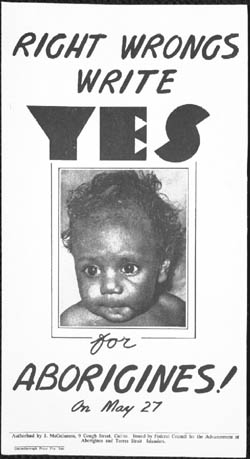
Last month marked the 40th anniversary of the historic 1967 referendum that allowed Australian aboriginals to be counted on the electoral roll. Before then, they weren't counted as people; they came under the Flora and Fauna Act. On 27 May 1967 for the first time in Australian history, black and white united for a common cause and 91 per cent of the white population voted in favour of changing the constitution. The referendum did not give Aboriginals voting rights; they had that already, though not many knew about it or exercised the privilege. What the referendum did do was to recognise Aboriginal rights to be counted in the census. It also allowed the commonwealth government to take responsibility for aboriginal affairs.

To understand why Australia got to this point, it is necessary to return to its birth as a nation. The original constitution drafted for federation in 1901 had the belief that the continent’s original inhabitants would never become equal citizens. The common whitefella belief was aboriginals were headed for extinction. The blacks became non-citizens.

For that oversight to be corrected, the constitution needed to be changed in two places. Firstly Section 51 had to change. Clause 127 of Section 51 says the commonwealth has to right to pass laws for any race of people except aboriginals. Aboriginal policy was purely at a state level. The purpose of this clause was to allow the Commonwealth Government to make labour laws covering the Kanakas in Queensland. Later in the same clause it also stated aboriginals were not to be counted in the census. The effect of these clauses left the aborigines at the mercy of the state and with no statistics to condemn the situation.

This notion of "unperson" dates back to when the British first arrived in Australia and declared the continent terra nullius, a land without people. Each state set up aboriginal protection boards and aboriginals became wards of the state. They were forced to adopt Christian values designed to undermine their traditional societies. South Africa used the template provided by the protection board to set up their own apartheid regime. The protection boards had enormous powers. Aboriginals couldn’t move or marry without permission of the board. Mission managers doled off rations to those who live off the land. Wages were withheld and children removed from their parents. They were dispersed and dispossessed of their land.

In 1924, the first signs of aboriginal resistance to this oppressive regime emerged. Frederick Maynard led the Australian Aboriginal Progressive Association which was the first organised aboriginal political group. It grew on the wharves of Sydney where aboriginals saw black men from other countries who shared their problems. A sense of common plight with American negroes saw aboriginals begin to define themselves as black Australians.

The question of aboriginal political rights first emerged in 1935 when Prime Minister Joe Lyons was petitioned for aboriginal representation in parliament by Aboriginal leader William Cooper. It was flatly rejected as constitutionally impossible. Black protesters mourned the passing parades as white Australia celebrated the 150th anniversary of the First Fleet landing in 1938. Maynard, Cooper and the Aborigines Progressive Association staged a Day of Mourning.

Cooper led the first mass strike of aboriginal people in 1939 when they walked off the land in protest at their conditions. But white interest was elsewhere. War was declared in faraway Europe and Prime Minister Robert Menzies sent off Australians to help their British brothers. When the war finally ended, the government introduced the Soldier Resettlement Scheme which gave land, often Aboriginal owned, to the returning troops.

White Australia grew in the 1950s and needed new immigrants to fill the jobs that were emerging in the booming economy. Under the paternal regime of minister of Territories Paul Hasluck, the policy towards Aboriginals was assimilation which insisted that they live more like white people. The policy echoed the assumptions of the writers of the 1901 constitution – that aboriginals would soon disappear.

The promise of equality through assimilation was an illusion. By the 1960s aboriginals crowded into the cities where they formed ghettoes. Aboriginal support groups began to address the issues of day-to-day poverty in the city. In 1958 the first mainstream national indigenous body emerged, the Federal Council for the Advancement of Aboriginals and Torres Strait Islanders (FCAATSI). Its early leaders were Gordon Bryant, Sam Davis, Shirley Andrews, Jack and Jean Horner, and Faith Bandler. It demanded rights of association and the right to join a union. It rejected assimilation and demanded the right to their own culture. It also demanded citizenship rights.

FCAATSI began to organise nationwide. This was a problem in itself as Aboriginals needed permission to cross state boundaries. FCAATSI brought together a wide range of Aboriginal opinion of every political persuasion. It raised the profile of Aboriginal issues both nationally and, importantly, internationally. It worked on a growing reputation that Australia was gaining of having a racially divisive government. Menzies was stunned and stung when Khrushchev accused Australia of a policy of extermination at the UN. The civil rights movement in the US also provided impetus. In 1965 Charles Perkins organised a freedom ride following the US example. For the first time ever, Aboriginal issues had captured the attention of the media. The ride went from Sydney to the outback town of Walgett where a protest was planned against segregation.

In 1966, the Gurindji people went on strike at Wave Hill in NT in an attempt to win wage parity with the white workers. FCAATSI supported the strike and criticised the court decision for a two-year wait to get equal pay. In 1958, television footage of ragged Aboriginals at Warburton, WA shocked the nation. The Warburton people lived at Maralinga, SA until the government took the land for A-bomb tests. They then shunted the Aboriginals across the border and abandoned them to their fate in a harsh land they were not familiar with.

The grainy TV footage galvanised the interest of a white Australian human rights activist Jessie Street. Her intervention would prove crucial. Street wanted to bring the issue to a sub-committee of the UN. She knew that this was the time to push for a change to the constitution. She saw the constitution as the base for Australia’s racism. Initially she was unsuccessful in lobbying Hasluck for change. But she did succeed in convincing FCAATSI leaders Faith Bandler and the Horners that constitutional change was the key. FCAATSI drew up a petition to change section 51 clause 127.

The petition also called for end to limitation of aboriginal rights, equal pay, the right of access to traditional lands and an end to anything that prevented Aboriginals from becoming equal citizens. They gained 100,000 signatures and presented it to the House of Parliament ten years in a row. They also wrote letters to influential people including MPs, mayors, councillors and business leaders. They handed out leaflets and held protests.

Some FCAATSI members were worried the constitutional crusade distracted the movement from more substantial issues. Living conditions, education and employment were immediate needs many thought might not be solved by a referendum. But Menzies eventually agreed to meet a FCAATSI delegation in 1963. He was sympathetic but unconvinced that a constitutional change was required.

Menzies retired in 1966 and suddenly FCAATSI had to deal with Harold Holt. Holt was anxious to step out of Menzies' shadow and he was the one to give the nod to the referendum. He agreed to the referendum in 1967 because he wanted to change another unrelated aspect of the constitution, section 24, known as the Nexus Question. The first question on the referendum on the ballot would be the Nexus Question which would allow politicians to increase their numbers in parliament. The government hoped that the popular Aboriginal change would get the Nexus Question over the line.

The referendum got overwhelming support from the countries intellectuals and bipartisan support from the political parties. On 27 May, 1967 the referendum occurred at the end of a ten year campaign. Worried by the Australian tendency to defeat constitutional change (29 had been rejected and only 5 narrowly accepted), FCAATSI fretted over the possible verdict. They need not have worried. The result was overwhelming. 90.77 per cent voted in favour of the Aboriginal amendments and it was carried in every state. Holt didn't get what he wanted - the Nexus Question was defeated 40-60. But it was a resounding triumph for the Aboriginal cause.

Elated Aboriginals believed the future was theirs but that promised land never arrived. Aboriginal policies on land rights, the National Aboriginal Conference (1971), hopes of a treaty and ATSIC (the Aboriginal & Torres Strait Islanders Commission) were all failures. By 1988 and the bi-centennial of Australia’s colonial beginning, Aboriginals marked another day of mourning. The 1967 referendum had not changed their basic living conditions.

Today Aborigines wonder what it means to be an Australian citizen. John Howard makes no distinction between those who are indigenous, those who are British or Irish and those who arrived after the war, “each no better than the other”. Howard proclaims the Federation goal of “one people, one destiny” without taking into account that Federation discriminated against Aborigines. Howard refuses to apologise for the past and promotes a policy of “practical reconciliation”.

But how practical has it been? The aboriginal prisoner population has doubled since 1988. Indigenous men have a life expectancy of 59 years compared to 77 years for the rest of the community. For females it is 65 compared to 82 years. The average household income for indigenous people is $364 a week. The unemployment rate among Aboriginals is almost 50 per cent. The Aboriginal retention rate for Year 12 students is 38 per cent compared to 73 per cent for non-Aboriginals.

Nonetheless, the referendum is worth celebrating. It remains the most popularly supported constitutional change in Australia’s history. As the National Indigenous Times puts it, “it is an important reminder that it is possible to capture the hearts and minds of other Australians. That once in while, the mood is right and Australians understand that the place of Indigenous people in Australian society is an important part of their own story”.

Thursday, June 14, 2007

FARC looks for more concessions from Uribe

The Colombian rebel group FARC is holding out for more concessions before releasing dozens of hostages despite the government’s release of its second-in-command Rodrigo Granda. President Alvaro Uribe released Granda, FARC’s “foreign minister” and 150 other guerrilla fighters last week in the hope of a reciprocal release of 60 hostages including Colombian Senator Ingrid Betancourt and three American contractors. But now the rebels have demanded that the government must also withdraw its troops from two southern towns in exchange for the release of its prisoners.

New French President Nicolas Sarkozy was reputedly involved in the negotiations in order to secure the release of Senator Betancourt. The senator was educated in Paris and is married to a Frenchman. There are reports that Sarkozy had requested Uribe to free Granda in order to secure her release. Granda himself has denied the connection and said his release from jail was a decision by the government and that he made no deal. Betancourt’s kidnapping in 2002 when she ran for president drew world attention to FARC’s hostage taking tactics.

FARC are responsible for most of the country’s 3,000 annual kidnappings. Alvaro Velez won a landslide victory in Colombia’s May 2002 presidential election by promising to crack down on the rebels. This year President Uribe has launched a US-backed $3 billion offensive to retake rebel-controlled territory. He also overturned a 1998 agreement which awarded FARC a 42,000 square km safe haven as a condition for attending peace talks. Uribe has personal motive too as his father was assassinated by FARC during a bungled kidnapping attempt in 1983. His unilateral release of 150 FARC fighters is surprising therefore in the context of his avowed aim to eradicate the organisation by the end of his second term in 2010.

FARC has been led for over 40 years by Manuel "Tirofijo" Marulanda (born Pedro Antonio Marin). Marulanda gained his nickname (Tirofijo means “sureshot”) because of a reputation for accuracy when using firearms during his earlier years as an insurgent. He is now approaching his 80s (his exact age is disputed) and was reported to be “acutely ill” in 2004. In March 2006, the US placed a $5 million bounty on a still very much alive Marulanda’s head.

FARC is one of two major leftist revolutionary groups currently active in Colombia. The US State Department considers both of them, FARC and the National Liberation Army (ELN) terrorist organisations. While both were founded in the 1960s counter-culture, FARC’s roots stretch further back in time. In 1948, influential populist leader Jorge Gaitan (pdf) was assassinated as he ran for presidency. His unexplained death sparked ten years of violence known as La Violencia which cost almost 300,000 lives.

During La Violencia, leftwing parties formed their own defence groups and guerrilla units which fought not only against the Conservative government but also against each other. In 1953, Gustavo Rojas seized control of Colombia in a coup and offered amnesty to all rebel groups in order to end the violence. But Communist groups were distrustful of Rojas and retreated into the mountains rather than hand over their weapons. The government mostly ignored the existence of these small Communist enclaves until it ordered the army under US pressure to disperse them in 1964.

One group known as Bloque Sur (Southern Bloc) dispersed during the height of the army assault but re-emerged after the incursion ended. Bloque Sur was led by Marulanda and Jacobo Arenas. Marulanda was the soldier to Arenas’s theoretician. In May 1964, they renamed the group Fuerzas Armadas Revolucionarias de Colombia (FARC) which means Revolutionary Armed Forces of Colombia. Inspired by the success of Castro in Cuba, FARC’s ultimate goal was to establish a Communist state. Arenas began an education program for the early FARC guerrilla fighters, as most came from low income peasant families. Their motto was “Learn and fight for Colombia”.

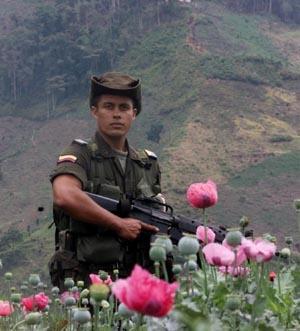
But the group had little success until it realised it could finance its operation by feeding the huge Western demand for heroin. By the late 1980s, FARC controlled every aspect of the drug production process including manufacturing the chemicals that turn the coco bush to cocaine, charging taxes to the farmers that grow it and charging airport fees for the export of the finished drugs. It now makes $300 million a year from its drug enterprises. Allied to income from kidnapping and extortion, FARC is probably the wealthiest insurgency organisation in the world.

FARC is now the largest and best-equipped of Colombia’s rebel group, with a possible 18,000 members. It operates in almost half the country, mostly in the jungles of the southeast and the plains at the base of the Andes Mountains. The smaller ELN operates mainly in north-eastern Colombia and has about 4,000 members. FARC briefly tried the military route to power in the eighties with a political front called the Patriotic Union (UP).

However the government of the day had no intention of letting them take part in the political process. They sponsored death squads who killed 3,000 UP members including its 1990 presidential candidate, Bernardo Jaramillo Ossa. FARC learned their lesson and concentrated on the military route to power. They are now a formidable enemy who control a territory the size of Switzerland. And with a western taste for heroin unlikely to diminish, they will remain part of Colombia’s Realpolitik for years to come.

Wednesday, June 13, 2007

New hope for Libyan AIDS six

The EU said yesterday it has made substantial progress in talks with Libya over the release of five Bulgarian nurses and a Palestinian doctor. The six, who have spent eight years in prison already, are accused of the murder of 240 children EU officials spent two days lobbying Libyan officials on the weekend and met with Gaddafy's son who is in favour of an early release. A European Commission told a Brussels news briefing that efforts will continue to release the six, but didn't expand on what that will involve. The news came a day after US President Bush called for their release on a state visit to Bulgaria. The six medics have been sentenced to death after they were found guilty of infecting Libyan children with AIDS in a Benghazi hospital in 1998.

The two officials, EU External Relations Commissioner Benita Ferrero-Waldner and German Foreign Minister Frank-Walter Steinmeier, left Tripoli on Monday. Steinmeier visited the five Bulgarian nurses on death row in Judeyda prison. "Libya has showed understanding on the case and I hope it will come to a positive end at my next visit to Jamahiriya [Libya]," said Steinmeier, whose country is president of the EU until the end of this month. His calls were echoed by Muammar Gaddafy son, Saif al-Islam, who praised European efforts to end the stand-off on the case.

Libya claims it will free the medics if an agreement is reached to pay compensation to the families of the children. Tripoli has demanded $13 million for each infected child's family. The EU has rejected this as an admission of guilt. However it has offered a fund for treatment for the children at European hospitals and already donated over $3 million to this plan. In 2005 Libya's ambassador to Britain, Mohammed al-Zaway, said Bulgaria should negotiate with the victims' families of the victims to decide on "dia", or blood money, which Sharia law allows to be paid to victims in murder cases to prevent a death sentence. "Any solution other than negotiations is a waste of time," said al-Zaway. "An agreement with the families of the children would reflect positively on the case according to Islamic law."

The nurses and a Palestinian doctor were sentenced to death in May 2004 by firing squad for infecting 426 children through contaminated blood products at Al Fateh Children's Hospital in Benghazi, Libya. They also were ordered to pay a total of $1 million to the families of the HIV-positive children. The Libyan Supreme Court in December 2005 overturned the convictions and ordered a retrial in a lower court. Finally an appeal court convicted the health workers in December 2006 and re-affirmed the death sentence.

The crisis first came to light in November 1988 when a Libyan magazine called “La” published an expose about a mass incidence of AIDS at a Benghazi paediatric hospital. The article quoted the Libyan Health Minister Sulaiman al-Ghemari, who said that most of the 60 known cases were children. The children’s parents blamed faulty blood transfusions for transmitting the virus. The article created a huge stir and countered the official propaganda that Libya was AIDS-free. An outraged Gaddafy shut down the magazine. Despite the shutdown, it soon became apparent that not only was magazine’s allegations correct, it was worse than initially thought. Up to 400 children were infected.

Scapegoats were needed and authorities immediately arrested Filipino, Polish, Hungarian and Bulgarian clinic workers on suspicion of organising the spread of the virus. Finally the court filed charges against five Bulgarian nurses, a Bulgarian doctor and a Palestinian doctor. They were charged with premeditated homicide, "activities which led to a massacre designed to sap Libya's strength" and "a violation of the Islamic way of life," according to the Bulgarian foreign ministry. The nurses were also accused of working for the CIA and Mossad. "Nurses from little towns in Bulgaria acting as agents of Mossad?" said a daughter of one of the nurses. "It all sounds funny and absurd until you realize your mother could die for it”.

The six have now been in prison for over eight years. Their names are: Ashraf Ahmad Jum’a, the Palestinian doctor, and Nasya Stojcheva Nenova, Valentinaa Manolova Sropulo, Valya Georgieva Chervenyashka, Snezhanka Ivanova Dimitrova and Kristiana Malinova Valcheva, the five Bulgarian nurses. In 1999, Libya commissioned a World Health Organisation (WHO) report on the growing crisis. The report cited multiple causes but particularly blamed the lack of supplies and equipment including sterilised needles and protective gloves.

At the trial, the six suspects claimed they were tortured and forced into confessions. They said police used many methods including sexual assault, electric shock, hanging by the arms, threats with dogs while the prisoners were blindfolded, and beatings with electric cable on the soles of the feet. It was also reported that police officers forced the nurses to undress before them, put insects on their bodies and set dogs on them. But the defence lawyers were denied access to files and investigation results. The court later rejected the torture claim and the accused police officers were cleared of any wrongdoing.

The court also ignored the testimony of Dr. Luc Montagnier, the French discoverer of the AIDS virus and Italian microbiology professor Vittorio Colizzi who evaluated more than 200 of the infected children and found the virus was present at least six months before the Bulgarian nurses arrived at the hospital. Montagnier and Colizzi’s report (pdf) concluded the virus was introduced through a contaminated injection and spread as a result of poor sanitary practices.

But at the trial the judge accepted the confessions backed up by testimony from Libyan medical experts for the prosecution who claimed the medics deliberately injected the AIDS virus into the patients. The six were sentenced to death in December 2006 in front of delighted parents of the infected children. The father of one child told the BBC “justice has spoken out with a ruling against those criminals and the punishment they deserve, because they violated their obligations and sold their consciences to the devil”.

While the fate of the six remains unknown, Libyan children continue to be at risk of AIDS due to poor sanitary practices in hospitals. The Association for Child Victims of Aids in Benghazi told Human Rights Watch in 2005 that 19 mothers of these children are also infected with the virus. The association’s spokesman Ramadan al-Faturi has demanded better training for Libyan doctors and psychological support for the families. “Tell the world that these children are innocent and suffering,” he said.

Tuesday, June 12, 2007

Congo reviews its wartime mineral contracts

The Democratic Republic of Congo (DRC) has launched a “fairness” review this week of 60 mining contracts signed during the last Congolese war of 1998-2003. With relative stability returned to the DRC, the mining industry is booming and metal prices are on the rise. However the government now believes that the terms and conditions of these contracts are unfair to the state and need revision. They have been supported by advocacy groups who say the contracts were signed without sufficient transparency and don't provide enough benefits to the local population. Big companies affected include the world’s largest miner BHP Billiton, the world's third-biggest gold producer AngloGold Ashanti, and U.S. major Phelps Dodge.

Mines Minister Martin Kabwelulu has launched a commission which will report to Prime Minister Antoine Gizenga in three months. Experts warn the task will much more daunting than the government realise and will take longer than expected. Carter Centre lawyer Peter Rosenblum is advising the commission and he believes it is a larger scale review than anything he has seen elsewhere.

The DRC suspended all negotiations on future mining deals in March pending the completion of the review. A two year UN Security Council investigation recommended the review of all wartime contracts. In 2003, the UN linked the war with exploitation of Congo’s resources saying that "illegal exploitation remains one of the main sources of funding for groups involved in perpetuating conflict."

After the war ended, the transitional government established a commission to look at the problem. Congolese lawmaker Christophe Lutundula headed the investigation, which came to be known as the Lutundula Commission. Its 50-page report showed how the DRC was often cheated by international mining companies. Private partners in joint ventures did not have to provide capital, which left the DRC carrying the debt. There was also a large smuggling culture with many minerals leaving the country unregistered, unrecorded and untaxed. The Lutundula report recommended many contracts should be renegotiated, or cancelled.

Congo holds one third of the world’s cobalt and one tenth of the world’s copper. It also has abundant reserves of gold, diamonds, tin, uranium and coltan. A group of NGOs launched an international appeal called "A Fair Share for Congo!" to ensure the profits of these minerals benefit the Congolese people. The rainbow group called on the new Congolese government and its international partners to "clarify and revise all mining contracts inherited from the past, set up an independent mechanism to monitor the implementation of contracts, and ensure transparent and fair management of mining resources”. The group said that after 30 years of dictatorship and more than 15 years of war and transition, the needs of the Congolese people are immense.

The most recent and more devastating of these wars left 4 million dead. But political tensions are now starting to ease. In December 2005, a nationwide referendum backed a UN-drafted constitution. The current government was elected in 2006 in first democratic polls in 40 years. Major problems remain to be solved. The DRC has one of the world's most dysfunctional economies, with a fragile government, little in the way of basic infrastructure and widespread poverty and desperation. Average income per person is less than $120 a year. There is still widespread conflict in the resource-rich border areas near Uganda and Rwanda. Corruption is widespread and there are few basic amenities.

But despite these daunting conditions and a World Bank warning that rates the DRC as the world’s worst country to do business, interest in mining in the country has soared since the election. Companies are prepared to take any risk to feed China’s apparently endless commodity boom. US company Phelps Dodge approved the building of a copper and cobalt mine in December 2006 at the provincial capital of Lubumbashi. This $600 million mine will yield 112 million kilos of copper a year with production starting as early as 2009. John Fenn, Phelps Dodge's senior vice president for Africa, acknowledges that doing business in the Congo is "especially challenging." But he adds, "the way you grow is you have to go after the resources."

Monday, June 11, 2007

Bush at home in the Balkans

After running the gauntlet of protests in Germany and Poland, US President George W Bush is enjoying a better reception on his two day to the Balkans. Bush is now in Bulgaria, on the second leg of his Balkans tour after his astonishingly successful eight hour visit to Albania. In Sofia, the greeting was more low key, but is also expected to be cordial as Bulgaria is now a member of NATO, hosts several US military installations and has agreed to extend its small Iraqi deployment through to the end of 2008. The only cloud on the horizon is the US decision not to deploy its missile defence shield in the country.

On Monday, Bush will have a day of talks with Bulgarian President Georgi Parvanov and Prime Minister Sergei Stanishev. The country’s government hopes to change Bush’s mind about excluding southern Europe from the defence shield. The country is also worried by the clash between Bush and Russian President Putin over the shield. Bulgaria can see both sides of the quarrel as a former loyal ally of the Soviet Union and now an emerging EU democracy and may have a role to play in placating their Slavic big brother.

But however cordial the welcome in Bulgaria, it will be unlikely to match the extraordinary scenes of presidential adulation in Albania. George Bush may have record-low approval rating at home, but in Tirana he could do no wrong. His short visit was the first ever by a US president to this mostly Muslim country. Bush was greeted by Prime Minister Ali Berisha who described him as the "greatest and most distinguished guest we have ever had in all times".

Bush was greeted like a conquering hero when he went for a walkabout on the streets of the capital Tirana. People clamoured to get close to him and clapped and cheered, many wearing cardboard Uncle Sam hats and carrying signs saying Albania welcomes President Bush. Officials matched the warmth of the country’s people by awarding Bush the Order of the Flag medal, putting his image on a postage stamp and renaming a street in front of the parliament in his honour.

Bush responded in kind by signalling he was running out of patience with Russia’s stalling on the independence of Kosovo. The mostly-Albanian populated former province of Serbia has been run under the auspices of the UN and NATO since the war in 1999 but Russia rejected calls for its full independence at the G8 summit in Germany last week. Bush played to his Albanian audience by saying "Sooner rather than later you've got to say `Enough's enough - Kosovo is independent.”

Like Bulgaria, Albania has troops serving in Iraq and Afghanistan. It has tripled its troop numbers in Afghanistan to 140, and has about 120 troops in Iraq. Albania hopes the visit will help the country’s bid to join NATO and the EU. Government spokesman Grid Roy said it was the primary goal of the government and 94 percent of Albanians support integration into the international organisations. The country with its population of 3.5 million remains desperately poor and subject to mass emigration.

Albania emerged as a national identity out of the Ottoman Empire. In the 19th century local intellectuals standardized the Albanian language which was a unique mixture of Latin, Greek, and Slavic dialects, in process creating a literary style for educational use. Albania gained local autonomy in 1911 and used the Balkan Wars of the following two years to gain full independence. But it came at a cost, the Kosovo province was ceded to Serbia.

After World War I, the newly created Kingdom of Yugoslavia backed Albanian chieftain Ahmed Bey Zogu believing him to be a pliable tool of Belgrade. But Zogu had his own ambitions become Prime Minister in 1924 and turning himself into King Zog in 1928. Zog looked to Italy for support and over the next 15 years Albania would become a pawn of Mussolini’s Fascist empire. The Italian military overthrew him in 1939 and ruled the country directly until defeated in 1944.

Internal resistance against the Italians and Nazis was formed a communist insurgency led by Enver Hoxha. Hoxha got crucial British support in 1944 to take control of the newly independent Albania. He installed a Marxist government and ruthlessly suppressed all opposition. For the next 40 years he pursued an increasingly isolationist policy with first Stalin and then Mao, as his only distant ally. Hoxha died in 1985 and the country underwent significant upheaval as Communism fell apart in Eastern Europe at the end of the decade.

In 1990 Albania reorganised itself into a multiparty democracy. The EU was quick to support its process of institutional, political and economic reform. Since then, the country has set a path towards a market-based economy. Initially the country went backwards with much economic hardship as government run enterprises stalled. The entire industrial sector collapsed shortly after Albania emerged from communism, triggering an exodus of 300,000 people to Italy and Greece. In 1997, the country descended into anarchy following the collapse of fraudulent pyramid investment schemes

In 2000, at Summit Zagreb the country joined the rest of the Western Balkan nations in signing a crucial stabilisation and association process agreement with the EU. The EU reaffirmed its commitment at the 2003 Thessaloniki Summit to the integration into the Union of the countries of the Western Balkans. Albania’s growing westernisation is also underscored by its desire to join NATO. While meeting Bush, Prime Minister Berisha said the country would increase its defence budget by 2 per cent. A beaming Bush will gladly accede, if only for the chance to repeat an increasingly rare positive photo opportunity.

Sunday, June 10, 2007

On the Waterfront: the Battle for Patrick Stevedores

Toll Holdings’ port and rail spin off company Asciano Group (AIO) made its debut on the Australian stock market last week. AIO contains Pacific National, the Patrick container ports and also the combined port operations and stevedoring businesses of Toll and Patrick, assets in total worth $8 billion. It is the latest incarnation of the now booming Patrick Stevedoring, the company that was at the centre of Australia’s waterfront reform crisis of 1998, recently dramatised by the ABC in the mini-series Bastard Boys.

The story is told in greatest detail by two Sydney Morning Herald journalists Helen Trinca and Anne Davies in their book “Waterfront: The Battle That Changed Australia”. Australian ports are a stevedoring duopoly, consisting of the locally-based Patrick and the British firm P&O Ports. The word ‘stevedore’ comes from the Spanish ‘estibador’ meaning ‘a man who stuffs (ships)’. In common Australian usage, it now refers to the owners and operators of the port while the workers are ‘wharfies’. In 1998, the waterfront was the scene for a massive battle between the two that had political, economic and legal consequences still felt today.

At the time, Australian ports were entirely manned by wharfies of the Maritime Union of Australia (MUA). In November 1997, an anonymous Canberra bureaucrat rang MUA national secretary John Coombs tipping him off about a plan to reform the Australian waterfront. The caller told Coombs the Army was going to train military men in Dubai to do dock work. The caller claimed the Government was behind the secret plan. Bizarre as it sounded, Coombs had to take the story seriously. 18 months earlier, Australia had a change of government to the right and the new John Howard administration made it clear waterfront reform was a top priority. Breaking the power of the union that that ran the waterfront since World War II, was the key.

Coombs briefed Greg Combet, then an assistant secretary of the Australian Council of Trade Unions (ACTU) who previously worked for the MUA. Both men were committed to the union, but both knew change was inevitable on the docks. The new government had changed laws on secondary picketing and both Patrick and P&O Ports were making noises labour costs had to be reduced. Patrick’s then boss Chris Corrigan was particularly determined to reduce his workforce. Corrigan was a successful merchant banker who now wanted to tame the waterfront. His problem was he didn’t have the money to pay for redundancies.

Coombs got more concrete information in writing from his mole. On letterhead of a company called Fynwest Ltd was a recruiting contract for a training program in Dubai. There was also background on the two men behind Fynwest, ex-military men Mike Wells and Peter Kilfoyle. Coombs and Combet took the information to the Federal Labor Party to raise in parliament. On the day the recruits were due to leave the country, Opposition leader Kim Beazley addressed Peter Reith, minister for Workplace Relations in Question time (Hansard - pdf). Beazley asked “Is the minister aware that the first contingent of a substantial force of up to 70 men, recruited through advertisements in the Army publication Army, is scheduled today to fly out to Dubai for three months training, operating stevedoring equipment in order to be deployed on the Australian waterfront early in 1998? What knowledge do you have of this covert operation to recruit a force of industrial mercenaries from the ranks of the military? When did you first become aware of it? Peter Reith responded, “The answer is I am not aware of it at all”.

The minister for defence Ian McLachlan also denied the army were involved in the operation. The Canberra press gallery smelled a rat and went ballistic. Another media pack ambushed the short-haired Dubai trainees leaving at Melbourne airport. Their civilian dress did little to disguise their obvious army-ness. The following morning Chris Corrigan was interviewed on radio. Corrigan admitted he was irritated by union practices and  institutionalised rorts but he claimed the parliamentary debate was the first he had heard of the Dubai venture.

Corrigan was lying. He was desperate to increase productivity on the wharves. In the first six months of 1997, he had lost $3.6 million in Melbourne alone and estimated he needed to shed 80 workers there. He also wanted to clamp down on overtime which workers regarded as part of their normal wage and which they often deliberately stalled jobs to make happen. The newly elected Coalition government was interested in a showdown with the unions. In its early days it commissioned a report about the waterfront problems. It identified monopoly unionism as the main problem. The Patrick / P&O Ports duopoly was only seen as a secondary issue and not pursued. The report advocated the engineering of a dispute as a catalyst for change. The government made overtures to the two stevedores.

The international operator P&O was not interested. It was too frightened it would attract a worldwide ban from the international maritime union. But local operator Corrigan was more amenable. What they needed was a trigger to sack the entire workforce which was not related to their employment and therefore not illegal. Peter Reith was the key government player in making it happen. To manage the project, he brought in Stephen Webster, a consultant for Australia’s richest men, Richard Pratt. It was Webster who hired Wells and Kilfoyle to put together the army team for Dubai.

Corrigan supported the government plans but wanted the commonwealth to foot the redundancy bill to finance the downsizing of his operation. He worked with Wells to compile a list of 260 people he would need to run the ports in Melbourne, Sydney, Brisbane and Fremantle. Corrigan would provide the trainers. Fynwest looked for men from engineering and electrical corps to manage the equipment and learn the operation quickly. In December 1997, the government agreed to fund the Patrick redundancies and Fynwest gave the go ahead to send 76 men to Dubai. Two days later, Labor dropped the bombshell in parliament.

On the day after, Prime Minister Howard side-stepped questions about knowledge of the operation and pledged his support for waterfront reform. Meanwhile John Coombs went to London where he got support from the International Transport Workers Federation (ITWF). Coombs and an ITWF rep met the United Arab Emirates ambassador and threatened his country with a maritime boycott if they supported the Dubai operation. It worked. The Dubai Port Authority pulled the plug and revoked the army men’s visas. The plan had collapsed and it seemed, the threat to the union was over. But it was just beginning – the farmers became the new players.

An increasingly desperate Corrigan turned his attentions to the National Farmers Federation (NFF) as his next hope. The NFF had track history. It was founded in 1979 in response to the live sheep confrontation the previous year when farmers stormed Adelaide docks to load sheep despite union resistance. Bulk shipping carried half of Australia’s $22 billion farm exports but the rest was container trade which operated far below world’s best practice. NFF president Don McGauchie became convinced the farmers would have to enter stevedoring themselves to solve the problem. Corrigan contacted the NFF and asked if they would run Webb Dock in Melbourne. In the weeks to follow, Corrigan, McGauchie, Reith and Webster would meet to discuss the venture. The farmers created a new stevedoring company called PCS. Their plans became public after police leaked details of the security operation to Trades Hall.

As the storm broke in January 1998, Corrigan proceeded with plans to clear Webb dock in advance of the PCS takeover. By the end of the month, the dock was in the hands of a private security company and the union was locked out. Greg Combet realised the union could not organise a secondary picket for fear of legal action under trade practices law. But they shut down the other docks anyway. At this stage, the union was contacted by a young industrial lawyer named Josh Bornstein. Bornstein rang Combet to ask what his legal strategy was. Combet had to admit they didn’t have one. One of Bornstein’s colleagues suggested the union had a case for conspiracy. Because Patrick had leased dock space to the farmers, Corrigan was conspiring with them to diminish the workers’ terms and conditions.

The farmers began to move into the empty terminal in February to conduct training. They had to run the gauntlet of an angry picket. It was tense and intimidating but not violent. Meanwhile the Fynwest people who were now out of the loop, were angry. They were not wanted by the PCS people so contacted the MUA and told them they had documents and taped conversations that could link Corrigan and the government to the Dubai operation.

On 6 February, Patrick went to the Industrial Relations Commission (IRC) looking for an order to force the wharfies to go back to work. The union called Corrigan as a witness who admitted he had talks with the NFF about Webb Dock where they discussed dismissing the entire unionised workforce. The IRC agreed the strike was illegal and ordered the wharfies back to work. But armed with Corrigan’s dynamite admission, the union now had the grounds for the conspiracy case. They asked Julian Burnside QC to join the team to represent them in court. The union ignored the IRC recommendation and continued picketing Webb Dock. By March the dispute had cost Patrick $2 million. It was now rumoured that Patrick would sack its workforce at Easter. The question, according to the worried union, was how would they get away with it?

On the week before Easter, the union went to the Federal Court asking for an injunction to stop Corrigan sacking his workers. Before they could get to court, Corrigan pushed the go button. On the night of 7 April 1998, security men in balaclavas with dogs arrived on the docks by boat. They told the workers they were no longer wanted and locked them out. At the same time in Canberra, 11pm on a Sunday night, Peter Reith issued a press release advising the media Patrick had restructured its business and terminated existing contracts with its current labour hire companies. Reith promised the sacked workers would receive $270,000 in compensation.

The following day, the parties met in the Federal Court in Melbourne. Patrick said they had appointed an administrator to the labour hire companies. This was a significant move. Under corporation law it is impossible to continue an action against a company in administration unless permitted by a court. Patrick argued the workers had not been dismissed but the company had simply ended the labour hire agreements with the subsidiaries that employed the men. Burnside argued the co-incidence of the timing of the dock seizure and Reith’s press release was too convenient and called it a ‘bottom of the harbour’ scheme. Justice Tony North issued a temporary injunction to stop the sacking with a view to hearing full arguments after Easter. Despite the legal setback, Corrigan pushed ahead with his plans to stevedore a ship at Webb Dock. Over the Easter weekend, the PCS operators unloaded the government-owned ship Australian Endeavour in Sydney. The ship’s crew were MUA members but couldn’t strike in sympathy with their wharfie brothers due to the tough new industrial laws on secondary boycott. Corrigan posed at the dockside for a media opportunity to bask in this success.

On the Tuesday after Easter, the legal team were back in court. Julian Burnside developed the conspiracy case. He argued Patrick had started with a share buy-back, then sold the four employer companies to other companies within the business before selling all their assets to yet another Patrick company. No one was sure if the companies were paid for these transactions and $300 million was unaccounted for by the administrators. Burnside argued the only reason the men were sacked was that they were members of the MUA. He asked for an injunction to prevent the next phase of Patrick’s plan. A barrister for the farmers said that PCS’s business would be destroyed if the unions won their injunction. The case adjourned for two days.

On the Thursday, the court reconvened. Justice North refused to hand down a decision claiming the issue were complex and adjourned again until ‘the weekend and if necessary beyond’. The pickets remains strong and Corrigan was angry that police wasn’t moving them on. But the police argued if the picket was peaceful and did not restrict access to the site, it was lawful. Union officials did their utmost to stop angry members from taking more violent action that would undermine their case. The picket was having success. Apart from Brisbane, very little cargo was being moved from Patrick’s docks. An attempt by 500 police to move the protesters at Melbourne during the night was thwarted by a large picket supported by a second group of a thousand workers which surrounded police who withdrew in defeat.

North was not ready with his decision until Tuesday. He ordered Corrigan to take back his union workforce pending a full trial to decide if he had broken the law. He also said there was a prime facie case for conspiracy. But union celebrations were short-lived. Patrick sought an urgent appeal set for the following day. The appeal process took two more days. At 7.30pm that evening they decided to televise their verdict live on television. The three judges found North’s reason for judgement ‘free from apellable error’. The union had won again. But once again, Patrick fought on. They found a High Court justice Kenneth Hayne at 8.45pm who granted a stay until the following morning. The next day Justice Hayne extended the stay saying the High Court would hear the appeal on Monday.

The legal teams traipsed off to Canberra for the High Court ruling. For the first time in the court’s 97-year history all seven judges sat on an application for special leave to appeal. Patrick argued the Federal Court did not have the power to grant an injunction at this stage. They also said Justice North had effectively rewritten Patrick’s contracts to force it to use the union workforce exclusively. Their third argument was it was unfair to force administrators to run insolvent companies. Burnside, for the unions, reposted that the court had ample powers to prevent the conspiracy. The High Court finished hearing submissions on the Thursday and promised to deliver judgement on the following Monday. On that day, six of the seven judges upheld Tony North’s judgement and found in favour of the union and ordered Patrick to pay costs. PCS was out of business.

It seemed at first a great win for Coombs. However a majority made alterations to the orders which left it in the administrator’s discretion whether or not to resume trading. Peter Reith spun this as a defeat for the unions saying “there’s no way the administrators can keep trading... the wharfies will be out on their ear well before this reaches a trial”. The government pressurised the banks to wind up the companies and lay off the men. Coombs agreed for the men to return to work without pay to overcome this problem. They would not claim wages until the company had the money to pay them. On 7 May, the MUA returned to work in Melbourne. Corrigan used the redundancy money to extract concessions in wages and conditions.

Half of Patrick’s staff accepted those redundancies. The union’s day-to-day power on the docks was severely eroded. Corrigan did well. The dispute cost him $60 million but the new work practices would save him that same amount annually. His overtime and wages bill were halved. Managers now ran rosters not the union and the men could be asked to work 12 hours a day without claiming overtime. The redundancies financed in soft loans of $150 million from the Government. Patrick eventually passed on that cost to the stevedoring companies so there was little benefit to exporting and importing companies. By 2006 Patrick was making after tax profits of $145.1 million.

The Government claimed a victory of sorts with the end of rorted practices and a union-dominated workplace. It then turned the screw on the media whom it claimed was biased in the dispute. Senator Richard Alston bombarded the ABC with complaints of bias objecting to specific items. The ABC commissioned a Philip Bell report to refute the claims. The Opposition released papers in parliament in July 1998 to prove the conspiracy case but by then, no-one cared. The waterfront dispute was over.

Saturday, June 09, 2007

Tony Mokbel offers deal to police to beat murder rap

Melbourne drug baron Tony Mokbel has offered to cut a deal with Australian police in order to cut short his extradition proceedings from Greece. Speaking to journalists in Athens last night during a court adjournment he offered to return to Australia in exchange for police dropping murder charges in favour of drug charges. With five levels of courts in Greece, Mokbel is capable of dragging out extradition for an indefinite period.

The 41 year old Mokbel appeared in a Greek court charged with possessing false documents. Prosecutors alleged Mokbel held a false passport and driving licence and Mokbel has denied the charges. The case has been adjourned to 22 June pending a police report. The charge has a maximum penalty of one year jail but is unlikely to affect the Australian extradition bid.

Mokbel was arrested on Tuesday in Athens after 15 months on the run posing as international trader “Stephen Papas”. Immediately, the Australian Federal Police issued a formal extradition request on one count of murder and five of drug trafficking. His Greek lawyer Yiannis Vlachos has moved to fight the extradition order claiming his client will not receive a fair trial in Australia.

Mokbel was on trial in March 2006 in the Victorian Supreme Court charged with importing 2.9 kg of cocaine when he absconded. Mokbel was found guilty in absentia and sentenced to 12 years. He was later charged with the 2004 murder of fellow druglord Lewis Moran. Earlier this year a hitman named Noel Faure pleaded guilty to his murder. Faure told the court that Mokbel and another man, Carl Williams, paid Faure $140,000 to execute Moran.

Antonios Sajih Mokbel was born in 1965. His family were from the small town of Achache in north Lebanon. His father worked in Kuwait for 15 years before moving to Australia. Mokbel was born in Kuwait and moved to Melbourne with the family. He went to Moreland High School in the 1970s but his desire to make money meant he was never destined for tertiary education.

He got his first job as a dishwasher at a suburban nightclub before he became a waiter. He then started working security. Mokbel was not a large man but he was a smooth talker able to persuade people to his point of view without using overt violence. In 1984, aged 19 he bought his first business, a milk bar in the Melbourne suburb of Rosanna. Aged 24 he married Carmel and they had two children. They worked long and hard but had to sell up without making any money.

In 1987 he bought an Italian restaurant in Boronia. This business was more successful and by 1997 he was able to expand by opening T Jays restaurant in Brunswick and becoming a property developer. By now Mokbel had become involved in drug trafficking. In 1998 he was convicted over amphetamine manufacturing but beat the charge on appeal. Mokbel was also a successful gambler who won big money on Melbourne racing. He had interests in shops, cafes, fashions, fragrances, restaurants, hotels, nightclubs and land in regional Victoria. At the turn of the century he was able to tell friends he controlled 38 different companies and he was worth $20 million.

Mokbel was one of the first of the major drug dealers to move into the designer pill industry, making amphetamine and speed for the nightclub set. As his business expanded he became involved with some of Melbourne’s shadier characters. The city has long had gangland murders. But the violence escalated in 2002 after ten of the city's most senior mobsters had met in a council of war in Carlton. Matters took a nasty turn at that meeting and Mokbel was almost beaten to death by bodyguards belonging to drug tsar Nick 'the Russian' Radev. Mokbel was taken to a private doctor by a hitman called Andrew “Benji” Veniamin, who was an associate of Carlton crime boss Mick Gatto. Afterwards Veniamin and Mokbel became friends and their mutual enemies began to die.

Radev was first to die, shot seven times outside his home. Lewis Moran's son Jason and his bodyguard were killed by a lone gunman as they watched a junior football clinic. They were followed in short order by two more associates of Moran who made speed. Then in December 2003 Moran’s friend and one of the city’s most influential gangsters, Graham 'the Munster' Kinniburgh, was shot dead outside his home in the leafy suburb of Kew. His death was the 24th gangland death in six years.

Responsibility for investigating these deaths rested with a Victorian police task force known as Purana. They were aware of Mokbel since 2001 when he was arrested over importing barrels of the chemical ephedrine. Although the charges couldn’t be proven, his assets were frozen by the National Australia Bank. Mokbel was charged for importing cocaine and defied his own lawyers’ advice to plead guilty. Mokbel hoped that delaying the trial, some of the drug squad detectives own charges of corruption would stick, thus discrediting their charges against him. Mokbel was released on bail after a year and tried to do a deal with police.

But by 2005 it was clear the deal wasn’t going to happen. Two of the cocaine traffickers were sentenced to 11 and five years respectively. Mokbel knew he was going down. He disappeared on 20 March shortly before the end of his trial, leaving his girlfriend and his frozen assets behind. But Mokbel couldn’t change old habits. He continued to run his drug empire from Greece. But his downfall came when one of his associates wired $400,000 to him in Athens by electronic transfer. Police picked up the trail. By early May officers from Purana knew where he lived. On Tuesday, Greek police caught up with him in a coffee shop. Mokbal had lost 20 kgs and was wearing a poor quality wig which matched the passport shots. But he was compliant with police when they arrested him. Perhaps he should have checked his horoscope that morning. It read "Leos tend to feel they're entitled to more freedom and independence … others might not agree today."

Friday, June 08, 2007

Mafia acquitted of killing God's Banker

A court in Rome has acquitted five people accused of murdering Italian financier Roberto Calvi due to insufficient evidence. Calvi was known as “God’s Banker” due to his work on behalf of the Vatican’s bank. The decision comes almost 25 years to the day of his death. In 1982 his body was found hanging from London’s Blackfriars Bridge with rocks and $15,000 in cash stuffed into his suit. London police initially ruled it suicide but Italian prosecutors eventually brought murder charges in 2003 after pressure from Calvi’s family. The five cleared this week are Giuseppe "Pippo" Calo, a mafia money launderer, businessmen Ernesto Diotallevi and Flavio Carboni, Calvi's driver and bodyguard Silvano Vittor, and Carboni's Austrian ex-girlfriend Manuela Kleinszig.

While the acquittal of Kleinszig was not unexpected (the prosecution had asked for her charges to be dropped due to insufficient evidence), the release of the four others after a 20 month trial was a shock. Prosecutors had asked for life sentences for all four. One of the detectives involved in the case, Geoff Katz, said he was surprised by the verdict. "It'll be a tremendous disappointment for the families and also the Italian magistrates who have spent so much time on this case," he said. But one of Calo's lawyers, Massimo Amoroso, said the evidence was weak. The judges have yet to release their reasoning for the verdict.

The acquittals leave a sense of continuing uncertainty over how Calvi met his death. Roberto Calvi was 62 years old when he was found hanging from a rope attached to scaffolding under the bridge. He had come to the UK on bail after having been convicted of corruption in Italy. During the trial, prosecutors alleged Calvi was taken to the bridge by boat and was probably still alive but unconscious when a noose was placed around his neck.

The Milan-born Calvi was chairman of Banco Ambrosiano which collapsed shortly before he died. The bank was founded in 1896 as a Catholic bank and named for St Ambrose, the fourth century archbishop of Milan. The bank’s purpose was to act as a counter-balance to Italy’s secular banks. Calvi joined Ambrosiano in 1947 and worked his way up to become chairman by 1975. Calvi created a number of off-shore companies in the Bahamas and South America and also bought Italy’s premier newspaper Corriere della Sera.

Meanwhile the bank’s major shareholder was now the Institute for Religious Works (IOR), the official name of the Vatican bank. In 1971 Pope Paul VI appointed Chicago-born Archbishop Paul Marcinkus chairman of the IOR. The burly Marcinkus was a papal bodyguard known as “the Pope’s gorilla”. He saved the pontiff’s life after he knocked a knife out of the hands of a deranged Bolivian painter who lunged at the Pope in the Philippines. The bank job was his reward. Marcinkus was a practical man when it came to financial affairs and his dictum was “you can’t run the church on Hail Marys”. He knew the unworldly Vatican needed a commercial banking partner and in 1974 he chose Banco Ambrosiano.

Calvi was a compulsive operator and used a complex network of overseas banks and finance companies to move money out of Italy, inflate share prices, and secure massive unsecured loans. By 1978 the bank was in deep trouble. The bank of Italy issued a report that found Banco Ambrosiano had made illegal exports of several billion lire. In 1981 Calvi was put on trial and given a four year suspended sentence and a $20 million fine for taking $26.4 million out of the country in violation of Italian currency laws. Incredibly Calvi kept his job at the bank.

While investigating Calvi, police uncovered a link to financier Licio Gelli. Both men were freemasons and Gelli was the leader of a covert Masonic lodge called Propaganda Due (P2). This lodge was extremely powerful and its members were journalists, parliamentarians, industrialists, and military leaders and the heads of the three Italian intelligence services. When police searched Gelli’s house they found a document called the Democratic Rebirth Plan which was a plan to steer Italy towards a more autocratic government. Its existence scandalised Italy. Gelli fled the country, but the affair brought down the government of Arnaldo Forlani.

A year later Banco Ambrosiano was on the verge of collapse with debts of $1.4 billion. It was revealed that Calvi had given the money in questionable loans to three of Banco Ambrosiano’s Latin American subsidiaries. The bank was accused of money laundering for P2 and the mafia. Archbishop Marcinkus and the Vatican bank were implicated. The IOR owned ten of the overseas dummy companies in the Bahamas and South America to which Ambrosiano lent the money.

Calvi was devastated by the discovery of the loans. On 5 June 1982, he wrote a letter to Pope John Paul II in which he pleaded for help. The letter started: “I have thought a lot, Holiness, and have concluded that you are my last hope.” Calvi went on to warn the pope that the collapse of the Banco Ambrosiano would “provoke a catastrophe of unimaginable proportions in which the Church will suffer the gravest damage”. He also claimed the IOR were hiding the facts about the Vatican’s financial irregularities from the pope.

Five days later Calvi left Rome, presumably without an answer from the pontiff. He obtained a false passport and flew to London. The prosecution in the court case alleged he was lured to London so he could be killed for embezzling Mafia funds as well as stop him from revealing what he knew about the Vatican Bank and P2. After being missing for seven days, he was officially sacked from the bank. On the morning after a mail-room clerk of the Daily Express, walking to his job on Fleet Street, found Calvi swinging from Blackfriars bridge in London’s financial district.

An initial autopsy judged the death as suicide. But a second autopsy a year later gave an open verdict. In 1984 the Vatican Bank agreed to pay US$224 million to the 120 creditors of the failed Banco Ambrosiano as a “recognition of moral involvement” in the bank's collapse. In 1987 Milan judges investigating the Ambrosiano affair issued a warrant for Archbishop Marcinkus’s arrest for being accessories to the fraudulent bankruptcy of the bank. But because the Vatican enjoyed protected borders under the 1929 Lateran Treaty, the Italian police could not arrest him. The Pope accused the Italians of a “brutal cover-up” and refused to extradite him. Marcinkus was quietly retired to Phoenix, Arizona.

Calvi's family continually maintained that his death had been a murder. His body was exhumed in 1998 and a forensic report four years later concluded he had been murdered. The case was re-opened in 2003. The ringleader of the five people charged was Pippo Calo, a Mafia gangster already serving a long prison sentence. Prosecutors said they believed Calvi was murdered by the Sicilian Mafia and mainland Italian mobsters, the Camorra, as punishment for pocketing money they had asked him to launder. The prosecution presented forensic evidence that he was strangled and his suicide staged in a manner suggesting Mafia or Masonic ritual.

But after this week’s verdict, his family are in anguish again. Calvi's son Carlo who now lives in Canada never believed that his father's death was a suicide. He said he was disappointed but not surprised. "I never thought this was going to end today," he said. "But these are the individuals I consider responsible for organizing his journey to London and his murder on the behalf of others."

Thursday, June 07, 2007

Kirk Kerkorian turns 90

Kirk Kerkorian, the father of the Las Vegas mega-resort, turned 90 yesterday. The Armenian-American billionaire Kerkorian is president of MGM and most intimately associated with the growth of Las Vegas. He was also responsible for building some of the biggest hotels on and off the strip. The Los Angeles based Kerkorian is the world’s 31st richest man and made his billions in shares in US auto manufacturers as well as Vegas's hotels. He is also one of the most secretive of the super-rich, never giving interviews, making speeches, or accepting awards.

Kerkorian is the original self-made American starting from nothing and now the holder of a $15 billion fortune. He owns five percent of General Motors worth $870 million and his company MGM Mirage owns half of the hotel rooms on the Las Vegas strip. He bought Steve Wynn's Mirage Resorts in $6.4 billion buyout in 2000, then snapped up Mandalay Bay Resorts for $7.9 billion in 2004.

He was born Kerkor Kerkorian on 6 June 1917 in Fresno, California. He dropped out of school and became a professional boxer. He became the Pacific amateur welterweight champion fighting under the name of "Rifle Right Kerkorian". At the start of World War II, Kerkorian took flying lessons and gained a commercial pilot’s licence six months later. He signed up with the Royal Air Force and flew Canadian built de Havilland Mosquitos combat aircraft across the dangerous Arctic Circle route for use in the European theatre of war.

As the war came to an end, he spent his $5,000 savings on a Cessna plane and became a general aviation pilot. He regularly flew into a dusty railroad town called Las Vegas where he became familiar with the small gambling operations that sprung out of the desert. In 1947, he paid $60,000 for a small airline called Los Angeles Air Service which ran chartered flights to take gamblers to Las Vegas from Los Angeles. Cashed-up Californians were just starting to discover the allure of Las Vegas and Kerkorian’s renamed Transinternational Airlines shuttled celebrities, high rollers, elopers, and the occasional mobster to the 24-hour wedding chapels and casinos. Kerkorian was on the way up and so was Las Vegas.

The name Las Vegas means ‘the meadows’ in Spanish. Its artesian wells were first used as a watering hole on the 1,200km Old Spanish Trail between Santa Fe and Los Angeles. A small Mormons contingent settled the area in 1855 to convert the local Paiute Indians. It became established as a railroad town in 1905 but it was two events in the 1930s that changed the town forever. Nevada legalised gambling in 1931 and the Hoover Dam was opened in 1936. The dam attracted tourists to the desert area and it was the closest town in Nevada to Los Angeles.

Mobster Benjamin “Bugsy” Siegel had fled New York to Los Angeles in 1937 and was attempting expand mob influence in Southern California. He was quick to understand the attraction between casinos and organised crime and saw his opportunity in Las Vegas. With the financial aid of fellow Murder Inc accomplice Meyer Lansky, he built his first casino, the Flamingo, which opened in 1946. It would be the first casino on what is now the 7.2km long Las Vegas Strip lined with mammoth casinos. The now wealthy Kerkorian bought his way on to the Strip by buying the Flamingo from the mob in 1967.

By now Kerkorian had been in the airline business for twenty years and had built up a lot of capital. He was also a property player. His major break came in 1962 when he bought a 320,000 sq m property across the Strip from the Flamingo for $960,000. The property was actually separated from the Strip however by a narrow band of land belonging to another owner. "It was landlocked," says Kerkorian, "We traded the owners four or five acres for all of this thin strip that they could never build on." Caesars Palace contacted Kerkorian and rented it for $4 million. He would eventually sell the land to Caesars Palace for another $5 million in 1969.

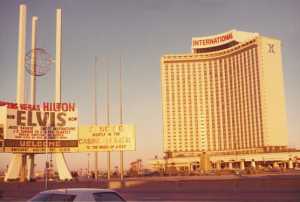
The Flamingo was just the start of his move into the hotel business. The same year he bought the Flamingo, he bought 33 hectares of land for $5 million and built the International, the largest hotel in the world. Barbra Streisand was Kerkorian's first headliner, but the hotel remains synonymous with another superstar. Elvis Presley was seen to be in decline and had been in exile from the stage for nine years. He flopped in Las Vegas back in 1956 but was now ready to return in triumph. He opened at the International on 31 July 1969. Over the next seven years, Presley gave 837 sold-out performances, playing Vegas for one month in the summer and another in midwinter while staying at a 30th floor suite at the hotel.

Kerkorian bought the then unprofitable Metro Goldwyn Mayer (MGM) for the first time in 1969. Kerkorian wasn’t interested in the studio; what attracted him was twofold, the MGM trademark and its Culver City real estate which was where MGM made movies since the silent film days of Hal Roach. Kerkorian proceeded to strip the assets and run down the studio. In 1979, he declared that MGM was now primarily a hotel company. In 1985 he sold the movie business to Ted Turner but bought most of it back 74 days later when Turner’s backers got cold feet (Turner retained the MGM film library which he used as the basis for his Turner Classic Movies channel).

In 1990 Kerkorian sold MGM again to an Italian financier Giancarlo Parretti. But Parretti was unable to turn the movie studio around and was forced to sell up five years later. There was only one bidder: Kirk Kerkorian. But despite a new business plan the movie side of MGM continues to flounder. The endlessly lucrative James Bond franchise remains its only continued success.

Meanwhile Kerkorian was also turning his attention and Midas touch to the automotive industry. Already a holder of 22 million shares, he paid $868 million in 2005 for 28 million GM shares. The deal netted him 9 per cent of the company and made his investment arm Tracinda Corporation (named for his daughters Tracy and Linda) the third largest shareholder of GM. Kerkorian is CEO, president, director and sole shareholder of Tracinda.

Despite his advanced age, Kerkorian shows no sign of slowing down. In April this year, Tracinda made a $4.5 billion cash offer to buy the struggling Chrysler Group from Daimler. Kerkorian also reaches back into his Armenian heritage with his Lincy Foundation. It helped rebuild Armenia after the earthquake of 1988, with millions of dollars in housing grants. They are still active today helping to fund the school and road systems.

Kerkorian remains as optimistic about the health of the Las Vegas resort industry as he was when he arrived in his Cessna in 1945. "Personally, I wouldn't say it's headed for a fall," says Kerkorian, "except that there will be a leveling-out time, and the best hotels and the best operators are going to suffer less than the others." Those who know him describe him not as a hermit in the Howard Hughes fashion, but a gracious normal person. Kerkorian himself claims he is not reclusive. "I have 30- or 40-year friendships that I prefer to meeting new people” he said. “I go to an occasional party, but just because I don't go to a lot of events, and I'm not out in public all the time doesn't mean I'm anti-social or a recluse”. It is not known how he celebrated his 90th birthday.

Wednesday, June 06, 2007

Charles Taylor trial starts in The Hague

The trial of Charles Taylor opened yesterday in The Hague with the dramatic boycott of proceedings by the 59 year old former Liberian dictator. Instead his lawyer read out a letter on Taylor’s behalf. In the letter Taylor denounced the court, claimed he could not receive a fair trial and terminated his participation by dismissing his lead counsel. "I cannot take part in this charade that does injustice to the people of Liberia and the people of Sierra Leone," he said in the letter. "I choose not to be a fig-leaf of legitimacy for this process."

Taylor’s lawyer Karim Kahn then walked out of the room in defiance of a court order to continue to represent Taylor for the day. Julia Sebutinde, the British-trained Ugandan presiding judge, said the trial would continue despite Taylor's failure to attend, as the session quickly got bogged down in legal arguments that delayed the prosecution's opening presentation. The case then began with an overview of the history, a description of the crimes and a description of the individual liability for which Taylor could be held responsible.

Charles Taylor has been indicted on 11 charges, including terrorism, murder, rape, sexual slavery, mutilation and recruiting child soldiers linked to his alleged support for rebels in Sierra Leone's civil war. The prosecution claims to have overwhelming evidence that holds Taylor conducted war crimes against Sierra Leone’s civilian population. He is being tried in the Special Court for Sierra Leone in offices borrowed from the International Criminal Court in The Hague.

The Special Court for Sierra Leone was set up joint by the UN and Sierra Leone. It is an independent judicial body set up to "try those who bear greatest responsibility" for the war crimes and crimes against humanity committed in Sierra Leone after 1996 during the Civil War that ravaged that country. So far, eleven people have been charged with offences. Ten of these trials have taken place in the capital Freetown but Taylor’s high profile trial was moved out of Sierra Leone due to fears that militias still loyal to Taylor might attack the court room. Proceedings are been broadcast live on four giant screens in Freetown.

Charles Taylor is the first African head of state to go on trial for war crimes before an international tribunal. He is currently being held in the same prison where former Yugoslav president Slobodan Milosevic was held when he died in 2006. This is not the first time Taylor has been in jail. In 1985, he was imprisoned in Massachusetts after he stole $900,000 in Liberian government funds in the US. He escaped after a year and returned to Africa.

Taylor first came to world prominence when he launched a revolt from the Ivory Coast which stormed Liberia’s capital Monrovia in 1989. He overthrew former leader Samuel Doe and kept control of the country in a civil war which lasted through the early 1990s. Although he cemented his position by winning an election in 1996, he was eventually ousted by Liberian rebels and Taylor accepted asylum in Nigeria in 2003. Liberia requested Nigeria to extradite him and in 2004 he was released into the custody of the Special Court for Sierra Leone.

Human rights organisations are hoping his trial sends a message to other dictators that no-one can escape punishment for atrocities. Human Rights Watch say the case provides an important chance for victims to see justice done. “The trial of a former president associated with human rights abuses across West Africa represents a break from the past,” said Elise Keppler, counsel with Human Rights Watch’s International Justice Program. “All too often, there has been no justice for victims of serious human rights violations. Taylor’s trial puts would-be perpetrators on notice.”

Taylor has denied all 11 charges. When the case for the prosecution finally started, Chief Prosecutor Stephen Rapp alleged that Taylor waged a campaign of terror against the civilian population of Sierra Leone by arming and training the Revolutionary United Front (RUF) rebel force which murdered and mutilated civilians, raped women and recruited child soldiers. Taylor armed the RUF in exchange for diamonds which he trafficked on the black market despite a ban on conflict diamonds. The decade long war claimed 60,000 deaths and an untold number of mutilations.

If convicted, he is likely to serve his sentence in the UK. Last year British foreign secretary Margaret Beckett said London has agreed to a request from former UN chief Kofi Annan to imprison him if convicted. The tribunal has wide powers of sentencing. It statutes allow a sentence of "imprisonment for a specified number of years" without giving a maximum. This means he could go to prison for life. The trial is expected to last 12 to 18 months.