Showing posts with label music. Show all posts

Monday, January 09, 2012

David Bowie turns 65: A personal recollection

My first memory of David Bowie is when I was a young teenager at the house of my two older cousins. They influenced my early musical tastes which meant I had an early eclectic collection that featured Mike Oldfield, Steve Hillage, Rory Gallagher and Rush. Among their albums was a strange looking LP with an unforgettable cover photo. There was a man and a woman both shown naked from the chest upwards, the man with big bright red hair staring pensively straight into the camera, while the woman, her head resting gently on his shoulder, seemed almost forlorn. The album was called “Pinups” and the artist announced as just “Bowie”. I didn’t know whether “Bowie” was him or her or both of them but desperately wanted to know more. Her face was familiar but it was his voice that transfixed me from the first listen.

Later my cousin told me he was David Bowie and she was the model Twiggy, whom I remembered seeing on television. What was she doing on the cover, I asked. He didn’t know. It would be many years before I found out why though I figured Bowie must have had a thing for Twiggy when she got name checked (“Twig the Wonder Kid”) in Drive In Saturday on the album Aladdin Sane. That album and Pinups were released within six months of each other in 1973 when I was nine years old.

It was probably around late 1978 or so when my cousins first exposed me to his work and his astonishing different coloured eyes. The following year I got my first summer job porting cases around the Grand Hotel in Tramore for ten quid a week. I stayed at my auntie’s in Tramore and for the first time in my life I had discretionary spending money. All that summer I spent my wages on David Bowie’s back collection. There was Pinups, of course and Aladdin Sane. But there were lots more besides and I immediately loved them all.

Space Oddity (1969) featured the hit single of the same name. The tune was instantly familiar from radio but I never realised it was the same guy who shared a possibly naked album cover with Twiggy. There was The Man Who Sold the World (1971) full of raucous rocking anthems and the album that Roy Carr and Charles Murray later told me in their “Bowie: An Illustrated Record” (1981) was where the Bowie story really began. The cover art of Bowie in a dress was too much for 1970s Catholic Ireland (as it was for less conservative Britain) and we all had to make do with the “leg up” photo from the Ziggy era.

Hunky Dory (1971) quickly established itself as a personal favourite. While cycling in the countryside near Waterford I would sing loudly each song in the order they appeared on the album, much to the bemusement of the cows in the nearby fields who had to put up with my squealing out every previous moment of “Oh You Pretty Things". It was pure pop, Bowie style and I loved every minute of it. I'm not sure the cows shared my tastes.

Next up was Ziggy Stardust (1972). While this was the album – and the persona – that made Bowie a household name, it was never one I particularly loved. I thought the concept album idea was boring and none of the songs haunted their way into my conscience as did his other albums of the same era. I did like the instruction on the cover “To be played at maximum volume” but I never risked the wrath of mum and dad by actually complying.

As stated before the 1973 albums were my entry point to Bowie. Not until I read Carr & Murray, did I realise Pinups was full of 1960s covers and even recently when I heard Ray Davies blast out “Where Have All the Good Times Gone?” my first reaction was to think the Kinks did a great cover of Bowie’s record. Aladdin Sane, however, was pure Bowie and utterly haunting from the first listen. I was entranced by Bowie’s apocalyptic vision from the subtitle of the title song Aladdin Sane (1913-1938-197?) expecting World War III to break out any day. But it was Mike Garson’s piano in the final track Lady Grinning Soul that penetrated deepest with Bowie crooning “She will be your living end” grinning its way into my soul. It’s still my all time favourite Bowie song.

Then it was Diamond Dogs from 1974, another overrated album by my lights. I was never a huge fan of the singles Rebel, Rebel or Diamond Dogs though I loved the epic sweep of the Sweet Thing trilogy. Young Americans from 1975 was much more to my liking. Very different from anything Bowie did before, his “plastic soul” sounded anything but plastic and the influence of John Lennon still in his prime and Luther Vandross made this a very classy sounding album. Bowie’s voice seemed to adapt to any style.

Station to Station (1976) was another departure and another Bowie character the vampire-like Thin White Duke. Bowie was a heavy cocaine user during this period and it drives on the pulsating title track that opens the album. The opening minutes of that song are unforgettable as the train build up speed slowly with a droning guitar before the thin white Duke’s voice returns to bring this massive song home with an up tempo conclusion. Well, if it's not the side-effects of the cocaine, I'm thinking that it must be love.

It took me a while to love the two 1977 albums Low and Heroes. By then Bowie was in Berlin and under the influence of ambient musician Brian Eno. Low was well named, the pain of Bowie’s then splintered personal life brought out in songs like Breaking Glass and Always Crashing in the Same Car. The instrumental side 2 was difficult listening but ultimately rewarding. Heroes followed a similar trajectory with side one distilling in lyrics Bowie’s drug-crazed agonies while an instrumental side two seemed to explore the same concepts in music.

Lodger (1979) came out in the same year I was seriously getting into Bowie. It was a bit more upbeat than the previous two and was minus the instrumental frenzies but it was still a dark record. Boys Keep Swinging got Bowie back in the British charts but there was not much singles joy in this platter. The title Lodger hinted Bowie was not really at home in this music but his travels around world music did give him a better feel for dance music he would exploit successfully in the coming years.

That decade started with Scary Monsters and Super Creeps which was the first Bowie album I bought as soon as it came out. I was a bit disappointed. The album was a commercial successful and the singles Ashes to Ashes and Fashion put him at the top of the charts. Yet somehow I was expecting a bit more from Bowie. It was another change of musical philosophy for sure, but it just seemed to fall short. Maybe I was just being precious because everyone liked Bowie at the time. Listening again to It's No Game (Part 1) recently, it is a classic track with Michi Hirota singing the song in Japanese and Bowie spitting out the translation in English as if, as Carr & Murray said he was “tearing out his intestines”.

My love affair with Bowie ended in 1983 with Let’s Dance. Sooner or later Bowie would have to release a disco record and this was it, and a great success. But by 1983 I was a know-all 18 and starting to get into more obscure music, listening to Wire, the Virgin Prunes and the young Matt Johnson (later The The). I was unimpressed by Bowie’s clean dance sounds on this album. The title track was playing in every discotheque in the world that summer and I loathed it like I loathed Thriller which came out around the same time. This music was beneath me and I didn’t buy another Bowie record for 20 years.

Around 2005, there was a time when all his back collection of CDs was selling at $10 a pop in Brisbane record stores. In a fit of nostalgia I bought all those albums from 1970 to 1983. I fell in love with his early music again. Too much time had passed under the bridge for me to care about more recent Bowie offerings. I bought Heathen (2002) but because it had no 1970s or 1980s memories to weave on to, it never impinged on my conscience and I’ve hardly ever played it. But for those 13 years or so, Bowie’s voice, dexterity and mastery of various genres made him a musical genius of the highest order. Happy 65th birthday, David.

Sunday, June 05, 2011

Reap what you sow: The axing of PCAP

There was much to admire in Surat today at what might possibly be the region's last Mid Winter Music Carnival. Every year hundreds of kids and some enthusiastic parents, gather in one of the region’s towns, march around the central streets behind a marching band pumping out Waltzing Matilda, and end up at the local shire hall where they break up into individual bands and play a free concert. This year it was Surat’s turn to host the carnival. There were over a hundred musical kids on stage who were proof positive this scheme for nurturing talent works. But while their parents listened with obvious enjoyment, they were also worried the dead hand of government is about to destroy a good thing. The funding for the program is about to be axed at the end of the year.

The full name of today’s carnival is the PCAP Mid Winter Carnival and is sometimes shortened as PCAP Winterfest. PCAP is an acronym for the Priority Country Area Program. It is the Queensland version of the national Country Area Program introduced by the Fraser Government in 1977 under the Disadvantaged Schools Programs to recognise students attending schools in isolated areas have less access to educational, social and cultural opportunities than metropolitan students. Queensland’s PCAP is a community-based program and unusually – and critical to its success - is intersystemic, that is, jointly administered by the State and Catholic school system.

From 1982 eligibility under the program was determined by eligible local government boundaries. Rural Queensland was divided into four geographical areas with local administration; each grew differently to each other as local needs were cared for.In South West Queensland 80 per cent west to an area wide program, rather than to individual schools. Itinerant PCAP teachers became devoted to the areas they served in. In 2008 there were 242 PCAP schools across Queensland, many of them very small, enrolling 31,500 students. There are 48 local committees that sit to decided where funds should go. These committees had high level of community involvement as social events and bonded rural communities as much as the programs they sponsored.

The Federal Government provides the funds to PCAP and gave $6.4 million in 2008. The cost of administering the program in wages, committee meetings and operational costs is $1.6m. While the PCAP has good educational outcomes in the bush, they are difficult to manage on a balance sheet. Moreover, the administrative bill of 26 per cent of the total budget was very visible and had bean-counters in Canberra and Brisbane worried. The 2008 Queensland Council Amalgamation and COAG insistence on more “accountability” from the states gave the cost conscious Queensland Government the opportunity it needed to claw back some of that funding.

They called in former Education Department bureaucrat Frank Rockett to review the program and his consultation report had contradictory findings. Focus group meetings with stakeholders revealed a number of flaws in the program including an onerous fund application process for even the smallest dollar amounts, occasional trips for entertainment rather than educational purposes, and a bucket of funding money for wider community groups. But Rockett also acknowledged the vital role it played in forging community ties and getting good educational outcomes for isolated kids. He made 27 recommendations to the Minister for Education, 20 of which were accepted in full in the final report.

The program will be axed at the end of 2011 and replaced by Rural and Remote Education Access Program, to be known as RREAP. Eligibility will be based on the Australian Standard Geographical Classification used in the Health industry bringing in a total of 347 schools and 54,850 students. The administrators will be sacked, teachers will be based in schools not paid by the program and funding will be tied to learning outcomes. The administration will be divested to the schools themselves – adding to their already large workload. According to Rockett, the School Principal “is clearly held accountable for school performance just as the manager of a business or the Chief Executive Officer of a large company are equally held accountable.” But there is no one the school CEO can turn to with knowledge of the program’s many small but vital services nor it is clear what will happen to all the instruments PCAP currently owns.

Without administrators RREAP will also not be able to promote itself. Most people in the south-west know about PCAP – there are stickers everywhere in the community promoting them. In the south-west, PCAP is most synonymous with music and produces a huge amount of musically-talented kids through the program, as Surat today showed. But it does much more. They run their own bus to events around a huge district, they charter other buses to take people to regional competitions in Toowoomba and they subsidise dance teachers to drive 200km to help children learn ballet in St George. There were other benefits that couldn’t be measured on the bottom line such as the confidence that flows on to other areas of learning and the sense of discipline and responsibility a child takes as a musician. As one parent told me today, her son was sick but didn’t want to miss playing as “he was the only saxophonist in the group”.

PCAP was introduced in the Joh era and some might call it pork-barreling, subsiding educational outcomes for a particular area. In Queensland parliament in September 2009, Current LNP leader-in-the-house Jeff Seeney called it “an important source of funding for country area schools in order for them to provide the extra opportunities that larger schools take for granted.” I would go further than that. PCAP is a great model for effective micro-local government. It cost money to run but it was ecumenical and rooted in the community. It inspired kids to be musicians and parents to be volunteers and it had value-added services based on unique local needs. The Government will save $1.6 million on the empty swings of administrators but may lose more on the busy roundabouts of harassed principals and demotivated volunteers with no paid support staff to give them a gentle push. As any parent in Surat could tell you today, it's a false economy.

Monday, February 22, 2010

The Polyphonic Spree perform in Brisbane

My second visit to the Powerhouse on Friday was to see the American band the Polyphonic Spree. The Spree is a Texan outfit with anything from 17 to 27 members on stage at any one time. Possibly due to the difficulties of playing in Australia (though this was their second visit in two years) they were down to the “bare bones” 17 that took the stage in New Farm. This included two percussionists, two guitarists, a bassist, three piece brass section, four piece Polyphonic Choir, a flautist, a keyboard player, two piece strings and front man and lead singer Tim DeLaughter. DeLaughter and fellow Polyphonics Pirro and Bryan Wakeland were in the band Tripping Daisy which disbanded in 1999 after the drug overdose death of guitarist Wes Berggren.


I always wondered how DeLaughter and co managed to make money out of touring given the number of band members and they went further in this tour handing out hundreds of free hats, Indian chief headgear, necklaces, masks and bracelets. It made for a colourful audience who expectantly waited for the Spree to emerge from behind the screen.

The foliage was dense.

Finally the band did emerge and put on a terrific show with their own music interspersed by such eclectic offerings as Paul McCartney's Live and Let Die,Neil Diamond's Sweet Caroline and Nirvana's Lithium.

Went upstairs to get a better view. This was a restricted ticket area only but I mumbled something about being a journalist and was allowed to take a few photos before being booted out.

foliage heaven.

Cowboys entertaining Indians.

A clue to how the band pays for its expenses. Apparently DeLaughter also makes big money from UK supermarket chain Sainsbury's use of "Light and Day / Reach For the Sun" for its advertising.

Tim takes centre stage.

Tim takes side stage.

Stuck in the middle again with you.

Mad balloon time.

End of Act 1. Just Tim left on stage with half the Polyphonic Choir.

More balloons yet to fall.

The Interval shows the foliage in all its glory.

Back for Part 2 in traditional kafkan garb.

Now its paper time and the venue briefly resembles an Argentinian football game.

I loved the Polyphonic parapharnalia over the stage.

More paper lace.

Finally the white balloons are released.

As Tim takes the final encore.

Time for a victory salute.

Before bowing to the audience.

And lining up to say farewell. An enjoyable (and eventful) gig is over.

Friday, October 02, 2009

The Audreys at Brisbane Festival Spiegeltent

The Spiegeltent, Queens Park, Brisbane
The Spiegeltent (Dutch for Mirror Tent) is brought out from Belgium for the three weeks of the Brisbane Festival

and placed at Queen's Park between the Casino and the Treasury Building
Playing tonight were blues and roots band The Audreys originally of Adelaide, now based in Melbourne

The Audreys are a five piece band who won an ARIA award for their debut 2006 album Between Last Night and Us

Pictured are singer Taasha Coates, guitarist Tristan Goodall (back turned) and bassist Lyndon Gray

Coates and Goodall are the creative heart of the band

The blurry view from the back of the mirror tent

This pic also shows drummer Toby Lang and guest violinist (whose name I didn't get). The band's usual fiddler Michael Green was at home in Adelaide with his partner who was about to give birth.

Coates is a dab hand with the little-used melodica

Coates' micro-guitar was quite endearing as was the person who played it

front-on view of the band

The set went for an hour and a half and it flew by with a series of fine songs played by a tight band and a singer with great voice

The band were enjoying themselves

Coates on piano

An encore featuring just Coates and bassist Gray

Sunday, August 17, 2008

Half century Madonna: La Ciccone kicks on

“Some boys kiss me, some boys miss me
I think they’re ok
But it’s the boy with the cold hard cash
Who makes my rainy day”
(“Material girl” 1985).

Madonna Louise Ciccone Ritchie turned 50 yesterday. Though she celebrated her birthday with a private party in the UK, Madonna shows little sign of letting up. The pop icon will kick off her “Sticky & Sweet” world tour with the first of more than 40 dates next Saturday in Cardiff. Her most recent album “Hard Candy” (which featured collaborations with Timbaland, Justin Timberlake, Pharrell Williams, and Kanye West) debuted at number one in the UK albums chart, but was panned as mediocre by many reviewers including Pitchfork who said no-one involved in the project “is anywhere near their creative peak.”

Having sold 120 million albums and 40 million singles, Madonna can well afford to ignore the occasional poor review. Despite being the second top selling female artist of all time (only Barbra Streisand is ahead of her), it is likely she would perhaps now prefer to be known as much for her HIV activism, clothing line, children’s books, and acting and directing career. Madonna’s success over 25 years is based a refusal to rest on her laurels and the uncanny ability to periodically re-invent herself anew in a way that consistently connects with mass audiences.

She was born Madonna Louise Ciccone on 16 August 1958 in the small town of Bay City on Michigan’s Lake Huron. She was named for her mother Madonna Louise Fortin, of French-Canadian descent. Madonna snr married Silvio “Tony” Ciccone. Ciccone’s parents moved to the US from Italy's Abruzzi region in the 1920s to work in Pittsburgh’s steel mills. Ciccone was upwardly mobile and studied engineering at college. He moved to Detroit to work in the automotive industry and also served in the military. Madonna, the third of six children and the eldest daughter, would get much of her own ambition from her father.

Silvio ensured his children were brought up as Catholics and learned how to play a musical instrument. Tragedy struck when her mother died when Madonna was just six. Tony married his housekeeper and had two more children with her. After high school, Madonna won a dance scholarship to the University of Michigan. She left after a year and moved to New York. Madonna drifted from job to job, including serving donuts and nude modelling, until she joined the Alvin Ailey Dance Company.

After a couple of years learning the dance trade, she went to Europe in answer to French disco artist Patrick Hernandez's offer that she work as a back-up singer and dancer. In Paris she met Dan Gilroy who became her boyfriend and taught her how to play the guitar and drums. When the couple returned to New York, they put together the band, The Breakfast Club, where she played drums, wrote songs and sang. In 1980 she teamed up with Steve Bray to form the band Emmy and was eventually signed up as solo artist to the record label Sire.

In 1982 she recorded “Everybody” which was a club hit in the US. A year later she crossed over into mainstream pop when she worked with New York DJ John “Jellybean” Benitez. The pair struck up an important relationship, both personally and professionally. Together they released “Holiday” and “Borderline” and Madonna was on her way to becoming a star. The first three hits would appear on her eponymous debut album released in 1983.

Madonna released her second album, “Like A Virgin” in 1984, with the title track hitting the number one spot on the music charts. She was quickly renowned for her fashion as much as her music with her signature look of bleached hair, lace tops and short skirts over capri pants. As VintageBlues puts it, she “burst onto the scene clad in yards of lace, beads, crosses and the infamous Boy Toy belt, singing about such taboos as virginity and unwed mothers.”

But Madonna wasn't just content with being a star of music and fashion. A year later, in 1985, she made her first forays into the movie business. She landed her debut role as a nightclub singer in Vision Quest and followed it up as the lead in Desperately Seeking Susan. The singles from both of the films became hits and the filmmakers renamed Vision Quest in its European release to cash in on Madonna’s hit “Crazy for You”.

By then, the world was crazy for Madonna. Her third album “True Blue” took her into unprecedented territory being a smash hit with four top five single and also garnering critical acclaim. Madonna had a hand in writing or co-writing all songs on the album. It didn’t hurt album sales that “Papa Don’t Preach” caused huge controversy with its music video depicting a pregnant young teenage mother. Madonna dedicated the album to new husband actor Sean Penn whom she called in the liner notes “the coolest guy in the universe”. But Penn’s penchant for violence wasn’t so cool and the pair split up after he was charged with felony domestic assault.

Nevertheless, Madonna’s career continued to go from strength to strength. She riffed on her failed marriage in her fourth album “Like a Prayer.” It was hailed by Rolling Stone as “far and away the most self-consciously serious album she's made” and “more interested in exorcising demons than entertaining fans.” But the fans were entertained all the same, and the album sold seven million copies worldwide.

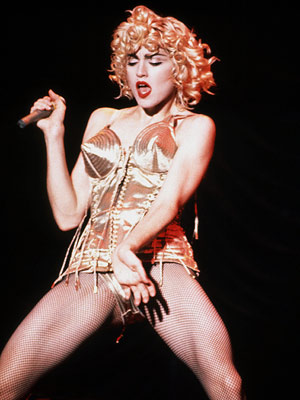
Her ability to subvert dominant gender codes to assert her own power and agency proved too much for many male-dominated organisations. In 1990, MTV banned the bondage-themed video for “Justify My Love” as being too sexually explicit. That same year, Pope John Paul II called on Romans to boycott Madonna’s “Blond Ambition” show. This was the tour that introduced Jean-Paul Gaultier's conical bra outfit and featured the singer simulating masturbation during Like a Virgin. The Vatican's newspaper, L'osservatore Romano, described the show as "a complete disgrace". Officials in Toronto also threatened to arrest her for her on-stage masturbation routine.

Madonna continued to make hit records in the 1990s, though she did not quite match the phenomenal success rate of the previous decade. In 1996, she underwent a serious image makeover when she was cast in the coveted role of Evita Peron in Alan Parker’s adaptation of the Lloyd Webber and Rice musical “Evita”. While the film was criticised for failing to accurately portray the Argentinean leader, Madonna was praised for her assured performance. The New York Times said her performance “which consists of cutting a glamorous swath through crowded settings and passionately feigning the emotions on the soundtrack, is legitimately stellar and full of fire.”

In real life, Madonna’s fire was taken on more spiritual dimensions. In a candid and wide ranging review of her career with Larry King in 1999, Madonna talked about her links with the Jewish mystical tradition of Kabala. Madonna first got into Kabala through a Jewish friend when she was heavily pregnant. Madonna hinted to King why she was attracted to it “It is considered traditionally the only people that are supposed to learn the Kabala are men, and they have to be over the age of 42,” she said. “Look, if this information is so enlightening and so important and can help other people, why are we limiting it to teaching it just to men, Jewish men who are passed the age of 42?”

Madonna herself passed the age of 42 as the new century approached. She celebrated Y2K by remarrying, this time to British film director Guy Ritchie whom she met through Sting. Ritchie became the step-father of Madonna’s daughter Lourdes who was born in 1996, and whose father was Madonna’s personal trainer Carlos Leon. Madonna and Ritchie’s attempt to adopt Malawian boy David Banda in 2006 was the subject of much controversy over allegations that the couple breached local adoption laws. There was also the accusation the boy's biological father merely thought he was being sent out for fostering. Madonna claimed it was an act of charity to “help one child escape an extreme life of…poverty”. However, academic Yvonne Roberts was one of many to question the move, saying Banda had become a public relations vehicle before he even learned to walk.

Meanwhile back in the recording studio, Madonna continued to pump out hit records showing little sign of slowing up. Her reputation as a shrewd businesswoman was recently enhanced when she severed ties with long-term record label Warner Brothers to sign up with Live Nation, a company that until recently specialised in music tours. As well as earning a reported $120 million over the life of the agreement, Madonna appears to be among the first to recognise which way the music industry was heading, meaning she will spend more time performing on stage rather than in the recording studio. And if the Rolling Stones are anything to go by, Madonna will be gracing the venues of the world for some time to come.

Thursday, July 17, 2008

Robert Forster in conversation with Andrew Stafford

I went along tonight to a free event at Queensland State Library where I saw Robert Forster in conversation with Andrew Stafford. The pair were talking about the legacy of Grant McLennan. McLennan died in 2006 and he and Forster were the creative heart of one of Brisbane’s finest gift to music: The Go-Betweens. Interviewer Stafford’s book “Pig City: from the Saints to Savage Garden” is a musically history of Brisbane, the city Forster and McLennan called home either side of a long stint in exile.

Stafford began by asking was their early move to London done for creative reasons. Forster said it was because they could finally see the bands they were reading about in the 1970s. They saw the Cure at the Marquee, Scritti Politti, The Fall, Gang of Four, Bauhaus and Simple Minds. They saw the Pretenders the week “Brass in Pocket” reached number one. Forster called it a crash course in musical education. “Interesting bands would only come to Brisbane every four months or so, but in London we were seeing bands three or four times a week,” he said. “It would have taken us five years to do in Brisbane”.

Stafford said it was almost a cliché now that bands no longer had to leave Brisbane to be successful. Forster disagreed and said not enough young Australian bands head overseas. “I could think of several bands who could do with six months in Berlin, Thailand or South America” he said, with more than a passing nod to Nick Cave’s Sao Paolo period.

Stafford then asked about Forster’s return to Brisbane in 1992 after eleven years away and whether he thought of it as a transitional phase of the city. Forster said he arrived back with no set of preconceptions. He met up with the members of local band Custard and its alter ego COW (Country or Western). Both bands were the brainchild of James McCormack. Forster said their music was like the Go-Betweens’ late 70s material and meeting McCormack was like “running into a younger version of myself”. But, he said, they made music together on Forster’s Calling From A Country Phone album in 1994 despite the fact “I was 34 and they were all 22 or 24”.

Stafford then asked Forster about the newest album The Evangelist, his first solo recording in 12 years and which was recorded in London. Forster said he wanted it to sound different. He wanted “big, clean sounds” with “piano, voices, acoustic guitar, no drums”. Forster said it was a return to the familiar London environment he worked in during the 80s. “London has always been good to me,” he said. “I had good recording times there”.

The album includes three songs written by McLennan. Forster said he first heard the songs in February 2006; three months before McLennan died. After they played the songs they were talking about Audrey Riley, a British cellist the pair met in London in the 1980s. Her career took off after she did the strings for their fourth album “Liberty Belle and the Black Diamond Express”. Forster invited her to do the strings on the new album on McLennan’s song “Demon Days”.

Stafford asked how difficult was the album to record in the studio where he did so much work with his former partner. Forster admitted he was worried by that, “but there were no scary moments, I mean pianos never suddenly started playing!” But it was difficult to get over the death of his professional partner of 30 years. “Part of it felt “like madness, but I’m glad we did it,” he said. “I thought it was going to get all ‘stoopy’, but it didn’t. Process takes over”. That musical process helped Forster get over his loss and record the album, entitled “The Evangelist”.

Stafford asked him to name his five favourite McLennan songs. Forster named seven: The Wrong Road, Cattle and Cane, Bye Bye Pride, Magic in Here, Finding You, Quiet Heart and The Clock. This creativity befits a man whose death was mourned in NSW’s parliament. Forster said McLennan had the gift of finding a new melody for basic chords. He remembers going around to McLennan’s house in New Farm where he played Forster the new tune he wrote “Finding You”. It had “great verse, great chorus, and an incredible middle eight,” said Forster, “ I thought: fuck! He nailed it!”

Stafford asked why three of McLennan’s last six songs did not make it to the new album. Forster said he “didn’t get” those songs. “Grant is a different singer to me”, he said. To do his songs justice Forster had to sing in McLennan’s key but these three songs didn’t work. He said he might give two of them away to other performers. One is quite rocky,” he said. “Don’t tell anyone, but I might give that one to Powderfinger!”

Forster said the album had to be true to his partner but there was always a contrast between them. He admitted McLennan could be “tetchy” and hard to work with at times. Telephone conversations would be terse and he could be cruel and cold. “At times you had to reintroduce yourself to him, talk about bands or movies you’d seen, the cricket, anything to get him going again,” he said. McLennan was moody, but “there was truth in that moodiness”.

Forster has brought back bassist Adele Pickvance and drummer Glenn Thompson from the Go Between’s final line-up for the new album. He said both were great friends and he couldn’t imagine making music without them. Adele lives in the Brisbane suburb of Paddington and Forster said she is his first port of call with the songs for the new album. “We’ll meet at ten, have a coffee, talk silly Brisbane rock gossip and then play music,” he said. “Adele played bass and mandolin as I played these new songs”. Forster described the songwriting process as “real music therapy” after Grant died. He will be showcasing songs from the new album (as well as singing McLennan’s own “Finding You”) on his national tour next month. Forster plays the Powerhouse in his home town Friday 15 August.

Forster / McLennan "Bye Bye Pride"

Wednesday, January 02, 2008

Radiohead declares war on the record industry

Radiohead front man Thom Yorke has hit back at record label EMI for suggesting the reason the band left the label because it refused to come to a $20 million deal. The spat comes in the wake of Radiohead’s independent release of its new album In Rainbows to huge acclaim. Speaking on the band’s website Yorke denied money was the reason for leaving EMI. “What we wanted was some control over our work and how it was used in the future by them,” he said “That seemed reasonable to us, as we cared about it a great deal”. Yorke also warned new bands not to sign a record contract that strips them of their digital rights.

The claims come as Radiohead finally releases the CD version of In Rainbows after releasing it three months ago online in what the New York Times called a ‘tip jar’ arrangement. The same article now questions whether anyone will fork out hard cash for the “material” version of the same product. But Radiohead have pre-empted the question by promoting the CD release with a “prerecording” of the band performing songs from “In Rainbows” on their own website and on Current Television as “Scotch Mist”.

This is extremely clever marketing by the band. On 10 October, Radiohead released In Rainbows as a digital download. For the next two months fans could download the album and pay whatever they wanted for it or indeed proffer no payment at all. The move caused a sensation in the music industry. No band as big as Radiohead had ever done such a thing. Besides the media hype, the music won the plaudits of critics as diverse as Pitchfork and Wired. The ploy also worked brilliantly from a public relations perspective, In Rainbows is the most talked about album of 2007. However the band has not released any figures about exactly how many downloads were made or how much people paid for them.

The band has recently celebrated its 21st anniversary. The original four members were all public schoolboys at Abingdon school in Oxford. Yorke (vocals), Ed O'Brien (guitar), Phil Selway (drums) and Colin Greenwood (bass) formed a band in 1986 called “On a Friday” celebrating the day on which the foursome got together to practice. Greenwood's brother Johnny soon joined on synths and guitars. But the band did not gain much momentum until after they completed their various degrees in the early 90s. They played in the indie scene in Oxford and eventually attracted the attention of the recording industry. They signed with EMI in 1991.

EMI’s first advice was to get the band to change their name. Singer Thom Yorke decided they would take their name from the Talking Heads’ song “Radio Head”. Radiohead’s first EP with EMI “Drill” in 1992 is now a sought-after collector’s item but at the time failed to break the British top 100. Their breakthrough came when their 1993 Creep EP reached number 2 in the Billboard Modern Rock Track Chart.

Despite this, the first album Pablo Honey (including the song “Creep”) failed to excite. While their 1995 second album The Bends got critical acclaim and some success, they had to wait until 1997 and the release of Ok Computer to really scale the musical heights. The album was a critical and commercial success and spent 71 consecutive weeks in the UK Charts. According to ‘reluctant fan’ Jon Lusk, the album captured the zeitgeist of the despairing-yet-hopeful dying days of the British Conservative administration. Others said the band had caught a wave of generational anxiety. Whatever it was, the album was quickly proclaimed one of the greatest albums of all time.

Radiohead found it difficult to work out what to do next after the plaudits of Ok Computer. They took a leisurely three years before they released Kid A. Without any proper marketing, Kid A went straight to number one. Fans were eager to soak up the new Radiohead experience. Critics raved; Pitchfork gave it ten out of ten. This new album was a stark, bleak experience and mostly synthesised. Brent DiCrescenzo perceptively called it the “sound of a band, and its leader, losing faith in themselves, destroying themselves and subsequently rebuilding a perfect entity.” But after the hype had calmed down, this perfect entity had infuriated as much as it inspired.

Amnesiac was released in 2001 comprising of additional tracks from the Kid A sessions. It too was successful but although displaying a more jazzy feel, it also suffered from the deep depressive attitudes that infused the earlier album. The more guitar oriented Hail to the Chief in 2003 represented in many ways a return to earlier form. Some critics were disappointed feeling that Radiohead had not evolved creatively with this new record. The band didn’t care. At the height of their fame, they launched a world tour headlining at Glastonbury and counting down the time to the end of their contract with EMI.

Finally free of the recording contract shackles in 2005, they began work on a new album. In an interview with Wired, Thom Yorke claimed EMI allowed no clauses for digital music rights as their contract was struck years before digital music stores were available. When In Rainbows was finally released in October 2006 it was the first real opportunity the group had to earn money on a digital offering. Yorke said the flexible price was manager Chris Hufford’s idea. “We all thought he was barmy. As we were putting up the site, we were still saying, "Are you sure about this?" But it was really good,” said Yorke “It released us from something. It wasn't nihilistic, implying that the music's not worth anything at all. It was the total opposite. And people took it as it was meant. Maybe that's just people having a little faith in what we're doing.”

Thursday, August 30, 2007

The Rolling Stones: reputation or retirement?

Keith Richards has demanded an apology from two Swedish newspapers who printed bad reviews of recent Rolling Stones concerts including a comment that he appeared "very drunk". The newspaper Aftonbladet claimed the guitarist looked "a bit confused", while the Expressen review gave Richards zero stars for his performance. Richards retorted by saying the press had abused its power. "How dare you cheapen the experience for …the hundreds of thousands of other people across Sweden who weren't at Ullevi and have only your review to go on?" He said. "Write the truth: It was a good show."

Richards' thin-skinned anger came as rumours persist the Stones will finally retire from live performance. The band wrapped up their “Bigger Bang” world tour in London last weekend. However guitarist Ronnie Wood has contradicted claims the band would be unlikely to tour any new album due to the time-scales involved. Yet Wood also said they have no plans to stop touring, and will probably be playing live until they drop dead. With band members Mick Jagger now 64, Keith Richards at 63, Charlie Watts at 66, and Wood at 60, it is likely they may be approaching their 70s by the time the next tour comes round. "We need a rest, but of course we will tour again,” said Wood. “We'll never stop."

Wood will release his autobiography called “Ronnie” in October this year. It is the first to be released by any members of the band and will tell how he went from a working class council estate in London to becoming one of the most famous musicians in the world. The memoir includes tales of the band's legendary sex, drugs and rock'n'roll lifestyle and reveals Wood and Richards held loaded guns to each other's heads during a bitter row and also claims Richards once held a knife to his throat during another bust-up.

While his relationship with Woods was sometimes thorny, Richards was always a close friend of Mick Jagger. The pair grew up in Dartford, Kent where they went to the same school. Though they lost touch, they met again in 1960 when both were students in London. They formed a band called Little Boy Blue and the Blue Boys (named for a DC comics superhero). The third member of the band was a mutual friend named Dick Taylor, who was later to form the group The Pretty Things. Mick sung and played the harmonica while the other two played guitars.

Mick and Keith drank regularly at a pub called the Bricklayer's Arms in Soho. Here they met Brian Jones who played slide guitar with a session band at the pub. The four decided to create a new band they called 'the Rolling Stones' taken from a track from a Muddy Waters album. In the summer of 1962, the new band got their first break after deputising at the Marquee Club and then winning a regular slot. There were a couple of further personnel changes. Taylor left the band to concentrate on his studies. Bassist Bill Wyman joined in December 1962 and drummer Charlie Watts joined a month later.

The band began to develop their R&B sound in 1963. They got a regular gig at the Crawdaddy Club in Richmond, Surrey. The Crawdaddy had the reputation of being a top R&B venue and London’s answer to Liverpool’s Cavern. It was here the Beatles first heard the band play live. As a result, George Harrison tipped off Decca's Dick Rowe to sign the Stones.

It was here also where Andrew Loog Oldham also heard the Stones. Oldham was a publicist who had worked for the Beatles but his head was turned by the Stones. Oldham and the Stones hit it off and he became the band’s manager. "I'd never seen anything like it," he recalls. "They came on to me. All my preparations, ambitions and desires had just met their purpose."

Oldham was a massive influence on the band. He insisted the band claim ownership of their master tapes and he created the bands “bad boy” image in deliberate contrast to the squeaky clean Beatles. It was also Oldham who convinced the Beatles to allow the Stones record their song “I Wanna Be Your Man” which was their first major hit single. The Stones followed it up quickly with Buddy Holly’s “Not Fade Away”. Both songs hit the top of the British charts.

But Oldham realised that the Stones couldn't sustain their popularity if they continued to perform other people's songs. One night he locked Jagger and Richards in his kitchen with orders not to come out until they had written something. But it would be another year or more before they would succeed with any of their own compositions. In the meantime the band toured the US in June 1964 where they were an instant hit. The band achieved notoriety after their version of the Willie Dixon-penned Blues classic “Little Red Rooster” was banned by US radio stations for its sexual content.

In 1965, “The Last Time” became the first Jagger/Richards original to crack the US top ten. But it was their next song that really cemented their worldwide appeal. Keith Richards woke up in the middle of the night in a Florida hotel room with a tune in his head based on a five-note guitar riff. Jagger added the lyrics “(I can’t get no) Satisfaction” and the song landed at the top of the US and UK charts.

The band quickly rose to the top with a string of smash hits. "Get Off of My Cloud" and "19th Nervous Breakdown" were followed by the Indian influenced Paint It Black". By now also, the band was beginning to be hounded by authorities for its drug use. In 1967 Jones was arrested for cannabis possession. That same year, the News Of The World tabloid newspaper tipped off Sussex police to raid a party at Keith Richards' home. The police found eight men with one woman who was wearing only a fur coat. She was Marianne Faithful, Mick Jagger’s girlfriend. Both Jagger and Richards were charged with amphetamine and cannabis offences. Jagger’s home was also raided in 1969 when police seized cannabis. Police also denied Jagger’s claim that they tried to plant some "white powder" on him.

Beyond the drugs, the Stones continued to make great music including Jumpin’ Jack Flash, Street Fightin’ Man, and a song based on Bulgakov’s the Master and Margarita “Sympathy for the Devil”. Brian Jones’s involvement with the band lessened as his drug dependency increased. Frustrated by his unreliability he was sacked from the band in June 1969. A month later Jones drowned in a swimming pool at his Sussex home after a night of drinking wine and taking downers.

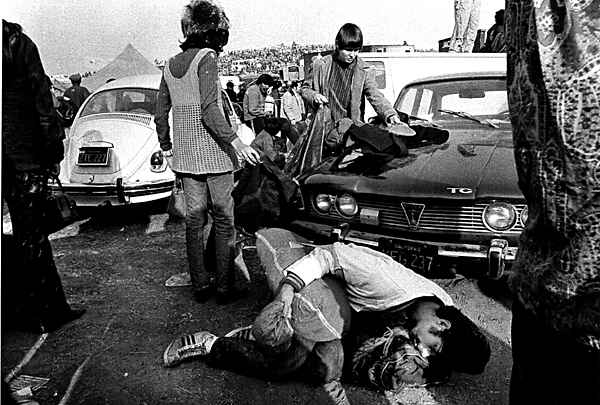
Jones's death was not the only disaster to befall the band in 1969. In November the band finished their US tour at Altamont near San Francisco. The Stones headlined a stellar bill that included Santana, the Grateful Dead, Jefferson Airplane, and Crosby, Stills, Nash and Young. The Stones hired the Hells Angels to provide security for the concert. The Grateful Dead had a long-standing relationship with the Angels and had used them for security on several occasions without incident. The Angels were drunk and drugged by the time violence broke out in the crowd. The Angels retaliated with pool cues and full beer cans. When the Stones began to play, security staff beat an 18 year old black man, Meredith Hunter, to death. Three others also died that day. Two people died sleeping as they got run over in their sleeping bags and a third person drowned.

Despite the traumas the band remained at the height of their artistic powers with songs such as “Gimme Shelter”, “Brown Sugar” and “Wild Horses”. Mick Taylor was drafted in to replace Jones and he in turn gave way to former Faces guitarist Ronnie Wood in 1974. The band became tax exiles in the south of France after the UK Inland Revenue hounded them for unpaid income tax. Although the Rolling Stones remained popular through the 1970s, music critics had grown increasingly critical of the band's output, and record sales went down. Richards’ heroin addiction was also a big problem at the time. In 2002 Richards described the impact of the drugs. “There was a lot of stuff happening, and it [heroin] gave me a sense of space,” he said. “Eventually, I was so far in space, I was almost in the atmosphere”.

But the band finished the decade on a commercial high with the successful album “Some Girls”. The album revitalised the band's career upon its release and re-established the Stones' credentials in a new era of punk and disco. The band continued to stage massive and successful tours through the 1980s and 1990s with each one threatening to be the farewell tour. After years of agonising and unwillingness to travel, Bill Wyman left the band after the 1991 world tour. The band survived his departure as it has done for many others.

The band continues to play with energy and conviction of people half their age. On 10 June 10 this year 2007, the surviving members Mick, Keith, Ronnie and Charlie performed their first festival gig in 30 years, at the Isle of Wight Festival, to a crowd of 50,000. According to newspaper reports they blew away the newcomers also headlining at the festival. The Belfast Telegraph said the Stones gave a “masterclass of rock’n’roll” while Mick Jagger “strode out at a pace which would have left most 20-somethings wheezing, before ripping into an exuberant set”.

Meanwhile the Swedish newspapers are unrepentant about the latest bad reviews. Aftonbladet's Markus Larsson wrote on their website, "he can forget it. I am not going to apologise. It is Keith who should apologise. After all, it costs around $145 to see a rock star who can hardly handle the riff to Brown Sugar any more." Expressen's entertainment editor, Dan Panas, was more phlegmatic, "our reviewer had one opinion of the quality of the show and Keith Richards has another."