Showing posts with label World Cup. Show all posts

Tuesday, July 13, 2010

The reign in Spain is mainly plain

And so a World Cup that began as African, and then turned South American before becoming European ended up as Spanish in a tense but always absorbing final overnight in Johannesburg. Nelson Mandela delighted fans by turning up but not as much as Barcelona midfielder Andres Iniestra did by scoring the game’s only goal deep into extra time consigning the Dutch to their third final defeat.

One punter on Twitter said after the game a Dutch victory would have been a Scorsese award: given purely for their work in the 1970s – this is a little unfair on Martin Scorsese whose more recent films Gangs of New York and The Departed are on a par with anything he did in his earlier career but the point is well made nonetheless.

Holland (never the more geographical correct Netherlands) were the great side of the 1970s with Johan Cruyff at the centre of most of their brilliance. But they never won anything at national level being undone by their own arrogance in 1974, 1976 and 1978 losing to the hosts and winners of the tournament each time. 1978 was a particularly tragedy when Cruyff decided for political reasons not to go to Argentina. What better rebuff to the junta generals would have been for him to lift the trophy in front of them.

The defeat of the current Dutch crop is no tragedy, being nowhere near as good as the total football side of the 1970s. The current vintage is a competent if workmanlike team epitomised by the starring role of Liverpool’s much maligned workhorse Dirk Kuyt. They beat Brazil which was perhaps the biggest shock of the entire World Cup. But otherwise they were like Brazil’s 2006 conquerors France, tough to beat and lucky but not worldbeaters themselves.

And in terms of sporting disappointment, they are only the second best of the month compared to unknown Frenchman Nicolas Mahut who lost his Wimbledon tennis match to equally obscure American John Isner in a record breaking three-day 11-hour contest 6-4, 3-6, 6-7 (7-9), 7-6 (7-3), 70-68. I can’t begin to imagine how Mahut felt at the end of that final 183rd game after they shared almost a thousand points between them.

But even Wimbledon reminds us of the World Cup with a Spaniard Rafael Nadal carrying off his second crown. His fellow countrymen – and they are countrymen, despites their catalogue of Catalans - one nilled their way to the World Cup final and repeated the dose one last time to deservedly take the crown. I congratulate them on their first title, a magnificent achievement especially outside their own continent.

As convincing European Champions in 2008 they went in as the favourite side from the northern hemisphere, but few people thought they could get past Brazil or Argentina to win outside their own continent. More still (myself included, I must admit) wrote them off after their opening shock loss to unrated Switzerland. The defeat was occasion for great angst in Madrid and Barcelona yet two games later they were back on track having won the group while the Swiss packed their bags for home.

The group win was crucial. It meant they avoided Brazil in the round of 16. Instead they won a tense Iberian derby before squeezing past a Paraguay side that was just delighted to be in the quarter finals. Germany was a different kettle of pescado having thrashed Australia, England and then Argentina but Spain passed them to death to deservedly win before repeating the dose against the Dutch.

Perhaps it is appropriate that the most Africanised country in Europe (and the one closest geographically) should triumph in Africa though the players probably won’t feel that way. But this victory may do what 50 years of oppression under Franco could not: seal a farrago of nationalities into a nation. Though it was a Castilian Iker Casillas who lifted the trophy (and in the process joining Dino Zoff in the pantheon of goalkeeping greats), it was a Catalan backbone that sealed the win. And the celebrations would have been just as great in Basque Bilbao and Galician La Coruna as they were in Madrid, Barcelona, Valencia and Seville. Viva Espana.

Tuesday, June 22, 2010

I'm hearing only bad news from Radio Africa

I remember at the Italia 90 World Cup when Cameroon got to the quarter finals and were unluckily beaten by England everyone saying it was only a matter of time before an African side won the World Cup. The breakthrough would come some time in the next 20 years. What no one predicted was that Cameroon’s 1990 performance would be remain an African high water mark, equalled only by Senegal who also went out in quarter-final extra time in 2002.

Things have gone backwards since then. With one round of the group matches left to go in the first ever African World Cup, it remains a distinct possibility that no African side will make it through to the last 16. South Africa, Ivory Coast and Nigeria are almost certainly out already. Algeria has some hope in the group of sleep but will probably lose to USA. That leaves Ghana who top their group currently ahead of Germany and Serbia. However their lacklustre performance against a poor ten-man Australian side suggests that they will probably lose to Germany and allow Serbia to grab the other place with a win or draw against Australia.

Just about the one African innovation of note in this World Cup is not the football but the vuvuzela. The infamous horn has split sporting fans across the world who either love it for its ability to get the fans involved or, more usually hate it for its incessant one-pitched drone which drowns out every other noise in the stadium. Problems with the vuvuzela were identified as early as the 2009 Confederation Cup which acted as a dress rehearsal for the hosts. FIFA boss Sepp Blatter went on the record saying he didn’t want to ban the vuvuzela saying “we should not try to Europeanise an African World Cup.”

As with most things Blatter says, this was hypocritical bullshit. It had nothing to do with anti-colonialism and everything to do with office politics. There is certainly no long history of the vuvuzela’s use in Africa or elsewhere. Plastic horns first emerged in Mexico in the 1970s and were seen at the Argentina 1978 World Cup. They didn’t become popular in South Africa until 20 years later. With its dangerously high sound level and closeness to the frequency of human speech, the horns are detestable and Blatter probably hates them as much as anyone who is not playing them. What the FIFA President was really saying is that he was not prepared to risk African votes deserting him during the 2011 presidential election.

But while Blatter is busy buying votes, the tournament he runs is starting to gather pace after a slow start. The first week saw a succession of negative games and 1-0 scorelines. Desperately poor and uneven refereeing didn’t help. The code’s complete refusal to use technology to help the refs leaves it looking a laughing stock compared to the range of facilities available to rugby, cricket and tennis umpires.

This is especially ludicrous now that the referees and assistants are wired up to talk to each other. It would not take long to talk to a fourth or fifth official in the stands with access to replays, goal-line incidents and offside decisions. The oft-quoted excuse that it would “interrupt the flow of the game” beggars belief especially when considering how many interruptions currently exist when players fall over under the slightest provocation.

But back to the football itself. I’ve mentioned the problems with Africa, but Europe does not seem in much better health. A European team has never won the competition outside its home continent and this statistic is likely to continue in South Africa. Germany looked strong against Australia only to fold against Serbia. Meanwhile Italy, France and England all lack a cutting edge. Favourites Spain inexplicably lost to Switzerland and may find it impossible to recover from the shock of that loss. The Dutch look the best of the Europeans so far but don’t really have the aura of trophy winners.

The same cannot be said of Brazil and Argentina. Both sides have aura in abundance and won their games easily. With the right amount of fortune they should end up playing each other in the first all-South American final since 1950 (or 1930 if you are being picky and say there was no actual final in 1950) and the first ever final between these two old foes. It would be hilarious to watch Diego Maradona pick up another world cup trophy, despite all his obvious flaws and apparent madness. I suspect Brazil have slightly too much guile to make that happen, but it is Argentina and its current on-field genius Lionel Messi that have my heart as we head into the next few fascinating weeks.

Monday, July 10, 2006

Forza Italia

Finito. Sepp Blatter’s bloated festival of football is over. Italy have won their 4th world cup having beaten France in the final at Berlin’s Olympic Stadium. The final score was 1-1 after 120 minutes and the Italians buried their shootout hoodoo with a 5-3 win on penalties.

Marco Materazzi headed an 19th minute equaliser after Zidane’s 5th minute penalty recalled both Holland’s 1974 start and Geoff Hurst’s bounced-over-the-line goal in 1966. Zidane wrote himself into the history books joining Hurst and the Brazilians Vava and Pele as the only players to score three goals in world cup finals. Alas he ruined his final appearance by a head-butt which landed on the chest of the Italian goalscorer Materazzi. The world awaits the verdict on what the Italian said to motivate this extraordinary action. One can assume that it wasn't an invite to come around for an evening of mah-jong. Whatever he said, the incident was missed by the referee and linesman but picked up on the video by the fourth official. Zidane had to make do with the Player of the Tournament award instead. The Italians hit a flawless set of five penalties. Trezuguet missed his and Fabian Grosso had the honour of scoring the winning penalty to send his country into raptures.

Some highlights of the tournament:

Graham “Three Cards” Poll. Poll was the only English referee in the cup. He was in charge of the powder keg Australia v Croatia game. With a few minutes to go he booked the Croatia no 3 Josip Simunic. Unfortunately in the heat of the moment he wrote down no 3 Craig Moore, his opposite Australian number. So when he booked him again a few minutes later Simunic was about to walk off the field when he noticed that Poll wasn’t going to brandish the red. But just for good measure Simunic transgressed again at the very end and got his third yellow and first red. Croatia went home into the bargain. Poll’s fellow referee, Russian Valentin Ivanov also gets a special mention for hectic 16 yellows and four reds in the 2nd round game between Portugal v Holland.

On June 27, an Islamist group in southern India have complained that many youths in the region have "gone mad" over football during the World Cup Finals. They have and are trying to dissuade them from watching matches. "Wherever you go, you see (youths) wearing jerseys of various teams. It's like idol worship which our religion doesn't promote in any form," said Sattar Pathallur, secretary of the Sunni Students Federation in Malappuram district of Kerala state.

The reason England were rubbish at the world cup: because of the WAGS (Wives and Girlfriends). This group of women led by Victoria Beckham were all holed up in the same five star hotel in Baden-Baden 20 miles from their partners. They proceeded to spend big in the town. They grabbed the headlines with drunken antics and phone calls to husbands at 4am. By day, the wags hunted in packs for designer gear. By night, their behaviour they danced on tables and ran up huge bar bills. The world cup made stars of Frank Lampard's partner Elen Rives and Joe Cole's personal trainer girlfriend Carly Zucker. If only England’s players had performed this well. Brazilian newspaper Gazeta Esportiva put it best, 'the WAGs are anorexics addicted to shopping with hollow lobotomised heads.’

The Vatican meanwhile lamented the flood of prostitutes into Germany for the World Cup, saying it cheapened the dignity of women, "who cost less than a ticket to a soccer game." How do they know how much it costs? A U.S. congressman estimated that as many as 40,000 women could be brought into Germany as sex workers, although some German officials have questioned those numbers. Prostitution is legal in Germany, and some 400,000 registered sex workers pay taxes and receive social benefits. In the end, the predicted industry boom failed to materialise. Hundreds of Czech, Russian and Spanish prostitutes left Germany before the quarter-finals due lack of demand. 'We saw it all so differently,' said a Colombian. 'I just sat in my brothel alone.'

The lonely ladies were not the only ones to see it differently. To Angola goes the award for the best named players in this tournament: Goliath, Akwa, Loco, Freddy, Love, Rats.

Loco Freddy love rats indeed! Roll on South Africa 2010.

Tuesday, June 27, 2006

Tuesday Therapy

One of the more spectacular failures dreamt up by a marketing department in recent years was the short-lived plan to rename audit firm Price Waterhouse Cooper (PwC) to “Monday”.

The company’s rationale was to connect Monday with fresh thinking and new ideas. “Sharpen your pencil” commanded their slogan. It continued with other snappy orders, “iron your crispy white shirts, set the alarm clock, relish the challenge, listen, be fulfilled, make an impact, take a risk," Unsurprisingly, the plan was met with universal derision. Monday? You’ve got to be kidding. The idea quickly collapsed in a screaming heap and PwC quietly dropped the idea.

Although I didn’t sharpen a pencil yesterday or iron a crispy white shirt, I did have to set the alarm to get up. Monday was a first day back in work after taking two weeks off to enjoy the late-night footballfest. These World cup midnight oils are addictive. By contrast England v Ecuador on Sunday night was supposedly a cure for insomnia but even here the sight of a vomiting David Beckham made up for the poor quality of the play. What would the marketers make of that? Monday night would be Australia’s time in the midnight sun. In the office, I noticed an incredible transition has occurred while I was away. Everyone was basking in the glow of a sporting success story. Tearoom conversation was all about Graham Poll’s cards, Brett Emerton’s suspension and Ned Zelic’s slouch. Someone wanted to know why the Italians are called the Azzurri. Harry Kewell’s groin was getting an unhealthy, almost forensic attention. In short, a bandwagon had come calling while I was away.

There was even giddy talk that once we beat Italy, Switzerland or Ukraine will be a push-over in the quarter finals. It was all too much. It had little to do with football and everything to do with national pride. I fled the office early. There was no respite on TV as all stations went into adrenalin overdrive and pushed the Aussie hyper-hype.

I decided that some radical pre-game therapy was needed and went to the Dendy Cinema in the city to see Michael Haneke’s Caché (Hidden). Almost ten years ago I saw a Haneke film called ‘Funny Games’ in which the director played tricks with time that kept the audience in a whirl of uncertainty. ‘Hidden’ takes this fooling with time to new levels. The plot is straightforward. A wealthy French couple’s lives are thrown into doubt and fear after they received a package of videos that shows they are under surveillance. They do not know who send them or why. Their lives are disrupted simply because someone is watching them. The film is all about frames and images, what we see and what we miss, what is real and what is fake, what is open and what is hidden. It perplexed me greatly and absolutely demands a second viewing.

At the very least it took my mind right off the big game until close to midnight. I walked over to the Pig and Whistle where the queue stretched down the street. I phoned a friend inside who pulled a favour with management to get me in. The place was packed. The crowd was filled with a belligerent Aussie pride. In the toilets I was asked ‘who did I think would win?’ I replied ‘well, my heart says Italy…” I meant to say ‘head’ and was immediately picked up. ‘Your heart?’ he replied angrily. “er…yes” The mistake wasn’t worth correcting and I quickly made myself scarce.

Fans gathered in front of the big screen and shouted their Aussie chants. When the recurring Nike ad came on with the craggy cranky character known as “History” taunting the Aussie players, the crowd shouted at the screen “Fuck off History, fuck off history” (unlike PwC, the swooshtika marketing boys at Nike are very clever indeed). The Italian anthem was booed and the Australian one was sung ferociously, off-key. Harry Kewell is shown on crutches wearing civvies. I guess he won’t be playing then. Then further disaster, TV loses the picture from Germany. Australia’s biggest game ever and for 54 seconds we are reduced to an image of the World Cup symbol and radio commentary. No-one knows where to look. The picture returns to a rapturous roar of approval.

Although Australia passed the ball around smartly, the Italians take the early ascendancy. Fiorentina striker Luca Toni (the first person to score 30 goals in a Serie A season in almost 50 years) should have scored with a header after just four minutes. He passes up three more good chances in the first half and the recalled Mark Schwarzer has to make a few smart saves. There are slim pickings at the other end with only one Scott Chipperfield effort forcing a response from Italian goalkeeper Gigi Buffon. Italy were slick and it look only a matter of time before the Azzurri (so called because they play in blue, the colour of the ruling house of Italy from 1861 to 1946) would strike lucky.

The second half started much like the first, the Australians fast and aggressive, the Italians determined, patient and economical. Then a flashpoint. Marco Materazzi fouls fellow Marco, Bresciano of Australia. The ref pulls out a red card. Italy are down to 10 men with 40 minutes to play. Immediately the Italians withdraw in their shells and the Aussies can smell blood. But a 20 period of intense pressure is superbly handled by the Italian defence marshalled by Fabio Cannivaro. Italy begin to look more dangerous again. The game fizzles out towards extra time. Then in the third minute of injury time, the Italians launch a hopeful ball for Fabio Grosso to chase down. He hoodwinks his way into the box past Bresciano. Neill lunges out to challenge and Grosso falls over his trailing knee. Penalty.

Francesco Totti is the coolest man on the field and he waits a seeming eternity before planting his kick wide of Schwarzer’s despairing dive. 1-0 and that’s it. Not even time for the re-start. Pins can be heard plummeting in the pub before a mass plaintive groaning as it begins to dawn on people that its all over. At 3am Tuesday, the wheels have fallen off the bandwagon. The crowd heads home wearily to watch Wimbledon. Tomorrow’s papers will see ‘Pies Injury Woes’ return to backpage headlines. And the football aficionados can return to the relative quiet of the quarter finals minus Australia.

Bring on Germany v Argentina.

Tuesday, June 20, 2006

The Ecuadors of Perception

The World cup is eleven days old. The final games in the groups start tonight. Many teams have already booked their place in the round of 16 and some others have booked their flights home. Togo may have done that but have probably not paid their players.

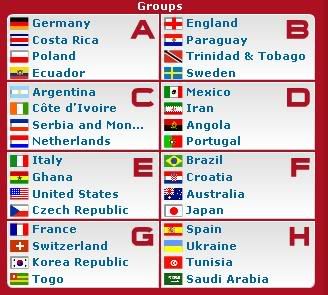
Tonight Germany play the sons of the Equator for the right to win Group A. Five hours later, England and Sweden do battle for the same prize in Group B. Ecuador are 5/1 to beat Germany but only need a point. Germany might be happy to take a point and then take their chances against a leaden-footed England in the next round. Crock Rooney early and they'll be done for.

Trinidad (ok, and Tobago too) could possibly still qualify from England's group but as well as they've done so far its hard to see how Beenhakker can turn them into Ajax overnight. Paraguay will win that game.

Group C mirrors Group A and 6 pointers Argentina and the Dutch have a tasty play off for the right to win that group of half death. Argentina are the team of the tournament so far (their 'periscope' Riquelme is the player of the finals so far) and only need to draw to finish first. Group D mirrors Group A with Portugal cast as England and Angola as T&T. Angola have a slim chance of qualifying if they win and Mexico lose.

Groups E and F have been the most intriguing. Italy & the Czechs started well but both lost the plot in the second game. Ghana's win has made it a real possibility that either European side could go out. The USA not quite dead yet but are unlikely to make it. Group F sees Brazil though but Australia has stirred the plot. Defeat to Croatia would put them out but any other result and they qualify UNLESS Brazil reserves lose 2-0 to Japan. Incroyable? Thankfully Kewell got away with his hairdryer routine on Markus Merk. FIFA obviously agreed that the over-officious Merk probably deserved it!

Group G and H should see the European sides sneak through. Admittedly Spain are in great form and in Villa and Torres (pictured) have the most potent attack. Nevertheless, the weight of history will prove too strong and I see them losing to a higher pedigree side in the quarter finals. Saudi Arabia are only slightly better than the abysmal effort of 2002. They are still an overpaid embarrassment to Asia. They will never improve until their best players are encouraged to play in Europe. Insh'allah indeed.

My guess for the round of 16 and beyond is

Germany v Sweden
Argentina v Mexico
England v Ecuador
Portugal v Netherlands
Italy v Australia
Switzerland v Ukraine
Brazil v Ghana
Spain v France

if quarters went according to favourites

Germany v Argentina
Italy v Switzerland
England v Netherlands
Brazil v Spain

after that...lap of the penalty gods!

Germany v Italy
Netherlands v Brazil

oh no...Its Germany v Brazil again in the final! Successive finals after avoiding each other for 70 years? Lets hope Argentina or Spain prove me wrong. Or Ghana. Or even Ecuador, brave men with lots of altitude.

Wednesday, June 14, 2006

They still call Kaiserslautern home

Its early doors. Barely four days in and this World Cup has already exploded into life. After many of the big guns such as Argentina, Netherlands, Mexico, Germany and even England have all started with wins. And yesterday's games were all of the highest quality. Two more big names, Italy and Czech Republic, set out their stall with excellent wins in a tough group. Both sides scored glorious goals and in Tomas Rosicky, the Czechs have a potential player of the tournament. And at 40/1 and with 2 goals already in the bank, he represents great value for the top scorer award, the “Golden Shoe” (surely they mean Golden Boot, given that a golden shoe is more like something Cinderella would wear?)

But it was the Australia-Japan game which took the plaudits for sheer drama. Woolly Days watched the game in the packed confines of the Pig & Whistle pub in Riverside in central Brisbane. The 3pm Kaiserslautern kickoff time meant an 11pm start in Brisbane. The pub started packing up after nine but with plenty of bars and a plethora of big screens to choose from, a good viewing spot wasn’t difficult. We must have been at the away end as there was a decent scattering of blue-clad Japanese around our TV. Many fans wore Australian shirts with a picture of the late Johnny Warren and his apparent mantra “I told you so.” SBS also have those four words as a backdrop to their Sydney set, and Woolly Days for one doesn’t like the arrogance and smarminess of the sentiments. Though it has to be said that Warren, a key player in the only previous Australian side to qualify for the World Cup in 1974, does have the right to be a little condescending to the doubters of Australian football.

Anyway, as 11pm approached the tensions increased in the pub. The SBS football pundits were talking up Australia’s chances. The magic of ‘Aussie Goos’ Hiddink was mentioned. Here was the man who ended 32 years of qualifying pain. But he has made a strange choice when the teams are announced. Tim Cahill is not in the starting eleven. Luke Wilkshire of English third tier team Bristol City is in instead. Let’s hope Guus knows what he’s doing. They cross to the stadium. Noisy and very colourful. Lots of Japanese in blue and Australians in green and gold.

Fill up with more beer just prior to kickoff. Jenny Craig have stated they are worried that men with turn to a high fat diet of beer, chips and pizza during the world cup. Health problems are a small price to pay for taking part in the carnival of nations. They’re off. Australia’s first world cup finals game in 32 years. They take a while to settle, Japan look quick and agile early. Japan wins a free kick on the edge of the Aussie box. Jesus, are they going one down in the first two minutes? Thankfully the wall does its job. After six minutes, Viduka has a double chance which forces two saves from keeper Kawaguchi. This is more like it.

The play is fast, very fast, given the 30 degree conditions. Viduka does a beautiful back heel jink to send the hero of Uruguay, Marco Bresciano, through on goal but Marco’s sidefoot shot isn’t strong enough to beat the keeper. A minute later, Japan scores. Unbelievable. A harmless cross floated in by Nakamura. It should be Schwarzer’s but the ball sails over his head as he falls out of the way and gently nestles in an empty net. What??? Replays show that Schwarzer was bundled out of the way by a Japanese player. Given that the Egyptian ref has already given two soft free kicks at corners when the goalkeeper is barely touched, it is impossible to believe he has left this one go. But he has. Japan 1, Australia 0. Hiddink is incensed. And one stage it looks as if he is having a heart attack on the sideline, as he is bent over double. But perhaps he is just giving the fourth official a free dramatic interpretation of the foul on Schwarzer. From the kickoff after the goal, Kewell - minus his two ponytails - bursts through forcefully and his vicious shot is barely a whisker away from being an immediate equaliser. Harry looks so much better with a hair cut.

Half time. Its 1-0. The Japanese in the pub are very happy and jumping around. The Aussies are going to the bar and grumbling about effing Egyptian refs. What do they know about football in Egypt? Bloody bunch of pyramid sellers. The goal doesn’t look any better on endless replay. Second half is underway. The breakneck pace has slowed down. Australia are struggling to refind their first half rhythm. Finally, Tim Cahill is brought on, Bresciano is off. Schwarzer almost blunders again, he rushes out of his area but heads the ball straight to a Japanese player. Luckily they also stuff it up. Six foot five forward and Jason Gillespie doppelganger Josh Kennedy comes on for defender Craig Moore. Poker-faced Hiddink has started to gamble. Kennedy is making himself awkward and causing trouble. Viduka blasts a great free kick but is splendidly saved. Last sub Aloisi is on for Wilkshire and is booked after just two minutes work.

84 minutes in and another free kick. This time Aloisi blasts it and the keeper makes another fine save. Its just not going to be Australia’s night. Ok, says a mate, so we lose this and then lose to Brazil, can we still qualify with only a win v Croatia? While we work out the maths, Kennedy is causing grief in the air again. The ball falls loose to Cahill and Timmy blasts home the equaliser. Yeeeaaas! The pub goes berserk. They’ve nicked a well deserved draw. Bloody Hell, Cahill then almost immediately undoes his good work by giving away a penalty when he hauls down a Jap-in-the-box. Luckily the ref point to the corner flag not the penalty spot. Just love those Egyptian referees! Then the aptly named Fukunishi prises open the Aussie defence and misses by inches. The heart just can’t stand up to this. Back come Australia. Here’s Cahill again…Cahill…Cahill….Yeeeeeeeaaaaaassss! he’s scored. 2-1. Two for Cahill. A stunning hit from the edge of the box in off both posts. Beer is flying everywhere. Australia are ahead with one minute to go!

Japan are all over the place. Aloisi has the ball, Viduka is ahead of him but offside. Who needs Viduka, Aloisi skips past the defender and slots it in the corner. 92 minutes and its 3-1. The game has been turned on its head. Beer has been spilled over my head. I don’t care. Grown men with mortgages and ulcers are jumping around and hugging complete strangers. Its all over. Australia 3, Japan 1. A scoreline impossible to imagine just 10 minutes ago.

The pub is awash with spilt beers, teary-eyed drunks and hoarse out-of-key singing. Bedlam had nothing on this place. Cheeky Australia have grabbed victory from the jowels of defeat to the Japanese. Changi is revenged. Australia are on the football map. Bring on Brazil!

Thursday, June 08, 2006

FIFA Frenzy

One day to go. The world expectantly awaits the start of the 18th football World Cup. Hosts Germany kick it off on Friday June 9 with a game in Munich v Costa Rica. Well, most of the world is expectantly awaiting. The US and Canada will be notable exceptions. But for everyone else from Santiago to Sydney and from Dublin to Durban, the biggest sporting event of the year takes place for the next month in Germany.

Football is run under the auspices of FIFA (Fédération Internationale de Football Association) and it has a larger membership than the UN – 205 in FIFA compared to 191 in the UN. Headquartered in Zürich, it a very powerful international organisation. The current president of FIFA is also Swiss, Sepp Blatter. Blatter is an extremely controversial figure in the game, not least due to his call for women's football to become sexier. Born in the small town of Visp in the south-west canton of Valais, Blatter graduated with a Bachelor's degree in Business Administration and Economics from the Faculty of Law at Lausanne University. Working for Longines SA, he was involved in the organisation of the 1972 and 1976 Olympics. He was then hired by FIFA as as Technical Director (1975-1981) and then as General Secretary (1981-1998). He rose to the pinnacle of football administration in 1998 after a bitter election victory over the European federation (UEFA) boss Lennart Johansson. In the internecine struggles of high sports politics, Blatter is seen to owe his power to the Asia and African bloc of countries. He was instrumental in getting South Africa to host the finals in 2010.

FIFA was founded in Paris in 1904. The laws of football had been codified in the 1860s in public school England. Melvyn Bragg chose the Football Book of Laws, written in 1863, as one of his “12 Books That Changed The World.” As a result of the laws, the game saw a explosion of popularity in England, especially in working class areas. It had two advantages over its competitor, rugby: it could be played anywhere and it could be played by anybody, of any build. Factory teams sprang up across Britain as did pub, police and church teams. These games started to attract spectators. And with it the paraphenalia of spectator sports; tickets, turnstiles and telegraphic terminals for recording results. In 1872 England and Scotland played the first international game which ended 0-0. A scoreless outcome was set as a valid result. The same year, the knock-out Football Association (FA) Cup was first contested. Also in that year, English sailors in Le Havre introduced the game to France. The game quickly spread through that country. English travellers, migrants, embassy officials and colonial authorities took the game around the world where it quickly took root. An English professor at Montevideo University formed the first club in Uruguay in 1882 and British railway workers soon formed a second. The number of inter-nation matches increased as football spread and the need emerged for a global governing body. It was thought that this body should be based in Britain to reflect the origins of the game. But the inward looking football associations of the FA and the other three home nations (Scotland, Ireland and Wales) unanimously rejected such a body. Continental Europe decided to go ahead without Britain and FIFA was born in Paris in May 1904. It had an initial membership of seven countries; France, Belgium, Denmark, Netherlands, Spain, Sweden, and Switzerland. Germany joined up the same year.

Early attempts to form a tournament failed with no interest from Britain in the idea. Despite this, England joined FIFA as early as 1905. The FA organised the Olympic football tournaments in 1908 and 1912. By this time FIFA had gone inter-continental with South Africa, Argentine, Chile and the US joining up. FIFA was moribund during World War I and reconvened in 1919. Britain was not interested in renewing football ties with old enemies and boycotted FIFA until after the World War II. Frenchman Jules Rimet was elected chairman in 1921. He gave the movement new vigour. He was president for 33 years and the organisation expanded to 85 member countries under his watch. FIFA took over the Olympic Games football and ran the events in 1924 and 1928. 60,000 people watched the Uruguay beat Switzerland in the 1924 Olympic final in Paris. Buoyed by this success, Rimet wanted to stage a World Championship event. In 1929, the FIFA congress in Barcelona awarded the inaugural event of 1930 to Uruguay which would be celebrating its 100th anniversary of independence that year.

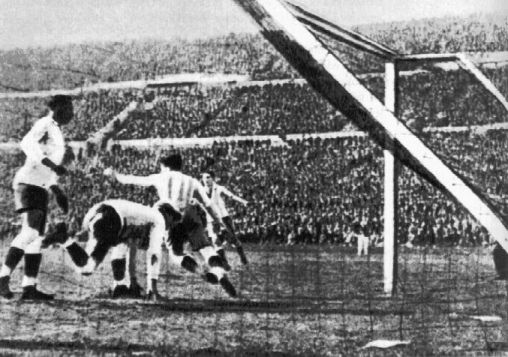
Unfortunately the 1929 stock market crash had international repercussions and Europe was in the middle of an economic crisis. All but four European countries pulled out as a result. The hosts Uruguay beat neighbours Argentina 4-2 in the first final. Mussolini’s Italy won the rights to host the next tournament in 1934. This was the first tournament to be broadcast by radio. Holders Uruguay returned the snub of 1930 and refused to participate. Italy, with the likely interference of Mussolini with the choice of referees, won on home soil. South America was outraged when the 1938 tournament was again awarded to Europe, this time France. Uruguay and Argentina boycotted again. Italy retained the title they won in 1934.

The tournament resumed after the war with the British nations finally taking part in 1950. It was held in Brazil and the trophy renamed the Jules Rimet Cup in honour of the 25th anniversary of his presidency of FIFA. India had qualified for the first (and only) time ever but withdrew because they were not allowed to play barefoot. England’s long awaited debut was inauspicious, they crashed out in the first round after an ignominious defeat to the part-time USA team 1-0. Uruguay went on to win their second championship beating the hosts in the de facto final 2-1. The attendance for the game is still a world record: 199,854 people in one sporting venue.

1954 was FIFA’s 50th anniversary and they celebrated it by playing the World Cup in its host country, Switzerland. The Marvellous Magyars, Hungary, were unbeaten in four years leading to the final but were shocked 3-2 in the final by West Germany in what became the ‘Miracle of Bern’. The victory gave pride back to a defeated nation and kick-started the German economic recovery of the fifties and sixties. Brazil began its domination of the modern game with victories in the 1958, 1962 and 1970 spearheaded by a young genius called Edson Arantes do Nascimento better known as Pelé. England interrupted the sequence and won their only trophy on home soil in 1966. Germany and Argentina did likewise in 1974 and 1978 respectively. Both sides beat the brilliant Dutch in the final. The Netherlands’ best player in 1974, Johan Cruyff refused to play in Argentina due to the military coup that took place there two years before the tournament. It is likely his attitude cost them the tournament.

The tournament became increasingly globalised and wealthy from the eighties onwards. Television audiences went into the billions. Players and teams were more technically proficient and it became harder for individual brilliance to dominate. 1986 was the last tournament which belonged to one player when Diego Maradona almost single-handedly brought victory to his beloved Argentina. Even Brazil, the samba kings, have succumbed to the trend and won in 1994 and 2002 with much more workmanlike teams than previously. Stars such Ronaldinho, Ronaldo, Kaka and Adriano will hoping to lead a more buccaneering Brazil to the title this time round. But Woolly Days is confident that history will ensure that a European team triumphs in their own continent again, possibly hosts Germany in a repeat of their famous final against the Netherlands of 1974.

But whoever wins it, I'll be enjoying it alongside five billion others. For football fans everywhere, this is as good as it gets. And for humanity, this is as inclusive as it gets.