Showing posts with label Norway. Show all posts

Tuesday, July 26, 2011

Norway forced to deal with gruesome genies

I’ve just watched the Breivik Video Manifesto, an odious, misogynist and ridiculous grab-bag of far right anti-Muslim ideas with a childish appeal to crusader and templar nonsense. I won’t be linking to it, go search it out yourself if you want to see it. No doubt my viewing it along with countless others is exactly what the mass murderer wanted to happen. American journalist Kevin Slaughter found more ravings in the aftermath of Anders Behring Breivik's slaughter in which a quiet, dangerous lunacy shines through. The hint of menace is there throughout, though the capacity to carry such ideas to their illogical conclusion still defies reason.

Breivik’s actions puts him in a different category to Martin Bryant, Michael Ryan, Thomas Hamilton, Cho Seung-Hui or countless other madmen who destroyed multiple lives randomly in mundane settings. Breivik’s aim was to wipe out an entire political class, both the current generation at the Oslo offices of the Prime Minister and the next generation at the youth camp in Utoya, leaving almost 100 dead people in his grisly wake. The first hand account of Prableen Kaur on Utoya is more chilling than anything Hollywood could dream up by way of terror. Nor was it the end of the matter. Unlike most of the other mass murderers, Breivik did not do the decent thing and turn the gun on himself. Instead he gave himself up and spoke freely of his actions in the start of the second act of his deadly charade.

Breivik’s careful planning of his actions took into account the aftermath. In setting up his recent Twitter and Facebook accounts, he knew the media would trawl all over his digital footprint in the wake of the atrocity. He was relying on mass media to get his message out beyond the lunatic fringe. This was why it was so important the judge closed the court when Breivik appeared this week. He desperately wanted an open court and be seen wearing a uniform. Some painted it as a press freedom issue, but the question needs to be asked “press freedom to do what?”

Judge Kim Heger agreed with police there was nothing to gain from giving him a soapbox. Heger did the right thing by kicking the media out and placing Breivik in solitary confinement for four weeks. Despite the need for transparency in the law, the media could simply not be trusted in the matter. On Saturday, many established journals were led astray by the feverish demands of the media machine, and blamed Islamic extremism for the events without a shred of evidence. Nature and the media abhor a vacuum and the information gap was filled with “fact free conjecture” as Charlie Brooker put it.

Afterwards there was the inevitable mad scramble to find out as much as possible about the life and motivations of the killer. Most picked up the crumbs of evidence he deliberately left behind. Others rushed into the arrant nonsense that the shootings somehow “destroyed Norway’s innocence.” Nor was Norway “suddenly exposed to the banality of evil.” This clichéd rot says nothing other than express a maudlin faux-sympathy for those who suffered a terrible loss. Many people have lost relatives or friends but that is no reason to infantilise the tragedy. Norway is a complex first world country not an eight-year-old child.

Immigration is on the rise in Norway as it is across Europe. Many are uneasy with the changing demographic though few would be prepared to be violent about it. Islam is the country’s second largest religion and there has been a corresponding rise in support for the anti-immigration Progress Party, now the second-largest party in Parliament. Lilit Gevorgyan, Europe analyst at the IHS Global Insight think-tank, sees the killings as a chance to be a catalyst for an honest discussion of the issue in the political centre. "If the twin attacks fail to trigger an honest discussion of the issue, exposing often scare-mongering arguments used by the extreme right, this may marginalise the radical groups and worsen the situation, which in turn could bring more similar attacks in the future," Gevorgyan said. "This is not just an issue in Norway. Across Scandinavia and also in Western and Eastern Europe, you have a lot of people who are very frustrated by the lack of open debate.” Maybe this is giving in to Breivik, but he has released the genie and it will be impossible to put it back in the bottle.

Wednesday, April 30, 2008

Svalbard stories

The Norwegian Arctic archipelago of Svalbard is likely to be the only place in the world where road signs exist warning of the dangers of polar bears. The island is home to 3,000 bears and just 2,300 people who between them share a space twice the size of Belgium. That means it’s usually big enough for them to stay apart. People tend to live on the milder west coast warmed by the Gulf Stream while the bears roam the colder east coast. But meeting between the species are a common enough hazard. There are two “beware of the bear” signs in Norwegian posted on roads that lead from the main settlement of Longyearbyen. The signs are there to remind people to carry a rifle when heading out bush. Meanwhile bears are drawn into populated areas drawn by the smell of seal meat used to feed dogs. Longyearbyen’s kindergarten is protected by a high-wire fence, just in case there’s a bear in there.

But while bears have accounted for just four humans on Svalbard since 1970, the ledger has not been so positive on the other side. Between 1998 and 2005 alone, 24 overly curious or hungry bears were killed. And the very existence of polar bears in the archipelago is being seriously threatened by climate change. The ice is receding on Svalbard at a rapid rate. In the wake of the opening of the North West Passage last Summer, the US National Snow and Ice Data Centre (NSIDC) is predicting that this year could see a completely ice free North Pole. And what ice there is dangerously thin, young ice that has only been around since last autumn.

Svalbard’s islands are among the closest land masses to the North Pole and they are bearing the brunt of climate change. A 2007 study found the spectacular glaciers on the three main islands of Spitsbergen, Nordaustlandet, and Edgeøya are melting faster than researchers believed. As well, the rate of melting has accelerated over the last five years with the glaciers now losing over 16 cubic kms of ice each year. Meanwhile Longyearbyen receives record summer temperatures and snowfall has declined. Some peninsulas have become islands as the ice retreats. As a consequence Svalbard has become a significant contributor to the world’s rising sea levels.

One thing that climate change in Longyearbyen won’t affect is the Svalbard Global Seed Vault. This is the recently created frozen "doomsday" vault buried inside mountain. The vault will become the world’s seed bank where millions of seeds will be stored to safeguard against wars or natural disasters wiping out food crops around the globe. European Commission President Jose Manuel Barroso called it “a frozen Garden of Eden” (though he may have been getting his Genesis references mixed up with Noah’s Ark). It will contain 4.5 million crop seeds from all over the world housed in silvery foil containers artificially chilled to 0.4.degrees below zero which should keep them fresh for a thousand years.

What future Svalbard itself will have in a thousand years remains debatable. It will require international co-operation to keep its current pristine state. Under a 1920 treaty, Svalbard is an international zone under Norwegian sovereignty that requires no tourist or resident visas. The treaty allows Russia and a number of other countries to establish settlements and impose local laws. For instance the town of Barentsburg is a Russian town with 500 mostly Russian citizens and a Russian owned coalmine. The Norwegian government is nervous about uncontrolled development on the archipelago and has clashed with Russia over fishing rights. However it has also admitted it cannot stop other countries from continuing to develop industries on the islands.

This is likely to be grim news for the island’s polar bears. The bears have been a protected species (apart from self defence) since 1972 which as caused bear numbers to triple. However scientists now say PCB (polychlorinated biphenyls) levels in the polar bears of Norway and western Russia are two-and-a-half to seventeen times higher than those in North American populations. PCBs are damaging their immune and endocrine systems and making over one per cent of them hermaphrodite. The news is also not good for those who survive PCB with their sex organs undamaged.
According to a report issued in November 2004 by the Arctic Council and the International Arctic Science Committee, polar bears could become extinct by the end of the 21st century if present warming trends continue in the Arctic. The Longyearbyen signs may need to be changed to read “beware of the lack of bears”.

Friday, September 01, 2006

Norwegian Police recover "The Scream"

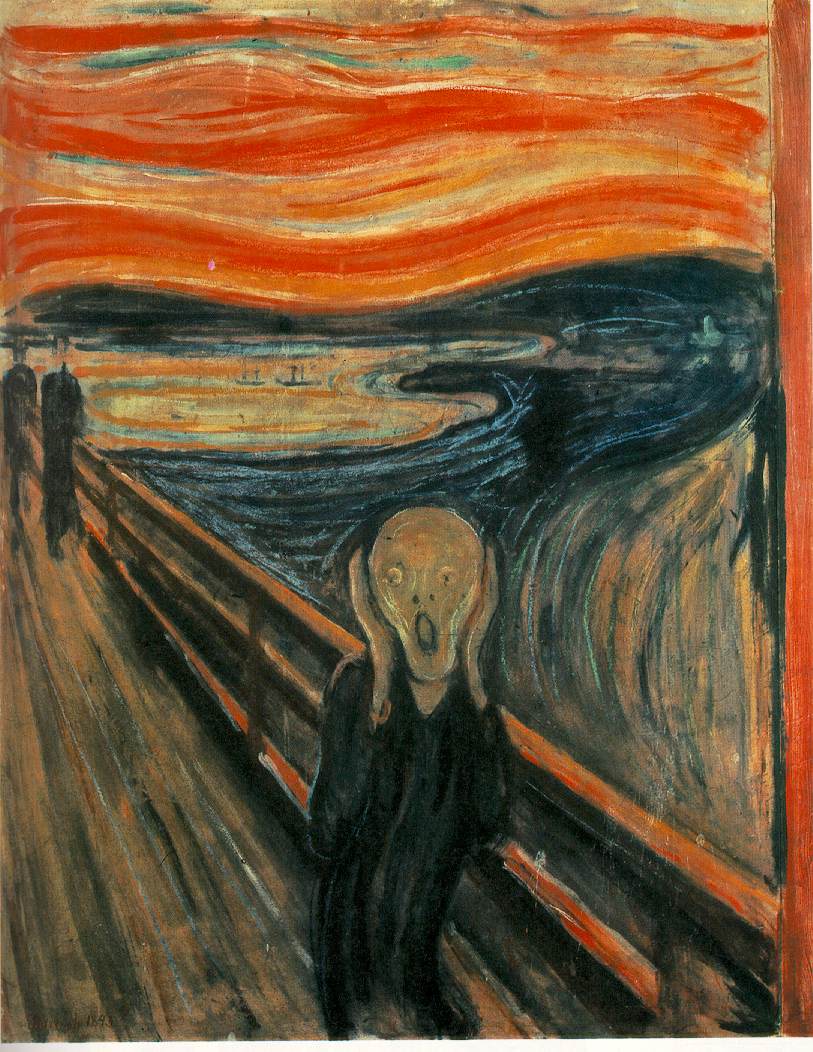
Yesterday, Oslo Police announced they have recovered “The Scream” and another stolen masterpiece by Edvard Munch. It happens two years and nine days after gunmen seized the paintings from a museum in the Norwegian capital. The two paintings date from 1893. The Scream, Munch's most famous work, is an icon of existential angst showing a terrified figure against a blood-red sky. The other picture Madonna shows a bare-breasted woman with long black hair. Police say they recovered the paintings yesterday but did not release any details about the recovery operation. Experts at the Munch Museum have examined the pictures and judged them authentic.

Two masked gunmen walked into the Munch Museum in Oslo in broad daylight in August 2004 and yanked the two works from the walls in front of dozens of terrified tourists. They escaped in a car driven by another man. Three men were convicted in May this year of taking part in the theft and were sentenced to up to eight years in jail. The City of Oslo foundation that owns the Munch Museum collection said they hoped the paintings could be put back on display soon.

Munch lived from 1863 to 1944 and was a pioneer of modern expressionism. He is Norway’s most popular artist. The painting “The Scream” was originally called “Despair” and was painted as part of a series titled “The Frieze of Life”. In this series, Munch explored themes of life, love, fear, death and melancholy. These themes recur throughout Munch's work, in paintings such as The Sick Child (1886, portrait of his deceased sister Sophie), Vampire (1893–94), Ashes (1894), and The Bridge. He was born in the village of Ådalsbruk in the eastern coastal province of Hedmark. Munch's convulsed and tortuous art was formed by the misery and conflicts of his time, and, even more important, by his own unhappy life. His mother died of TB when Edvard was just 5 years old and he was raised by his father Christian. Two other siblings, a brother and sister also died young while another sister was mentally ill. Christian Munch instilled a very Protestant deep-rooted fear of hell in his children. He constantly told them that if they sinned, they would be doomed to hell without chance of pardon.

In 1879, Munch went to college to study engineering, but frequent illnesses interrupted his studies. A year later he left to become a painter and enrolled at the Royal School of Art and Design of Kristiania (the old name for Oslo). He went to Paris in 1885 where his work first began to show the influence of the French impressionist and post-impressionist painters. Munch became an overnight celebrity in Germany when the inclusion of his works caused the 1892 Verein Berliner Künstler exhibition to be shut down after a week. His man-destroying Vampire was deemed "objectionable." The infamy secured his reputation and he remained in Germany for many years where he was a major influence on German art. In Berlin he associated with fellow Scandinavian Henrik Ibsen and August Strindberg. Between 1892 and 1908, Munch divided his time between Paris and Berlin, where he became known for his etchings, lithographs, and woodcuts.

In the autumn of 1908, his anxiety became acute and he became a patient of Dr. Daniel Jacobsen. Jacobsen’s therapy had a profound effect on Munch’s personality, and he showed more interest in nature subjects when he returned to Norway. His work became more colourful and less pessimistic. In the 1930s and 1940s, the Nazis labelled his work "degenerate art", and removed his work from German museums. This deeply hurt Munch, who thought of Germany as his second homeland. Edvard Munch died near Oslo, on January 23, 1944, about a month after his 80th birthday. He left 1,000 paintings, 15,400 prints, 4,500 drawings and watercolours, and six sculptures to the city of Oslo, which built the Munch Museum at Tøyen in his honour.

In 1893, he produced his seminal expressionist masterwork “Skrik”. The Norwegian word skrik is usually translated as "scream", but is related to the English shriek or screaming-cry. There are several versions of the painting two of which have been stolen. In a diary note Munch described his inspiration for the image "I was walking along a path with two friends – the sun was setting – suddenly the sky turned blood red – I paused, feeling exhausted, and leaned on the fence – there was blood and tongues of fire above the blue-black fjord and the city – my friends walked on, and I stood there trembling with anxiety – and I sensed an infinite scream passing through nature". The scene has been identified as being the view from a road overlooking Oslo from the hill of Ekeberg. Astronomers believe that the intense red sunset is caused by the volcanic eruption of Krakatoa in 1883. In 1994 the National Gallery version was stolen on the opening day of the Winter Olympics in nearby Lillehammer. The painting was recovered after a sting operation involving Norwegian and British Police. The story is told brilliant in Matthew Hart’s lively account of international art thefts “The Irish Game”.

The Munch Museum's Scream was stolen at gunpoint in August 2004. The photograph shows a man escaping from the museum with the canvas. Although three men were convicted of the crime in May this year, none of the suspects could be persuaded to reveal the paintings' whereabouts due to fear of retaliation. The recovered painting will be re-displayed in the Munch Museum which has completed a $6 million security overhaul.