Showing posts with label Kazakhstan. Show all posts

Sunday, August 26, 2007

Nazarbayev moves closer towards dictatorship in Kazakhstan

After parliamentary elections last weekend, Kazakhstan has become a one-party state. President Nursultan Nazarbayev’s governing Nur Otan (“Ray of Light-Fatherland”) party has won all 98 seats parliament’s lower house with 88 percent of the vote. None of the other parties reached the parliamentary threshold of 7 percent. Nazarbayev called the snap election two years early to allow him to implement constitutional changes to give him unlimited terms of office.

Kazakhstan's two main opposition parties Ak Zhol (Bright Path) who took 3.27 percent and Nationwide Social-Democratic Party who polled 4.62 percent have announced they do not recognise preliminary returns of last Saturday's elections. Ualikhan Kaisarov, the Nationwide Social-Democratic Party's representative in the Central Elections Commission described the elections as "utter profanation". Ak Zhol were equally unimpressed. "They absolutely do not reflect the actual alignment of political forces or the social support they draw,” said Burikhan Nurmukhamedov, a party leader in the Kazakh capital Astana. “These elections are neither a step forward, nor even remaining at standstill.”

The result confirms the power base of 67 year old President Nursultan Nazarbayev who has ruled the country for 16 years since independence. Nazarbayev claims credit for an annual economic growth of almost 10 percent since 2001 and is credited with ensuring the country’s stability. However his critics say he has concentrated power in his family, suppressed the opposition and has failed to deliver free and fair elections.

Kazakhstan was one of the five central Asian nations along with Kyrgyzstan, Tajikistan, Turkmenistan and Uzbekistan that gained independence in 1991 after the break-up of the Soviet Union. All five countries had central planned economies and had no experience of nationhood before being incorporated into the Russian Empire in the 18th and 19th century. The Kazakh economy was based on primary products and the country suffered severe disruption in the immediate aftermath of independence. Efforts to keep the ruble as a common currency with the other four nations caused hyper-inflation. It was abandoned at the end of 1993 and replaced by the tenge (the Kazakh word for ‘set of scales’). Kazakhstan initially appeared to take a liberal western path but the president became more autocratic as the decade progressed and the economy took on the look of “crony capitalism” based on favours and influence. Privatisation transferred valuable public assets to a small group and health care declined.
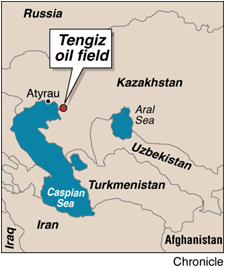
Matters have improved greatly since the turn of the century. Much of this improvement is due to the profits generated by the massive Tengiz oilfield. Formed in 1993, Tengiz is operated by TengizChevroil a joint venture between the Kazakh government oil company and Chevron. The Tengiz field is one of the largest in the world, with 6 to 9 billion barrels of reserves. The field produces 180,000 barrels a day, most of which is exported through the Russian pipeline system to Novorossiysk. Exports from Tengiz are expected to increase to 1.3 million barrels per day by 2010.

Nazarbayev is now aiming to make Kazakhstan one of the world's top 10 oil exporters in the next seven years and wants to lift his country's international profile. He is pushing for Kazakhstan to chair the Organisation for Security and Co-operation in Europe in 2009. His call has met with opposition from Paris-based Reporters Without Borders (RSF). The RSF has condemned Kazakh media's coverage of the elections as biased and heavily influenced by the authorities." The Paris-based group said there were many cases of "pressure, self-censorship, violations of electoral legislation, and bias" in favour of Nur Otan. The RSF said a country where "press freedom stops whenever the authority of the president and his party is challenged is not fit to head an organization such as the OSCE."

Monday, April 09, 2007

Aral Sea gets life support

The long lingering death of the Aral Sea is humanity’s biggest crime against the planet. The Aral was once the 4th largest in-land body of water in the world, and teeming with life. The Aral Sea is now the 10th largest sea, a fourth of its former size and mostly dead. Once a lake of the Soviet Union, it is now international waters bordered by Kazakhstan on the north and Karakalpakstan (Uzbekistan) in the south. Between them both, the Aral Sea is dying.

But this week Kazakhstan announced it had secured a multi-million dollar loan from the World Bank to help save some of the Sea. The project will not restore the Aral Sea to her former glory, but may preserve the northern part of the sea. The funds will add a second dam to the first created in 1998. The dams between the two halves will be a benefit to the Northern part of the Sea but will accelerate the death of the south.

The tragedy of the Aral dates back to a decision made in 1918 and reached its recriminations by the 1970s. The Aral Sea is a desert region, and is fed by two great rivers that rise in the mountains of Tajikstan. These rivers are the Amu Darya and the Syr Darya. In 1918 the young Soviet government, fighting for its life against the Whites, believed it would be a good idea to use these rivers to irrigate the desert region and feed the people of the revolution. Both the revolution and the irrigation project were eventually successful. Kazakhstan is today one of the world’s leading exporters of cotton.

The Soviet Union diverted the waters of the Amu Darya and the Syr Darya to irrigate cotton fields in Uzbekistan and Kazakhstan. Not surprisingly, the sea quickly began to shrink. By the 1960s, the Soviet Union knew there was a problem. In 1968 a Soviet engineer said "it is obvious to everyone that the evaporation of the Aral Sea is inevitable". But there was no turning back. According to the Soviets, the Aral was "nature's error". Instead they redoubled their efforts to empty its water. By 1980, they had dug enough canals to stretch three times to the moon. Almost the entire flow of the two rivers was diverted to grow cotton in the desert.

In 1990, the shrinking Sea split into two. The falling waters cut the North, or "Small" Aral Sea off from the bigger southern part. In 2001 the island Vozrozdeniya lost its long status as an off-shore entity and re-joined the mainland. The former island was a secret biological research station. It is a toxic time bomb set to infect central Asia with some of the deadliest germs on Earth. By cruel irony, space photos showed the southern sea now resembled two collapsing lungs. Two years on, the Northern Sea was again chopped in two.

While the shape of the sea was mutating, what water remained became increasingly salty. All the sea’s freshwater fish died. And the fishing ports were now 40km inland. The fishermen moved on. Those that remained were poisoned by exposed seabeds, full of the run-off of salt and pesticides. Over the past 15 years chronic bronchitis has increased by 3,000 per cent in the area, arthritic diseases by 6,000 per cent.

When the Communists collapsed in 1991, Kazakhstan won its independence. The new government inherited 2.7 square kilometres of what was to become the ninth largest country in the world. They also inherited half of the Aral Sea. Today, the people of the northern Aral Sea region rely on raising animals in barely survivable conditions while those in the Uzbek south, blessed with more annual rainfall, are able to grow limited albeit salty crops near the Syr-Darja river.

The newly independent nation decided to try to rescue what was left of the Sea. They used a $65 million World Bank loan to build a dam across Berg Strait, the North’s narrow connection with the southern sea. The dam has helped the north. The waters are flowing back towards Aralsk, the main port in the north, having previously retreated as far as 80km. Fishermen are going to sea again, and the government has announced they will release 30 million young fish into its waters to restock the North Aral. With the money from the latest loan yesterday, Kazakhstan will build a second dam which they hope will bring the water back to the deserted port of Heralsk. Kolbai Danabayev, vice-mayor of Aralsk says "There are seven wonders in the world and the eighth is the dam on the Aral Sea”. His optimism is understandable, though Karakalpakstanis may not agree.