Showing posts with label GoMA. Show all posts

Sunday, August 01, 2010

Where there's Mueck

Brisbanites flocked to the GOMA this weekend to catch the last two days of the much talked about Ron Mueck exhibition which has been touring Australia. I went along on Saturday morning to check out the hype. There was a long queue outside the venue but it moved quickly in the pleasant sunshine and I was inside admiring Mueck’s work within a half hour of arrival. It didn’t take long to see what the fuss was about. There were only a dozen or so of his works on display but each was intensely enthralling and engaging.

Ron Mueck is a Melbourne-born hyperrealist who seeks extreme verisimilitude with his work. His extraordinary detailed high resolution works had the audience constantly snapping on their cameras and phones. His early career was as a model maker and puppeteer for children's television and films. He then established his own company in London, making photo-realistic props and animatronics for the advertising industry.

Mueck is married to scriptwriter Caroline Willing, the daughter of artist Paula Rego. Rego watched Mueck created a giant sand sculpture of a dragon for his two young daughters on the beach. When she was working on drawings for a show at London's Hayward Gallery, she asked him to draw a Pinocchio. Mueck created a metre-tall, ultra-realist Pinocchio, wearing only undies and an embarrassed expression.

Rego put Mueck in the path of a professional artistic career. Mueck gets incredibly convincing detail through the meticulous use of polyester resins and multiple moulds. His works demand to be seen close-up so people can inspect the hairs, freckles and blemishes and scrutinise the peculiar expressions his subjects have. Whether the look represents fear, shock or yearning they are always drawn with sympathy and extraordinary care.

No more so than the first work in the GOMA exhibition Dead Dad (1996–97), commemorating the death of Mueck's father through a smaller than life-size sculpture. Though diminutive, the touching naked portrait of his own dead dad made of silicone, acrylic paint and his own human hair manages to cast a spell on the crowd it kept for the entire exhibition. It was Dead Dad that first brought Mueck to world attention at the 1997-1998 Sensation exhibition of Young British Artists in London, Berlin and New York (but notably rejected by prudish Australia) which featured the work of Damien Hirst and Tracey Emin among others.

The second GOMA work goes the opposite route to Dead Dad in terms of sex, size and age. This is the five metre long 2006 sculpture “A Girl” of a just-born infant complete with smears of blood and a dangling umbilical cord. If Dead Dad forces us to contemplate the mystery of death it is this intensely over-alive newborn daughter that screams (or is about to) with the possibilities of life.

Wild Man (2005) is also naked, but unlike Dead Dad is very much alive. Wild Man is three metres high and is complete with long hair and unkempt beard. He sits nervously clutching his stool with his feet raised in a slightly fearful expression. His eyes stare off to some unknown danger to the right. Has he been caught out or was he threatened? A similar puzzle confronts us with the two old ladies ("Two Women" 2005) who Mueck portrays gossiping to each other. One looks away from the other towards the audience as if slyly aware of their eavesdropping.

This sense of invading personal space is also keen felt with the giant woman “In Bed” (2005) covered by an enormous white doona with her knees raised under the blanket (picture from Wikipedia above). Her right hand is raised to her face is quiet contemplation perhaps of a missing partner. By contrast the Still Life (2009) of a slaughtered and plucked giant chicken lacks the nuance and therefore interest of his human pieces.

I quickly drifted to Drift (2009) another puzzling human piece though not as intriguing as his earlier works. A man in his thirties or forties lies on a sunbed or inflatable raft his eyes covered by dark sunglasses. He wears board shorts and expensive jewellery but is emotionless and probably asleep. With the raft hanging from the wall, his outstretched hands create the impression of a crucifixion, but it is hard to care why he is drifting. A better recent work is Youth (2009), a black teenager who lifts his bloodied white t-shirt to examine with horror what looks like a deep knife wound to the stomach. The piece is only 65cms high but Mueck takes us into another of his dark, dangerous worlds as we attempt to craft on the backstory.

This perhaps is why Ron Mueck is so successful. Despite his often grand canvasses and hyperrealism, he leaves ample room for the viewers to impose their own imagination on the works. Here is a great original talent who deservedly gains popular acclaim to go with the critical stuff.

Sunday, January 31, 2010

APT6 at Brisbane GOMA

I took in the APT6 at the Gallery of Modern Art on a whistlestop visit to Brisbane this weekend. APT6 is shorthand for the sixth Asia Pacific Triennial of Contemporary Art and having been greatly impressed by the last three triennial incarnations (in my ten years or so living in Brisbane), I was looking forward to seeing the latest version. I was not alone in my excitement. The exhibition has attracted 200,000 visitors in the opening six weeks since it began on 5 December.

This level of patronage is not unprecedented. 1.3 million have visited the six exhibitions but numbers really took off with APT5 in 2006 when it moved into the gleaming new GOMA building on Kurilpa Point. First established in 1993, the APT is the Queensland Art Gallery’s flagship international contemporary art event. It is the only major series of exhibitions in the world to focus exclusively on the contemporary art of Asia, the Pacific and Australia.

The 2009 exhibition shows the work of over 100 artists from 25 countries, including a number of artists and artist collaborations never seen in Australia including works by artists from Tibet, North Korea, Turkey, Iran, Cambodia and Burma. According to Queensland Art Gallery director Tony Ellwood, APT6 looks at a number of thematic links, including “the dynamism of collaboration, the power of popular culture to articulate perspectives on contemporary life, the impact of rapid social change on local communities and cultures, and the practice of drawing”. The exhibition continues until 5 April 2010.

Here are some of my favourites from this year's collection.


I was expecting the North Korean art to be showy in a Stalinist way and while they do promote Dear Leader's Juche they are surprisingly touching and endearing. The work from the Mansudae art studio display a heart and affection for their subjects I simply wasn't expecting.

Chen Qiulin's enormous installation is a poignant reminder of what rural life along the Yangtze River was like before Three Gorges Dam hydro-electric project flooded the entire region. If the house is the ghost of Three Gorges past, his video Garden 2007 is a equally fascinating walk through the towns that now exist in the area.

The Funky Buddhas is a work by London-based Tibetan artist Gonkar Gyatso. This work is supposedly for the kids as you get the chance to place colourful stickers all over the buddhas. But although there were no stickers available to put on the Buddhas when I was there, I still enjoyed the humour of the piece and its fantastic location looking out to the new Kurilpa footbridge.

Ah yes, the elk. Impossible to walk past and deservedly gets a room all to itself. The 2.5m taxidermied elk, or to be precise Pixcell Elk#2 is by Japanese sculptor Kohei Nawa. It is covered in glass, acrylic and crystal baubles of varying sizes which magnify and distort the object’s form in different parts to various degrees.

Called "People Holding Flowers" this installation by Zhu Weibing and Ji Wenyu is the signature piece for APT6. The work is made of synthetic polymer paint on resin; velour, steel wire, dacron, lodestone and cotton. There are 400 figures all holding flowers in a deliberate memory of Mao's short-lived 1950s mantra of "let a hundred flowers bloom". An overwhelming response to the Hundred Flowers Campaign led to serious crackdowns on dissent. Arguably nothing much has changed in 50 years in China.

I loved Rudi Mantofani's collection of unplayable guitars. Mantofani is an Indonesian sculptor and painter whose work transforms ordinary objects into strange or absurd "visual parables". Mantofani's guitar sculptures were inspired by a benefit concert he saw in New York. He said, the gap between American philanthropic rhetoric and the harsh effects of its foreign policies in the Muslim world led him to "create a series of distorted guitars, as a means to express such ethical contradictions." I'm not sure I saw those contradictions in the works but I couldn't help loving the guitars.

Friday, August 22, 2008

Picasso and his collection at Brisbane’s GOMA

Police in Sao Paulo have recovered a Picasso painting stolen two months ago by armed robbers. The 1933 painting "Minotaur, Drinker and Women" was found wrapped in paper in a woods by the side of a highway near Brazil’s largest city. Police say it was abandoned there by thieves who stole another Picasso and two other paintings from the city’s Pinacoteca Museum. All four paintings, with an estimated value of $630,000, have now been recovered.

Nothing quite so dramatic in Brisbane’s art show dedicated to Picasso, but an enjoyable exhibition here nonetheless, at the city’s stunning Gallery of Modern Art (GoMA). “Picasso and his Collection” is an exhibition of his personal art collection showing at the Gallery of Modern Art (GoMA) from 9 June to 14 September. GoMA is the first venue outside Europe to host the collection. The exhibition features 80 of the artist's own works interspersed with over 100 works from other artists in his extraordinary private collection.

Pablo Picasso is probably one of the greatest painters of the 20th century and certainly one of the most inventive. From the time he moved to Paris in 1900, aged 19 to his death 73 long years later, he explored every imaginable style from realistic to abstract. He worked in many mediums including paintings, drawings, sculptures in stone, bronze, wood, and printmaking. He invented the collage technique, co-founded Cubism and was one of the pioneers of Surrealism.

He was born 1881 in Malaga with the improbable name of Pablo Diego José Francisco de Paula Juan Nepomuceno María de los Remedios Cipriano de la Santísima Trinidad Martyr Patricio Clito Ruíz y Picasso. Ruiz was his father’s name; Picasso his mother’s. The other names honoured various family members and saints in traditional Spanish fashion. His father José Ruiz y Blasco was a well known painter in his own right and an art teacher who instilled a love of classic art in his son. After studying art in Barcelona, the young Pablo went to Paris, where he was befriended by the poet Max Jacob. The pair shared a tiny apartment, Jacob slept in the single bed by night and Picasso slept by day.

Gradually, Paris transformed Picasso and his painting. Through Jacob he got to know most the great cultural figures of the city and through exhibitions at the salon des independents he got to know most of its art. Picasso would prove to be a great collector of art too and he inherited his father’s love of the old masters, in particular the 19th century realist paintings of Louis Le Nain, Jean-Baptiste Chardin and Jean-Baptiste Camille Corot.

Picasso loved their primitiveness and called their works “pure painting”. He painted “Returning from the Christening (after Le Nain)” in pointillist style in Le Nain’s honour. He acquired Gustave Courbet’s “Head of a Chamois” which turned its subject matter into a minotaur and then recreated the moment in his own visceral 1952 painting “Goats Skull, bottle and candle”. Picasso was also deeply affected by the realist paintings of Henri Rousseau which in turn inspired many in Picasso’s own set. Juan Miro said “it was at Picasso’s place I first saw a Rousseau”.

As well as the realist masters, Picasso loved the works of Gauguin, Degas, Cezanne and Renoir. He saw all their works as they were displayed in Paris. Once again, it was the primitivism of Gauguin that captured Picasso’s imagination. He was also deeply influenced by Gauguin's Tahitian diary Noa Noa. Picasso was no great fan of the impressionists but when Gauguin, Degas and others disassociated themselves from the movement, they were seen as providing the origins of the modernist movement.

This movement was all around Picasso. His poet friend Guillaume Apollinaire decried impressionism and said it was time “for an art that is nobler, bettered ordered and more cultivated”. Picasso himself also admired Cezanne and Renoir as “dissidents of impressionism” and he called himself “the grandson of Cezanne”. Meanwhile Renoir’s fleshy nudes were art in a classical vein free of any dry formalism. These paintings inspired Picasso’s 1920s “large bathers” series.

Picasso first collaborated with George Braque in 1907. Picasso had by then become intrigued by African and Polynesian art forms and was starting to build up his own collection of masks, drums and totems. As well, Cezanne’s later work began to break up the painted surface into small multifaceted areas of paint. Together, Picasso and Braque began to paint objects in broken-up and abstract forms flattened into geometric forms viewed from different angles showing “all sides at once”. Cubism was born. The pair worked on each others paintings and were fascinated by the idea of anonymous art. When Picasso designed the costumes, masks and sets for the 1920 Stravinsky ballet Pulcinella, the masks were modelled on the Mukuyi masks from Gabon in his personal collection.

It was Apollinaire again who coined the term surrealism in 1917 to describe Jean Cocteau's ballet Parade and his own play The Mammaries of Tiresias. Picasso quickly became enamoured of the new word and its possibilities. “I’m interested in a deeper level of resemblance, more real than reality, which reaches the level of surreal,” he said. Picasso participated in the surrealist painters’ first exhibition at the Galerie Pierre in 1925 alongside Max Ernst, Giorgio de Chirico, Joan Miró, Hans Arp and Paul Klee. However he refused to affiliate himself with the movement, always preferring to be, as Victor Brauner put it in 1953, "a great initiator".

Throughout his artistic life, Picasso had a great friendship and rivalry with Henri Matisse. Their meeting in 1906 marked the beginning of a relationship based on reciprocal admiration and a creative rivalry. Gertrude Stein said they both showed “great enthusiasm for the other, without actually liking each other much”. Both men were inspired on to further greatness by the works of the other but neither deigned to copy. As Picasso said “a painter’s studio must be a laboratory. It is not about aping but about invention. Painting is done in the mind”. The GoMA exhibition ends with Picasso’s Le Vieil homme assis (the seated old man) 1970–71, a disguised self-portrait of which the brilliant colours speak in memory of Matisse. As he neared his own death he could confidently state “No-one has ever looked at Matisse’s painting as closely as I have”.

Thursday, January 03, 2008

Warhola: Andy Warhol at Brisbane’s GOMA

According to Brisbane Gallery of Modern Art (GOMA), the Andy Warhol exhibition has been a big success with 36,000 people attending since it opened four weeks ago with big queues every day. The exhibition is Australia’s first Warhol retrospective and is exclusive to Brisbane. It is the largest ever loan of works from the Andy Warhol Museum in Pittsburgh and features 300 pieces spanning his career from the 1950s to his death in 1987. Woolly Days joined the queue today to check it out.

Warhol was a great exponent of hype in his lifetime and it was tempting to look at his art in the same light. But that does great disservice to his body of work. Warhol had incredible energy and crammed a great deal into his short 58 years. He was active across many areas of art including paintings, drawings, prints, sculptures, photographs, films, videos and installations. The GOMA exhibition celebrates all this with his cow wallpaper thrown in for good measure. Warhol’s understanding of mass culture, semiotics, and the power of the media is brought out brilliantly in this retrospective. His Pop Art celebrates the age of mass production in an unsettling fashion. Warhol’s work was the epitome of postmodernism.

The exhibition is organised chronologically in the main, beginning with his early commercial illustrations which include his extraordinary shoe drawings. It then moves on through his silkscreen works of the 1960s (with his trademark soup cans). We see his wonderful celebrity portraits including Marilyn Monroe and Jackie Onassis. These are part of his decidedly dark “Death and Disaster” series with its forensic examination of car crashes. The cropped images are taken out of a journalistic framework and placed repeatedly into the context Warhol wants for them.

Warhol’s work took some time to recover from the 1968 assassination attempt. The exhibition features his famous paintings of Mao Zedong with their rich overtones of the similarities between consumerism and communism (Warhol was also attracted to Mao’s personality cult). The contrast is also obvious between the iconography and commercialism in the religious pieces such as his Last Supper (his final painting in 1986).

Perhaps the most interesting work in the entire exhibition is the later semiological pieces including the dollar signs, crosses and the hammer and sickle series. Nevertheless the most popular items were his time capsules, thirty years of compulsive and compelling daily hoarding which presented fascinating insights to the man and his times.

Warhol was born Andrew Warhola in Pittsburgh, Pennsylvania on 6 August 1928. His Byzantine Christian parents Ondrej and Julia were ethnic Rusyns (Ruthenians) from Slovakia who emigrated to work in the mines in Pennsylvania. Aged 8 young Warhola was struck down with chorea (St Vitus Dance) a neurological disorder which led to blotchiness in skin pigmentation. He was a loner and a bedridden child who drew in bed and collected pictures of his favourite movie stars. Warhola studied commercial art at the School of Fine Arts at Carnegie Institute of Technology in Pittsburgh and then moved to New York in 1949.

His first job was as a commercial illustrator in which he was very successful. He did shoe ad jobs for I. Miller in a stylish blotty line. He also worked as an illustrator for several magazines including Vogue, Harper's Bazaar and The New Yorker. By the end of the fifties, he was one of the most sought after designers in New York. During this period he dropped off the final ‘a’ from his name to become Warhol.

He first exhibited in an art gallery in 1962, when the Ferus Gallery in Los Angeles showed his 32 Campbell's Soup Cans, 1961-62. Fascinated by mass production, Warhol tried to duplicate it in his art. In 1963 Warhol founded a studio at East 47th St known as “The Silver Factory” where he employed a cast of fashionable young people to help him work and play.

After Marilyn Monroe died in 1962, Warhol became infatuated by her and drew hundreds of drawings on the subject. During this period, he became associated with the movement known as Pop Art. Pop Art emerged in Britain and the US in the 1950s; its name derived from "popular mass culture". Some critics hated Warhol's open embrace of market culture. But Warhol didn’t care. As he became more successful, he branched out into other art forms, and became a key figure in New York’s underground art and cinema scene. He also brought Lou Reed and the Velvet Underground to world attention.

In 1968, Valerie Solanas, founder and sole member of SCUM (Society for Cutting Up Men) walked into the Factory, and shot Warhol. Earlier that day, Solanas had been turned away from the Factory after asking for the return of a misplaced script she had given to Warhol. The attack was nearly fatal and Warhol was in surgery for five hours. The attack profoundly impacted his work.

At the beginning of the 1970s, Warhol began publishing Interview magazine and renewed his focus on painting. Works created in this decade include Maos, Skulls, Hammer and Sickles, Torsos and Shadows and many commissioned portraits. By the end of the decade he was firmly established as a major 20th-century artist and international celebrity, and exhibited his work extensively in museums and galleries around the world.


In the 1980s, he created two cable television shows, "Andy Warhol's TV" and "Andy Warhol's Fifteen Minutes" for MTV in 1986. His paintings in this era include The Last Suppers, Rorschachs and, in a return to his Pop Art theme, a series called Ads. Warhol was admitted to hospital for routine gall bladder surgery but he died from complications a day later on 22 February, 1987. He was buried in Pittsburgh, and more than 2,000 people attended a memorial mass at St. Patrick's Cathedral in New York organised by his friends and associates. The Andy Warhol Museum was opened in Pittsburgh in 1994. It is the largest American art museum dedicated to a single artist, holding more than 12,000 works by the artist himself.

Sunday, February 04, 2007

GoMA Pile

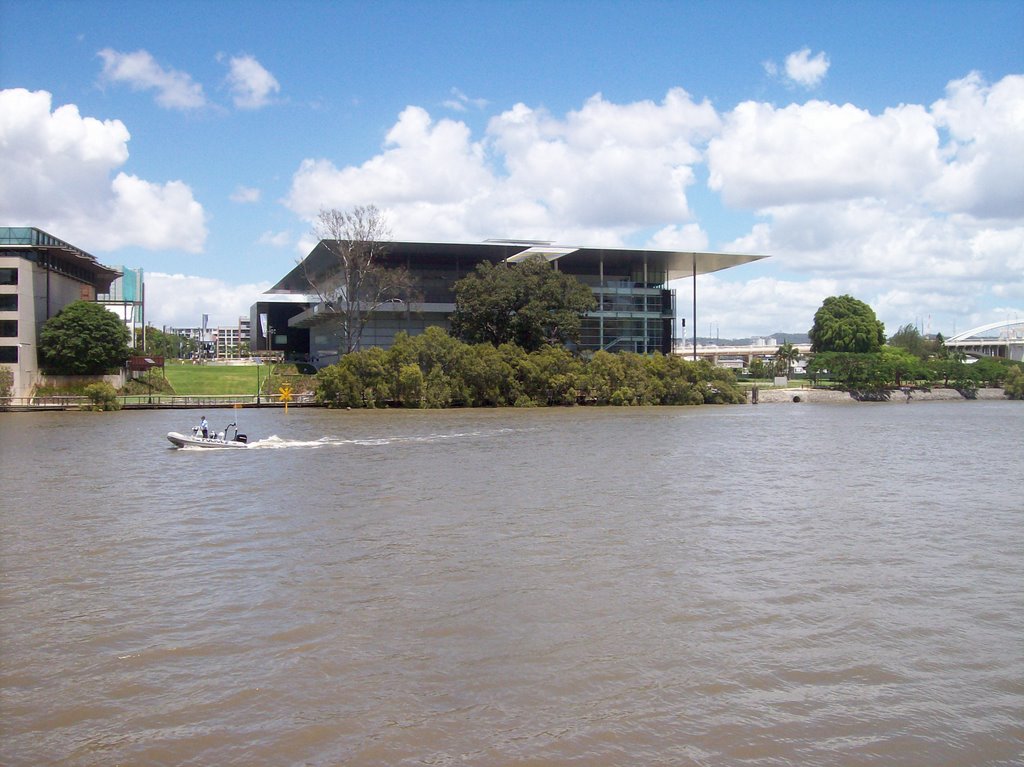
The fifth Asia-Pacific Triennial (APT5) exhibition is the highlight of Brisbane’s newest attraction, the sparkling Gallery of Modern Art (GoMA). There have been more than half a million visitors to Southbank’s Cultural Centre is since the $300m GoMA and the adjacent State Library of Queensland opened on 2 December last year.

Wayne Goss, Chairman of the Queensland Art Gallery Board of Trustees said in a media release that GoMA was a major new contemporary art museum for Australia and the Asia-Pacific region, and a cultural triumph for Brisbane. “With the addition of GoMA, Queensland Art Gallery remains a single institution with two magnificent sites: the celebrated Robin Gibson-designed Gallery, which opened in 1982, and the Architectus-designed Gallery of Modern Art at Kurilpa Point, the last reach of the Brisbane River overlooking the city," he said. The two galleries are only 150m apart.

APT4 drew 220,000 during its 20-week exhibition in the old art gallery in 2002. This year's APT has reached almost half that in its first three weeks. The attendances and the architectural brilliance have been attracting envious glances from other gallery. GoMA director Doug Hall is due to leave his role in April and National Gallery of Victoria acting director Frances Lindsay said that whoever gets the job next would have “big shoes” to fill. National Gallery of New South Wales chief curator Tony Bond said "We can't get anything like that in NSW. Queensland…have managed to build something to die for”.

Although APT5 has been criticised for not having enough local exhibits, it does contain a stunning range of modern art. The beautiful high ceilings and spacious rooms of the gallery with river and city views complement the artwork. One of the first exhibits as you climb to the first floor, and one of the most popular, is a montage of 29 sequences from Jackie Chan movies. Chan leaps operatically at the viewer from all angles on a bank of TV screens, big and small. GoMA's head of cinema Kathryn Weir describes Chan as a "complex local-global phenomenon". She says his presence in APT "explores how someone who is out of Hong Kong is possibly one of the best-known actor-directors today, working in Hollywood but also maintaining a very strong local identity. And also with a strong and complex relationship with a traditional Chinese art form."

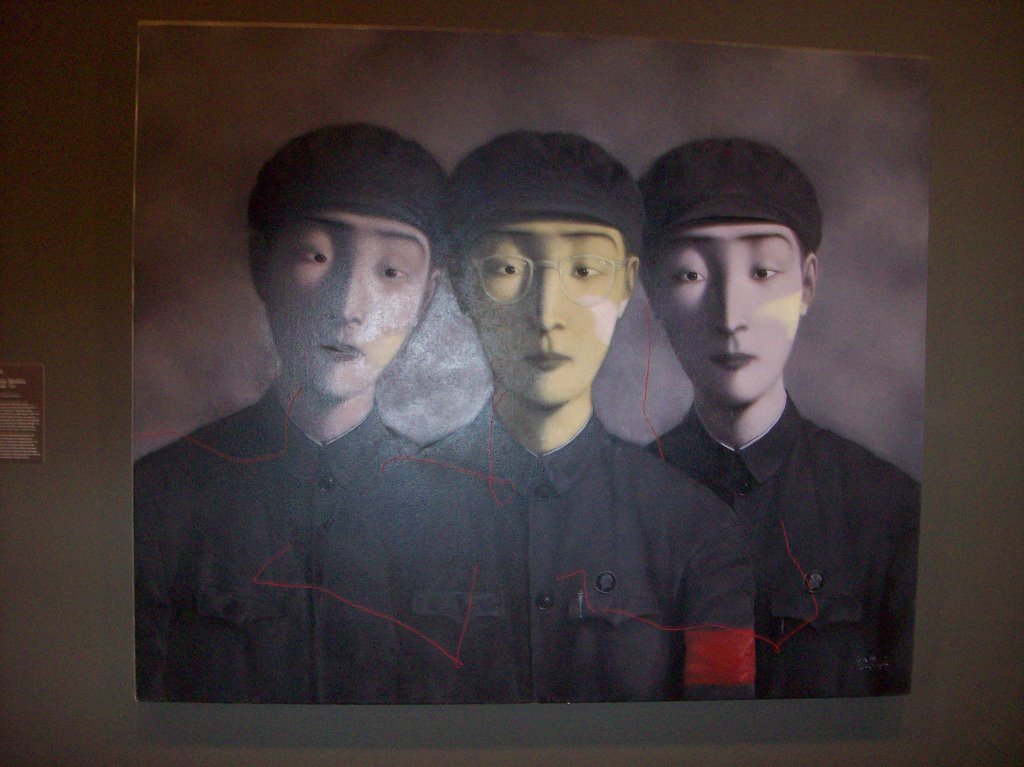
Next to the Chan exhibit is a striking picture from Chinese artist Zhang Xiaogang. His oil on canvas picture “Three Comrades” is from his Bloodlines: The Big Family series. His three comrades are deliberately androgynous figures. Born in 1958, Xiaogang grew up during Mao’s Cultural Revolution when the fervour of disowning the past meant that many photos were destroyed or lost. The painting “Three Comrades” is inspired by a rare surviving photo of his mentally-ill mother during younger, happier times. It conjures up the three Chinese ‘big families’ of blood, social and cultural ties.

The Chinese influence on APT5 is massive. Near the river end of the gallery, lie the beautiful porcelain sculptures of Ah Xian and the photographs of Australian born William Yang. Yang tells a poignant story “about my mother” in 24 family photographs. Like Yang, his mother was also born in Australia, in Dimboola in Far North Queensland. She is a Cantonese who marries a Mandarin speaking Hukka. The family grows up speaking English only. The 24 photos show the life of a graceful westernised woman (the christmas dinner was turkey and ham). She dies but not before having to cope with the shock of finding out her artist son William is gay.

There is a queue to see the exhibit of Japanese artist Yayoi Kusama. Kusama was responsible for the beautiful “Narcissus Garden” in APT4. This time, her piece is called “Soul under the Moon”. It is a playful installation set in a closed dark room. Kusama uses mirrors, lights, water, plastic, nylon thread, timber, synthetic polymers and paint to create a disconcerting illusion of never-ending space. Its themes are reflection, infinity and repetition.

Also impressive is Jitish Kallat’s “public notice” (2003). Kallat was born in Mumbai in 1974 where he was also trained as an artist. He has gained a reputation for bold figurative paintings. “Public notice” is a five-panelled work using acrylic mirrors. The letters are rubber adhesive cement which are ignited and melted. The text is from the speech delivered by Jawaharlal Nehru at midnight on the occasion of Indian independence from British rule on 15 August 1947. Nehru’s “tryst with destiny” speech remains a important historical milestone for India.

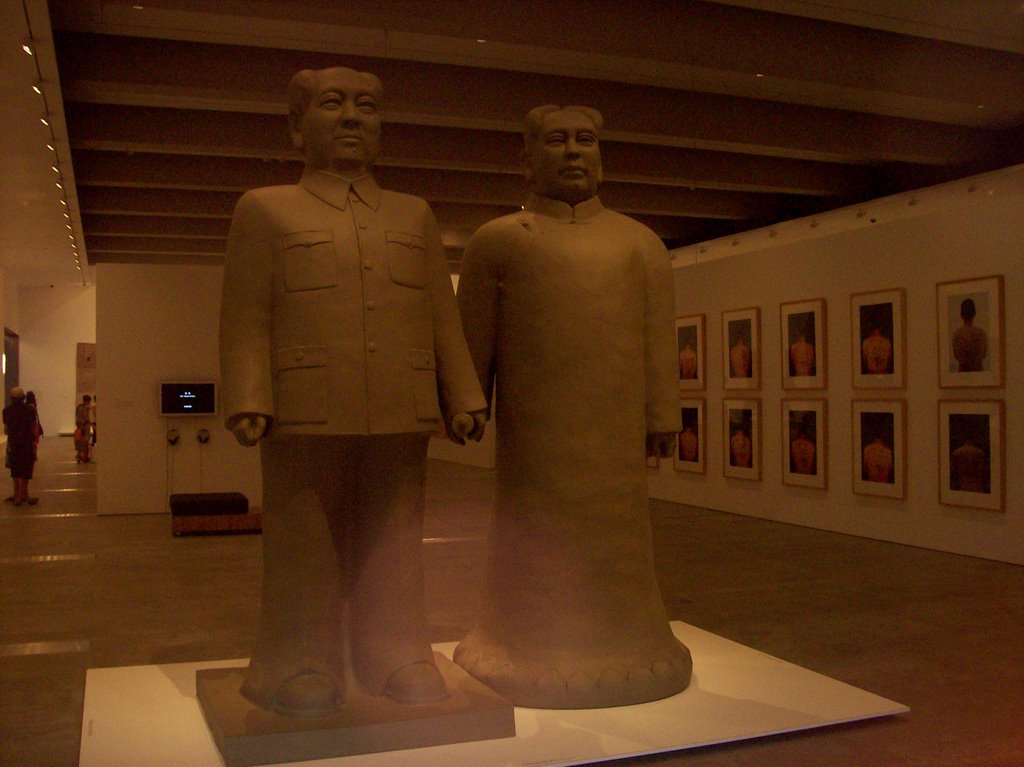
Back on the ground floor the highlight is another Chinese sculpture. It is Wang Wenhai’s “Mao Zedong and Mao Zedong”. These are two giant fibreglass sculptures of Mao; one as the familiar chairman, the other in the guise of emperor Qin Shi Huang who united China in 221 BC. Wenhai is a staff member at the Yan'an Revolutionary Museum in Northwest China's Shaanxi Province. He has been making clay sculptures of Mao for 20 years and believes he has made over 1,000. The two that grace APT5 are imposing as befits one of the 20th century's most successful leaders.

The Asia Pacific Triennial 5 expo continues until 27 May 2007. The Queensland Gallery of Modern Art is at Southbank, a short walk from the city across Victoria Bridge and close to South Brisbane station. It is open 10am to 5pm Monday to Friday and 9am to 5pm Saturday and Sunday. Admission is free.