Showing posts with label Canada. Show all posts

Monday, December 14, 2009

Negotiator paid $500,000 to release Nigel Brennan and Amanda Lindhout

John Chase, the hostage negotiator in the Somali kidnap of Nigel Brennan and Amanda Lindhout has admitted they paid a half a million US dollars to secure their release. The Australian Brennan and Canadian Lindhout were released from Mogadishu last month after being held for 15 months and Chase was instrumental in getting the initial $2.5 million ransom demand per head down to the $250,000 a head that was paid in the end. Chase said the kidnappers had no political motives and were not related to the Islamic Courts Union that rules much of Mogadishu. (photo credit: Reuters)

A blog called Free Amanda Lindhout said last week the Canadian Government would send a plane to take Lindhout and her family back to Canada. However the Canadian Department of Foreign Affairs would not confirm this saying the family deserved privacy. Whenever she returns, it brings an end to a long ordeal she suffered in the name of getting the story of Somali refugees out to the wider world. Lindhout had worked in Iraq where she wrote stories about honour killings. She went to Mogadishu in August 2008 with Nigel Brennan. Brennan is a Brisbane-based photojournalist, who studied photography at Griffith University and a former photographer for the Bundaberg NewsMail newspaper.

On 23 August 2008 the pair were kidnapped in Mogadishu. Lindhout told Canadian TV they were researching a story about internally displaced people in Somalia. Many IDPs preferred the certainty of the camps to life in the war-torn capital. The journalists had been to a refugee camp the day before to interview IDPs and were going back to film for a second day. Their vehicle was ambushed and pulled to the side of the road. According to the pair’s local fixer and journalist Abdifatah Elmi the kidnappers opened the door of the car and brandished guns. They forced all three to get into their car and drove away from the scene very fast.

Within twenty-fours, Brennan’s parents in Australia got a call from the hostage takers. As Brennan’s sister Nicky Bonney described it, a voice identified himself as Aden, ringing from Mogadishu. Aden said he had Nigel and this was a ransom call for $1.5 million. A few hours later, Australian federal police turned up and directed the family to ask the hostage-takers a “proof of life” question. Bonney asked them, what was the name of their dog and the correct answer came back two hours later.

The Somali journalists union claimed they were being held in the north-eastern Mogadishu neighbourhood of Suqa Holaha by militias. After a month, Al Jazeera television showed footage of Brennan and Lindhout. They were accompanied by armed men, who identified themselves as the Mujahideen of Somalia. They accused Australia and Canada of helping to destroy Somalia, and demanded they end this policy.

In January, the hostage takers released the Somali journalist Abdifatah Elmi after 150 days in captivity. Elmi said his clan elders negotiated his release and that no ransom was paid. He said he was kept separately from the others and didn’t know their whereabouts. There was no further contact until May when Brennan and Lindhout made a five-minute phone call to an AFP journalist in Mogadishu saying they were in poor health and requested help from their governments. A day later Australian Foreign Minister Stephen Smith asked for a media black-out saying public discussion could endanger Brennan's life.

The problem for Brennan and Lindhout is that they were freelance journalists. If they had been employed by a news agency, the employer would likely have had kidnap insurance and the situation would have been resolved quickly. But being freelance, they had no choice but to ask their governments to pay. Both the Australian and Canadian Governments refused citing their long-standing policy not to pay ransoms.

However this is not a hard and fast rule. What the Australian Government would agree was $250,000 which it was prepared to facilitate as payment to secure a release. This had to be described as an incidental cost and not as a ransom. The Australian and Canadian Governments set up a Nairobi task force but the kidnappers were not prepared to accept $250,000 a head. It was up to the hostages’ families to raise the rest of the money. The families got together and hired a hostage release and ransom negotiator with a proven track record of dealing with Somali kidnap situations. The contractor was John Chase, the managing director of crisis response with the AKE group. He said the kidnappers were criminal gangs who could be placated with extra money. Chase was not cheap at $3,000 a day. But the families raised funds with the help of Dick Smith and other businesspeople. Finally after 462 days of captivity, the hostages were released for half a million dollars each.

Writing in Online Opinion today, African scholar David Robinson went behind the trite "lawless since 1991" common media headline to show why Somalia is such a complicated place. There has been a long-standing post-colonial conflict between Ethiopia and Somalia for control of the Ogaden. During the Cold War both countries were courted in turn by the US and the USSR but the Somali regime found itself bereft of friends after the Soviet collapse. In 1991 Siad Barre’s rebel movement displaced the Government which led to the disastrous 1993 UN peacekeeping mission. The US lost 30 soldiers and more important lost its will to engage in Africa. The intervening years have seen an ongoing power struggle between the UN-backed Transitional Government and the fundamentalist but popular Islamic Courts. As Robinson says “Nigel Brennan travelled to Somalia to reveal its story; it is a story worth telling.”

Thursday, April 09, 2009

CanWest, bankruptcy and Channel Ten

The CanWest Global Communications Corp has extended a bank deadline to renegotiate a $243 million (all amounts in this article are USD) credit facility. On Tuesday its subsidiary company CanWest Media Inc (CMI) reached a deal with its main lenders to extend the waiver of certain borrowing conditions for two weeks to 21 April. The revised terms means that CanWest will get additional credit in the interim fortnight. Discussions will continue with lenders to look at terms to extend the waiver for a longer period to allow CMI to pursue a recapitalisation transaction. But a lot of hard wheeling and dealing lies ahead for the Canadian media giant to avoid bankruptcy in the coming months.

Lenders and hedge funds have been remarkably flexible so far over several missed deadlines to make various repayments on their massive $4 billion debt. However CanWest faces another crucial deadline next week on a $30m interest payment to hedge funds on risk sensitive 8 per cent senior subordinated notes it failed to re-pay last month. If CanWest does not meet this deadline next week, they could possibly be in default on $761 million worth of notes plus missed interest and associated default interest. This would leave the company in the precarious situation of trying to offload assets in a time when media stocks are virtually worthless.

As Boyd Erman points out, CanWest has two serious problems when it comes to selling assets to potential buyers. The likely prices are dwarfed by the debts tied to the assets, and the company’s convoluted corporate structure makes it almost impossible to make sales work. Erman says broadcasting assets would need to be sold for five times ebitda (earnings before interest, taxes, depreciation and amortisation) to meet the debt of those assets and such a deal would be extremely unlikely in the current market. “CanWest is almost like a landlord with a rental house that's fallen so much in value that selling it wouldn't cover what's left on the mortgage,” he says.

If CanWest does go under, it will provide a tasty meal for asset strippers. The Canadian company owns the Global Television Network, the cable network E!, the Southam newspaper paper chain, and is the majority shareholder of Australia’s Channel Ten. CanWest is controlled by the Asper family (CEO Leonard and his brother David) based in Winnipeg. Much of their debt was accumulated in buying the Southam chain in 2000 from Conrad Black's former company Hollinger International.

Here in Australia CanWest owns 56.6 per cent of Channel Ten and owns stations in the five mainland state capitals. The uncertainty over Ten’s parent company has affected the local share price and the bottom line. Last week, Ten posted a first half net loss of $57 million and cancelled its fiscal 2009 final dividend. Television revenue was down 12 per cent and the share of its key 16-39 demographic fell 5.5 per cent this year. This Easter local staff have been instructed to take extra leave and asked to restructure their hours to a permanent shorter working week.

Meanwhile CanWest have informally put the feelers out to sell its stake in the Channel. They hope to raise $280 million from the sale if they can sell out at 75c (Australian) which was the floor price in an unsuccessful capital raising project in February, and which co-incidentally was the closing share price going into Easter. CanWest have sounded out possible buyers who already have a stake in Ten including the Commonwealth Bank (6.5 percent) and fund management company 452 Capital (5.7 percent).

The wildcard in any bidding may be Ten’s second biggest shareholder Birketu. Owned by little known Bermuda-based Bruce Gordon (described by Margaret Simons as "Australia's forgotten TV mogul"), Birketu control 13.3 per cent of the network. The 79 year old Gordon already has extensive interests in Australian television. He owns Nine Network stations in Adelaide and Perth and the WIN regional network and is free to extend his interest in Ten in the wake of the 2006 loosening of Australian media ownership. While officially CanWest are saying they are not talking to Birketu, Gordon has long expressed an interest in increasing his stake. If CanWest’s creditors lose their patience in the next few weeks, expect Gordon to make his move and become Australia’s most powerful unknown television mogul in the process.

Friday, March 21, 2008

Being Good Friday

(Picture: the Breakfast Creek Hotel, a Brisbane pub that wasn't open today)

Though it was a 28 degree scorcher of a public holiday in Brisbane today, there was little chance of being able to quench your thirst with a beer. Because here as in the rest of Australia, the pubs were shut for Good Friday. But why should shops and pubs shut for a Christian festival? This is a quaint practice retained from the days that Australia was a Christian country but those times have long since past. The census is showing Christianity declining as a force in Australian society with just 64 per cent of the population (down from 71 per cent in 1996) calling themselves Christians in 2007. It is surely time to remove this archaic custom.

Meanwhile, the Australian Retailers Association believes the shops should also remain open on the day. They have asked the Federal Government to take the lead in deregulating shopping hours at Easter across the country. They say ambiguous and inconsistent state laws are hurting national chains, franchises and consumers. While the laws have been liberalised in the ACT (where there are no restrictions) and Tasmania (where they still close on Good Friday), laws elsewhere remain stuck in a mid century timewarp. WA is particularly regressive with shops shut throughout Easter except Saturday.

Adelaide businesses are pushing hard to liberalise their laws ahead of the Rugby World Sevens tournament to be held there next Easter. Rugby bosses also want the Good Friday laws relaxed. But vested interests are speaking up determined to keep the status quo. The Catholic Church has warned that opening on Good Friday for shop and hotel trading would destroy a tradition they describe as “deeply embedded in the South Australian psyche”. The Church's Monsignor David Cappo says the day is a holiday, a rest day and a highly religious day for an enormous number of South Australians which needs to be treated with respect. "I would urge very strong caution about such a fundamental change to Easter,” he said. “Good Friday is such a powerful day, it is about the death of Christ."

Britain has begun the process of open trading on Good Friday. High street betting shops are the latest to open today for the first time on Good Friday. Bookmakers reckon thousands of shops will be operating, even though there will be no racing taking place today. Church groups are angry, saying the opening showed a lack of respect for the day of Christ's crucifixion. The Church of England said it was part of a gradual trend to remove the shared holidays that "help create a rhythm for the nation's life".

This point was also picked up by the Daily Telegraph opinion writer who said that a liberalised trading has led to rampant commercialism. While the writer acknowledged that previously Good Friday was stupefyingly dull, he or she (the writer’s name is not identified in the article) is not convinced the replacement is any better. “Instead of it being a day for churchgoing, Good Friday now marks the start of the Easter sales frenzy,” said the Telegraph. “It's as bad as any Bank Holiday, and we wistfully long for quieter times.”

While such materialism is an unwelcome side-effect of liberalisation, it is not enough justification to stop it. While Australia remains steadfastly shut down on Friday, its commonwealth cousin Canada has removed most restrictions in the last couple of decades. This year Nova Scotia has changed its 80 year old laws that allowed pubs to only serve alcohol with meals on Good Friday. Nova Scotia was one of the last holdouts. Only Manitoba and Prince Edward Island still require pubs and clubs to be closed on the day while in Saskatchewan, bars cannot open until noon. "Good Friday has held out…because of its religious connotations," said Craig Heron, associate professor of history at York University. "Which is odd in a society where there are many, many other religions that don't celebrate Good Friday."

Saturday, August 11, 2007

North Pole dancing: Denmark joins the Coldest War

Danish researchers will set sail for the North Pole tomorrow to collect geological data on an underwater ridge they believe is connected to Danish claimed territory in Greenland. The Danish team will collect bathymetric, gravity and seismic data to map the seabed under the ice. The mission is an escalation of tensions around polar mineral explorations tensions in the wake of the similar Russian mission last week.

Although the seabed under the pole is not regarded as part of any single country's territory, Russian explorers planted a flag last Tuesday on the seabed 4,200m below the pole. Russia's most famous explorer, Artur Chilingarov led the expedition to plant a rustproof flag in a capsule on the ocean seabed under the pole. "The Arctic is Russian," Chilingarov said earlier. "We must prove the North Pole is an extension of the Russian coastal shelf”.

The polar zone is believed to hold vast resources of oil and natural gas that will become more accessible as climate change melts the ice cap. Russia and Denmark are two of the five countries with land borders that approach the North Pole. Norway, Canada and the US are the other three. The other countries are less than impressed with Russia’s latest polar manoeuvre. Canadian Foreign Minister Peter Mackay said Russia was behaving like a 15th century explorer. “You can't go around the world and just plant flags and say 'We're claiming this territory',” he said. US Department of State deputy spokesman Tom Casey said: “A metal flag, a rubber flag or a bed sheet on the ocean floor ... doesn't have any legal standing or effect on this claim.”

Nevertheless the US has its own plans to assert its ownership of polar regions. An American Coast Guard icebreaker, the Healy, headed to the Arctic last week to map the sea floor off Alaska. Russia claims this mission shows that the US is actively joining the competition for resources in the Arctic. Larry Mayer, director of the Centre for Coastal and Ocean Mapping at the University of New Hampshire, denies this claim and said the purpose of the Healy’s mapping work was to determine the extent of the continental shelf north of Alaska. "In that area, the country would have rights over the resources of the sea floor and subsurface that would include drilling for oil and gas," he said.

Russia’s claim to the pole is based on an underwater mountain known as the Lomonosov Ridge which it states is an extension of the Russian landmass. This gives Russia a claim to a triangular area up to the pole, allowing it rights due according to the United Nations Law of the Sea Convention. Article 76 of the convention says a state can claim a 200 nautical mile exclusive zone and beyond that up to 150 nautical miles of rights on the seabed. Of most interest to Russia is the key fact is that these distances are measured from where the continental shelf ends. Russia will aim to show that the Lomonosov Ridge, a seam that crosses the seabed from Russia to Greenland, is an extension of Russia’s continental shelf.

As a result of Chilingarov’s mission, Russia has now laid formal claim to a triangle-shaped area of the Arctic Ocean. Its base is formed by the Russian coast from the Kola Peninsula in the west to the tip of the Chukotka Peninsula in the east, across the Bering Strait from Alaska. The apex of this 1.2 million sq km triangle is the North Pole. Russia had traditionally claimed this territory but was forced to drop the claim after it ratified the UN Convention on the Law of the Sea in 1997. The mapping of the Lomosonov is the attempt to win back the territory.

The area under consideration has immense wealth and economic importance. Some estimates have the continental shelf holding about 100 billion tons of oil plus a wealth of fish species. A study by the US Geological Survey (USGS) said 25 percent of all untapped reserves in areas known to contain oil are found north of the Arctic Circle. As most of the Arctic is unexplored that figure is likely to be higher still. "It's very likely there's a great deal of oil and gas out there," said Don Gautier, a research geologist at USGS who is leading an effort to put a number on those reserves. "The real possibility exists that you could have another world class petroleum province like the North Sea."

There is also the matter of the Northern Sea Route, (NSR) the shortest way from Europe to Asia and the Pacific coast of America. The NSR is a sort of North-East passage which runs through the Arctic Ocean along Russia's northern coast and which would become a highway to transport oil and gas from Arctic deposits. The NSR has traditionally been off-limits to international shipping due to difficult ice conditions and the geo-political problems during the Cold War era. Russia officially re-opened the NSR for foreign shipping in 1991, and improved ice-breaking technology is being developed. Although the NSR is impeded by ice and Russian political instability, it avoids the draft limitations of the Suez and Panama canals, as well as the political instability in the Middle East and Panama, and piracy problems in SE Asia. There are also indications that global warming may improve the ice conditions of the NSR.

The Arctic Climate Impact Assessment team suggested in 2004 that the Arctic summer ice cap could melt completely before the end of this century because of global warming. Meanwhile another race is on to protect interests in the polar region. Canada will build up to eight new patrol ships and the US Congress is considering a proposal to build two new heavy polar ships. The US and Canada argue over rights in the North-west Passage, Norway and Russia differ over a disputed region of the Barents Sea, Canada and Denmark are competing over the tiny Hans island off Greenland, the Russian parliament is refusing to ratify a 1990 agreement with the US over the Bering Sea and Denmark is claiming the North Pole itself. A new and dangerous Cold War may be about to begin.

Thursday, March 29, 2007

Quebec independence setback

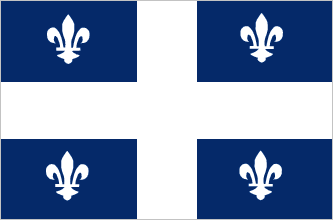
The Quebec independence movement is licking its wounds after a surprisingly heavy defeat for the Parti Quebecois (PQ) in Monday’s provincial election. If elected, PQ had promised to hold a referendum on independence from Canada but instead finished third with 28% of the vote, their worse electoral showing since 1973.

Jean Charest, the region's Liberal premier, narrowly won re-election but will now lead the province's first minority government in 130 years. 38% of the province’s 5.6 million electorate voted Liberal who took 48 of the 125 seats. The result means that the Liberals have lost 24 seats since the last election.

The main winners were the right-of-centre Action Democratique du Quebec party (ADQ). They finished second with 32% of the vote and 41 seats (up 36 since the last election). The ADQ wants more autonomy for Quebec but does not want to secede from Canada. Their conservative platform consists of attacking debt, allowing more private medical clinics, a stronger law and order policy and moving people off welfare. 36 year old charismatic party leader Mario Dumont now holds the balance of power and represents a new force in a province used to the bipolar opposites of separatists and federalists.

Meanwhile Prime Minister Stephen Harper said the PQ defeat reflects the central government's efforts to give more power and resources to provinces. “We're very encouraged to see that we have a government that is opposed to having another referendum, and we have an official opposition that is opposed to having another referendum," Harper told reporters today in Ottawa. “It's good news for this government, but it's also good news for Quebec and Canada."

Quebec has had two independence referendums in the last 26 years. In 1980 the Quebec provincial government asked for a mandate to negotiate sovereignty association. Nearly 60 percent of Quebeckers voted no. There was a second almost identical referendum in 1995 on the sovereignty issue. The margin was much closer but the “no” vote still triumphed 51% to 49.

The white history of Quebec dates back to 1534 when Jacques Cartier erected a cross on the shore of the Gaspé Peninsula. He took possession of the land in the name of the king of France. But Cartier's gesture changed nothing and the province remained the haunt of aboriginals and the occasional fisherman until 1608. In that year Samuel de Champlain founded the city of Quebec and established the first permanent colony. The French went on to establish Trois-Rivières and Montreal and claimed the entire watersheds of the Mississippi and St. Lawrence Rivers but were blocked from further expansion by hostile Iroquois.

The British, meanwhile, built their own forts at Oswego and Halifax and the government granted lands in the Ohio Valley to the Ohio Company. Adventurous traders set up bases in the region which led to inevitable clashes with the French. In 1750 the two European powers met in Paris to try to resolve the territorial disputes. Two years later, the new Governor-General of New France, Marquis Duquesne, sent troops to Pennsylvania to build forts. The lieutenant-Governor of Virginia demanded they leave. Under the command of a young Virginian officer named George Washington, the British launched a pre-emptive attack in 1754, the first strike in what became known as the French & Indian War.

The war would drag on for eight years as the British slowly gained the upper hand. The key turning point came in 1759 with the capture of Quebec City after a three month siege. By the end of 1760, Montreal fell to the British and the war was ended with the capture of Fort Detroit. British de facto control of Eastern North America was confirmed in 1763 with the Treaty of Paris.

But nothing much changed in Quebec despite British control. In 1774, authorities passed the Quebec Act. This act guaranteed the French freedom of worship and property rights under French civil law and gave the Catholic Church the right of collecting tithes which ensured it would keep its status as the established church. In 1837 French and English speaking Canadians rebelled against the British garrison. Although the rebellion was brutally put down, Britain was forced to consider independence. The Province of Canada was founded in 1841 and the Quebeckers gained a key victory by insisting that the French language have legal status in the new entity.

Calls for Quebec independence remained muted until the 1960s. The Front de Liberation du Quebec (FLQ) was formed in February 1963 with the goal of seeking full independence from Canada. The group was most active in the period up to 1972 until it was proscribed by the Wars Measures Act. Although the group failed, their ideas permeated the mainstream. In 1974, French was declared the official language of the province and a separatist party won the provincial elections two years later. Although the separation referendum failed in 1980, dissatisfaction with Quebec’s status remained.

In 1987 the Government proposed a set of amendments known as the Meech Lake Accords in an effort to persuade Quebec to sign the 1982 constitution. Quebec demanded a status as a “distinct society”. But the proposal was defeated by aboriginal politicians who felt that the First Nations had not been adequately involved in the process.

The defeat of the Accords led to the rise of the Parti Quebecois who took power in Quebec. They organised and narrowly lost a second referendum in 1995. Then Party leader Jacques Parizeau blamed the sovereignist defeat on "money and the ethnic vote" and declares that "we will have our country and we will get our revenge." Four years later the federal government passed the Clarity Act, which set out the rules by which a province could secede from Canada.

The Clarity Act demanded that in order for separation to occur, a referendum on independence in a given province would have to have "clearly" framed its question to voters in terms of independence, and that the result would have to be a "clear majority" in favour. While the “clearness” of the question and the result were not defined, the act ensured that Quebec could not unilaterally declare independence unless by a substantial majority. The PQ opposed the act and said Quebec would proclaim independence even if they won by just one vote. In a 2005 TV interview Parizeau said that the Clarity Act "meant nothing" and would be ignored. But this week’s election has shown the Quebec electorate haven’t ignored it.


Many analysts are calling this weekend’s vote a watershed election. For decades Quebec politics have been dominated in turns by either federalist or separatists groups. Now this polarisation will be forced to end. Who ever forms government will have to work within a coalition and make some unpalatable choices with likely compromise on core policies.

But some are optimistic that this outcome is for the best. The Canadian dollar rose on news of the election results finishing up 0.35 US cents overnight Wednesday. George Davis, chief technical strategist at RBC Capital Markets said the strong showing by the ADQ strengthens the position of Conservative PM Harper. "I think the market would view anything that would move the federal government towards a majority as positive," said Davis.

Wednesday, May 03, 2006

New Home for Brisbane Inukshuk

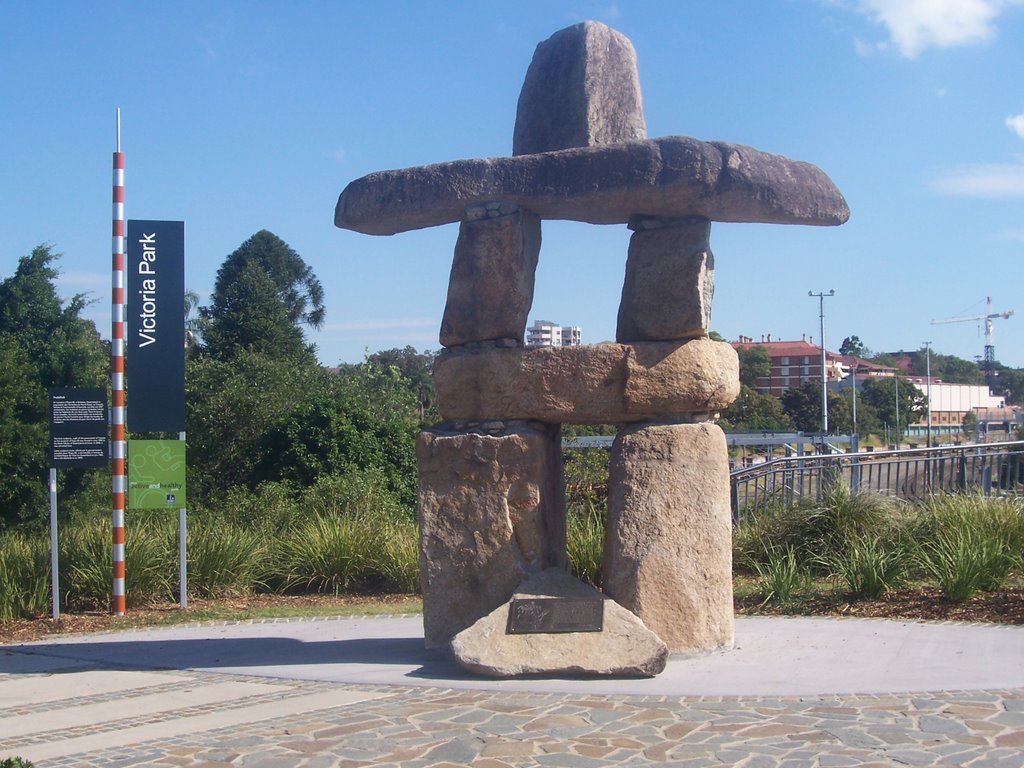
A Canadian replica directional marker was recently dedicated in its new home in Victoria Park, in the suburb of Herston.

It is the third home in 18 years for the Brisbane monument which is known by its Inuit name of “inukshuk”.

The Canadian High Commissioner, Mr Michael Leir attended the re-dedication ceremony on Thursday, April 6, this year.

The monument weighs 19 tonnes and was created for the Canadian stand at Brisbane’s Expo 88 by indigenous artists of Nunavut, a territory in Arctic Canada.

In his re-dedication speech, Mr Leir said the inukshuk is easily one of Canada’s most recognizable symbols.

It is a traditional stone sculpture of the Inuit people of north-west Canada and inukshuk translates roughly into English as "likeness of person."

The Inuit used inukshuks to show directions to travellers, to warn of impending danger, to mark a place of respect, or to act as helpers in the hunting of caribou.

The sculpture was presented as a gift to Brisbane when Expo 88 concluded and it sat outside the entrance to the Queensland State Library for the next 15 years.

In 2004, extensions to the new State Library meant it needed to be moved again.

The new site is the pedestrian bridge on the Great Northern Greenway at Victoria Park, Herston.

Queensland Arts Minister Rod Welford said he was delighted a new home had been found for the important sculpture, which will now be enjoyed by more than 800 cyclists and pedestrians who pass the site each weekday.

According to a Canadian embassy media release, the High Commissioner Mr Leir said the inukshuk would become an important stop on the tourist trail for the 175,000 Canadians who travel to Australia each year.

The inukshuk appears on the flag of Nunavut and has also been chosen as the official symbol for the Vancouver 2010 Winter Olympics.