Showing posts with label communication. Show all posts

Monday, September 26, 2011

Arse over Titanic

In the final scene of the 1953 film about the Titanic, A Night to Remember, second mate Charles Herbert Lightoller (played by Kenneth More) ruminates on the cause of the sinking. “There were quite a lot of ifs about it,” he said. “If we’d be steaming a few knots slower, or if we’d sighted that berg a few seconds earlier...if we carried enough lifeboats for the size of the ship...” This sinking was different, he concludes. “Because we were so sure, because even though it has happened it is still unbelievable.” The reluctance of many passengers to leave the ship, believing that it was unsinkable meant nearly all the lifeboats were lowered away without their full complement of passengers. The sinking of the Titanic was the shattering of the belief in the human harnessing of technology for good that was the beginning of the end for modernism.

Expect a deluge of commemoration in April next year for the 100th year anniversary of the sinking. 1502 people died in the North Atlantic on 15 April 1912 when Titanic sunk on its maiden voyage. It was the worst disaster at sea ever and it remains among the top peacetime sinking today behind only the Filipino Dona Paz (1987) and the Senegalese La Joola (2002) disasters.

Neither of these Third World tragedies have a cultural affinity in the west worthy of a Hollywood movie. Similarly unknown is the worst marine disaster ever the Nazi ship Wilhelm Gustloff which was torpedoed by a Russian submarine in 1945 for a loss of 7,000 lives. What too about the unheralded British Troopship Lancastria which sunk in 1940 for the loss of over 3,000 lives but whose official record has been classified until 2040 possibly because the captain ignored maximum loading capacity instructions?

The Lancastria is a mystery but the Titanic has become a myth. The reason it sank is for reasons familiar today: the law not keeping up with communication, technology and corporate greed. While fitted with wireless, it was unregulated and not unknown for rival companies to jam each other. Meanwhile the law the Titanic was sailing under the Merchant Shipping Act, 1894. The relevant section about the number of life-boats, life-jackets, life-rafts and life-buoys on British ships was a matter delegated to the Board of Trade “according to the class in which they are arranged”. The Board, guided by ship owners, judged the number of lifeboats to be a function of tonnage not of total passengers. By law Titanic needed to have a lifeboat capacity for 1060 people but carried 20 lifeboats, enough for 1178 people including all of first class. She could carry three times that many people.

The last time the Board had regulated on the matter was 1896. At the time the law was passed, the largest ship afloat was the 12,950 ton vessel RMS Lucania. Identical in dimensions and specifications to Cunard sister ship RMS Campania, the Lucania was the joint largest passenger liner afloat when she entered service in 1893. But the Germans outstripped the Cunard ships with the 14,400 ton Norddeutsche Lloyd vessel Kaiser Wilhelm der Grosse in 1897, and further ruffled British feathers by winning the Blue Riband for the record speed in an Atlantic crossing averaging 22.3 knots, half a knot faster than Lucania.

White Star line then seriously upped the ante with vessels such as the Oceanic (1899), Celtic (1901), Baltic (1905) and Olympic (1911) trebling the tonnage. A year later their Titanic weighed in at a new record 46,329 tons, almost four times as heavy as the law aimed for Lucania. White Star’s ships were built for comfort and style not speed. Cunard continued to dominate the Blue Riband, despite their smaller ships. White Star was cutting corners of a different kind.

In 1912 White Star was owned by the International Mercantile Marine company owned by monopolist J.P. Morgan. At the time, IMM was overleveraged and suffered from inadequate cash flow that would eventually cause it to default on bond interest payments in 1914. At the British Inquiry into the Titanic disaster Sir Alfred Chalmers of the Board of Trade was asked about the lifeboat regulations. Sir Alfred made a strange claim.

He said if there were fewer lifeboats on Titanic then more people would have been saved. He said if there had been fewer lifeboats then more people would have realised the danger and rushed to the boats filling more to capacity. This claim has superficial validity as in theory the lifeboats could have saved 1,187 but only 710 survived. But then he gave the real reasons: The latest boats were stronger than ever and had watertight compartments making them unlikely to require any lifeboats, sea routes used were well-travelled meaning that the likelihood of a collision was minimal, the availability of wireless technology, the difficulties of loading more than 16 boats, and ultimately it was a matter for the ship owners.

Those owners were well served by the highest ranking surviving officer Second Mate Lightoller - the hero of A Night to Remember. Lightoller somehow guided his upturned boat through four hours of increasingly choppy seas to safety. In his testimony to the London Board of Inquiry said it was “very necessary to keep one’s hand on the whitewash brush”. That meant giving careful answers to sharp questions “if one was to avoid a pitfall, carefully and subtly dug, leading to a pinning down of blame on to someone’s luckless shoulders.” His job was to defend the work of the Board of Trade and White Star Lines and he succeeded admirably.

But his testimony did force a change of the rules. Lightoller himself admitted the pendulum had swung “to the other extreme and the margin of safety reached the ridiculous.” But then he would remember the “long drawn out battle of wits, where it seemed that I must hold that unenviable position of whipping boy to the whole lot of them.” The only other thing that bothered him was that White Star never thanked the whipping boy. Perhaps they had others things on their mind. Although the Line survived the tragedy, both IMM and Morgan went under - just like their most famous ship.

Wednesday, July 13, 2011

Carbon Tax: Which companies will pay?

I was writing an article on Monday for my paper about the carbon tax. The Government released a vast amount of information on Sunday about their new proposal. I had interviewed a couple of the local gas companies, Santos and Origin, a few weeks prior and I was keen to write about the coal seam gas industry impact of the tax, which had local implications. In her speech to the nation on Sunday, Prime Minister Julia Gillard said around 500 big companies would pay for every tonne of carbon they produce. Climate change minister Greg Combet confirmed it in one of his releases. I assumed the gas majors I spoke to would be on the list.

However a very quick look at the new government website “cleanenergyfuture” showed the list was nowhere obvious. ABC chief political correspondent Sabra Lane said those affected would be “mining, steel companies and aluminium manufacturers”. There was no mention of coal seam gas. So I set the task of finding the 500 to a keen young journalist who started here last week. I thought it might be a tough task for her because this is one of the more incendiary consequences of the legislation and therefore one the Government might not be keen to publicise. I gave her 15 minutes to find it.

After 10 minutes of silence, I realised this must be harder than I thought and I went looking for it again. I was no more successful than my new journo, so I thought it was time to ask Twitter. Turns out it wasn’t obvious there either. “Good question” was the best response I got; others were on the line of “let us know if you find out.” In the end what we wrote in the newspaper was “precise information on which companies were in or out were not available when the Western Star went looking.”

Annabel Crabb did find more precise information when she turned her attention to the problem yesterday. Crabb wondered who was in the “Misfortune 500 and said the biggest companies may not be the biggest emitters of carbon. "Can we get a list?," she asked. “No - we can't" said the Government. The 500 companies are not an identified list but an estimate of how many companies in Australia would be caught by the scheme's eligibility rules.

I eventually found the Government page that talks about the 500 companies. “Most are companies operating large facilities (with over 25,000 tonnes annual CO2-e emissions) that directly emit greenhouse gases, such as power stations, mines and heavy industry,” the site said. “Some are public authorities responsible for emissions from landfills.” A fact sheet gave a breakdown of where the companies were. NSW and Queensland had half the companies, 100 were involved in coal, 60 each in electricity and heavy industry, 50 in other fossil fuel and 40 in natural gas. I assumed the latter category covers my local companies, but could not confirm this as there were no company names in the fact sheet.

For political reasons, petrol and agriculture are exempt and Crabb explained other problems with the eligibility rules. “A company with 20 facilities each emitting 24,000 tonnes of CO2 a year would not be liable, while some poor boob with one factory emitting 26,000 tonnes of carbon dioxide and 19 clean green beansprout-fired tofu smelters would still have to cough up.”

Crabb found the compulsory reporting that is done under the National Greenhouse and Energy Reporting Act 2007. The National Greenhouse and Energy Reporting on “Greenhouse and Energy Information 2009-2010" has a list of 300 companies that emit more than the 2009-10 annual threshold of 87,500 tonnes a year. It does not break the data down by facility but it is difficult to see how companies like Macquarie Generation (23.4 million tonnes), Delta Electricity (20.45m), CS Energy (16.8m), TRUenergy (15.6m), Blue Scope Steel (10.8m), Woodside Petroleum (8.4m), Alinta (7.8m), and Alcoa (6.75m) can avoid paying some of the tax. There were only 300 companies in this list, so 200 others need to be added.

Both of the coal seam gas companies I was interested in were on the list, Santos at 3.57m and Origin at 1.87m. So the likelihood is, as I suspected all along – they will both be in the 500. At $23 a tonne I estimate Santos will have to pay $85m a year and Origin $43m. Macquarie Generation (getting their message out through the sympathetic Australian) are up for a bill of $538 billion. Despite what the Government said, it should not have been that hard to find out. Watch out too for fiddling along the edges as companies try to make the most of that “facilities” loophole.

Friday, August 28, 2009

Is Media140 abandoning Twitter?

The inaugural Media140 conference in Australia is on in November in Sydney. As a totally Twitterised wannabe journalist, I’m looking forward to attending. There will be lots of great speakers and good discussions there, I'm sure. Interestingly, the event’s flyer barely mentions Twitter, the technology that inspired the 140 idea. That’s a pity in some respect because sometimes a little technological determinism doesn’t hurt. No matter what it is called, Twitter is a reforming technology.

Its name may be for the birds, but Twitter is usually imagined as a stream. Right now, it is a raging current rushing towards some eventual ocean of communication. The channel is known but it might be more difficult to work out who is saying what to whom and for what effect.

At first glance Twitter seems anchored and orderly with a precise naming system. There are hashtags denoting issues and an honest sounding at-sign denoting voices - My voice is @DerekBarry. But the information in the sign may not be reliable as it seems it is at.

Fakes about on Twitter. The real fakes acquire a fixity over time channelling other personalities. Tiny Buddha spreads 140 character wisdom, Marcel Marceau spreads a similar amount of silence. Nietzsche may have killed God but he cannot stop him/her from tweeting.

If there is genuine in the fake, there is also as much fakery in the genuine. Last week, “Media-more-than-140” gleefully published research that headlined 40 percent of Tweets are pointless babble. They were wrong to call it Twitter twaddle; the figure grossly underestimates the need for phatic conversation as a part of social bridge-building. But whatever the true ratio of signal to noise, the question has validity. It implies there is a discrete judgement about each individual communication.

Discrete communication Twitter may be, but discreet it ain’t. Yes, there are backchannels where you can sometimes privately engage in conversation via the deep and meaningful DM. But most of Twitter’s output is in the public sphere where followers can see directly and a network of others can indirectly. Twitter is a 21st century agora and a marketplace of ideas. It exists in mostly equal fashion across the Internet though there is manipulation. China and other countries can switch it off from time to time and the US can keep it on the air in an attempt to update Mohammad Mossadegh's Iranian fail whale story.

As the State Department found out, Twitter is useful. It is a vibrant source of news, stories, information, jokes, links, music, arguments, gossip and goofs. There are leads, information, signposts, arguments, diary entries, story, contact, and laughing. There are many expressions of boredom. It is how taste is transferred; a sort of Bourdieu on Big Brother.

Much of this milieu is familiar to other modes of communication. But there is also joy in the technology itself. Like Google, it is simple. Unlike Google there is a restriction. The 140 character limit concentrates the mind. Twitter's most ingenuous factor is the creative motif of denial. The need for brevity is paramount. Every letter of every word must be scrutinised to ensure it is working for the cause. Driven by the limit, Twitter is a 21st century telegraph on steroids. But what goes on in this digital Vegas doesn’t necessarily stay there.

Digital data is easily replicable and there is also a wonderfully organic search engine. Twitter search has its faults as it doesn’t keep a great history, but it is right up to date with the present. Anything new, interesting, informative or important will cascade quickly through its networks in the form of an accelerating power law. It can go from 0 to 140 in under ten seconds. Google might be able to tell you what something is, but Twitter can tell you what it is right now.

Friday, January 23, 2009

Twitter and public broadcasting issues under one mumbrella

A real breath of fresh air on the Australian blogging scene is Tim Burrowes at Mumbrella. The former editor of B&T magazine is one of the few bloggers who actually breaks stories and he broke two good ones today. Just minutes ago, he revealed that the viral Twitter messages that a plane on fire caused Melbourne airport to close this evening were a gross overreaction. While it was true that a passenger reported seeing fire from the left wing of a Boeing 767 this evening, the plane was cleared after eight minutes and there were no further consequences. But while Burrowes confirmed there was no fire with a quick phone to the airport, the Twitter world was happier just to repeat the "plane on fire" news ad infinitum in an Australian version of the Hudson plane landing incident. But in this case, the airport press office was justified telling Burrowes that “unfortunately the Internet is full of gossip.”

In scotching the rumours, Burrowes exemplified the remarks of Jason Wilson’s provocative post at Gatewatching last week by showing that “journalists use telephones”. Burrowes was also on the phone earlier today after he read one of the more contentious entries of the 2,400 submissions to the review of Australia's two national broadcasters, the Australian Broadcasting Corporation (ABC) and Special Broadcasting Service (SBS). The government will review the submissions ahead of the broadcasters' next funding review in July this year.

Burrowes’ interest was in the submission by Astra, the peak body representing Australia’s subscription TV industry. In their submission, Astra were critical of the plan to give six new digital channels to ABC and SBS. Astra picked on the point made by ABC’s managing director Mark Scott that the new channels (in areas of news, children’s entertainment and foreign language programming among others) addressed a “market failure”. Astra denied there was a market failure and said they were (or will be soon) delivering similar products to what ABC planned to deliver. It was a persuasive argument if you leave out the fact that just two million Australians subscribe to pay TV and that leaves a potential market failure for 19 million others.

Nevertheless the newsworthy element that Burrowes noticed was an Astra comment that the public broadcasters are doing aggressive deals that lock out pay TV from showing up-to-date content. They claim “ABC and SBS have included pursuit of commercial terms which seek to ensure longer than industry standard ‘hold back’ clauses in production and acquisition deals, and in some instances the ABC in particular has been willing to pay more for content to ensure this happens”. The result is that pay TV has to wait longer to get content for re-run and Astra says this is contrary to ABC 1983 charter goals (a charter Astra says is out of date as is the 1992 Broadcasting Act).

Once again Burrowes picked up the telephone and spoke to both SBS and ABC today for comment on Astra’s accusation. SBS firmly denied the claims and gave examples where SBS and Pay TV have cooperated in acquiring broadcast rights. Their spokesperson also told Burrowes that they often allow World Movies Channel and other pay TV channels to run content first. The ABC spokesperson was similarly dismissive: “The ABC is not sure how ASTRA can justify such claims of warehousing when there are many examples of rights sharing of programs between the ABC and the subscription channels” he said. But this controversy is not likely to go away and Burrowes may have reported on what is likely to be the opening salvo of a long running debate between the public broadcasters and the Pay TV industry for hearts, minds and control of the digital spectrum.

Thursday, January 15, 2009

Optus spanked for spamming

The Australian Communications and Media Authority (ACMA) has imposed a major fine on Optus for sending thousands of unsolicited and anonymous text messages. Optus were fined under the Spam Act for not providing sufficient identification of origin on text message that were sent out to 20,000 customers. Optus tried to negotiate their way out of the penalty but failed and now face a substantial $110,000 fine for two related offences.

ACMA issued the two infringement notices to Optus for failing to provide clear and accurate sender identification with SMS promotions. The messages promoted the OptusZoo entertainment service to mobile phones with the sender identification of ‘966’. ACMA chair Chris Chapman did not accept Optus's assumption that message recipients would make the connection between the keypad letters of Zoo and 966. “This was not considered sufficient identification, as 966 could be used to represent any number of permutations on a telephone keypad,” he said. He went on to warn companies considering similar shonky schemes that “ensuring spam compliance procedures are understood by all staff is imperative for all businesses if they want to avoid the risk of costly fines.”

The fines are mandated by the 2003 Spam Act (pdf) which regulates unsolicited commercial electronic messages such as emails, SMS messages, MMS messages and instant messaging. The act imposes three key obligations on businesses that send electronic messages. They must firstly only send messages with the implied or explicit consent of customers, secondly they must include clear and accurate information about the identification of the sender and finally they must include an “unsubscribe” function in all messages. Unlike the weak ‘opt out’ US CAN-SPAM Act (message recipients had to ask the sender not to send future messages), the Australian legislation was ‘opt in’. Only charities, religious organisations, political parties and the Government are exempt from the law. The downside is that is has no jurisdiction over foreign spammers.

Yet if ACMA are to be believed, the Act has been successful in significantly reducing locally-generated spam. They say that at the time the penalty provisions of the Act were introduced (2004) Australia was 10th in the ranking of spam-relaying countries. However by end 2007, Australia had fallen to 35th. The biggest offender against the Act so far has been DC Marketing Europe Limited which copped a $150,000 fine for contraventions relating to missed call marketing (short duration calls which deliberately leave a ‘missed call message’ to entice callers to ring back) in 2006. DC Marketing breached the Spam Act on all three counts; sending unsolicited messages, not identifying the sender and not containing an unsubscribe facility. While it is arguable that Optus also failed under the first of these requirements, ACMA charged them over the second requirement. The problem is that spam remains an attractive business proposition despite the high penalties. “Eliminating spam is a war you cannot win," according to one computer security expert. "It is much cheaper to send spam than stop it.”

Nonetheless the best tactic for consumers inundated with unwanted corporate pap is to ignore it. An Optus customer who did not want to be identified told Woolly Days he had gotten the spam emails that incurred the wrath of ACMA. He said the “966” texts could be identified as coming from Optus as the term "optuszoo" did appear in the actual text. However, he added, "like all other unsolicited text I receive, I just disregard them."

Thursday, May 18, 2006

Cyrus Field and the Transatlantic Cable

In 1812, British soldiers


Cyrus West Field is a giant figure in the history of international communications. In 1844 Samuel Morse said a telegraph line would be established across the Atlantic linking Britain and the US in real time. It was to be over 20 years before Cyrus Field could prove him right.

Ten years before Morse's prediction, the 15-year-old Field was starting his working life as an office boy in New York’s first department store, A. T. Stewart. Co. Cyrus did well enough that his salary was doubled each year until he left to join a paper manufacturing company. By 1839, aged 20, he was a partner in the paper wholesaler E. Root and Company. He proved an extremely savvy paper merchant. Profits from business ventures allowed him to retire at 33 with a quarter of a million dollars. His wealth allowed him to concentrate on a sudden burning passion: laying the first telegraphic cable across the Atlantic Ocean.

In 1854, he was approached by Frederick Gisborne, the developer of the cross-Newfoundland telegraph line. Gisborne’s company was in financial strife and he tried to persuade Field to invest in the company. Field was not keen but the meeting did produce an epiphany. As his brother Henry Field reported after Gisborne left the meeting, "Mr Field took the globe which was standing in the library and began to turn it over. It was while thus studying the globe that the idea first occurred to him, that the telegraph might be carried further still, and be made to span the Atlantic Ocean."

The globe showed Field that it might be possible to link Europe and North America via the two nearest land points: Newfoundland and the west of Ireland. It would shorten the time for messages to cross the ocean by two weeks.

Any cable living on the bottom of the ocean would need good waterproofing and electrical insulation. Samuel Canning had recently identified Gutta-percha, a resin from the Isonandra Gutta tree in Malaya as a suitable insulating material.

Field also knew that the transatlantic project would require an enormous amount of capital. From his home in Gramercy Park, he galvanised his wealthy neighbours and created what he called a “castle cabinet”. His first stop was neighbour, industrialist, and inventor of jello, Peter Cooper. Cooper was intrigued by the project and said it offered the possibility of "a mighty power for the good of the world”.

Field obtained other crucial backers in Gisborne himself, the banker Moses Taylor, the shipowner Marshall Roberts and his long-term ally from the paper business Chandler White. These were all powerful men who could the financial value in urgent cross-Atlantic communication. The final member of his castle cabinet was Samuel Morse himself. Morse was feeling particularly vindicated as the US Supreme Court had just confirmed his sole patent of the electric telegraph.

On March 10, 1854, the cabinet agreed to take over Gisborne's company. They formed a new company called the New York, Newfoundland, and London Telegraph Company (N.Y.N.L.T.C., or given the difficult of remembering the initials called simply "the Company"). They managed to raise the extraordinary amount of $1.5 million in private funding for the project, an amount equal to roughly 2.5 percent of what was then the total expenditure of the US government. Yet this colossal amount wasn’t enough and Field was forced to travel many times to Britain to drum up more support.

By July 1857, all 2,500 nautical miles of the first transatlantic cable was manufactured and ready to load. No single ship could shoulder the entire load so the British and American navies provided one ship each carrying half a cable. They went to the middle of the Atlantic where their cables were spliced and set off in opposite directions. The USS Niagara was a modern ship and much faster than the ancient hulk of HMS Agamemnon. But it was the Niagara that hit trouble. It had laid 400 miles of cable when a huge wave struck and snapped the cable.

Field took this defeat in his stride and tried again twice in 1858. The second voyage failed again with a snapped cable. But the third time they got lucky. Once again it was the Niagara and the Agamemnon who faced off across the Atlantic. This time the cable held and the two ships successfully made shore. North America and Europe were linked.

This was an occasion of great, if shortlived joy. In August 1858 Field arranged for Queen Victoria to send the first transatlantic message to President James Buchanan. The Queen's 99 word message to Washington took almost 18 hours to transmit. Despite the slowness, New York erupted in celebrations, lauding Field, Morse, modern technology, and American ingenuity in general.

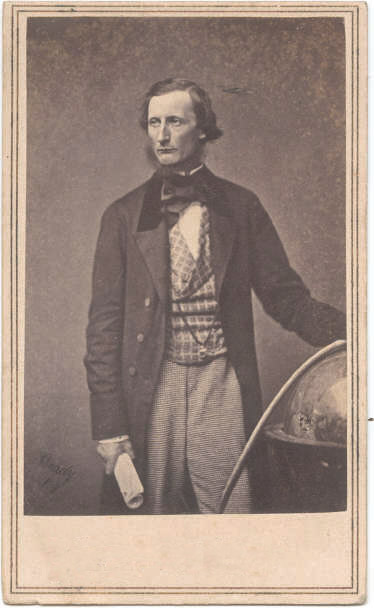
Compared to 2 weeks, 18 hours was a vast improvement. But it was still a work in progress. Field posed for Mathew Brady, who would achieve greatest success for his realistic Civil War photography. Brady added two key props for his portrait of Field - a length of wire cable and a globe.

But the cable would provide Field's undoing again. Victoria's message took too long to transmit and it was getting worse. The cable finally broke after three weeks. Celebration turned to anger. The Boston Courier newspaper suggested that the entire project had been part of an elaborate stock fraud and the cable had never worked. Their front page screamed a conspiracy theory headline: "Was the Atlantic cable a humbug?"

When the British cable in the Red Sea failed a year later, a committee of enquiry was asked to find out why underwater cables were humbug. Field and his electrician Dr Edward Whitehouse gave evidence. Serious problems emerged from the design of the cable. The cause was twofold. The first cause was the hastiness of the project due to Field’s relentless monomania, proving both a plus and a minus to the project. The second was Whitehouse’s excessive voltage to the cable. Whitehouse was trying to overcome the problem of low current which slowed down the operation.

Scottish physicist William Thomson solved that problem with his mirror galvanometer. The mirror galvanometer was a long distance receiver which could detect signals a thousand times fainter than other receivers.

But the cable project was put on hold for five years by the Civil War. A new attempt was undertaken in 1865 with much-improved material. This time just one ship was used to lay the cable, the massive SS Great Eastern designed by Brunel. New since Field last laid the cable, it was the largest steamship in the world. The Brunel completed the job in July 1866. The new connection was successful, more durable than before and many times faster. Even more public confidence resulted when a second cable was established shortly afterwards. The modern age had safely begun.

Field's finest hour would herald an astonishing downfall in his fortunes. With the profits from the Atlantic Cable company, Cyrus Field invested in New York’s elevated railroad. The railroads were successful, but Field was double-crossed by business partners, Jay Gould and his friend Russell Sage, who had well earned their nicknames of “robber barons”. Field suffered the ultimate indignity when his remaining fortune was stolen by his son. Field died in 1892, almost penniless.

But his cable had profound impact. It brought London and Wall St into each others sphere of instantaneous communication and influence. News and information could now spread quickly across the world from San Francisco to Singapore. Field is generally forgotten now and he remains relatively unknown but his transatlantic cable was one of the major birth pangs of the global village.