Showing posts with label Vatican. Show all posts

Sunday, April 04, 2010

Urbi et Orbi: Pope on the ropes

As the Easter Sunday Catholic faithful wait outside St Peter’s for Benedict XVI to deliver his tenth papal address, the Church itself has come under unprecedented attack and criticism. Numerous controversies have emerged about the protection of child-molesting priest in many countries including Germany, the US and Ireland with the Pope implicated in many of the scandals.

Although the Church has addressed some of the concerns, its preference is to adopt a siege mentality as the charges multiply. The Pope downplayed the charges as “petty gossip” while the Vatican daily, L'Osservatore Romano, has accused the media of a "clear and ignoble intent of trying to strike Benedict and his closest collaborators".

One of the Pope’s apologists, Vatican priest Raniero Cantalamessa noted Easter and Passover fell during the same week this year and said this led him to think of comparisons with the Jews. “They know from experience what it means to be victims of collective violence, and also because of this they are quick to recognise the recurring symptoms,” Cantalamessa said. “The use of stereotypes [and] the passing from personal responsibility and guilt to a collective guilt, remind me of the more shameful aspects of anti-Semitism.” However a US advocate for sexual abuse victims said the comparison was “breathtakingly callous and misguided.” David Clohessy said “men who deliberately and consistently hide child sex crime are in no way victims and to conflate public scrutiny with horrific violence is about as wrong as wrong can be.”

The public scrutiny into child sex crimes is becoming deeply uncomfortable for the Church and indeed for Benedict himself. In Germany, Father Peter Hullermann has become the focus of an expanding sexual-abuse scandal that has embroiled the Pope. Hullermann was a priest in northern Germany with an addiction to sexual abuse of children. He was transferred to Munich for therapy where Pope Paul VI had appointed Joseph Ratzinger as Archbishop in 1977. Ratzinger was copied in on a 1980 memo which said Hullermann would be returned to pastoral work within days of beginning psychiatric treatment. A German court eventually convicted Hullermann of further child abuse in 1986 but the church still took no action to stop him from working with children. The Archdiocese has acknowledged that “bad mistakes” were made with Hullermann, but said it was the fault of people reporting to Ratzinger rather than to the cardinal himself.

In the US, the news is no better for the Pope. As the then leader of the Congregation for the Doctrine of the Faith (1981-2005), he was also implicated in the scandal of the St. John’s School for the Deaf in Milwaukee, Wisconsin. Lawrence C. Murphy worked at the school from 1950 to 1974 initially as chaplain and later as director. Murphy admitted he sexually abused deaf boys for 22 years. Victims tried for more than three decades to bring him to justice, but recent documents show Ratzinger’s office neither defrocked him nor referred him for prosecution but instead encouraged “pastoral action” to resolve the problem. In the end Murphy solved the problem for the Vatican by conveniently dying before the trial could proceed.

In Ireland too, sex scandals have left the reputation of the Church in tatters (though it hasn’t stopped them from trying to enforce Good Friday alcohol bans). There have been three official Irish state-sanctioned investigations into the Church’s abuse of children. The most recent and most comprehensive, the Commission to Inquire into Child Abuse released its damning report last year which found widespread physical and emotional abuse were a feature of outdated Catholic-run institutions and sex abuse was endemic, particularly at boy’s institutions and known to Church authorities.

Sexual offenders were usually transferred elsewhere where they were free to continue abusing other children. The Church relied on a culture of secrecy, a compliant Education department and a fear of retribution to keep matters quiet. While the Pope has recently blasted the Irish bishops for “grave errors of judgement”, his apology did not address the Vatican's own role nor did it endorse the report finding that the church leadership was to blame for the scale and longevity of abuse heaped on Irish children throughout the 20th century.

That would have been a step too far for the Vatican as it would mean having to confront its own rulebook. The Catholic Church’s unnatural insistence on celibacy for its priests has contributed greatly to the problems in the US, Germany, Ireland and elsewhere. It is hardly surprising that men without sexual access to women looked for gratification elsewhere, particularly among young and vulnerable people without the access or knowledge about how to complain about their treatment. And while the Church professes to be pro-life, care for its flock seems to stop at birth. The Church continues to see sexual offence as a risk only in terms of the potential for scandal and bad publicity. The danger to children has never been taken into account. This obsessive, cynical and secretive accretion of power at all costs is now coming back to bite the Church badly.

Tuesday, December 02, 2008

Sur les Papes d’Avignon

It should probably come as no surprise that the idea for the world’s largest Gothic building should come from a Goth. Not one of the East Germanic barbarian tribe who terrorised the Romans in the fourth century, nor a black-dressed post-punk pallid type that gauntly haunt the streets of most cities in current times. No, this Goth is Raymond Bertrand de Got, who was crowned pope as Clement V in 1305. A haughty Frenchman, he decided to be crowned in Lyon not Rome. After his election, he went one step further and moved his whole court and papacy out of Rome and into the southern French city of Avignon.

Clement V was a controversial choice for pope. The conclave of cardinals took twelve months to elect him as it was split down the middle between French and Italian cardinals. Clement was a pawn of the powerful French king Philip IV better known as Philip Le Bel (“the fair”). The king’s nickname referred to his hunky good looks not his morals. In truth Philip the Fair was Machiavellian before the word was even invented and used his influence over Clement to destroy the Knights Templar so he could remove himself from the debts he owed them. It was under Philip’s influence that Clement moved his papal court to Avignon so he could be closer the real action that was taking place in France.

Strictly speaking, Avignon was not a French city at the time but a papal enclave surrounded by French territory. In fact Avignon would not become part of France until the time of the Revolution. The city stood on a strategic position on the Rhone river on the main route between Rome and Santiago de Compostela in northern Spain, the shrine of St James, and Europe’s most important pilgrimage destination since the fall of Jerusalem to Saladin’s armies in 1187. Avignon had long prospered from this lucrative trade of pilgrims.

But to get past Avignon required a treacherous crossing of the Rhone. The city’s only crossing over the hazardous waters was the St Benezet bridge (the Pont d’Avignon) which was regularly washed away by the fierce currents of Spring and early Summer when the upstream Alpine ice was melting. The bridge was finally put out of use by a catastrophic flood in 1668 and remains today as a sort of pier poking out over half the Rhone. Yet as the only fixed crossing of the river between Lyon and the Mediterranean, the Pont and the town it served were hugely important.

Clement V (and Philip the Fair) were clearly aware of the town’s importance when he (they) chose it as the site of the new papacy in 1305. But it was one thing to choose a new Vatican, what was really needed was a new St Peter’s. And so began the creation of the enormous Palais des Papes. Clement V did not build it himself and was content to as a guest at the Dominican monastery than overlooked the town but his successors were far more ambitious.

For most of the 14th century, Avignon would become the home of the popes and the imposing Palais des Papes would be their residence. Clement's French successor John XXII stayed in the city and upgraded the Dominican residence but it took a third French pope Benedict XII to build an impressive palace at Avignon befitting the papacy. Under his guidance a massive Palais Vieux took shape flanked by high towers. Under the popes that followed him, Clement VI, Innocent VI, and Urban V, the building was expanded to form what is now known as the Palais Neuf.

While a succession of popes became ensconced in Avignon, Rome never forgot the slight of losing its primary source of power. Finally under Guillaume Grimoard, crowned as Urban V, it won back its precious prize in 1367. But it was a short lived triumph. With numerous cities of the Papal States in revolt, Urban was forced to return to Avignon where he died in 1370. His successor Gregory XI would be the last of the official Avignon popes. After he died, the Romans rioted to ensure the election of a local pope. But the new man, Urban VI, was quickly disowned by the hierarchy. A majority of bishops elected Robert of Geneva as a rival pope taking the name Pope Clement VII and re-established a papal court in Avignon. The great Western schism had begun.

Now thanks to the Church’s own manipulations, Christendom had a pope and an antipope. But which was which? Britain, Ireland, Portugal and Rome supported Urban, while France supported Clement. The Holy Roman Empire could not wholly support either Roman emperor. But in 1398 France withdrew its support from Clement’s successor Benedict XIII and that made him officially an antipope. The Council of Constance in 1414 ensured the legitimacy of the Roman line, and excommunicated Benedict formally ending the Avignon line.

The city remained a papal possession and a nepotistic papal nephew continued to rule the town. Finally in 1797 the treaty of Tolentino sanctioned the transfer of the city to the French state. Today the city of Avignon proudly wears its papal (and anti-papal) history on its chest. The Palais des Papes towers over the city and the Rhone. The city is a capital of culture and remains an important outpost of Catholic history, antipopes or not.

Thursday, July 31, 2008

Vatican chicanery: Australia and China to upgrade relations with the Holy See

One of the more intriguing outcomes from the Pope’s visit to Australia last week, was the announcement of a new Australian embassy to the Holy See. Previously all Vatican related matters have been handled as a minor item by the Australian embassy in Ireland. Labor crossed the political divide and appointed former National Party leader and Deputy Prime Minister Tim Fischer to the post. Fischer will take up the position early next year. According to media reports, the creation of the position goes against the specific advice of the Department of Foreign Affairs and Trade who see no need for it. There is also criticism of the fact the new embassy will cost $5 million to set up and an additional $3 million a year to support.

But Prime Minister Kevin Rudd was not worried by these issues as he announced the decision last week in the wake of the papal Sydney visit for World Youth Day. As he farewelled Pope Benedict XVI, Rudd announced that Fischer would become Australia's first resident ambassador to the Vatican. Australia will now join 69 other nations with resident ambassadors to the Holy See, the world’s smallest official sovereign nation. The Age’s foreign affairs writer Daniel Fitton described the decision to open the embassy as bizarre. He found it hard to see how a “deeper engagement” with the Pope fits in Australia’s key foreign priorities of South East Asia, the US and the UN.

Some have pointed to the possible opening of relations between Vatican and China as a pointer to Australia’s decision. Greg Sheridan believes that Rudd’s establishment of the Vatican embassy is a “brilliant and far-sighted act” because of a likely thaw in the Vatican-China relationship. Sheridan says the Vatican is a world power despite being a small state. “It has agencies all over the world, an immense amount of global knowledge and huge influence,” he said. He believes the Vatican will move its diplomatic recognition from Taiwan to China in the next few years. In return, Rome will appoint Catholic bishops, rather than having them appointed by the Chinese Government.

Currently, the Vatican is the only European “nation” that maintains diplomatic ties with Taiwan, which it established at the height of World War II in 1942 (with what was then Chiang Kai-Shek’s nationalist China). Earlier this month, the Taiwanese ambassador was forced to hose down rumours that the Vatican was switching its allegiance to Beijing. Tu Chou-shen said there were many issues to resolve before that would happen. “I cannot say the Vatican will never forge formal ties with China,” he said. “But such relations will not happen until Beijing commits to respecting basic human rights and the public’s freedom to worship.”

Animosity between the sides goes back over half a century. The Vatican broke off official relations with the newly founded People’s Republic of China in 1951. While the two sides have been making overtures to each other for many years, matters took a turn for the worse in 2006 when Beijing appointed its own bishops ignoring Catholic Church procedure. A Vatican spokesman announced that the pope was “profoundly displeased” to hear of the news and said ordaining new bishops without papal approval seriously harms the unity of the church, leading to "severe canonical sanctions."

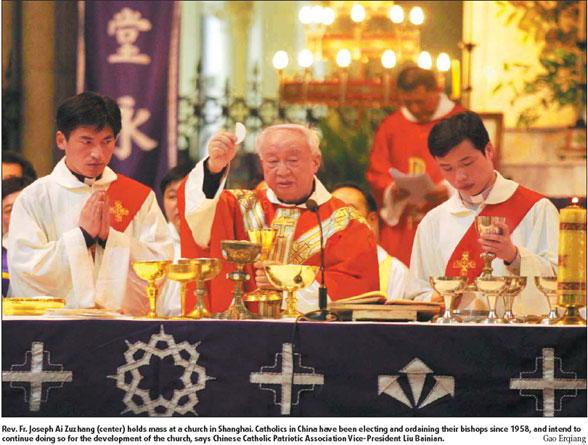
The appointments are part of a power play between the Vatican and the Communist Party for control of Catholicism in China. While there are an estimated 13 million Catholics in China (one percent of the total population), they are split across Vatican and Beijing sponsored organising bodies. The official Church organ in China is the state-approved Chinese Patriotic Catholic Association (CPCA). The CPCA is the only brand of Catholicism tolerated by the government and has an estimated five million members. It was established in 1957 by the country’s Religious Affairs Bureau for the purpose of introducing party ideals into the Catholic Church.

Since then the Vatican has maintained an ambiguous relationship with the CPCA. The Vatican’s hand is strengthened by the fact that it has the support of the majority of Chinese Catholics. While five million Chinese Catholics profess to belong to the CPCA, the other eight million follow the illegal underground church which remains loyal to Rome. In a letter to Chinese Catholics last year, Pope Benedict offered “guidelines” about how to evangelise non-Catholics (presumably including CPCA members). He also acknowledged the difficulty of episcopal appointments which he described as a “delicate problem”. Solving this issue will open the door to diplomatic relations. Australia will be there among the neighbours to welcome them.

Friday, June 08, 2007

Mafia acquitted of killing God's Banker

A court in Rome has acquitted five people accused of murdering Italian financier Roberto Calvi due to insufficient evidence. Calvi was known as “God’s Banker” due to his work on behalf of the Vatican’s bank. The decision comes almost 25 years to the day of his death. In 1982 his body was found hanging from London’s Blackfriars Bridge with rocks and $15,000 in cash stuffed into his suit. London police initially ruled it suicide but Italian prosecutors eventually brought murder charges in 2003 after pressure from Calvi’s family. The five cleared this week are Giuseppe "Pippo" Calo, a mafia money launderer, businessmen Ernesto Diotallevi and Flavio Carboni, Calvi's driver and bodyguard Silvano Vittor, and Carboni's Austrian ex-girlfriend Manuela Kleinszig.

While the acquittal of Kleinszig was not unexpected (the prosecution had asked for her charges to be dropped due to insufficient evidence), the release of the four others after a 20 month trial was a shock. Prosecutors had asked for life sentences for all four. One of the detectives involved in the case, Geoff Katz, said he was surprised by the verdict. "It'll be a tremendous disappointment for the families and also the Italian magistrates who have spent so much time on this case," he said. But one of Calo's lawyers, Massimo Amoroso, said the evidence was weak. The judges have yet to release their reasoning for the verdict.

The acquittals leave a sense of continuing uncertainty over how Calvi met his death. Roberto Calvi was 62 years old when he was found hanging from a rope attached to scaffolding under the bridge. He had come to the UK on bail after having been convicted of corruption in Italy. During the trial, prosecutors alleged Calvi was taken to the bridge by boat and was probably still alive but unconscious when a noose was placed around his neck.

The Milan-born Calvi was chairman of Banco Ambrosiano which collapsed shortly before he died. The bank was founded in 1896 as a Catholic bank and named for St Ambrose, the fourth century archbishop of Milan. The bank’s purpose was to act as a counter-balance to Italy’s secular banks. Calvi joined Ambrosiano in 1947 and worked his way up to become chairman by 1975. Calvi created a number of off-shore companies in the Bahamas and South America and also bought Italy’s premier newspaper Corriere della Sera.

Meanwhile the bank’s major shareholder was now the Institute for Religious Works (IOR), the official name of the Vatican bank. In 1971 Pope Paul VI appointed Chicago-born Archbishop Paul Marcinkus chairman of the IOR. The burly Marcinkus was a papal bodyguard known as “the Pope’s gorilla”. He saved the pontiff’s life after he knocked a knife out of the hands of a deranged Bolivian painter who lunged at the Pope in the Philippines. The bank job was his reward. Marcinkus was a practical man when it came to financial affairs and his dictum was “you can’t run the church on Hail Marys”. He knew the unworldly Vatican needed a commercial banking partner and in 1974 he chose Banco Ambrosiano.

Calvi was a compulsive operator and used a complex network of overseas banks and finance companies to move money out of Italy, inflate share prices, and secure massive unsecured loans. By 1978 the bank was in deep trouble. The bank of Italy issued a report that found Banco Ambrosiano had made illegal exports of several billion lire. In 1981 Calvi was put on trial and given a four year suspended sentence and a $20 million fine for taking $26.4 million out of the country in violation of Italian currency laws. Incredibly Calvi kept his job at the bank.

While investigating Calvi, police uncovered a link to financier Licio Gelli. Both men were freemasons and Gelli was the leader of a covert Masonic lodge called Propaganda Due (P2). This lodge was extremely powerful and its members were journalists, parliamentarians, industrialists, and military leaders and the heads of the three Italian intelligence services. When police searched Gelli’s house they found a document called the Democratic Rebirth Plan which was a plan to steer Italy towards a more autocratic government. Its existence scandalised Italy. Gelli fled the country, but the affair brought down the government of Arnaldo Forlani.

A year later Banco Ambrosiano was on the verge of collapse with debts of $1.4 billion. It was revealed that Calvi had given the money in questionable loans to three of Banco Ambrosiano’s Latin American subsidiaries. The bank was accused of money laundering for P2 and the mafia. Archbishop Marcinkus and the Vatican bank were implicated. The IOR owned ten of the overseas dummy companies in the Bahamas and South America to which Ambrosiano lent the money.

Calvi was devastated by the discovery of the loans. On 5 June 1982, he wrote a letter to Pope John Paul II in which he pleaded for help. The letter started: “I have thought a lot, Holiness, and have concluded that you are my last hope.” Calvi went on to warn the pope that the collapse of the Banco Ambrosiano would “provoke a catastrophe of unimaginable proportions in which the Church will suffer the gravest damage”. He also claimed the IOR were hiding the facts about the Vatican’s financial irregularities from the pope.

Five days later Calvi left Rome, presumably without an answer from the pontiff. He obtained a false passport and flew to London. The prosecution in the court case alleged he was lured to London so he could be killed for embezzling Mafia funds as well as stop him from revealing what he knew about the Vatican Bank and P2. After being missing for seven days, he was officially sacked from the bank. On the morning after a mail-room clerk of the Daily Express, walking to his job on Fleet Street, found Calvi swinging from Blackfriars bridge in London’s financial district.

An initial autopsy judged the death as suicide. But a second autopsy a year later gave an open verdict. In 1984 the Vatican Bank agreed to pay US$224 million to the 120 creditors of the failed Banco Ambrosiano as a “recognition of moral involvement” in the bank's collapse. In 1987 Milan judges investigating the Ambrosiano affair issued a warrant for Archbishop Marcinkus’s arrest for being accessories to the fraudulent bankruptcy of the bank. But because the Vatican enjoyed protected borders under the 1929 Lateran Treaty, the Italian police could not arrest him. The Pope accused the Italians of a “brutal cover-up” and refused to extradite him. Marcinkus was quietly retired to Phoenix, Arizona.

Calvi's family continually maintained that his death had been a murder. His body was exhumed in 1998 and a forensic report four years later concluded he had been murdered. The case was re-opened in 2003. The ringleader of the five people charged was Pippo Calo, a Mafia gangster already serving a long prison sentence. Prosecutors said they believed Calvi was murdered by the Sicilian Mafia and mainland Italian mobsters, the Camorra, as punishment for pocketing money they had asked him to launder. The prosecution presented forensic evidence that he was strangled and his suicide staged in a manner suggesting Mafia or Masonic ritual.

But after this week’s verdict, his family are in anguish again. Calvi's son Carlo who now lives in Canada never believed that his father's death was a suicide. He said he was disappointed but not surprised. "I never thought this was going to end today," he said. "But these are the individuals I consider responsible for organizing his journey to London and his murder on the behalf of others."