 The recent troubles of Bear Stearns and now British mortgage lender HBOS have caused commentators to see resemblances with the empire of publishing tycoon Robert Maxwell which collapsed on his mysterious death in 1991. The Times’ Patrick Hoskins suggests the financial world could do with a few more naysayers as it did when “half the City was employed in puffing up Maxwell’s house of cards”.
 That mogul’s house spectacularly collapsed during the night of 5 November 1991, when he disappeared at sea off the side of his yacht, aged 68. The official verdict was accidental drowning though family members disputed the finding. While some have called it suicide, the most overwhelming evidence for his death is murder, especially as presented in the book “The Assassination of Robert Maxwell: Israel’s Superspy” by Gordon Thomas and Martin Dillon. As the subtitle suggests, the authors say it was Maxwell’s espionage exploits on behalf of Israel that brought about his eventual death – at the hands of Mossad, the agency he gave so much service to.
There were many things to doubt about Maxwell's strange life, but there was no doubt that he was Jewish. He was born in 1923 in the village of Slatinske Doly in a remote anti-Semitic corner of what was to become Czechoslovakia. His father was given the surname Hoch (German for “tall”) by a census taker. When the Czechs took over after World War I, Hoch's name was changed to Ludvik. Born in 1923, Robert Maxwell’s earliest name was Jan Ludvik. He was a model pupil and a quick learner. But these were dangerous times to be Jewish. Encouraged by his father young Jan left Czechoslovakia before the Nazis took over.
Maxwell moved to Budapest. He claims he joined the Czech resistance there in 1939 and fought with the exiled Czech army in Eastern Europe. This is unverified but what is known is that by 1940 he was in Marseilles where he joined the Czech Legion before sailing to Liverpool. In England, he instinctively felt at home. Frustrated by the anti-Semitism of his fellow Czechs, he transferred into the British Army’s Pioneer Corps under the name of Jan Hoch. Here he perfected his English and assumed the mannerisms of a born and bred Englishman.
But it was Maxwell’s German language skills that got him his break. He was transferred to an intelligence unit in the North Staffordshire Regiment. He changed his name again, this time to Leslie du Maurier and returned to France in the second wave of the Normandy Landings. Once he was promoted into the officer class, he picked a new and very British name Ian Robert Maxwell which, with the Ian dropped, he would keep for the rest of his life. He fought with distinction in a number of battles and won the Military Cross. Stationed in liberated Paris, he attracted the eye of a young woman named Elizabeth Maynard. They married in 1945, shortly before the fall of Germany.
After the war, he served in Berlin and then into business as a distributor for scientific books. Maxwell’s fortune was linked with Pergamon Publishing, a specialist firm he set up in 1951 that launched scientific publishing in Britain. Pergamon found a niche and did well for itself. The now wealthy Maxwell was elected to parliament in 1964 as a Labour MP in Harold Wilson’s first Government. He was unseated in Wilson’s surprise defeat by Ted Heath in 1970. But his media interests prospered and in 1984 he acquired Mirror Group Newspapers which printed the Daily and Sunday Mirrors and the Sunday People. From then on, he was one of the most well-known people in the world.
His business empire’s Israeli head was the son of that country's Prime Minister Yitzhak Shamir. Maxwell and the PM were good friends, especially since Maxwell invested $100 million in Israel’s unsteady economy. One of the Israeli companies he acquired was a Tel-Aviv software house called Degem Computers. Israel’s intelligence agency Mossad used this company as cover for many of their worldwide operations. Israeli was also interested in Maxwell’s links with the USSR. Maxwell met Soviet leader Leonid Brezhnev in 1978 and since then had met every important member of the Politburo and those who ruled over the Soviet satellite states. Israel wanted Maxwell’s help to bring home USSR’s Jews.
 Robert Maxwell became Mossad’s most valuable asset. As well as his Soviet bloc contacts, Maxwell was also friendly with then US President George H.W. Bush and British Prime Minister Margaret Thatcher. He also knew French President Mitterand and German Chancellor Helmut Kohl. As well, he knew most of the key players in the intelligence world through his work in the British army and the scientific world through his work in the publishing industry. Through this vast network, he could open most doors for Mossad.
 Meanwhile the Israeli intelligence agency had illegally gained access to a super-spy computer software. Promis (Prosecutor’s Management Information Systems) was owned by American company Inslaw and was used by the US Justice Department to track intelligence information across the world. Incredibly, they gave a disk copy to a Mossad operative who took it back to Israel where it was reverse engineered, enhanced and given the name Promis. They added a "trapdoor" to Promis, a microchip give Israel information about the purchaser. Mossad knew potential buyers would be suspicious of Israeli software. What they needed was a trusted outsider, someone beyond reproach who would sell it on their behalf – Robert Maxwell.
His first client was Robert Mugabe. Maxwell told him Promis was better and cheaper than anything else on the market. He assured Mugabe it would enable him to track any plotters among the remaining white tobacco farmers in the country. After making the deal, Maxwell went south and sold it to the apartheid regime in Pretoria. They day after he left, black miners’ leaders planning a strike were all arrested. There was similar "success" in Guatemala where government rounded up 20,000 government opponents thanks to Promis. Maxwell persuaded Swiss banks to install it, which gave Mossad valuable information on what Israeli businessmen were illegally sequestering money out of the country.
As the 1980s drew to a close, Maxwell’s empire was in trouble. With interest rates high and the share price falling in his major companies, he secretly brought millions of his own shares through tax havens in Virgin Islands, Gibraltar and Liechtenstein. Maxwell purchased these through collateral for bank loans. He was secretly withdrawing vast sums of money from the pension funds of his 24,000 Mirror Group employees which he invested in French and Israeli companies. By 1990 repayments to his bankers had reached £415m a year while he was caught in a vicious debt spiral.
With police and journalists on his trail, an increasingly desperate Maxwell turned to Israel to bail him out. Mossad turned him down. When Israel refused to help, Maxwell threatened to spill the beans about his spying in the Daily Mirror. When the first claims of links between Mossad and Maxwell became public, the intelligence agency was seriously alarmed. Though he was a hero to many in Israel, Mossad concluded he had to be silenced before he could do serious damage. They recruited a four man “kidon" (death squad) to kill Maxwell.
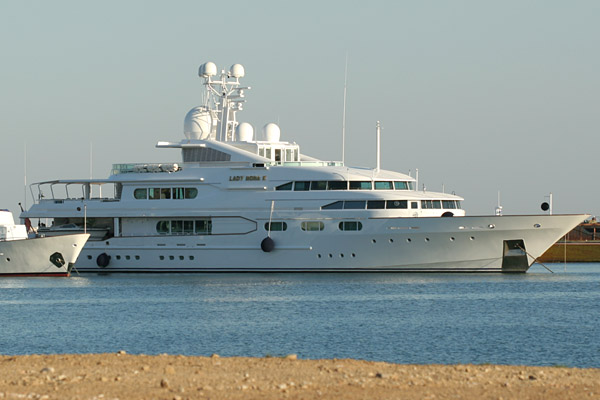 The kidon hired a small motorised yacht in the Gran Canaria port of Las Palmas. They looked like four men on a fishing trip but on board they had locked onto the frequency of Maxwell’ superyacht the Lady Ghislaine (named for his favourite daughter). They followed the Ghislaine up the coast. Mossad passed a secret message to Maxwell to expect a secret package on board in the early hours of the morning. They told him go on deck between 4 and 5 am and stand on the starboard side.
With Maxwell in place for the hit, a dinghy from the kidon’s yacht crept up under the radar, hidden by the noise of Ghislaine’s engine. Two frogmen climbed aboard and reached Maxwell in a few strides. One held a syringe which he plunged into Maxwell’s neck. It contained a lethal nerve agent developed by a biological research institute in Tel Aviv. The men gripped the body and lowered it over the side and into the sea. It would be another six hours before anyone on board realised he was missing. His body was recovered 30km south of Gran Canaria.
A botched Spanish autopsy concluded his death was due to heart failure. They ruled out suicide because Maxwell was a good swimmer. His unhappy insurers insisted on a second autopsy which occurred before his burial in Jerusalem. This one found the most likely cause was drowning but the insurers refused to pay up anyway saying it was suicide. Maxwell was buried with full state honours in Jerusalem’s Mount of Olives. Prime Minister Shamir, who probably authorised his death, eulogised “He has done more for Israel than can today be said". His death could not be spoken about either.


1 comment:
The evidence that he was murdered seems to be overwhelming, discerning the actual agency/entity at fault is probably not going to be possible. Reportedly he worked with MI6 as well as Mossad. It seems fair to say he was pretty much amenable to using any person or group for his own ends- so who knows who he was involved with beyond Mossad, MI6, Oliver North & the CIA and Eastern European gangsters.
However, one assertion I would challenge is that he was undeniably Jewish. The fact is that his entire putative family were killed- so nobody is in a position to confirm whether or not Ian Robert Maxwell was the real Jan Luvik Hoch from Slatinske Doly.
I heard that he vigorously tried to have a book censored (using his perfected method of issuing libel writs in every country possible and threatening book distributors as well as authors with legal action) which claimed to prove that he was neither Czech nor Jewish- but that he was a British MI6 agent who assumed the identity of a dead Czech Jew, Jan Ludvik Hoch.
The only evidence I know of to corroborate this is his perfect, accentless Queen's English. After the age of 14-15 it is impossible to speak a language the way a native does due to the fact that one's mouth muscles have already been set in place. Since he supposedly didn't come to Britain until he was 17, how did he learn to speak perfect English?
Post a Comment